Tag Archives: Card Meanings

Tarot Encyclopedia – The Eight of Pentacles or Coins

(Note: this is a collection of the meanings attributed to the cards by some occultists in the past centuries. It does not reflect my own study or opinion of the cards. It is only meant as a quick comparative reference as I develop my own take.)

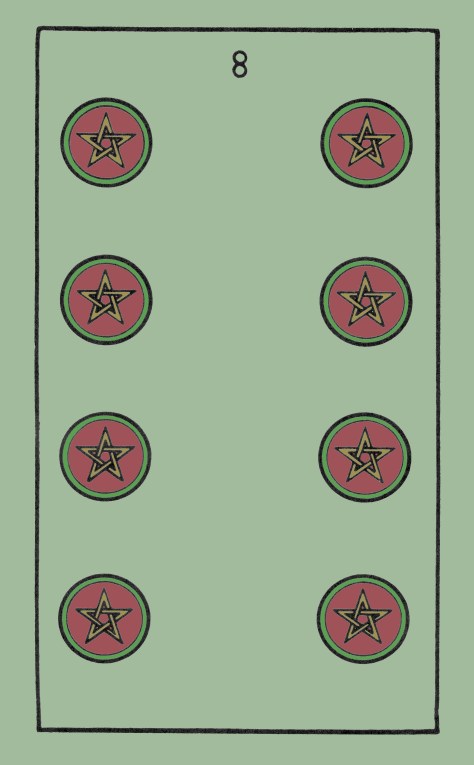
The Eight of Pentacles from the Builders of the Adytum (BOTA) tarot

Paul Foster Case (and Ann Davies)

The time period is the first decanate of Virgo, under the rulership of Mercury, from August 23 to September 2. Meanings:
Well-Dignified: skill in the management of material affairs; industry; gain in subordinate positions through writing, clerical work or travel; gain of ready money in small sums.
lll-Dignified: avarice and hoarding; penny wisdom and pound foolishness; meanness in money matters; loss through travel or writings; the Querent is likely to be in difficulties with superiors and also with inferiors; he may lose through trying to overreach somebody else.
Keyword: Prudence
(From the Oracle of Tarot course)

A. E. Waite

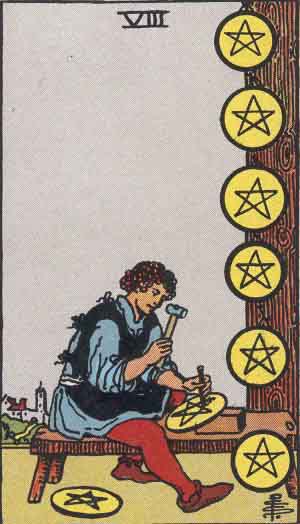
An artist in stone at his work, which he exhibits in the form of trophies. Divinatory Meanings: Work, employment, commission, craftsmanship, skill in craft and business, perhaps in the preparatory stage. Reversed: Voided ambition, vanity, cupidity, exaction, usury. It may also signify the possession of skill, in the sense of the ingenious mind turned to cunning and intrigue.
(From The Pictorial Key to the Tarot)

The Eight of Pentacles from the Rider Waite Smith tarot

Aleister Crowley

The Eight of Disks is called Prudence. This card is a great deal better than the last two [Eights], because, in purely material matters, especially those relating to actual money, there is a sort of strength in doing nothing at all. The problem of every financier is, first of all, to gain time; if his resources are sufficient, he always beats the market. This is the card of “putting something away for a rainy day”.

[…]

The number Eight, Hod, is very helpful in this card, because it represents Mercury in his most spiritual aspect, and he both rules and is exalted in the sign of Virgo, which belongs to the Decan, and is governed by the Sun. It signifies intelligence lovingly applied to material matters, especially those of the agriculturalist, the artificer and the engineer.

One might suggest that this card marks the turn of the tide. The seven of Disks is in one sense the fullest possible establishment of Matter-compare Atu XV-the lowest fallen and therefore the highest exalted. These last three cards seem to prepare the explosion which will renew the whole Cycle. Note that Virgo is Yod, the secret seed of Life, and also the Virgin Earth awaiting the Phallic Plough.

The interest of this card is the interest of the common people. The rulership of the Sun in Virgo suggests also birth. The disks are arranged in the form of the geomantic figure Populus. These disks may be represented as the flowers or fruits of a great tree, its solid roots in fertile land.

In the Yi King, Sol in Virgo is represented by the 33rd Hexagram, Thun, “Big Air”. It means “retiring”; and the commentary indicates how best to make use of that manoeuvre. This is congruous enough with the essence of Virgo, the secret withdrawing of Energy into the fallow Earth. Populus, moreover, is the Moon retiring from manifestation to her conjunction with the Sun.
(From The Book of Thoth)

The Eight of Disks from the Thoth tarot

Golden Dawn’s Book T

A WHITE Radiating Angelic Hand, issuing from a cloud, and grasping a branch of a rose tree, with four white roses thereon, which touch only the four lowermost Pentacles. No rosebuds even, but only leaves, touch the four uppermost disks. All the Pentacles are similar to that of the Ace, but without the Maltese cross and wings. They are arranged like the geomantic figure Populus:

* *
* *
* *
* *

Above and below them are the symbols Sun and Virgo for the Decan.
Over-careful in small things at the expense of great: “Penny wise and pound foolish”: gain of ready money in small sums; mean; avaricious; industrious; cultivation of land; hoarding, lacking in enterprise.
Hod of HB:H (Skill: prudence: cunning).
Therein rule those mighty Angels HB:AKAYH and HB:KHThAL

Etteilla

Brunette Girl
Upright. This card, as far as the medicine of the spirit is concerned, means, in its natural position: Brunette Girl, Passive, Great Night.
Reversed. Empty aspiration, Avarice, Usury.

MQS

Playing Cards That Indicate Stability

Let’s move on with our look at the playing cards divided by concept. This time, we see which cards represent stability.

Ace of Hearts
The Ace of Hearts, like in many systems of reading playing cards, represents the home. It is a symbol of durability and stability, since houses tend to be stable things that don’t change. Mostly, the Ace of Hearts symbolizes the house or the family, however, when describing someone’s character, for instance, it shows them to be family-oriented, looking at stabilizing their life, being rooted in traditional values, etc.

Four of Hearts
The Four of Hearts usually brings agreement in all fields of life. However, the type of agreement it shows is effortless, and it resembles more a state of peace where the waters aren’t ruffled (and if they are, the waves calm down immediately). Usually this card indicates harmony, harmonious surroundings and ease.

Six of Hearts
Unlike the previous two cards, the Six of Hearts, which represents such things as reconciliation, healing, etc. does often imply the presence of some disturbing factors (though not necessarily. We need to look at the spread as a whole), but it shows that these disturbing factors, such as a break-up or a disagreement, can and probably will be overcome, returning the situation to its previous stability.

Ten of Hearts
The Ten of Hearts is one of the most powerful in the deck, as it is often capable of diminishing the negative impact of negative cards. Since it is symbolic of paradise, heaven or ultimate attainment of one’s happiness, it hints at a situation either being stable (and happy) or becoming stable (and happy). When it is followed by very negative cards, though, it can show this paradise being lost. In fact, it is sometimes a bad sign when we find the Ten of Hearts at the beginning of the spread without other strong cards, because it shows that the best is already in the past.

Three of Clubs
The Three of Clubs brings union and unity. It causes situations or people to become locked in place, usually by signing contracts, celebrating a marriage of making a commitment to each other or doing things together. Sometimes it can show that a situation perseveres (it remains married to us).

Six of Clubs
A somewhat obnoxious card, the Six of Clubs isn’t tragic, but it brings disturbance. It shows situations that have lost their momentum, and problems that we thought we had overcome reemerging. It shows a sort of static discontent with no disruption in sight, either for good or bad, unless other cards clearly show it.

Nine of Clubs
This is the card of distance, either in terms of miles or in terms of time. As such, it lengthens out the timeframe, but unlike the Six, the Nine of Clubs has no negative undertones, except in the sense that often we want all the good in the world to happen to us quickly, and this card stalls us for some time. However, it can also make a good situation last longer.

Four of Diamonds
Unlike the Four of Hearts, which shows effortless stability and agreement, the Four of Diamonds represents agreement following either tensions or negotiations. Thus it represents all things to do with bureaucracy and the government that seek to regulate life and make it more stable within the borders of a country.

Ten of Diamonds
Of the Ten of Diamonds we can say something similar to the Ten of Hearts, except that the success promised by Diamonds tends to be more material, and doesn’t necessarily imply happiness. However, it does represent situations that have developmed to their utmost in a positive sense and have reached their aim.

Five of Spades
Being the card of prison, the Five of Spades symbolizes constraints, blockages and the need to make great sacrifices. As such, it means that the person (symbolized by the central pip, hemmed in by the four other pips at the corners) cannot move and is bound to a situation. Usually this is in a negative sense. Even when surrounded by positive cards, thus showing a positive commitment, it still indicates a certain sense of being stifled.

Six of Spades
The Six of Spades is the card of illness, and it shows all situations that are ill, broken, suffering, etc. In itself it is not the most tragic card in the suit, but it represents a state of suffering stillness, which may be overcome or lead to disruption, depending on the cards that follow this one.

MQS

Tarot Encyclopedia – The Eight of Swords

(Note: this is a collection of the meanings attributed to the cards by some occultists in the past centuries. It does not reflect my own study or opinion of the cards. It is only meant as a quick comparative reference as I develop my own take.)

The Eight of Swords from the Builders of the Adytum (BOTA) tarot deck

Paul Foster Case (and Ann Davies)

The time period is the first decanate of Gemini, May 21 to May 31, under the rulership of Mercury.
Well-Dignified: even well-dignified, the excessive Mercurial influence expressing in the Yetziratic field of unstable forces and changing forms, symbolized by the Eight of Swords, gives a marked tendency toward ill-directed or wasted action. Meanings in divination: force wasted in petty affairs; too much talk; too much illdirected action; the state of being terribly busy without accomplishing much; over-careful about details; could possibly intimate a crisis in affairs, and probably much talk, correspondence and moving about.
Ill-Dignified: malice; ill-natured gossip; pettiness; too much concern with personalities; disagreements with brothers and sisters. This Key divinatorily expresses unbalanced or excessive Gemini qualities in third house affairs. The se negative Gemini qualities portend the need for balancing the quick-mindedness and penchant for action of this astrological type with the d e pth of feeling and emotional warmth corresponding to Netzach and Venus.
Keyword: Mediocrity
(From the Oracle of Tarot course)

A. E. Waite

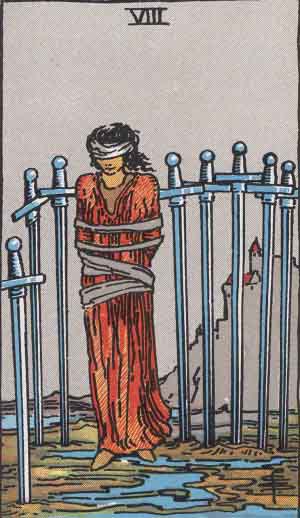
A woman, bound and hoodwinked, with the swords of the card about her. Yet it is rather a card of temporary durance than of irretrievable bondage. Divinatory Meanings: Bad news, violent chagrin, crisis, censure, power in trammels, conflict, calumny; also sickness. Reversed: Disquiet, difficulty, opposition, accident, treachery; what is unforeseen; fatality.
(From The Pictorial Key to the Tarot)

The Eight of Swords from the Rider Waite Smith tarot

Aleister Crowley

The Eight of Swords is called Interference. At first sight, it would seem easy to confuse it with the Eight of Cups; but the idea is, in reality, quite different. The card is attributed to Jupiter and Gemini; accordingly, there is no weighing down of the will by internal or external stress. It is simply the error of being good-natured when good-nature is disastrous. Gemini is an airy sign, an intellectual sign; Jupiter is geniality and optimism. This will not do in the world of Swords; if one must hit at all, a knock-out blow is best.

But there is another element in this card; that of unexpected (the Eights, being at heart Mercurial, are always that) interference, sheer unforeseen bad luck. Trivial incidents have often altered the destiny of empires, brought to naught “the best laid plans of mice and men”.

[…]

The number Eight, Hod, here signifies lack of persistence in matters of the intellect and of contest. Good fortune, however, attends even these weakened efforts, thanks to the influence of Jupiter in Gemini, ruling the Decan. Yet the Will is constantly thwarted by accidental interference.

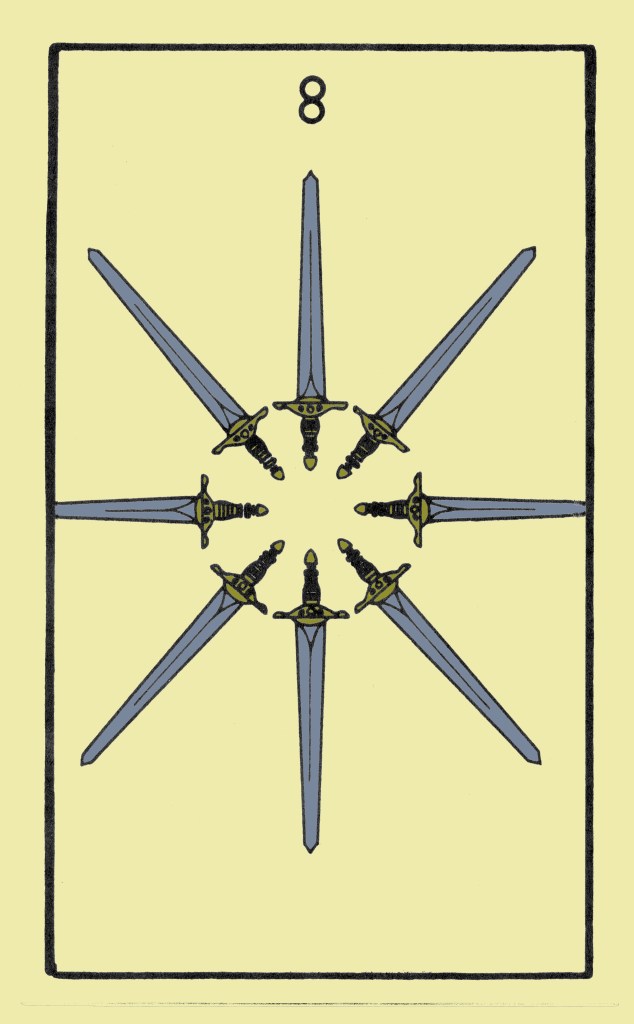
The centre of the card is occupied by two long Swords pointed downward. These are crossed by six small swords, three on each side. They remind one of weapons peculiar to their countries or their cults; we see here the Kriss, the Kukri, the Scramasax, the Dagger, the Machete and the Yataghan.
(From The Book of Thoth)

The Eight of Swords from the Thoth tarot deck

Golden Dawn’s Book T

FOUR White Radiant Angelic Hands issuing from clouds, each holding two swords, points upwards; all the points touch near the top of the card. Hands issue, two at each bottom angle of the card. The pose of the other sword symbols is reestablished in the centre. Above and below are the Decan symbols Jupiter and Gemini.

Too much force applied to small things: too much attention to detail at the expense of the principal and more important points. When ill dignified, these qualities produce malice, pettiness, and domineering characteristics. Patience in detail of study; great care in some things, counterbalanced by equal disorder in others. Impulsive; equally fond of giving or receiving money or presents;

generous, clever, acute, selfish and without strong feeling of affection. Admires wisdom, yet applies it to small and unworthy objects.

Hod of HB:V (Narrow, restricted, petty, a prison).
Therein rule the Angels HB:VMBAL and HB:YHHAL.

Etteilla

Criticism
Upright. This card, as far as the medicine of the spirit is concerned, means, in its natural position: Criticism, Unfortunate position, Critical moment, Critical time, Decisive instant, Unfortunate situation, Delicate circumstance, Crisis. – Examination, Discussion, Research, Blame, Censure, Critical comment, Critical epilogue, Control, Disapproval, Condemnation, Cassation, Judgment, Contempt.
Reversed. Accident, Difficulty, Particular circumstance, Conjunction, Occurrence, Accessory, Unconscious, Obstacle, Delay, Hindrance. – Abjection. – Contestation, Contradiction, Opposition, Resistance, Divergence. – Unplanned, Unforeseen, Chance, Adventure, Occurrence, Destiny, Fatality, Accident, Misfortune, Symptom

MQS

Divination With The Piquet Deck – The Meanings

The great thing about occultism being my life but not my job is that I get to do whatever I please. Well, right now it pleases me to talk about this deck, somehow.

Fortune-telling with Piquet cards or Skat cards. Like the video and subscribe

MQS

Cards That Change Topic

In the latest reading I presented, an interesting phenomenon occurred. At some point during the reading, two cards came up that seemed very negative, but which actually had nothing to do with the reading in itself. Instead, they simply acted as some form of punctuation. This happens especially with simple methods like the one I used, called ‘alla zdoura’ (literally, ‘method of the housewife’, or ‘like the housewives do it’ in dialect), where we start with a very limited number of cards, usually one, two or three, and then we keep adding them without following a specific layout.

In this type of reading, if the cards need to signal that we are changing topics and moving on to a new one, they may use cards or combinations that show an ending (sometimes even just the Death card). Of course, I had a huge deal of luck in this reading, because it came up clear. It isn’t always like that. Often, these combinations look really bad, but if we look around we see that they feel out of place.

In playing cards, the same can happen when the Four of Spades and Five of Spades, or the Ace of Spades, or the Five of Diamonds come up. Usually, in these situations, it pays to zoom out of the reading and catch the general flow of it: it will become apparent, generally, whether these cards are part of the reading or if they act as punctuation. 

I am also experiencing a similar phenomenon while experimenting with the Bolognese tarot. For instance, in the first few lines of a thirteen- card spread, it may happen that the Angel and Death cards come up together, and then the cards seem to discuss other topics. In this case, the cards seem to be answering the question positively and quickly, only to introduce new discussions. At other times, the Queen of Coins comes up to say “and that’s the truth about it, period.” or the Justice card, to say “and that ok the way it is.” Of course, I need to experiment a little more, especially to see if apparently negative combinations can act in the same way.

MQS

Another Way of Reading the Skat / Piquet Deck

A couple of years ago I published a series of three articles on the Skat deck. This is not a system I use, merely one that has been kindly passed down to me, together with the premission to translate it. I came into contact with another reader, who also kindly accepted to share her system, which she learned from a friend some years back. This is another German system, which is recognizable in that Spades tend to be neutral and Clubs negative. There are also many similarities with the previous system I published, which is not surprising since the various systems tend to be regional, and both readers come from the same region ( the Südpfalz). Still, there are some interesting differences. What follows is my translation of the meanings, combinations and reading method. Thanks to Anke for this method.

Hearts

Ace – The Home
King – The Man (Herzensmann, the man of my heart)
Queen – The Woman (Herzensfrau, the woman of my heart)
Jack – Thoughts, Projects, Hopes, Positive Feelings/Thoughts (gute Gesinnung)
Ten – Great Joy, Wish Fulfillment, Wedding Bells (Hochzeitsglocken)
Nine – Joy, Love, Sympathy, Affection / Inclination (Zuneigung)
Eight – A Relationship, Harmony, Accord / Deal, Reconciliation
Seven – Fun, Entertainment (Fröhlichkeit, Spaß)

Spades

Ace – Office (Amt), understood as official things, Bureaucracy, Documents, Laws, Lawsuits, etc.
King – A friend or relative, Can be an office worker
Queen – A friend, relative or office worker (Büroangestellte)
Jack – Message, Contacts
Ten – Journey, A long period of time, The Long Road (auf dem langen Weg), An important change (Umbruch)
Nine – Uncertainty, Uncertain timeframe, Jealousy, Unwarranted turmoil, at the end of a sequence it improves the situation (the worry is unwarranted)
Eight – A short timeframe, Also the card of society (Gesellschaftskarte)
Seven – Very short timeframe, Discussions and Talks, The Short Road (auf dem kurzen Weg)

Diamonds

Ace – Letter, Invitation or Gift
King – A Man of position, Respected (angesehener Mann), Someone who counts
Queen – A woman of position, Respected, Who counts
Jack – The Jack of Good Luck (Glücksbube)
Ten – Big Money
Nine – Success, Ambition, Idealism
Eight – Work, Also buying and selling, Business (Geschäftskarte)
Seven – Small Money, A child

Clubs

Ace – Shock (Schreck), Fear, Fright, Suffering or Loss
King – A lonely man, Older or inimical, Father-in-law
Queen – A lonely woman, Older or inimical, Mother-in-law
Jack – The Jack of Bad Luck (Pechbube), Bad/evil ideas / feelings / disposition (böse Gesinnung)
Ten – Great sorrow, Illness
Nine – Falseness, Antipathy (Abneigung), Dislike
Eight – Arguments, Fights, The need to fight, Obstacles
Seven – Tears

Some Combinations

Ace of Hearts – Ace of Spades – Ten of Hearts = Wedding
Ace of Spades – Ten of Clubs – King of Clubs = Hospital stay
Any Queen – Seven of Diamonds – Ten of Clubs = Pregnancy (apparently pregnancy is seen as a sickness)
Ace of Clubs – Ace of Spades – Evil card (especially the Jack of Clubs) = death
Ace of Spades – Eight of Clubs – King of Clubs = Court case
Ten of Spades – Person card = Someone who comes from afar (but can also be someone who is away)

Spreads

There are two phases to a general reading. The first is a cross spread not unlike the one I use. Lay out the querent’s card (King or Queen of Hearts), but with some slight variations. Let’s say you are reading for a woman:

4914
2712QH3813
1611
51015

The positions’ meanings are quite similar, although the order of laying out the cards differs: above are the thoughts, underneath the problems or what she has command over, behind is the past, in front is the next future. The second stage is as follows:

38134914
QH
1611
271251015

This second spread is called the Rundum Blick, literally the comprehensive view or all-around view. The cards covering the Queen are supposed to be the most important ones, while the others all cover the future, with those to the left being a bit closer than the ones to the right, unless the Ten of Spades (the long time card) is present, in which case it can change the timeframe.

I didn’t receive any instructions on how to read the cards for answering specific questions, which is not surprising, since many folk methods of divination were simply meant to talk generally about what was ahead. Still, I am quite sure you can devise your own strategy.

MQS

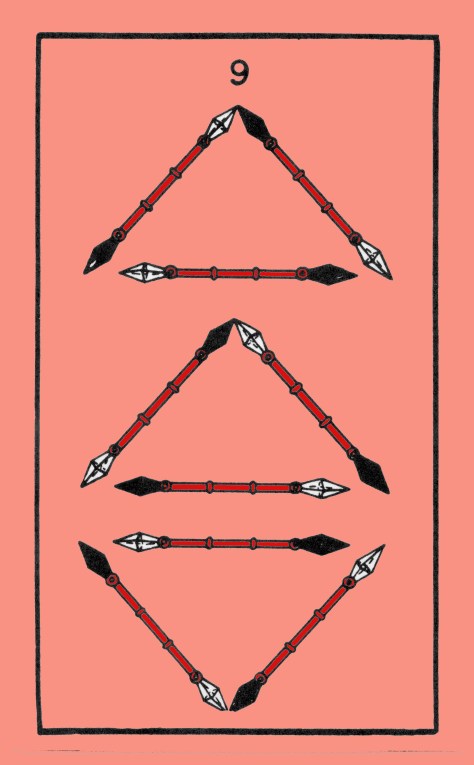
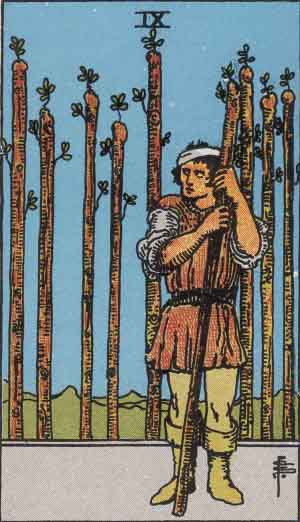
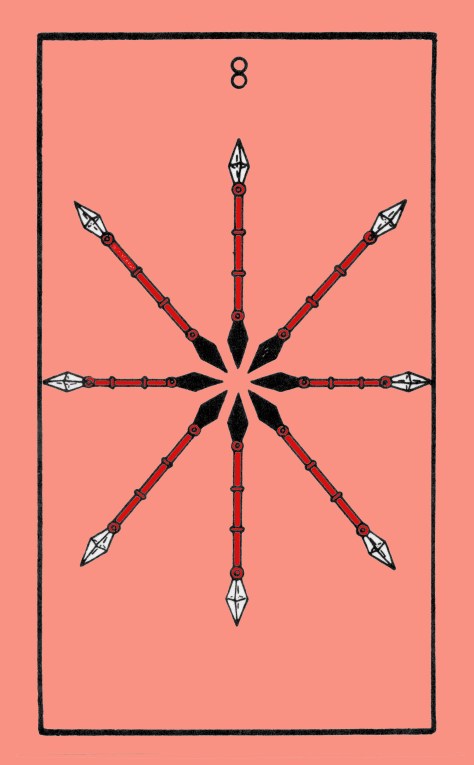
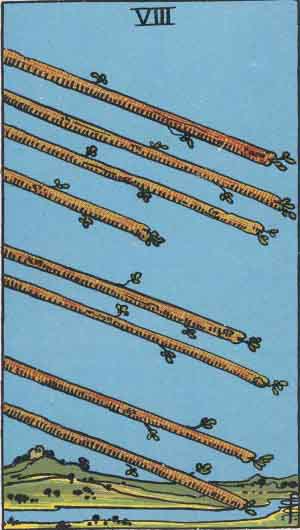
Tarot Encyclopedia – The Eight of Wands

(Note: this is a collection of the meanings attributed to the cards by some occultists in the past centuries. It does not reflect my own study or opinion of the cards. It is only meant as a quick comparative reference as I develop my own take.)

The Eight of Wands from the Builders of the Adytum (BOTA) Tarot deck

Paul Foster Case (and Ann Davies)

As the first decanate of Sagittarius, the Eight of Wands is the time period of November 22 to December 1, ruled by Jupiter, suggesting a combination of the powers of Mercury and Jupiter together with the zodiacal attributions of the sign Sagittarius and its natural 9th house. Well-Dignified: aspiration; foresight; rapid expression of force, but quickly expended; the acceleration of anything in which the querent is interested; generosity; confidence ; freedom.
Ill-Dignified: violence; warfare; rapacity; insolence; theft or robbery. These are suggested by some of the evil meanings connected with Hermes or Mercury associated with misuse of human intellect.
Keyword: Swiftness
(From the Oracle of Tarot course)

A. E. Waite

The card represents motion through the immovable-a flight of wands through an open country; but they draw to the term of their course. That which they signify is at hand; it may be even on the threshold. Divinatory Meanings: Activity in undertakings, the path of such activity, swiftness, as that of an express messenger; great haste, great hope, speed towards an end which promises assured felicity; generally, that which is on the move; also the arrows of love. Reversed: Arrows of jealousy, internal dispute, stingings of conscience, quarrels; and domestic disputes for persons who are married.
(From The Pictorial Key to the Tarot)

The Eight of Wands from the Rider Waite Smith tarot

Aleister Crowley

The Eight of Wands is called Swiftness, as one might expect from its attribution to Mercury and Sagittarius. This is an etherealization of the idea of fire; all gross elements have disappeared.

[…]

The remaining three cards of the suit belong to Sagittarius, which represents the subtilizing of the Fiery energy; and Mercury rules the card, thus bringing down from Chokmah the message of the original Will.

The card also refers to Hod, splendour, in the suit of Fire, whence it refers to the phenomena of speech, light, electricity. The pictorial representation of the card shows the Light-wands turned into electrical rays, sustaining or even constituting Matter by their vibrating energy. Above this restored universe shines the rainbow; the division of pure light, which deals with maxima, into the seven colours of the spectrum, which exhibit interplay and correlation.

This card, therefore, represents energy of high velocity, such as furnishes the master-key to modern mathematical physics. It will be noted that there are no flames; they have all been taken up into the wands to turn them into rays. On the other hand, the electric energy has created intelligible geometrical form.
(From The Book of Thoth)

The Eight of Wands from the Thoth Tarot

Golden Dawn’s Book T

FOUR White Radiating Angelic Hands (two proceeding from each side) issuant from clouds; clasped in two pairs in the centre with the grip of the First Order.
They hold eight wands, crossed four with four. Flames issue from the point of junction. Surmounting the small wands with flames issuing down them, and placed in the centre at the top and bottom of the card respectively, are the symbols of Mercury and Sagittarius for the Decan.

Too much force applied too suddenly. Very rapid rush, but quickly passed and expended. Violent, but not lasting. Swiftness, rapidity, courage, boldness, confidence, freedom, warfare, violence; love of open air, field-sports, gardens and meadows. Generous, subtle, eloquent, yet somewhat untrustworthy; rapacious, insolent, oppressive. Theft and robbery. According to dignity.

Hod of HB:Y (Hasty communications and messages; swiftness).
Therein rule the Angels HB:NThHYH and HB:HAAYH.

Etteilla

Countryside
Upright. This card, as far as its medicine is concerned, means, in its natural position: Countryside, Field, Plain, Agriculture, Cultivation, Landed Property, Immovable Property, Farm, Homestead, Garden, Orchard, Prairie, Forest, Grove, Foliage, Pleasure, Amusement, Leisure, Pastime, Recreation, Enjoyment, Peace, Calm, Tranquility, Innocence, Country Life. – Forest, Valley, Mountain, Battlefield.
Reversed. Inner dispute, Examination, Reasoning, Incomprehension. – Regret, Remorse, Repentance, Inner turmoil, Irresolution, Uncertainty, Indecision, Inconceivable, Incomprehensible, Doubt, Scruple, Fearful consciousness.

MQS

The End of Misfortune (Example Reading)

This is a cool reading because it shows that the cards tend to describe a situation and take their time to do so, so that trying to immediately get a yes or no out of them can be problematic and cause mistakes (though making mistakes is part of the human condition, obviously). This is the reason why, talking about the Bolognese tarot, I tend to disregard the yes and no rule of the Death card. It is also the reason why I don’t believe in the yes and no value of playing card colors.  To me, that’s just a coin flip, and coin flips don’t work as reliably as actual divination, which is a language.

Here the question was if an unemployed man would get a job.

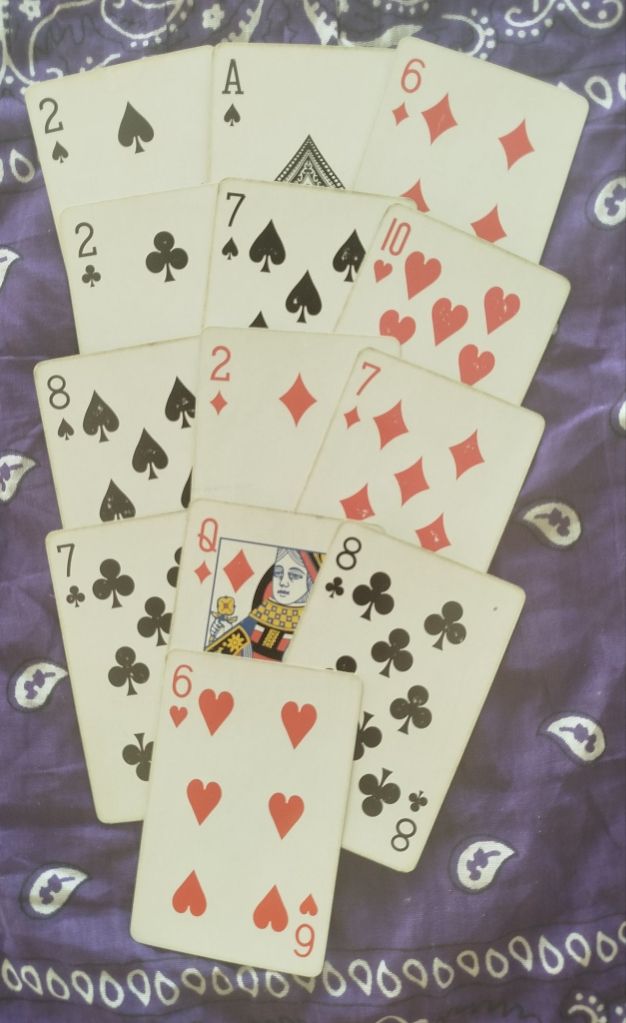
A career spread. Divination with playing cards.

The first thing I noticed is that the reading ends with a very positive combination of Queen of Diamonds, Eight of Clubs (work) and Six of Hearts (reconciliation/solution/adjustment). This bodes well, but the rest of the spread is more disastrous.

The first row shows that the subject is a thorn in the heart of the person (Two of Spades, Ace of Spades and the Six of Diamonds showing worry). Then we see that every step taken (Two of Clubs) to solve the issue has met with misfortune (Seven of Spades), meaning that the person has probably tried to find a job repeatedly but failed. This explains the very emotional cards in the first row, as well as the fact that the Happiness card (Ten of Hearts) is squeezed between Misfortune (Seven of Spades) and Tears (Eight of Spades). This is a whole unfortunate period unfolding in the person’s life.

There are some cards I am not quite sure about: the Two of Diamonds, Seven of Diamonds, Seven of Clubs. 2♦️ + 7♦️ can be a cheque or paper money, or projects about money. I asked the querent a couple of questions and it didn’t really help. I think a more general reading would be that, quite obviously, the lack of a job has impacted negatively (7♣️) his financial situation.

Then finally we have a woman who is either going to help him find a job or give him a job. If I had to bet I would say this is a female boss, since she shows up as a Diamond and not as a Heart. Either way, the period of misfortune is going to thankfully end.

MQS

Vera Sibilla Cards That Indicate Spirituality and Occultism

Pretty much every card in the Vera Sibilla has some connection with spirituality and occultism, especially when that’s the topic of the question. However, some cards are more pronounced in the kind of indications they give. The unfortunate thing about this sort of topics is that people tend to use them as a substitute for real life. So, for instance, once someone wrote that the Queen of Clubs can indicate a psychic vampire, and then everyone started reading that card primarily as that for a while (becuase, of course, you are such a wonderful person that everyone wants to leech off of your energy). In reality, unless the question is about spiritual or occult topics, such interpretations are best kept rare, and even then, the surrounding cards need to be kept in mind.

Ace of Hearts – The Conversation (Conversazione)

This is not an especially esoteric or spiritual card, but I’ll talk about it to show how easy it can be to expand a card’s regular meaning to cover those topics. The Conversation card is about words and people meeting or living together. In a spiritual or esoteric reading it can therefore indicate prayers (communion with the divine), exorcisms or spells (the spiritual or esoteric use of words). It can also indicate a group of people operating a ritual or praying together.

Four of Hearts – Love (Amore)

Again, not an especially esoteric card, but it is one of the possible cards indicating the soul (winged, heart-related). It can also indicate that one has the otherworldly tendency to attract certain types of happenings into their life. This has nothing to do with the law of attraction, but merely a statement of the fact that certain people simply tend to end up in specific situations.

Seven of Hearts – The Scholar (Letterato)

The Scholar is connected with the constructive use of the mind. It can therefore indicate plans, including esoteric plans, mostly tending to be good ones. It can also show the divine plan, providence etc.

Eight of Hearts – Hope (Speranza)

The Hope card is the main significator of faith, though not necessarily religious faith. It is heavily indicative of our psychic connection with the divine. It is also involved in those situations where the person has prophetic dreams, psychic powers and all those abilities witches on WitchTok pretend to have but really don’t. Reversed, it can indicate atheism (lack of hope in the divine) or, with very evil cards, it can indicate negative faith systems, such as satanism (we’re talking O9A, not the coastal post-crowleyan, occult-flavored performance art that passes itself off as satansim).

Nine of Hearts – Faithfulness (Fedeltà)

The Faithfulness card is one of great protection and support, whether from worldly friends or from otherworldly ones. As such, it can indicate angels (the Messenger is another possible card for angels, but in a more neutral sense). More commonly, it can indicate devotion to a belief system.

King of Hearts – The Gentleman (Gran Signore)

Obviously, God is the esoteric and spiritual gentleman par excellence, and this is usually what this card can represent. It indicates great protection from the divine (the female counterpart would be the Maiden for the Virgin Mary, or the Girlfriend for a female saint or goddess).

Two of Clubs – The Peacock (Pavone)

The Peacock is one of the cards we look for in sequences about magic and spirituality. When upright, it represents the god-power which unfolds at its own pace, like the peacock’s tail, creating opportunity for marvel and salvation. Esoterically, it shows magic in a neutral to positive sense. It represents oaths and religious vows. Reversed, it is the card of the devil (the one who was doomed by his pride), demons and dark magic.

Three of Clubs Reversed – The Journey (Viaggio)

When reversed, the Journey has a specific connection with white magic in its ability to interrupt any negative trend, harmonizing us with our path in life.

Five of Clubs – Fortune (Fortuna)

In itself the Five of Clubs is the card of destiny, of one’s path through life, whether good or bad. It can represent protection, though not necessarily divine, from magical forces. It can be present when a magical attack is aimed at modifying a person’s natural destiny.

Four of Diamonds – Falsehood (Falsità)

The Falsehood card is the card of negativity in all contexts. Esoterically, it shows negativity in the person’s aura and/or the evil eye, but it usually doesn’t represent heavy black magic.

Six of Diamonds – Thought (Pensiero)

Our thought is where past, present and future coincide and gather in the form of memories, plans and inclinations. It can give us hint as to the person’s inner life, their religious beliefs, their inner and esoteric talent, etc. Reversed, in addition to indicating negative thoughts, it can have a connection with subonsciousness and the powers that are buried within it, or with thought-forms and spirits.

Three of Spades – The Widower (Vedovo)

The Widower is one of the primary culprits we look for when discussing rituals, whether religious or magical. This is especially true when the card is reversed. It is also the card of graveyards and graveyard magic, and it can indicate sects (mostly in a negative sense).

Five of Spades – Death (Morte)

The Death card is always very incisive. It can talk about the person’s aura being out of wack, and it is one of the possible cards representing the summoning of dark forces, especially when reversed.

Eight of Spades – Desperation and Jealousy (Disperato per Gelosia)

The Eight of Spades is strongly connected with magical attacks, whether upright or reversed. It is indicative of demonic presences or dealing with dark forces in a negative sence. Being the card of envy, it can indicate the ill will of the dark magician. Spiritually, it can herald a crisis of faith or beliefs, either leading to loss of faith or to conversion.

Nine of Spades – The Prison (Prigione)

On a positive note, it can indicate the taking of religious vows (which bind us). More commonly it indicates feelings of guilt or feeling limited. Magically it represents the creation of magical bonds.

Ten of Spades – The Soldier (Militare)

Another strongly esoteric card, the Soldier is the card of the night, and therefore of the occult (which means that which is hidden). Because it is the card of attacks, esoterically it can show the tackling of the problem, or more commonly the psychic attack.

King of Spades – The Priest (Sacerdote)

Just like the two Enemies, the Priest can represent a magician. However, it usually signifies the magus in a more neutral and high sense, unless the card is reversed. Spiritually it can indicate spiritual institutions and religions, but also divine justice.

MQS

The Door Knockers – A Deep Dive into Italian Cartomancy

In almost all cartomancy systems, Italian or otherwise, the Ace of Hearts/Cups is the house. Here the Sibilla is an exception, since it relegates the House to the Two of Hearts, although the Ace of Hearts still has connections to the idea of family and people living together. In the second most widespread Sibilla deck in Italy, which is the Sibilla Regionale, which uses the suits of the Neapolitan cards, the Ace of Cups is once again the house.

One thing I have so far never found in non-Italian systems, which on the contrary is very widespread in Italy, is the concept of the door knockers, also known as ‘close to home’. This is a meaning that is found in many regional Italian cartomancy systems, and keep in mind that almost everything in Italy is regional, since regions have a much older history as separate states than Italy itself, if we discount the Roman Empire.

When I was taught to read playing cards, my teacher told me that the Two of Hearts is “al martel di porta”, knocking at the door. This refers to the way old house doors are made in many European countries, including Italy, where door knockers were used back when you couldn’t ring at the door. At least in Italy door knockers are still very much en vogue, though mostly as a decorative element.

The idea of the Two of Hearts as “the door knockers” is a reference to the fact that door knockers usually come in twos and to the fact that the Two of Hearts comes right after the Ace, which is the house, so that the Two is quite literally close to the home.

This meaning is also found in many systems for reading Piacentine cards, where the Two of Cups takes on that meaning (in some other systems this meaning is given to the Two of Wands) as well as in the Bolognese Tarot, where it’s the Ace of Swords that depicts it, due to the odd shape of the picture.

In some systems I am aware of, there are two distinct cards: the door knockers and the roof of the house. This is true for some systems employing Piacentine cards, where the Two of Cups is the door knockers and the Four of Wands is the roof.

This distinction is also found in the Bolognese tarot, where the Ace of Swords depicts the door knockers and the Seven of Cups the roof of the house. In the oldest surviving system for reading the Bolognese tarot, which dates back to before the French revolution (I talk about it here), the Knight of Wands indicated the door knockers and the Ten of Cups the roof of the house. Clearly, therefore, this symbolism is deeply ingrained in Italian cartomancy.

According to the person who taught me the 45-card system of Bolognese tarot, the Ace of Swords, the door knockers, tends to show something close to home in a temporal sense (about to happen) whereas the Seven of Cups, the roof, is more connected to everyday life, to our close environment and to the protection of people surrounding us, as well as to the family in a more extended sense. Germana Tartari, who initiated me to the 50-card system, which she was taught by her grandmother and by some of her grandmother’s friends, uses the Nine of Cups as ‘the staircase to the house‘, again mostly in a temporal sense as something about to happen.

On the other hand, in the system for reading playing cards that I was taught, the Two of Hearts covers both possibilities: it indicates something about to knock at the door or it can show family situations, people who are close to us etc.

I have never found this symbolism in other non-Italian systems. If you did, feel free to drop me a line, as it would be very interesting. Manuel Arcuri, an American reader who was taught to read playing cards by his Italian grandmother, says somewhere that his grandmother called the Two of Hearts “l’attesa”, which means waiting or expectation, as of something about to happen. He doesn’t mention door knockers though.

Furthermore, many card reading systems I have read about assign the meaning of “within two weeks” to the Two of Hearts, which once again gives us the idea of something about to knock at the door. Interestingly, Regina Russell‘s playing card system uses the Two of Hearts to indicate excitement for something that is about to happen, expectation and even pregnancy (expecting a child).

MQS