Tag Archives: Card Meanings

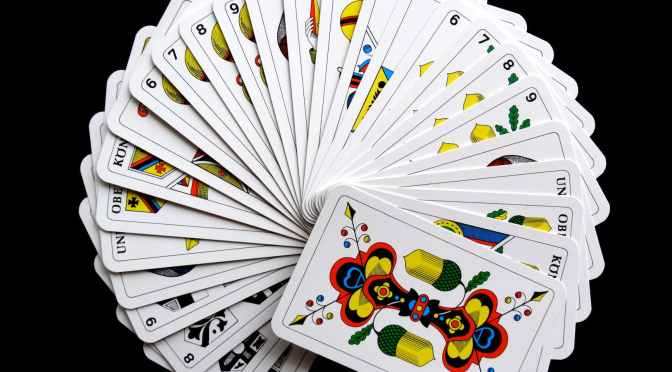
Cartomancy with the Skat / Piquet Deck of 32 Cards – Card Meanings

This is the list of meanings I have received for the German Skat deck. If you need a background, click here for part I.

Hearts – Hearts (also called “Rot”, red)

Ace – The home, The Family
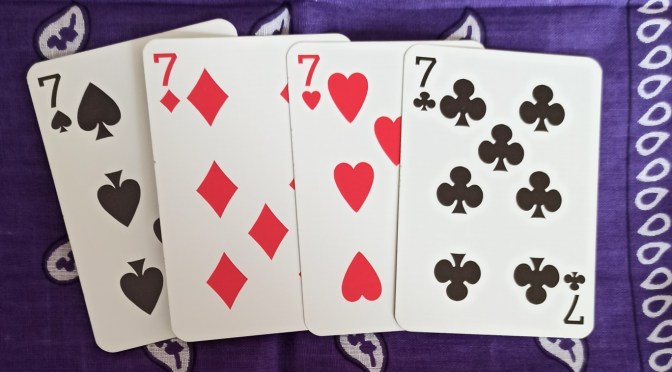
Seven – Intimacy, Someone or something close, Something imminent
Eight – Fun, Entertainment, Festivity
Nine – Friendship, Joy, Love
Ten – Marriage, Union, Connection, Bond
Jack / Unter – A Child, Naive, Inexperienced, Positive, Immature
Queen / Ober – The female querent
King – The male querent

Spades – Leaves (called “Grün”, green)*

Ace – A letter, Document, A book, Study
Seven – Visit, Meetings, Hopes, A short trip (even just going out on foot)
Eight – Society, People meeting, Groups, Talks, Also a short trip, but a bit longer than the Seven
Nine – Worry, Uncertainty, Preoccupation
Ten – Long road, Travel, A long time, Abroad
Jack / Unter – Message, News, also relatives
Queen / Ober – An older woman, A dark-haired woman, A friend or relative
King – The male counterpart to the Queen

Diamonds – Bells (“Schellen”)

Ace – Success, Great fortune, Gift, Good for career and business
Seven – Small money, Something small, Objects, little by little, of small account
Eight – Job, Occupation, also Praise
Nine – Success, Growth, Increase, Recognition, Satisfaction, Improvement
Ten – Money, Success
Jack / Unter – Good luck, Fortunate occurrence
Queen / Ober – A blond woman, A younger woman
King – The male counterpart to the Queen

Clubs – Acorns (note that Clubs are called “Kreuzkarten”, Crosses)

Ace – Sorrow, Suffering, Spirituality, Loss, Shock, A large building
Seven – Tears, can rarely be tears of happiness
Eight – Anger, Arguments, Clashes
Nine – Loss, Lack of success, Also jealousy
Ten – Illness, Situations that are sick
Jack / Unter – Disruption, Bad luck, Falseness, also wearing a uniform
Queen / Ober – An elderly woman, An ex, A negative woman, Lonely, lying, A female doctor or a woman in a position of authority
King – The male counterpart to the queen

Combinations

A♣ – 10♣ – K♣ = hospital, sickness
K♣ – 10♥ – 8♥ = marriage
7♥ – 7♠ – J♥ = pregnancy
8♦ – A♠ = a new job
8♦ – 9♦ – A♦ = career advancement
8♦ – 7♦ = part-time job
8♦ – 10♦ = full-time job
10♦ – K♦ – A♦ = successful businessman
8♠ – 8♥ = meeting people, a party
A♥ – 7♣ – 9♣ – A♣ = loss in the family
10♥ – K♣ – 8♣ = divorce
K♣ – J♣ – A♣ = problems with the law, prison (if another bad card instead of the Ace, problems with the law)
10♠ – 7♠ = someone visiting from far away
8♥ – J♦ – A♦ – 10♦ = winning money
J♦ – J♣ = bad luck, lost opportunity
J♣ – J♦ = good luck
7♥ – 7♦ = flirt, just sex, small money coming in
7♠ – 8♥ = going out with friends
10♠ – 8♥ = a pleasant trip
10♠ – 10♣ = problems with the car
10♠ – 8♣ – A♣ = an accident
7♦ – A♥ – 9♦ = house renovations
A♠ – 10♦ – A♥ – A♦ = buying a house
K♥ or Q♥ – 9♠ – 9♣ = person is jealous
7♦ – 7♣ = money problems

* as I said in part I, in the German tradition Spades are good and Clubs bad. If that seems weird to you, feel free to swap them.

Playing Cards and Numerology – The Kings

In cartomancy with playing cards, Kings are almost always significators for men. On rare occasion, Kings can come up to signify action, judgments and protection.
In some systems, the significators for the querents vary, but in the one I have been taught, it’s normally the Queen and King of Clubs that represent the querent.

The King of Hearts is a family man. He can be a father, a brother, an uncle, etc. For a gay man, the King of Hearts can be a partner. He is a good man, one who has an interest in the querent’s welfare. He is the archetype of the philanthrope. Even when he is not close to the querent, he is warm and kind. Even on the rare occasions when it doesn’t stand for an actual man, the card symbolizes a positive opinion of the querent (for instance, a judge ruling in the querent’s favor or a public servant furthering his aims). It shows positive outcomes thanks to protection. In general, it shows action taken in favor of the querent.

The King of Clubs is the male querent or the female querent’s male partner. When this figure doesn’t exist, he still represents a man, not necessarily related to the querent. Broadly, the card speaks of action, a positive role model, fair judgement and fair procedures.

The King of Diamonds is a man who is not close to the querent. He can be an acquaintance, a boss, a professor, a businessman. He is a person of good means and, like the Queen of Diamonds, one who follows primarily his self-interest, though he is not necessarily evil. He can be a rival in love in the appropriate context. Even when it doesn’t represent a man, the card symbolizes financial institutions, decisions concerning money and situations where there are interests at play that are greater and more powerful than the querent’s.

The King of Spades can be the male counterpart to the Queen of Spades, a man who is lonely, bitter, a rival, an enemy, an ex etc. He can be a difficult person, a bad father and all the things that apply to the Queen. However, the allegorical meaning of this card is also quite common, in that it represents the law itself, as well as a doctor or even the concept itself of medicine. It signifies great power being brought to bear on the querent, often in a cold and impersonal manner, if not altogether antagonistic. With negative cards it also signifies evil deeds and the will (and ability) to hurt

Playing Cards and Numerology – The Jacks

The way I was taught to read playing cards, Queens and Kings are often real people, representing women and men respectively, while Jacks are only rarely real people, although the Jack of Hearts can represent a real child.

Jacks tend to represent news and attitudes.
The Jack of Hearts, in addition to representing a child, can represent someone or something who is fresh, naive, immature, honest, happy-go-lucky. In love readings, for instance, it tends to show flirts and situations that haven’t fully matured yet. It is also a card of inexperience.

The Jack of Clubs represents friendship and help. It represents also service to others. Next to another court card representing a person, it shows that he or she is helpful, friendly, positive, serious, constructive. The card is also connected to cooperation and, as an extended meaning, to co-workers.

The Jack of Diamonds represents messages and the knowledge of facts. It shows the acquisition of information. As an extended meaning, it signifies study and research. It can also signify a go-between (you will notice that the Jacks of Diamonds and Clubs are similar to their Sibilla counterparts). The card points to someone who is inquisitive, curious and desirous to delve deeper into something.

The Jack of Spades signifies enmity. It shows a negative attitude toward the querent (or of the querent toward someone or something). It is a card of ill-will. It is also the uniform card, especially when together with the King of Spades. Animosity, a competitive attitude and the desire to dominate another are all part of the meanings of this card.

Despite the Jack of Hearts being the Child card, all Jacks can represent children. Usually, the Jack of Spades is a child with problems, or a sick child, or a child that misbehaves. The Jack of Clubs is a good child, while the Jack of Diamonds is a smart child.

Playing Cards and Numerology – The Tens

The tens in playing cards represent goals and destinations.

The Ten of Hearts is another lucky card in the deck, signifying happiness and well-being. Just like the Nine of Hearts, the Ten has the power to greatly reduce the negative impact of other cards. It represents lasting joy and a sense of not needing to look further. It is a great love card. It is also connected with the querent’s city or homeland.

The Ten of Clubs is the card of travel. Clubs are cards of action, but the aim of the action is represented by Diamonds. By themselves, Clubs are just a means, and travel is the means to get from where you are to your destination. Likewise, the Ten of Clubs signifies metaphorical pathways, the course of action.

The Ten of Diamonds is the card of success, and broadly speaking of accomplishment of aims. It is a generally material card, and can signify a large sum of money, or at the very least that money is not an issue. It also represents cities other than the querent’s, seen as goals or destinations to travel toward.

The Ten of Spades has a variety of meanings. Some are neutral. For instance, it represents unknown destinations, stranger places and destinations abroad. It is also a card of negative goals, illegal aims and, more generally, of secrets and silence. It is connected to night time, just as the Ten of Hearts is connected to day time. Broadly, it is a card of failure, but only if together with other cards that point in that direction.

Playing Cards and Numerology – The Eights

The eights in cartomancy with playing cards represent people, consciousness/conscience and the concept of time. They show how we relate to other people and how we interact with them. In studying other systems of cartomancy, I’ve been struck by how similar my approach to the Eights is to the hedgewytchery system. Look it up for a comparison. I also find them quite similar to the eights of the Sibilla.

The Eight of Hearts is the card of cheerfulness. It represents optimism, satisfaction, good outcomes and the gathering of people to celebrate, public holidays, etc. It represents things done with a positive intent in mind, positive thinking in general, honesty, choosing the high road. It is also a flirtatious card and it is connected with watery places, possibly because in Italy people tend to turn flirtatious during the summer months while tanning on the beach (this card is somewhat similar to the Hope card in the Vera Sibilla). Broadly, it symbolizes peace. It is connected with relatives and with people taking an interest in the querent, as well as to the clergy.

The Eight of Clubs is representative of working people, the “common folk”, although more specifically it relates to the peasantry, and by extension it signifies work. There are other cards that can signify employment (Three, Seven, Eight of Diamonds, for instance) but in the case of the Eight of Clubs, work is seen as how people who don’t have the luxury of wasting the day sitting on their hands or soapboxing on Twitter spend their time. The card is connected to the fields and to the countryside. It is also the card of things done according to a plan or knowing full well what their consequences are, for better or worse.

The Eight of Diamonds is the card of business. It’s all things that bring in money or we invest money in. Because this card signifies where money comes from and where it is headed (compare to the Eight of Diamonds in the Sibilla), and because for most people money comes from working, this is another possible work card. It represents financial markets, banks and the bourgeoisie, as well as the city as an environment (usually not the querent’s city, though). The card represents investments, savings, transactions etc. depending on where it falls. It shows concerns with money and can imply aridity or ulterior motives, or, more neutrally, thinking about yourself and about your “business”.

The Eight of Spades is the card of tears. It represents the falling through of plans and the shattering of hopes and desperation in general. But this is also a card of negative thoughts, and of things done with the intent to hurt. Ill-will and malice are indicated. It can represent difficulties with other people, interpersonal trouble. It also has a connection with groups of spade-like people, such as armies, juries, medical teams, adjudicating boards, committees and all those situations where there are people who have the querent by the balls (in war it would represent a siege). The card is connected to isolated places in general.

Playing Cards and Numerology – The Sevens

In cartomancy with playing cards, the sevens in general represent the idea of achievement.

The Seven of Hearts has the general meaning of surprise. This is because the suit of Hearts does not contemplate the notion of effort, so anything that happens happens either thanks to other people or thanks to positive circumstances. This card signals positive turns of events, fortunate breakthroughs and good luck. It is also connected with the idea of talent, because if we have a talent for something, achieving great results in it is easy.

The Seven of Clubs is less fortunate. It is a card of problems, things that stand in the way of achievement and that need to be worked through. It is not a tragic card. Sometimes it limits the amount of success shown by the other cards, while at other times it signifies that the sailing will be less than smooth. Either way, the problems shown by this card are solvable (which doesn’t automatically mean they will be solved). Supported by positive cards, the Seven of Clubs becomes a card of hard-won achievement. It can signal the conclusion of an agreement or that of a practical project.

The Seven of Diamonds is the card of money and financial achievement, and of achievement in general. It is a simple card most of the times. Unlike the Seven of Hearts, here effort is implied. By extension, this card is positive for recognition and winning prizes, and allegorically it is connected to harvesting.

The Seven of Spades is a card of misfortune. It shows obstacles that are difficult to solve, against which the querent has little power. More broadly, the card has to do with all negative unforeseen circumstances that either prevent us from achieving what we want or strongly limit us. With positive cards it shows that success won’t be complete, while with negative cards it’s a sign of utter capitulation.

Playing Cards and Numerology – The Sixes

The way I read playing cards, sixes are the difficult number. In general, six brings out the worst in the cards. I’ve noticed that this is a trend in Italian systems of cartomancy (althouth not in Kapherus’ system).

The Six of Hearts is the only positive card of the bunch, as it signifies the solution of trouble, adjustment and the return to happiness, health, etc. It shows peace, improvement and relax. Only when hemmed in by nasty cards it turns foul and it brings tears (which the card graphically reminds me of) and the impossibility of a solution.

The Six of Clubs is a very static card. It signifies tiredness and a situation with all work and no play and no enthusiasm. It is symbolic of subordinate work and, more broadly, it implies the inability to definitely put a problem behind you, as it keeps showing up. With positive cards, it shows the ability to reach your goal, but usually without a great sense of realization.

The Six of Diamonds is also a meh card. It is connected with insecurity, worries, confusion and indecision, especially but not exclusively of a financial nature. It shows all those situations where you can’t stop thinking about something and being tormented by it. However, with positive cards it can signify a situation that is sorted out by being resourceful, planning and making an informed decision.

The Six of Spades is a card of illness, as it figuratively depicts the wards of a hospital. It is one of those cards that is very difficult to put a positive spin on. The illness can be literal or figurative, when it symbolizes a situation of suffering and upset, or even one that is noxious or damaged. In itself, it negates reconciliations and the possibility of returning to the past, though of course the following cards may alleviate it.

Playing Cards and Numerology – The Fives

In cartomancy with playing cards, fives have an affinity with the idea of change, just as fours are related to stability.

The Five of Hearts shows positive change coming our way without effort. It is a card of evolution, good opportunities, gifts, offers (it is somewhat similar to the Three) and in general it shows that the querent thrives. Its general meaning is that of abundance and flourishing, freedom and being in a positive environment.

The Five of Clubs also signifies change, but change that is enacted by the querent. It implies effort, even physical effort. Nothing is free in the realm of Clubs, and therefore the card implies combativeness and even competition and the need to fight for what you want. While the Five of Hearts shows abundance, this card has an inherent sense of scarcity to it and the need to make the best of your chances.

The Five of Diamonds is the card that I thought exemplifies this number best, because in my system it just means change in a neutral sense. Generally it’s a positive card and it can bring some dynamic energy to a static spread. Of course it is also connected to the movement of money, information and energy, all of which are themes of the suit of Diamonds.

The Five of Spades is a bad card. The main meaning is that of prison, but of course it needs to be interpreted figuratively most of the times. It signifies the inability to move or to act, and it is symbolic of all things that keep us fenced in (like the pip in the middle) and chained, unable to change, be it guilt or an addiction. In general it signifies lack of opportunities, scarcity, dejection, the need for great sacrifice or, if followed by negative cards, a definite turn for the worse.

Playing Cards and Numerology – The Fours

In most systems of cartomancy with playing cards, the fours are cards of stability. However, a further connotation that I think attaches to them is that of pact or agreement between parts. Possibly this is due to the four pips resembling the legs of a table where people sit to talk.

The Four of Hearts is the card of reunions, gatherings and positive social occasions. It is also a symbol of agreements that come easy or are easily restored (Hearts): harmony and affinity all play into the meaning of the card. Because of the emotional connotation of the suit, the card can signify sex.

The Four of Clubs represents talks, and it is mainly the conversation card. However, it is not splendid. Because of the neutral nature of the suit of Clubs, which implies struggle and the need for action, the Four can go either way: toward agreement or toward breakup. It implies a degree of difference that needs to be reconciled, which is why talks are necessary. It’s not a bad card, but it is open-ended.

The Four of Diamonds is the card of formal agreements. It represents all things to do with papers, documents, offices, etc. Because the suit is more material than that of Hearts, the agreement can be interpreted as a transaction, and therefore the card represents buying and selling, and, by extension, all objects. In general, it signifies economic activity and has an affinity with the more material side of life.

The Four of Spades takes the basic theme of the number and runs it into the ground. The card represents loneliness and isolation. It shows the inability to get along or reach a positive conclusion. It shows complete disharmony and the impossibility of proceeding in a given direction, thus implying blockage. With other negative cards it means failure and trouble that cannot be overcome.

Vera Sibilla | The Kings – Gentleman, Doctor, Merchant, Priest (Gran Signore, Dottore, Mercante, Sacerdote)

King of Hearts – The Gentleman (Gran Signore)

Design: a protective lord, his hand resting confidently at his hip

UPRIGHT K♥

The card tends to be positive, unless surrounded by cards that taint its meaning. In the main, it depicts a married man, often the querent, or a father, brother, grandfather, friend etc. The person is usually a positive influence in the querent’s life. He is the archetype of the philanthropist. All kings are connected with power, and the King of hearts is power wielded to do good, in general or in the specific context. It represent someone who protects or furthers the querent’s aims. Because it represents positive power, in spiritual readings he represents God (just as the Queen of Clubs represents the Virgin Mary or other figures of virginity). When a person who has power over the querent is represented by the King of Hearts, it’s a good sign.

REVERSED K♥

The card becomes negative, showing someone who is either troubled or the cause of trouble. When the man is a source of trouble, then he tends to be overbearing, manipulative, motivated only by the furthering of his own aims and often addicted to something. The notion of addiction attaches to the card as a general meaning even when it doesn’t stand for a man. It’s the archetype of the misanthrope or the apparent helper.

King of Clubs – The Doctor (Dottore)

Design: a well-meaning doctor taking a patient’s pulse

UPRIGHT K♣

A card with a plethora of meanings. All kings represent power, and the King of Clubs represents someone in a position of power in society, often with a degree (it can signify the degree itself, and university studies). He can be a boss or a professional of some kind, whose help will be required. It’s a more neutral power than that of the King of Hearts. Figuratively, the card often signifies that a situation requires someone’s authoritative help, because something is not right. Sometimes it means that there is a health issue, so he becomes a real doctor (a GP), at other times the sickness is figurative. Rarely, the card indicates a man in the querent’s life who is not violent, but certainly controlling, such as a father or husband. This is rare though. Broadly, it signifies that health will play a role in the querent’s life.

REVERSED K♣

It becomes an extremely negative card. When it does not represent a person, its most traditional meaning is that of wrong diagnosis or wrong help. Figuratively this can mean the querent is receiving help but it’s the wrong type of help and some mistakes are being made. Broadly it signifies the wrong path, strategy or choice. When it represents a person it reperesents an untrustworthy man who abuses their position. He can even be a criminal, a boss in the mafia sense. It signifies a man with a double life.

King of Diamonds – The Merchant (Mercante)

Design: a man with a turban waiting for his cargo to ship or to arrive

UPRIGHT K♦

One of the most important cards in the deck, it very rarely represents a person. It represents financial power, and where it comes from. It is connected to money, banks, buying and selling, calculating, maths etc., but its chief role is that of significator for the querent’s job. 4/5 of the times this will be the interpretation. Even in love it usually represents the fact that work and career have something to do with the question. Rarely, the King of Diamonds can stand for selfishness and a calculating character, and a man who is completely absorbed by his own interest and doesn’t do anything for nothing.

REVERSED K♦

The chief intepretation is that of trouble at work. It may be that the querent is unemployed, or doesn’t like their job, or is not good at it, or is not paid enough. The reason will be explained by the other cards. Just as, when upright, the Merchant is connected to maths and calculating exactly what you want to achieve, when reversed it represents incompetence and lack of good old common sense. It stands for wrong financial decisions. Rarely, it represents a man who is corrupt, sleazy, and potentially connected to crime, or at least to the gray area between what’s lawful and what isn’t.

King of Spades – The Priest (Sacerdote)

Design: a priest in a wintry courtyard.

UPRIGHT K♠

A neutral card whose meaning depends greatly on the context and on the other cards. It can stand for religion (not necessarily for faith, which is signified by the Eight of Hearts) but this is rare and usually only in the context of the question. Usually it represents authority. As all Kings are connected to power, the Priest, the King of Spades, has the power to punish or reward the querent. It represents the law and all lawful authority. It signifies all those rigid structures that layer themselves on society, beating it into shape (religion, politics, mores, institutions, bureaucracy, etc). More broadly it signifies the concept of justice, equilibrium, the right way. It can stand for a person with a degree, but its status is more prestigious than that of the Doctor card, and often signifies a specialist doctor. It signifies people who are strict and perfectionistic, but just and not evil. In love it stands for faithfulness, but it lacks passion. It can be a significator card for an older man. Sometimes the card behaves peculiarly. The cards the Priest shields himself from represent a problem or issue, something wrong or something that could get the querent into trouble. The cards the Priest points toward can represent the right way or what will be done. They represent the sentence, especially in a legal framework. This behavior of the card is rare.

REVERSED K♠

It often signifies legal trouble, a decision that is made against the querent, and injustice. It can signify lack of morality and bigotry, sometimes together. It can represent a dangerous individual who will not let what’s right stop them. Broadly, it implies having the law or the bureaucracy or the system against you.