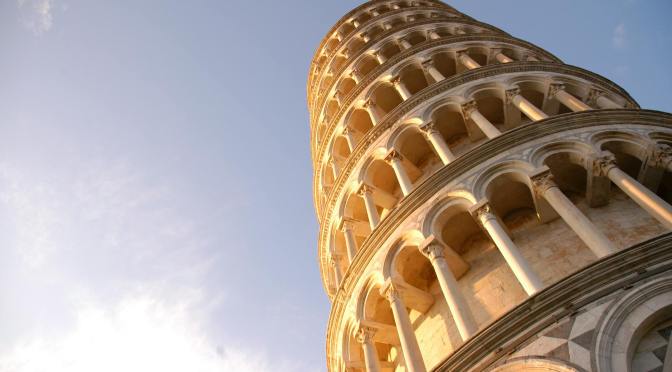
I did a reading recently with the Bolognesw tarot that I unfortunately forgot to record. It was one of those instances of “of course I will remember it.” The one thing I do remember is that the Tower featured prominently in the reading and did not take on a nefarious meaning, instead just indicating a place other than the home.
This gave me the idea of collecting here the combinations I have actually experimented in practice so far.
Tower + Queen of Coins (Truth) = School, Place of learning (this combo was in the reading I did recently)
Tower + World (big) = A palace (in the example of the reading I did, it was a tourist attraction)
It is not an endless list, as you can see, but then again the Tower doesn’t always come up in a reading, and when it does it doesn’t always indicate a place, and when it does it isn’t always clear what kind of place it represents, based on the other cards. But this short list is what my experience has borne out so far, and it clearly shows how the cards operate as small particles of meaning that gravitate toward each other to create complex structures.
Obviously, much depends on the context and on the other cards. The Ace of Coins, for instance, is the table, but it is also a big money card, so with other material cards it could turn the Tower into a bank instead of a restaurant. What I can say for certain at this point is that my experience with the Bolognese tarot shows the Tower isn’t necessarily an evil place (like a hospital or a prison) as some strands of the tradition seem to indicate, but its meaning can be modified by the presence of positive cards.
The bed symbolism is almost as widespread in cartomancy as that of the table, of which it is a natural counterpart. The table often stands for conviviality, nourishment, feasting and interpersonal contact, and it often represents situations happening during the day. The bed, by contrast, is a nocturnal symbol of retreat and rest, and can stand for sickness, but also for physical intimacy, depending on the other cards. As usual, it is admirable how the card readers of yore used to weave simple and effective symbols of daily life in their reading systems, which allowed them to talk about reality.
The oldest mention I could find of a card representing the bed is in a little-known system for reading Italian regional playing cards with a reduced pack of 25 (instead of the full deck of 40). In this method, the Four of Coins is the bed card. It tends to represent situations becoming static or sick, or it can talk about passion, depending on the other cards. It can also indicate that something happens in the evening or at night. Interestingly, in another system I’m aware of, this time utilizing the full pack, the Four of Coins is the table, while the Five of Wands is the bed.
In the Bolognese Tarot, which is the oldest used divination deck we have written records of, the Chariot is the bed card. This has got to be one of the most puzzling bits of symbolism of the deck: a card that is usually indicative of forward movement, travel, progress, launching forward is seen as a card of static sickness, likely due to how the chariot is represented, with the horses crouching at the sides, as if the forward movement had stopped.
Truth be told, in the oldest extant document on divination with the Bolognese tarot, which dates back to the Pre-Napoleonic period, the Chariot is still considered a card of journey, but shorter than the World card, which is assigned the meaning ‘long journey’. This may indicate that the meaning of the card evolved through time, from ‘little journey’ to ‘little movement’ to ‘not much movement’ to ‘staticity’. Another likely possibility is that different meanings were used by different strands of the tradition, one of which hadn’t yet been put down in writing. This latter possibility is confirmed by the fact that there are readers who who assign both meanings to the Chariot, depending on the cards that surround it (static cards activate the static meaning, active cards the moving, active meaning).
The bed card is also present in some of the oracle decks that originated in the XVIII century as parlor games. In the Sibilla we have two bed cards: one is the Four of Spades, the Sickness card, which interprets the symbolism of the bed in its more static and negative sense of needing to interrupt one’s routine and of situations that are not healthy. The other bed card is the Ace of Diamonds, the Room, which can indicate any room in a building, but which in itself stands for the bedroom. As an extended meaning, it is the card of intimacy, so the presence of cards indicating love or physical contact can lead to rather hot interpretations.
The Kipper deck does not have two bed cards, but it does contemplate the symbol of the bed in the card “a short sickness”, which depicts a patient in bed being visited by a doctor. This is mostly a card of sickness, but many German-language sources I’ve read consider it also an ingredient in combinations about intercourse, partly due to the presence of the bed and partly due to the doctor touching the sick man’s wrist, which is supposed to be indicative of physical contact, if supported by other cards.
Working on my review of Andrea Vitali and Terry Zanetti’s book on the Bolognese tarot I came across some interesting information that matches what some Bolognese tarot readers have confirmed.
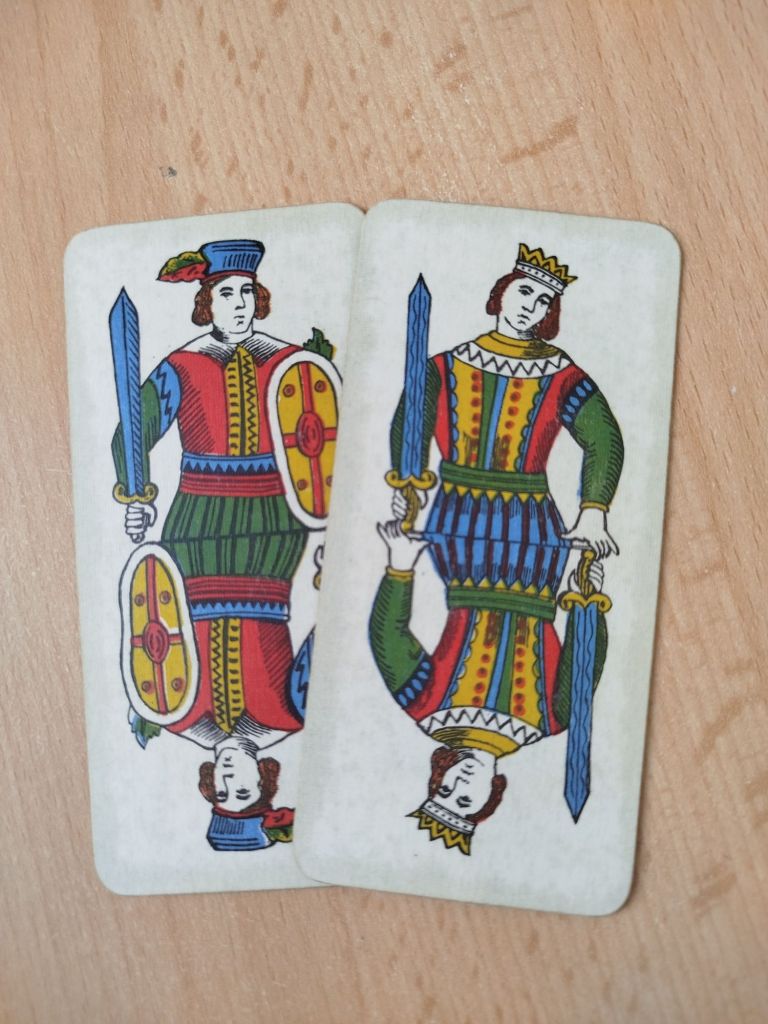
If you read my section on the card meanings of the Bolognese tarot, you will see that I call the King of Swords “Spadino”, which literally means “little sword” or, more appropriately in this context, “little sword bearer” (the ‘bearer’ part is implied). This is because the people I have chiefly learnt from all agreed on this one name, independently from one another.
When we read Zanetti’s section on the divinatory meanings of the cards, though, we find that she calls the Page of Swords ‘Spadino’, identifying the figure with a young man. This is in contrast with the tradition I’ve received, whereby the Page of Swords is just a letter or message. Zanetti does say that the card can also sometimes signify a disquieting letter, but she chiefly identifies the Page with a young man.
The Page of Swords and the King of Swords in the Bolognese tarot / Tarocchino bolognese
I must say I find this option strangely titillating, as the Page of Swords, Spadino, would then be a male counterpart to the Page of Cups, Coppina, ‘little cup bearer’. The ending -ino, which in Italian points to something small or young, definitely fits the Page more than the King. Zanetti denies that this parallel between Coppina and Spadino exists, because the Coppina is supposed to be always negative (she’s traditionally the little floozy who snatches hubby away). But I have not found this to be the case: the Page of Cups is just a young (or younger) woman.
Ultimately, as my understanding and practice with the Bolognese tarot evolves, I know I will have to create my own deck (all traditional readers seem to have done so, preserving a part of tradition and integrating it with their own discernment and experience). Tradition is, after all, not something fixed, but something that is handed over to us (from the Latin tradere) and that we must administer intelligently.
Another interesting fact is that Zanetti emphasizes the intellectual aspect of Spadino, calling the card “young man and his thoughts”. This is in contrast with what I’ve learned from Germana Tartari, my teacher for the 50-card method, whose grandma taught her that the Knight of Swords can sometimes represent the King of Swords’ thoughts, in a kind of parallel to the Knight of Wands being the thoughts of the King of Wands.
The fact that so many traditions seem to exist should not discourage us from engaging with them. Keep in mind that the Bolognese tarot tradition evolved locally, with each city, village or even street having slightly different versions of it. Thus, this is less a matter of who is right or wrong and more one of systemic preference and whether integrating different system together leads to new systems that work, or whether it is best to keep them separate. This is something that can be established only through trial and error.
(Note: this is a collection of the meanings attributed to the cards by some occultists in the past centuries. It does not reflect my own study or opinion of the cards. It is only meant as a quick comparative reference as I develop my own take.)
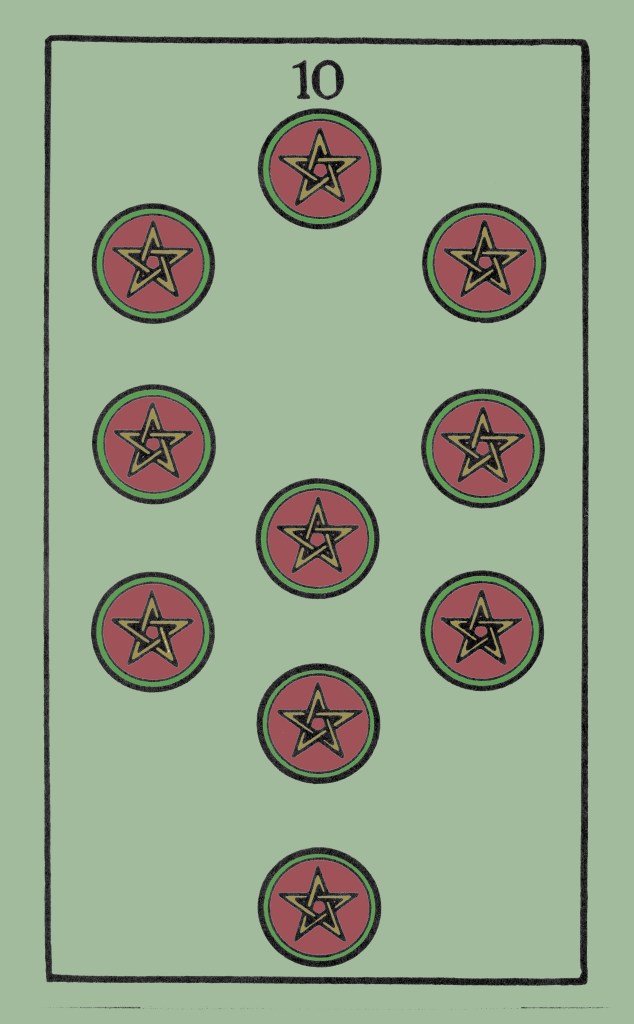
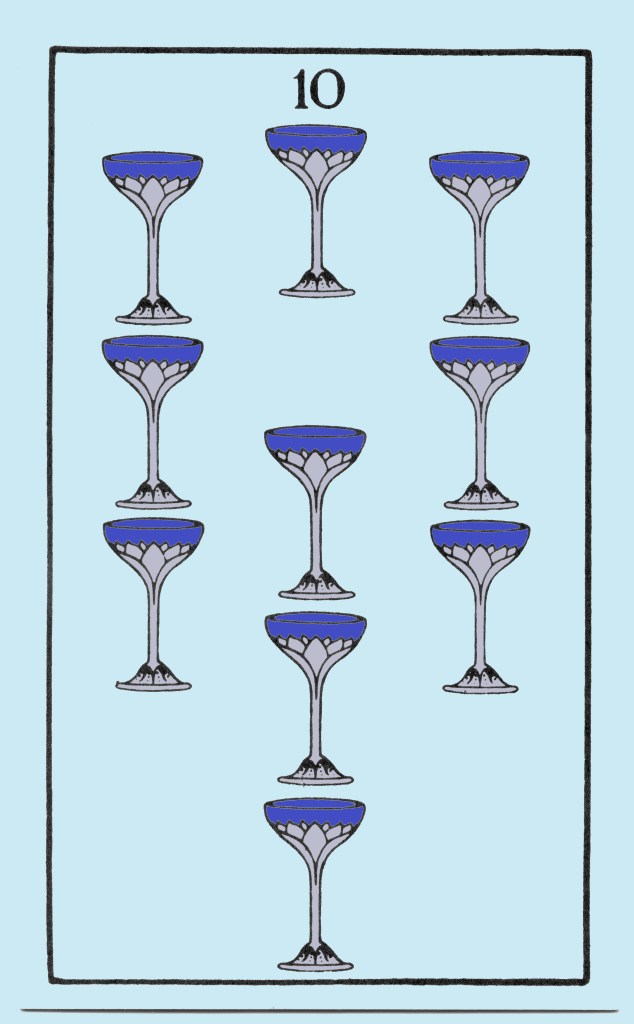
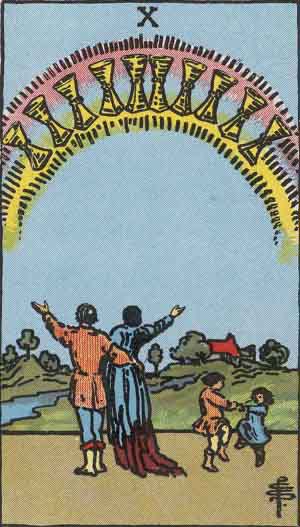
The Ten of Cups from the Builders of the Adytum (BOTA) tarot deck
Paul Foster Case (and Ann Davies)
The time period is the third decanate of Pisces, from March 11 to March 20, under the sub-rulership of Mars in its Scorpio aspect. The meanings are unfortunate unless the divination refers to spiritual matters; for the combined forces of Mars, Jupiter and Neptune in Pisces on the physical levels, while they mean tremendous power of desire and sometimes the satisfaction of desire, point rather to unbalanced force than otherwise, Well-Dignified: if relating to spiritual matters, permanent and lasting success through inspiration from higher levels of consciousness; high psychic development; realization of the highest aspirations; happiness. On questions at a lower level, even if well dignified: great ambition; ultra sensitiveness; great power of realizing desires, but equally great danger of misusing that power. lll-Dignified: in spiritual questions, danger from psychism; probability of being injured mentally through unwise attempts at meditation. On all other questions: danger of self-undoing from psychism; prodigality; possibility of being influenced by others through the desire-nature; tendency to drug habits and drunkenness; disgust resulting from overindulgence; excess in pleasure. Keyword: Excess .
(From The Oracle of Tarot course)
A. E. Waite
Appearance of Cups in a rainbow; it is contemplated in wonder and ecstacy by a man and woman below, evidently husband and wife. His right arm is about her; his left is raised upward; she raises her right arm. The two children dancing near them have not observed the prodigy but are happy after their own manner. There is a home-scene beyond. Divinatory Meanings: Contentment, repose of the entire heart; the perfection of that state; also perfection of human love and friendship; if with several picture-cards, a person who is taking charge of the Querent’s interests; also the town, village or country inhabited by the Querent. Reversed: Repose of the false heart, indignation, violence. (From The Pictorial Key to the Tarot)
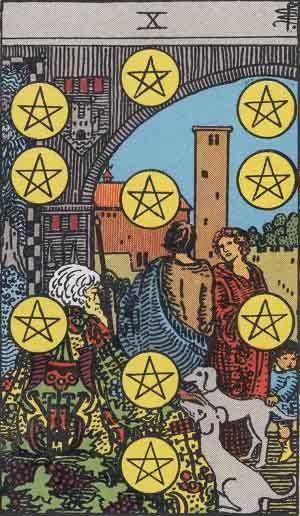
The Ten of Cups from the Rider Waite Smith tarot
Aleister Crowley
The Ten of Cups is called Satiety. Its attribution is Mars in Pisces. The watery sign has sunk into a stagnant dream, but in it broods and breeds the violent quality of Mars, to putrefy it. As it is written: “Until a dart strike through his liver.” The pursuit of pleasure has been crowned with perfect success; and constantly it is discovered that, having got everything that one wanted, one did not want it after all; now one must pay.
[…]
This card represents a conflicting element. On the one hand, it receives the influence of the Ten, Malkah the Virgin. The arrangement of the cups is that of the Tree of Life. But, on the other hand, they are themselves unstable. They are tilted; they spill the water from the great Lotus which overhangs the whole system from one into the other.
The work proper to water is complete: and disturbance is due. This comes from the influence of Mars in Pisces. Mars is the gross, violent and disruptive force which inevitably attacks every supposed perfection. His energy displays the greatest possible contrast with that of Pisces, which is both peaceful and spiritualized. (From The Book of Thoth)
The Ten of Cups from the Thoth tarot deck
Golden Dawn’s Book T
HAND, as usual, holding bunch of water-lilies or lotuses, whose flowers pour a white water into all the cups, which “all run over.” The uppermost cup is held sideways by a hand, and pours water into the left-hand upper cup. A single lotus flower surmounts the top cup, and is the source of the water that fills it. Above and below the symbols Mars and Pisces.
Permanent and lasting success and happiness, because inspired from above. Not so sensual as “Lord of Material Happiness,” yet almost more truly happy. Pleasure, dissipation, debauchery, quietness, peacemaking. Kindness, pity, generosity, wantonness, waste, etc., according to dignity.
Malkuth of HB:H (Matter settled: complete good fortune). Herein the Great Angels HB:a’aShLYH and HB:MYHAL rule.
Etteilla
The city Upright. In terms of spiritual medicine, this card, in its natural position, signifies: City, City Center, Homeland, Country, Town, Village, Place, Site, Dwelling, Home, Residence. – Citizen, Group of citizens, City dweller. Reversed. Anger, Indignation, Agitation, Irritation, Outburst of rage, Wrath, Violence.
There is a number of cards in the Vera Sibilla that can indicate ambiguity and unreliability. As usual, context is key, but the following ones are the most common.
Four of Hearts Reversed – Love
As I discussed in my recent video about the Fours, traditionally the Four of Hearts is the card of homosexuality. And it can still mean that in particular situations, but more broadly, aside from the other main meaning of ‘lack of love’, it can also indicate an unhealthy approach to love (hence the XIX century association with homosexuality). An unhealthy approach to love can also involve secret perversions or cheating, so the Love card reversed can be an indicator of unreliability in love.
Five of Hearts Reversed – Happiness
Being a card that represents more than one person, being in the suit of Hearts and being reversed, the Happiness card can indicate betrayal. However, traditionally, this more commonly refers to relatives (since the upright card can stand for relatives in a neutral sense). It can show disharmony among relatives, and relatives you must guard against, especially with people cards next to it.
Seven of Hearts Reversed – The Scholar
Upright, the Scholar is a symbol of the positive use of the intellect in a creative or constructive way. Reversed, the card can symbolize nonsensical or useless abstraction from reality, impotence (in all senses) but also the negative use of the intellect. Hence, the card can indicate ulterior motives and a sneaky disposition of character.
Eight of Hearts Upright/Reversed – Hope
The Hope card has many spiritual and moral virtues, among them that of choosing the high road and doing what’s good. When the card is next to cards of ambiguity, or when reversed, it can stand for someone who is extremely fickle and even promiscuous in love.
Nine of Hearts Reversed – Faithfulness
Upright, the dog symbolizes fidelity, friendship, sincerity in the affections. Reversed it can, quite literally, indicate unfaithfulness. It is also the proverbial dog biting the hand that feeds it, showing ungratefulness, anarchy, rebellion.
Ten of Hearts Reversed – Perseverance
Upright, the Ten of Hearts can indicate a stable, reliable character. Like the dog card, it reversed this symbolism when reversed, showing situations that are not stable, but also people who are unreliable.
Two of Clubs Reversed – The Peacock
When upright, the card emanates the positive energy of the peacock symbolism, showing beauty, marvel, art, beauty, completion, immortality. Reversed, it takes on its more sinister characteristics: vanity, being full of oneself, being blinded by one’s ego, which can all of course make us unreliable.
Ten of Clubs – Levity
The butterfly symbol speaks for itself. It shows someone who is fickle, not thorough, changeable, too easygoing or carefree. Still, the unreliability indicated by this card, unless supported by cards of dubious moral character, can also be of the innocent kind, due to superficiality rather than to some grand secret plan.
Four of Diamonds – Falsehood
The cat card is obviously the opposite of the dog: it indicates everything that isn’t as it seems, and so is the card of lies and cover-ups. But don’t go crying foul too easily: this is also the card of everything that is wrong, and so it also covers such things as mistakes and oversights. Still, it is never good when coming up next to a significator.
Six of Diamonds Reversed – Thought
Somewhat similarly to the Scholar, the Thought card is connected with what goes on between one’s ears. When it is reversed, the card indicates negative thoughts, which must be understood broadly to signify negative thinking or the thought of doing something negative. As such, if a significator comes up with the Thought card reversed after it, look at the other cards to see if they are feeling down, are deluded or a plotting something.
Seven of Diamonds Upright/Reversed – The Child
The Child card is neutral and has many positive undertones, but it is also card of immaturity. If it comes up upright with cards that highlight this side of its symbolism, or even worse if it comes up reversed, then you may be dealing with people who are not mature enough to be trusted, in whatever sense that might be meaningful in the context.
Eight of Diamonds Reversed – The Handmaid
Upright, the Handmaid is a card of morality and education. But when it is reversed, it becomes a card of the shallow trashy character that you should not take seriously. It can stand for someone who will betray your confidence.
Ten of Diamonds – The Thief
Obviously, the Thief is the card of betrayal par excellence. It always shows something that sneaks into a situation to ruin it from the inside. A person card with the Thief card next to it should make you think twice about trusting them.
Six of Spades Reversed – Sighs
The Sighs card is complex in its meanings, especially when reversed. Its broadest meaning is that of “no sighs”, so it can be good. But this can also signify that someone is not losing any sleep over the evil they are concocting, and so it can be a symptom of an unscrupulous character. This submeaning of the card usually emerges when other cards of similar signification are next to it.
Nine of Spades Reversed – The Prison
As with the Sighs card, the Prison reversed can be positive, as it shows freedom, being unchained or unburdened, repentance, and similar concepts. But with cards of dubious moral character it can indicate that someone is unhinged, lacking restraint and giving into unscrupulous ambitions.
Ten of Spades Upright/Reversed – The Soldier
The Soldier is the card of the night, and of everything that happens at night, including shady dealings. Because of this, especially when reversed, it can sound the alarm on the fact that something is going on behind your back. A person card next to the Soldier reversed is rarely someone you can trust.
People Cards
The general rule is that a person card reversed is either suffering or is against the querent. Especially the Heart court cards must be treated with caution, as they can become traitors and cheaters. It goes without saying that the two Enemy cards already have this potential indication baked into their upright meaning.
A Warning
You may have noticed that a lot of cards in the Sibilla can indicate unreliability. Follow these indications strictly and you’ll go around accusing everyone and their mother of being a cheater and a fraud. Interpretation is never a matter of a single card: it is important to see if cards of similar import accumulate, how the court cards relate to them and if there aren’t more likely explanations.
(Note: this is a collection of the meanings attributed to the cards by some occultists in the past centuries. It does not reflect my own study or opinion of the cards. It is only meant as a quick comparative reference as I develop my own take.)
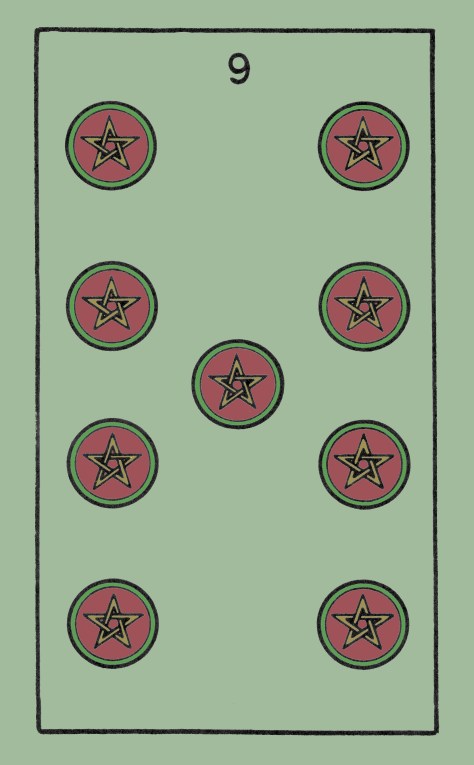
The Nine of Pentacles from the Builders of the Adytum (BOTA) tarot deck
Paul Foster Case (and Ann Davies)
The time period is the second decanate of Virgo, under the rulership of Saturn, September 3 to September 12. Meanings: Well-Dignified: reserve, discretion, caution, frugality; some worries over money matters because of slow-maturing of plans; gain through careful investment. Occasionally when this card is especially welldignified, and other cards in the layout confirm it, this Key represents inheritance, material gain and much increase of goods, corresponding to the positive meanings of Saturn in Capricorn. Ill-Dignified: discouragement; troubles through theft and knavery. Keyword: Harvest. (From the Oracle of Tarot course)
A. E. Waite
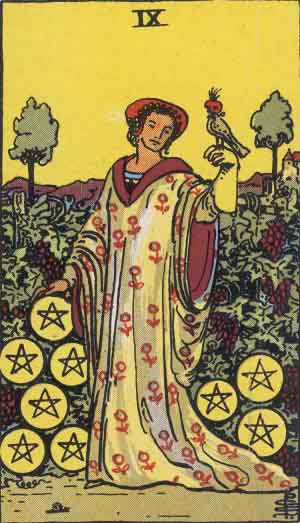
A woman, with a bird upon her wrist, stands amidst a great abundance of grapevines in the garden of a manorial house. It is a wide domain, suggesting plenty in all things. Possibly it is her own possession and testifies to material well-being. Divinatory Meanings: Prudence, safety, success, accomplishment, certitude, discernment. Reversed: Roguery, deception, voided project, bad faith. (From The Pictorial Key to the Tarot)
The Nine of Pentacles from the Rider Waite Smith tarot
Aleister Crowley
The Nine of Disks is called Gain. The suit of Disks is much too dull to care; it reckons up its winnings; it does not worry its head about whether anything is won when all is won. This card is ruled by Venus. It purrs with satisfaction at having harvested what it sowed; it rubs its hands and sits at ease. As will be understood from the consideration of the Tens, there is no reaction against satisfaction as there is in the other three suits. One becomes more and more stolid, and feels that “everything is for the best in the best of all possible worlds”.
[…]
The number Nine, Yesod, inevitably brings back the balance of Force in fulfilment. The card is ruled by Venus in Virgo. It shows good luck attending material affairs, favour and popularity.
The disks are arranged as an equilateral triangle of three, apex upwards, close together; and, surrounded at some distance by a ring, six larger disks in the form of a hexagon. This signifies the multiplication of the original established Word-by the mingling of “good luck and good management”. The three central disks are of the magical pattern as in earlier cards; but the others, since the descent into matter implies the gradual exhaustion of the original whirling energy, now take on the form of coins. These may be marked with the magical images of the appropriate planets.
As a general remark, one may say that the multiplication of a symbol of Energy always tends to degrade its essential meaning, as well as to complicate it. (From The Book of Thoth)
The Nine of Disks from the Thoth tarot deck
Golden Dawn’s Book T
A WHITE Radiating Angelic Hand, holding a rose branch with nine white roses, each of which touches a Pentacle. The Pentacles are arranged thus
* * * * * * * * *
and there are rosebuds on the branches as well as flowers. Venus and Virgo above and below.
Complete realization of material gain, good, riches; inheritance; covetous; treasuring of goods; and sometimes theft and knavery. The whole according to dignity. Yesod of HB:H (Inheritance, much increase of goods). Herein those mighty Angels HB:HZYAL and HB:ALDYH have rule and dominion
Etteilla
Effect Upright. In terms of the medicine of the spirit, this card, in its natural position, signifies: Effect, Realization, Positive, Accomplishment, Success. Reversed. Deception, Fraud, Disappointment, Empty promises, Vain hopes, Failed projects.
(Note: this is a collection of the meanings attributed to the cards by some occultists in the past centuries. It does not reflect my own study or opinion of the cards. It is only meant as a quick comparative reference as I develop my own take.)
The Nine of Cups from the Builders of the Adytum (BOTA) tarot deck
Paul Foster Case (and Ann Davies)
The time period is the second decanate of Pisces, March 1 to March 10, under the subrulership of the Moon. Well-Dignified: complete realization of desires; almost perfect pleasure and happiness; wishes fulfilled; physical well-being. lll-Dignified: vanity, conceit, egotism; foolish generosity or ostentatious expenditure; the person to whom the card applies is too easily led; one spoilt by prosperity. Keyword: Desire fulfilled. (From the Oracle of Tarot course)
A. E. Waite
A goodly personage has feasted to his heart’s content, and abundant refreshment of wine is on the arched counter behind him, seeming to indicate that the future is also assured. The picture offers the material side only, but there are other aspects. Divinatory Meanings: Concord, contentment, physical bien-être; also victory, success, advantage; satisfaction for the Querent or person for whom the consultation is made. Reversed: Truth, loyalty, liberty; but the readings vary and include mistakes, imperfections, etc. (From The Pictorial Key to the Tarot)
The Nine of Cups from the Rider Waite Smith tarot
Aleister Crowley
The Nine of Cups is called Happiness. This is a peculiarly good card, because happiness, as the word implies, is so much a matter of luck: the card is ruled by Jupiter, and Jupiter is Fortune.In all these watery cards, there is a certain element of illusion; they begin by Love, and love is the greatest and most deadly of the illusions. The sign of Pisces is the refinement, the fading away of this instinct, which, begun with dreadful hunger and carried on with passion, has now become “a dream within a dream”.
The card is ruled by Jupiter. Jupiter in Pisces is indeed good fortune, but only in the sense of complete satiety. The fullest satisfaction is merely the matrix of a further putrefaction; there is no such thing as absolute rest. A cottage in the country with the roses all around it? No, there is nothing permanent in this; there is no rest from the Universe. Change guarantees stability. Stability guarantees change.
[…]
The Number Nine, Yesod, in the suit of Water, restores the stability lost by the excursions of Netzach and Hod from the Middle Pillar. It is also the number of the Moon, thus strengthening the idea of Water. In this card is the pageant of the culmination and perfection of the original force of Water.
The Ruler is Jupiter in Pisces. This influence is more than sympathetic; it is a definite benediction, for Jupiter is the planet of Chesed which represents Water in its highest material manifestation, and Pisces brings out the placid qualities of Water. In the symbol are nine cups perfectly arranged in a square; all are filled and overflowing with Water. It is the most complete and most beneficent aspect of the force of Water.
The Geomantic Figure Laetitia is ruled by Jupiter in Pisces. For its meaning consult the “Handbook of Geomancy” (Equinox Vol I, No.2). Laetitia, Joy, gladness, is one of the best and most powerful of the sixteen figures; for the Solar, Lunar, and Mercurial symbols are, at the best, ambiguous and treacherously ambivalent; those of Venus portend rather relief than positive beneficence; Saturn and Mars are seen at their worst; and even the stable-companion of Laetitia, Acquisitio, has its unpleasant aspects, and even its dangers. But the consonance of Laetitia with this card amounts to little less than an identity; the wine is poured by Ganymede himself, unstinted vintage of true nectar of the Gods, brimful and running over, an ordered banquet of delight, True Wisdom self-fulfilled in Perfect Happiness. (From The Book of Thoth)
The Nine of Cups from the Thoth tarot
Golden Dawn’s Book T
A WHITE Radiant Angelic Hand, issuing from a cloud holding lotus or waterlilies, one flower of which overhangs each cup; from it a white water pours. Cups are arranged in three rows of 3. Jupiter and Pisces above and below.
Complete and perfect realization of pleasure and happiness, almost perfect; selfpraise, vanity, conceit, much talking of self, yet kind and lovable, and may be self-denying therewith. High-minded, not easily satisfied with small and limited ideas. Apt to be maligned through too much self-assumption. A good and generous, but sometimes foolish nature.
Yesod of HB:H (Complete success, pleasure and happiness, wishes fulfilled).
Therein rule the Angels HB:SALYH and HB:a’aRYAL.
Etteilla
Victory Upright. This card, as far as the medicine of the spirit is concerned, means, in its natural position: Victory, Success, Achievement, Advantage, Gain. – Pump, Triumph, Trophy, Preeminence, Superiority. – Spectacle, Arrangement, Equipment. Reversed. Sincerity, Truth, Reality, Loyalty, Good faith, Frankness, Naiveté, Candor, Openness of heart, Simplicity. – Freedom, Science, Overconfidence, Familiarity, Boldness, Looseness, Debauchery
Following my deep dive into the symbols of the door knockers and the road in divination by cards, I want to tackle the symbol of the home. This, too, like the road, is a widespread symbol that is almost never absent from any divination system of a practical nature (I am aware of systems for playing card divination based on Rider Waite symbolism, but they have very little practical use).
The popularity of the symbol of the home is simply a consequence of its importance in people’s lives. The home or house card is, in most systems, a ‘topic’ or significator card indicating the querent’s or someone else’s house, and the cards surrounding it show us the atmosphere or happenings of the household. Its practical value, therefore, is immense.
Whether this association originates with the Bolognese tarot I don’t know. It is possible that the symbolism is simply suggested by the shape of the Ace of Cups. In the Visconti tarot, the Ace of Cups is a water spring similar to a baptismal font, but in many old decks it can look similar to a walled structure. If we add to this the fact that the function of the cup is to contain, it may be that this could have suggested the idea of the house to old cartomancers, since a house is a large (the ace is large) containment structure.
Similarly, in almost all card reading systems using Italian regional cards, the Ace of Cups is the home, although I am aware of a couple where the meaning is attributed to the Four of Cups, possibly due to the squarish form suggested by the arrangement of the pips. The Ace of Cups is also the house card in the Sibilla regionale, which is the second-most widespread sibilla deck in Italy.
Why the same idea of home as the Ace was suggested by people using regular playing card suits is unclear, since the Ace of Hearts does not look like anything but a heart. Still, if the system I was taught is anything to go by, the main idea is that hearts deal with one’s emotional life and nourishment, and the home is the origin and source (ace) of our emotional life, the place where our first (ace) needs are met. As a matter of fact, the person who taught me cartomancy with playing cards often insisted that the Ace of Hearts is not just any house (though it can be, in practice) but especially one’s home, where we come from (the ‘spring’ we come from, in the Visconti sense), which is why an extended meaning of the house card is often one’s family.
The same attribution of the Ace of Hearts to the home is found in most systems I am aware of, including German cartomancy and most English and French methods. As far as tarot is concerned, we find that, in some earlier tarot documents, the Tower is simply called ‘casa’ (house), before being called House of God or House of the Devil in some other decks (the title ‘Tower’ is actually a rather late innovation).
Etteilla assigned the house to the Ten of Coins, which Waite retains in his illustration of the Ten of Pentacles, while Paul Case generally matched the house with the Two of Cups, among other things. However, this was more of an accidental consequence of the Golden Dawn attribution of the first cards of the suit of Cups to the zodiac sign of Cancer and, according to the sign/house equivalence theory, to the fourth house, which is the house of the father and therefore of one’s fathers and one’s family/house.
The Sibilla is a partial exception to the rule of the ace as the home, as the House card is given to the Two of Hearts. The meaning of origin (which metaphorically, depending on the reading, can also indicate the origin of a problem) is retained. Still, the Ace of Hearts is also given to the family and to people living together, among other meanings.
The Sibilla, like the Kipper cards, distinguishes between a House card and a Room card. This is probably because both decks seem to have been consolidated from earlier German or Austrian decks which also had similar cards, although the makers of the Sibilla also took playing cards into consideration.
I cannot speak to the Kipper cards (nor to Lenormand, where there is a House card, attributed to the King of Hearts), but in the Sibilla, the Room can represent a small(er) apartment, as well as a place in general, but it doesn’t usually have a connection with the emotional side of life, like the House, although it can represent intimacy, since it is connected with rooms in general, but with the bedroom specifically.
(Note: this is a collection of the meanings attributed to the cards by some occultists in the past centuries. It does not reflect my own study or opinion of the cards. It is only meant as a quick comparative reference as I develop my own take.)
The Nine of Wands from the Builders of the Adytum (BOTA) tarot deck
Paul Foster Case (and Ann Davies)
In Tarot divination this Key combines the forces of the Moon, Mars and Jupiter and the zodiacal influences of Sagittarius and Aries, together with the Ninth house of the Higher Mind. Well Dignified: well placed in a divination, this Key suggests originality, independence and daring. It has meanings that include strength in reserve; health after illness; success, but attended with some strife. Ill-Dignified: danger; violence in foreign places or during long journeys; difficulties with relatives of the marriage partner; conflict with persons prominent in religion or law; obstinancy. Keyword: Preparedness (From the Oracle of Tarot course)
A. E. Waite
The figure leans upon his staff and has an expectant look, as if awaiting an enemy. Behind are eight other staves–erect, in orderly disposition, like a palisade. Divinatory Meanings: The card signifies strength in opposition. If attacked, the person will meet an onslaught boldly; and his build shews, that he may prove a formidable antagonist. With this main significance there are all its possible adjuncts–delay, suspension, adjournment. Reversed: Obstacles, adversity, calamity. (From The Pictorial Key to the Tarot)
The Nine of Wands from the Rider Waite Smith Tarot
Aleister Crowley
The Nine of Wands is called Strength. It is ruled by the Moon and Yesod. In “The Vision and the Voice”, the eleventh Aethyr gives a classical account of the resolution of this antinomy of Change and Stability. The student should also consult the works of any of the better mathematical physicists.
Of all important doctrines concerning equilibrium, this is the easiest to understand, that change is stability; that stability is guaranteed by change; that if anything should stop changing for the fraction of a split second, it would go to pieces. It is the intense energy of the primal elements of Nature, call them electrons, atoms, anything you will, it makes no difference; change guarantees the order of Nature. This is why, in learning to ride a bicycle, one falls in an extremely awkward and ridiculous manner. Balance is made difficult by not going fast enough. So also, one cannot draw a straight line if one’s hand shakes. This card is a sort of elementary parable to illustrate the meaning of this aphorism: “Change is Stability.”
Here the Moon, the weakest of the planets, is in Sagittarius, the most elusive of the Signs; yet it dares call itself Strength. Defence, to be effective, must be mobile.
[…]
This card is referred to Yesod, the Foundation; this brings the Energy back into balance. The Nine represents always the fullest development of the Force in its relation with the Forces above it. The Nine may be considered as the best that can be obtained from the type involved, regarded from a practical and material standpoint.
This card is also governed by the Moon in Sagittarius; so here is a double influence of the Moon on the Tree of Life. Hence the aphorism “Change is Stability”.
The Wands have now become arrows. There are eight of them in the background, and in front of them one master arrow. This has the Moon for its point, and the Sun for the driving Force above it; for the path of Sagittarius on the Tree of Life joins the Sun and Moon. The flames in the card are tenfold, implying that the Energy is directed downwards. (From The Book of Thoth)
The Nine of Wands from the Thoth tarot deck
Golden Dawn’s Book T
FOUR hands, as in the previous symbol, holding eight wands crossed four and four; but a fifth hand at the foot of the card holds another wand upright, which traverses the point of junction with the others: flames leap herefrom. Above and below are the symbols Moon and Sagittarius.
Tremendous and steady force that cannot be shaken. Herculean strength, yet sometimes scientifically applied. Great success, but with strife and energy. Victory, preceded by apprehension and fear. Health good, and recovery not in doubt. Generous, questioning and curious; fond of external appearances: intractable, obstinate.
Yesod of HB:Y (Strength, power, health, recovery from sickness). Herein rule the Angels HB:YRThAL and HB:ShAHYH.
Etteilla
Delay Upright. This card, as far as the medicine of the spirit is concerned, means, in its natural position: Delayed, Dilated, Removed, Suspended, Stretched, Slowed, Slowly. Reversed. Travail, Obstacle, Impediment, Contrariness, Disadvantage, Adversity, Penalty, Accident, Misfortune, Calamity.