(Note: this is a collection of the meanings attributed to the cards by some occultists in the past centuries. It does not reflect my own study or opinion of the cards. It is only meant as a quick comparative reference as I develop my own take.)
The Three of Wands from the Builders of the Adytum (BOTA) tarot deck
Paul Foster Case (and Ann Davies)
In Tarot divination the key ideas related to the Three of Wands are: mental energy, leadership, ambition, determination. It is a card related to the realization of hopes and of success after struggle. Well-Dignified: it stands for courage, persistence, pride and nobility. Ill-Dignified: it represents conceit, arrogance, insolence. Keyword: Established strength. (From the Oracle of Tarot course)
A. E. Waite
A calm, stately personage, with his back turned, looking from a cliff’s edge at ships passing over the sea. Three staves are planted in the ground, and he leans slightly on one of them. Divinatory Meanings: He symbolizes established strength, enterprise, effort, trade, commerce, discovery; those are his ships, bearing his merchandise, which are sailing over the sea. The card also signifies able co-operation in business, as if the successful merchant prince were looking from his side towards yours with a view to help you. Reversed: The end of troubles, suspension or cessation of adversity, toil and disappointment. (From The Pictorial Key to the Tarot)
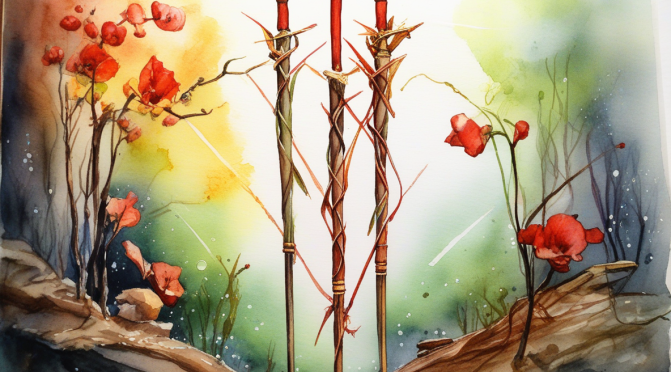
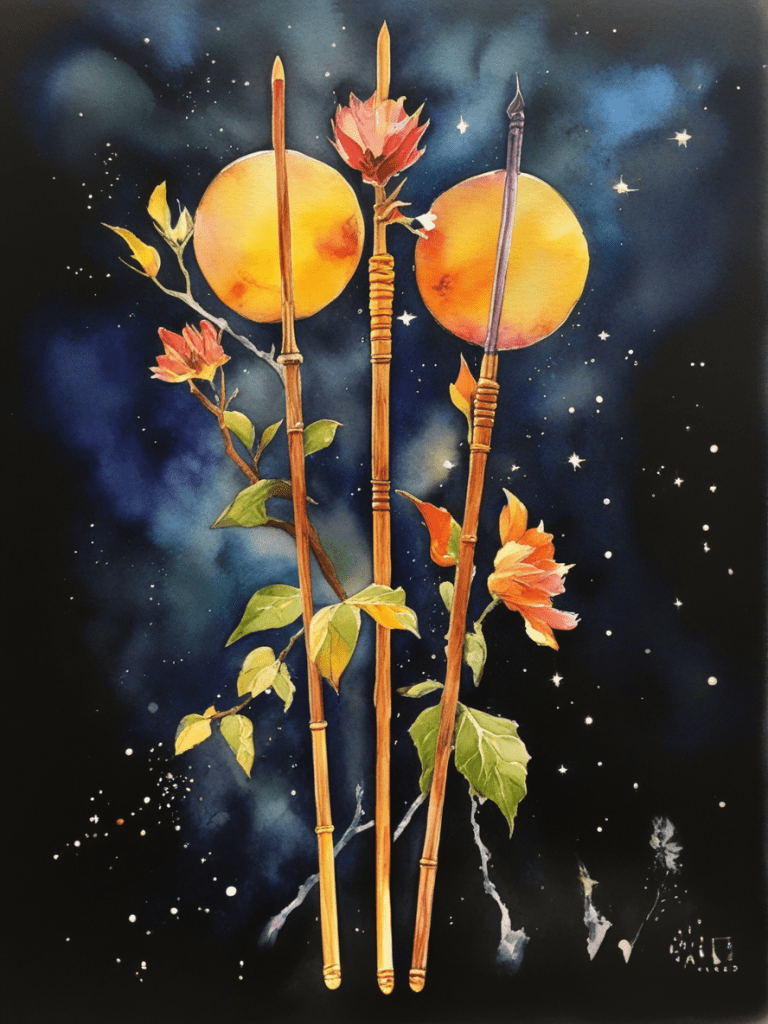
A beautifully essential AI-generated illustration for the Three of Wands
Aleister Crowley
The Three of Wands is […] the Lord of Virtue. The idea of will and dominion has become interpreted in Character.
[…]
This card refers to Binah in the suit of Fire, and so represents the establishment of primeval Energy. The Will has been transmitted to the Mother, who conceives, prepares, and gives birth to, its manifestation.
It refers to the Sun in Aries, the Sign in which he is exalted.
The meaning is harmonious, for this is the beginning of Spring. For this reason one sees the wand taking the form of the Lotus in blossom. The Sun has enkindled the Great Mother.
In the Yi King, Sol in Aries is represented by the 11th hexagram, Thai; its meaning is identical with the above description. (From The Book of Thoth)
Golden Dawn’s Book T
A WHITE Radiating Angelic Hand, as before, issuing from clouds and grasping three wands in the centre (two crossed, the third upright). Flames issue from the point of junction. Above and below are the symbols Sun and Aries. Established force, strength, realization of hope. Completion of labour. Success after struggle. Pride, nobility, wealth, power, conceit. Rude self-assumption and insolence. Generosity, obstinacy, etc. Binah of HB:Y (Pride, arrogance, self-assertion). Herein rule the Angels HB:HHShYH and HB:a’aMMYH.
Etteilla
Enterprise Upright. This card, as far as the medicine of the spirit is concerned, means, in its natural position: Enterprise, Undertake, Begin. – Usurp, Seize. – Boldness, Temerity, Fierceness. – Imprudence, Undertaking, Bold, – Committed, Embarrassed. Bewildered. – Paralyzed, Effort, Experiment, Attempt. Reversed. Interruption of misfortune, torment, sorrow or toil. – End, Cessation, Interruption, Pause, Rest, Influence, Intermediary, Intermittence.
(Note: this is a collection of the meanings attributed to the cards by some occultists in the past centuries. It does not reflect my own study or opinion of the cards. It is only meant as a quick comparative reference as I develop my own take.)
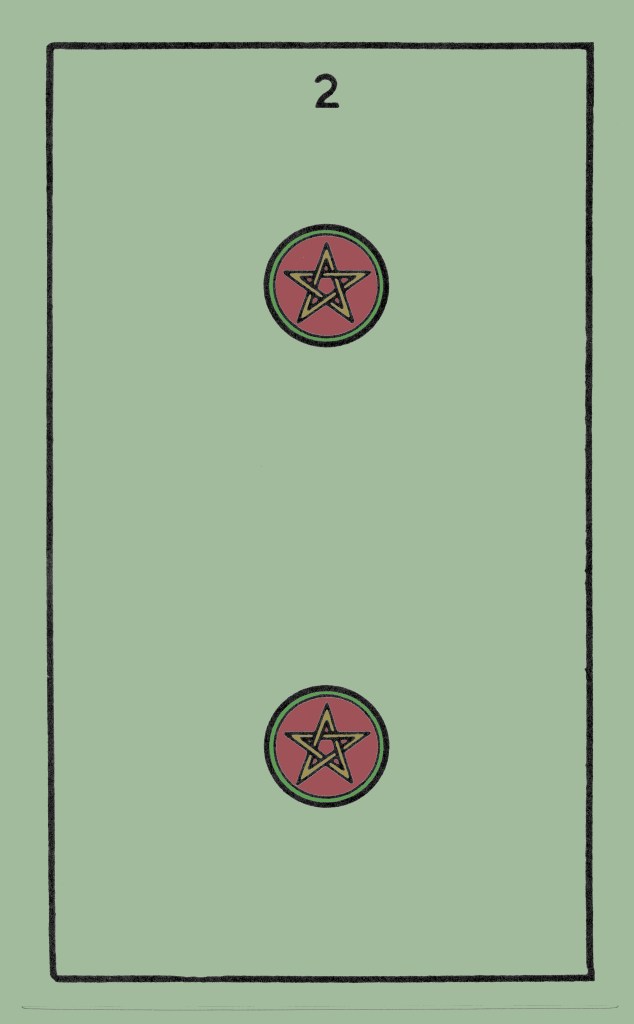
The Two of Pentacles / Coins from the Builders of the Adytum (BOTA) tarot deck
Paul Foster Case (and Ann Davies)
The time period is the first decanate of Capricorn, December 22 to December 31, under the rulership of Saturn. Meanings: Well-Dignified: harmony in the midst of change; alternation of gain and loss; change of occupation; travel in quest of wealth; ups and downs of fortune; a visit to friends. Ill-Dignified: intimates discontent; foolishness in the management of resources; restricted condition of material affairs due to bad management; the Querent is probably too talkative and too suspicious. He is kind, but inconsistent, and should avoid arguments. Keyword: Fluctuation (From the Oracle of Tarot course)
A. E. Waite
A young man, in the act of dancing, has a pentacle in either hand, and they are joined by that endless cord which is like the number 8 reversed. Divinatory Meanings: On the one hand it is represented as a card of gaiety, recreation and its connexions, which is the subject of the design; but it is read also as news and messages in writing, as obstacles, agitation, trouble, embroilment. Reversed: Enforced gaiety, simulated enjoyment, literal sense, handwriting, composition, letters of exchange. (From The Pictorial Key to the Tarot)
Aleister Crowley
The Two of Pentacles was of old time called the Lord of Harmonious Change. Now, more simply, Change; and here the doctrine must be stated a little more clearly. This suit being of Earth, there is a connection with the Princesses, and therefore with the final Heh of Tetragrammaton. Earth is the throne of Spirit; having got to the bottom, one immediately comes out again at the top. Hence, the card manifests the symbolism of the serpent of the endless band.
[…]
The number Two, Chokmah, here rules in the suit pertaining to Earth. It shows the type of Energy appropriate to Two, in its most fixed form. According to the doctrine that Change is the support of stability, the card is called Change.
Its celestial rulers are Jupiter and Capricornus; and these symbols are most inharmonious, so that in practical matters the good fortune of Jupiter is very limited. Their influence on the card is not great. Yet, Jupiter being himself the Wheel (Atu X), he emphasizes that idea.
The card represents two Pantacles, one above the other; they are the Chinese symbols of the Yang and Yin duplicated as in the Hsiang. One wheel is dextro- and the other laevo-rotatory. They thus represent the harmonious interplay of the Four Elements in constant movement. One may in fact consider the card as the picture of the complete manifested Universe, in respect of its dynamics.
About them is entwined a green Serpent (see Liber 65, chapter iii, verses 17-20). His tail is in his mouth. He forms the figure Eight, the symbol of the Infinite, the equation 0=2. (From The Book of Thoth)
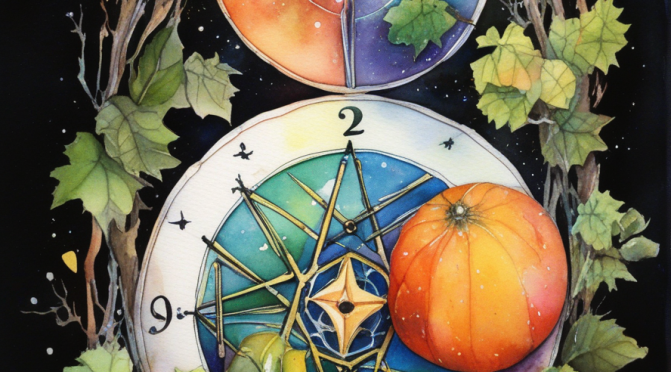
Nice AI-generated illustration for the Two of Pentacles or Coins
Golden Dawn’s Book T
TWO wheels, disks or pentacles, similar to that of the Ace. They are united by a green-and-gold serpent, bound about them like a figure of 8. It holds its tail in its mouth. A White Radiant Angelic Hand holds the centre of the whole. No roses enter into this card. Above and below are the symbols of Jupiter and Capricorn. It is a revolving symbol.
The harmony of change, alternation of gain and loss; weakness and strength; everchanging occupation; wandering, discontented with any fixed condition of things; now elated, then melancholy; industrious, yet unreliable; fortunate through prudence of management, yet sometimes unaccountably foolish; alternatively talkative and suspicious. Kind, yet wavering and inconsistent. Fortunate in journeying. Argumentative. Chokmah of HB:H (Pleasant change, visit to friends). Herein the Angels HB:LKBAL and HB:VShRYH have rule.
Etteilla
Embarrassment Upright. This card, as far as the medicine of the spirit is concerned, means, in its natural position: Awkwardness, Obstacle, Commitment, Obstruction, Setback. – Disturbance, Bother, Emotion, Mess, Confusion, Difficulty, Impediment, Tangle, Obscurity. – Agitation, Restlessness, Perplexity, Concern. Reversed. Ticket, Piece of Writing, Writing, Text, Literature, Doctrine, Erudition, Work, Book, Production, Composition. – Dispatch, Epistle, Missive. – Written character. – Literal Meaning. – Alphabet, Elements, Principles. – Promissory note.
(Note: this is a collection of the meanings attributed to the cards by some occultists in the past centuries. It does not reflect my own study or opinion of the cards. It is only meant as a quick comparative reference as I develop my own take.)
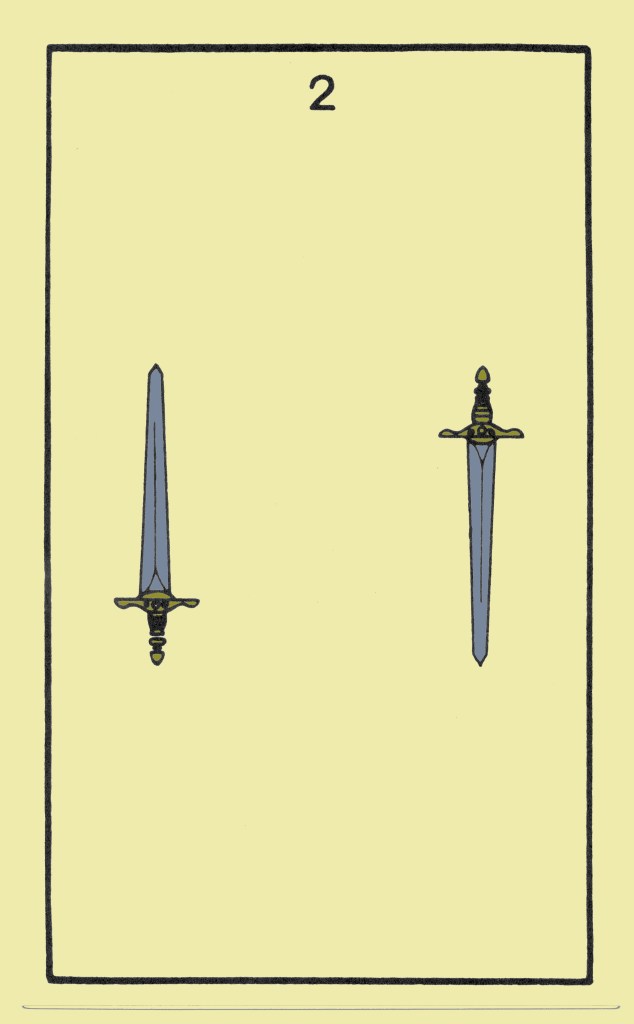
The Two of Swords from the Builders of the Adytum (BOTA) tarot deck
Paul Foster Case (and Ann Davies)
The time period is the first decanate of Libra from September 23 to October 2, under the rulership of Venus. Well-Dignified: contradictory characteristics in the same nature; strength through suffering; pleasure after pain; delay in the realization of objectives. This card sometimes indicates a period of uncertainty, during which the Querent, though he has a sense of adequate power, does not know just what to do with it. It also indicates justice, unselfishness and the restoration of peace. Ill-Dignified: falsehood; sorrow; injury from another who really means well to the Querent, or injury by the Querent to another whom he wishes to help; always a symbol of tension, of want of tact, and suggests force held in abeyance, awaiting some announcement or revelation that will make decision possible. Keyword: Indecision. (From the Oracle of Tarot course)
A. E. Waite
A hoodwinked female figure balances two swords upon her shoulders. Divinatory Meanings: Conformity and the equipoise which it suggests, courage, friendship, concord in a state of arms; another reading gives tenderness, affection, intimacy. The suggestion of harmony and other favourable readings must be considered in a qualified manner, as Swords generally are not symbolical of beneficent forces in human affairs. Reversed: Imposture, falsehood, duplicity, disloyalty. (From The Pictorial Key to the Tarot)
Aleister Crowley
The Two of Swords was formerly called the Lord of Peace Restored; but this word “restored” is incorrect, because there has been no disturbance. The Lord of Peace is therefore a better title: but it needs thinking hard to work this out, since the Sword is so intensely active. It may be helpful to study the Essay on Silence (p. 120) for a parallel: the Negative Form of the Positive Idea. See also the Essay on Chastity (Little Essays toward Truth, pp. 70-74) which concludes: Sir Knights, be vigilant: watch by your arms and renew your oath; for that day is of sinister augury and deadly charged with danger which ye fill not to overflowing with gay deeds and bold of masterful, of manful Chastity.
Witness also Catullus: domi maneas paresque nobis Novem continuas futationes. Nor does he misunderstand the gesture of Harpocrates; Silence and Chastity are isomers. It is all one case of the general proposition that the sum of the infinite Energy of the Universe is Zero.
[…]
This card is ruled by Chokmah in the Element of Air. This suit, governing all intellectual manifestations, is always complicated and disordered. It is subject to change as is no other suit. It represents a general shaking-up, resulting from the conflict of Fire and Water in their marriage; and proceeds, when Earth appears, to crystallization. But the purity and exaltation of Chokmah are such that this card manifests the very best idea possible to the suit. The energy abides above the onslaught of disruption. This comparative calm is emphasized by the celestial attribution: the Moon in Libra.
The Moon is change, but Nature is peaceful; moreover, Libra represents balance; between them, they regulate the energy of the Swords.
In the card appear two swords crossed; they are united by a blue rose with five petals. This rose represents the influence of the Mother, whose harmonizing influence compounds the latent antagonism native to the suit. The Rose emits white rays, producing a geometrical pattern that emphasizes the equilibrium of the symbol. (From The Book of Thoth)
An ominous AI-generated illustration for the Two of Swords
Golden Dawn’s Book T
Two crossed swords, like the air dagger of a Zelator Adeptus Minor, each held by a White Radiant Angelic Hand. Upon the point where the two cross is a rose of five petals, emitting white rays. At the top and bottom of the card are two small daggers, supporting respectively the symbol {Crescent moon with horns upward} thus, and Libra representing the Decanate. Contradictory characters in the same nature, strength through suffering; pleasure after pain. Sacrifice and trouble, yet strength arising therefrom, symbolized by the position of the rose, as though the pain itself had brought forth beauty. Arrangement, peace restored; truce; truth and untruth; sorrow and sympathy. Aid to the weak; arrangement; justice, unselfishness; also a tendency to repetition of affronts on being pardoned; injury when meaning well; given to petitions; also a want of tact, and asking question of little moment; talkative. Chokmah of Vau. Quarrel made up, yet still some tension in relations: actions, sometimes selfish, sometimes unselfish. Herein rule the Great Angels HB:YZLAL and HB:MNHAL.
Etteilla
Friendship Upright. This card, as far as the medicine of the spirit is concerned, means, in its natural position: Friendship, Attachment, Affection, Tenderness, Benevolence, Relationship, Identity, Intimacy, Convenience, Correspondence, Interest, Conformity, Sympathy, Affinity, Attraction. Reversed. Falsehood, Falsehood, Lying, Imposture, Duplicity, Bad faith, Overbearingness, Dissimulation, Cunning, Deceit, Superficial, Superficiality, Surface.
(Note: this is a collection of the meanings attributed to the cards by some occultists in the past centuries. It does not reflect my own study or opinion of the cards. It is only meant as a quick comparative reference as I develop my own take.)
The Two of Cups from the Builders of the Adytum (BOTA) tarot deck
Paul Foster Case (and Ann Davies)
The Two of Cups, astrologically, is assigned to the first decanate of Cancer, ruled by the Moon, time period June 22 to July 1. The specific divinatory ideas associated with this Key are: Well Dignified: reciprocity, reflection; gain and benefit through parents; favors from the opposite sex; changes of residence. Ill Dignified: reverses and losses through parents or the opposite sex; unfortunate changes of residence; fluctuations of mood; unwise decisions. Keyword: Response to environment. (From the Oracle of Tarot course)
A. E. Waite
A youth and maiden are pledging one another, and above their cups rises the Caduceus of Hermes, between the great wings of which there appears a lion’s head. It is a variant of a sign which is found in a few old examples of this card. Some curious emblematical meanings are attached to it, but they do not concern us in this place. Divinatory Meanings: Love, passion, friendship, affinity, union, concord, sympathy, the interrelation of the sexes, and–as a suggestion apart from all offices of divination–that desire which is not in Nature, but by which Nature is sanctified. (From The Pictorial Key to the Tarot)
Aleister Crowley
The Two always represents the Word and the Will. It is the first manifestation. Therefore, in the suit of Water, it must refer to Love, which recovers unity from dividuality by mutual annihilation.
The card also refers to Venus in Cancer. Cancer is, more than any other, the receptive Sign; it is the House of the Moon, and in that Sign Jupiter is exalted. These are, superficially, the three most friendly of the planets.
The hieroglyph of the card represents two cups in the foreground, overflowing upon a calm sea. They are fed with lucent water from a lotus floating upon the sea, from which rises another lotus around whose stem are entwined twin dolphins. The symbolism of the dolphin is very complicated, and must be studied in books of reference; but the general idea is that of the “Royal Art”. The dolphin is peculiarly sacred to Alchemy.
The number Two referring to Will, this card might really be renamed the Lord of Love under Will, for that is its full and true meaning. It shows the harmony of the male and the female: interpreted in the largest sense. It is perfect and placid harmony, radiating an intensity of joy and ecstasy.
Of necessity, the realization of the idea in the Four (as the suit develops) will gradually diminish the purity of its perfection. (From the Book of Thoth)
A somewhat mundane AI-generated illustration for the Two of Cups
Golden Dawn’s Book T
A WHITE Radiant Hand, issuant from the lower part of the card from a cloud, holds lotuses. A lotus flower rises above water, which occupies the lower part of the card rising above the hand. From this flower rises a stem, terminating near the top of the card in another lotus, from which flows a sparkling white water, as from a fountain. Crossed on the stem just beneath are two dolphins, Argent and Or, on to which the water falls, and from which it pours in full streams, like jets of gold and silver, into two cups; which in their turn overflow, flooding the lower part of the card. Venus and Cancer above and below.
Harmony of masculine and feminine united. Harmony, pleasure, mirth, subtlety: but if ill dignified — folly, dissipation, waste, silly actions. Chokmah of HB:H (Marriage, love, pleasure). Therein rule the Angels HB:AVa’aAL and HB:ChBVYH.
Etteilla
Love Upright. This card, as far as the medicine of the spirit is concerned, means, in its natural position: Love, Passion, Inclination, Sympathy, Attraction, Propensity, Friendship, Benevolence, Affection, Attachment, Taste, Bonding, Galantry, Attraction, Affinity. Reversed. Desire, Augury [= Aspiration], Vow, Will, Want, Cupidity, Concupiscence, Jealousy, Passion, Illusion, Appetite.
(Note: this is a collection of the meanings attributed to the cards by some occultists in the past centuries. It does not reflect my own study or opinion of the cards. It is only meant as a quick comparative reference as I develop my own take.)
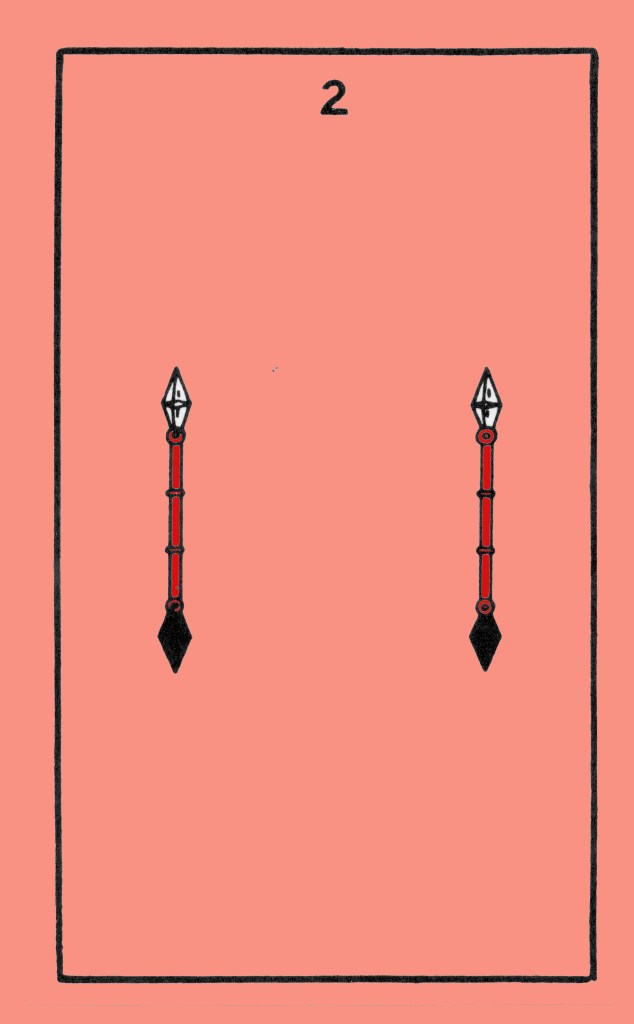
The Two of Wands from the Builders of the Adytum (BOTA) Tarot deck
Paul Foster Case (and Ann Davies)
In Tarot divination the Two of Wands has these key meanings: Well Dignified: it shows force, enterprise, boldness, resolution, some combativeness, much originality. lll Dignified: it signifies restlessness, fierceness, shamelessness, inordinate ambition, turbulence, obstinancy, revenge. A card of enthusiasm, but of strong self-interest. Keyword: Dominion (From the Oracle of Tarot course)
A. E. Waite
A tall man looks from a battlemented roof over sea and shore; he holds a globe in his right hand, while a staff in his left rests on the battlement; another is fixed in a ring. The Rose and Cross and Lily should be noticed on the left side. Divinatory Meanings: Between the alternative readings there is no marriage possible; on the one hand, riches, fortune, magnificence; on the other, physical suffering, disease, chagrin, sadness, mortification. The design gives one suggestion; here is a lord overlooking his dominion and alternately contemplating a globe; it looks like the malady, the mortification, the sadness of Alexander amidst the grandeur of this world’s wealth. Reversed: Surprise, wonder, enchantment, emotion, trouble, fear. (From The Pictorial Key to the Tarot)
Aleister Crowley
The Two of Wands is called the Lord of Dominion, and represents the energy of fire; fire in its best and highest form.
[…]
This card, pertaining to Chokmah in the suit of Fire, represents the Will in its most exalted form. It is an ideal Will, independent of any given object.
“For pure will, unassuaged of purpose, delivered from the lust of result, is every way perfect.” AL. 1. 44.
The background of this card shows the power of the planet Mars in his own sign Aries, the first of the Signs. It there represents Energy initiating a Current of Force.
The pictorial representation is two Dorjes crossed. The Dorje is the Tibetan symbol of the thunderbolt, the emblem of celestial Power, but more in its destructive than its creative form.
More, that is, in its earlier rather than its later form. For destruction may be regarded as the first step in the creative process. The virgin ovum must be broken in order to fertilize it. Fear and repulsion are therefore the primary reaction to the assault. Then, with understanding of the complete plan, willing surrender rejoices to co-operate. Six flames issue from the centre. This indicates the influence of the Sun, who is exalted in Aries. This is the creative Will.
Mars in Aries is the attribution of the Geomantic Figure Puer. The meaning of these figures is to be studied in the Handbook of that science: “The Equinox” Vol. I, No.2. Remember that the Geomantic Intelligences (see Liber 777 Cols. XLIX and CLXXVIII) are all primarily Gnomes. (From the Book of Thoth)
Weirdly religious AI-generated illustration of the Two of Wands
Golden Dawn’s Book T
A WHITE Radiating Angelic hand, issuing from clouds, and grasping two crossed wands. Flames issue from the point of junction. On two small wands above and below, with flames of five issuing therefrom, are the symbols of Mars and Aries for the Decan. Strength, domination, harmony of rule and of justice. Boldness, courage, fierceness, shamelessness, revenge, resolution, generous, proud, sensitive, ambitious, refined, restless, turbulent, sagacious withal, yet unforgiving and obstinate. Chokmah of HB:Y (Influence over others, authority, power, dominion). Therein the Angels HB:VHVAL and HB:DNYAL bear rule.
Etteilla
Sadness Upright. This card, as far as the medicine of the spirit is concerned, signifies, in its natural position: Sadness, Misery, Melancholy, Affliction, Sorrow, Desolation, Mortification, Mood, Discontent, Vapors, Gloomy Ideas. – Bitterness, Anger, Spite. Reversed. Surprise, Enchantment, Shock, Upset, Unexpected event, Unexpected fact, Excitement, Fear, Fright, Terror. – Consternation, Stunning, Domination, Abduction, Alarm. – Marvel, Phenomenon, Miracle.
(Note: this is a collection of the meanings attributed to the cards by some occultists in the past centuries. It does not reflect my own study or opinion of the cards. It is only meant as a quick comparative reference as I develop my own take.)
The Ace of Swords from the Builders of the Adyum (BOTA) tarot deck
Paul Foster Case (and Ann Davies)
The time period is from the beginning of Libra to the end of Sagittarius, Sept. 23 to Dec. 21., representing the conjoined power of Venus, Mars and Jupiter. In divination , when the sword is turned downward it is ill-dignified and has a negative significance. In ceremonial magic the sword in this position is used for the invocation of evil forces, while with the point upward it denotes invocation of spiritual forces. Keep this in mind in divination , as an ill-dignified Ace of Swords shows need to control and overcome negative emotions and thoughts. Keyword: Activity (particularly mental force in operation). (From the Oracle of Tarot course)
A. E. Waite
A hand issues from a cloud, grasping as word, the point of which is encircled by a crown. Divinatory Meanings: Triumph, the excessive degree in everything, conquest, triumph of force. It is a card of great force, in love as well as in hatred. The crown may carry a much higher significance than comes usually within the sphere of fortune-telling. Reversed: The same, but the results are disastrous; another account says–conception, childbirth, augmentation, multiplicity. (From The Pictorial Key to the Tarot)
Aleister Crowley
The Ace of Swords is the primordial Energy of Air, the Essence of the Vau of Tetragrammaton, the integration of the Ruach. Air is the result of the conjunction of Fire and Water; thus it lacks the purity of its superiors in the male hierarchy, Fire, Sol and the Phallus. But for this same reason it is the first card directly to be apprehended by the normal consciousness of Mankind. The errors of such cards as the 7 and 10 of Cups are yet of an Order altogether higher than the apparently much milder 4 of Swords. The study of the subtle and gradual degradation of the planes is excessively difficult.
In nature, the obvious symbol of Air is the Wind “which bloweth whithersoever it listeth”. It lacks the concentrated Will of Fire to unite with Water: it has no corresponding passion for its Twin Element, Earth. There is indeed, a notable passivity in its nature; evidently, it has no self-generated impulse. But, set in motion by its Father and Mother, its power is manifestly terrific. It visibly attacks its objective, as they, being of subtler and more tenuous character, can never do. Its “all-embracing, all-wandering, all-penetrating, all-consuming” qualities have been described by many admirable writers, and its analogies are for the most part patent to quite ordinary observers.
But, it will instantly be asked, what of the status of this Element in the light of other attributions? In the Yetziratic World, is not Air the first element to follow Spirit? Is not Vayu the first emergence of the phenomenal from the arcane obscurity of Akasha? How may one reconcile the doctrine of Mind with the fact that Ruh, or Ruach, actually means Spirit itself? “Achath Ruach Elohim Chiim” (777) means “One is the Spirit (not Air) of the Gods of the Living”? And is not Air, the element attributed to Mercury, also most properly the Breath of Life, the Word, the Logos itself?
The student must be referred to some less raw, cursory, elementary and superficial Treatise than this present bat-eyed, penguin-winged, bluebottle-brained buzzing. Nevertheless, although Air is in no system the lowest, and so cannot claim benefit of clergy from the doctrine that Malkuth automatically resolves into Kether, the following reference seems not wholly to lack either cogency or pertinence.
The Ruach is centred in the airy Sephira, Tiphareth, who is the Son, the first-born of the Father, and the Sun, the first emanation of the creative Phallus. He derives directly from his mother Binah through the Path of Zain, the sublime intuitive sense, so that he partakes absolutely of the nature of Neschamah. From his father, Chokmah, he is informed though the Path of Heh’, the Great Mother, the Star, our Lady Nuit, so that the creative impulse is communicated to him by all possibilities soever. [How strikingly this fact confirms the counterchange of IV and XVII, above fully expounded: as a link between Chokmah and Tiphareth, the Emperor would have no great significance, and this exquisite doctrine of the Three Mothers would be lost.] Finally, from Kether, the supreme, descends directly upon him, though the Path of Gimel, the High Priestess, the triune light of Initiation. The Three-in-One, the Secret Mother in her polymorphous plenitude; these, these alone, hail him thrice blessed of the Supernals!
The card represents the Sword of the Magus (see Book 4, Part II) crowned with the twenty-two rayed diadem of pure Light. The number refers to the Atu; also 22=2 X II, the Magical manifestation of Chokmah, Wisdom, the Logos. Upon the blade, accordingly, is inscribed the Word of the Law, This Word sends forth a blaze of Light, dispersing the dark clouds of the Mind. (From The Book of Thoth)
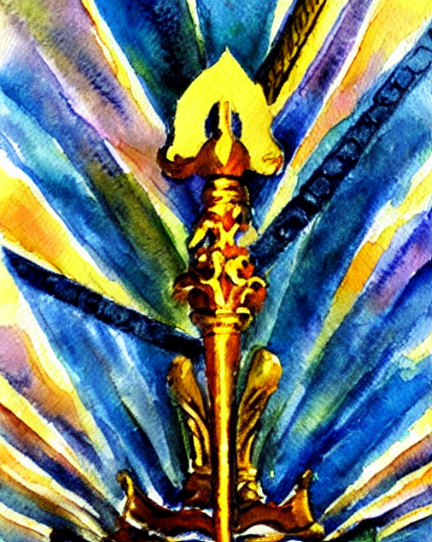
AI generated illustration for the Ace of Swords, looking more like a spear
Golden Dawn’s Book T
A WHITE Radiating Angelic Hand, issuing from clouds, and grasping the hilt of a sword, which supports a White Radiant Celestial Crown; from which depend, on the right, the olive branch of Peace; and on the left, the palm branch of suffering. Six Vaus fall from its point. It symbolizes “Invoked,” as contrasted with Natural Force: for it is the Invocation of the Sword. Raised upward, it invokes the Divine crown of Spiritual Brightness, but reversed it is the Invocation of Demonic Force; and becomes a fearfully evil symbol. It represents, therefore, very great power for good or evil, but invoked; and it also represents whirling Force, and strength through trouble. It is the affirmation of Justice upholding Divine Authority; and it may become the Sword of Wrath, Punishment, and Affliction.
Etteilla
Fructification Upright. This card, as far as the medicine of the spirit is concerned, means, in its natural position: Extreme, Great, Excessive. – Exaggerated, Furious, Choleric. – Extremely, Passionately, Excessively. – Vehemence, Animosity, Carriage, Impetus, Anger, Fury, Rage. – Extremity, Terms, Boundary, End, Limits. – Last sigh, Last extremity. – Divergence. Reversed. Pregnancy, Germ, Seed, Sperm, Matter, Impregnation, Generation, Conception, Fructification. – Childbirth, Puerperium. – Fertilization, Production, Composition. – Enlargement, Increase, Multiplicity.
(Note: this is a collection of the meanings attributed to the cards by some occultists in the past centuries. It does not reflect my own study or opinion of the cards. It is only meant as a quick comparative reference as I develop my own take.)
The Ace of Cups from the Builders of the Adytum (BOTA) tarot deck
Paul Foster Case (and Ann Davies)
Well Dignified: fertility, productiveness, development, multiplication, happiness, pleasure, gratification, fruition of desires; cheerfulness, geniality, gaiety. lll Dignified: too much emphasis on pleasure; over-intensity of the desire nature; trouble in love. Keyword: Desire force (From the Oracle of Tarot course)
A. E. Waite
The waters are beneath, and thereon are water-lilies; the hand issues from the cloud, holding in its palm the cup, from which four streams are pouring; a dove, bearing in its bill a cross-marked Host, descends to place the Wafer in the Cup; the dew of water is falling on all sides. It is an intimation of that which may lie behind the Lesser Arcana. Divinatory Meanings: House of the true heart, joy, content, abode, nourishment, abundance, fertility; Holy Table, felicity hereof. Reversed: House of the false heart, mutation, instability, revolution. (From The Pictorial Key to the Tarot)
Aleister Crowley
This card represents the element of Water in its most secret and original form. It is the feminine complement of the Ace of Wands, and is derived from the Yoni and the Moon exactly as that is from the Lingam and the Sun. The third in the Hierarchy. This accordingly represents the essential form of the Holy Grail. Upon the dark sea of Binah, the Great Mother, are Lotuses, two in one, which fill the cup with the Life-fluid, symbolically represented either as Water, as Blood, or as Wine, according to the selected purpose of the symbolism. This being a primordial card, the liquid is shown as water; it can be transformed into Wine or Blood as may be required.
Above the Cup, descending upon it, is the Dove of the Holy Ghost, thus consecrating the element.
At the base of the Cup is the Moon, for it is the virtue of this card to conceive and to produce the second form of its Nature. (From The Book of Thoth)
AI-generated illustration for the Ace of Cups
Golden Dawn’s Book T
A WHITE Radiant Angelic Hand, issuing from clouds, and supporting on the palm thereof a cup, resembling that of the Stolistes. From it rises a fountain of clear and glistening water: and sprays falling on all sides into clear calm water below, in which grow Lotuses and Water-lilies. The great Letter of the Supernal Mother is traced in the spray of the Fountain. It symbolizes Fertility — productiveness, beauty, pleasure, happiness, etc.
Etteilla
Table Upright. This card, as far as the medicine of the spirit is concerned, means, in its natural position: Table, Meal, Feast, Gala, Banquet, Nourishment, Food, Nutrition. – Guests, Services. – Invitation, Prayer, Supplication, Convocation. – Guest, Hotel, Inn, Tavern. – Abundance, Fertility, Production, Soundness, Stability, Steadfastness, Constancy, Perseverance, Continuance, Duration, Follow-through, Assiduity, Persistence, Steadfastness, Courage. – Picture, Painting, Image, Hieroglyphic, Description. – Tablet, Portfolio, Office, Secretary. – Natural tablet, Bronze tablet, Marble tablet, Law. – Catalog, Index of subjects. – Harmonic table, Garden table, Holy table. Reversed. Mutation, Permutation, Transmutation, Alteration, Vicissitude, Variety, Variation, Inconstancy, Lightness. – Exchange, Barter, Purchase, Sale, Market, Treaty, Convention. – Metamorphosis, Diversity, Versatility, Reversal, Reversal, Revolution, Reversal. – Version, Translation, Interpretation.
(Note: this is a collection of the meanings attributed to the cards by some occultists in the past centuries. It does not reflect my own study or opinion of the cards. It is only meant as a quick comparative reference as I develop my own take.)
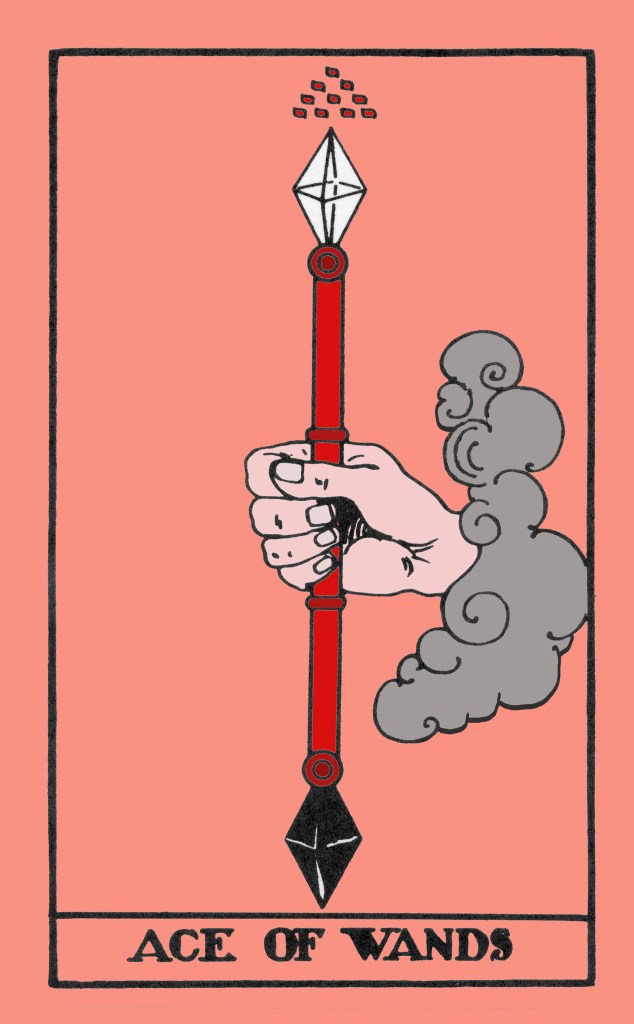
The Ace of Wands from the Builders of the Adytum (BOTA) Tarot deck
Paul Foster Case (and Ann Davies)
In Tarot Divination the Ace of Wands has these key meanings: natural as opposed to invoked force; strength; force; vigor; vitality; particularly the force of concentrated will; the principle of beginning; initiation or inception of any enterprise or activity; concentration of power; involution of force. Keyword: Initiative (From the Oracle of Tarot course)
A. E. Waite
A hand issuing from a cloud grasps a stout wand or club. Divinatory Meanings: Creation, invention, enterprise, the powers which result in these; principle, beginning, source; birth, family, origin, and in a sense the virility which is behind them; the starting point of enterprises; according to another account, money, fortune, inheritance. Reversed: Fall, decadence, ruin, perdition, to perish also a certain clouded joy. (From The Pictorial Key to the Tarot)
Aleister Crowley
This card represents the essence of the element of Fire in its inception. It is a solar-phallic outburst of flame from which spring lightnings in every direction. These flames are Yods, arranged in the form of the Tree of Life. (For Yod, see Atu IX supra.) It is the primordial Energy of the Divine manifesting in Matter, at so early a stage that it is not yet definitely formulated as Will.
Important: although these “small cards” are sympathetic with their Sephirotic origin, they are not identical; nor are they Divine Persons. These (and the Court Cards also) are primarily sub-Elements, parts of the “Blind Forces” under the Demiourgos, Tetragrammaton. Their rulers are the Intelligences, in the Yetziratic world, who go to form the Schemhamphorasch. Nor is even this Name, “Lord of the Universe” though it be, truly Divine, as are the Lords of the Atu in the Element of Spirit. Each Atu possesses its own private, personal and particular Universe, with Demiourgos (and all the rest) complete, just as every man and every woman does.
For example II’s or VI’s Three of Disks might represent the establishment of such an oracle as that of Delphi, or VIII’s might be the first formula of a Code such as Manu gave to Hindustan; V’s, a cathedral, XVI’s, a standing army; and so on. The great point is that all the Elemental Forces, however sublime, powerful, or intelligent, are Blind Forces and no more. (From The Book of Thoth)
Golden Dawn’s Book T
A WHITE Radiating Angelic Hand, issuing from clouds, and grasping a heavy club, which has three branches in the colours, and with the sigils, of the scales. The Right-and Left-hand branches end respectively in three Flames, and the Centre one in four Flames: thus yielding Ten: the Number of the Sephiroth. Twoand-twenty leaping Flames, or Yodh, surround it, answering to the Paths; of these, three fall below the Right branch for Aleph, Men, and Shin, seven above the Central branch for the double letters; and between it and that of the Right twelve: six above and six below about the Left-hand branch. The whole is a great and flaming Torch. It symbolizes Force — strength, rush, vigour, energy, and it governs, according to its nature, various works and questions. It implies Natural, as opposed to Invoked, Force.
Etteilla
Birth Upright. This card means, in its natural position, as far as the medicine of the spirit is concerned: Birth, Beginning. – Nativity, Origin, Creation. – Source, Beginning, Primacy. – Extraction, Race, Family, Condition, House, Lineage, Posterity, Occasion, Cause, Reason, First, First fruits. Reversed. Fall, Decadence, Decay, Decline, Decay, Decay, Dissipation, Failure, Bankruptcy, Ruin, Destruction, Demolition, Damage, Devastation. – Guilt, Error, Contempt, Abatement, Depression, Discouragement. – Perdition, Abyss, Chasm, Precipice. – Dying, Falling, Decay, Derogation. – Depth.
This is intended as a collection of meanings attributed by some sources to the Major Arcana and Minor Arcana of the Tarot. I will add sources as I study them. If you have sources to recommend, hit me up.
If you are interested in a (partial) list of the meanings I attribute to the Major arcana in my reading examples and case studies, click here.
(Note: this is a collection of the meanings attributed to the cards by some occultists in the past centuries. It does not reflect my own study or opinion of the cards. It is only meant as a quick comparative reference as I develop my own take.)
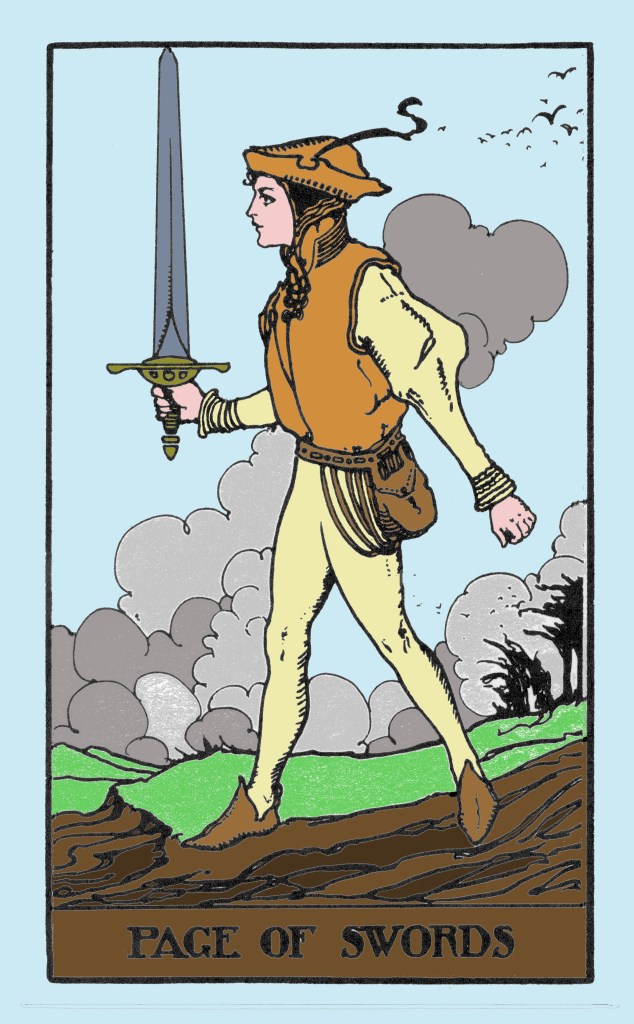
The Page of Swords from the BOTA (Builders of the Adytum) Tarot deck
Paul Foster Case (and Ann Davies)
The time period is from the beginning of Libra to the end of Sagittarius, September 23 to December 21. Meanings: a young person of either sex. Artistic, active, generous. Capable of weighing evidence, somewhat interested in occultism, philosophy or religion. Naturally aspiring, graceful. If Ill-Dignified: frivolous, cunning and prodigal Light brown hair and blue eyes (From the Oracle of Tarot course)
A. E. Waite
A lithe, active figure holds a sword upright in both hands, while in the act of swift walking. He is passing over rugged land, and about his way the clouds are collocated wildly. He is alert and lithe, looking this way and that, as if an expected enemy might appear at any moment. Divinatory Meanings: Authority, overseeing, secret service, vigilance, spying, examination, and the qualities thereto belonging. Reversed: More evil side of these qualities; what is unforeseen, unprepared state; sickness is also intimated. (From The Pictorial Key to the Tarot)
Aleister Crowley
The Princess of Swords represents the earthy part of Air, the fixation of the volatile. She brings about the materialization of Idea. She represents the influence of Heaven upon Earth. She partakes of the characteristics of Minerva and Artemis, and there is some suggestion of the Valkyrie. She represents to some extent the anger of the Gods, and she appears helmed, with serpent-haired Medusa for her crest. She stands in front of a barren altar as if to avenge its profanation, and she stabs downward with her sword. The heaven and the clouds, which are her home, seem angry.
The character of the Princess is stern and revengeful. Her logic is destructive. She is firm and aggressive, with great practical wisdom and subtlety in material things. She shews great cleverness and dexterity in the management of practical affairs, especially where they are of a controversial nature. She is very adroit in the settlement of controversies.
If ill-dignified, all these qualities are dispersed; she becomes incoherent, and all her gifts tend to combine to form a species of low cunning whose object is unworthy of the means.
In the Yi King, the earthy part of Air is represented by the 18th hexagram, Ku. This means “troubles”; it is, for all practical and material matters. The most unhappy symbol in the book. All the fine qualities of Air are weighed down, suppressed, suffocated.
People thus characterized are slow mentally, the prey of constant anxiety, crushed by every kind of responsibility, but especially in family affairs. One of both of the parents will usually be found in the aetiology.
It is hard to understand line 6, which “shows us one who does not serve either king or feudal lord, but in a lofty spirit prefers to follow his own bent”. The explanation is that a Princess as such, being “the throne of Spirit”, may always have the option of throwing everything overboard, “blowing everything sky high”. Such action would account for the characteristics above given for the card when well dignified. Such people are exceedingly rare; and, naturally enough, they appear often as “Children of misfortune”. Nevertheless, they have chosen aright, and in due season gain their reward. (From the Book of Thoth)
Golden Dawn’s Book T
AN AMAZON figure with waving hair, slighter than the Rose of the Palace of Fire. Her attire is similar. The Feet seem springy, giving the idea of swiftness. Weight changing from one foot to another and body swinging around. She is a mixture of Minerva and Diana: her mantle resembles the AEgis of Minerva. She wears as a crest the head of the Medusa with serpent hair. She holds a sword in one hand; and the other rests upon a small silver altar with grey smoke (no fire) ascending from it. Beneath her feet are white clouds. Wisdom, strength, acuteness; subtlety in material things: grace and dexterity. If ill dignified, she is frivolous and cunning. She rules a quadrant of the heavens around Kether. Earth of Air
Etteilla
Observer Upright. This card, as far as the medicine of the spirit is concerned, means, in its natural position: Spy, Curious, Observer, Scrutinizer, Collector, Overseer, Intending. – Examination, Note, Observation, Annotation, Speculation, Account, Calculation, Conjecture. – Scientist, Artist. Reversed. Unexpected, Suddenly, Suddenly, Suddenly. – Stunning, Astonishing, Inopinently. – Improvise, Acting and speaking without preparation, Composing and acting sitting down.