The literary landscape in Italy is rather dismal, as far as the occult arts are concerned, even though in recent years something seems to be changing. But Il Tarocchino di Bologna (the Little Tarot of Bologna) by Andrea Vitali and Terry Zanetti is not a very recent book, and this makes its outstanding quality even more of a surprise.
The book is divided into several sections, some authored by Vitali and some by Zanetti. Andrea Vitali is possibly the greatest living tarot historian (and a damn good diviner too), the one who has shed the most light on the history and origins of the tarot, bursting a lot of bubbles in the process. His section is, as usual, well documented and written, and generally aims at showing that the tarot probably originated not in Milan but in Bologna.
But, as undisputed as Vitali’s expertise in the field, our focus in this review is Zanetti’s section on cartomancy. This is well organized and competently written. Aside from a brief preamble, the largest part of her section of the book is dedicated to the meanings of the cards, which she has researched in various ways, including by looking for old decks with the meanings written on them.
Zanetti, like Celi (and currently like me), uses a 45-card deck. The deck, however, differs: instead of one Stranger, she uses two, one of them taking the place of the Ten of Coins. As I mentioned elsewhere, these discrepancies are to be expected from a tool of popular divination that was invented in a non-globalized world of isolated villages and streets. Even some of the meanings differ, as I explained in this post, where I talked about the fact that she interprets the Page of Swords not as a letter but as a young man.
Each card is presented with their Italian and Bolognese dialect name, a brief iconographic rundown, the list of meanings, an example reading with a three-card method, a saying from the Bolognese popular tradition that illustrates the meaning of the card, and a combination. Some combinations are exceedingly curious and stray far way from the original meanings of the cards.
The spreads covered by Zanetti are also interesting and worth studying. One is a variation of the great staircase spread I talked about, but Zanetti gives very specific and somewhat rigid rules for interpreting it. She then covers a pyramid spread and a variation of the cross spread, the thirteen card spread and, finally an oracle made up of only three cards.
The only small concern is the rigidity with which Zanetti treats combinations of two cards. My experience is that cards must be first and foremost combined logically based on the context of the question and the other cards, but she asserts that when two specific cards come together they always have a specific meaning regardless of everything.
This, I have found, may be true when many cards come together. For instance, even if you ask about love, if someone in your life is about to drop dead, lots of cards will amass in that regard, not just two. Yet Zanetti treats two-card combos as if they were powerful enough to transcend the question (and yes, she does give a combination about death). Again, this is a question of method and personal experience. It does not detract from the validity of her experience, but it does highlight one of its peculiar traits.
So is this book worth having? To this my answer is a big fat yes!
The 45-card method, which is the one I’m trying to specialize in on this blog, despite being acquainted with and using the other methods as well, tends to be rather more obscure than the better-known 50-card one. One possible reason is that Maria Luigia Ingallati’s niche-defining book discusses the latter, and has consequently inspired others who follow her school.
Another separate source for the 50-card system is Germana Tartari’s book, whose approach I follow when using the 50-card deck, having been her student and now friend. Tartari’s book was also met with good success, further cementing the 50-card system in people’s imagination.
But before Ingallati made the Bolognese tarot available to a wider public there were a couple of books on the 45-card method, and Lia Celi’s Il Manuale di Cartomanzia (The Cartomancy Handbook) is one of them. The book was first published in 1999 and is very difficult to come by (don’t ask me how I got my copy. Or maybe do ask me, who knows.)
The subtitle of the book, “How to read tarot cards without boring yourself to death” serves as a good introduction to the style in which the book is written. Lia Celi is not a card reader, but a writer and journalist, and this is immediately evident in the refreshingly irreverent tone of the book. She did collaborate with some card readers to put together this book.
The second thing to notice is that, if you were to buy the book based on the front or back covers, you’d never know it’s about the Tarocchino Bolognese, as the title, subtitle and description simply talk about tarot cards and cartomancy, and even the cover art pictures regular tarot cards (I believe Sergio Ruffolo’s tarot).
The third thing to take notice of is that this is, broadly speaking, a good book. Honestly, it would be worth a read even if you had no interest in cartomancy, simply because it is guaranteed to tickle your funny bone on more than one occasion. And this is probably how the book was commissioned in the first place: as a fun and exotic read for the beach, aimed mostly at young women who may or may not choose to pursue cartomancy as a passion.
Given these presuppositions, Celi’s work has no right to be this informative. Pretty much everything you need in order to start using the 45-card system is offered to you in easily digestible bits: the various traditional methods on how to acquire, christen,1 study, shuffle and lay out the deck, the individual meanings of the cards (which are often easy to remember thanks to Celi’s sharp humor), a decent, if small, selection of traditional combinations, some of which I recognize from my own source, some practical advice on how to deal with various types of querents, and a final interview with the daughter of a card reader who is just setting out to practice the art herself, and who offers some advice. Clearly, Celi did her homework and did not skimp on looking for good information.
The card selection the author discusses is the same as the one I know, with one exception: she uses the Nine of Coins as the card of tears, while I use the Seven. Also, the meanings of some of the cards differ. For instance, she says that the Star is chiefly the card of health, while for me it is chiefly the card of business. Still, she does say that the Star is good for work and study, and even my own source taught me that the Star represents medications and healing in the right context. Besides, it is perfectly normal for a tradition like that of the Bolognese Tarot to differ a little from source to source.
The spreads Celi illustrates tend to be on the shorter side: a three-card spread, a four-card cross, a variation of the thirteen-card spread and a pyramid spread of fifteen cards that may be adapted to various questions.
So what is missing? Well, as in most books, what’s missing is the practical part. We have only brief mentions of how the cards interact with one another, so that if I didn’t come from a background in cartomancy and didn’t have access to first-hand information, I don’t know if I would be able to pick up a deck and start reading after finishing this book. Still, Celi’s Cartomancy Handbook is a good addition to your library if you are interested in the Bolognese tarot.
Where to find: This is the book’s amazon page. Unfortunately the book is unavailable, so your next best shot is ebay. However, the lord does work in mysterious ways…
MQS
The traditional practice of ‘christening’ the deck or having it blessed so that, according to popular superstition, it starts working properly. In reality the deck works anyway and only in particular situations (such as curses or difficult periods) does it need to be blessed. ↩︎
In recent years, a small number of new books on the Bolognese tarot have been published to meet the demands of the small but growing niche of afficionados. This, as I explained, is largely the merit of Ingallati’s book, which, in spite of some limitations, managed to create that niche outside of Bologna.
Rossella Giliberti’s book is one of these new books. The title of the slim publication literally translates as ‘Practical Handbook for Reading the Bolognese Tarot’. It is a wonderful title, one that is likely to arouse hope in many people. Unfortunately, it has very little to do with the actual content of the book.
Giliberti uses a similar deck as Ingallati (49 cards plus the Joker). I have already explained in my review of Ingallati’s book why I don’t like this selection of cards, which however is unique to Ingallati’s style and must be accepted as such.
Seeing Giliberti’s choice of deck, one would think that she’s just a copycat of Ingallati. But this would be unfair to Giliberti. As short as it is, her book is filled to the brim with notes on combinations and meanings that Ingallati doesn’t talk about, plus she swaps certain cards for others. It is clear that Giliberti, despite obviously being inspired by Ingallati, also had other sources for learning the tarocco bolognese, and this alone makes her book worth buying if one is serious about this deck.
That said, there are some glaring issues with it. For starters, there is absolutely nothing practical or handbookish about it. It is a very (VERY) disorganized collection of notes which would have been fine as initial preparatory work for a book. After the skippable part (the initial chapter about history, which however is more interesting than that in Ingallati’s work) the book gives the usual rundown of the cards one by one, with their core meanings and a couple of classical combinations. For whatever reason, the picture of the Hanged Man is from the Marteau Marseille Tarot.
The merit of this section is that it is clearer, more concise and less fluffed up than Ingallati’s, and the symbolic interpretation more down-to-earth and more informed by Bolognese folklore, as it should be. The possible drawback is that there is space left for the reader to take notes, possibly in an attempt to make the book longer, with the result that the sections seem a bit disjointed and separated from one another. I guess that’s the ‘practical’ part of the book.
When Giliberti comes to the description of the minor arcana, the book starts to fall apart more clearly in terms of organization, with some cards often repeated, some out of order, lack of punctuation and proof-reading, tips on how to read the cards thrown in the mix in random places, some paragraphs all in caps lock, etc. At this point one would be excused for thinking the book is self-published, but it’s not. Some publisher took a look at this and said “yes, I want our brand to be linked to it”.
Giliberti also offers the meanings of the other minor arcana, the ones that are discarded from the 62-card deck. Unfortunately the meanings are taken from a famous discussion board post dating back several years, where one user had assigned the meanings of the Rider Waite deck to the discarded minor arcana.
Afterward there is a section on combinations, all rigorously in caps lock, all rigorously with huge amounts of blank space left between paragraphs. The wording of some of them even makes one think they were taken from other books that I shall review in the future. Some combinations make no sense (e.g., the Page of Coins and the Ace of Cups is a marriage). Some are repeated multiple times with different meanings. Typos and mistakes abound. Still, for all its limitations, an interesting section.
Then there is another section, organized differently in the form of a table, this time on… Combinations?And then there is another section, organized in yet another manner, which is about… Meanings and combinations, some of which have little to do with the ones presented in the first section, and which are more clearly taken “as is” from other sources.
At the end comes an extremely slim final section with some layouts, one of which is taken from Ingallati’s book (I do not mean the layout itself, which is traditional. I mean the actual spread, down to the cards shown in the example). The thirteen card spread is explained in two different ways. The cross spread is also explained in two different ways. You get the picture.
So, what to think of this book? It depends on how one sees it. As a ‘practical handbook’, as promised in the title, it is a bad joke bordering on false representation. As a disorganized mess of poorly edited notes taken from many different sources, some of which are credible, it is somewhat serviceable, especially if you know where and how to look, where and how to block out the information, and if there are no linguistic barriers between you and the text.
Whether it is worth your money depends on the level of autistic fixation you have for the Bolognese Tarot. As I am definitely on that spectrum, I’d rather have it than not, but I am not going to sit here and pretend it is a finished book worth 20€.
I was accompanying hubby to the optometrist in another city, when we came across one of those easily overlooked book shops selling second-hand books. And right on display was this deck (I’ll do a flip-through video soon):
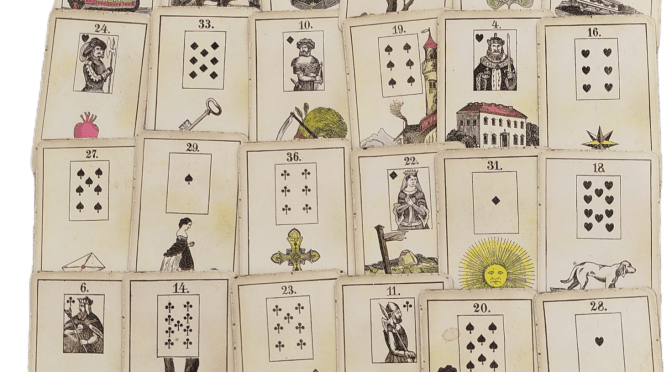
An old Lenormand deck
Also, get a load of this: the backs are completely plain, like in days of yore!
The cards’ back
The deck came with a book. The author gives off German Mary Greer vibes, in the sense that he published on a variety of topics while trying to appeal both to the casual as well as to the psychotically fixated at the same time.
However, being an old book (I believe it came out in 1992 or so) I was hoping for less psychology. He has the (suspicious to me) tendency to read way too much into the symbols, bringing in Freud, among others. He also tries to combine the meaning of the skat cards with that of the symbols, with mixed results. Sometimes it makes sense, sometimes it doesn’t.
But this is only from leafing through the book cursorily. Maybe I’m judging him too harshly. An interesting thing is that he uses the Grand Tableau / Große Tafel in the less known 6×6 variant.
However good or bad the book may be, I only bought it because it was attached to the deck, which is lovely, and the set cost only a little over 5€. The deck has an old-timey feel to it. Some of the symbols are a bit hard to see. For instance, the Clouds look more like a sea, and the Mice are actually a single mouse which almost disappears in comparison to the pudding and wine he is stealing: while looking at the card I was thinking “Wait, did the Lenormand deck have a Bistro card?” Oh well, at least the mouse doesn’t have to share the wine with the others.
Still a really cute deck and a good buy. I am not planning on studying the Lenormand deck soon (I have way too many irons in the fire) but I just couldn’t resist it.
I Tarocchi Parlano (The Tarot Speaks) by Maria Luigia Ingallati is perhaps the most well-known book about the Tarocchino Bolognese in Italy, and the one that, thanks to its success, launched the rediscovery of this deck outside of its native region. Since the publication of Ingallati’s book, the Bolognese tarot has enjoyed a small but growing cult following. This, we shall see, is probably the book’s greatest merit, though not the only one.
Ingallati herself is not from Bologna. She relocated there many years prior to the publication of her first book (‘Il Tarocchino Bolognese’, which I will review separately). There, she started seeing the local card readers, getting her fortunes told and learning a great deal from them, until she began practicing the art herself and synthesizing a personal method from the Bolognese tradition and her own experience as a card reader.
The book does a good job of presenting Ingallati’s journey, and it is undeniable that her personality shines through the pages of the richly illustrated volume. Ingallati is a good story-teller, enjoys reading and talking about poetry, philosophy and psychology, all of which she uses to shed light on the Bolognese tarot.
Ingallati uses a personal variation of the 50-card method, comprised of the following cards: the 18 surviving Major Arcana; the 3 Strangers or Moors; 7 Cup cards (Ace, Nine, Ten and the Court); 6 Wand cards (Ace, Six and the Court); 8 Coin cards (Ace, Six, Nine, Ten and the Court); 7 Sword cards (Ace, Six, Seven and the Court); and the red Joker.
Of Ingallati’s selection, the choice to include the Joker is the one that has always stuck out like a sore thumb to me. The traditional deck includes no Jokers, since they are not needed for playing card games, and to this day only one producer has recently randomly decided to add them. That being said, Ingallati is very careful in acknowledging what she took from the tradition and what she introduced as her own innovation.
The book starts off with a chapter on the history of the Tarocchino. It is not the best and most accurate historical account, but it covers most of the basics and it is the one most people will skip anyway. Then, Ingallati presents the spreads she uses. This is a peculiar trait of her method, which she also teaches in her private classes: she uses a huge variety of spreads one after the other to move from an account of the querent’s past to the future.
No time is wasted on the technical details of how to lay out the cards, in what order, etc.: the reader is left to his or her own initiative of how to apply the traditional spreads. This may overwhelm us at the beginning, but it is clear that she thinks everyone should find their own way of laying out the traditional spreads, which is fair. This is possibly the most interesting part of the book: Ingallati’s method is a synthesis of many strands of traditional lore about the spreads which can be mined by reading the section carefully and comparing it to other sources.
Only after the section on the spreads does Ingallati start her discussion of the card meanings. Here, the writer spends, in my opinion, way too much time overanalyzing the various details of color and symbol. We learn, thus, that the shape of the lace on this or that character’s tunic has this or that meaning; that the number of triangular shapes on the Queen of Coin’s scepter suggests certain symbolic interpretations; that the colors of the Fool’s feathers is very important.
Of course, none of this has any historical relevance nor any bearing on the interpretation of the cards, nor with the traditional, succint meanings that Ingallati scatters around in the descriptions, sometimes almost as an afterthought. This leaves one wondering if the overzealous interpretation of the various bits of design was just the happy meeting point between the publisher needing a longer book and the writer being happy to provide it with a clear poetic gusto for the mysterious and the metaphorical. Almost every card is accompanied by snippets of poetry and aphorisms, anecdotes as well as by illustrations of some combinations.
The final part of the book is dedicated to Jungian character analysis based on the Bolognese tarot, something that the author clearly has a great deal of interest in, and for which she provides some curious combinations that might be worth trying.
Ingallati’s book is hard to review objectively. It has the incredible historical merit of having brought the Bolognese tarot to a wider public, and it is undeniable that her poetic and evocative style and her attempt at ennobling it as a ‘legitimate’ tool for divination is part of why she succeeded.
The esoteric landscape has a growing public of people I like to call educated suckers, those who think themselves too smart and learned for folk superstitions but can easily be sold on the idea of reinterpreting them as deeper mysteries of personal development and esoterically flavored self-help. This is the reason why so many ‘real and only’ Tarot of Marseilles’ get sold every year, together with ridiculously expensive courses on ‘this is not divination’ and books of metaphysical platitudes that sound deep if you don’t think too much about them.
Ingallati struck gold when she managed to appeal to this kind of public with her literary style while also preserving the teachings she received and developed from the card readers she met in Bologna. In doing so she succeeded where the small handful of other books published before and since failed: creating a niche for the Bolognese tarot. Despite my sarcasm in the previous paragraph, this is no small accomplishment. Pragmatically speaking, it is a serious merit.
The book also excels at being a treasure trove of meanings, spreads, combinations and suggestions that can be studied, reflected on and compared with other sources. It is certainly a book I recommend, in this regard.
English Version (scroll down for the Italian version)
It is an exciting time to be practicing divination. Among the occult arts it is probably the most popular for its immediate practical usefulness. The tarot is enjoying a divinatory revival after being brought to its knees by decades of pseudodeep elucubrations, and even lesser known systems of fortune-telling are being slowly fished out the obscure underbelly of folk tradition.
And occult folk tradition is especially rich in Italy, a country which, in part due to its chaotic and conflicted history, can boast a huge diversity of divinatory systems, especially (but not exclusively) of the card-based kind. It is especially reassuring to see that, unlike in the past, people of considerable education are taking these folk systems seriously.
It’s the case with Ernesto Fazioli’s latest book: Carte Piacentine. Divinare con le Briscole (Piacentine Cards. Divining with Briscola* Cards), a book dedicated to one of the many dozens of cartomancy systems based on the many types of Italian playing cards — in this case, Piacentine Cards–
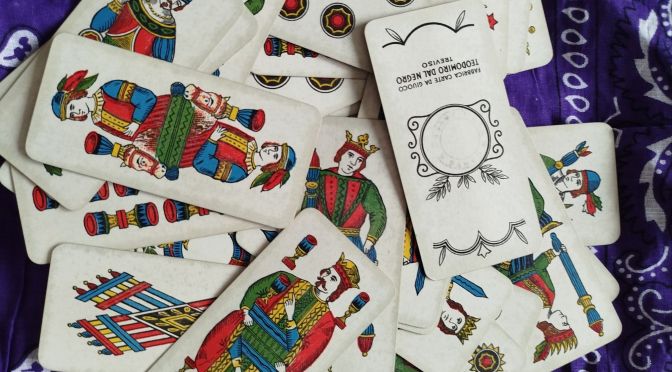
Carte piacentine, one of the most popular playing card decks in Italy
Fazioli’s book is part of the same series as Germana Tartari’s Book on the Bolognese Tarot and it shares some of its traits: it is short (84 pages) and goes straight to the point; it is prefaced by a very quick but well-documented historical introduction; finally, it is aimed at shining a light on a small part of the Italian folk tradition while giving the reader the tools to work with it in today’s world.
I could quibble on a couple of points that made me wrinkle my nose, such as the association of the four suits with the four elements following the Golden Dawn pattern (which is not rooted in folk tradition, Italian or otherwise) but in reality all this is of very little account, as it can be very easily overlooked. The bulk of the book is solid and it teaches a traditional and little-known method of fortune-telling using a reduced pack of 30 Piacentine cards.
Each of the 30 cards is dedicated a small paragraph, which is enough, considering that, in traditional fortune-telling, one doesn’t spend a great deal of time musing on the quaint design of this or that card based on the latest fashion. For what little I know about this deck, the meanings retrieved by Fazioli feel genuine and even show a degree of overlap with the meanings of the Bolognese tarot.
This should not be a surprise, as fortune-telling and divination were born as methods of “gathering intelligence” about the world, meaning that, whatever system one uses, one must be given access do an adequate vocabulary–that is, a vocabulary that is adequate to describing the real world.
The spreads that Fazioli present also come from the folk tradition, and vary from the easier ones (the five card spread) to the very complex (a tableau of all 30 cards).
All in all, I am very pleased with my purchase, and will probably be posting a spread or two following the system. I am especially surprised by the good amount of information that Mr. Fazioli could pack into such a short booklet, and am endlessly fascinated, once again, by how folk divination emerges in its quality of spontaneous and creative remedy to life’s uncertainty.
* Briscola refers to one of the most popular game cards in Italy, usually played with Piacentine cards or a similar 40 card regional deck. For this reason, regional playing cards are often known as “carte da briscola” (briscola cards) in common parlance.
Versione Italiana
È un momento storico molto entusiasmante per chi pratica la divinazione. Tra le arti occulte è probabilmente la più popolare per la sua immediata utilità pratica. I tarocchi stanno vivendo un revival divinatorio dopo essere stati messi in ginocchio da decenni di elucubrazioni pseudointelletuali, e anche sistemi di cartomanzia meno conosciuti vengono lentamente ripescati dal ventre oscuro e creativo della tradizione popolare.
E la tradizione popolare occulta è particolarmente ricca in Italia, un Paese che, anche a causa della sua storia caotica e frammentata, può vantare un’enorme varietà di sistemi divinatori, soprattutto (ma non esclusivamente) del tipo basato sulle carte. È particolarmente rassicurante vedere che, a differenza del passato, persone di notevole cultura prendono sul serio questi sistemi popolari.
È il caso dell’ultimo libro di Ernesto Fazioli: Carte Piacentine. Divinare con le Briscole, un libro dedicato a una delle molte decine di sistemi di cartomanzia basati sui numerosi tipi di carte da gioco italiane – in questo caso le carte piacentine -.
Il libro di Fazioli fa parte della stessa collana del Libro sui Tarocchi Bolognesi di Germana Tartari e ne condivide alcuni tratti: è breve (84 pagine) e va dritto al punto; è preceduto da un’introduzione storica molto rapida ma ben documentata; infine, si propone di far luce su una piccola parte della tradizione popolare italiana dando al lettore gli strumenti per metterla a frutto nel contesto odierno.
Potrei cavillare su uno o due punti che mi hanno fatto storcere il naso, come l’associazione dei quattro semi con i quattro elementi secondo lo schema della Golden Dawn (che non ha radici nella tradizione popolare, italiana o meno), ma in realtà tutto ciò è di ben poco conto, perché può essere facilmente trascurato da chi non è interessato. Il libro ha solidi contenuti e insegna un metodo di cartomanzia tradizionale e poco conosciuto, utilizzando un mazzo ridotto di 30 carte piacentine.
A ciascuna delle 30 carte è dedicato un piccolo paragrafo, il che è sufficiente, considerando che, nella cartomanzia tradizionale, non si passa molto tempo a riflettere sul design pittoresco di questa o quella carta in base all’ultima moda. Per quel poco che so di questo mazzo, i significati recuperati da Fazioli nella sua attenta indagine sembrano genuini e mostrano persino un certo grado di similitudine con i significati dei tarocchi bolognesi.
Ciò non deve sorprendere, poiché la cartomanzia e la divinazione sono nate come metodi di “raccolta di informazioni” sul mondo, il che significa che, qualunque sia il sistema utilizzato, ci deve dare accesso a un vocabolario adeguato, cioè un vocabolario che sia adeguato a descrivere il mondo reale.
Anche le stese che Fazioli presenta provengono per lo più dalla tradizione popolare e variano da quelli più semplici (la stesa delle cinque carte) a quelli molto complessi (una stesa di tutte le 30 carte).
Nel complesso, sono molto soddisfatto del mio acquisto e probabilmente pubblicherò una o due stese seguendo il sistema. Sono particolarmente sorpreso dalla buona quantità di informazioni che Fazioli è riuscito a racchiudere in un libricino così breve e sono infinitamente affascinato, ancora una volta, da come la divinazione popolare emerga nella sua qualità di rimedio spontaneo e creativo all’incertezza della vita.