Tag Archives: Bolognese Tarot

Bolognese Tarot – The Love / Couple’s Spread (Three Variants)

The Bolognese Tarot tradition has several spreads for the couple. One that has been taught to me, and which I have also found is practiced by other Bolognese tarot readers, is the following:

123456
HeShe
789101112
131415

He and She are, of course, the King and Queen of Wands. However, we can explore the relationship between any two individuals. The cards above the two significators show what’s on their mind (1-2-3 his mind, 4-5-6 her mind, in this case).

The cards covering them (7-8-9 for him, 10-11-12 for her) are ambiguous. The way the method has been passed down to me, these cards show what’s going on with him and what’s going on with her, but I have found other readers (such as Rossella Giliberti) who say that these cards show what’s in his heart and what’s in her heart. Choose the variant you prefer, and remember that these are local methods, so there’s bound to be variations between one town and the other. The final three cards (13-14-15) show what’s happening to them as a couple in the near future, or if there is potential, or what connects them.

Another spread, which is found in Maria Luigia Ingallati’s book on the Bolognese Tarot (which I will review in the near future together with the few others that have been published). The layout is as follows:

HeShe
1231516178910
456181920111213
72114

Here we have cards 1 through 7 talking about what’s going on with him, cards 8 through 14 telling us what’s going on with her, and finally the group in the center (15 through 21) talking about them as a couple. Another reader I know (Monica Barbieri) uses thirteen cards for each group instead of seven.

Another variant is found in Lia Celi’s out-of-print book on the 45-card method. This is the layout:

He and She
12345
67 – 89
1011 12
13 – 14
15

As can be seen, this is a pyramid spread. Here, cards 1, 2, 6, 7, 10 and 13 talk about him, cards 4, 5, 8, 9, 12 and 14 talk about her, and cards 3, 11 and 15 talk about them.

These methods are specific for analyzing two people’s interaction, but nothing prevents you from using a simpler spread, like the thirteen card spread. To be honest, that’s what I do. Still, this is an interesting bit of traditional lore about the Bolognese tarot.

MQS

Tarot Encyclopedia – The Eight of Wands

(Note: this is a collection of the meanings attributed to the cards by some occultists in the past centuries. It does not reflect my own study or opinion of the cards. It is only meant as a quick comparative reference as I develop my own take.)

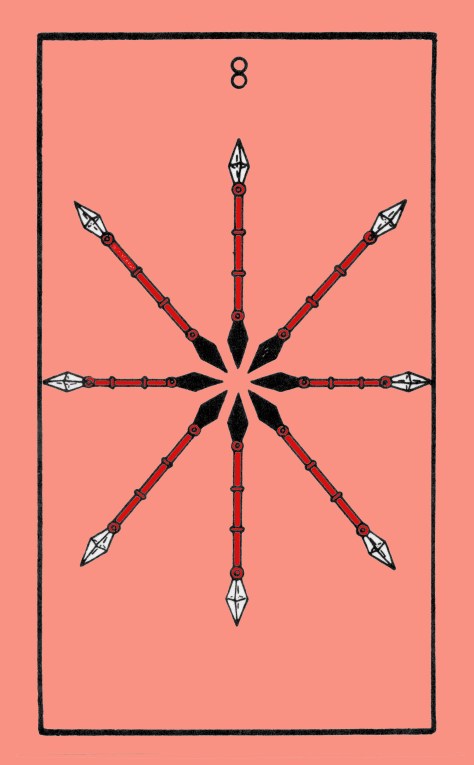
The Eight of Wands from the Builders of the Adytum (BOTA) Tarot deck

Paul Foster Case (and Ann Davies)

As the first decanate of Sagittarius, the Eight of Wands is the time period of November 22 to December 1, ruled by Jupiter, suggesting a combination of the powers of Mercury and Jupiter together with the zodiacal attributions of the sign Sagittarius and its natural 9th house. Well-Dignified: aspiration; foresight; rapid expression of force, but quickly expended; the acceleration of anything in which the querent is interested; generosity; confidence ; freedom.
Ill-Dignified: violence; warfare; rapacity; insolence; theft or robbery. These are suggested by some of the evil meanings connected with Hermes or Mercury associated with misuse of human intellect.
Keyword: Swiftness
(From the Oracle of Tarot course)

A. E. Waite

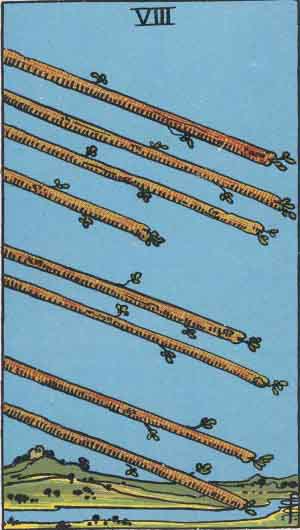
The card represents motion through the immovable-a flight of wands through an open country; but they draw to the term of their course. That which they signify is at hand; it may be even on the threshold. Divinatory Meanings: Activity in undertakings, the path of such activity, swiftness, as that of an express messenger; great haste, great hope, speed towards an end which promises assured felicity; generally, that which is on the move; also the arrows of love. Reversed: Arrows of jealousy, internal dispute, stingings of conscience, quarrels; and domestic disputes for persons who are married.
(From The Pictorial Key to the Tarot)

The Eight of Wands from the Rider Waite Smith tarot

Aleister Crowley

The Eight of Wands is called Swiftness, as one might expect from its attribution to Mercury and Sagittarius. This is an etherealization of the idea of fire; all gross elements have disappeared.

[…]

The remaining three cards of the suit belong to Sagittarius, which represents the subtilizing of the Fiery energy; and Mercury rules the card, thus bringing down from Chokmah the message of the original Will.

The card also refers to Hod, splendour, in the suit of Fire, whence it refers to the phenomena of speech, light, electricity. The pictorial representation of the card shows the Light-wands turned into electrical rays, sustaining or even constituting Matter by their vibrating energy. Above this restored universe shines the rainbow; the division of pure light, which deals with maxima, into the seven colours of the spectrum, which exhibit interplay and correlation.

This card, therefore, represents energy of high velocity, such as furnishes the master-key to modern mathematical physics. It will be noted that there are no flames; they have all been taken up into the wands to turn them into rays. On the other hand, the electric energy has created intelligible geometrical form.
(From The Book of Thoth)

The Eight of Wands from the Thoth Tarot

Golden Dawn’s Book T

FOUR White Radiating Angelic Hands (two proceeding from each side) issuant from clouds; clasped in two pairs in the centre with the grip of the First Order.
They hold eight wands, crossed four with four. Flames issue from the point of junction. Surmounting the small wands with flames issuing down them, and placed in the centre at the top and bottom of the card respectively, are the symbols of Mercury and Sagittarius for the Decan.

Too much force applied too suddenly. Very rapid rush, but quickly passed and expended. Violent, but not lasting. Swiftness, rapidity, courage, boldness, confidence, freedom, warfare, violence; love of open air, field-sports, gardens and meadows. Generous, subtle, eloquent, yet somewhat untrustworthy; rapacious, insolent, oppressive. Theft and robbery. According to dignity.

Hod of HB:Y (Hasty communications and messages; swiftness).
Therein rule the Angels HB:NThHYH and HB:HAAYH.

Etteilla

Countryside
Upright. This card, as far as its medicine is concerned, means, in its natural position: Countryside, Field, Plain, Agriculture, Cultivation, Landed Property, Immovable Property, Farm, Homestead, Garden, Orchard, Prairie, Forest, Grove, Foliage, Pleasure, Amusement, Leisure, Pastime, Recreation, Enjoyment, Peace, Calm, Tranquility, Innocence, Country Life. – Forest, Valley, Mountain, Battlefield.
Reversed. Inner dispute, Examination, Reasoning, Incomprehension. – Regret, Remorse, Repentance, Inner turmoil, Irresolution, Uncertainty, Indecision, Inconceivable, Incomprehensible, Doubt, Scruple, Fearful consciousness.

MQS

Is He Gay? (Example Reading)

A reading with the Bolognese Tarot. Like and subscribe to my YT channel to support my work

MQS

The Door Knockers – A Deep Dive into Italian Cartomancy

In almost all cartomancy systems, Italian or otherwise, the Ace of Hearts/Cups is the house. Here the Sibilla is an exception, since it relegates the House to the Two of Hearts, although the Ace of Hearts still has connections to the idea of family and people living together. In the second most widespread Sibilla deck in Italy, which is the Sibilla Regionale, which uses the suits of the Neapolitan cards, the Ace of Cups is once again the house.

One thing I have so far never found in non-Italian systems, which on the contrary is very widespread in Italy, is the concept of the door knockers, also known as ‘close to home’. This is a meaning that is found in many regional Italian cartomancy systems, and keep in mind that almost everything in Italy is regional, since regions have a much older history as separate states than Italy itself, if we discount the Roman Empire.

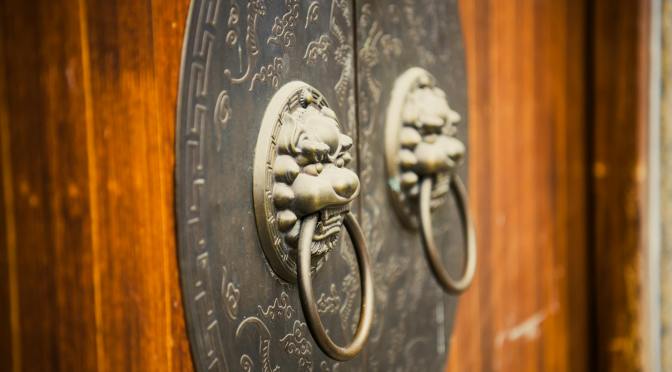
When I was taught to read playing cards, my teacher told me that the Two of Hearts is “al martel di porta”, knocking at the door. This refers to the way old house doors are made in many European countries, including Italy, where door knockers were used back when you couldn’t ring at the door. At least in Italy door knockers are still very much en vogue, though mostly as a decorative element.

The idea of the Two of Hearts as “the door knockers” is a reference to the fact that door knockers usually come in twos and to the fact that the Two of Hearts comes right after the Ace, which is the house, so that the Two is quite literally close to the home.

This meaning is also found in many systems for reading Piacentine cards, where the Two of Cups takes on that meaning (in some other systems this meaning is given to the Two of Wands) as well as in the Bolognese Tarot, where it’s the Ace of Swords that depicts it, due to the odd shape of the picture.

In some systems I am aware of, there are two distinct cards: the door knockers and the roof of the house. This is true for some systems employing Piacentine cards, where the Two of Cups is the door knockers and the Four of Wands is the roof.

This distinction is also found in the Bolognese tarot, where the Ace of Swords depicts the door knockers and the Seven of Cups the roof of the house. In the oldest surviving system for reading the Bolognese tarot, which dates back to before the French revolution (I talk about it here), the Knight of Wands indicated the door knockers and the Ten of Cups the roof of the house. Clearly, therefore, this symbolism is deeply ingrained in Italian cartomancy.

According to the person who taught me the 45-card system of Bolognese tarot, the Ace of Swords, the door knockers, tends to show something close to home in a temporal sense (about to happen) whereas the Seven of Cups, the roof, is more connected to everyday life, to our close environment and to the protection of people surrounding us, as well as to the family in a more extended sense. Germana Tartari, who initiated me to the 50-card system, which she was taught by her grandmother and by some of her grandmother’s friends, uses the Nine of Cups as ‘the staircase to the house‘, again mostly in a temporal sense as something about to happen.

On the other hand, in the system for reading playing cards that I was taught, the Two of Hearts covers both possibilities: it indicates something about to knock at the door or it can show family situations, people who are close to us etc.

I have never found this symbolism in other non-Italian systems. If you did, feel free to drop me a line, as it would be very interesting. Manuel Arcuri, an American reader who was taught to read playing cards by his Italian grandmother, says somewhere that his grandmother called the Two of Hearts “l’attesa”, which means waiting or expectation, as of something about to happen. He doesn’t mention door knockers though.

Furthermore, many card reading systems I have read about assign the meaning of “within two weeks” to the Two of Hearts, which once again gives us the idea of something about to knock at the door. Interestingly, Regina Russell‘s playing card system uses the Two of Hearts to indicate excitement for something that is about to happen, expectation and even pregnancy (expecting a child).

MQS

What’s the Bird Thinking? (Example Reading)

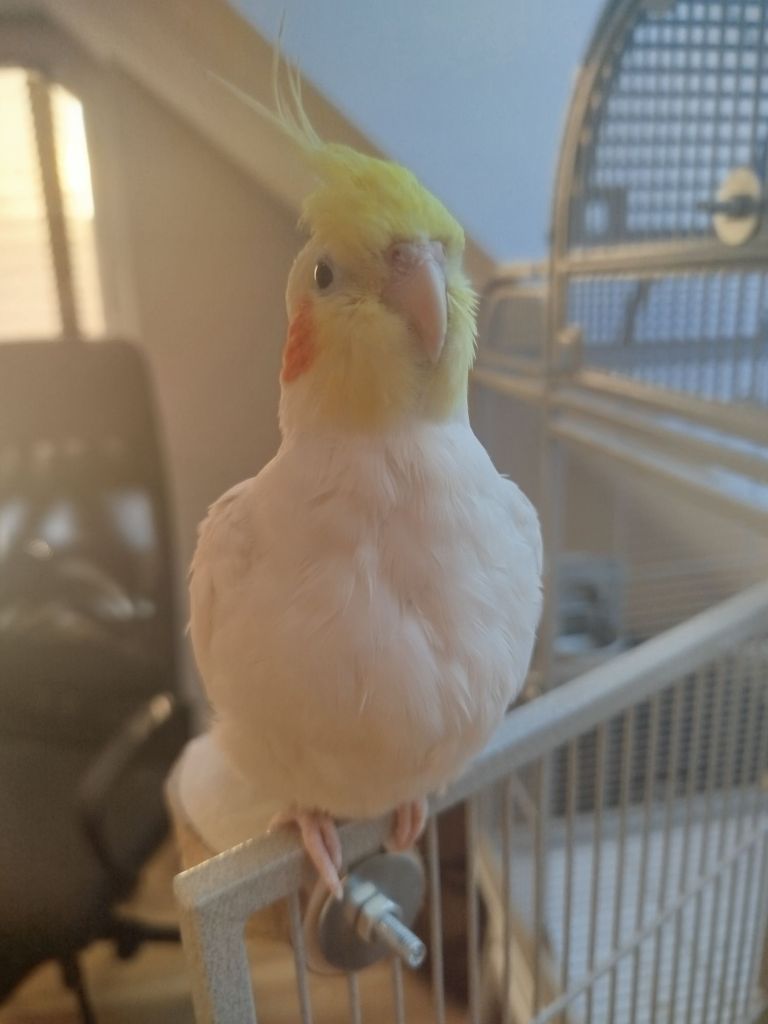
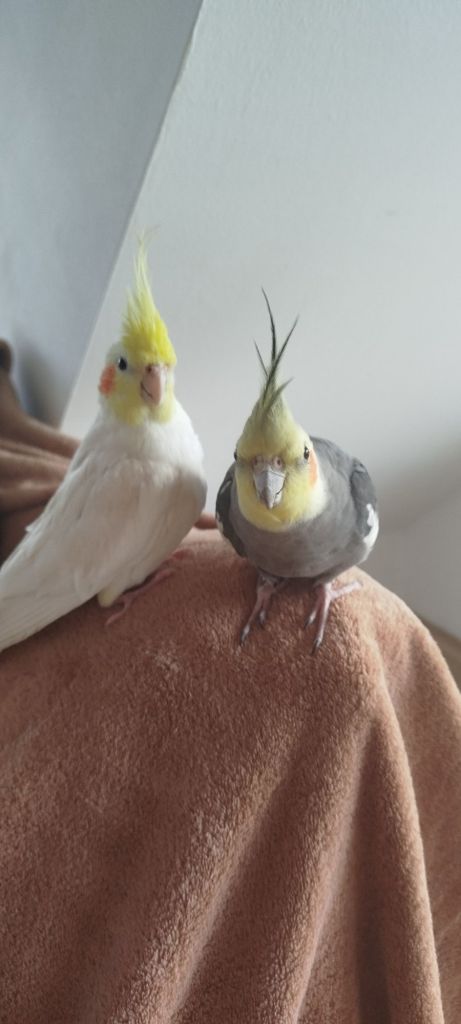
My two cockatiels couldn’t be more different from one another. Ciuffy, the white one, is a sweet cuddlebug who’ll do anything for a head scratch. He’s never nipped me, let alone bitten me. The only time he hurts me a little is when he tries to preen my ear.

“I’m the guy you want your daughter to bring home”

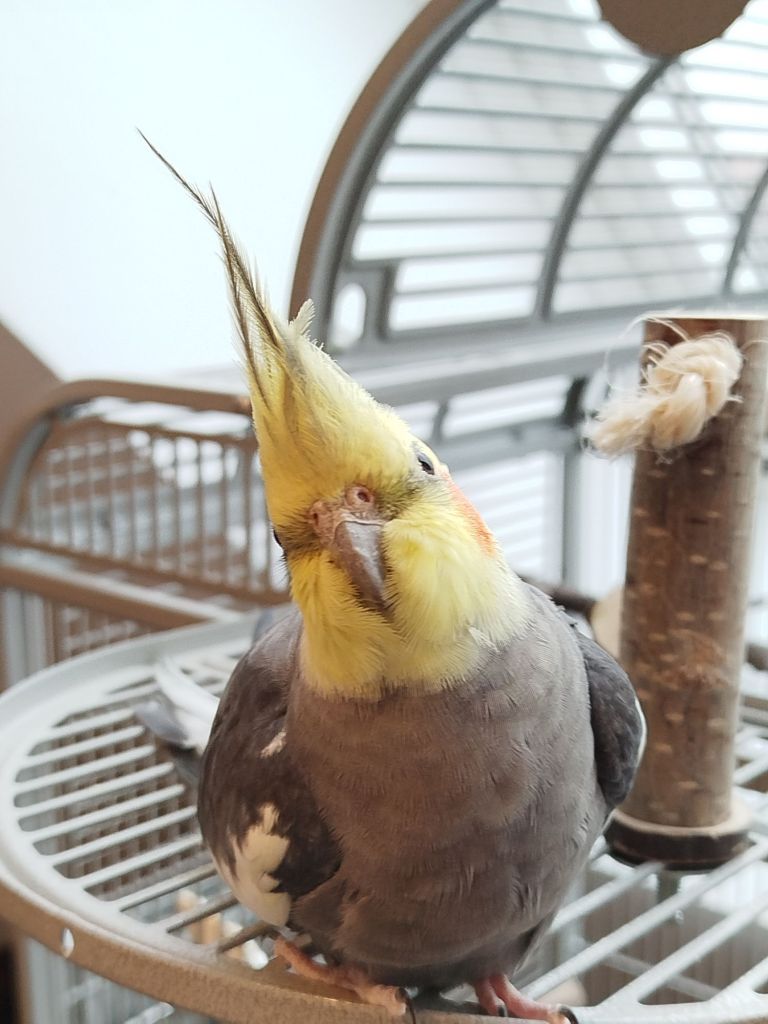
Zazu, the gray one, is a beaky, bossy, overbearing prick. He does have his sweet side, and considering I’ve had him for only a little over a month we’ve made huge progress, but when I have him on my shoulder I KNOW I’m going to get hurt at some point, and when he bites he really means it.

“I’m the guy your daughter brings home”

Now that I’ve set the scene and used the excuse to show you a couple of pics of my cutie pies, let’s get to the point. A couple of days ago, while Zazu was on my shoulder, he bit my earlobe incredibly hard out of nowhere (maybe he saw me move my head and didn’t like it).

I shooed him away with my hand, but he spooked and flew against a wall. Although he wasn’t hurt, he spent the day avoiding me and hissing (for those who don’t know, cockatiels can hiss, like cats).

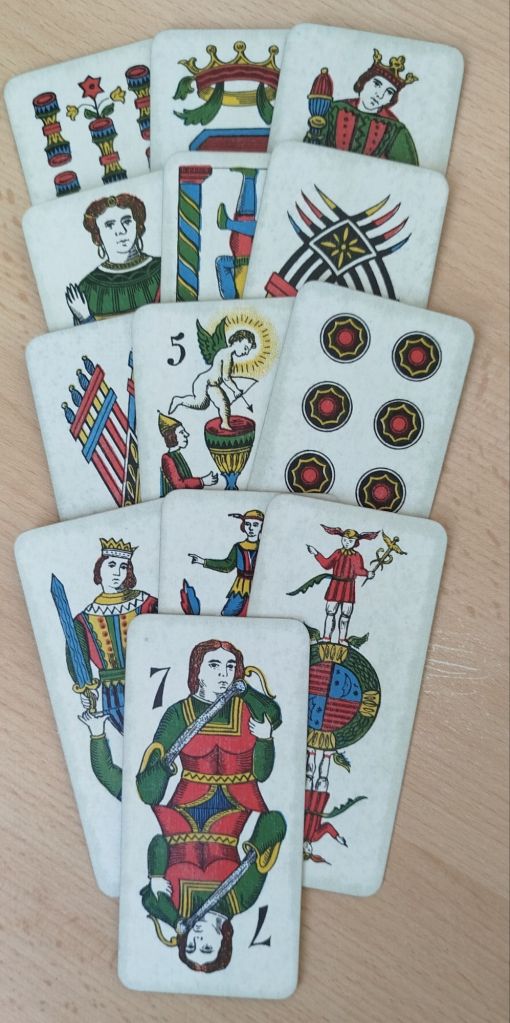
I knew that the accident set some of that hard-won progress back, but I wanted to know Zazu’s perspective and how it would likely evolve. Here’s what the Bolognese Tarot had to say:

What’s the featherball thinking? Tarot reading

One thing that surprised me is the first row, where we have happiness (Ten of Cups) in the house (Ace of Cups) with me (King of Wands). I know I try to care for the two little balls of feathers as best I can, but Zazu is always grumpy and old-farty in his behavior, so I assumed he didn’t like me very much. Apparently that’s just his character.

The second row is interesting, since we have unexpected (Stranger) betrayal (Hanged Man) leading to negative emotions (Eight of Swords). Clearly his good vibes were somewhat disrupted by the incident.

The third has a path (Eight of Wands) toward Love with harmony or small satisfactions (Ten of Coins). So even though there was a setback, there is room for moving toward love. Obviously we should be very careful when projecting human sentimentalism onto animals, but then again, divination is a language understandable to humans, so the tarot is probably translating Zazu’s reality in terms that are understandable to me.

I have some doubts about the last line. The King of Swords might be Zazu himself (it could represent my husband, but my husband isn’t particularly involved). Technically, pets are represented by the Juggler, but then again, the King of Swords does have some characteristics of the Juggler, so it’s a possibility. At any rate, the King is next to the sickbed. There are no combinations talking explicitly about sickness, so I believe this just shows his being cranky or a bit uncertain, but the World card at the end of the row indicates that this uncertainty doesn’t cause breaks: the situation remains open and moving.

The Temperance card at the end simply shows that patience and time are needed. I expected no less.

For now, the reading seems to be accurate. The day after the little bastard had gone back to his old behavior, being just a little more shy than usual, and the day following that he was back to normal.

MQS

Odd Things On This Blog, And Other News

For a couple of months I have been getting between 35 and 60 individual daily visitors on this blog, which, considering it’s a personal blog with no advertising I am perfectly happy with, especially since I started out with 0 daily visitors a day a couple of years back and it has slowly but steadily been increasing.

So you can imagine my surprise when the other day I check my stats and I see over 1000 daily visits (that is, individual users, not page views). Well, I look into it and I discover that they all come from Falkenstein, a small town in Germany. I start researching people with a similar experience and it turns out it’s a bot or AI thingy (excuse the technical jargon).

The following day, I still had a staggering amount of visitors, but around half. The day following that, the number was halved again and so on. But it is still happening, and it kind of freaks me out, though I don’t know why. I hope it goes away by itself. If anyone knows anything about this kind of stuff and wants to hit me up, I’m all ears.

In other news, I have been having crazy fun with the Bolognese tarot, but soon I will be needing fresh victims, so I’m planning on offering cheap readings within a couple of months.

Finally, although I’ve been getting good feedback from you guys about my youtube videos, I know part of it is also encouragement, and I know I need to improve my craft. It’ll come with time. Still I am grateful for the nice messages!

Also, get a load of this:

MQS

Tarot Encyclopedia – The Seven of Swords

(Note: this is a collection of the meanings attributed to the cards by some occultists in the past centuries. It does not reflect my own study or opinion of the cards. It is only meant as a quick comparative reference as I develop my own take.)

The Seven of Swords from the Builders of the Adytum (BOTA) tarot deck

Paul Foster Case (and Ann Davies)

The time period is the third decanate of Aquarius, February 9 to 18, under the rulership of Venus.
Well-Dignified: partial success; the Querent is too easy-going or does not draw sufficiently on his reserve force; he has good opportunities but may not make the most of them; he is likely to compromise too easily.
Ill-Dignified: love of ease and display cause loss; the Querent suffers from the insolence of others and may be insolent himself; there is danger that his own confidence may be betrayed, or that he may be led into betraying the confidence of others.
Keyword: Instability.
(From the Oracle of Tarot course)

A. E. Waite

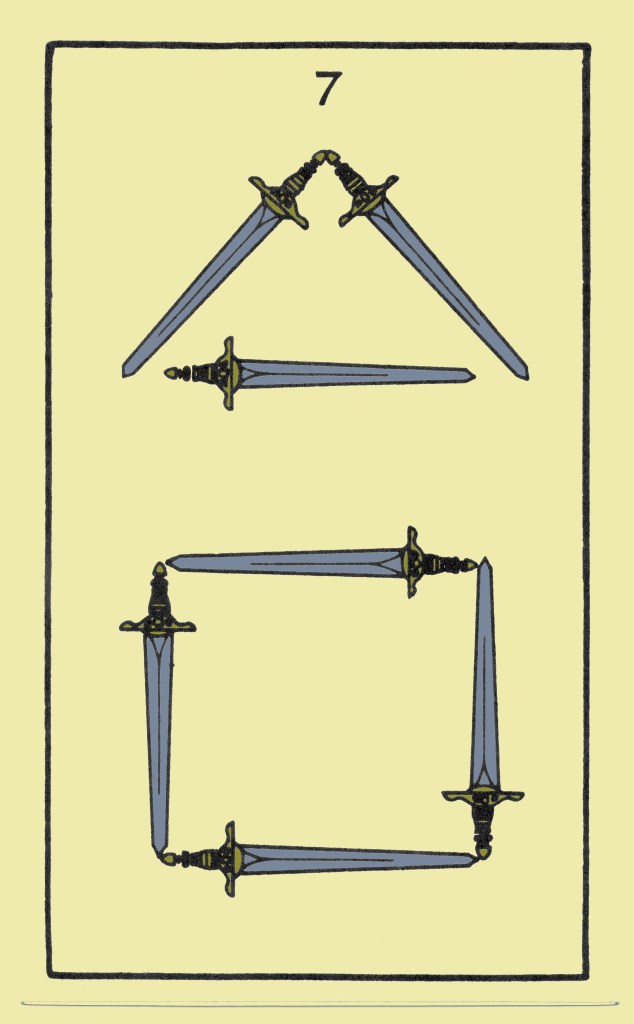
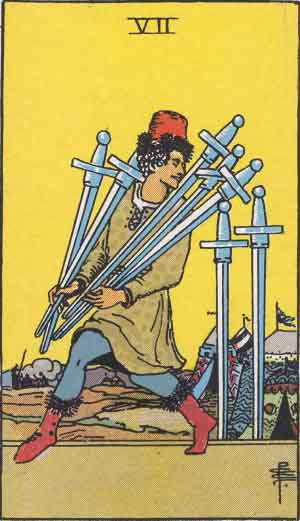
A man in the act of carrying away five swords rapidly; the two others of the card remain stuck in the ground. A camp is close at hand. Divinatory Meanings: Design, attempt, wish, hope, confidence; also quarrelling, a plan that may fail, annoyance. The design is uncertain in its import, because the significations are widely at variance with each other. Reversed: Good advice, counsel, instruction, slander, babbling.
(From The Pictorial Key to the Tarot)

The Seven of Swords from the Rider Waite Smith tarot

Aleister Crowley

The Seven of Swords is called Futility. This is a yet weaker card than the Seven of Wands. It has a passive sign instead of an active one, a passive planet instead of an active one. It is like a rheumatic boxer trying to “come back” after being out of the ring for years. Its ruler is the Moon. The little energy that it possesses is no more than dream-work; it is quite incapable of the sustained labour which alone, bar miracles, can bring any endeavour to fruition. The comparison with the Seven of Wands is most instructive.

[…]

Netzach, in the suit of Swords, does not represent such catastrophe as in the other suits, for Netzach, the Sephira of Venus, means victory. There is, therefore, a modifying influence; and this is accentuated by the celestial rule of the Moon in Aquarius.

The intellectual wreckage of the card is thus not so vehement as in the Five. There is vacillation, a wish to compromise, a certain toleration. But, in certain circumstances, the results may be more disastrous than ever. This naturally depends upon the success of the policy. This is always in doubt as long as there exist violent, uncompromising forces which take it as a natural prey.

This card, like the Four, suggests the policy of appeasement. The symbol shows six Swords with their hilts in crescent formation. Their points meet below the centre of the card, impinging upon a blade of a much larger up-thrusting sword, as if there were a contest between the many feeble and the one strong. He strives in vain.
(From the Book of Thoth)

The Seven of Swords from the Thoth tarot deck

Golden Dawn’s Book T

TWO Angelic Radiating Hands as before, each holding three swords. A third hand holds up a single sword in the centre. The points of all the swords “just touch” each other, the central sword not altogether dividing them.
The Rose of the previous symbols of this suit is held up by the same hand which holds the central sword: as if the victory were at its disposal. Symbols of Moon and Aquarius.

Partial success. Yielding when victory is within grasp, as if the last reserves of strength were used up. Inclination to lose when on the point of gaining, through not continuing the effort. Love of abundance, fascinated by display, given to compliments, affronts and insolences, and to spy upon others. Inclined to betray confidences, not always intentionally. Rather vacillatory and unreliable.
Netzach of HB:V (Journey by land: in character untrustworthy).
Herein rule the Great Angels HB:HHHAL and HB:Ma’aKAL.

Etteilla

Hope
Upright. This card, as far as the medicine of the spirit is concerned, means, in its natural position: Hope, Expectation, Expectation, Pretending, Founding, Overestimating, Founding, Designing, Willing, Wanting, Wishing, Vowing, Wanting, Taste, Fantasy.
Reversed. Wise opinion, Good advice, Salutary warnings, Instruction, Lesson. – Observation, Reflection, Note, Caution, Thoughtfulness. – Reprehension, Reprimand. – News, Announcement, Posting. – Consultation, Admonition.

MQS

Bolognese Tarot Spreads – The Thirteen Card Spread

Nothing prohibits anyone from using whatever spread they prefer, or even just from laying out a row of cards. However, traditionally, the smallest spread used with the Bolognese Tarot is the thirteen card spread, which is a small tableau of cards used to answer a specific question or explore a specific theme (although nothing prevents you from laying it out for a general reading. It will respond anyway). This is a spread I have already presented, and it is one that is used with many decks in Central and Northern Italy in particular. The layout is as follows:

123
456
789
101112
13
The Thirteen Card Spread

Some readers take out the significator for the querent or even the significator for the question and put them on top of the layout (above card 2) before starting to shuffle. I prefer to have all cards in the deck and have not found it necessary, but feel free to experiment.

The cards may be read in rows or in columns, and which direction is the primary one depends on which tradition you come from. Personally I tend to see rows as the primary reading direction, but I will look at columns if there is clear information contained in them. I have found that the columns tend to describe the situation rather than to predict it. But don’t force yourself to read in every direction possible: simply read the information where it is found, and leave the rest.

There is no strict differentiation between past, present and future. However, I have found, personally, that at least the first row, or sometimes two (and on occasion even three), contains the past or present of the situation. Occasionally the cards simply jump ahead into the future from the start.

Be open about it: it may sound confusing in theory but in practice it is often quite clear. For instance, if you see the cards changing from good to bad or vice versa (or simply changing “tone”) in the first row or two, that’s usually a sign that the cards before the change happens are the past/present, and the others the future. In doubt, simply ask the querent: we are not there to play Nostradamus, so it’s fine to ask for help in interpreting the spread.

The final card, number 13, doesn’t have any specific preassigned meaning. However, I have found that it can either simply be a regular part of the spread (simply coming after card 12 or under card 11), or it can highlight an important detail, or something that will be true, regardless of what the previous cards say. For instance, if the spread is a disaster but the thirteenth card is good, it can tell us the querent will have some kind of satisfaction, or will be protected.

Yes-or-No Questions

Now we come to an odd bit of tradition. I will relay it as it has been taught to me, and then I’ll give you my two cents. Although the thirteen card spread is not unique to the Bolognese Tarot, the Bolognese Tarot adds another layer to the spread.

This is relevant only when the question is a yes-or-no question. If it is, then, according to some traditions, the answer is yes if the Death card comes up in the spread or while cutting the deck (it says: “yes, as sure as the fact we all die”). If the Angel card comes up, according to some it’s a maybe, while according to others it’s a no but with positive developments; if the Death and Angel cards both come up, not necessarily together, it’s the best possible outcome (a super yes, as it were). If neither card comes up, it’s a no.

Some also add that if the Death card doesn’t come up but the Angel and Devil card come up in the spread, not necessarily together, it’s also a yes (the Devil card alone would be a no, but if you remember the combinations, Angel+Devil means good news or satisfaction). Others still also believe the answer is yes if three or four Kings come up in the spread.

Now I’m going to tell you what my experience is. My experience is that there is something to these rules, but it is not all so cut-and-dry. The spread always needs to be interpreted as describing a concrete situation, and the yes or no comes from our evalutation of whether the picture presented by the cards matches what the querent wants or not. It’s happened more than once that the Death card was present but the answer (confirmed by experience) was a no, or vice versa, the answer was yes with no yes-marker present.

Focus on interpreting the cards. If the Death card comes up, what does it say in the context? Does it show some sharp change? Does it show inner suffering? Does it confirm something? If so, look at the cards around it: what is it saying yes to? Sometimes it is obvious that the Death card comes up for no reason other than to say “yes” to the question, while at other times it is a regular card, like the others. Again, be flexible, record your experience and learn from it.

MQS

Bolognese Tarot – How to Tackle Combinations

Life is a recipe, and the art of living consists in large part in detecting the ingredients to know if and how to mix them differently. Divination is a mirror of life, and oracular systems usually have some kind of vocabulary to create descriptions of life.

In traditional divination by cards, each card carries small bits of meaning that must be mixed together to form coherent pictures. If divination mirrors life, then it stands to reason that the recipe for something in real life should be mirrored by a recipe for that same thing in the divinatory language. This is how all card reading systems I know work, and that’s how the Bolognese tarot works, with the exception of a couple of universal combinations with odd meanings (Angel + Devil = Good news or satisfaction; Sun + Moon = sorrow; Angel + Death = yes, confirmed).

Let us make an example. What are the ingredients of an inheritance in real life? I would say the ingredients are: death (no inheritance without someone croaking); family ties (usually we inherit from someone whom we are related to, though not always); the law (inheritances are generally regulated by the law and require a bureaucratic mechanism to be set in motion); material possessions (the things we inherit).

In the language of the Bolognese tarot, these ingredients correspond to the following cards: Death: Death; Family ties: Ace of Cups and/or Seven of Cups; The Law: Justice and/or King of Coins; Material Possessions: The Star and/or a money card.

Do we need all the cards to be present? It much depends on the context. If the question is directly about an inheritance, then we could do without many of these cards, while if it is a general reading then the more cards, the clearer the message. But we might also find other cards to flavor the basic recipe: the Moon is also connected with death (the realm of shadows); tears may sometimes be expected, so the Seven of Coins could come up; the court card of the deceased person could show up, etc.

Let us make another example. Let’s take surgery. What’s the recipe for surgery in real life? I would say: a hospital, a bed, a doctor, a cutting instrument. In the Bolognese tarot these same ingredients are: Hospital: The Tower; Bed: The Chariot; Doctor: King of Coins; Cutting instrument: Knight of Swords.

Again, there can be additions and variations. The doctor or the bed might be absent, while the Ten of Cups (blood) or the Moon (unpleasantness) or the Eight of Swords (suffering) might be present. A King or Queen of Swords may take the doctor’s place to show someone holding the knife. Just like my lasagne recipe might differ from yours, but it would still be recognized as lasagne, so the way the deck mixes the ingredients might vary slightly from time to time, but the broad picture remains the same.

One last example. Let’s take marriage. In many situations, a marriage requires the following ingredients: a commitment; love (let’s assume the best intentions in this case); a celebrant. The same ingredients are, in the language of the Bolognese tarot: Love: Love; Commitment: Ace of Wands or Ace of Swords; Celebrant: The Stranger. This is the basic recipe. But we might also expect the main significators to show up. A marriage is a celebration, so the Ten of Cups (fun) might be expected; the family life is certainly impacted, so some Cup cards could be there.

Once we start recognizing that life is made up of ingredients mixed together, it becomes easy (or at least easier) to see how the tarot might mix its own ingredients, the cards, to match the recipe. In many cases, while it is useful to reason out the combinations handed down by tradition, it is much easier to understand the basic principles and be flexible in our observations.

Ultimately, divination starts with logic, not with psychic powers, even though psychic abilities may occasionally be of help. The more we immerse ourselves in the logic of divination, the easier it becomes to decode its messages.

MQS