Tag Archives: astrology

Three Enemies of Good Divination (and One Ally)

Remember those listicles that were much in demand about ten years ago, before people grew tired of the rage-bait? Yea, they still do them, but they have somewhat fallen out of favor, especially since they are so basic even AI can do them better than the poorly paid saps who wrote them back then. Anyway, here’s a short one, hopefully more interesting than the average listicle, on what generally hinders good divination, plus a bonus entry for what helps.

Mechanic Behavior

Divination eschews mechanic repetition. Asking the same question one or two times is fine because there is still enough emotion behind it to put the system into motion. In fact, it is fine to ask the same question many times as long as the querent is truly invested in it, but the more the querent asks the same question with the same emotional drive as the first time, the more you know the querent is cuckoo and is best avoided. In general, it is best to wait a little between divinations.

This point is one that skeptics seem unable to wrap their heads around, because it seems to run against the principle that experiments can be repeated ad libitum, but it is really quite simple: divination is not an experiment, and the more you mechanically ask the same question, the more the real question changes to whatever it was at the beginning to “does divination really work?” and this question cannot be answered by divination itself.

All in all, a balanced relationship to divination as a means of intelligence gathering, together with the understanding that we are attempting something more exceptional than cleaning the cat’s litterbox, is in order.

Shallow Understanding of the System You Work With

If you asked your doctor how he knows his diagnosis is right and he told you it was just his intuition, you’d feel justified in seeking a second opinion. Yet among ‘spiritual seekers’ anything that reeks of effort and study is frowned upon and people go to extraordinary lengths in order to avoid the simple fact that both knowledge and experience are needed to perform satisfactorily in any sector of life. So they come up with anything from intuitive advice (which essentially means “don’t ask me how I know”) to the great angel HRU to fairies to ‘kickass schools of non-duality.’

The reality is that divination is a method for the acquisition of knowledge. If we don’t make the effort of studying the method we don’t get much knowledge. I believe the current distrust of study comes in part from the distrust of intellectual knowledge (see the bonus entry in this list) and in part from the fact that many people who become interested in divination do it to create a little bubble of mystery and mysticism away from the golden cage that is modernity.

Either way, it is a misguided attitude. Divination requires study. Lots of it. In fact, the study will never end. The good news is that we can start practicing much sooner. As for intuition, it does have a place in divination, and I’ll talk about it in the future, but unbridled intuition is just a badly behaved kid.

Bias and Preconceptions

I’ve already talked at length about this, and I will probably still talk about it in the future. It bears repeating: the more we think we know, the less we’re open to discovery.

Aside from ideological forms of bias, which are always bad regardless of the ideology, there are also other forms. One of the most deadly forms of bias is, for instance, the belief that the querent knows what they are talking about. A querent doesn’t need to be malicious in order to confuse us: they can just be confused themselves, or they can have built a whole scenario inside their heads before sitting in front of us.

On the other hand, talking over our querent and treating them like a special needs child won’t do either. There needs to be a balance between our ability to see the truth of the matter in a dispassionate way (thanks to the divination system we are employing) and open-heartedness toward the querent. As a matter of fact, an open heart can go a long way.

Querents can also be biased against us, but we can do nothing about it. People sometimes ask me what happens when someone asks false questions maliciously. What happens is that if I’m lucky, I’ll understand it from the cards, while if I’m not lucky I’ll make a fool of myself. Either way, the person won’t change their mind about divination or about me, so why bother getting worked up about it? Stuff happens.

Your Brain, Your Best Friend

Ever since Madame Blavatsky disgracefully started peddling poorly understood principles of oriental philosophy, the Western esoteric world has become convinced that the “mind is the enemy”. People generally think so (isn’t it ironic? The mind thinking that the mind is the enemy) because they are incapable of using it but want to sound deep in their incompetence.

In reality, if there is such a thing as overthinking, there is also such a thing as underthinking. The idea that everything must come immediately and instinctively to us in a space of pure knowing and that everything resembling logic is the work of the devil is patently wrong.

Aside from the fact that this is philosophically delusional, most people who think only the mind lies never stop to consider how many times their instincts or their heart actually let them down on a day-to-day basis. The reality is that our mind, our body and our heart are ways for us to acquaint ourselves with the world, and all three can lead us astray depending on the context, just as much as they can guide us to profound insight.

Therefore, if it is not correct to let the other two dry up, it is also not correct to become mindless pseudomystics, sacrificing our understanding on the altar of an ill-digested and rather offensive orientalism (“Counterfeit Asian philosophy 101 says the mind is poo poo, therefore it’s true. See how smart I am? I misquote exotic people!”)

The funny thing is that most Eastern forms of divination are not at all intuitive, and in fact verge on the overly technical (see Da Liu Ren, Qi Men Dun Jia, Wen Wang Gua, Vedic Astrology, Purple Emperor Astrology, etc.) They are also incredibly accurate exactly because of how majestically brainy they are, though they may not have the glamour of the latest useless set of empowering witchy cards. Traditional Western divination systems, of course, can be just as accurate, but people usually have the expectation that they need to unplug their brains on the way in. Let’s not do this. Our mind can sometimes lead us astray. It can also help a great deal.

MQS
Is This Course for Me? (Playing Cards Reading and Horary Astrology)

I’m always on the look-out for opportunities to deepen my knowledge of esoteric topics. Since the esoteric world is filled to the brim with junk covering a couple of pearls on the bottom (but don’t worry, things don’t get much better outside of lalaland) it is very useful to know some forms of divination to supplement my bullshitometer.

I recently came across a certain course on traditional Italian witchcraft which passed all my preliminary tests (no mention of Wicca or neopaganism, relating anecdotes on practices I’m already familiar with and know are valid, etc.)

Still something was off, though I couldn’t put my finger on it. On thing was probably the reference to authors, like Raven Grimassi, who have been largely debunked. I asked the heavens for a sign, and then pulled some cards. Let’s start with the cards. They were:

4♣ – 2♠ – K♦ – 2♣ – 6♦

Right off the bat, I don’t like the teacher being represented by a King of Diamonds. The King of Diamonds is the merchant, the banker, the one whose end goal is money. If he had been the King of Hearts or even the King of Spades I would have been reassured. You may argue that obviously a course is offered to earn money, to which I respond that there is a difference between earning through your passion and earning through other people’s passion.

I am unsure about the preceding combination of Four of Clubs and Two of Spades, but it likely represents contradictory (2♠, arguments, going apart) doctrines (4♣, that which is told). The Two of Clubs and Six of Diamonds traditionally represent limping (insecure steps). The King of Diamonds is not secure enough in his knowledge. Limping is still better than being bed-ridden, so there is something good to the course, but probably not enough to offset the negatives.

Horary Astrology Reading

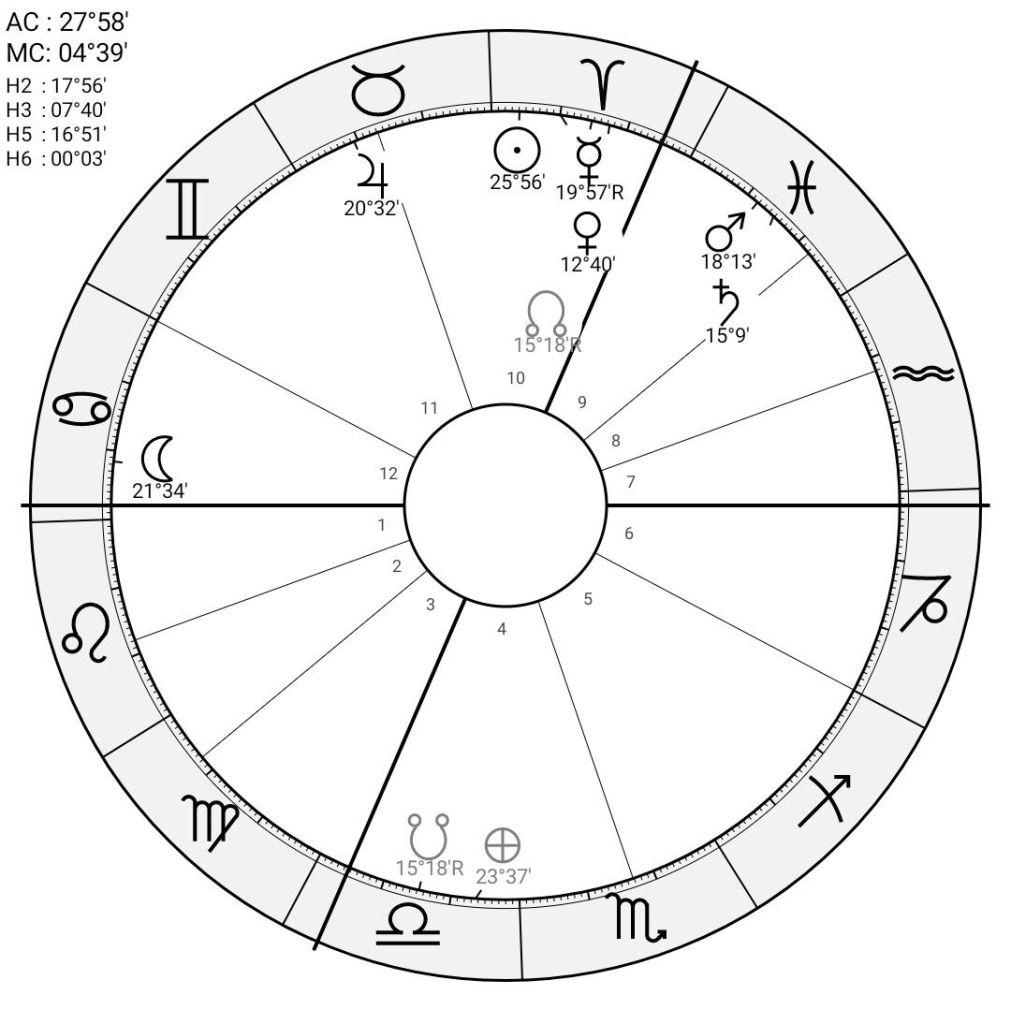
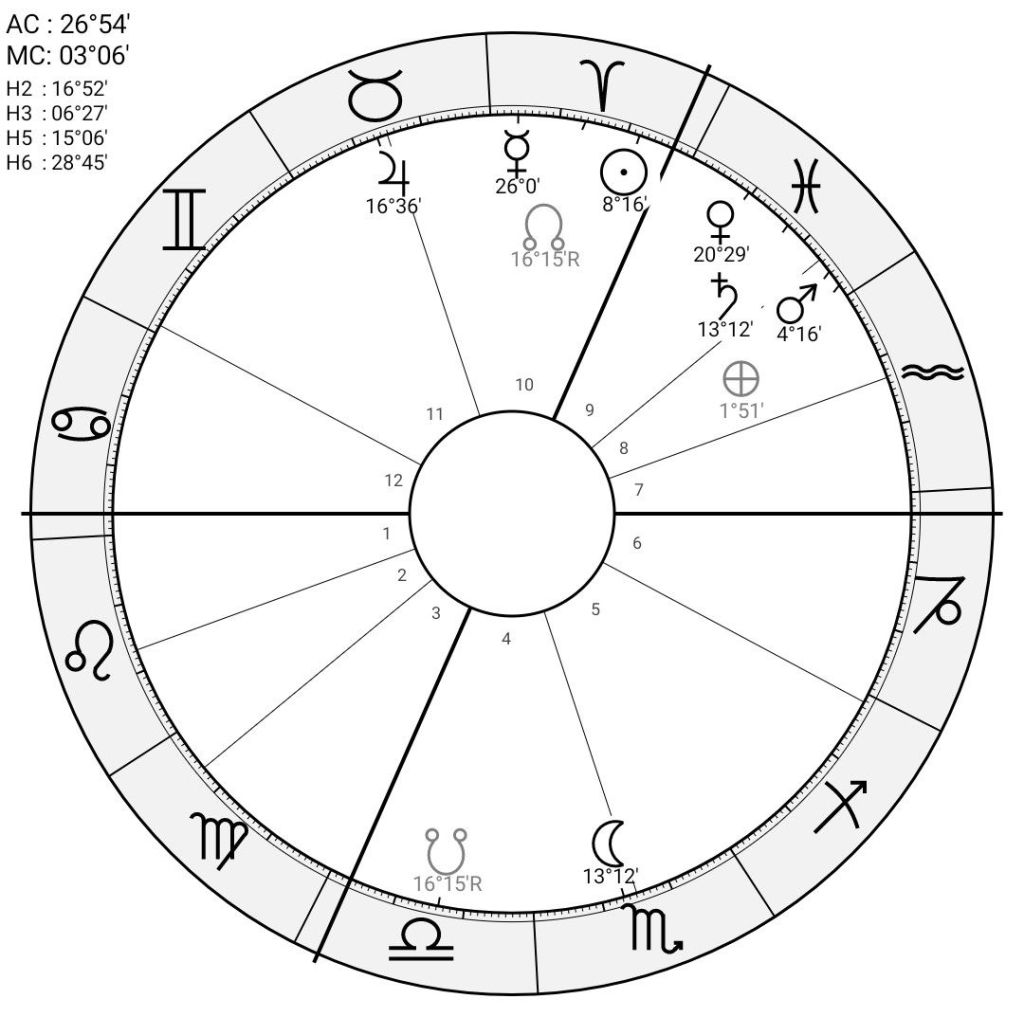
Let’s look at the horary chart:

Is the course good for me?

The Moon is the Lady of the Ascendant and thus represents me. Magic is higher knowledge, so it’s Ninth House. This is Jupiter. The two malefics Mars and Jupiter are present in the Ninth house, and are both peregrine, so they afflict the house.

The Moon is in her sign, but she’s also tucked away in the very malefic Twelfth house. Interestingly, the Twlefth house represents witchcraft, but only in the sense of something done behind the querent’s back to hurt him, not magic in general (which, again, is higher knowledge). So while I’d be capable of learning (Moon in own sign) my position is not good. There’s something iffy.

Jupiter is mildly dignified by term and in the succedent Eleventh house. The Moon is in sextile with Jupiter, which is technically good, but it is separating from it, indicating growing divergence. The Moon’s next aspect is a square of the Sun, which is negative. The Sun rules the second house, the house of money. So proceeding would put a strain on my finances. This isn’t necessarily to say that it costs too much in absolute terms, but it costs too much compared to its quality. Interestingly, Jupiter is disposited by Venus, which is in detriment and moving toward the Sun, which hurts her, so Venus has a rather excessive love of my money compared to the necessary love of knowledge.

All in all, based on both readings, I would say that the course would probably contain some valuable information, but would not be a great investment in my education.

MQS

Tarot Encyclopedia – The Knight of Swords

(Note: this is a collection of the meanings attributed to the cards by some occultists in the past centuries. It does not reflect my own study or opinion of the cards. It is only meant as a quick comparative reference as I develop my own take.)

The Knight of Swords from the Builders of the Adytum (BOTA) tarot deck

Paul Foster Case (and Ann Davies)

The time period is from the beginning of the third decanate of Taurus to the end of the second decanate of Gemini, May 11 to June 10. Meanings: youngish man; some talent for governing; materialistic, with some artistic appreciation; active, clever, skillful in management.
Well-Dignified: favorable to querent and his enterprises
Ill-Dignified: Inimical, domineering, overvalues small things, crafty.
Dark hair and eyes.
(From the Oracle of Tarot course)

A. E. Waite

He is riding in full course, as if scattering his enemies. In the design he is really a prototypical hero of romantic chivalry. He might almost be Galahad, whose sword is swift and sure because he is clean of heart. Divinatory Meanings: Skill, bravery, capacity, defence, address, enmity, wrath, war, destruction, opposition, resistance, ruin. There is therefore a sense in which the card signifies death, but it carries this meaning only in its proximity to other cards of fatality. Reversed: Imprudence, incapacity, extravagance.
(From The Pictorial Key to the Tarot)

Aleister Crowley

(Note: Crowley and the Golden Dawn made a mess with the kings and knights)
This card represents the airy part of Air. With its particular interpretation, it is intellectual, it is a picture of the Mind as such. He rules from the 21st degree of Capricornus to the 20th degree of Aquarius.

The figure of this Prince is clothed with closely woven armour adorned with definite device, and the chariot which bears him suggests (even more closely) geometrical ideas. This chariot is drawn by winged children, looking and leaping irresponsibly in any direction that takes their fancy; they are not reined, but perfectly Capricious. The chariot consequently is easy enough to move, but quite unable to progress in any definite direction except by accident. This is a perfect picture of the Mind.

On the head of this Prince is, nevertheless, a child’s head radiant, for there is a secret crown in the nature of this card; if concentrated, it is exactly Tiphareth.

The operation of his logical mental processes have reduced the Air, which is his element, to many diverse geometrical patterns, but in these there is no real plan; they are demonstrations of the powers of the Mind without definite purpose. In his right hand is a lifted sword wherewith to create, but in his left hand a sickle, so that what he creates he instantly destroys.

A person thus symbolized is purely intellectual. He is full of ideas and designs which tumble over each other. He is a mass of fine ideals unrelated to practical effort. He has all the apparatus of Thought in the highest degree, intensely clever, admirably rational, but unstable of purpose, and in reality indifferent even to his own ideas, as knowing that any one of them is just as good as any other. He reduces everything to unreality by removing its substance and transmuting it to an ideal world of ratiocination which is purely formal and out of relation to any facts, even those upon which it is based.

In the Yi King, the airy part of Air is represented by the 57th hexagram, Sun. This is one of the most difficult figures in the book, on account of its ambivalence: it means both flexibility and penetration.

Immensely powerful because of its complete freedom from settled principles, capable of maintaining and putting forward any conceivable argument, insusceptible of regret or remorse, glib to “quote Scripture” aptly and cunningly to support any thesis soever, indifferent to the fate of a contrary argument advanced two minutes earlier, impossible to defeat because any position is as good as any other, ready to enter into combination with the nearest element available, these elusive and elastic people are of value only when firmly mastered by creative will fortified by an intelligence superior to their own. In practice, this is rarely possible: there is no purchase to be had upon them, not even by pandering to their appetites. These may nevertheless be stormy, even uncontrollable. Faddists, devotees of drink, drugs, humanitarianism, music or religion, are often in this class; but when this is the case, there is still no stability. They wander from one cult or one vice to another, always brilliantly supporting with the fanaticism of a fixed conviction what is actually no more than the whim of the moment.

It is easy to be deceived by such people; for the manifestation itself has enormous potency: it is as if an imbecile offered one the dialogues of Plato. They may in this way acquire a great reputation both for depth and breadth of mind.
(From The Book of Thoth)

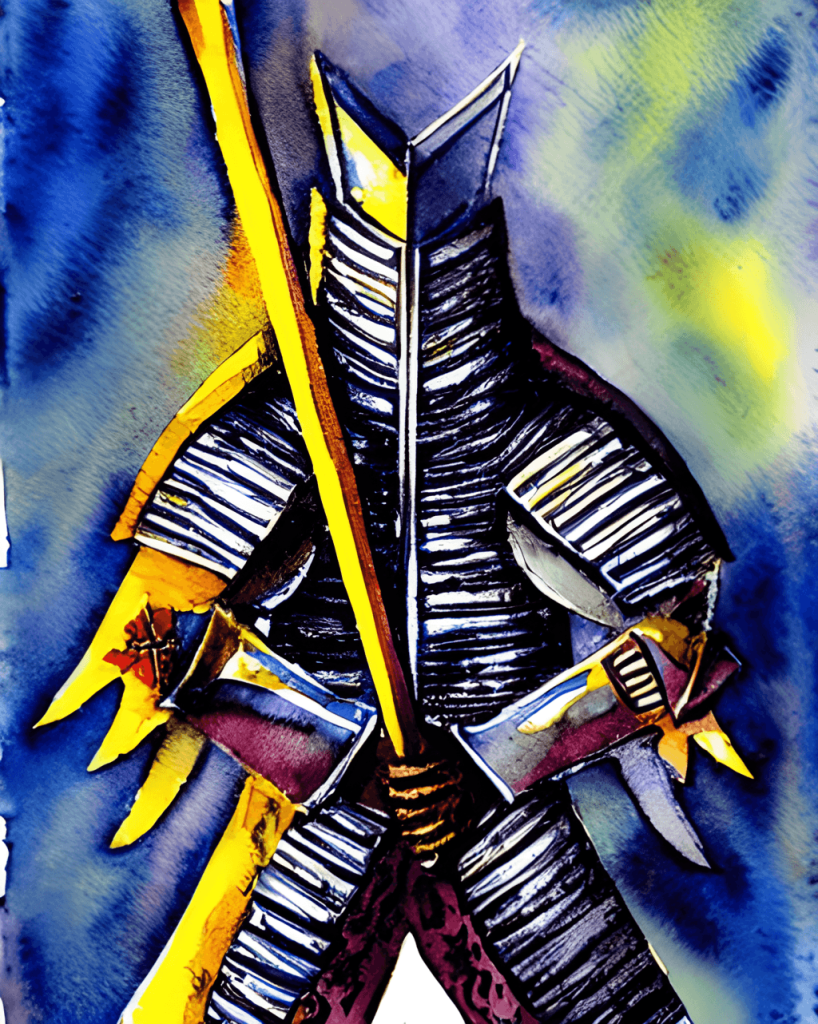
A futuristic AI generated illustration for the Knight of Swords

Golden Dawn’s Book T

A WINGED King with Winged Crown, seated in a chariot drawn by Arch Fays, represented as winged youths very slightly dressed, with butterfly wings: heads encircled by a fillet with a pentagram thereon: and holding wands surmounted by pentagrams, the same butterfly wings on their feet and fillets. General equipment as the King of Wands: but he bears as a crest a winged angelic head with a pentagram on the brows. Beneath the chariot are grey nimbus clouds. His hair long and waving in serpentine whirls, and whorl figures compose the scales of his armour. A drawn sword in one hand; a sickle in the other. With the sword he rules, with the sickle he slays.
Full of ideas and thoughts and designs, distrustful, suspicious, firm in friendship and enmity; careful, observant, slow, over-cautious, symbolizes GR:Alpha and GR:Omega; he slays as fast as he creates.
If ill dignified: harsh, malicious, plotting; obstinate, yet hesitating; unreliable.
Rules from 20 Degree Capricorn to 20 Degree Aquarius.
Air of Air

Etteilla

Military Man
Upright: This card, as far as the medicine of the spirit is concerned, means, in its natural position: Military Man, Man of Sword, Man of Arms, Fencing Master, Swordsman. – Soldier of any corps and weapon, Enemy Fighter. – Dispute, War, Combat, Battle, Duel. – Attack, Defense, Opposition, Resistance, Destruction, Ruin, Overthrow. – Enmity, Hatred, Anger, Resentment. – Courage, Valor, Bravery. – Satellite [= Attendant], Mercenary.
Reversed: Inexperience, Inertia, Stupidity, Bestiality, Stupidity, Imprudence, Impertinence, Extravagance, Ridiculousness, Baggianity. – Scrounging, Fraud, Bricolage, Industry.

MQS

When Will the Horror End? (Horary Astrology Reading)

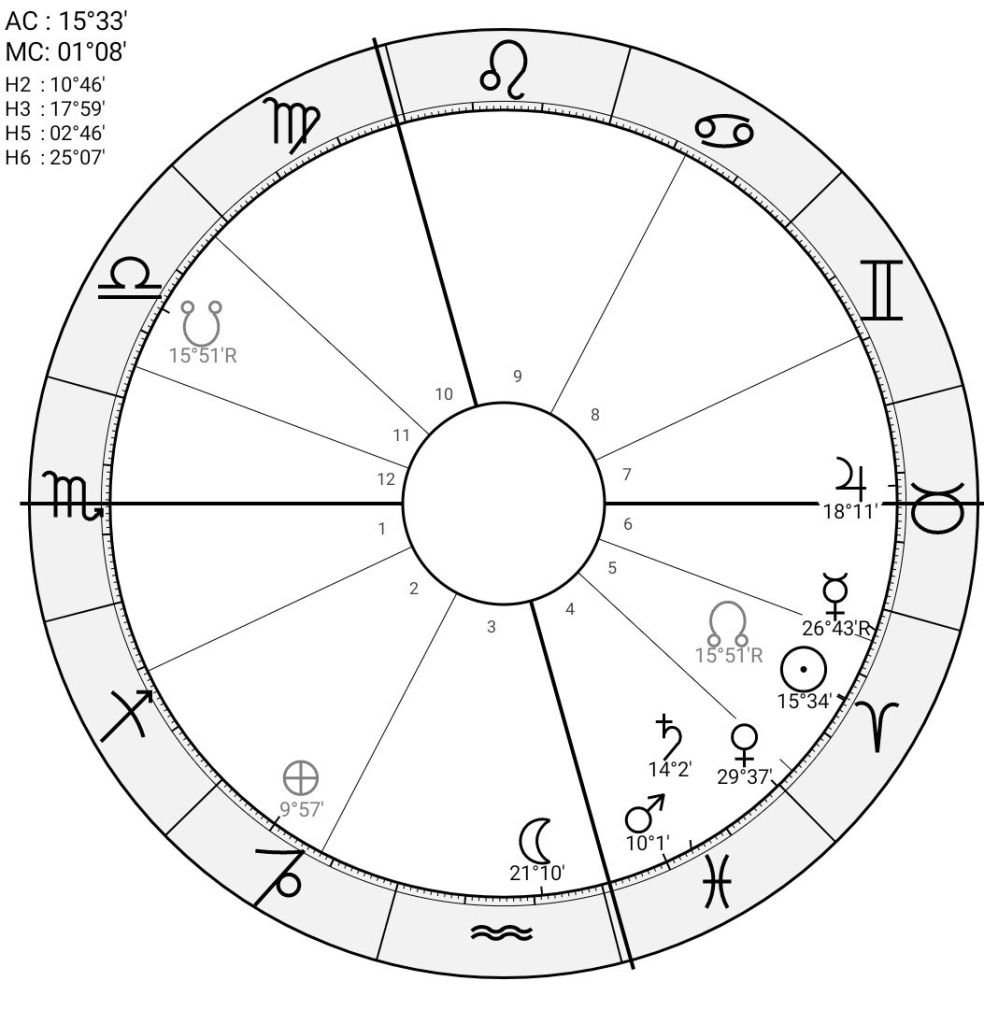
I occasionally help my husband when he needs to work from home and I’m free. Yesterday was one such occasion. He’s a stenographer and was sent several audio bits from a famous company so that he would make a protocol out of them. I don’t think I need to stress how tedious this is. I do it mostly to improve my German, aside from being helpful to my husband. At around 18:04, he was told that the meeting was running late and that there was the possibility of us receiving audios well into the night. Horrified, I asked “when will it be over?”

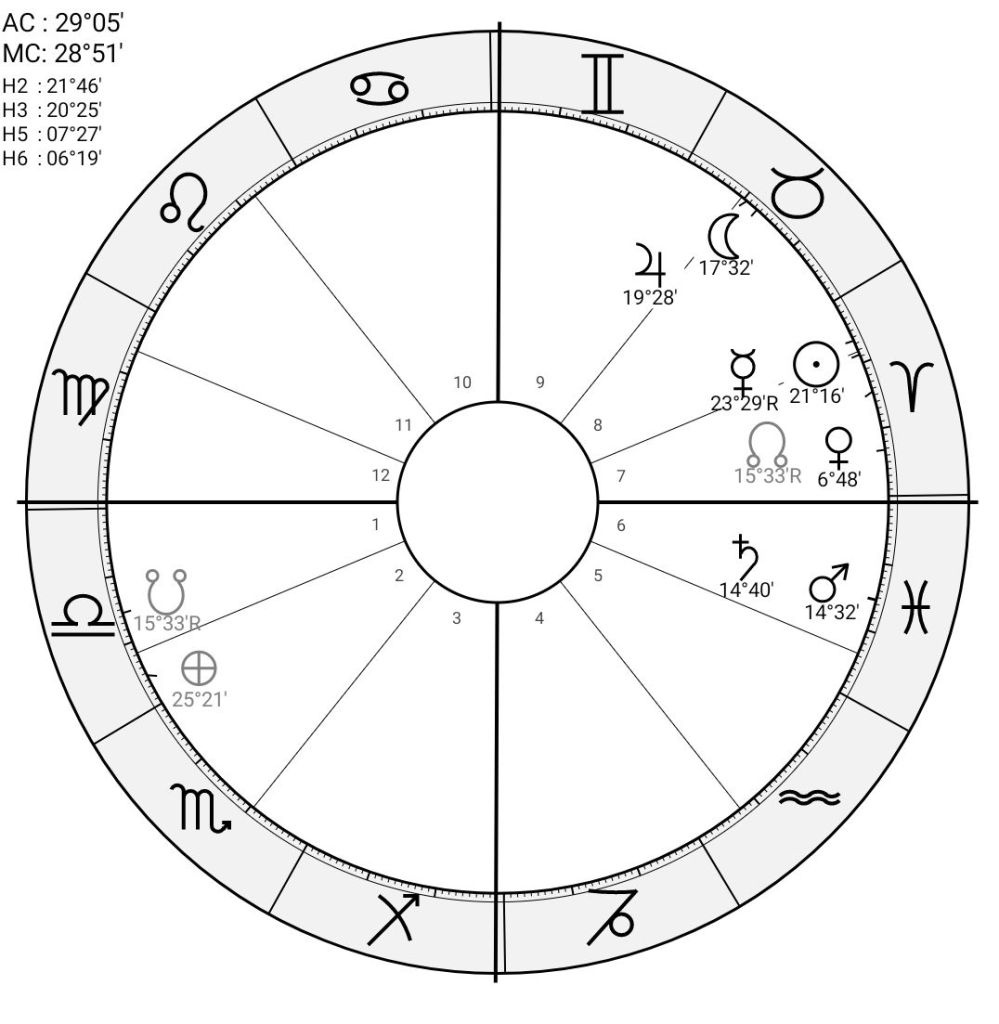
The Heavens answered with this chart.

When will it be over?

I am represented by Mercury, Lord of the Ascendant. Mercury is retrograde, stuck in the evil Eight House of “fear and anguish of Minde”, as William Lilly wrote, and speeding into Combustion of the Sun. In a word, my poor Mercury is a mess. At this point I am unsure if only I am signified by Mercury and my husband by Jupiter, Lord of the Seventh House, or if we are both signified by Mercury. The fact that a Bi-Corporeal sign is rising (Virgo) seems to indicate we are both Mercury. Our stress is well captured by Mercury’s affliction.

However, one thing that gives me hope is the VERY late ascendant (29.05 Virgo), which seems to indicate it won’t take that much. Let’s look at the Moon. She is in her exaltation in Taurus, separating from a sextile of the two Malefics and about to bump into Jupiter, the Great Benefic. Help may be at hand! Initially, as I said, I half-thought that Jupiter was my husband. However, reflecting on my question “when will it end?” I realized that Jupiter rules the Fourth House, which can indicate the end of the matter. In this case, it is quite appropriate that the end of the matter be signified by a benefic.

If that’s the case, then the Moon approaching Conjunction with Jupiter must indicate that things are about to end. When though? The Moon perfects the aspect in around two degrees, so we are left with “two somethings”, i.e., two seconds, two minutes, two hours (days wasn’t an option). The Moon is in a fixed sign, but also very quick in motion and strongly dignified, so my sense was that it would be over in less than two hours. Looking at the ascendant, which had less than one degree of Virgo left on it, I had the feeling that it could possibly be around an hour.

The question was asked at around 18:04, and at 19:02 we were told it was over.

MQS

Love Fool (Horary Astrology and Playing Cards Reading)

This is the first time I use my new interest, Horary Astrology, in conjunction with playing cards. Let’s see what they have to say. The question was asked by a friend of mine who just broke up with her girlfriend. He wants to know if there is a future. This reading was made a couple of days ago.

Relationship reading, is there a future?
Answered with horary astrology

The querent is Mars, lord of the Ascendant, while the quesited, i.e., the girlfriend, is Venus lord of the Seventh. The Moon indicates the flow of the action.

In a night chart, Mars is dignified by triplicity in Pisces, and is angular, while Venus is exalted, also in Pisces, and also angular. The first thing that strikes me is that Venus is moving away from Mars. Furthermore, the Moon is separating from a difficult square with Jupiter in the Seventh. I asked my friend if he had broken up with her or she had broken up with him, since from the chart it seems it was her initiative. He didn’t like to admit it, but said she had left him.

Note that Mars is in triplicity, so a decent Mars, but also conjunct Saturn. Saturn is peregrine. Also note that Venus, the girlfriend, is exalted, and exaltation is sometimes an indication of haughtiness. Clearly she thought she could do better than Saturn-like Mars as she moved away from him. My friend then told me she told him she didn’t like the fact she is to attached to her.

Well, CAN she do better? Venus is about to change sign, from Pisces to Aries, whereupon she will not only lose all her dignity, but she will also enter her detriment. Let us look at the Moon now. The Moon separates from the square with Jupiter and moves toward a sextile with Mercury Retrograde. Sextiles are positive aspects. If we put together the indications, we have: 1) Venus moving away but regretting her decision 2) A future positive contact 3) the contact is about things that go back (retrograde)

This seemed to me a sign of reconciliation. Just to be on the safe side, I had the querent pull three cards from the playing card deck. These were:

5♠ – Q♣ – 3♥

The cards are quite clear. The Five of Spades is a card of imprisonment, but it also indicates regret (which is what you are supposed to feel in prison). Then we have her significator, followed by the Three of Hearts. I would have preferred to see a Six of Hearts to show reconciliation, but the Three of Hearts will do. In this case, the added shade of meaning seems to be that the cards don’t even consider the breakup effective, because the Three of Hearts show things that flow positively without interruption.

I will update this post when I know the outcome.

MQS

The Height of Science is to Know Nothing

or “Summa Scientiae Nihil Scire” in Latin. This motto is very useful in practical fortune-telling. One of the greatest risks we run is of assuming. “She’s 85, how is she gonna find love?” “He’s a 23-year-old jock, he’s probably not a priest.” “She looks so prim and proper, she’s unlikely to have seven lovers.”

All these preconceptions and more cloud our mind as we try to read the oracle’s answer, regardless of the oracle, whether it be the Tarot, playing cards, astrology, the I Ching, etc. All these preconceptions are poison to the art of divination. They are not of service to us, nor to our querent. Let’s delve into why.

Let us start from the fact that bias is a natural and necessary phenomenon, as politically incorrect as this may sound. Bias comes to us from our experience, but also from the experience of others, especially family members, friends, teachers and people we trust. Bias orients our life, and this cannot be otherwise. The attempt to forcibly eliminate bias from people’s minds only causes suffering, and is its own kind of irrational crusade.

You know who is NOT biased? God. You know what God does? Everything. But you can’t do everything. You can only do something. And in order to do something, you must be biased against something else. That’s life.

This is not to say that all bias is good. For instance, I may have accepted some preconceptions from my parents, who got them from their grandparents, who got them from the priest, who got them from a crazy lady next door, etc. This kind of bias is the worst because it can needlessly limit our options and create likewise needless suffering in those around us. The best kind of bias is the critically examined one that you accept based on your actual life experience and keep open to revision.

Yet even this kind of “good” bias is harmful to divination. When someone comes to us for a reading, or when we read for ourselves, what we are doing is trying to look at reality from the point of view of a symbolic system that reflects life from an objective, or at least less subjective standpoint.

Divination is a language with no native speakers, except maybe the guy upstairs, which means that our understanding of it is always going to be imperfect and faulty. But this is a technical kind of difficulty, and in its own way it’s excusable. What is less excusable is the additional confusion we create by reading our biases into the divination. This is not just about politics, philosophy, morality or religion. It’s everything.

“A 85-year-old is not going to find love again” is one sort of bias. “An attractive young guy is probably not a priest” is another. The aim of divination is to read the truth, not ourselves. That’s why the height of science is to know nothing. If we start with a clean slate we can receive much more information from the tool we are using, simply because we are not randomly blocking out information we consciously or subconsciously deem unlikely.

The unlikely happens everyday. Think about it. Almost everyday something unlikely happens in the world. That’s not to say we must feel the urge to make our predictions as unlikely as possible in order to impress the querent. Most of the time, what’s likely is what ends up happening. Still the unlikely is not the impossible.

I am big on comparing divination with language, as those reading this blog know. And as you know, I am not a native speaker. Around fifteen years ago, I was trying to improve my English by watching youtube videos. Yet this was very hard, because the language people use on youtube is very inconsistent, erratic at times, filled as it is with memes, asides, jokes, ancdotes, interruptions… I was trying to project the artificial English I had learned in school onto this truer, more lived English.

“Surely he can’t have said what he has just said. It doesn’t make any sense,” I constantly thought. It was when I stopped projecting my presuppositions and started just taking in what was objectively being said that my English truly improved. That’s the same with divination. The height of science is to know nothing. Only if we know nothing we can take in what is being said.

MQS

Checking Talismans with Playing Cards

In one of my recent posts I discussed how playing cards can detect curses (of course, it’s not just playing cards that can do it). Today I wanted to add to this subject by discussing the esoteric use of Playing Cards to check if a spell (in this case, a talisman) is a good idea or has been successfully created and is working.

I should perhaps first explain that there is a modicum of belief in magic involved in all this. The modern worldview tends to react to the idea of magic in two ways: the skeptical way (“it’s not really true”) and the new age way (“it’s not really true, but I would really love for it to be true, so I’ll play make belief and tailor everything to my preconceptions”)

Either way, magic is reduced to the acceptable role of cathartic theater or psychological tool (unfortunately, even great minds within the occult scene, like William Gray, have partly fallen for this approach, or at least considered it viable). From here it has even found its way even into the corporate sphere (a friend of mine working for Google told me she was forced to attend a “magical” day with a psychic who talked to them about tarot and Wicca). You know something is crap when pandering megacorporations appropriate it.

At least since Aleister Crowley (but there are predecessors) magic has been understood as the way of the will. Granted, Crowley’s understanding of the word “Will” is not the same as how we understand it in our everyday life, which would rather be “whim“. His view resembles more closely Nietzsche’s view of the will, so it does have some nobility.

But this doesn’t detract from the fact that most people whose view of magic has been colored by Crowley’s (and that’s almost everyone today, whether they know it or not) don’t REALLY believe in magic. Instead, they tend to see it as, again, little more than a placebo. It’s true if you believe in it. It’s true if you want it to be true.

Still, it’s my experience that belief in magic is not really required for magic to work. In fact, one would be hard pressed to find any trace of the concept of the magician’s will in the traditional Western approach to magic (or in the Eastern approach, for that matter).

Because just believing in it was usually not considered a prerequisite for success, the use of divination to check the efficacy of magical workings has been advocated a long time. Besides, if belief is not enough, other, more objective factors must be checked. *

The Arab mages of old, for instance, invited people to do a horary reading to see if the use of planetary magic was warranted. Agrippa probably used geomancy for the same purpose. We don’t know about Abano, but it is not a stretch to think he would have consulted a geomantic shield to check how his spellwork was doing.

In general, all forms of divination take the reality of magic for granted within the worldview that informs their language. After all, why would divination work, but not magic? ** This is true for playing cards as well. Here is an example.

Last year while the Sun was in Leo I was working on a Sun talisman. I’m not going to disclose the aim of the talisman. It was nothing untoward, but I’d rather keep it to myself. After the creation of the talisman I set out to consecrate it. The number of days varies.

On the first day, after the first consecration, I got the following spread:

A♠ – 6♣ – 5♠

Definitely a bad start. And I wouldn’t have expected anything less. The majority is Spades, which is bad for anything but black magic.

6♣ – 8♣ – 10♣

Second day of consecration. A mash of clubs is not positive. It shows difficulties and toil without success. Still, Spades have abandoned the spread, which is a positive.

6♣ – A♦ – 3♠

This is the third day. Close but no banana. It is still a negative spread. It has the Six of Clubs in common with the previous spread, and it closes with an unpromising Three of Spades, which bring Spades and large obstacles back into the equation. Note that this is the third day in a row I get the Six of Clubs. But the Ace of Diamonds has appeared, which indicates success, talismans and even the Sun.

A♦ – 9♦ – 10♦

Fourth day. This is the sign I was waiting for. The Ace of Diamonds is back. This time it is well-placed. The Nine of Diamonds and Ten of Diamonds together just mean “it works”, whether we are talking about an object, a business plan or a spell.

MQS

* This is not to say that the old magi wanted you to do your homeworks half-heartedly. Marsilio Ficino talks about the importance putting your heart in your spellwork.

** this would lead us off into an interesting discussion of all those that practice divination without believing it to actually work (“it’s just a brainstorming method” being the most common rationalization)

Is She Alright? Horary Astrology Reading

Horary astrology is a centuries old form of divination. The word ‘horary’ means ‘of the hour’, because unlike natal astrology, which predicts from someone’s natal chart, Horary looks at a chart for the time and place a meaningful question is asked.

The fascinating thing about Horary is the way it works: it doesn’t require you to shuffle a deck or cast dice. There’s nothing for you to manipulate. Once someone asks a (relatively) serious question to someone else who can cast a chart, the answer is there. In a way, it presupposes a view of the universe as an unraveling system of self-answering questions or self-solving problems.

As I strive to create a coherent philosophy of divination, Horary is definitely one of my most important sources of inspiration. I will probably start offering cheap email horary readings in the near future in exchange for feedback, in order to gain experience. In the meantime, here’s an example from yesterday.

Is she alright? Horary question answered with the App Aquarius2Go

Background: A woman my husband is involved with for some projects had disappeared for a couple weeks after the death of her father. She didn’t answer any message my husband or the other people involved sent her, so naturally they were all worried that she might have fallen into depression and done something silly. So the question he asked me, knowing I’ve started dabbling in Horary, was “Is she alright?”

My husband is signified by the Moon, lady of the Ascendant. The woman is not really his friend (Eleventh house) but rather his colleague, so she is signified by the Seventh house and its ruler, Saturn. This is appropriate, as Saturn rules solitude.

Since the question is about this person’s wellbeing, we are looking at potential afflictions that Saturn may be suffering from. It’s peregrine, that is, it is in no dignity. Peregrination is a minor affliction. It also describes her very well: “peregrine” means “wanderer”, and she has disappeared. Saturn is also in a cadent house, the ninth, which however is not especially malefic. On the other hand, Saturn is Sextiled by Jupiter. This is a positive aspect, and Jupiter is a protective planet. My idea was that she wasn’t especially fine, but she wasn’t in any great danger either.

My husband (and probably the other people involved) is the Moon. The Moon is in her fall and inside the Via Combusta, i.e., the stretch of Zodiac that goes from 15 Libra to 15 Scorpio, which is bad for the Moon, as it is said to indicate turmoil. This is a good description of their apprehension. Mercury is slow in motion and squaring the Ascendant: communication is a problem.

The Moon is in exact Trine (to the minute) with Saturn. Trines are aspects of amity, so obviously they want to know that Saturn (aka the woman) is fine, and are worried (Fall, Via Combusta) about her.

Since Saturn doesn’t seem to be in any grave peril, it stands to reason that the woman will be back in contact (we would need strong testimonies to show the contrary). The fact that the Trine aspect is exact doesn’t allow us to say whether it is still applying or separating, but considering all the chart, it seems to be an indication that she will soon resurface. This is also shown by the fact that the Moon is near the end of the Via Combusta, so I judged that she would write my husband soon. Another possible indication is that the First House Cusp is nearing the end of Cancer, so the situation is in its late phase and is about to change. But I’m on the fence about this testimony.

Result: yesterday (day of the question) after weeks of not hearing from her, my husband got a message from her three or four hours after this chart was cast. The woman was of course not in top shape, but she was relatively fine.

MQS

Astrological Aspects in Geomancy

In Medieval and early modern times, Astrology was everything. Being a natural consequence of the philosophical worldview tolerated by the church (that is, Aristoteleanism), Astrology was not seen, strictly speaking, as a Bible-prohibited practice, but merely as an extension of the science of the day. Though it always had its detractors, it was generally accepted. Therefore it was normal to try to astrologize everything.

We’ve already discussed geomantic perfection. This takes place thanks to something resembling aspects. But some old books go a step further and seek to introduce the actual astrological aspects of the time into geomantic practice.

In Astrology, an aspect happens when two planets occupy the same degree in different signs: a sextile happens to planets that are 60 degrees apart (e.g., Venus at 10 Aries and Jupiter at 10 Gemini); a square is between planets that are 90 degrees apart (e.g. Venus at 10 Aries and Jupiter at 10 Cancer); a trine is between planets that are 120 degrees apart (e.g., Venus at 10 Aries and Jupiter at 10 Leo); an opposition is between planets that are 180 degrees apart (e.g., Venus at 10 Aries and Jupiter at 10 Libra)

Aspects are key to astrological perfection. They show the things signified by the planets coming together, with sextile and trine indicating good contact on one hand and square and opposition showing bad or difficult contact. For instance, if in a love question my significator aspects my love interest’s significator, it shows us coming together. If by trine, we get along, if by square we argue.

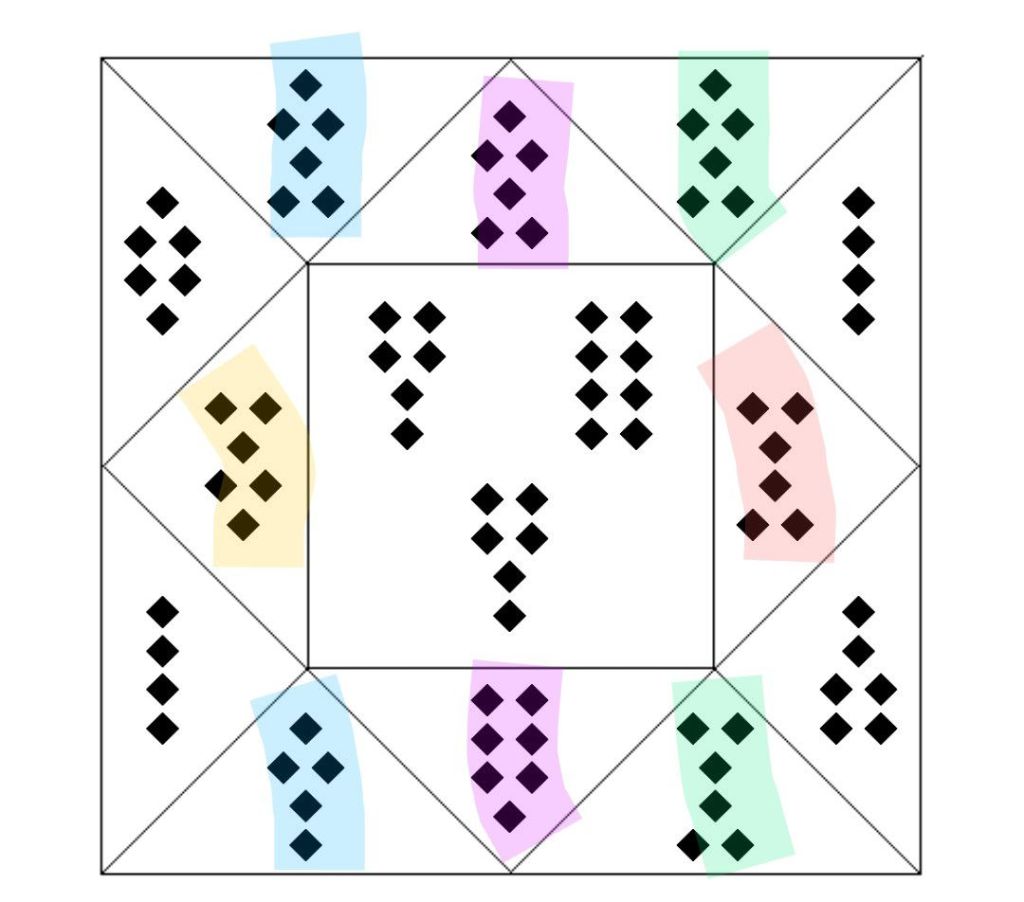
In geomancy, astrological aspects have been adapted to the chart as follows:

Astrological aspects in Geomancy (App used: Simple Geomancy)

If we take the figure in the first house (marked in yellow) as a reference point, then the figures in blue sextile it, because they are separated from it by a single sign; the figures in purple square it, because they are separated from it by two houses; the figures in green trine it because they are separated from it by three houses, and the figure in red opposes it, since it occupies the houses directly opposite.

This is supposed to shed some light on the relationship between the figures: two figures that fall into a square pattern have a difficult relationship, two figures in a trine a good one, etc.

The problem with using astrological aspects in Geomancy is that aspects work in a fundamentally different way: in Astrology, an aspect requires a planet to move in order to apply to another planet. After perfection, then, the aspect separates and its effect wanes.

Geomancy, though, is a static system with no real movement. Sure, we can say a figure moves from one house to another, but in reality that figure is already present in both houses. The only way to conceptualize movement in a geomantic chart is when we take a significator’s house to be the original position of the figure in it, and every other instance of that figure as a successive movement (e.g., in a career reading, if Laetitia is in the tenth house and in the seventh, we take it to move from the tenth to the seventh and not vice versa).

I am honestly not convinced that astrological aspects can find a meaningful place in geomancy. They certainly cannot bring matters to perfection, otherwise everyone would always be separating from their partner since the figure in the seventh house always opposes the figure in the first. Similarly, everyone would always get along with their siblings since the third house always sextiles the first.

One possibility which has been suggested is that of applying aspects only to figures that move. In a love reading, for instance, if the seventh figure moves to the tenth, it moves to square the querent, since the tenth house squares the first.

I personally find this application also problematic, because the tenth house represents the job, among other things, so that would mean that everytime the querent’s job is involved in their love life it causes trouble, which is a false assumption.

At most, I would take an aspect into consideration only if BOTH significators move. In the hypothetical love reading, for instance, if the first figure (querent) moves to the fourth house and the seventh (significant other) moves to the tenth, then they are in opposition to one another. Maybe they will argue. Or, if the first moves to the fourth and the seventh to the second, they sextile each other, which is good.

Even in a situation like this I am generally cautious about applying this theory. There are certain aspects of Astrology (pun intended) that simply don’t translate well to other systems of divination. You are of course welcome to try this theory on for size, but personally I believe Geomancy already has its particular version of aspects, and throwing other stuff into the mix feels more like an attempt at complicating this “brief and simple science” to find something more to tell the querent.

MQS

Tarot Encyclopedia – Knight of Coins or Pentacles

(Note: this is a collection of the meanings attributed to the cards by some occultists in the past centuries. It does not reflect my own study or opinion of the cards. It is only meant as a quick comparative reference as I develop my own take.)

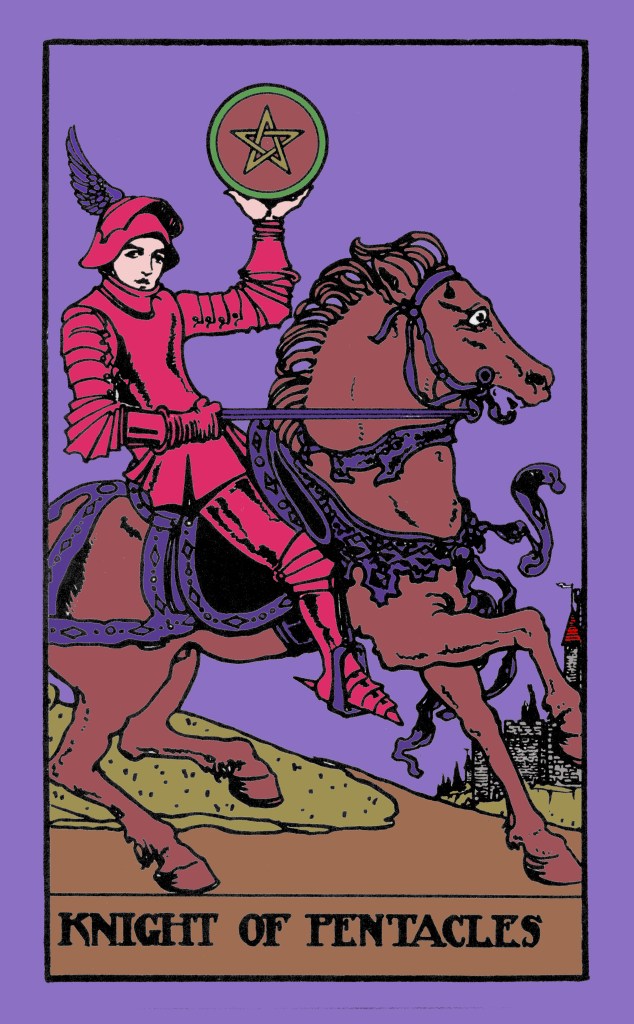
The Knight of Pentacles from the Builders of the Adytum (BOTA) tarot deck

Paul Foster Case (and Ann Davies)

The time period is from the beginning of the third decanate of Leo to the end of the second decanate of Virgo, August 13 to September 12. This period is under the rulership of Mars, Mercury and Saturn. Meanings: Well-Dignified: ability to use actions effectively; good mind, able to see through the veils of sense experience to their true import. In specific divination, a man younger than the King and though intelligent, somewhat matter-of-fact; not original or imaginative; good at carrying out any plan calling for intelligent action on the physical plane.
Ill-Dignified: avaricious, mean, jealous, somewhat violent and cruel. Dark brown hair and dark eyes.
(From the Oracle of Tarot course)

A. E. Waite

He rides a slow, enduring, heavy horse, to which his own aspect corresponds. He exhibits his symbol, but does not look therein. Divinatory Meanings: Utility, serviceableness, interest, responsibility, rectitude-all on the normal and external plane. Reversed: inertia, idleness, repose of that kind, stagnation; also placidity, discouragement, carelessness.
(From The Pictorial Key to the Tarot)

Aleister Crowley

(Note: Crowley and the Golden Dawn make a mess with the Kings and Knights)
The Prince of Disks represents the airy part of Earth, indicating the florescence and fructification of that element. He rules from the 21st degree of Aries to the 20th degree of Taurus.

The figure of this Prince is meditative. He is the element of Earth become intelligible. Clothed in light armour, his helmet is crowned with the head of a bull; and his chariot is drawn by an ox, this animal being peculiarly sacred to the Element of Earth. In his left hand he holds his disk, which is an orb resembling a globe, marked with mathematical symbols as if to imply the planning involved in agriculture. In his right hand he bears an orbed sceptre surmounted by a cross, a symbol of the Great Work accomplished; for it is his function to bring forth from the material of the element that vegetation which is the sustenance of the Spirit itself.

The character denoted by this card is that of great energy brought to bear upon the most solid of practical matters. He is energetic and enduring, a capable manager, a steadfast and per severing worker. He is competent, ingenious, thoughtful, cautious, ‘trustworthy, imperturbable; he constantly seeks new uses for common things, and adapts his circumstances to his purposes in a slow, steady, well-thought out plan.

He is lacking almost entirely in emotion. He is somewhat in sensitive, and may appear dull, but he is not; it so appears because he makes no effort to understand ideas which are beyond his scope. He may often appear stupid, and is inclined to be resentful of more spiritual types. He is slow to anger, but, if driven, becomes implacable. It is not very practicable to distinguish between the good and evil dignities in this card; one can merely say that, in case of his being ill-dignified, both the quality and quantity of his characteristics are somewhat degraded. The reaction of others to him will depend almost entirely upon their own temperaments.

In the Yi King, the airy part of Earth is represented by the 53rd hexagram, Kien. The commentary concerns the flight of wild geese, “gradually approaching the shore”, then “the large rocks”, then “advanced to the dry plains-the trees-the high ~ finally, to “the large heights”. It thus symbolizes slow, steady emancipation from repressive conditions.

The description is even happier than that given by the Qabalah, although in every way congruous with it. Practical considerations are never absent from Chinese thought, even at its most abstruse and metaphysical. The fundamental heresy of the Black Lodge is con tempt for “the world, the flesh, and the devil”, all which are essential to the plan of the Universe; it is cardinal to the Great Work for the Adept so to order affairs that “even the evil germs of Matter shall alike become useful and good”.

The error of Christian Mystics on this point has been responsible for more cruelty, misery, and collective insanity than all others put together; its poison can be traced even in the teaching of Freud, who assumed that the Unconscious was “the devil”, whereas in fact it is the instinct which expresses, beneath a veil, the inherent Point-of-View of each, and, properly understood, is the key to Initiation, and a hint of what seed may blossom and fructify as the “Knowledge and Conversation of the Holy Guardian Angel”. For “Every man and every woman is a star”.

But no doubt the judgment of the Adepts Exempt (for it is they who determine, under the guidance of the Masters of the Temple, all such details of doctrine) in respect of this card has been influenced by its transition from Aries to Taurus. It is too often forgotten that Taurus is the House of Venus, and that Luna is exalted therein. The new doctrine set forth in this present Essay makes the primary colour of Earth not black, but green; it insists that every Disk is a living and revolving symbol. The central thesis of the Book of the Law asserts the Perfection of the Universe. In its pantheistic conception all possibilities are equal in value; each and every Point-Event is “a play of Nuit”, as it is written in the Book of Wisdom or Folly, “Bind nothing! Let there be no difference made among you between any one thing & any other thing; for thereby there cometh hurt. But whose availeth in this, let him be the chief of all!” Liber Al. 1. 22. Or, yet more comprehensively and simply: “Every number is infinite; there is no difference.” Ib I.4.
(From The Book of Thoth)

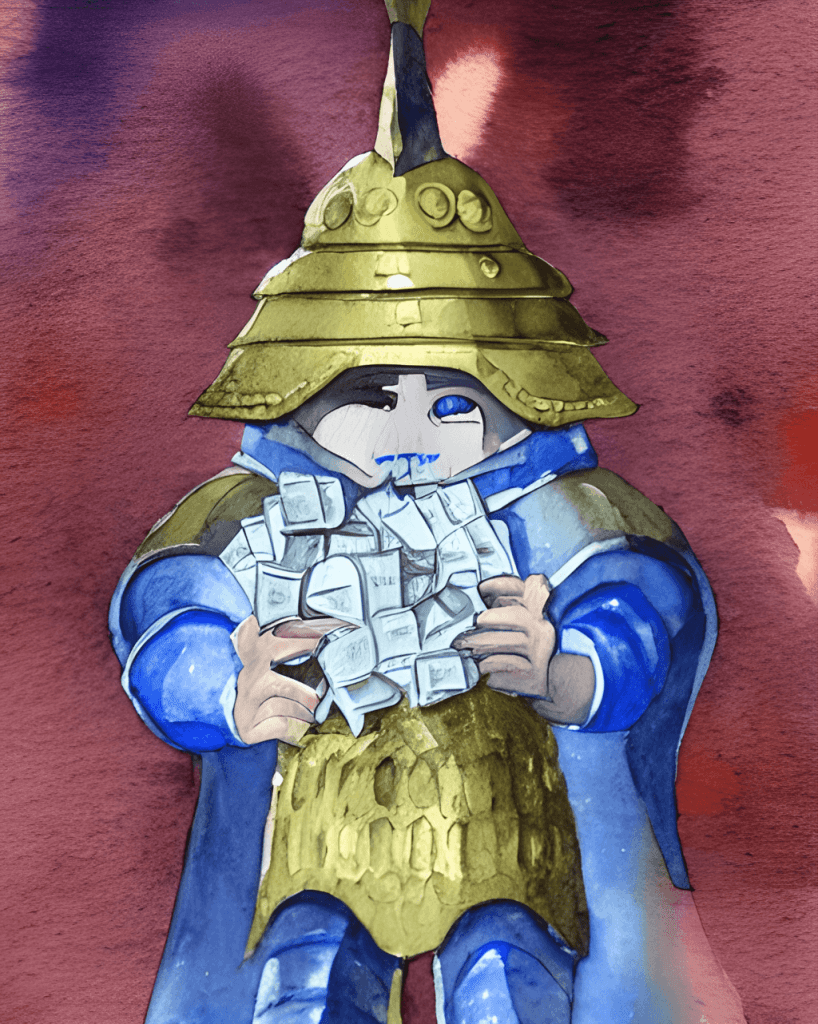
Weirdly adorable AI generated illustration for the Knight of Coins

Golden Dawn’s Book T

A WINGED Kingly Figure seated in a chariot drawn by a bull. He bears as a crest the symbol of the head of the winged bull. Beneath the chariot is land, with many flowers. In the one hand he bears an orb of gold held downwards, and in the other a sceptre surmounted by an orb and cross.

Increase of matter. Increases good or evil, solidifies; practically applies things. Steady; reliable. If ill dignified he is selfish, animal and material: stupid. In either case slow to anger, but furious if roused.
Rules from 20 Degree Aries to 20 Degree Taurus.
Air of Earth

Etteilla

Utility
Upright. This card, as far as the medicine of the spirit is concerned, means, in its natural position: Useful, Advantageous, Gainful, Profitable, Interesting. – Interesting, Important, Necessary, Obligatory.
Reversed. Peace, Tranquility, Rest, Sleep, Apathy, Inertia, Rest, Inactivity, Unemployment. – Leisure, Pastime. – Recreation, Carefreeness, Indifference, Indolence, Laziness, Poltrony, Numbness, Discouragement, Annihilation.

MQS