Tag Archives: astrology

Tarot Encyclopedia – The Ace of Wands

(Note: this is a collection of the meanings attributed to the cards by some occultists in the past centuries. It does not reflect my own study or opinion of the cards. It is only meant as a quick comparative reference as I develop my own take.)
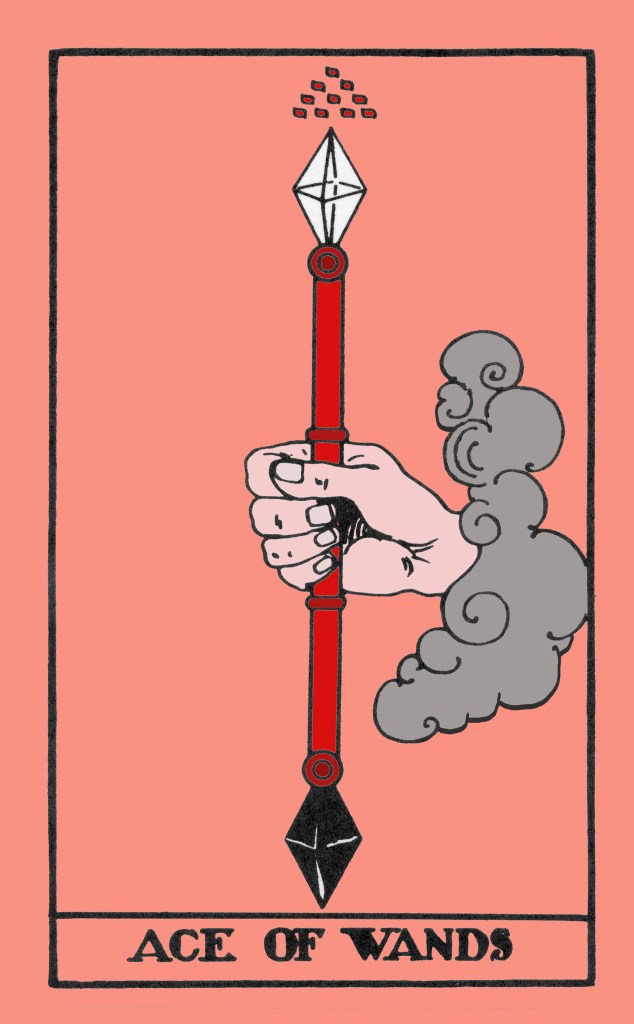
The Ace of Wands from the Builders of the Adytum (BOTA) Tarot deck

Paul Foster Case (and Ann Davies)

In Tarot Divination the Ace of Wands has these key meanings: natural as opposed to invoked force; strength; force; vigor; vitality; particularly the force of concentrated will; the principle of beginning; initiation or inception of any enterprise or activity; concentration of power; involution of force.
Keyword: Initiative
(From the Oracle of Tarot course)

A. E. Waite

A hand issuing from a cloud grasps a stout wand or club. Divinatory Meanings: Creation, invention, enterprise, the powers which result in these; principle, beginning, source; birth, family, origin, and in a sense the virility which is behind them; the starting point of enterprises; according to another account, money, fortune, inheritance. Reversed: Fall, decadence, ruin, perdition, to perish also a certain clouded joy.
(From The Pictorial Key to the Tarot)

Aleister Crowley

This card represents the essence of the element of Fire in its inception. It is a solar-phallic outburst of flame from which spring lightnings in every direction. These flames are Yods, arranged in the form of the Tree of Life. (For Yod, see Atu IX supra.) It is the primordial Energy of the Divine manifesting in Matter, at so early a stage that it is not yet definitely formulated as Will.

Important: although these “small cards” are sympathetic with their Sephirotic origin, they are not identical; nor are they Divine Persons. These (and the Court Cards also) are primarily sub-Elements, parts of the “Blind Forces” under the Demiourgos, Tetragrammaton. Their rulers are the Intelligences, in the Yetziratic world, who go to form the Schemhamphorasch. Nor is even this Name, “Lord of the Universe” though it be, truly Divine, as are the Lords of the Atu in the Element of Spirit. Each Atu possesses its own private, personal and particular Universe, with Demiourgos (and all the rest) complete, just as every man and every woman does.

For example II’s or VI’s Three of Disks might represent the establishment of such an oracle as that of Delphi, or VIII’s might be the first formula of a Code such as Manu gave to Hindustan; V’s, a cathedral, XVI’s, a standing army; and so on. The great point is that all the Elemental Forces, however sublime, powerful, or intelligent, are Blind Forces and no more.
(From The Book of Thoth)

Golden Dawn’s Book T

A WHITE Radiating Angelic Hand, issuing from clouds, and grasping a heavy club, which has three branches in the colours, and with the sigils, of the scales. The Right-and Left-hand branches end respectively in three Flames, and the Centre one in four Flames: thus yielding Ten: the Number of the Sephiroth. Twoand-twenty leaping Flames, or Yodh, surround it, answering to the Paths; of these, three fall below the Right branch for Aleph, Men, and Shin, seven above the Central branch for the double letters; and between it and that of the Right twelve: six above and six below about the Left-hand branch. The whole is a great and flaming Torch. It symbolizes Force — strength, rush, vigour, energy, and it governs, according to its nature, various works and questions. It implies Natural, as opposed to Invoked, Force.

Etteilla

Birth
Upright. This card means, in its natural position, as far as the medicine of the spirit is concerned: Birth, Beginning. – Nativity, Origin, Creation. – Source, Beginning, Primacy. – Extraction, Race, Family, Condition, House, Lineage, Posterity, Occasion, Cause, Reason, First, First fruits.
Reversed. Fall, Decadence, Decay, Decline, Decay, Decay, Dissipation, Failure, Bankruptcy, Ruin, Destruction, Demolition, Damage, Devastation. – Guilt, Error, Contempt, Abatement, Depression, Discouragement. – Perdition, Abyss, Chasm, Precipice. – Dying, Falling, Decay, Derogation. – Depth.

MQS
It’s The Economy, Stupid! (Example Reading)

This is a quick one. My husband comes from a particular family background, and as a consequence of it is often afraid of not being left with enough money despite his hard work (and he is a hard worker). As I said elsewhere, we are moving, and so expenses are popping up left and right, and I’ve noticed a certain anxiety in his eyes. Consequently, I asked the Heavens a bank statement.

My husband’s finances, Horary Astrology reading

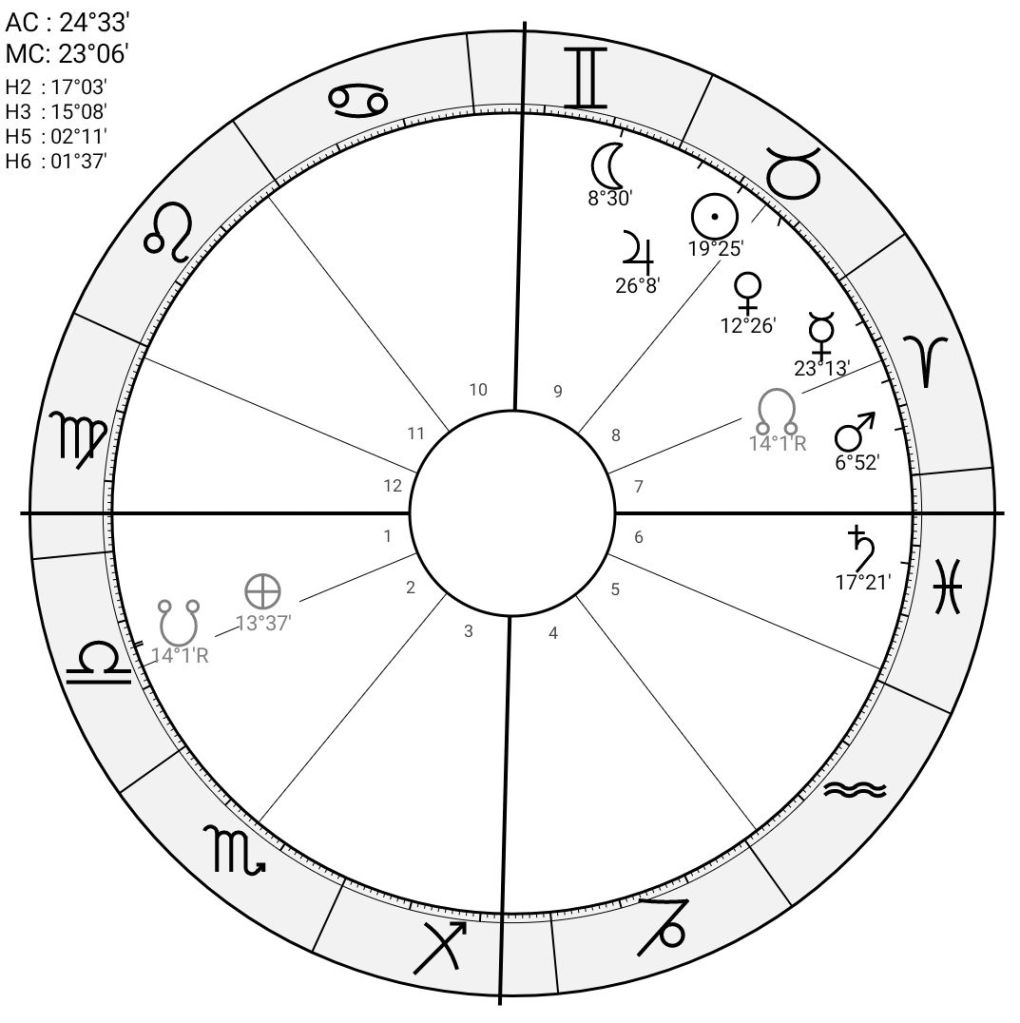
Since I didn’t tell my husband I was doing a reading, I am the querent, and he is my husband, and therefore Seventh House ruler, Jupiter. His money is represented by the second house from the Seventh, therefore the radical Eighth House, ruled by Mars.

Jupiter is peregrine in Taurus, and conjunct Caput Algol, a malefic star that, some say, is connected metaphorically to losing one’s head. Furthermore, Jupiter is combust and approaching the Sun. Therefore, my husband is under great stress.

How are his finances? Well, Mars is its sign and face, angular and inside the Seventh House, which represents my husband. So his finances are good, and they remain in his possession. This may sound silly. After all, if they are his money, of course they are his possession. Still, it is comforting to see his money in his house: he retains control over it.

I believe this wonderful Mars testimony shows that, as it were, the fundamentals of his finances are solid, i.e., there is no risk of dejection, poverty, major adversity, etc.

That being said, this does nothing to alleviate his stress. The Moon is cadent, possibly indicating that the economy is going to be slow for a while, and it separates from a positive sextile of Mars, showing a positive financial recent past, and applies to a square of Saturn. Saturn shows restriction. In other words, while there is nothing to fundamentally worry about, the next period isn’t going to be the most prosperous.

I already have a partial outcome for this reading, which was done some weeks ago. As soon as we entered the house, after a couple of days, some household utensils gave up the ghost, including the fridge, and we had to buy new ones. Since Saturn rules the Fifth house, the house’s possessions, I’m wondering if that was what it was referring to, though this is stretching it quite a bit (they are our possessions, not the house’s). Alternatively, Capricorn is the second sign on the Fourth cusp, so Saturn would generally show the house.

MQS

The Geomancy of Peter of Abano – Book I Pt. 6

Previous / Back to Index / Next

Abano explains how to judge the figures in the houses.

Furthermore you must know that when the question is asked by a person, it is not always the case that the first house goes to the questioner, according to the universal rule, but there are eight cases of people who have a special house assigned, and one must judge the question according to said houses. These are the Pope and cardinals, a prelate, the Emperor or King, a great Lord, an absent party, a bandit or thief, a servant, one who’s been chased off the home and an imprisoned thief. These you must judge according to the house that is assigned to them.1

Similarly you ought to know that those figures that are called entering are better than those called exiting, except Tristitia, which is unfortunate, and they have great positive power against the opposite figures, if they happen to fall in good houses depending on the question asked. All exiting figures are weak and don’t promise much good, except when one wants things to happen quickly. However, they are strong in evil things and when one wishes for evil things. Entering figures are those who have more points in the upper half than in the lower half, and exiting figures have more points in the lower half than in the upper half.

And if in a chart you find an entering, fortunate figure in a good house, but the opposite, exiting figure is in a bad house, the entering figure is said accidentally exiting and unfortunate. For instance, suppose that Acquisitio is in the First and Amissio in the Second. If this is the case, Acquisitio is said to be exiting and unfortunate, but only accidentally. And if it’s the opposite, i.e., Amissio in the First and Acquisitio in the Second, we have the opposite case. In the same way you must understand every other figure with respect to its opposite.2

Similarly, every exiting, unfortunate figure is strong in evil things, and every entering figure is weak against evil, except when one seeks things to be firm and late, although Laetitia, though exiting, is good and fortunate.

One must also in every chart and question see what is the first figure and that of the quesited, i.e., what qualities they possess, e.g., fiery, airy, earthy or watery, cold or hot, wet or dry, and what’s the planet of each. And according to their conformity (to one another) or their difference, so one may judge them together with the other figures depending on which is better and has the better planet, always keeping in mind the question and the querent’s desire. And every time that a figure opposite to that of the first house falls in that of the quesited, it couldn’t get any worse.3 And this same effect have Populus and Via, although both are figures of the Moon, and Minor and Major, although both are figures of the Sun.4

Additionally, one must keep in mind, in every figure and question, the geomantic figures that are assigned to each side, and see which is better and which is worse, and thus judge. The figures of the first side, i.e., of the querent, are the first, second, third, fourth, ninth, tenth and thirteenth. Those of the second side, that is, of the quesited, are the fifth, sixth, seventh, eighth, eleventh, twelfth and fourteenth. If the two parts were equally good or bad, judge by the fifteenth figure, and according to the comformity of the four angles.5

And if in any question a geomantic figure that is appropriate to that question falls in the house of the quesited, this is excellent, and if the opposite happens, this must also be judged. For instance, if the question is about travel and and Via falls in the third house it means well, and good journey. If the question is about gain and Acquisitio falls in the second it means good things and usefulness, but if it were the opposite [that is, Amissio in the second] it means the opposite. The reason for this is that the third and ninth house have, among their attributions, journeys and roads and mobility; and the second house is a good place for Acquisitio, which means gain and usefulness; and if there were a geomantic figure which means damage of delay, it means these two things. As such, we call opposite figures those whose fortune is the opposite one of the other, that is, Amissio/Acquisitio or Albus/Rubeus, and so on. And so also Via and Populus, both being mobile, but Via is quicker and good for travel by road, while Populus is slower and bodes well for travel by water.

The example we have discussed can be applied to any other question, looking for appropriate figures and houses in the way we have explained. In the example of a question of gain, if there was Amissio [in the second], it signifies what its name promises, i.e., damage and loss, and whenever you seek to obtain anything or if you ask about an absent party or a messenger or any other similar issue, and if Laetitia was in the second house, or in the house of the quesited, it means happiness and pleasure, and the obtaining of what one wishes, and good outcome. But if there was Tristitia it means the opposite, because Tristitia means problems, except in earthy and fixed things that don’t move, and these (negative) effects will be so much the more true when in the second house (or in the house of the quesited) we find this figure, or a similar figure.

End of the first book.

MQS

Footnotes
  1. There seems to have been considerable debate in the Middle Ages concerning whether the querent in horary questions was always represented by the First House or if certain people, such as kings or priests, ought to be considered according to their particular house (for instance, kings from the Tenth, priests from the Ninth). I advise against Abano’s practice. The querent is the querent, and as such is the First House. If the querent asks about the king, then the house of the quesited is the Tenth. Besides, but if the king asks about something, he is represented by the Ascendant, Abano does not explain how an absent party might ask a question without ceasing to be absent. ↩︎
  2. This passage is exceedingly obscure. It is not clear how we are supposed to distinguish good from bad houses. The second house may have been considered bad by some Hellenistic astrology due to the fact that it doesn’t behold the ascendant, but I am wondering if what Abano is referring to here is the company of houses. Alternatively, it seems that whenever a bad figure is in a bad house and said figure is the opposite of a the good one, then the bad hurts the good even if there is no contact between them. Abano says that the opposite is also true, but this seems to lead to a regressus ad infinitum. ↩︎
  3. I believe Abano is referring, as before, to figures that are the opposite in terms of points, such as Acquisitio and Amissio. However, later Abano says opposite figures are opposite in terms of fortune. ↩︎
  4. I do not understand this. Does this mean that it is bad if the said figures are in the house of the quesited? This seems hardly likely. ↩︎
  5. This passage is very interesting, as it shows the geomantic shield to be a sort of soccer field with two contenders. However, it is hard to reconcile what Abano says here with what he said before, for instance that it is better to have the fourteenth figure good than the thirteenth, because the former signifies the future. That being said, a certain digree of ambiguity about this issue is to be found in most texts on Geomancy. ↩︎

Tarot Encyclopedia – The Page of Swords

(Note: this is a collection of the meanings attributed to the cards by some occultists in the past centuries. It does not reflect my own study or opinion of the cards. It is only meant as a quick comparative reference as I develop my own take.)

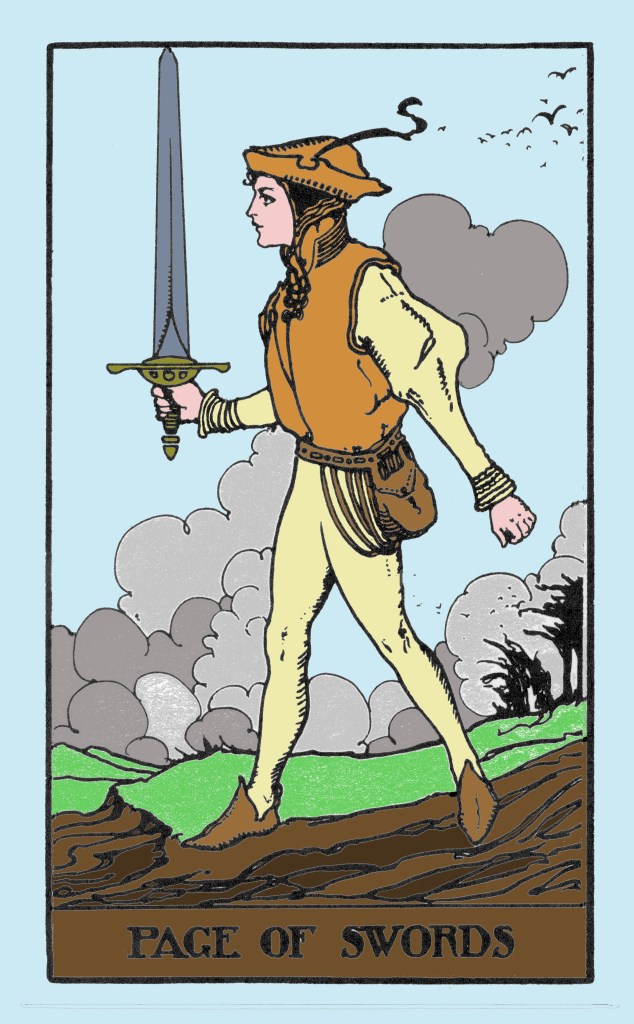
The Page of Swords from the BOTA (Builders of the Adytum) Tarot deck

Paul Foster Case (and Ann Davies)

The time period is from the beginning of Libra to the end of Sagittarius, September 23 to December 21. Meanings: a young person of either sex. Artistic, active, generous. Capable of weighing evidence, somewhat interested in occultism, philosophy or religion. Naturally aspiring, graceful.
If Ill-Dignified: frivolous, cunning and prodigal
Light brown hair and blue eyes
(From the Oracle of Tarot course)

A. E. Waite

A lithe, active figure holds a sword upright in both hands, while in the act of swift walking. He is passing over rugged land, and about his way the clouds are collocated wildly. He is alert and lithe, looking this way and that, as if an expected enemy might appear at any moment. Divinatory Meanings: Authority, overseeing, secret service, vigilance, spying, examination, and the qualities thereto belonging. Reversed: More evil side of these qualities; what is unforeseen, unprepared state; sickness is also intimated.
(From The Pictorial Key to the Tarot)

Aleister Crowley

The Princess of Swords represents the earthy part of Air, the fixation of the volatile. She brings about the materialization of Idea. She represents the influence of Heaven upon Earth. She partakes of the characteristics of Minerva and Artemis, and there is some suggestion of the Valkyrie. She represents to some extent the anger of the Gods, and she appears helmed, with serpent-haired Medusa for her crest. She stands in front of a barren altar as if to avenge its profanation, and she stabs downward with her sword. The heaven and the clouds, which are her home, seem angry.

The character of the Princess is stern and revengeful. Her logic is destructive. She is firm and aggressive, with great practical wisdom and subtlety in material things. She shews great cleverness and dexterity in the management of practical affairs, especially where they are of a controversial nature. She is very adroit in the settlement of controversies.

If ill-dignified, all these qualities are dispersed; she becomes incoherent, and all her gifts tend to combine to form a species of low cunning whose object is unworthy of the means.

In the Yi King, the earthy part of Air is represented by the 18th hexagram, Ku. This means “troubles”; it is, for all practical and material matters. The most unhappy symbol in the book. All the fine qualities of Air are weighed down, suppressed, suffocated.

People thus characterized are slow mentally, the prey of constant anxiety, crushed by every kind of responsibility, but especially in family affairs. One of both of the parents will usually be found in the aetiology.

It is hard to understand line 6, which “shows us one who does not serve either king or feudal lord, but in a lofty spirit prefers to follow his own bent”. The explanation is that a Princess as such, being “the throne of Spirit”, may always have the option of throwing everything overboard, “blowing everything sky high”. Such action would account for the characteristics above given for the card when well dignified. Such people are exceedingly rare; and, naturally enough, they appear often as “Children of misfortune”. Nevertheless, they have chosen aright, and in due season gain their reward.
(From the Book of Thoth)

Golden Dawn’s Book T

AN AMAZON figure with waving hair, slighter than the Rose of the Palace of Fire. Her attire is similar. The Feet seem springy, giving the idea of swiftness. Weight changing from one foot to another and body swinging around. She is a mixture of Minerva and Diana: her mantle resembles the AEgis of Minerva. She wears as a crest the head of the Medusa with serpent hair. She holds a sword in one hand; and the other rests upon a small silver altar with grey smoke (no fire) ascending from it. Beneath her feet are white clouds. Wisdom, strength, acuteness; subtlety in material things: grace and dexterity.
If ill dignified, she is frivolous and cunning.
She rules a quadrant of the heavens around Kether.
Earth of Air

Etteilla

Observer
Upright. This card, as far as the medicine of the spirit is concerned, means, in its natural position: Spy, Curious, Observer, Scrutinizer, Collector, Overseer, Intending. – Examination, Note, Observation, Annotation, Speculation, Account, Calculation, Conjecture. – Scientist, Artist.
Reversed. Unexpected, Suddenly, Suddenly, Suddenly. – Stunning, Astonishing, Inopinently. – Improvise, Acting and speaking without preparation, Composing and acting sitting down.

MQS

The Key Handover (Example Reading)

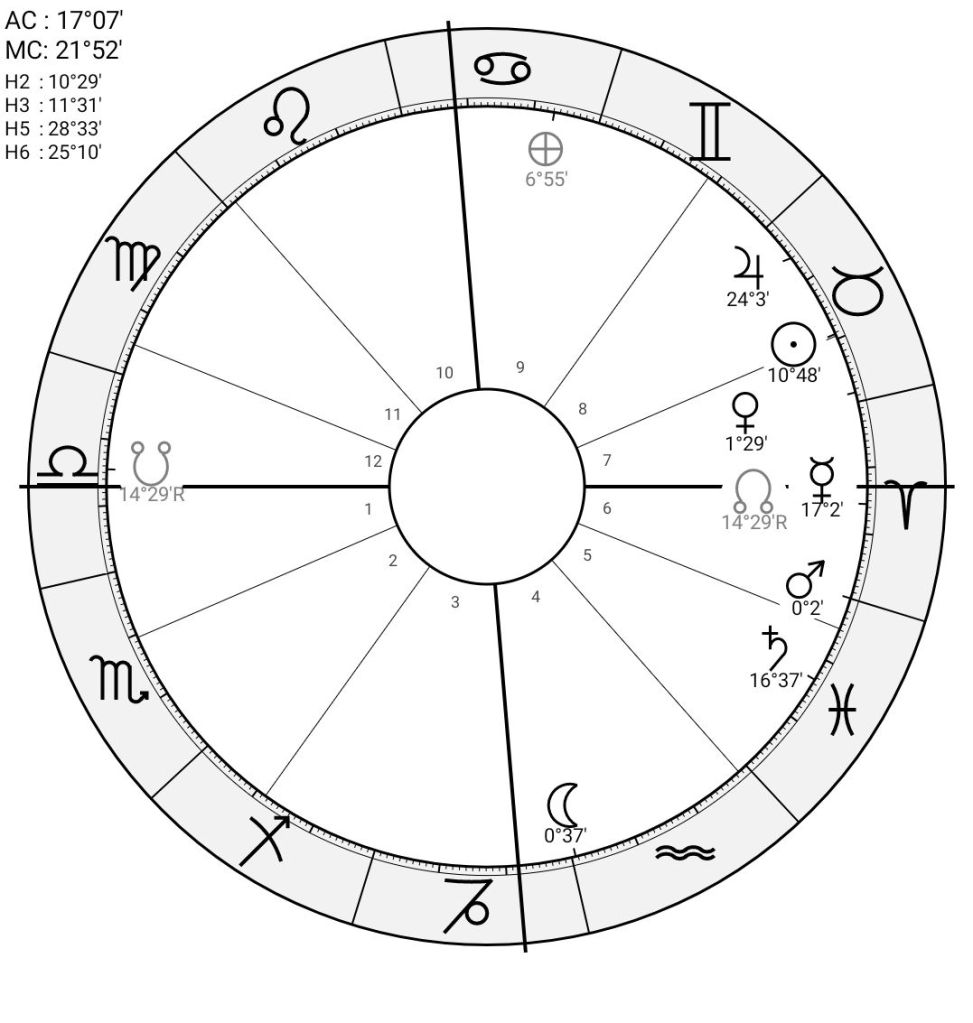
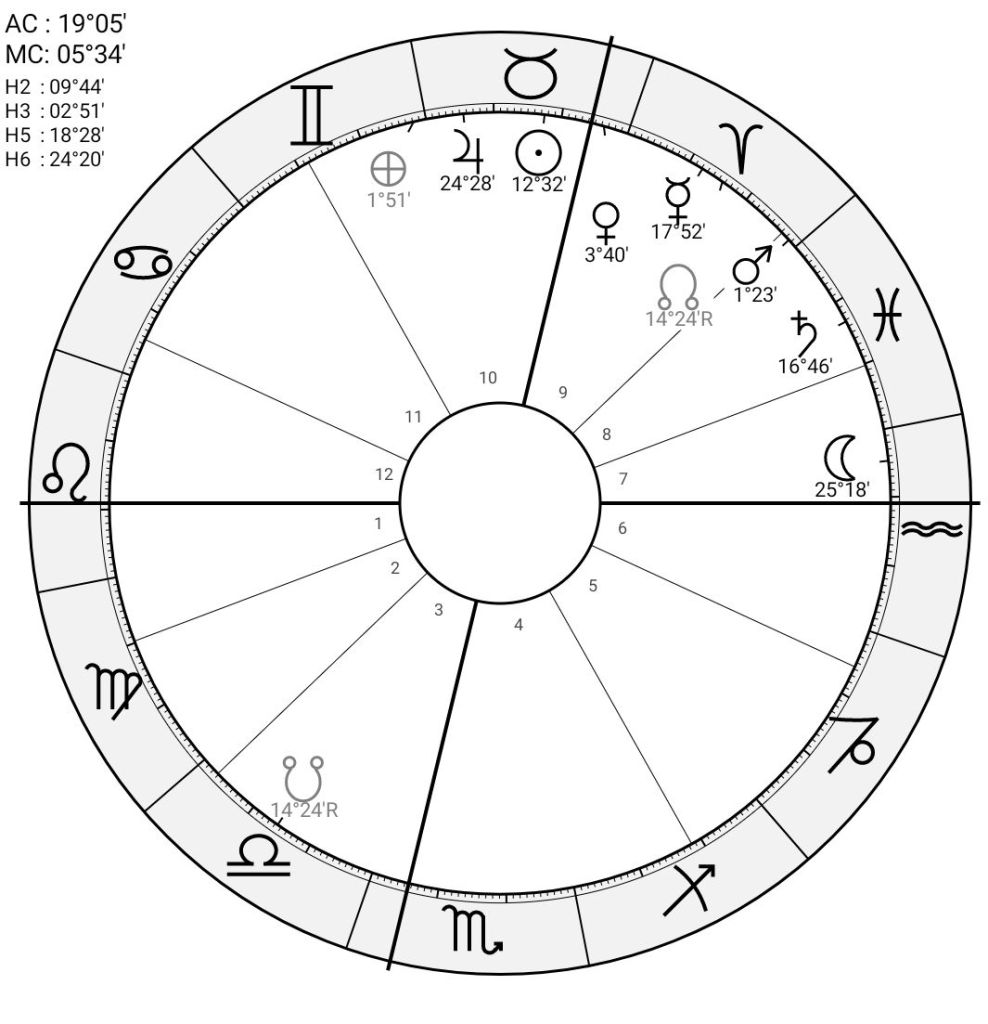
As most people reading this blog probably know at this point, we’ve recently bought our first home. A couple of weeke ago we scheduled the key handover with the previous owner, and I asked if everything would run smoothly. The result was a very interesting chart with a clear example or translation of light.

Key handover, horary reading. App used: Aquarius2go

We are represented by Venus, ruler of Libra on the Ascendant. The previous owner is Mars, ruler of Aries on the Seventh. The Moon represents action. Notice the South Node of the Moon on the Ascendant, indicating troubles.

The second thing I noticed is that both Venus and Mars have recently changed signs, and especially that Mars has moved from Pisces, the sign of Venus’ exaltation, to its own sign, and Venus has moved from Mars’ sign to her own sign. Furthermore, the Moon has also just changed signs while being in the Fourth house which represents the property.

The Moon is the most interesting factor here: she is separating from a sextile with reception of Mars (back when she was in the last minutes of Capricorn) and applies to a square with reception of Venus from Aquarius. By this translation of light the Moon shows very well the passage from one owner to the other.

A square aspect is technically a negative indication, showing either friction or obstacles. The reception, though, allows the obstacle to be overcome. In his chapter on reception, the Medieval astrologer Guido Bonatti seems to hint at the idea that a square with reception is basically like a sextile without reception, but this doesn’t seem to be the case here: a square is a square, and it shows trouble, even though reception shows the overcoming of the difficulty.

And this is what happened: the owner cancelled on us two times for other appointments that took up a lot of his time, so the handover happened (reception) but with delay (square).

NOTE: the two aspects made by the Moon were both with reception: she was received by Mars in his exaltation and then received Venus in her (the Moon’s) own exaltation, thus smoothly transfering the ‘virtue’ she had received.

MQS

Friend or Acquaintance?

In Astrology, and therefore in Geomancy, we distinguish between a friend and an acquaintance, the former being eleventh house matter, the latter seventh house. Obviously, the difference is not as clear cut as it may seem, especially in the age of social media, where all it takes to be someone’s friend is to click on the ‘add’ button.

In the old texts, both of Geomancy and Astrology, we often find examples of how to judge questions like “Will my friends be useful to me?” This may sound callous compared to our sentimental notions of friendship, but keep in mind that 1) the old notion of usefulness was broader back then, and it included everything concerned with the person’s well-being, both inner and outer 2) friends formed part of the person’s network of alliances in tackling the hardships of life 3) the eleventh house is the second from the tenth, which represents heaven, so it represents friends as wealth from heaven. Clearly friends were highly revered (just read Plato, Seneca, Xenophon or even Confucius for proofs).

As I mentioned somewhere else, my husband and I are in the process or moving, and as usual when moving, we suddenly discovered that we own three times more stuff than we thought. One friend volunteered to help us the following day, bringing us boxes and helping us with her car. In the evening though she said she didn’t know if she would make it. I cast a reading to see whether she would come:

Will she come to help us? (app used: Simple Geomancy)

Let us forget the Judge for a second and concentrate on the chart. If we take the girl as ‘our friend’ she should be eleventh house, and the eleventh house is occupied by Cauda, which also doesn’t move anywhere.

Now if my mom asked me who she is, I would say ‘a friend’. Yet she is more my husband’s friend. I am just on good terms with her, but I wouldn’t call her to spill my guts or even to ask for help, though it was of course very nice of her to volunteer.

If I take her to be my acquaintance, she is seventh house, and occupied by a more promising Conjunctio, which does spring to the second toward me. And she did end up coming.

The negative Judge, Amissio, possibly refers to the fact that we ended up losing a couple of objects due to recklessness (notice the Via Puncti reaching back to Puer in the fourth house). I also ended up losing a friend to gain an acquaintance, it seems.

MQS

The Geomancy of Peter of Abano – Book I Pt. 2

Previous / Back to Index / Next

Here Abano teaches how to cast a reading and then explains the main meanings of the astrological houses.

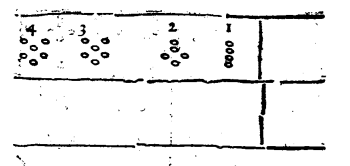
The method of forming the above mentioned sixteen figures is to use a pen to mark sixteen rows of points on a piece of paper. These must then be paired two by two, until, at the end of each row, either two points are left or only one.

Abano’s illustration of how the four mothers are formed

Then one must take the geomantic figures that emerge, in the following way.

Abano illustrates how to add the Four Mothers to their place

Note, however, that the previous operation is not carried out by counting the points one makes, nor by following one’s fancy, but rather by virtue of the Primum Mobile and First Motor God the Eternal, who moves one’s hand, and is to be carried out with good intentions and by invoking God’s grace and help.1

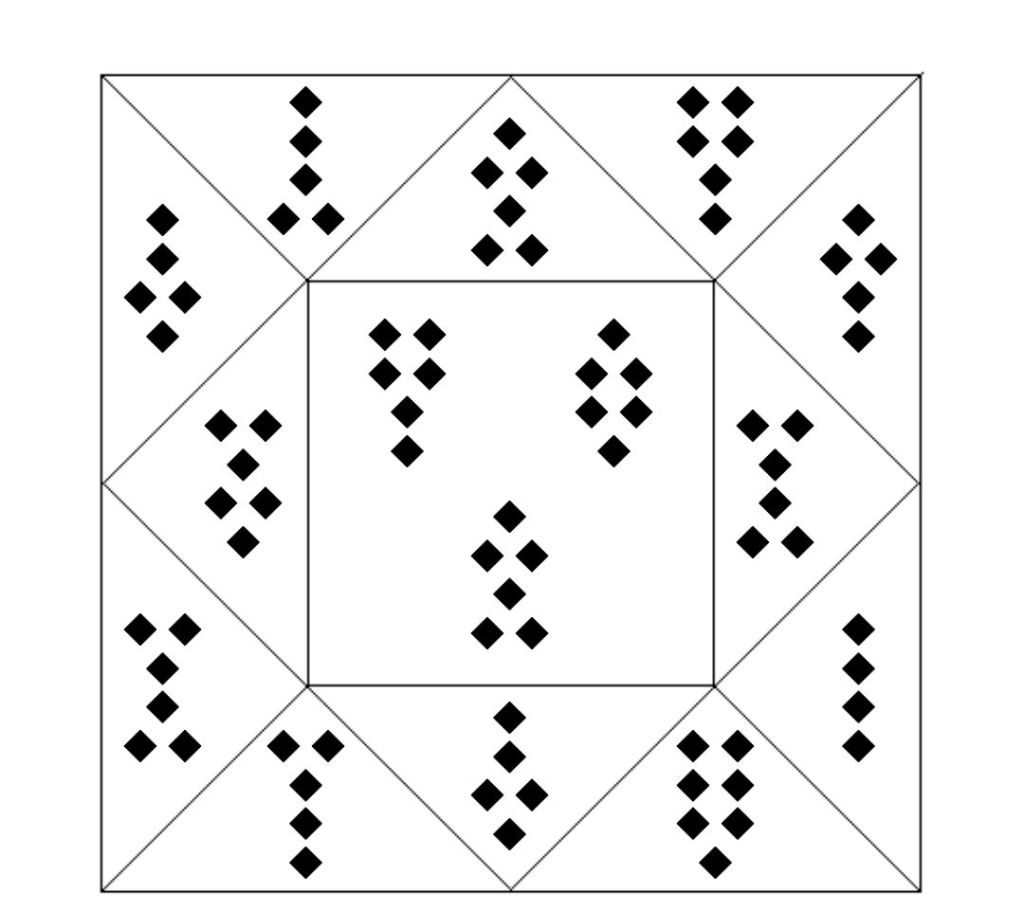
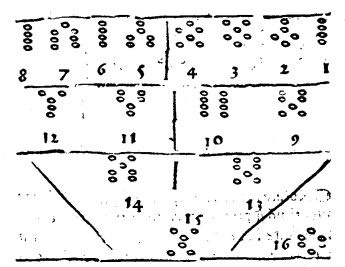
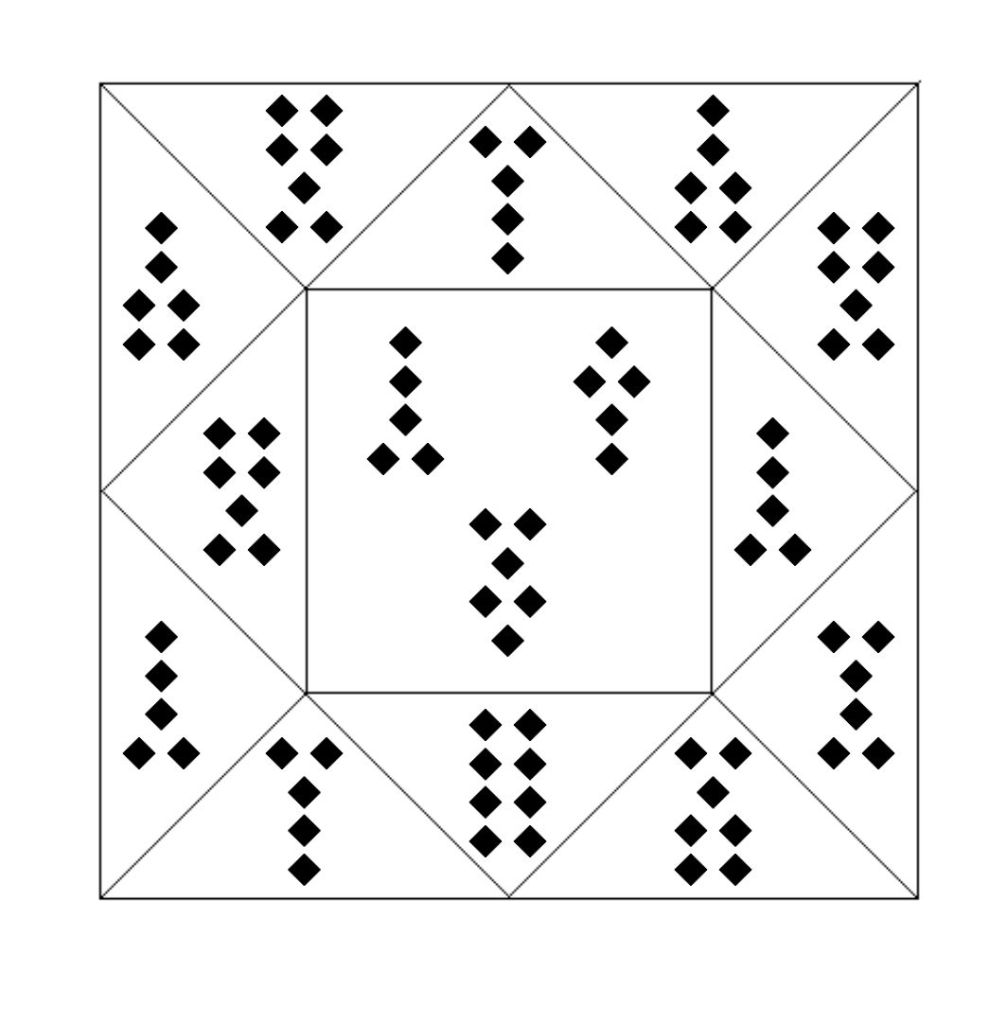
From the first four figures, four other figures are derived by taking the first points of each of the first four figures, which go to form the fifth figure; then by taking the second points of each figure to form the sixth figure, and so on with the third row of points to form the seventh, and the fourth row to form the eighth, as shown below.

Abano’s illustration of the Geomantic Shield

Once the eighth figure has been drawn, take the first and second [figure] and, proceeding in the same way as at the beginning, form the ninth; then take the third and fourth to form the tenth; then the fifth and sixth to form the eleventh; then the seventh and eighth to form the twelfth.

Then, add the tenth and the eleventh to form the thirteenth, known as the First Witness, and the eleventh and the twelfth to form the fourteenth, known as the Second Witness. Add the witnesses to discover the Judge.

This completes the chart, with every figure in its necessary place according to the question asked, as will be explained.
However, often one may take the Judge and the first figure and add them together to obtain the Judge of the Judge,2 which is the sixteenth figure, which we will discuss later.

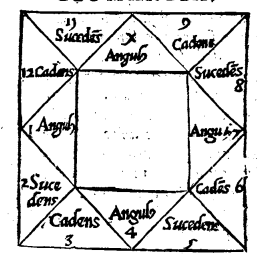
It is to be noted that the main figures are the first twelve, of which four are strongest. The first and the tenth are the best, but the first is even better. The seventh and fourth are also good. These four figures are called the angles, noting which one may know the strength and virtue of the chart. Following them, the second and fifth figure, and the eighth and the eleventh are known as succedent. Finally the last four are the third, the sixth, the ninth and the twelfth, which are called cadent, as shown in the following figure.3

Abano’s illustration of the principle of angularity as it applies to geomancy

And the first figure is called the strongest and best of all, because it signifies the virtue of the Heavens on the querent, that is, he who asks the question.4 It is called the Ascendant.
Following that, the tenth is in the middle of the heavens and has great power and influence. When it is good it bodes well, but when it is unfortunate it means great misfortune in terms of how the question is going to end.5

The seventh figure is opposite the Ascendant and is called the Western Angle, and it bodes well when good, ill when bad, especially in questions concerning the seventh house, as will be shown.
The fourth figure or house, although categorized as an angle, is called the feeblest of them, because it is at the bottom of the skies in our hemisphere. Nonetheless it indicates the end of the matter and of the querent’s intention.

Then we have the second, fifth, eighth and eleventh, which are succedent houses because they come after the angles, and are good or bad according to the figure [that falls in them] and the question asked, and they indicate the present and what is yet to come for the question asked.
The third, sixth, ninth and twelfth figure are called cadent, meaning what runs against the question, and the worst are the sixth are twelfth. The eighth is also among the evil houses.

The above is especially to be noted because every figure has two virtues, one according to its nature and an accidental virtue depending on where it falls in the chart.6 As such, if a good figure falls in the first house, its goodness is amplified, and similarly in any other angle. When it falls in a succedent house, it has less power, and when it is cadent it has even less.
And this point holds true for evil figures as well in their ability to cause bad fortune. An evil figure in an angle, therefore, will mean a great bad fortune, especially in the fourth.

Nonetheless, among the bad houses, the sixth and eighth and twelfth are the worst, and every figure falling therein is dangerous in any question.7 And they are especially dangerous if they are evil by their own nature.
Said figures are considered not just according to their virtue and the places where they fall, but also according to the question, that is, according that they are appropriate or inappropriate concerning the thing asked.8 As such, what follows is the signification and the property of each of the houses.

The first house signifies the life and body, the being and soul and intention of the querent or the one for whom the question is asked. It also means the beginning of all things. It sits opposite the seventh, and signifies the goods and money of the prisoner. It is the joy of Mercury.9

The second house is wealth,10 gain and loss, and all that the querent owns. It is opposite the eighth, and it signifies the gain of the querent’s family.

The third house indicates siblings, blood relatives, short journeys and enemies of faith and of the Roman Church,11 neighbors, etc. This house is opposite the ninth. It also signifies rumors, and travel companions. It is the joy of the Moon.

The fourth house indicates buildings, buried things, the end of every question. Also, the father, the wealth of a brother or sister.12 It is opposite the tenth.

The fifth house indicates mirth and happiness, children, messengers and letters, music, food, clothes, mid-range travel, the father’s wealth. It is opposite the eleventh and it is the joy of Venus.

The sixth house indicates wrath and an evil mind, toil, malady, servants, people who are subjected to the querent, small animals. This house is the joy of Mars.

The seventh signifies the wife,13 the lover, an opponent, public enemies, games of chance, thieves, bandits, partners. The place the querent goes to, medicine, the wealth of one’s servants. It is opposite the fist house, and is absent.14

The eighth house indicates death, fear, danger, the wealth of the enemy, inheritance from the dead, the wife’s dowry, gain from the land one moves to,15 debts, Necromancy, evil spells. It is opposite the second.

The ninth house signifies religion, Ecclesiastics, the Pope, preferment, priests, the Christian faith, burials, fame or infamy, long travels, the wealth of the absent party.16 It is opposite the third, and is the joy of the Sun.

The tenth signifies the Emperor, the King, the lord,17 great honor, a doctor, a master, art, profession, sea, ship, towers, the thing stolen, famine, fertility, the church’s wealth, and advantages gained from the church. It is opposite the second.18

The eleventh signifies friends, hopes, fortune, courtesans, a lord’s wealth, common goods, the mother’s dowry. It is opposite the fifth, and is the joy of Jupiter.

The twelfth house signifies prison, prisoners, pilgrims and endless wandering, long violence,19 adversities, traitors, occult enemies, great beasts, the friend’s wealth. It is opposite the sixth. It is the joy of Saturn.

Whenever a question is asked, the issue always involves the first house, and in the second place the figure found in the house that is appropriate for the question, and depending on whether it is fortunate or not, together with the four angles, thus does one judge the issue. And especially [it is to be considered] whether the Witnesses and Judge are good.

MQS

Footnotes
  1. Here again, as in Part 1, Abano insists on the role of the divine (and again, he does it in a typical Christian Aristotelean fashion). He is doing more than just paying lip service to the religious ideas and institutions of the time, in so much as he asserts a central point common to all forms of divination: that it is divine nature that shines through the divination process. This explains his assertion that the points must not be counted nor be created following one’s fancy: the diviner’s ego must be switched off in order for the divine to act through it. ↩︎
  2. ‘Sopragiudice’ in Italian, which literally means Superjudge or Overjudge. ↩︎
  3. Abano follows the relatively standard (by that time) association of the astrological houses with varying degrees of strength. ↩︎
  4. The first house is given to the querent, so a good figure in it would indicate something positive for them or that they are positive. ↩︎
  5. This seems intended more to emphasize the importance of the angles than to link the tenth house with the ‘end of the matter’, which is a meaning typical of the fourth house. ↩︎
  6. This is meant to reflect the notions, common in Medieval astrology, of accidental and essential dignity of the planets, though the concept must be modified a little in order for it to apply to geomancy. ↩︎
  7. There is a certain digree of ambiguity concerning this issue, as it is not always clear if a figure in a weak house will see its power decreased or its evil import amplified. This ambiguity is present in astrology as well. ↩︎
  8. This is an important concept. A good figure becomes bad if its meaning is opposite to the querent’s intention, and vice versa. ↩︎
  9. Joy is an astrological term. The joys of the planets are houses where the planets are supposed to perform their heavenly duty better. A typical attribution is: the first to Mercury, the third to the Moon, the fifth to Venus, the sixth to Mars, the ninth to the Sun, the eleventh to Jupiter, the twelfth to Saturn. Abano follows this scheme. ↩︎
  10. The term used by Abano is ‘robba’ or, in current Italian, roba. This literally means ‘stuff’. Keep in mind that in the Middle Ages, for many people, stuff was more important than money, and that the moneyed economy we have today was barely in its infancy back then. The second house indicates stuff, and therefore all moveable possessions. ↩︎
  11. Because the third house sits opposite the ninth, which is the house of God. Obviously, Abano wrote at a time when Catholicism was the dominant and (for the most part) only allowed creed. ↩︎
  12. This is by the principle of turned houses. The second house from every house indicates the wealth of the thing or person signified by that house. ↩︎
  13. or husband, if the querent is a woman or a man interested in men. ↩︎
  14. It’s unclear to me what Abano means by this. The seventh house is sometimes given to ‘the absent party’ to know if the person will come back, but the wording Abano uses is strange. ↩︎
  15. The land one moves to is ‘there’, which is the opposite of ‘here’, signified by the first house. ↩︎
  16. I don’t understand why the ninth should indicate the absent party’s wealth. ↩︎
  17. ‘Signore’ i.e., the ruler of a Signoria, a small Italian monarchy typical of the time. ↩︎
  18. Actually it is opposite the fourth. ↩︎
  19. ‘longa violentia’ ↩︎

The Spiritual Aim of Divination

I had a short but interesting conversation with a visitor of this site. He quite liked many of my articles but was somewhat perplexed by my iconoclastic attitude toward the spiritual side of divination. I think this is a good time to clarify my views further, since the reason I am so scathing is not that I hate spiritual work, but that I take it seriously.

First off, let us distinguish inspired divination from technical divination. Inspired divination is the downloading of information, as it were, from a spirit, a deity, an inner contact or some such. This depends wholly on either the inborn talent or the level of initiation of the diviner.

Technical divination works for the same reason that stones fall: because that’s how things are. One learns it the same way one learns math: they must be predisposed to it and must put in the work. Of course, one can mix the two types of divination, but they are essentially different.

Either type can be used to obtain concrete information. Either type can be used to fool yourself or others (but especially yourself). The difference is that inspired divination, especially as a consequence of initiation, has the perk that the diviner must have somewhat balanced themselves out of many of the delusions typical of the spiritual community at large. Technical divination may be just as hard for other reasons, but the counters used in the prediction are available to everyone.

From here come the hordes of tarot readers and astrologers that (believe they) are using divination for spiritual aims, or inner work, when in fact they are sinking more and more into Delululand, as most of the time they aren’t really speaking to gods or angels or ancestors but rather to their own ego (have you ever heard any tarot reader or astrologer that uses this approach say something that goes against their convictions? How come their gods or ancestors always have their same values, their same political bias, their same preferences?)

The preconception here is that divination, in order to be spiritual, must be about spiritual topics. This is as a result of two widespread phenomena: 1) most people in our society see spirituality as something separate from concrete life, something that takes place in a bubble of white light 2) most people who become interested in divination are initially interested in concrete answers, but finding that getting these is hard and not immediately rewarding, they reframe divination as ‘not really to know the future but to improve yourself’. This is at the heart of the deadly divination/fortune-telling distinction that plagues our art.

In reality, divination is an inherently spiritual practice: 1) by the mere fact of working it deflates the modern ego 2) by its ability to pinpoint how the future is likely to pan out it puts a stop to the marketable but untrue ‘you are the master of your own destiny’ nonsense 3) by showing how the intricacies of real life can be mirrored in a microcosmic mirror it teaches the diviner to rise above himself and his preconceptions and adopt a more universal standpoint 4) by proving that some things are fated it teaches the practitioner to have compassion for themselves and others and to reevaluate their priorities.

Once again, a geographic analogy could help. A traditional diviner who seeks to understand life is like one using a map of a territory to find his way around. By studying it closely the traveler can eventually form a good understanding of the land he is in. A (pseudo)spiritual approach to divination though is like that same traveler painting the map with a uniform white paint because, at the end of the day, everything is one divine unity. That may very well be, but now the traveler is lost without the map and can only sink deeper in his preconceptions in trying to picture the route.

MQS

Veggie Delivery Service! (Double reading)

Background: hubby and I are on a weekly veggie delivery service from a nearby farm. Yesterday they told us they might come a bit later than usual (normally they deliver at around 12-13pm). As hubby needed to go to work and I had a ritual to carry out and carefully timed, I needed to know that I wouldn’t be disturbed during the ceremony. So I asked when the veggies would come.

Horary Astrology

Here’s the horary chart (the time was 12:56)

Horary question: when will the veggies arrive? App used: Aquarius2go

Leo rises, so Leo’s ruler, the Sun, is my significator. The delivery service is our business partner, since we buy stuff from them and they bring it to us, so they are signified by the seventh house ruler Saturn (ruling planet of Aquarius). The veggies are their moveable possession, so they are indicated by the second house from the seventh, i.e., the eighth house, and its ruler Jupiter. The Moon is given to us as cosignificator and indicator of the flow of action.

Right off the bat we notice the Moon, weakly dignified in the seventh house, so action (obviously) starts from the delivery service. The Moon has separated from a square with reception with Jupiter, i.e., the veggies, and is now void of course. Clearly there are some problems (a square with reception is still a square). Still, there is a promising sextile (a positive aspect) between the Sun and Saturn, though it’s odd to see our significator applying to theirs (see the Outcome for why).

The Sun perfects the aspect at 17 degrees and 10 minutes of Taurus. The difference from its current position is of 4 degrees and 38 minutes, so they will come in 4 and 38 somethings. I would need to see serious testimonies to judge they won’t come. The Moon being void of course can delay them, but there is a clear aspect showing they’ll come. So they will come today, I thought.

Therefore, they will either come in 4 minutes and 38 seconds or in 4 hours and 38 minutes. I thought the second option was the most likely, so since the chart was cast at 12:56, and allowing some wiggle room for reality to follow astrology, I judged they’d come anywhere between 17.30 and 18, though I was somewhat skeptical, since this timing would have been unprecedented for them, and they’d told us they would come only a little bit later than usual. But at least this gave me plenty of time for my ritual.

Geomancy

After my ritual, which was timed for around 15 in the afternoon, I decided to have a look at what Geomancy had to say about this delivery:

Geomancy reading: veggie delivery service. App used: Simple Geomancy

The Geomantic court is positive, with the Judge Acquisitio showing we’ll get the veggies, but the Witnesses are mixed, showing problems. Albus is in the first, and it’s a good figure for commerce. A very unpromising Cauda Draconis is in the seventh house (which is also the left witness). I must say that I have seldom seen things resolved satisfactorily when Cauda is involved. However, Cauda does spring to the second house, perfecting. I was also relieved, but also a bit puzzled, to see Albus spring to the eighth, also perfecting the chart. Usually, the figure that moves makes the effort. In this case, it seems both of us will make some effort, and that our effort is better than theirs.

Outcome

They did come between 17.30 and 18 (around 17.45). However, they gave us the wrong delivery, which we only noticed when they’d already gone away. So we had to call them back and go meet them to exchange the wrong veggies for the right ones. Note how in the horary our significator applies to theirs and how, in the Geomantic chart, Albus moves to the eighth.

Lessons to be learned

1. Horary questions must not be idle, but they need not be life-changing. Knowing when a delivery service will arrive may seem idle curiosity, but I had a serious reason to want to know the answer (I take my magic work seriously)

2. The divination device, whatever it may be, ALWAYS knows best, though we may be fallible in interpreting it. People like to say that divination lets you contact your unconscious. I think there is altogether too much talk about the unconscious, and not enough talk about the superconscious. I saw from the Geomancy reading that there were problems connected with the delivery, though I could not pinpoint them exactly. In hindsight it is clear what the chart meant.

3. It is a humbling and inspiring experience to see how perfectly the cosmic mechanism works.

MQS

Tarot Encyclopedia – The Page of Coins or Pentacles

(Note: this is a collection of the meanings attributed to the cards by some occultists in the past centuries. It does not reflect my own study or opinion of the cards. It is only meant as a quick comparative reference as I develop my own take.)

The Page of Pentacles from the BOTA (Builders of the Adytum) tarot deck

Paul Foster Case (and Ann Davies)

The time pe r iod is from Decembe r 21 t o March 21, which encompasses the three signs of the winter quarter, Capricorn, Aquariusand Pisces, ruled by Saturn, Saturn- Uranus and Jupiter- Neptune.
Well-Dignified: good command in practical matters; ability to see the
principles be hind physical plane situations and phenomena; a young person of either sex, friendly to the Querent. Usually a friendly disposition with some leaning to the occult or a touch of psychic ability
in the make-up. Generous, diligent, compassionate.
lll-Dignified: more or less in bondage to material matters; inability to see beyond physical plane phenomena . A young person unfriendly, dull, wasteful, thoughtless, self-centered. If interested in the occult, it is usually for the sake of furthering selfish ends.
Dark eyes and rich brown hair.
(From the Oracle of Tarot course)

A. E. Waite

A youthful figure, looking intently at the pentacle which hovers over his raised hands. He moves slowly, insensible of that which is about him. Divinatory Meanings: Application, study, scholarship, reflection another reading says news, messages and the bringer thereof; also rule, management. Reversed: Prodigality, dissipation, liberality, luxury; unfavourable news.
(From The Pictorial Key to the Tarot)

Aleister Crowley

The Princess of Disks, the last of the Court cards, represents the earthy part of Earth. She is consequently on the brink of transfiguration. She is strong and beautiful, with an expression of intense brooding, as if about to become aware of secret wonder.

Her crest is the head of the ram, and her sceptre descends into the earth. There its head becomes a diamond, the precious stone of Kether, thus symbolizing the birth of the highest and purest light in the deepest and darkest of the Elements. She stands within a grove of sacred trees before an altar suggesting a wheatsheaf, for she is a priestess of Demeter. She bears within her body the secret of the future. Her sublimity is further emphasized by the disk which she bears; for in the centre thereof is the Chinese ideogram denoting the twin spiral force of Creation in perfect equilibrium; from this is born the rose of Isis, the great fertile Mother.

The characteristics of an individual signified by this card are too various to enumerate; one must summarize by saying that she is Womanhood in its ultimate projection. She contains all the characteristics of woman, and it would depend entirely upon the influences to which she is subjected whether one or another becomes manifest. But in every case her attributes will be pure in themselves, and not necessarily connected with any other attributes which in the normal way one regards as symbolic. In one sense, then, her general reputation will be of bewildering inconsistency. It is rather like a lottery wheel from which the extraction of any number does not predict or influence the result of any subsequent operation. The fruit of the Philosophy of Thelema is enjoyed, rare, ripe, nourishing and vitalizing at its highest and fullest in this meditation; for to the adept every turn of the wheel is equally probable, and equally a prize; for every Event is “a play of Nuit”.

In the Yi King the earthy part of Earth is represented by the 52nd hexagram, Kan. The meaning is “a mountain”; of how sublime a significance is this Chinese doctrine of Balance, and how closely congruous with that of the Holy Qabalah!

The mountain is the most sacred of all terrestrial symbols, stark, rugged, and immoveable in its aspiration to the Highest, thrust up as it is by the Titan energy of Hidden Fire. It is no less an hieroglyph of the Inmost Godhead than the Phallus itself, even as Capricornus, the sign of the New Year, is exalted in the Zodiac, its deity autochthonous no less than the Most Holy Ancient One himself.

It is essential for the Student to trace this doctrine for himself in every symbol: Air, the elastic and flexible, yet all-pervading and the element of combustion; Water, fluid yet incompressible, the most neutral and composed of all components of living matter, yet destructive even of the hardest rocks by physical assault, and irresistible in its burning power of solution; and Fire, so kin to Spirit that it is not a substance at all, but a phenomenon, yet so integral to Matter that it is the very heart and essence of all things soever.

The characteristic of Kan in the Yi King is rest; each line of the comment describes repose in the parts of the body in turn, and their effects; the toes, the calves, the loins, the spine, and the jaws.

This chapter is a close parallel in this respect, line by line, with the 31st, Hsien, which begins the second section of the Yi.

The Rosicrucian doctrine of Tetragrammaton could hardly be more adequately stated-to every ear that is to heavenly harmony attuned.

“There’s not a planet in the firmament
But in his motion like an angel sings,
Still quiring to the young-eyed cherubim;
But while this muddy vesture of decay
Doth wrap us round, our nature cannot hear it.

Let every student of this Essay, and of this book of Tahuti, this living Book that guides man through all Time, and leads him to Eternity at every page, hold fast this simplest, most far-reaching Doctrine in his heart and mind, inflaming the inmost of His Being, that he also, having explored each recess of the Universe, may therein find the Light of Truth, so come to the Knowledge and Conversation of the Holy Guardian Angel, and accomplish the Great Work, attain the Summum Bonum, true Wisdom and perfect Happiness!
(From the Book of Thoth)

A medieval looking AI-generated illustration for the Page of Pentacles

Golden Dawn’s Book T

A STRONG and beautiful Amazon figure with rich brown hair, standing on grass or flowers. A grove of trees near her. Her form suggests Hebe, Ceres, and Proserpine. She bears a winged ram’s head as a crest: and wears a mantle of sheepskin. In one hand she carries a sceptre with a circular disk: in the other a Pentacle similar to that of the Ace of Pentacles.
She is generous, kind, diligent, benevolent, careful, courageous, persevering, pitiful.
If ill dignified she is wasteful and prodigal. She rules over one quadrant of the heavens around the North Pole of the Ecliptic.
Earth of Earth

Etteilla

Brown-haired boy
Upright. This card, as far as the medicine of the spirit is concerned, means, in its natural position: Brown-haired Boy, Study, Instruction, Application, Meditation, Reflection. – Work, Occupation, Apprenticeship. – Schoolboy, Disciple, Pupil, Apprentice, Amateur, Student, Speculator, Shopkeeper.
Reversed. Profession, Superfluity, Width, Luxury, Lavishness, Magnificence, Abundance, Multiplicity. – Liberality, Beneficence, Generosity, Beneficence. – Crowd, Multitude. – Degradation, Dilapidation, Squandering, Dissipation.

MQS