Tag Archives: astrology

Get Out And Read!

When it comes to divination, theory can only get you so far. The best way to improve your reading skills is to learn the basics of a *valid* system and then start reading.

For most of us, we are our own first querents, and that is a problem. I don’t have a 100% accuracy record when reading for others, but I barely reach 60% when reading for myself, especially if I’m invested in the topic. It is not just a matter of wrong interpretation, which can and does happen. I am more and more convinced that sometimes, when we read for ourselves and we are not perfectly at peace, we tend to get readings that reflect what we think rather than what is happening or will happen.

Furthermore, the tendency that many people have to start obsessively putting questions to the cards just to see if they say something vaguely understandable (which doesn’t mean true) is dangerous, and can get us in a warped frame of mind.

I know that for many, especially coming from certain societal backgrounds, reading for others can be a big step into the unknown, but I would advise anyone to start reading for some sympathetic friends or relatives (and when I say for them I mean in front of them, not asking questions about them) and then to graduate as soon as possible to readings for people we don’t know or know little about.

I don’t have too many friends, but they do a good job of talking about me to their friends and to their friends’ friends, which is how I get my supply of test anim-ehm, querents. If you start reading for your friends and ask them to spread the word the same will happen to you.

The cool thing about reading for people we don’t know is that it is so much easier than you might think. Divination DOES work! And divining for someone when there is no chance of you knowing the information in advance is very impressive for them and very satisfying for us as diviners. It will build your confidence much more quickly than torturing the cards about your own mental dramas. Plus, the oracles always seem to be much clearer and much more crisp when I divine for strangers.

One thing I would advise is to be as scientific as possible: record the question, the reading, your interpretation and the results. Don’t think you cannot build your vocabulary because the only right answer is the one offered to you by your intuition. 99% of intuitive readers are terrible, and what they call intuition is not actual intuition: it’s their stupidity echoing in the empty chambers of their mind. Be systematic and slowly you will gain experience.

MQS
Intuition – Do You Need The Gift of Prophecy?

I received a really sweet message from a fledgling occultist who wants to pick up some form of divination, but has been put off so far because they have been convinced that they don’t have “the gift”, as they put it, by which I think they meant intuition.

It is a fact of life that a certain predisposition can give you a head start. My high school chemistry teacher could explain to me every single step of how to balance a formula, and I would sort of understand it, but then, left to my own devices, I would still get it wrong. I certainly didn’t have the gift for it. But that doesn’t make chemistry hoplessly outside of my reach. If I had persevered instead of throwing my hands up and saying “oh well, at least I can read Plato in Greek” I would have definitely made some progress. It’s just that in life you’ve got to pick your battles, and I knew I wasn’t the next Marie Curie, and I did like Plato, so Plato it was.

The same holds true for the various esoteric disciplines. The kind of gift that is required to practice them is not different from the predisposition toward high school subjects. Yet there is this widespread belief something more is needed. Well, it isn’t needed.

Oracles, i.e., the various forms of divinations, are languages, and like all languages they require study and practice. The idea that all it takes is intuition is a result of the loss of understanding for occult practices that resulted from the scientific revolution, which confined anything that wasn’t understandable in terms of the rising empiricism to the realm of irrational superstition.

This new designation was either consciously or unconsciously accepted by those practicing divination, so divination became something irrational that requires non-rational tools to be practiced. This, in spite of the fact that, wherever you look around the world, and even in the West before the Enlightenment, divination is considered to be primarily made of rules to be studied and applied with intelligence.

True divination, like all parts of magic, is hopelessly technical. It has nothing to do with following your heart, much less your intuition. Speaking of which, actual intuition is a much more sacred thing than the “I can’t prove it but I know it’s true” that many make it out to be. “I just feel this is how it is” is how cults get started, which is probably why so many people who describe themselves as intuitive are so up their own asses and so full of unconscious prejudices.

That is not intuition: it is personal bias subtracting itself from scrutiny. Actual intuition is the prerogative of the great saints, and only to a lesser extent of people who are on a spiritual/esoteric path. It is rare and cannot be commanded. It is the result of brief moments of perfect union with the source of all, and for that reason it comes from outside the limitations of the individual vessel. What many call intuition are simply personal hunches that they cannot trace back to any line of reasoning.

And mind you: hunches ARE a thing. They can work, and sometimes they can help. They can also fail. Many people seem to believe that ‘intuition’ is never wrong. And fair enough, the intuition I talked about is in fact never wrong. But personal hunches CAN indeed be wrong, in the same way that a logical inference can be wrong: hunches, like reason, the senses and all other channels humans use to gather information, are fallible. The fact that many think their hunches are never wrong is simply the result of confirmation bias: if they concentrated on how often their hunches let them down on a daily basis they’d be crushed.

Another use of the term intuition is simply a cooler way of describing the facility that comes from experience. The experienced doctor comes in, eyeballs you, listens to a couple of your complaints and knows with a high degree of probability what is wrong with you. The experienced mechanic listens to the purr of your car and knows immediately it will break down in two weeks if you don’t do something about it.

That’s also not intuition, although it is far more valuable than what average psychics do. It is simply the result of having gone through the same process so often that you can skip some of the steps, at least consciously. It is the intellectual version of muscle memory.

So, can anyone become a diviner? Let me answer with a question: can anyone become a chemist? Well, no. If we all could, the human race would go extinct. But the only thing keeping you from studying chemistry is your decision and perseverance. So is with divination.

MQS

Calling Other People’s Demons By Name

In many supernatural movies about exorcism, the priest trying to free the victim needs to discover the demon’s name. This is actually founded in (part of) the real practice of exorcism and does have its roots in the magical belief of the power of names. For instance, there are certain practices in folk magic in Italy that require the magician to go to the christening of a child whose name translates to the effect he or she wants to achieve.

But belief in the power of names is not just found in Italy and it probably goes back to the most ancient and elemental relationship that humans established with the things around them in their attempt to dominate them. Traces of this fact are found in the doctrines of many Greek philosophers, sophists, poets and playwrights, and I have also found some similarities with Chinese Daoist literature. A wonderful fictionalized account of this belief is found in Ursula LeGuin’s Earthsea saga, which anyone interested in magic should read, in my humble opinion.

I am not one who seeks to psychologize occultism, although I believe that psychology is not at all a useless discovery and can be part of a modern magus’ training. I think that the attempt to reduce occultism to psychology is just as misguided as the attept to condemn anything that modernity has brought us as a deviation from an ancient splendor.

That being said, as someone who practices divination for others, there is also a certain sense in which naming works in a cathartic way. Most of the people that consult me are rather upfront about their problems, especially since I don’t ask for money and therefore feel no guilt in telling them to go sit on a cactus if they are trying to waste my time.

But people can be reticent about their issues for a variety of reasons, and malice is not always the motivation. Among the many possible reasons is the fact that people sometimes feel the need to have their demons driven out of them by someone outside of their regular field of experience.

Having someone discover our particular demon’s name without us feeding it to them can be a powerful and cathartic experience, because it smokes the demon out of the dark recesses of our subjective experience and into the light of objectivity, where it can be addressed as a definite and therefore limited issue, rather than being consumed by its overwhelming lack of contours.

Not every divination session calls forth such existential experiences, nor should we as diviners try to turn each session into a catharsis. We are not therapists and our duty is not to give people advice, although advice can certainly be given if required. Our role is to provide information, whatever that may mean in the context of each particular reading. For this reason, our language and that of our divination tool needs to be earthly, concrete and objective.

But sometimes informing the querent can mean gathering the diffuse knowledge that they already have festering inside of them and turning it into useable information by giving it its proper name.

MQS

Tarot Is Not Deep (and Its Limits as a Tool for Self-Reflection)

I always bring up poor Rachel Pollack whenever I need to give a paradigmatic example of someone who utterly ruined tarot divination by turning it into a heap of psychobabble, though in reality the list is quite long. At some point, it was decided that 1) divination could not be a serious undertaking in an age of reason, and 2) we still wanted to think our illustrious predecessors who bought into it were not poor saps. The compromise therefore was that there was something deeper to divination, and so divination had to be reassessed and purged in accordance to this new ideology of ‘depth’ or *shudders* ‘wisdom’.

The reality is that in the “I’m too special for religion but wouldn’t it be fun if there was something more to life” community, where most people tend to think exactly alike in spite of how different they think they are, depth is a misunderstood concept.

Something is considered deep if it will allow them to talk themselves or others silly while giving them plenty of safe thrills and predictable a-ha moments by hurling around the latest buzzwords (try finding a tarot reader who doesn’t talk about narcissists, gaslighting or inner truth).

Thankfully, the tarot is not deep, just like playing cards–and tarot cards ARE playing cards–or tea leaves or dice or geomantic figures are not deep, which is what makes them marvellous divination tools. Even astrology is not deep by today’s standards, if by astrology we mean astrology in its traditional forms (Hellenistic, medieval, Chinese, etc.)

But the depth that is found in divination, just like the depth that is found in all other branches of magic, has nothing to do with finding abstract meanings or deep doctrines that move us beyond real life. Although there can be space of deep philosophy, the real depth is found in the shift in our consciousness of existence and of our place in it as we practice it concretely and see its concrete impact on real life.

I will forever be grateful to my GD supervisor, who always insisted that I practice tarot in real life and not as a mere metaphysical plaything (people will be surprised by how concrete the GD tarot system is, in spite of its metaphysical underpinnings). Traditionally, in magical practice, people are advised on how to recognize when they have established contact with an entity other than themselves.

The risk is sometimes that of contacting parasites masquerading as great beings, but the even higher (and more common) risk is that of simply contacting one’s ego. Psychic onanism IS a thing, and a much worse vice than the physical counterpart.

This is what limits, in my view, the potential for tarot as a tool for self-reflection or meditation or scrying. Granted, most symbols can be used as doorways for these aims, and therefore also the tarot. There is some value to it, especially when done under supervision or with the proper frame of mind. There is also some value in allowing symbols to bring certain aspects of oneself to the surface, if one has the necessary detachment.

Wisdom is a great thing, and it is something that can be pursued on the path of magic, including divination. But more often than not, those who are too good for simple divination and want to discover the “deeper layers” of the tool simply end up massaging the shallower parts of their own psyche without realizing it, and often even thinking they are making some kind of psychological or occult progress when in fact they are simply digging themselves a deeper hole in their own ego.

MQS

The Neighbors (Update on Reading)

In this article I discussed a horary reading I did for myself on whether the new house we moved to would be good. My interpretation was that the house was generally good, but that there might be problems with the neighbors due to Saturn, ruler of the third house, afflicting the cusp. It turned out that the neighbors were normal people, it seemed, and that there was a problem with the manager.

Well, that was until last week, when the new manager contacted my husband, who represents the homeowners, to tell him that one of our neighbors hasn’t been paying his share of the bills for some months. Hopefully we won’t have to end up in front of a judge, but it is turning out to be quite an annoyance.

There is a small lesson to be learned, I think, from this whole thing. Often when I read for others, they contact me after a week telling me that they were excited about the prediction but nothing has come to pass. It is easy, right after a reading, to forget that readings can take months (sometimes many months) to materialize.

This is also where we, as readers, need to be honest with the querent. It is easy to turn our sitters into addicts hanging on to our every word, asking for a reading on whether they should shift their weight on their right or left ass cheek when sitting on the toilet, needing to be reassured every week of what we are saying.

Personally, I rarely accept to redo readings unless enough time has passed, or unless something absolutely new and unforeseen comes up that I hadn’t predicted. Still, it is normal for querents (and for us, when we are the querent) to assume that the first thing that happens is the materialization of the final result instead of a step in its unfoldment.

MQS

Why I Don’t Do Horoscopes, Taroscopes Or Interactive Readings

Some weeks ago I got asked why I only present readings I did for myself or others, and don’t do interactive readings which may be useful to more people. The question was asked in good faith and in good faith I answered. But I thought it made for a nice article. As usual, I will be brash and abrasive, because I’m not an easy person, but I mean no disrespect to any particular individual.

Horoscopes. In reality, horoscopes are more the invention of journalists than of astrologers: astrologers just unwittingly lent themselves to the farce. Horoscopes are predicated on the fundamental misunderstanding that the place the Sun occupies at birth automatically has something to say about us. This is a relatively modern invention in the long history of astrology, and anyone who thinks about it seriously for even five minutes must conclude that, in order to say anything at all about one twelfth of the world population purely based on their month of birth, one needs to water down everything one says to the point that nothing is said at all except playing into the belief that everyone is adorably quirky (oh those Aries boys who ram through everything, oh those Gemini girls always being nutty). That some astrologers, realizing this, feel the need to add Moon signs, Rising signs etc. into the equation does not improve matters at all: a fundamentally silly idea multiplied by itself remains silly.

Taroscopes. Taroscopes are an even more modern invention. They substitute or complement the reading of a sun sign chart with a broad card reading (usually tarot, hence the name). They started popping up on social media some ten years ago as a way of feeding the sludgeflow of nonsense that is required to keep the algorithm satisfied. I am pretty sure they started out as a silly game, then some saw that it was good for business. I am even aware of established readers who haughtily denounced taroscopes for the travesty of divination that they are, only to bend the knee once it was clear the current flowed in one direction only.

Interactive Readings. Interactive readings are the height of silliness, and the perfect exemplification of the words ‘internet slop‘. Choose between Deck One and Deck Two and listen to why he doesn’t deserve you because you are such a special, intuitive an free-minded queen. Choose between the butterfly and the butter knife and listen to why all the narcissists in your life hate you for being such an authentic empath (somehow those buying into this nonsense are always surrounded by narcissists, yet they are never narcissists themselves). That’s the essence of interactive readings as a further development from taroscopes.

The reality is that divination is already hard as it is, being an imprecise and complex art due to the amount of factors to be considered and the fallibility of humans in considering them. Trying to extend it to a whole swath of people who randomly happen to bump into your video or post is beyond ludicrous.

In attempting to justify this to themselves, some readers are eternally caught between two stances: “if you bump into it, it is meant for you” and “if it doesn’t resonate it’s not the right message”, logic being the first thing to fly out the window once someone decides to be a brave and empowered little witch. Of course you’ll always find someone who responds to an interactive saying “I chose the butterfly. That’s exactly it, that’s me to a T”. And those are the unlucky ones, because they get roped into a world of self-delusion and meaningless hype: the universe seems to be constantly cooking up something big for you, according to interactive readers, so you better stick around for the next video!

So yeah, that’s why I stick to traditional readings.

MQS

Frenzy or Stillness? – The Appropriate Behavior in Divination and Magic

The way we do things, the way we say things, matters. The same apologetic arguments we find in Blaise Pascal’s most feverish and haunting pages would be enough to bring a doubter to conversion, yet when coming out of the lips of a cheap street preacher holding a sign, they are often received with distrust, when not with disgust.

The way we do and say things matters in occultism as well. The old texts of magical tradition, and even some old accounts of rituals and supernatural occurrences, are full of the frenzy-stillness dichotomy: some things seem to happen in a state of ecstasy, others in a state of torpor.

My path, both as diviner and as occultist, has been informed by the pursuit of stillness more than by that of frenzy. All the teachers I’ve had the honor to learn from have always required of me to reach a state of calm rather than one of heightened overexcitement.

In divination, there is always a moment of randomness required in order to break the barrier between what the personality thinks it knows and what is actually the case. Arranging the cards (or geomantic points, or whatever) consciously in the order we wish they would come out may teach us something about ourselves, but very little about the reality of a situation. Randomness ensures that our self-consciousness doesn’t interfere with the process of allignment between oracle and reality.

Whether through a frenzy or through calmness, randomness introduces itself into the process by bypassing the limits of our personality’s structure, with its limits and its biases. The choice between the “inspired” moment of frenzy and the “deadened” moment of calm rests on a partially different view of the relationship between individual and whole, between ourselves and the divine.

Ecstasy, which is the process of leaving oneself behind, occurs in both cases, but it occurs differently. By achieving a drunken confusion one simply rams through the walls of one’s personality, achieving contact with what is outside of it. By stilling oneself, one reaches the point within one’s core where individual and divine coincide.

Obviously, once each option is brought to an extreme, it bleads into its opposite. Pure frenzy becomes absence of limits and therefore absence of what is limited, and its movement resolves itself in calm. Pure calm is delivered from all difference from change, so it coincides with pure frenzy.

MQS

Collection of Light in Astrology (with Example)

In another article, I discussed the technique called translation of light, which occurs when a planet collects the influence of one significator and translates it to the other.

There is another technique which is, in many ways, the opposite of translation, but has the same effect. This is called collection of light. It happens when a slower-moving planet has been in contact with a faster one, thus receiving its influence, and then another planet also comes into contact with the slow planet. Contact can happen by conjunction or by (usually) positive aspect, that is, sextile or trine, or at least with reception. As with translation, collection usually implies the presence of third parties or external circumstances bringing things together.

Whereas translation can only be effected by a fast planet, and therefore the Moon (or sometimes Mercury) is the most likely culprit, collection of light can only be caused by a slow planet, and therefore Saturn or Jupiter are the most likely intermediaries here.

Example: Is The Book Arriving At All?

My Bolognese Tarot teacher, who is now a good friend, has recently written a follow-up to her book on the 50-card method, and she wanted to send me a dedicated copy. She posted the parcel before Christmas 2024, but by January 6 it hadn’t arrived and I was worried it might have been lost or forgotten in some dispatchment center. So I asked the heavens.

Is the gift arriving at all? App used: Aquarius2Go

I am signified by Mercury, ruler of the ascendant. My teacher sent me the book in her quality of personal friend (it wasn’t part of a course or anything), so she is signified by the Eleventh House ruler, the Moon. The Moon also represents the flow of the action (keep that in mind for later). Her gift for me is her second house, that is, the second house from the Eleventh, i.e., the radical Twelfth, ruled by the Sun. My stuff is signified by Venus, ruler of my second house.

So, ideally, we would want the Sun to be reached by Mercury. How do we get them together? Well, we don’t, clearly, or at least not for a while and not before the Sun has left Capricorn. That’s a problem.

However, we note that the Sun has just sextiled Saturn, having been received by it as well. What is Saturn? Well, it rules the Fifth and Sixth Houses, so the closest thing I can think of is the courier/delivery service (Sixth, house of servants).

What happens to Saturn next? It is sextiled by the Moon. The Moon is the ruler of the Eleventh, my teacher/friend, but it doesn’t make sense (she sent the book, she’s not gonna receive it). However, in most horary charts, the Moon also signifies the flow of the action. So the flow of the action moves favorably (sextile) with the courier (Saturn): the book hasn’t been lost. What happens next is that my significator (Mercury) and the significator of my stuff (Venus) almost simultaneously meet Saturn: Mercury by sextile with reception by sign, Venus by conjunction with reception by exaltation. Even if we chose to disqualify the Venus conjunction because Venus squares Jupiter first, Mercury makes no other aspect before the Saturn sextile.

Thankfully, the book arrived yesterday (I’m gonna review it in the near future). Note that timing in this chart seems to fail: the chart was made on January 8, the parcel arrived on January 15. If we take the Moon sextile it is two degrees away (two days, two weeks), if we take the Mercury sextile it is 15/16something degrees away (again, 16 days). The only aspect that seems to come closer is the Venus conjunction with around 10 degrees (10 days, though it took 7). It is probable that the chart was simply responding to my core question: yes, it will arrive, and took timing for granted. It could also be that I’ve misread the chart and got lucky. If you have an idea, drop a line!

Either way, we’ve finally answered the age-old question: Why is Saturn so fat and slow? The better to collect your light!

MQS

Psychological Hang-Ups of Diviners and Querents

When a person sits in front of a diviner, a number of preconceptions have often already been set off in their mind, and sometimes even in the mind of the diviner.

We must always remember that, nowadays, many people don’t visit an astrologer or card reader by chance, nor (usually) as their first go-to choice. Often, they have made a deliberate choice to step outside of the norm, for better or for worse, meaning that they have found the norm to be lacking in its ability to provide certainty. For many, therefore, the underlying presupposition seems to be: “I accept to take part in something that operates outside of consensus reality as long as it gives me the certainty I can’t find any other way.”

As diviners, we instinctively know it, and we may feel pressured to play into this presupposition or swim directly against it, thus falling into the opposite error.

Some diviners may feel they need to provide the querent with the unreasonable all-knowledge that only God can gift them with, only to end up providing uncertain information with unreasonable confidence. Others may push in the direction of vague self-help: We may not know if Mr. Right is behind the corner for our love-starved querent, but her divine feminine or other buzzword can still derive important lessons and “aha moments” from reflecting on the whole situation.

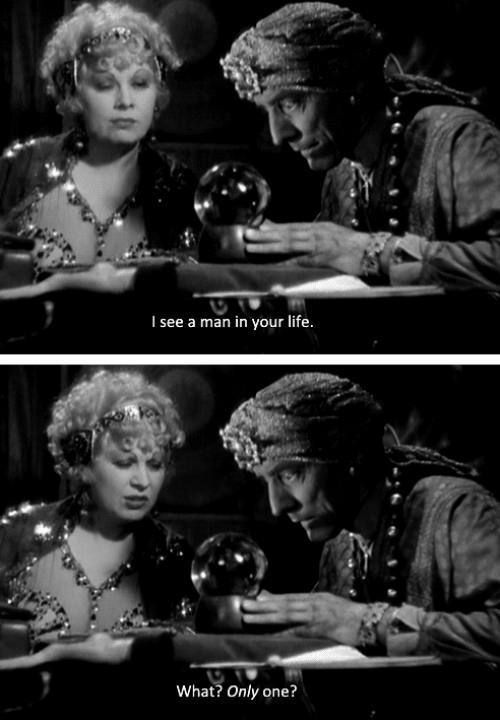
Mae West said it best. Picture by Sophie Charlotte on Pinterest

There are many dimensions to divination, some of which are indeed very deep. However, as far as our relationship with querents is concerned, we are simply an added means of intelligence-gathering, which, like all tools at our disposal, may fail for a variety of reasons, not the least of which is the diviner’s limited knowledge (our knowledge is always limited).

“But I came here to have undebiable, clearcut answers,” one might argue. To which I anwer: Tough titties! If you want undeniable clearcut answers shake a magic eightball. Divination is, quite literally, a divine language, and is not always so cleacut, either in itself or due to our limitations, or sometimes simply because the situation isn’t clearcut in itself. This is especially the case for issues involving human emotions.

As a rule, honesty is the best policy. I believe in voicing my procress to the querent, and the querent has a right to as clear an answer as I am capable of giving them, but we should never feel pressured to give them more certainty than we can truly see in the oracle.

It is perfectly acceptable to talk to the querent about our doubts or about the possible interpretations we are seeing in the oracle. For instance, it is ok to say “it seems like x, but y is also a possibility, while z seems less likely and w is out of the question.” It is also acceptable to say “these cards seem to point to such and such being the case, but I’m uncertain, as this other interpretation might also be right”. More often than not, the querent will say that both interpretations apply, and when this is not the case they can help us disambiguate the oracle.

Ultimately, the fact that divination has no legitimate place in our society implies as a consequence that, because our society believes itself to be held together by reasonable rules and processes, then divination must be either complete poppycock for delusional idiots or it must be capable of unreasonable fits of prowess in other to justify its existence in spite of its current ostracism.

This in turn creates expectations and hang-ups on both ends of the divination process that need to be analyzed and clarified to avoid them subconsciously ruling our practice. Doing so can make divination much more valuable and much more enjoyable.

MQS

On Mental Health (Example Reading)

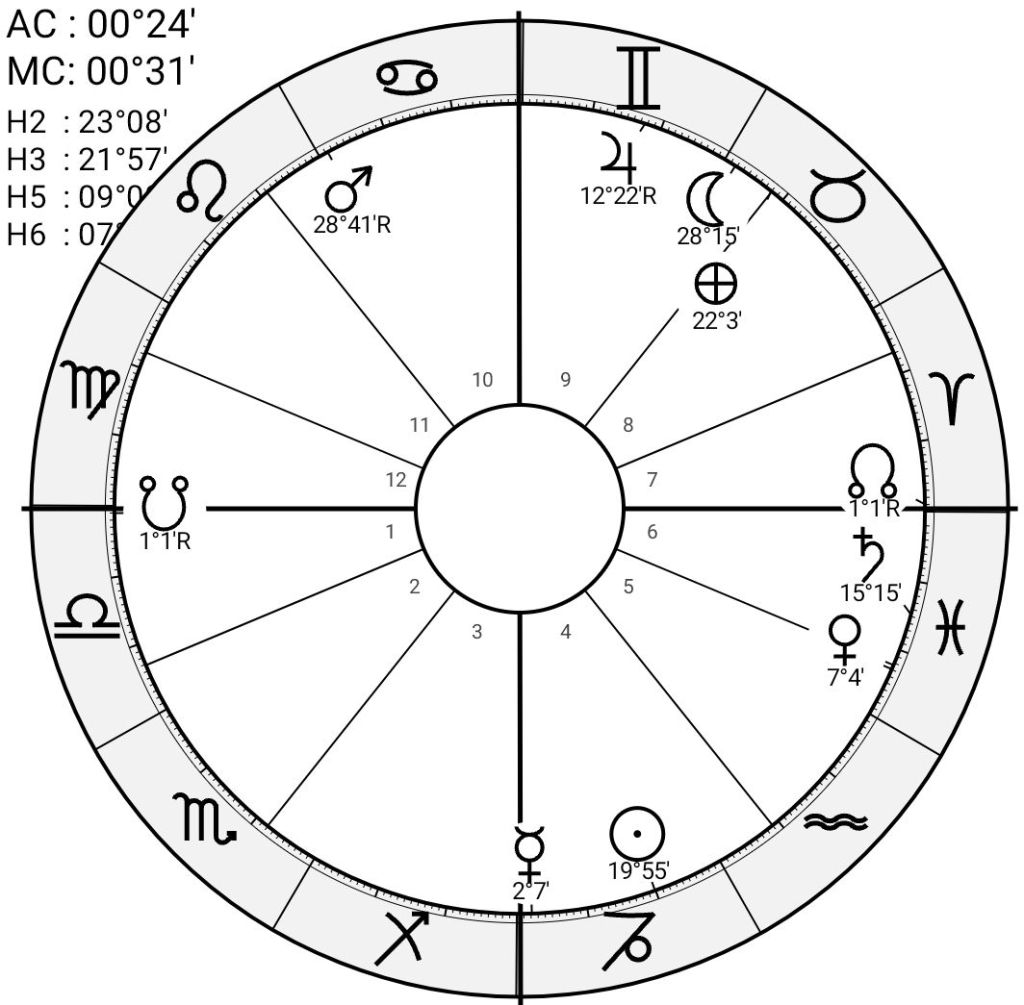
Since I’ve started studying horary astrology, my teacher has encouraged me to take on questions to learn on battlefield, as it were. I probably only need some exra push to start offering cheap readings here. This horary was asked by a social media contact of mine, who wants to know how her mental health will evolve.

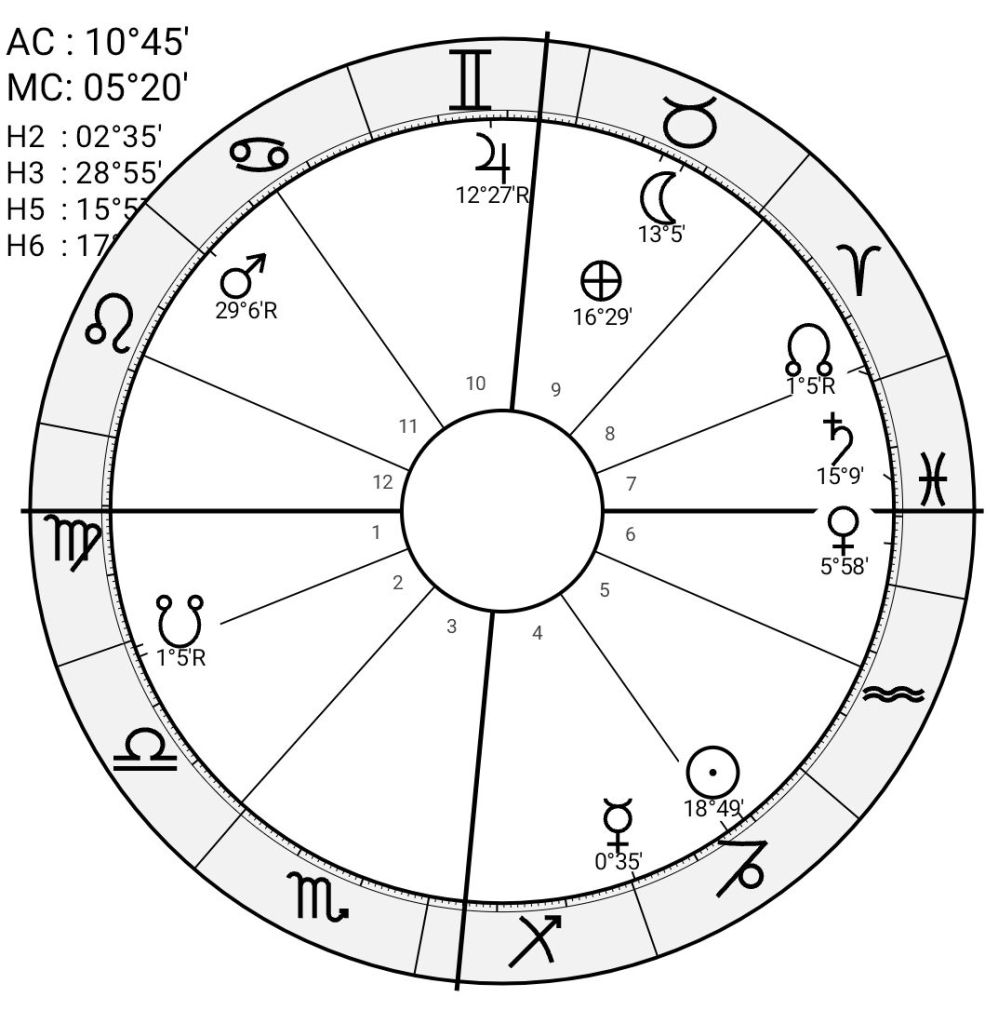
Mental health. App used: Aquarius2Go

An immediate giveaway that something is off is the conjunction of the South Node of the Moon to the Ascendant. This is the “bad” node, traditionally attributed to the nature of the malefics, Mars and Saturn. It is as if the chart wanted to tell us “hey, there IS something wrong, go look!”

The querent is represented by the ruler of the Ascendant, Venus. Venus is exalted in Pisces, but conjunct the cusp of the malefic Sixth House of sickness. The Moon shows us the flow of the action. She, too, is exalted in Taurus, but conjunct some evil fixed stars and cadent in the Ninth House. She is sextiling Mars.

Venus is not terribly afflicted, but it is in a bad place in the chart. Since we are talking about mental health, and Venus is conjunct a house of sickness, it is probably reasonable to conclude that the querent is experiencing mental trouble of some sort. Considering that Pisces is a common sign, the trouble is probably recurring, coming and going.

Venus is approaching conjunction with a bad Saturn in the Sixth, and before that a square aspect with the ruler of the Sixth house, Jupiter, which is cadent, retrograde and in detriment. Since the square is approaching, the trouble is intensifying, at least at present. Still, there is reception between Venus and Jupiter, which tells me that the querent does have some inner strength to deal with it and work through it, especially with someone’s help. Note that both Venus and the Moon are exalted, which argues that the mental trouble is due to excessive expectations being disappointed.

The Moon is quickly approaching the sextile aspect with Mars. Mars is ruler of the Third and Eighth house. The Eighth house is the house of death, but also of mental anguish. But the sextile is a positive aspect and it happens with reception, so once again we have an image of the potential for overcoming the trouble.

All in all, the chart depicts a situation of suffering but it is encouraging. The querent is not as helpless as she may think and can find the strategies to go through the period of difficulty.

MQS