Here Abano discusses matters relating to the Fifth House and Sixth House.
Fifth House
If one shall have children. If the question is about having children, look at the first, fifth and seventh figures.1 If they are entering and fortunate and the fifth is united or conjunct to the first or seventh house, the querent shall have children, especially if if the figures are Albus, Populus, Conjunctio or Laetitia. And depending on how many figures are on the side of the first figure,2 it means this is thanks to the husband’s inclination, and if the on the side of the seventh, of the wife’s, and if in said places you find exiting and unfortunate figures, it means the opposite, and if the fifth moves to the eighth or twelfth it means miscarriage and death of one’s children.3
If a woman is pregnant, and if the child is a boy or a girl. And if you want to know if a woman is pregnant and whether she will give birth to a boy or a girl, look at the aforementioned figures, to wit, the first, fifth and seventh, and also the fourth. If they are entering and fortunate, and if the fifth joins the seventh, then the woman is pregnant, especially if the figure is Major, Caput or Carcer. And this is especially true if the same is found in the fifteenth house. But if in those houses you find Puella, Cauda or Amissio, she is not pregnant. If the majority of the figures in those places, but also in the rest of the chart (and especially the angles and the fifteenth) are masculine, she will give birth to a boy, and if they are mostly feminine to a girl. If you find Populus or Conjunctio, she will give birth to twins. And if there are still doubts, form a figure from the fourth and seventh, and if the resulting figure is more consonant to the fourth the baby is a boy, if to the seventh, a girl.4
If the children shall be good or evil. If one wishes to know whether his children will be good or evil, look at the first, fourth, fifth and seventh and also the sixth figure, and if all these figures are good, entering, fortunate, then the children shall be good, and vice versa. And if the picture is mixed, you ought to form a figure from the fourth and fifth figure, and judge by the goodness or malice of the result. But you should never neglect to keep in mind the tenth and fifteenth figure.5
Sixth House
If one shall fall ill. If you want to know whether you shall fall ill during the year, look at the first and sixth figures, whether the first figure is good and the sixth shows good health, and judge accordingly. And especially if the first is unfortunate and it moves to the sixth, or if the first is bad and the sixth moves to the seventh, or if the sixth should come into contact with the first by falling in the second house, and if the fifteenth figure is unfortunate, and if you want to know the quality of the illness look at the sixth, of what nature and complexion, and whether it is malicious or unfortunate.
If they are earthy and unfortunate it means a grave illness, long and melancholic, and if they are fiery and unfortunate, it means a choleric illness, sudden and strong and acute; and if they are airy and more unfortunate than fortunate, it means a light illness, but bothersome and long, and maybe accompanied by another illness; and if they are watery and more unfortunate than fortunate, it means the illness is troublesome, whether long or short depending ont he nature and property of the figure.6
And if you are afraid of dying of said illness, if the sixth is in the eighth or in the ninth, judge the illness very serious. Similarly, if the sixth shows an illness and the first, being unfortunate, moves to the eighth it shows death. Always judge with diligence and in everything consider the nature and condition of the planets, and judge the great secrets and admirable things always keeping into account the angles and the fifteenth.7
Whether the sick person shall die. Look at the first, sixth, eighth, tenth and fifteenth figures. If you find Caput, Puella, Major, Acquisitio or Laetitia, it shows liberation from illness. If it is Albus, Tristitia, Cauda, Rubeus, Populus, Conjunctio or Pure, it shows a deadly illness and especially if the first, being one of these figures, goes to the eighth or ninth, and similarly if the sixth goes to the seventh or fifteenth. And if this figure is Carcer, by as much as it multiplies itself in these places, so much the more it shows the illness to be deadly, and if Tristitia moves to the eleventh figure it indicates healing and then relapsing and dying, especially if you find it in the thirteenth or fourteenth or fifteenth.8 And if it’s Rubeus in the first and it agrees with the sixth, it shows long infirmity.
Whether the doctor will help the patient. The seventh is attributed to the doctor. If the first, sixth and seventh are good, fortunate and in agreement with each other, it means the doctor shall heal the sick person, and vice versa. If the first, sixth and eleventh are good and fortunate, it shows a quick recovery because the eleventh indicates goodness and the perfection of one’s nature and complexion.9
Of a lost or stolen item The first figure is the querent, the sixth the thief, the second, the tenth, the eleventh and seventh are the thing inquired about. If the tenth is in the second, third or fourth, the thing lost or stolen is in the house of the querent or nearby. If it is in the seventh it shows it to be in the house of the thief, if in the ninth, eleventh or twelfth it means it is far from home, and according to the fortune or malice of the figure, judge whether it shall be gotten back or not, and the condition and identity of the thief, and where.
Whether the servant is good or bad. If the sixth is good, fortunate and in agreement with the first it means a good servant, and similarly if it is in conjunction with the first, especially if it is fixed and fortunate. Look also at the angles and the ninth figure.10
If it is good to buy a small animal. Look at the first, sixth, ninth and tenth.11 If they are good, entering and fortunate, it means it is good to buy, and vice versa if they aren’t. If the first, sixth and tenth are bad but the Witnesses and Judge good, it means it is good to buy, but not at the time you thought was ideal, and you must delay by as many days as are the points in the first figure.12 If you want to know what kind of animal it is good to buy, look at the figure in the sixth and thirteenth and fourteenth, and if you find Rubeus it means pigs, Albus sheep, Minor and Major horses, Tristitia and Laetitia oxen. If you find Caput, Acquisitio or Cauda, other small animals. Look also if the second house is fortunate.
I believe Abano means the two sides of the Geomantic Shield. Abano says “how many figures”, but in reality, of course, the number of figures is always the same. What he means is how good they are. ↩︎
Note that the Eighth house, aside from indicating death, is also conjunct the Seventh, so it seems Abano is giving us contradictory indications. However, the chart must be read as a whole. A bad figure in the Fifth house springing to the Eighth is a bad omen. ↩︎
We are accustomed to calling the Seventh the house of the spouse, but in many older texts it is called the house of women, and it is not at all clear that this is just due to the old bias against women. There may be something to it. Similarly, the Fourth house is generally considered a house mostly of men. ↩︎
The rationale behind the choice of house is not always clear, but I believe the First House is to show the child’s attitude toward the querent, the Seventh to judge their attitude toward the spouse, the Fourth is the end of the matter, the Sixth is in Company with the Fifth, the Tenth has to do with one’s actions. Furthermore, the angles are always important, regardless of their meaning. ↩︎
This paragraph offers insight into the old theory of humors as applied to matters of health. Though this theory is thoroughly alien to us now, Abano’s description is eminently practical and worth exploring. ↩︎
Abano is not the poetic kind of writer, but here he is clearly intimating that there is more to judging and treating illnesses than merely interpreting an oracle. ↩︎
Many of these indications are somewhat obscure. Furthermore, Tristitia cannot be the judge. ↩︎
The Eleventh House was known as the “Good demon” of the person. It is also connected with the Guardian Angel. ↩︎
I don’t understand why the Ninth ought to be involved into this kind of judgment. ↩︎
Again, it is not clear why the Ninth and Tenth ought to be involved. However, they are the first two Nieces, and are on the querent’s side of the chart. This might be the connection. ↩︎
This timing technique is especially interesting. I do not believe I have seen it anywhere else. ↩︎
Here Abano discusses matters relating to the Third House and Fourth House.
Third House
Of whether a messenger brings good news. If you want to know about a messenger or letter you’ve sent out, and about what effect they will have, and whether the messenger will come back with good news, then the first house is the querent, the third is the messenger or letter. When the first figure is good and the third one is exiting, or at least if it is entering or mixed but good, this is positive.
This is especially the case if the fourth house is conform to the first, and the third to the ninth. If the first or second figure1 moves to the house of the quesited, that is, of the person you send the message or messenger to, this augments the positivity of the message you get in return. The same is true if the first or second figure are conjunct to the house of the quesited or the person. Whether the message comes soon or late is known by whether the figures are mobile and exiting or fixed and entering, and also by the fifteenth and fourth figures.
The figures representing letters or messengers are Albus and Conjunctio. If Rubeus or Puer are in the second, it means airy words2 and talking inappropriately, and rumors or gossip, and discord, unless the message is about war. And if it’s Tristitia or Carcer, it means obstacles and lateness in what you inquire about. The other positive figures have a good meaning.
Which among one’s siblings or relatives will die sooner. 3 The first house is the querent . If it moves to the eighth, or if the eighth moves to the second, it means the querent will die before his siblings, and all the sooner if the figure moves to the angles.4 On the other hand, if the second figure5 were in the eighth or the ninth, and if the eighth were unfortunate, it means the sibling or relative will die sooner, especially if it is also found in the fourteenth or fifteenth. The death is good or bad depending on whether the figure is positive or negative.
If one is loved by their relatives. Look at the first house, whether it is good or bad, and similarly the third, and if they are conform or not, and in this way you judge whether they love each other. If they are not conform, but if the third is in the second, or the first in the fourth,6 and if the third figure is good, similarly they are friends and love each other. If the first figure is unfortunate and malicious and the third good, the querent doesn’t love the relative, but the relative loves them, and vice versa.
Fourth House
Paternal Inheritance. If you want to know about paternal inheritance, or from an older relative, or father-in-law, look at the fourth figure, if it moves to the second and if it is fortunate and entering, of fixed, judge that the querent will have what he wishes for, but if it is unfortunate and exiting, it means not obtaining it. Similarly, if the fourth does not move to the second, and if the first does not move to the fifth or eleventh.7 If the first and fourth were contrary to one another, it means not obtaining it, and similarly if the first is unfortunate and the second is contrary to the fourth. If the fourth moves to the seventh or ninth or tenth or twelfth, it means the inheritance goes toward other people, and this according to the properties of the figures, as explained before.
If one is loved by the father or uncle or partner.8 Look if the fourth figure is good and entering and if it is conjunct to the first, that is in the second, or if the first is in the fifth.9 If the first is good and is united to the fourth in the second, it means that affection is reciprocal, and all the more if the fifth or eleventh are conform to the first or the fourth. And if the first or fourth are in the fifth, it means the same, especially if the eleventh is conform to the aforesaid figures. When the first is good and the fourth bad, even if the fourth moves to the fifth, it means that the father or uncle doesn’t love the querent, although the querent loves him. On the other hand, if the fourth is in the second and is good, but the first is bad, it means the querent is well-liked, but the querent doesn’t like him. And even if the two figures are contrary to one another and there is no conjunction between them and there is no mutation of place it has a similar [negative] effect, as it shows lack of affection, and whichever of the figures is more unfortunate shows who is more at fault, and if the first and fourth are both evil, it means one is bad and the other worse.
Whether it’s good to build If you want to erect a building, look whether the fourth is good, entering and fixed, which means it’s good to build, especially if the tenth figure is conform to the fourth, and the first is good and fortunate. If the fourth is good but not fixed, the building is good but won’t last. If the fourth is mobile and exiting, and the seventh is contrary to it and unfortunate, it means the building will be ruined by an enemy, especially if the twelfth is unfortunate and contrary. And if the tenth is contrary to the fourth, it means ruin through one’s lord. If the fifth is contrary to the fourth, it will be ruined soon. However, note that if the fourth is exiting and the three other angles are fixed, the building will still last, especially if the fifteenth figure is fixed or entering and fortunate.
Whether there will be abundance or a famine. If the fourth figure is entering and fixed and fortunate, it means the year is abundant and the soil fertile, especially if the figure is earthy, and similarly if the angles are so, and also the fifteenth figure. But if the figure is unfortunate and exiting it means dearth, especially if the figure is fiery, and if the angles and the fifteenth are similar. Furthermore, add up the fourth and fifth,10 and judge if the result is good or bad or mediocre.
If a besieged fortress will be taken. The first and second figures are attributed to the fortress and those inside, the fourth means the fortress, the seventh and tenth the enemies. If the first and second houses are good, fortunate, entering and better than the seventh and tenth, it means those in the fortress will win. So also if the fourth is fixed and fortunate and earthy, and vice versa if the seventh and tenth are better. Similarly, if the fourth figure goes to the tenth or if it is conjunct to it, it means the enemies will come inside.
And if both are good and benign, they will conquer it peacefully, and if the fourth and tenth are are evil, but the first and second are strong and entering, there will be a battle, and the fortress will be taken by force, especially if the tenth figure is fortunate and powerful in virtue, and if the seventh and tenth are weak and the first and second are fortunate and entering, those in the fortress will win.
And if the third and fourth are fixed and fortunate and entering or earthy, those in the fortress will also win, and vice versa. When the first and the second are evil and unfortunate, and the seventh and tenth are likewise evil, and the fourth is fixed, it means the fortress will be conquered through betrayal.11 And if only the second is exiting and unfortunate and the first and fourth are good and fixed, money will be used [illeggibile] those of the third.
Of buried treasures and hidden things The fourth means the buried treasure and the hidden thing. If the figure is entering and fixed and fortunate, it means the question is valid, and if the first and fifteenth are conform it means the querent will get the treasure, especially if the fourth is in the second, or any other positive, entering figure is in the second, and vice versa if the figure is exiting and unfortunate and evil, and the first and fifteenth are unfortunate. And if the treasure or hidden thing is in a house it is shown by the figure in the fourth being fiery,12 and if it is airy it means in the attic, and if it is watery it is below, and if earthy it is buried.
What end the question shall have. If you want to know what effect any question will have, consider the fourth, if it is good and fixed, or exiting according to the querent’s wish, whether it is good or bad, or unfortunte, and if it is conjunct to the first or to its opposite, and if it is good according to the querent’s intention, and fortunate, it means a good end, especially if the tenth and fifteenth are conform to the querent’s intention, and similarly look at the other angles and see [if the majority of them is good]. If you want to know the cause or means of reaching this end, look at the angles and the second, fifth, eighth and eleventh,13 and the one that is best or worst will cause the greatest good or evil.
MQS
Footnotes
It is not clear why Abano refers to the second figure instead of the third in this passage. If it is not an oversight, then it could be a reference to the Company of Houses. ↩︎
This may sound a rather grim topic to ask about, but it was by no means uncommon in Abano’s times. Death was much more frequent and much more in the nose of people than it is today, and therefore something to prepare adequately for. I had a woman once ask me who would die first between her, her sister and her brother. ↩︎
The Angles (First, Tenth, Seventh and Fourth House) were generally considered quick. ↩︎
This reference to the Second House instead of the Third is difficult to explain. ↩︎
Notice, once again, that Abano refers to the First and Second Houses as pertaining to the querent (but not the Twelfth) and the Third and Fourth to the sibling or relative (but not the Second). ↩︎
The Fifth house is the second from the Fourth and thus represents the father’s wealth. The Eleventh house is harder to justify, except that it is considered a lucky house and, on the Geomantic Shield, it falls right underneath the Fifth. ↩︎
“Compagno”. I don’t know what this should imply here, in reference to the Fourth House. ↩︎
Interestingly, Abano refers to the Fifth house here in connection to the father’s or uncle’s love, but not to the third. This cannot be a reference to the Company of Houses, since by that doctrine the Fourth is in company with the Third, not with the Fifth. The Fifth house aspects the First by trine, so maybe that is an explanation. ↩︎
the Fifth house represents wealth derived from the Fourth, including the fruits of the earth. ↩︎
Possibly this is because the Fourth house, being strong, wouldn’t have been conquered without help from the First and Second. ↩︎
Traditionally, in some old Astrology handbooks, fiery signs were symbolic of the walls of a house, because bricks were made with fire. ↩︎
Abano discusses matters related to the First House. and Second House
Having shown in the first book how one may know and judge (questions), we must now show some practical examples of this science according to the twelve houses of the chart, so that everyone may more easily understand what they wish to know. And this always according to the above described rule of giving the first house to the querent and the appropriate one to the quesited.
First House
Of the life of the man or woman.1 Having made the chart and the fifteenth figure, and wanting to know one’s fortune or misfortune,2 consider the figure in the first house and, depending on its meaning and the virtue of the planet ruling this figure, judge whether it is good or bad.
And if you want further clues, look whether the figure moves toward one of the angles or in more than one of them.3 And the life is all the more long and better and fortunate depending on how good the angle is, as said before.4 And if the figure doesn’t move, but it is still good and fortunate, it means one still has a long time to live, but is lonely.5 And if it moves to the second, it causes gain through one’s industriousness and solicitude. And if it moves to the third, it means getting along with younger relatives and siblings, and if to the fourth, it indicates increase of patrimony and wealth of the father or of the older relatives.
If to the fifth, it means happiness through children, and usefulness, but if to the sixth, misfortune, tragedy, accidents, but also other people’s service (to the querent), depending on whether the figure is fortunate or not. If it moves to the seventh, it means good things from the wife or girlfriend, and good deals, or gain through war or gambling, and maybe in a foreign country, depending on the quality and condition of the figure. If it moves to the eighth, the life is short, unless one is a butcher or deals in dead animals, that is, skin, wool, or if one is a loan shark.6
If it moves to the ninth, it means much journeying, and being a knight or a wayfarer or a churchman, and the person’s luck is better if the figure is good. If it moves to the tenth, it means honors and public office and receiving dignity from people up high, or through them, depending as the figure is fortunate or not. If it moves to the eleventh, it shows good luck with friends and from people who are noble or from the Roman Curia. If it moves to the twelfth, the person will meet his end in prison, or through long infirmity, or it shows being kidnapped or being in a remote place like some religious people do.
If the figure shows up as a Witness or as the Judge, the person’s fortune depends on how good the figure is. And what we have said of the first figure, whether it is good, mediocre or bad depends on its nature.
Second House
Of wealth, possessions and gain. If you want to know about merchandise, one must judge the first house, whether it is good or bad, and then the second, depending on its virtue, and judge thus: if it contains one figure among Acquisitio, Major, Conjunctio, Caput and Albus, it means that gain will come from things that are easily movable from place to place, or from things that change, or that are sold by approximation (that is, without carefully weighing them).
If it were Puer it signifies gain through things sold after careful weighing. If it were Puella, it means gain through things that are easily obtained. If it were Rubeus, it means in things that cause fire or that have to do with blood. If it were Amissio, Cauda or Via, it shows little gain, and if it were Tristitia or Carcer, it means ups and downs of fortune or possessions. And if it is Laetitia or Minor, it means being able to keep one’s possessions. If it is Populus, then it depends on how good the first figure is, however by its own nature it means abundance. Note that every entering figure indicates gain or buying, and exiting indicates loss or selling.7
Whether one will retrieve the lost possession. If the question is about lost items, or stolen items, and we want to know whether we will get them back, look at the first figure, whether it is good or not, and then the second, and if they are entering or exiting. Afterwards, if you are looking for the thing, look at the tenth figure, if it is entering and good it means retrieval of the lost thing, especially if the same figure is in the second, or if here is another figure that is entering.8 Also look at the eleventh and the fifteenth. If instead the figures are exiting or bad, it means the opposite.
If you are looking for a stolen item, look at the seventh house, if it is entering and fortunate, and if it moves to the second or first house, which means retrieval.9 Similarly in the tenth, eleventh of fifteenth. And if the seventh [figure] is in the third, it means that the lost or stolen item is in the house of a sibling or relatives; if in the fourth, in or around the house of the father or of the older relatives, or near the house or place were it was originally. If it is in the fifth or sixth or eighth it means it is far away. If it is entering, however, you still will get it back.
If one will get back the money they lent to someone else. The first figure is he who must receive back the money, the second is the thing that he wants to get back, and the seventh is the borrower. If the first and second figure, or at least one of them (especially the second) are entering, and if the seventh is exiting, it means getting it all back easily. Similarly, if the second and seventh are the same, that is, entering. But if they aren’t, it means the opposite.
MQS
Footnotes
The First House was often called “Life, Body and Wit/Talent” ↩︎
This type of question may sound vague nowadays, but it must have been common in the premodern era, as Astrology and Geomancy handbooks are full of tips on how to handle it. This was especially true at a time when one couldn’t just arrange an online meeting with the diviner and when one’s time of birth was unknown, so that one may have looked at other possible alternatives to know about their general fortune in life that didn’t involve the birth chart. ↩︎
the angles, i.e., the First, Tenth, Seventh and Fourth houses, are considered strong and highly performant, so they endow the figure with strength. ↩︎
I am not sure what Abano means here. The angles are traditionally arranged as stronger (First and Tenth) and weaker (Seventh and Fourth) though all are generally strong. He may be referring to this. Or he may be referring to the practice of assigning the angles to the four phases of life, so that maybe a good figure passing, say, in the Seventh, shows good midlife. ↩︎
Because the eighth represents other people’s money (being the second from the seventh). ↩︎
“Every entering figure” probably implies “to the exception of Tristitia”. ↩︎
It is not clear why Abano mentions the Tenth House. It is possible that this is because the Tenth House opposes the Fourth House of buried and invisible things, and thus shows visibility and coming to light. ↩︎
Abano does not seem to count the Twelfth house as being next to the First. He is not the only authority to do so. Possibly this has to do with the doctrine of the Company of Houses, or simply with the fact that, on the Geomantic Shield, the First and Twelfth houses are visually distant. ↩︎
Abano explains how to judge the figures in the houses.
Furthermore you must know that when the question is asked by a person, it is not always the case that the first house goes to the questioner, according to the universal rule, but there are eight cases of people who have a special house assigned, and one must judge the question according to said houses. These are the Pope and cardinals, a prelate, the Emperor or King, a great Lord, an absent party, a bandit or thief, a servant, one who’s been chased off the home and an imprisoned thief. These you must judge according to the house that is assigned to them.1
Similarly you ought to know that those figures that are called entering are better than those called exiting, except Tristitia, which is unfortunate, and they have great positive power against the opposite figures, if they happen to fall in good houses depending on the question asked. All exiting figures are weak and don’t promise much good, except when one wants things to happen quickly. However, they are strong in evil things and when one wishes for evil things. Entering figures are those who have more points in the upper half than in the lower half, and exiting figures have more points in the lower half than in the upper half.
And if in a chart you find an entering, fortunate figure in a good house, but the opposite, exiting figure is in a bad house, the entering figure is said accidentally exiting and unfortunate. For instance, suppose that Acquisitio is in the First and Amissio in the Second. If this is the case, Acquisitio is said to be exiting and unfortunate, but only accidentally. And if it’s the opposite, i.e., Amissio in the First and Acquisitio in the Second, we have the opposite case. In the same way you must understand every other figure with respect to its opposite.2
Similarly, every exiting, unfortunate figure is strong in evil things, and every entering figure is weak against evil, except when one seeks things to be firm and late, although Laetitia, though exiting, is good and fortunate.
One must also in every chart and question see what is the first figure and that of the quesited, i.e., what qualities they possess, e.g., fiery, airy, earthy or watery, cold or hot, wet or dry, and what’s the planet of each. And according to their conformity (to one another) or their difference, so one may judge them together with the other figures depending on which is better and has the better planet, always keeping in mind the question and the querent’s desire. And every time that a figure opposite to that of the first house falls in that of the quesited, it couldn’t get any worse.3 And this same effect have Populus and Via, although both are figures of the Moon, and Minor and Major, although both are figures of the Sun.4
Additionally, one must keep in mind, in every figure and question, the geomantic figures that are assigned to each side, and see which is better and which is worse, and thus judge. The figures of the first side, i.e., of the querent, are the first, second, third, fourth, ninth, tenth and thirteenth. Those of the second side, that is, of the quesited, are the fifth, sixth, seventh, eighth, eleventh, twelfth and fourteenth. If the two parts were equally good or bad, judge by the fifteenth figure, and according to the comformity of the four angles.5
And if in any question a geomantic figure that is appropriate to that question falls in the house of the quesited, this is excellent, and if the opposite happens, this must also be judged. For instance, if the question is about travel and and Via falls in the third house it means well, and good journey. If the question is about gain and Acquisitio falls in the second it means good things and usefulness, but if it were the opposite [that is, Amissio in the second] it means the opposite. The reason for this is that the third and ninth house have, among their attributions, journeys and roads and mobility; and the second house is a good place for Acquisitio, which means gain and usefulness; and if there were a geomantic figure which means damage of delay, it means these two things. As such, we call opposite figures those whose fortune is the opposite one of the other, that is, Amissio/Acquisitio or Albus/Rubeus, and so on. And so also Via and Populus, both being mobile, but Via is quicker and good for travel by road, while Populus is slower and bodes well for travel by water.
The example we have discussed can be applied to any other question, looking for appropriate figures and houses in the way we have explained. In the example of a question of gain, if there was Amissio [in the second], it signifies what its name promises, i.e., damage and loss, and whenever you seek to obtain anything or if you ask about an absent party or a messenger or any other similar issue, and if Laetitia was in the second house, or in the house of the quesited, it means happiness and pleasure, and the obtaining of what one wishes, and good outcome. But if there was Tristitia it means the opposite, because Tristitia means problems, except in earthy and fixed things that don’t move, and these (negative) effects will be so much the more true when in the second house (or in the house of the quesited) we find this figure, or a similar figure.
End of the first book.
MQS
Footnotes
There seems to have been considerable debate in the Middle Ages concerning whether the querent in horary questions was always represented by the First House or if certain people, such as kings or priests, ought to be considered according to their particular house (for instance, kings from the Tenth, priests from the Ninth). I advise against Abano’s practice. The querent is the querent, and as such is the First House. If the querent asks about the king, then the house of the quesited is the Tenth. Besides, but if the king asks about something, he is represented by the Ascendant, Abano does not explain how an absent party might ask a question without ceasing to be absent. ↩︎
This passage is exceedingly obscure. It is not clear how we are supposed to distinguish good from bad houses. The second house may have been considered bad by some Hellenistic astrology due to the fact that it doesn’t behold the ascendant, but I am wondering if what Abano is referring to here is the company of houses. Alternatively, it seems that whenever a bad figure is in a bad house and said figure is the opposite of a the good one, then the bad hurts the good even if there is no contact between them. Abano says that the opposite is also true, but this seems to lead to a regressus ad infinitum. ↩︎
I believe Abano is referring, as before, to figures that are the opposite in terms of points, such as Acquisitio and Amissio. However, later Abano says opposite figures are opposite in terms of fortune. ↩︎
I do not understand this. Does this mean that it is bad if the said figures are in the house of the quesited? This seems hardly likely. ↩︎
This passage is very interesting, as it shows the geomantic shield to be a sort of soccer field with two contenders. However, it is hard to reconcile what Abano says here with what he said before, for instance that it is better to have the fourteenth figure good than the thirteenth, because the former signifies the future. That being said, a certain digree of ambiguity about this issue is to be found in most texts on Geomancy. ↩︎
Here Abano describes the meaning and function of the Geomantic Court.
In order to have better cognition of all that one wishes to know, one must consider the thirteenth and fourteenth figure, which are called the Witnesses, because they unveil many secrets, depending on the good or evil nature of the figures they contain. And one must also consider the fifteenth figure, called the Judge, which shows the end of the matter for good or ill, together with the figure in the fourth house.1
The thirteenth figure signifies the past, but also the present, depending on the question, while the fourteenth the future.2 When the thirteenth and fourteenth figures are good, it means the question asked is positively answered, especially if the Judge is also good, but when the thirteenth figure is evil and the fourteenth good there is some trouble, and if the thirteenth is good and the fourteenth evil, then the question has a negative answer, especially if the Judge is evil. 3
If both Witnesses are evil and the Judge good, one must refer to the fourth house and judge from it what shall come to pass. Similarly, if the Right Witness is good and the Judge evil, one must look at the fourth to consider whether the matter will end in joy or sorrow.
If, after all this, there were still doubts, take the fifteenth and the first figures and add them to create another figure, and judge depending on the nature of this figure. And if this figure happens to fall in any of the houses, good or evil will come from a person or thing signified by that house. This sixteenth figure is called the Judge of the Judge [Sopraiudice].
Furthermore, this sixteenth figure is produced also from the Judge and from the figure in the house of the quesited, according to the properties of the houses as described before, and according as said figure is conform or not conform to the fifteenth or sixteenth figure, so one judges the chart of the question.4 And when they are good, all the better, and when they are bad, all the worse. And when they contradict each other it is also somewhat bad. But when they are in everything opposed to the fifteenth and sixteenth, the chart is null and void, and the chart is called anomalous, without order or rule. 5
MQS
Footnotes
Here Abano seems to put the Judge and the Fourth house on the same plane. ↩︎
This idea seems to stem from astrology, where the Moon’s previous aspect indicates the present or the past, and the one she makes immediately after shows the future. ↩︎
The way Abano describes the interrelation of the Witnesses with the Judge almost seems to make the Witnesses more important than the Judge. ↩︎
This additional technique begs a couple of questions. First off, why does Abano call both figures ‘the sixteenth figure’? Are they on the same plane? Secondly, is this technique always employed whenever the traditional Judge of the Judge (from the Judge and the First Mother) is used? ↩︎
In other words, this seems to have been taken as a sign that the chart didn’t answer the question. Personally, I am skeptical of this technique. It is my experience that charts are always radical, whether they are astrological charts or geomantic shields. They always answer, or at the very least they are always meaningful. Clearly, if we keep making up new figures, the chances of them contradicting each other increase accordingly. But contradiction is not a sign that a chart is not valid: only that it mirrors a complex, contradictory reality. Maybe I am wrong. ↩︎
Abano quickly summarises the meanings of the planets in traditional Western astrology, so that the geomancer may better understand the meanings of the corresponding figures.
In order to make it even easier to make a judgment, we shall now consider the planet of every figure, and conveniently we shall list the virtue and meaning of every planet.1
Saturn is always evil, wherever it is, and it means sick or vile people, malady, poverty, blind or maimed people, laborers, problems and toil, prison and prisoners. Adversities and obstacles, loss of wealth. It is only good for building and in agriculture and in things that need to last. Its two figures are Tristitia and Carcer.
Jupiter is always good, wherever it is, and it means Church people, prelates, noblemen, rich people, merchants, captains, courtesans and friendly people. It is good and pleasurable, useful in every thing. It is only bad for the sick and the prisoner, whose trouble it prolongs. Its figures are Acquisitio and Laetitia. Acquisitio is the better one.
Mars is sometimes good and sometimes bad, depending on the question, but inclining to evil, and it means malicious people, wrongdoers, traitors, thieves, ruffians, harlots, murderers. It is only good in things of wars and when blood is concerned. Its figures are Puer and Rubeus, and Puer is the worse one.2
Venus is good, but its goodness is minor, for good or ill, depending on the question asked. It means people who are friendly, happy, young, with little troubles in life. But also harlots. Its figures are Puella and Amissio. Puella is the more noxious for travel and sickness and prison. Amissio is the better one.3
Mercury is a mixed planet in terms of good and evil. It means servants, messengers, letters, embassies, writers, scholars and painters, science and doctrine. Its figures are Albus and Conjunctio. Conjunctio is the worse one, as it always shows malicious intention or duplicity, and hexes.
The Sun and Moon are mixed planets in their good and evil import depending on the question, but the Sun is the better of the two,4 and it means nobles, kings, emperors and people of high station, who have dominion. Its figures are Fortuna Major and Fortuna Minor. Minor means more trouble than prosperity.
The Moon is also a mixed planet, but mostly bad, and its figures are Via and Populus. Via is only good for travel, Populus is good for dealing with people, and it means abundance and lots of water.
Caput and Cauda are associated with the planets Jupiter and Venus (Caput) and Mars and Saturn (Cauda).5
MQS
Footnotes
The elaborate psychological attributes that modern astrology assigns to the twelve zodiac signs are virtually unknown to premodern Astrology, having been invented relatively recently to make up for modern astrology’s inability to make verifiable predictions. Instead, traditional astrology relies much more heavily on the planets as celestial actors. ↩︎
This is not the first time Abano alludes to Puer being worse than Rubeus, although in other places he seems to contradict this statement. ↩︎
This statement is also odd, and it reeks of either mistake or blind. ↩︎
In Medieval Astrology the Sun was often considered a benefic when aspecting other planets, but a malefic in conjunction (planets conjunct to the Sun are said to be combust or burned up, except when they are very close, in which case they are said to be in the heart of the Sun and strengthened). The Moon’s evaluation, quite ironically, fluctuated depending on the author, but in general she was believed to be a benefic when waxing and a malefic when waning. ↩︎
The practice of assigning the two Nodes to the benefics and malefics seems to have started possibly with Medieval Muslim philosophers, or at least in the Latin West. In the original Western tradition, the Hellenistic one, there doesn’t seem to have been much talk of the Nodes except in negative terms. ↩︎
Here Abano explains the broad signification of the sixteen geomantic figuresand the seven traditional planets.
In order that one may more easily judge every question without much effort, what follows is the signification of the sixteen figures.1
Acquisitio is the figure of Jupiter in Aries, good, fortunate, mobile, entering, masculine, airy, eastern, hot and wet. Good in the first house and bad in the seventh. It signifies good fortune in what one seeks to obtain, and in things of friendship, weddings, merchandise, company, in traveling, in getting what you desire. It is bad for sick people and prisoners. It signifies blood loss, torments and a long time, and similarly it signifies pregnancy, and changing abode, and sailing, and for the sailor it announces storms. The absent party is delayed, and it is not good for changing from one lord to another, and it shows damage from enemies. In war against enemies it promises victory, and it’s good for obtaining honors and offices, but it doesn’t grant greater accumulation. In case of suspected pregnancy, or theft or other crime, or when one hears rumors, this figures confirms that they are true. The stolen goods are retrieved. The baby is a boy. In sending money or making down payments/deposits it is good. It is good for children and friends and relatives and indicates holiness, abundance, great harvest, but famine will soon follow.2
Amissio is a figure of Venus in Scorpio, unfortunate, mobile, exiting, masculine, fiery, hot and dry, southern, evil. Good in the eighth and bad in the second. Good for travel and selling, the sick person will heal soon, the prisoners comes out of prison soon, it is good for pregnant women, the baby is a boy, the medicine is good. It is bad for fights and enmities, it signifies unfaithfulness, end of friendship, theft, murder and similar things, and if an army marches against the other it will be victorious without effort. If one is in the right it solves matters quickly. It signifies droughts, dearth, flax, legumes. Sending money to make gain is fruitless, you will lose. The fugitive is not found, nor the stolen goods. One doesn’t obtain the pardon, nor anything one seeks. There is no marriage, and when there is, it is soon broken with great shame. It is the enemy of all pleasure and usefulness. Favors, honors, dignity and friendship are not lasting. It is good for asking about family and friends that one hasn’t seen: they are well. If one departs to go damage someone else, one doesn’t succeed, but still comes back safe and sound. One doesn’t acquire the besieged place, but it is good for taking medicines. Abundance of fruits, shortage of everything else.
Fortuna Maior is a figure of the Sun in Acquarius, fortunate, entering, fixed, well-meaning, feminine, earthy, western, nocturnal, cold and dry. Good in the eleventh, bad in the fifth. It denotes increment and accumulation and increases the wealth of one’s lords, friendship with people in high places, with noble people and women, good marriage, pleasure in writing and through messengers, good news, honors, dignity, friendship, the absent party and the pilgrim are well. It grants all that one wishes, except if one wants to gain it from an enemy or suspicious person, especially if it’s about money. Love and hate are firm and unshakable, positive for building and sowing. Rumors and suspicions of theft and pregnancy are true. It is good for coming out of a bad situation, but at the beginning it is hard. In traveling it will be hard at first and easy and with mirth afterward. One can flee from danger. There is no war. The baby is a boy, born without danger. Sickness and imprisonment are of long duration, and difficult to overcome, and it is hard to get back one’s dues. Fertile year. Lots of rain.
Fortuna Minor is a figure of the Sun in Taurus. Unfortunate, mobile, exiting, fiery, masculine, hot and dry, southern, evil, good in the second and bad in the eighth. It signifies company of noble people, traveling with noblemen and buying and selling on their account. It is good for the sick and the imprisoned, and for anyone who wants to flee dangers or problems. It helps pregnant women, and the baby is a girl. Sailing. Sentences can be appealed victoriously, good for entering in other people’s places and country, the besieged town is not captured. It is not good for starting something that is meant to last. The stolen goods are not found. The army will be defeated. Bad for marriage, and if the marriage is made soon there will be rumors. It doesn’t concede anything. Dignity and honor don’t last. Suspicions and rumors are false. The messenger and the absent party come back and bring gain. Damaged merchandise. Promises are not kept. Debts are not collected. Family and friends in good state. If one takes a medicine one heals soon, but it also signifies bleeding. A year of dearth, few fruits, lots of barley and spelt. Problems while traveling.
Laetitia is a figure of Jupiter in Taurus, eastern, airy, fortunate, hot and wet, masculine, sanguine, mobile, entering, positive, diurnal. It means honors, exaltation, dignity, good travel and good for returning. The messenger and the absent party come back bringing joy, good news, it is useful to travel, albeit belatedly, and the dignity one has obtained may falter. Good for buying and selling, the prisoner will be released, changing one’s lord or king or one’s place is positive, it is good to be at the service of a lord, to make down payments/deposits, taking medicines. Long life, increase of wealth. The sickness is long, even though one will heal eventually, bad for partnerships. Every suspicion is false. The stolen goods and runaway servant are not found, the debt won’t be paid back. Hatred and friendship are both steadfast, the servant or subject don’t love you. In questions of faith, of doubt about treason, and when asking about absent friends or family members, they are well. It helps pregnant women, the baby is a boy. Good for sailing, dreams are positive. A year of dearth, but it doesn’t last long, good rain. If you wonder about a friend’s death, it’s not true, and he’ll heal. Good in all houses, except the seventh, eighth, twelfth and the occupied place won’t be conquered.
Tristitia is a figure of Saturn in Scorpio, unfortunate, fixed, entering, malicious, earthy, melancholic, cold and dry, western, feminine. Good to be with noblemen and not bad for departing. Going up against an enemy won’t cause damage out of doubt,3 risk of death in conflict, you will stay in prison, good for partnerships, and the occupied place will be conquered unexpectedly. Good to buy animals, bad for selling them. Good for down payments/deposits, bad for sending money, lots of rain which is helpful, the shunned woman will go back to the friend, victory in a fight, one can keep one’s salaried office. It is bad for the sick and the prisoner, for it lasts long, bad for traveling, danger of death. It doesn’t give you anything that you may wish, except trifles. When there’s suspicion of someone’s death, or of robbery, or any other rumor of the sort, it is true. Accidents by water. The absent party is in trouble, sickness or poverty, the marriage will cause trouble, damage, enmity, moving to another region will cause ill, and wanting to conquer it will cause defeat, the debt is paid back but with great trouble and many issues. One’s life or that of those around you will be problematic or full of sickness, when one has an office, or some dignity, one will suffer through it. Little honor. Childbirth causes issues and comes late, and perhaps results in miscarriage. The baby will be a girl. Both love and hatred are steadfast. Whatever is damaged won’t be fixed. The year will be plentiful. Evil in all houses, except the eighth. Worst of all in the eleventh. When trying to hurt others one will cause even worse damage.
Albus is a figure of Mercury in Cancer, fortunate, common, feminine, nocturnal, phlegmatic, watery, cold and wet, southern, mobile, benign. It means good profit, increase of wealth, honor, influence and being in the right, merchandise, useful partnership, excellent marriage, the stolen goods are retrieved, it concedes everything one asks, honors, servants, buying livestock, conquering a land, the debt is paid back, the rumors or suspicions are true. The runaway servant comes back. Good friendship and money or other possessions. Risk of losing something through oversight. Short life. In war it is bad for the querent, it implies flight and loss of blood, infirmity, long time in prison, problems in pregnancy, the baby is a girl, storms during the sailing, if one has doubts about traveling, the travel will cause harm, the absent party won’t come back, and it is bad for changing place. If one asks for friends or relatives, they are well, and he who is in the right will win the fight [or court case]. Good for agriculture, abundance, good and fruitful rains. Good in the fourth house, bad in the tenth.
Rubeus is a figure of Mars in Gemini, unfortunate, mobile, exiting, masculine, fiery, hot and dry, diurnal, malicious, southern, evil in everything, except in war, in which case it is the best. Good for writing and for marriage, in occult things, and he who seeks honors will obtain them. Good for bloodletting or bleeding, good for going up against the enemy, war will cause death and blood, good for not changing room [place?] or country, the pregnant woman will, after great trouble, be happy with the child, the suspicion of theft or other vice is true. Every good company (or partnership) is good, except in traveling, and the sick will heal after long trouble, and the prisoner will stay long in prison, will need to pay a bail, the down payment is secure, it grants everything one wants from a nobleman, the rumor coming from afar is false, love is steadfast, especially if adulterous, and war will be victorious. Good for buying animals, bad for selling them. The absent party won’t come back, debts are paid back but there will be controversies, and if one wants to speak to a lord one will find him occupied in many things. Very bad for the sick and for prisoners, it means damage, and burials. In travel there is damage and danger when changing place. The marriage is surrounded by suspicions and issues, sailing bad, winds against your way, bad for selling. The occupied place is conquered, the lost item is not found. Good fortune for the querent, and everyone he asks about is well except one.4 The year is dearthful at the beginning, abundant later, lots of rain. Wrath and hatred and danger, bad for taking medicine. Bad in the fourth, seventh and eleventh house, and also in the first except for war and conflict.
Puella is a figure of Venus in Gemini, fortunate, positive, temperate, fixed, entering, feminine, nocturnal, watery, cold and wet, phlegmatic, southern. Good for buying, it brings peace with problematic friends, it solves fights. The absent party comes back with profit, inheritance, increases wealth, confirms marriage, but it will be with suspicions, enemies are won, the journey is delayed but will bring profit. In war there will be loss, sickness and prison are of long duration, and one will pay a fine, sailing causes trouble but only at the beginning. One gets what one wants. Animals and servants will be lost. The pregnant woman will give birth with some problems, the baby is a girl. The suspicion of death, or that a woman is pregnant, is false, suspicion of theft and vice are true. Good for taking medicines, and even if the illness is serious one will heal. You will get your goods back. For obtaining honors, dignity and office it is positive. Good for getting back money, bad for sending money, what is lost is found. If you fear a lord or any other danger, you are not without danger, the down payment/deposit is not secure, as you will lose a good deal of it, changing place or lord is bad, better to stay where you are. If you are accused of something you will be punished, the occupied place won’t be conquered, good for one’s or other people’s health. Average year, at first abundant, then with dearth, lots of rain, which will endanger fruits and plants, good in all houses except the seventh.
Puer is a figure of Mars in Libra, unfortunate, airy, hot and wet, sanguine, masculine, eastern, exiting, malicious, good in war and in sickness, it means overcoming and vanquishing the enemy. Obtaining a favor from a lord will be hard at the beginning, but then you’ll succeed, good for sending money and traveling, the sick and the prisoner and the absent party are fine, and after trouble they’ll come out of it. Suspicion of theft and other wicked deeds is true, suspicion of pregnancy is true, and the woman is give birth with great trouble, and the baby will be a boy. Good for traveling to other countries, good for buying animals and servants. The suspicion of enmity is false. Death will be due to chance happenings and disasters. Good for serving a lord, but bad for gaining from other people; the absent party will come back with usefulness; reconciliation with enemies, the bandits will go back to their homeland, long life, one will die rich. Friendships won’t last, the journey is long and full of issues, problems with merchandise. Not getting back your dues without fighting harshly and with great controversy. Bad for relocating, risk of drowning, promises are not kept. Family and friends are fine, but some of them will fall sick soon. Good for agriculture. A year of dearth, with little rain. Only ryegrass will be abundant. Good in the second and seventh houses, not in the others.
Populus is a figure of the Moon in Capricorn, temperate, of mixed fortune, mobile, common, watery, phlegmatic, cold and wet, bicorporeal, feminine and masculine, northern, nocturnal. Good in things done in company and with many people or animals, and for commerce, siblings, sailing and travel, in sailing positive powerful winds, good for selling and buying but with difficulty in marriage, childbirth will be easy, and there will be twins, in travel rain and lots of water, the sick person dies, the absent party and the pilgrim come back with gain: the prisoner will be released soon but with issues and money problems. The figure grants what one wants, good in things of fathers and mothers, and in occult things. In war and fights one can flee without causing rumors, the besieged place is not conquered. Bad for travels by land, and war and fights are long, and relocating will cost a lot of money. Suspicion of theft or other vice are true, as well as love and hate, if a lord waves war he’ll have a hard time winning. In things of faith and Church it means disunion and schism. Marriage is not easy, will cause debts and divorce with infamy. In making contracts and down payments and partnership, they won’t last. Long life, useful for the querent, but when asking for friends or family, it means infirmity and death, honor and dignity don’t last. The year will be in every way abundant, with much rain and water. It is middling in all houses.
Via is a figure of the Moon in leo. Temperate, mediocre for good or ill, though more bad than good, watery, cold, wet, phlegmatic, nocturnal, feminine, northern. Good in travel and things that are done soon and don’t last. Good for gardens and fields and for taking water from the river, for sowing small grains, in marriage in selling and in buying with little gain, for going from place to place, but not for staying a long time. The pregnant woman will give birth soon, the baby is a boy. The prisoner and the sick are soon free, the absent party and the pilgrim will come back soon. In things of war it causes quick resolution, and one must be cautious, because it threatens flight.5 And every thing is easy and good in the beginning, but doesn’t last. Buildings, marriage, contract, company, friendship, servants, honor, offices, commerce and in every thing it means some diminishment and loss, except in travel, and it is not very good in the eleventh.
Carcer is a figure of Saturn in Pisces, unfortunate, fixed, earthy, feminine, cold and dry, melancholic, western, bicorporeal, malicious for possessions, marriage, contracts, down payments/deposits. It means6 secret sciences, occult things, company. Good for travel by road, and in earthy things, suspicion of prison and news of death are true. Good in building, in inheritance, in entering a region or city or office. The besieged place won’t be conquered, the lord lasts in his dominion. In war and in other strifes, the enemy will flee, in planting trees and wineyards, it means great inner turmoil, grave sickness, possibly deadly, burial. The absent party doesn’t come back, long term in prison, lack of success, not good for asking for help, bad for travel by water, dangers in pregnancy, the baby is a boy. Faith is steadfast, in everything else it’s bad. A year of dearth. Good only in the second.
Conjunctio is a figure of Mercury in Virgo, bicorporeal, mediocre, fortunate, airy, hot and wet, sanguine, eastern, masculine, diurnal, common, benign. Good intellect, science, doctrine, scriptures, writings, company, partnership, commerce, but the partnership will be with ulterior motives, and with issues, and one will need to be cunning to take advantage of the partner, good for marriage. The lost good or stolen good are returned, betrayal and such things are found out, in office and dignity it is good, mediocre wealth and inheritance, easy and short travel, woman with child, but childbirth with issues, twins. The besieged place will be freed with cunning and betrayals. War with shrewdness and deceit, rumors, fights will lead to bleeding, discord and bad advice among fellow citizens. It promises death and burial to the sick, the prisoner will be condemned to death if he is a thief, one can be bailed out belatedly by paying, dangers in travel and problems through it, and storms on the sea, accidents and drowning. The absent party comes back with difficulties. Messengers and letters are false, sent by occult enemies, all kinds of machinations, duplicity, bad in the second house.
Caput is a figure of Jupiter and Venus in Virgo, entering, fortunate, earthy, cold and dry, fixed, melancholic, benign, late, feminine, western, nocturnal. Good for being at the court of the king or of a lord, and good for them, improvement of one’s status, lordship, noblemen, mirth, marriage, long travel and with honor. The absent party comes back belatedly, but with profit. The childbirth is easy, the baby is a boy, good children and siblings, obtaining help from noblemen, victory in war and conflict, the besieged place won’t be conquered, ecclesiastic honor, good for sailing and buying animals. Long trouble for the sick and the imprisoned. The lost or stolen goods are not found. Good in every other thing. Best in the sixth house, bad in the twelfth.
Cauda is a figure of Mars and Saturn in Capricorn, unfortunate, exiting, malicious, choleric, fiery, hot and dry, southern, diurnal, masculine, mobile. Good in retrieving stolen goods and lost things, but with trouble, and in finding out occult things, and for betraying. Travel will happen soon, but with danger. It frees one from enemies and allows to sell animals, and it is good for asking help to one’s superiors. The sick person will heal after great trouble, and the prisoner will be freed after great danger. Suspicion of theft and other vice is true. The marriage is cause for suspicions, the pregnant woman will give birth soon with many issues, the baby is a boy. In water and sea there are storm and wind. The besieged place is conquered, it means rumors and controveries and what one doubts will happen, love is false, buying causes damange, and the lost honor won’t be won back, except with grave diffulties. And it is good for being soon freed from trouble. Good in the sixth, seventh, twelfth and tenth and fourth house, bad in the second, fourth, eleventh.
MQS
Footnotes
For the modern mind, this is one of the most maddening and frustrating sections of Abano’s book due to the seemingly unreconcilable descriptions of the figures. Still, I believe it is important to take this section seriously as it gives insight into the way of thinking of the old practicioners of Geomancy. In the original text, Abano sorts the meanings of each figure out into ‘Good’ or ‘Bad’ but because he often doesn’t keep to the classification (attributing good meanings to the ‘bad’ category and vice versa) I have eliminated the headings of ‘good’ and ‘bad’. It may be that I am wrong in doing so. ↩︎
Admittedly, the above is quite a mishmash of significations, some of which are hard to reconcile among themselves and with the general meaning of the figure. In the following figures similar discrepancies can be observed. We ought to bear in mind that, as it often happens with Medieval authorities on occult subjects, Abano is aiming at giving us extremely concrete examples so that the intelligent reader can extract a general signification from them. As for the seemingly nonsensical meanings (why would Acquisitio signify famine?) it may be that I am missing something, or it may mean we ought to keep an open mind in judging the figures. It may also be a blind placed deliberately to confound readers. This may explain such gross inconsistencies as Laetitia being given as entering instead of exiting (note that Abano said the opposite in the first section) and being given some of Tristitia’s ideas of stuckness. ↩︎
“Andando contra lo inimico per sola dubbitatione non patira alcun damno”. This sentence is not clear to me. Could it mean that the enemy will be assailed by doubts? ↩︎
This sentence is not clear, as it seems to imply everyone around the querent is fine, except one person. Also, this description of Rubeus has to be one of the most puzzling I have ever come across. ↩︎
it is not clear if this means the flight of the querent’s side or of the enemy’s side. ↩︎
I have added this “it means”, as otherwise it seems that Carcer would be bad for occult things as well. However, this addition also causes another problem, as it makes it seem as though Carcer means company, while usually it is seen as a figure of solitude. ↩︎
In Astrology, and therefore in Geomancy, we distinguish between a friend and an acquaintance, the former being eleventh house matter, the latter seventh house. Obviously, the difference is not as clear cut as it may seem, especially in the age of social media, where all it takes to be someone’s friend is to click on the ‘add’ button.
In the old texts, both of Geomancy and Astrology, we often find examples of how to judge questions like “Will my friends be useful to me?” This may sound callous compared to our sentimental notions of friendship, but keep in mind that 1) the old notion of usefulness was broader back then, and it included everything concerned with the person’s well-being, both inner and outer 2) friends formed part of the person’s network of alliances in tackling the hardships of life 3) the eleventh house is the second from the tenth, which represents heaven, so it represents friends as wealth from heaven. Clearly friends were highly revered (just read Plato, Seneca, Xenophon or even Confucius for proofs).
As I mentioned somewhere else, my husband and I are in the process or moving, and as usual when moving, we suddenly discovered that we own three times more stuff than we thought. One friend volunteered to help us the following day, bringing us boxes and helping us with her car. In the evening though she said she didn’t know if she would make it. I cast a reading to see whether she would come:
Will she come to help us? (app used: Simple Geomancy)
Let us forget the Judge for a second and concentrate on the chart. If we take the girl as ‘our friend’ she should be eleventh house, and the eleventh house is occupied by Cauda, which also doesn’t move anywhere.
Now if my mom asked me who she is, I would say ‘a friend’. Yet she is more my husband’s friend. I am just on good terms with her, but I wouldn’t call her to spill my guts or even to ask for help, though it was of course very nice of her to volunteer.
If I take her to be my acquaintance, she is seventh house, and occupied by a more promising Conjunctio, which does spring to the second toward me. And she did end up coming.
The negative Judge, Amissio, possibly refers to the fact that we ended up losing a couple of objects due to recklessness (notice the Via Puncti reaching back to Puer in the fourth house). I also ended up losing a friend to gain an acquaintance, it seems.
Here Abano teaches how to cast a reading and then explains the main meanings of the astrological houses.
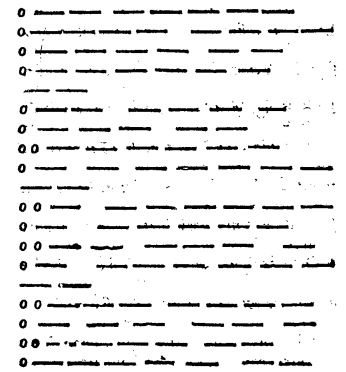
The method of forming the above mentioned sixteen figures is to use a pen to mark sixteen rows of points on a piece of paper. These must then be paired two by two, until, at the end of each row, either two points are left or only one.
Abano’s illustration of how the four mothers are formed
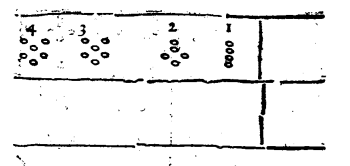
Then one must take the geomantic figures that emerge, in the following way.
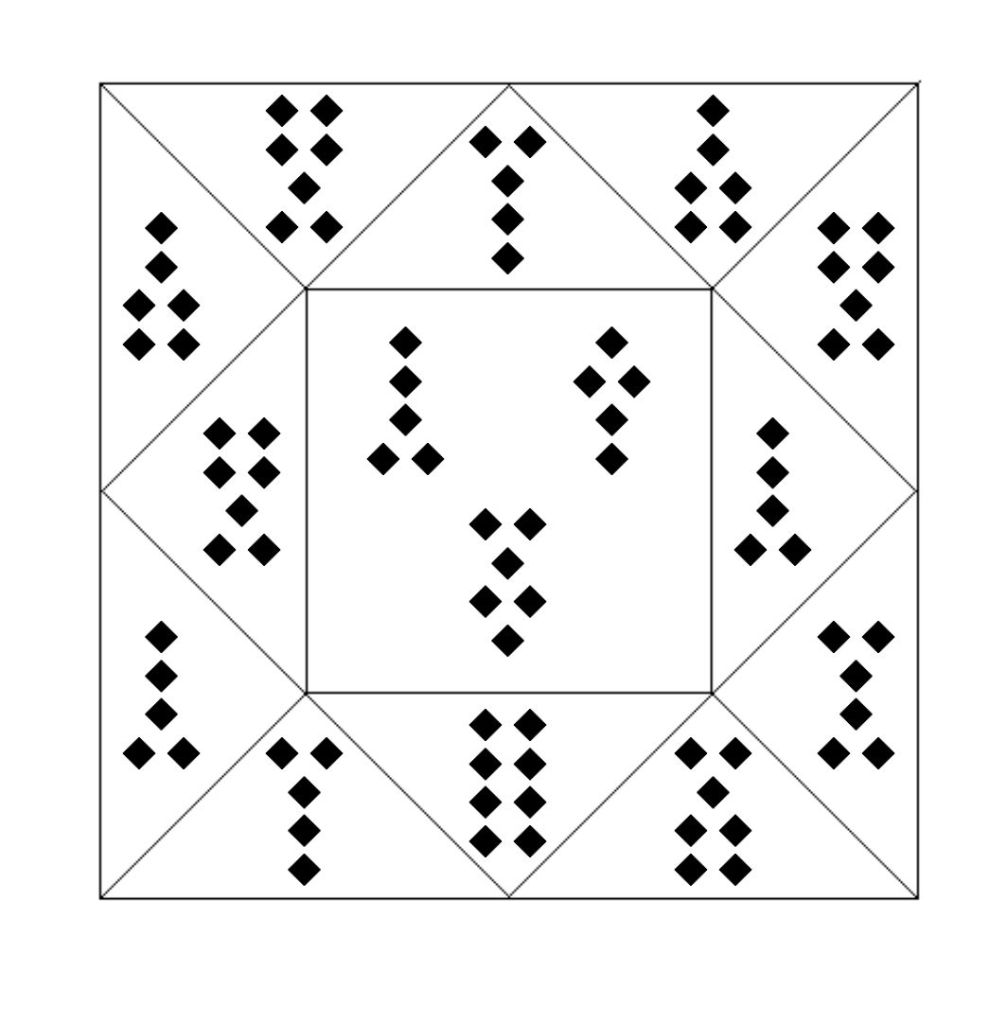
Abano illustrates how to add the Four Mothers to their place
Note, however, that the previous operation is not carried out by counting the points one makes, nor by following one’s fancy, but rather by virtue of the Primum Mobile and First Motor God the Eternal, who moves one’s hand, and is to be carried out with good intentions and by invoking God’s grace and help.1
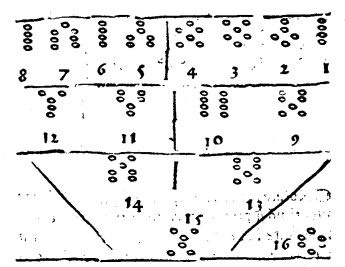
From the first four figures, four other figures are derived by taking the first points of each of the first four figures, which go to form the fifth figure; then by taking the second points of each figure to form the sixth figure, and so on with the third row of points to form the seventh, and the fourth row to form the eighth, as shown below.
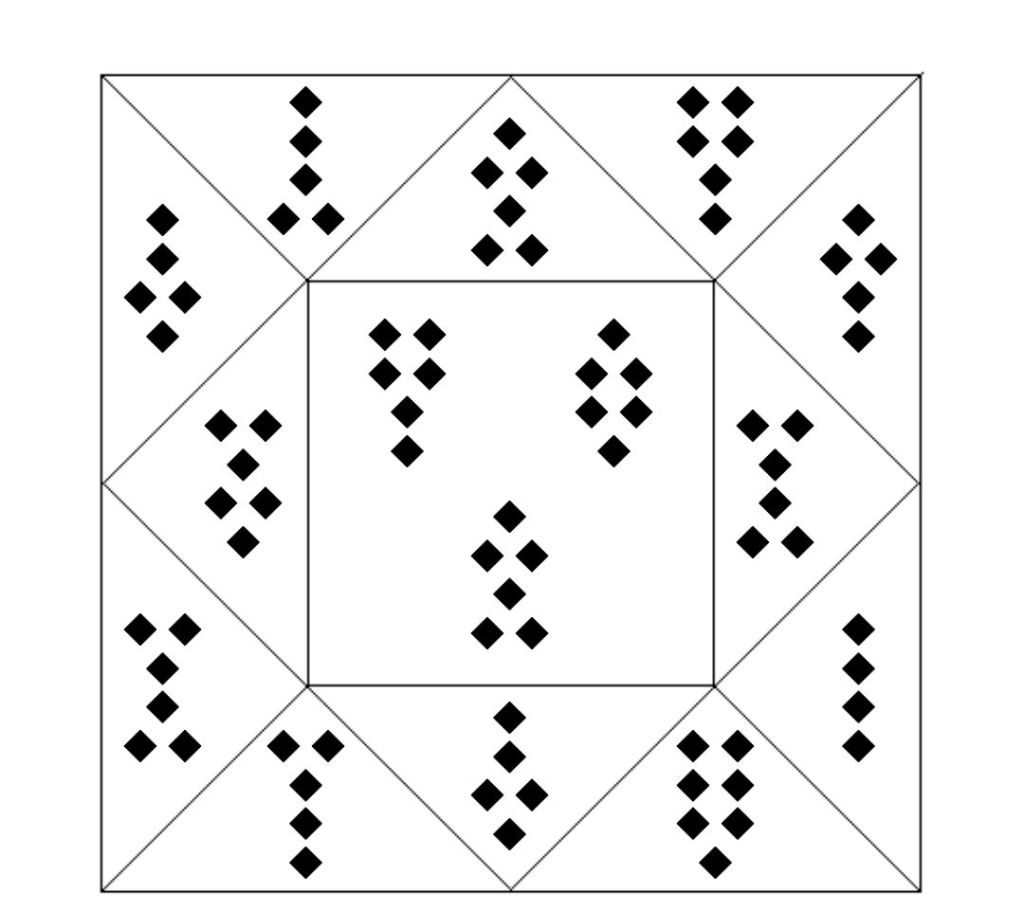
Abano’s illustration of the Geomantic Shield
Once the eighth figure has been drawn, take the first and second [figure] and, proceeding in the same way as at the beginning, form the ninth; then take the third and fourth to form the tenth; then the fifth and sixth to form the eleventh; then the seventh and eighth to form the twelfth.
Then, add the tenth and the eleventh to form the thirteenth, known as the First Witness, and the eleventh and the twelfth to form the fourteenth, known as the Second Witness. Add the witnesses to discover the Judge.
This completes the chart, with every figure in its necessary place according to the question asked, as will be explained. However, often one may take the Judge and the first figure and add them together to obtain the Judge of the Judge,2 which is the sixteenth figure, which we will discuss later.
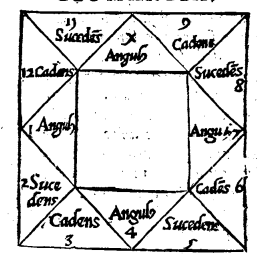
It is to be noted that the main figures are the first twelve, of which four are strongest. The first and the tenth are the best, but the first is even better. The seventh and fourth are also good. These four figures are called the angles, noting which one may know the strength and virtue of the chart. Following them, the second and fifth figure, and the eighth and the eleventh are known as succedent. Finally the last four are the third, the sixth, the ninth and the twelfth, which are called cadent, as shown in the following figure.3
Abano’s illustration of the principle of angularity as it applies to geomancy
And the first figure is called the strongest and best of all, because it signifies the virtue of the Heavens on the querent, that is, he who asks the question.4 It is called the Ascendant. Following that, the tenth is in the middle of the heavens and has great power and influence. When it is good it bodes well, but when it is unfortunate it means great misfortune in terms of how the question is going to end.5
The seventh figure is opposite the Ascendant and is called the Western Angle, and it bodes well when good, ill when bad, especially in questions concerning the seventh house, as will be shown. The fourth figure or house, although categorized as an angle, is called the feeblest of them, because it is at the bottom of the skies in our hemisphere. Nonetheless it indicates the end of the matter and of the querent’s intention.
Then we have the second, fifth, eighth and eleventh, which are succedent houses because they come after the angles, and are good or bad according to the figure [that falls in them] and the question asked, and they indicate the present and what is yet to come for the question asked. The third, sixth, ninth and twelfth figure are called cadent, meaning what runs against the question, and the worst are the sixth are twelfth. The eighth is also among the evil houses.
The above is especially to be noted because every figure has two virtues, one according to its nature and an accidental virtue depending on where it falls in the chart.6 As such, if a good figure falls in the first house, its goodness is amplified, and similarly in any other angle. When it falls in a succedent house, it has less power, and when it is cadent it has even less. And this point holds true for evil figures as well in their ability to cause bad fortune. An evil figure in an angle, therefore, will mean a great bad fortune, especially in the fourth.
Nonetheless, among the bad houses, the sixth and eighth and twelfth are the worst, and every figure falling therein is dangerous in any question.7 And they are especially dangerous if they are evil by their own nature. Said figures are considered not just according to their virtue and the places where they fall, but also according to the question, that is, according that they are appropriate or inappropriate concerning the thing asked.8 As such, what follows is the signification and the property of each of the houses.
The first house signifies the life and body, the being and soul and intention of the querent or the one for whom the question is asked. It also means the beginning of all things. It sits opposite the seventh, and signifies the goods and money of the prisoner. It is the joy of Mercury.9
The second house is wealth,10 gain and loss, and all that the querent owns. It is opposite the eighth, and it signifies the gain of the querent’s family.
The third house indicates siblings, blood relatives, short journeys and enemies of faith and of the Roman Church,11 neighbors, etc. This house is opposite the ninth. It also signifies rumors, and travel companions. It is the joy of the Moon.
The fourth house indicates buildings, buried things, the end of every question. Also, the father, the wealth of a brother or sister.12 It is opposite the tenth.
The fifth house indicates mirth and happiness, children, messengers and letters, music, food, clothes, mid-range travel, the father’s wealth. It is opposite the eleventh and it is the joy of Venus.
The sixth house indicates wrath and an evil mind, toil, malady, servants, people who are subjected to the querent, small animals. This house is the joy of Mars.
The seventh signifies the wife,13 the lover, an opponent, public enemies, games of chance, thieves, bandits, partners. The place the querent goes to, medicine, the wealth of one’s servants. It is opposite the fist house, and is absent.14
The eighth house indicates death, fear, danger, the wealth of the enemy, inheritance from the dead, the wife’s dowry, gain from the land one moves to,15 debts, Necromancy, evil spells. It is opposite the second.
The ninth house signifies religion, Ecclesiastics, the Pope, preferment, priests, the Christian faith, burials, fame or infamy, long travels, the wealth of the absent party.16 It is opposite the third, and is the joy of the Sun.
The tenth signifies the Emperor, the King, the lord,17 great honor, a doctor, a master, art, profession, sea, ship, towers, the thing stolen, famine, fertility, the church’s wealth, and advantages gained from the church. It is opposite the second.18
The eleventh signifies friends, hopes, fortune, courtesans, a lord’s wealth, common goods, the mother’s dowry. It is opposite the fifth, and is the joy of Jupiter.
The twelfth house signifies prison, prisoners, pilgrims and endless wandering, long violence,19 adversities, traitors, occult enemies, great beasts, the friend’s wealth. It is opposite the sixth. It is the joy of Saturn.
Whenever a question is asked, the issue always involves the first house, and in the second place the figure found in the house that is appropriate for the question, and depending on whether it is fortunate or not, together with the four angles, thus does one judge the issue. And especially [it is to be considered] whether the Witnesses and Judge are good.
MQS
Footnotes
Here again, as in Part 1, Abano insists on the role of the divine (and again, he does it in a typical Christian Aristotelean fashion). He is doing more than just paying lip service to the religious ideas and institutions of the time, in so much as he asserts a central point common to all forms of divination: that it is divine nature that shines through the divination process. This explains his assertion that the points must not be counted nor be created following one’s fancy: the diviner’s ego must be switched off in order for the divine to act through it. ↩︎
‘Sopragiudice’ in Italian, which literally means Superjudge or Overjudge. ↩︎
Abano follows the relatively standard (by that time) association of the astrological houses with varying degrees of strength. ↩︎
The first house is given to the querent, so a good figure in it would indicate something positive for them or that they are positive. ↩︎
This seems intended more to emphasize the importance of the angles than to link the tenth house with the ‘end of the matter’, which is a meaning typical of the fourth house. ↩︎
This is meant to reflect the notions, common in Medieval astrology, of accidental and essential dignity of the planets, though the concept must be modified a little in order for it to apply to geomancy. ↩︎
There is a certain digree of ambiguity concerning this issue, as it is not always clear if a figure in a weak house will see its power decreased or its evil import amplified. This ambiguity is present in astrology as well. ↩︎
This is an important concept. A good figure becomes bad if its meaning is opposite to the querent’s intention, and vice versa. ↩︎
Joy is an astrological term. The joys of the planets are houses where the planets are supposed to perform their heavenly duty better. A typical attribution is: the first to Mercury, the third to the Moon, the fifth to Venus, the sixth to Mars, the ninth to the Sun, the eleventh to Jupiter, the twelfth to Saturn. Abano follows this scheme. ↩︎
The term used by Abano is ‘robba’ or, in current Italian, roba. This literally means ‘stuff’. Keep in mind that in the Middle Ages, for many people, stuff was more important than money, and that the moneyed economy we have today was barely in its infancy back then. The second house indicates stuff, and therefore all moveable possessions. ↩︎
Because the third house sits opposite the ninth, which is the house of God. Obviously, Abano wrote at a time when Catholicism was the dominant and (for the most part) only allowed creed. ↩︎
This is by the principle of turned houses. The second house from every house indicates the wealth of the thing or person signified by that house. ↩︎
or husband, if the querent is a woman or a man interested in men. ↩︎
It’s unclear to me what Abano means by this. The seventh house is sometimes given to ‘the absent party’ to know if the person will come back, but the wording Abano uses is strange. ↩︎
The land one moves to is ‘there’, which is the opposite of ‘here’, signified by the first house. ↩︎
I don’t understand why the ninth should indicate the absent party’s wealth. ↩︎
‘Signore’ i.e., the ruler of a Signoria, a small Italian monarchy typical of the time. ↩︎
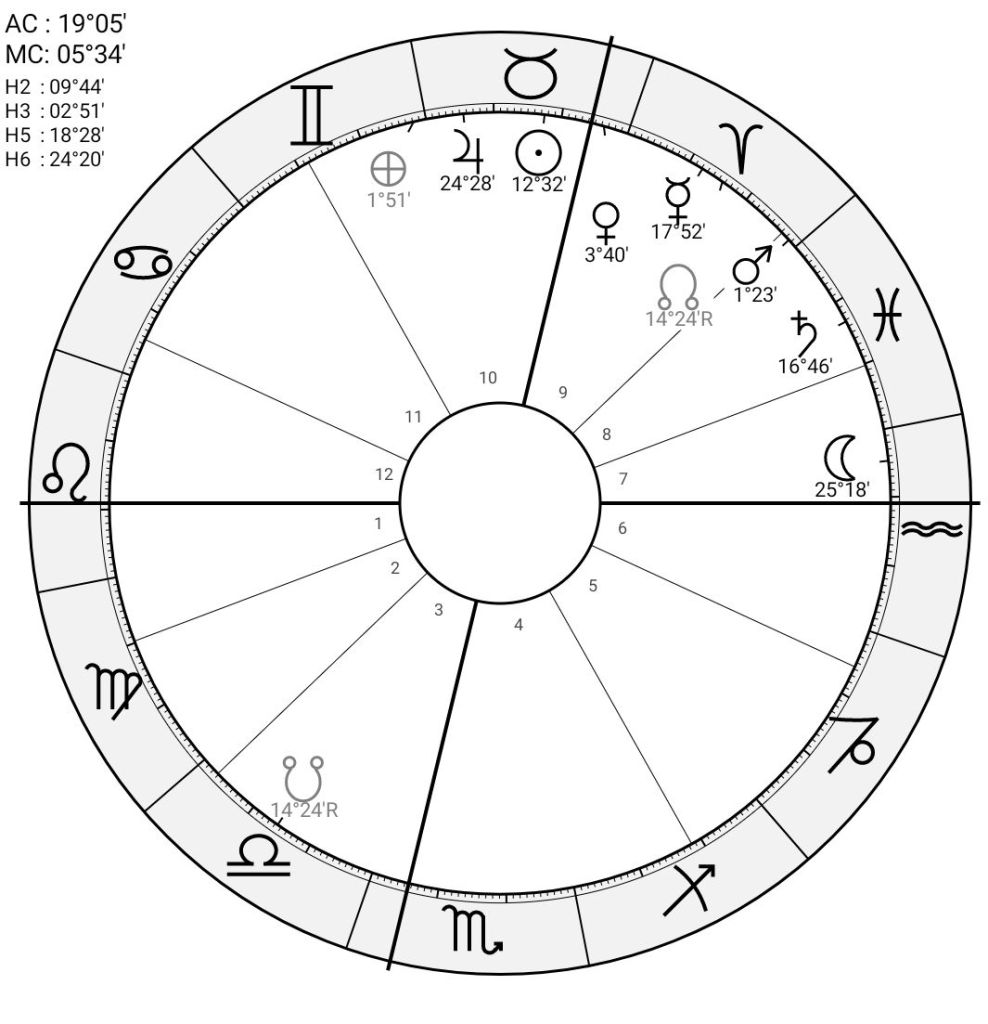
Background: hubby and I are on a weekly veggie delivery service from a nearby farm. Yesterday they told us they might come a bit later than usual (normally they deliver at around 12-13pm). As hubby needed to go to work and I had a ritual to carry out and carefully timed, I needed to know that I wouldn’t be disturbed during the ceremony. So I asked when the veggies would come.
Horary Astrology
Here’s the horary chart (the time was 12:56)
Horary question: when will the veggies arrive? App used: Aquarius2go
Leo rises, so Leo’s ruler, the Sun, is my significator. The delivery service is our business partner, since we buy stuff from them and they bring it to us, so they are signified by the seventh house ruler Saturn (ruling planet of Aquarius). The veggies are their moveable possession, so they are indicated by the second house from the seventh, i.e., the eighth house, and its ruler Jupiter. The Moon is given to us as cosignificator and indicator of the flow of action.
Right off the bat we notice the Moon, weakly dignified in the seventh house, so action (obviously) starts from the delivery service. The Moon has separated from a square with reception with Jupiter, i.e., the veggies, and is now void of course. Clearly there are some problems (a square with reception is still a square). Still, there is a promising sextile (a positive aspect) between the Sun and Saturn, though it’s odd to see our significator applying to theirs (see the Outcome for why).
The Sun perfects the aspect at 17 degrees and 10 minutes of Taurus. The difference from its current position is of 4 degrees and 38 minutes, so they will come in 4 and 38 somethings. I would need to see serious testimonies to judge they won’t come. The Moon being void of course can delay them, but there is a clear aspect showing they’ll come. So they will come today, I thought.
Therefore, they will either come in 4 minutes and 38 seconds or in 4 hours and 38 minutes. I thought the second option was the most likely, so since the chart was cast at 12:56, and allowing some wiggle room for reality to follow astrology, I judged they’d come anywhere between 17.30 and 18, though I was somewhat skeptical, since this timing would have been unprecedented for them, and they’d told us they would come only a little bit later than usual. But at least this gave me plenty of time for my ritual.
Geomancy
After my ritual, which was timed for around 15 in the afternoon, I decided to have a look at what Geomancy had to say about this delivery:
The Geomantic court is positive, with the Judge Acquisitio showing we’ll get the veggies, but the Witnesses are mixed, showing problems. Albus is in the first, and it’s a good figure for commerce. A very unpromising Cauda Draconis is in the seventh house (which is also the left witness). I must say that I have seldom seen things resolved satisfactorily when Cauda is involved. However, Cauda does spring to the second house, perfecting. I was also relieved, but also a bit puzzled, to see Albus spring to the eighth, also perfecting the chart. Usually, the figure that moves makes the effort. In this case, it seems both of us will make some effort, and that our effort is better than theirs.
Outcome
They did come between 17.30 and 18 (around 17.45). However, they gave us the wrong delivery, which we only noticed when they’d already gone away. So we had to call them back and go meet them to exchange the wrong veggies for the right ones. Note how in the horary our significator applies to theirs and how, in the Geomantic chart, Albus moves to the eighth.
Lessons to be learned
1. Horary questions must not be idle, but they need not be life-changing. Knowing when a delivery service will arrive may seem idle curiosity, but I had a serious reason to want to know the answer (I take my magic work seriously)
2. The divination device, whatever it may be, ALWAYS knows best, though we may be fallible in interpreting it. People like to say that divination lets you contact your unconscious. I think there is altogether too much talk about the unconscious, and not enough talk about the superconscious. I saw from the Geomancy reading that there were problems connected with the delivery, though I could not pinpoint them exactly. In hindsight it is clear what the chart meant.
3. It is a humbling and inspiring experience to see how perfectly the cosmic mechanism works.