In Medieval and early modern times, Astrology was everything. Being a natural consequence of the philosophical worldview tolerated by the church (that is, Aristoteleanism), Astrology was not seen, strictly speaking, as a Bible-prohibited practice, but merely as an extension of the science of the day. Though it always had its detractors, it was generally accepted. Therefore it was normal to try to astrologize everything.
We’ve already discussed geomantic perfection. This takes place thanks to something resembling aspects. But some old books go a step further and seek to introduce the actual astrological aspects of the time into geomantic practice.
In Astrology, an aspect happens when two planets occupy the same degree in different signs: a sextile happens to planets that are 60 degrees apart (e.g., Venus at 10 Aries and Jupiter at 10 Gemini); a square is between planets that are 90 degrees apart (e.g. Venus at 10 Aries and Jupiter at 10 Cancer); a trine is between planets that are 120 degrees apart (e.g., Venus at 10 Aries and Jupiter at 10 Leo); an opposition is between planets that are 180 degrees apart (e.g., Venus at 10 Aries and Jupiter at 10 Libra)
Aspects are key to astrological perfection. They show the things signified by the planets coming together, with sextile and trine indicating good contact on one hand and square and opposition showing bad or difficult contact. For instance, if in a love question my significator aspects my love interest’s significator, it shows us coming together. If by trine, we get along, if by square we argue.
In geomancy, astrological aspects have been adapted to the chart as follows:
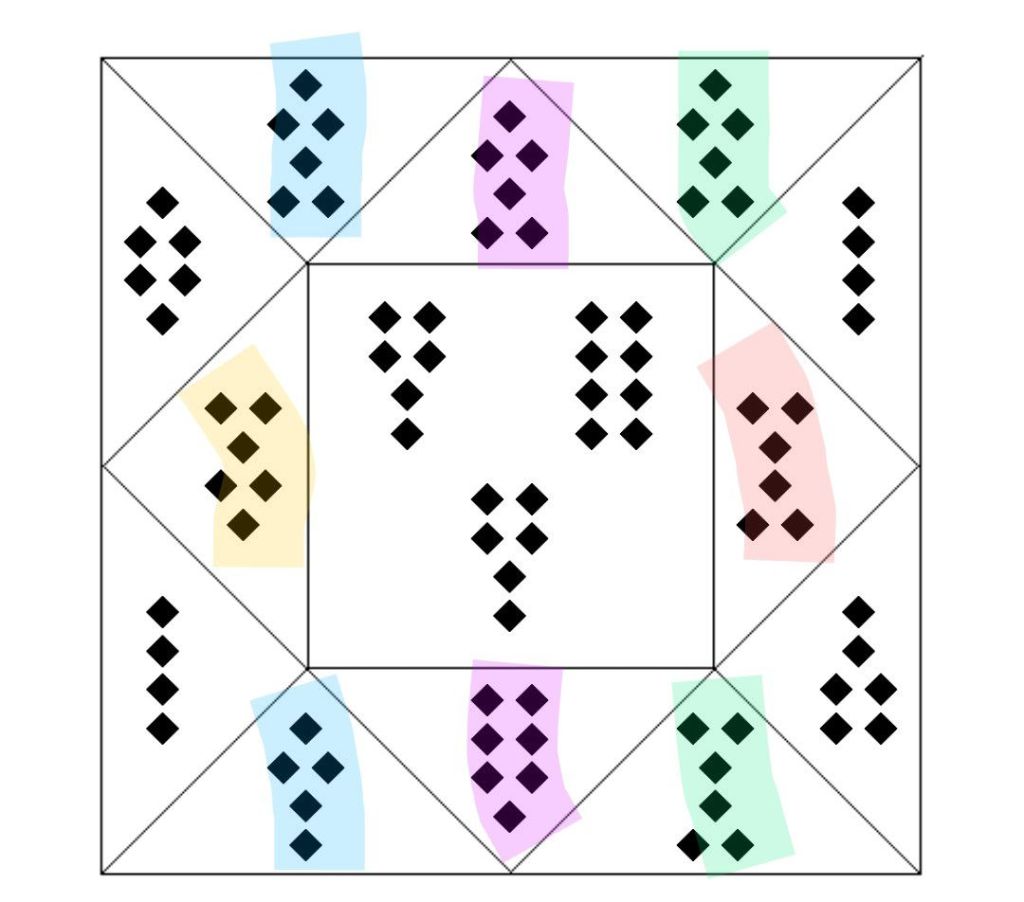
If we take the figure in the first house (marked in yellow) as a reference point, then the figures in blue sextile it, because they are separated from it by a single sign; the figures in purple square it, because they are separated from it by two houses; the figures in green trine it because they are separated from it by three houses, and the figure in red opposes it, since it occupies the houses directly opposite.
This is supposed to shed some light on the relationship between the figures: two figures that fall into a square pattern have a difficult relationship, two figures in a trine a good one, etc.
The problem with using astrological aspects in Geomancy is that aspects work in a fundamentally different way: in Astrology, an aspect requires a planet to move in order to apply to another planet. After perfection, then, the aspect separates and its effect wanes.
Geomancy, though, is a static system with no real movement. Sure, we can say a figure moves from one house to another, but in reality that figure is already present in both houses. The only way to conceptualize movement in a geomantic chart is when we take a significator’s house to be the original position of the figure in it, and every other instance of that figure as a successive movement (e.g., in a career reading, if Laetitia is in the tenth house and in the seventh, we take it to move from the tenth to the seventh and not vice versa).
I am honestly not convinced that astrological aspects can find a meaningful place in geomancy. They certainly cannot bring matters to perfection, otherwise everyone would always be separating from their partner since the figure in the seventh house always opposes the figure in the first. Similarly, everyone would always get along with their siblings since the third house always sextiles the first.
One possibility which has been suggested is that of applying aspects only to figures that move. In a love reading, for instance, if the seventh figure moves to the tenth, it moves to square the querent, since the tenth house squares the first.
I personally find this application also problematic, because the tenth house represents the job, among other things, so that would mean that everytime the querent’s job is involved in their love life it causes trouble, which is a false assumption.
At most, I would take an aspect into consideration only if BOTH significators move. In the hypothetical love reading, for instance, if the first figure (querent) moves to the fourth house and the seventh (significant other) moves to the tenth, then they are in opposition to one another. Maybe they will argue. Or, if the first moves to the fourth and the seventh to the second, they sextile each other, which is good.
Even in a situation like this I am generally cautious about applying this theory. There are certain aspects of Astrology (pun intended) that simply don’t translate well to other systems of divination. You are of course welcome to try this theory on for size, but personally I believe Geomancy already has its particular version of aspects, and throwing other stuff into the mix feels more like an attempt at complicating this “brief and simple science” to find something more to tell the querent.
MQS