Tag Archives: Aleister Crowley

Tarot Encyclopedia – The Queen of Pentacles or Coins

(Note: this is a collection of the meanings attributed to the cards by some occultists in the past centuries. It does not reflect my own study or opinion of the cards. It is only meant as a quick comparative reference as I develop my own take.)
The Queen of Pentacles or Coins from the Builders of the Adytum (BOTA) tarot deck

Paul Foster Case (and Ann Davies)

The time period is from the beginning of the last decanate of Aries to the end of the second decanate of Taurus, April 10 to May 10. This period is under the rulerships of Jupiter, Venus and Mercury.
Well-Dignified: the ability to detect the workings of Divine Guidance in all aspects of incarnate life. In divination, a generous, somewhat ceremonious, great-hearted woman who is both charming and graceful. She is probably possessed of considerable means and is friendly to the
Querent.
lll-Dignified: some problem with materialism and ability to express unselfish love. A woman who is ostentatious, loose in morals, capricious, changeable, superficial. Likely to do Querent harm through foolish talk, exposure of his plans, etc.
Dark hair and eyes.
(From the Oracle of Tarot course)

A. E. Waite

The face suggests that of a dark woman, whose qualities might be summed up in the idea of greatness of soul; she has also the serious cast of intelligence; she contemplates her symbol and may see worlds therein. Divinatory Meanings: Opulence, generosity, magnificence, security, liberty. Reversed: Evil, suspicion, suspense, fear, mistrust.
(From The Pictorial Key to the Tarot)

Aleister Crowley

The Queen of Disks represents the watery part of Earth, the function of that element as Mother. She rules from the 21st degree of Sagittarius to the 20th degree of Capricornus. She represents passivity, usually in its highest aspect.

The Queen of Disks is throned upon the life of vegetation. She contemplates the background, where a calm river winds through a sandy desert to bring to it fertility. Oases are beginning to shew themselves amid the wastes. Before her stands a goat upon a sphere. There is here a reference to the dogma that the Great Work is fertility. Her armour is composed of small scales or coins, and her helmet is adorned with the great spiral horns of the markhor. In her right hand she bears a sceptre surmounted by a cube, within which is a three-dimensional Hexagram, and in her left arm is curved her proper disk, a sphere of loops and circles interlaced. She thus represents the ambition of matter to take part in the great work of Creation.

Persons signified by this card possess the finest of the quieter qualities. They are ambitious, but only in useful directions. They possess immense funds of affection, kindness, and greatness of heart. They are not intellectual, and not particularly intelligent; but instinct and intuition are more than adequate for their needs. These people are quiet, hard-working, practical, sensible, domesticated, often (in a reticent and unassuming fashion) lustful and even debauched. They are inclined to the abuse of alcohol and of drugs. It is as if they could only realize their essential happiness by getting outside themselves.

If ill dignified, they are dull, servile, foolish; they are drudges rather than workers. Life for them is purely mechanical; and they cannot rise, or even seek to rise, above their appointed lot.

In the Yi King, the watery part of Earth is represented by the 31st hexagram, Hsien. This has the meaning: Influence. The commentary describes the effect of moving various parts of the body, from the toes to the jaws and tongue. This is rather an amplification of what has been said above than an exact correspondence; yet there is no discordance. The general advice is to go forward quietly without overt attack upon existing situations.
(From The Book of Thoth)

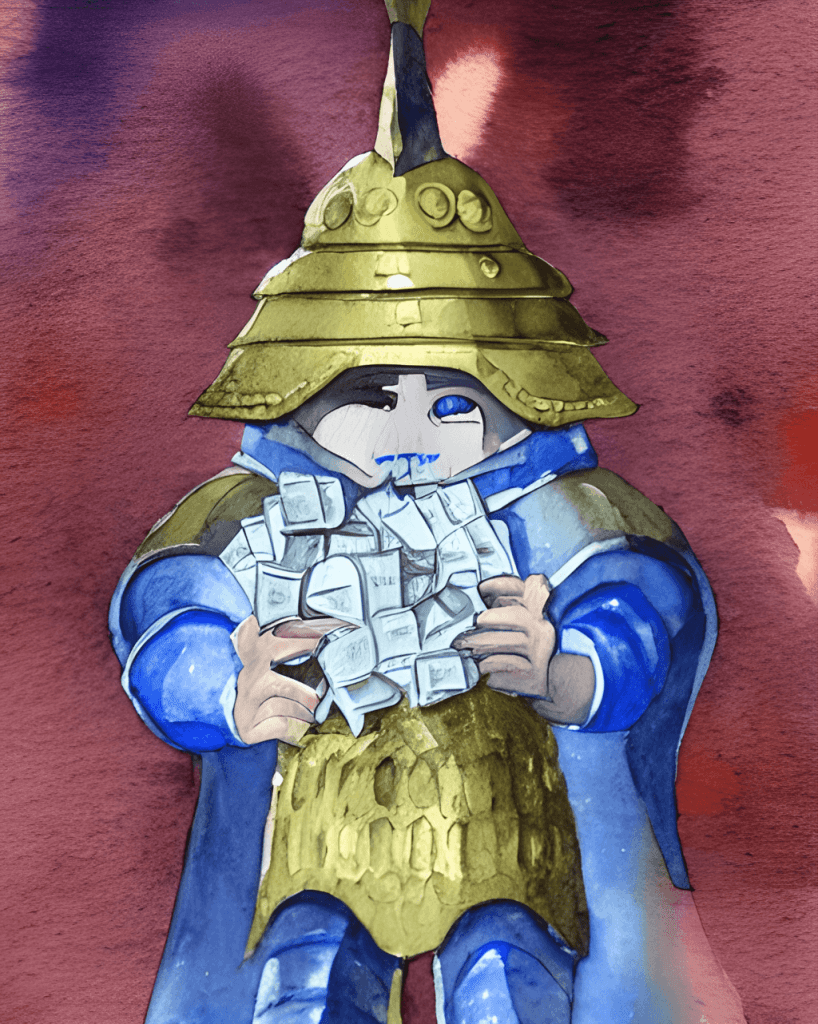
AI-generated illustration for the Queen of Pentacles or Coins

Golden Dawn’s Book T

A WOMAN of beautiful face with dark hair; seated upon a throne, beneath which is dark sandy earth. One side of her face is light, the other dark; and her symbolism is best represented in profile. Her attire is similar to that of the Queen of Wands: but she bears a winged goat’s head as a crest. A goat is by her side. In one hand she bears a sceptre surmounted by a cube, and in the other an orb of gold. She is impetuous, kind; timid, rather charming; great-hearted; intelligent, melancholy; truthful, yet of many moods.
If ill dignified she is undecided, capricious, changeable, foolish.
She rules from 20 Degree Sagittarius to 20 Degree Capricorn.

Etteilla

Dark Woman
Upright. This card, as far as the medicine of the spirit is concerned, means, in its natural position: Dark Woman, Opulence, Wealth, Lavishness, Luxury, Sumptuousness. – Assurance, Reliability, Trust, Certainty, Confirmation. – Confidence, Boldness, Freedom, Frankness.
Reversed. Unsafe, Doubtful, Uncertain, Doubt, Indecision, Uncertainty. – Fear, Fright, Timidity, Apprehension, Vacillation, Hesitation. – Indeterminate, Irresolute, Perplexed, He who is suspended.

MQS

Tarot Encyclopedia – The Queen of Wands

(Note: this is a collection of the meanings attributed to the cards by some occultists in the past centuries. It does not reflect my own study or opinion of the cards. It is only meant as a quick comparative reference as I develop my own take.)

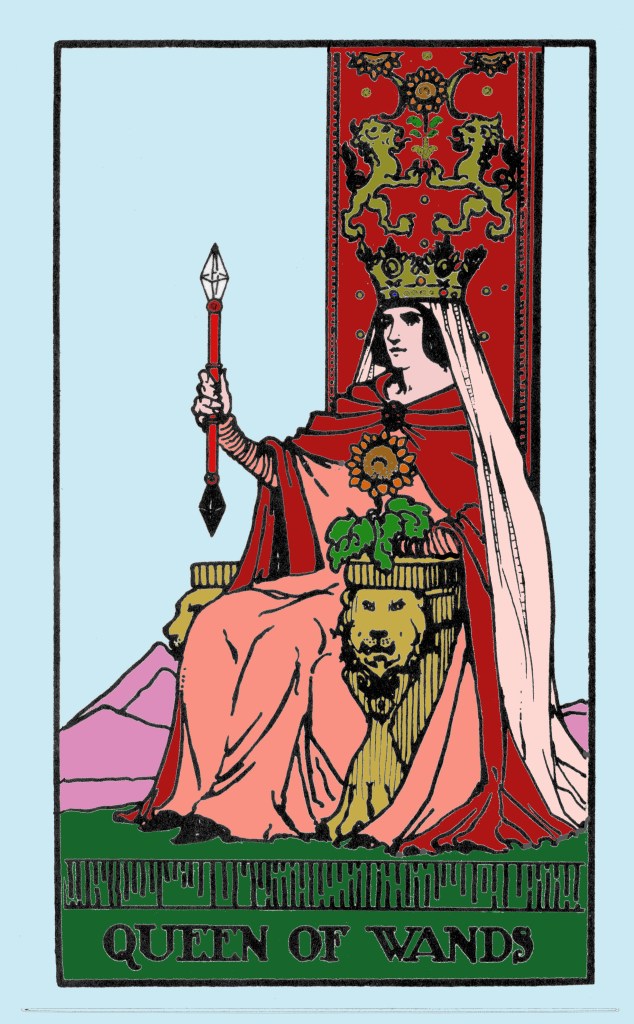
The Queen of Wands from the Builders of the Adytum (BOTA) tarot deck

Paul Foster Case (and Ann Davies)

The time period related to the Queen of Wands is from July 13 to August 12, symbolizing the influence of Jupiter and Neptune in Cancer and of the Sun and Jupiter in Leo. The basic power suggested by this Key is that of command.
Well Dignified: in a divination the Queen of Wands symbolizes a kind, generous woman, resolute in the face of opposition, strongly psychic and intuitive but practical in applying her spiritual gifts; intense; magnetic ; friendly to the querent and a favorable influence for the success or business of the querent.
Ill Dignified: Inimical to the querent; obstinate, dangerous woman, unfavorable to querent’s affairs; revengeful and tyrannical.
(From the Oracle of Tarot course)

A. E. Waite

The Wands throughout this suit are always in leaf, as it is a suit of life and animation. Emotionally and otherwise, the Queen’s personality corresponds to that of the King, but is more magnetic. Divinatory Meanings: A dark woman, countrywoman, friendly, chaste, loving, honourable. If the card beside her signifies a man, she is well disposed towards him; if a woman, she is interested in the Querent. Also, love of money, or a certain success in business. Reversed: Good, economical, obliging, serviceable. Signifies also–but in certain positions and in the neighbourhood of other cards tending in such directions–opposition, jealousy, even deceit and infidelity.
(From The Pictorial Key to the Tarot)

Aleister Crowley

The Queen of Wands represents the watery part of Fire, its fluidity and colour. Also, she rules in the Zodiac from the 21st degree of Pisces to the 20th degree of Aries. Her crown is topped with the winged globe and rayed with flame. Her long red golden hair flows down upon her armour of scaled mail. She is seated upon a throne of flame, ordered into geometrical light by her material power. Beneath the throne the surging flames are steady. She bears a wand in her left hand; but it is topped with a cone suggestive of the mysteries of Bacchus. She is attended by a couchant leopard upon whose head she lays her hand. Her face expresses the ecstasy of one whose mind is well in-drawn to the mystery borne beneath her bosom.

The characteristics of the Queen are adaptability, persistent energy, calm authority which she knows how to use to enhance her attractiveness. She is kindly and generous, but impatient of opposition. She has immense capacity for friendship and for love, but always on her own initiative.

There is as much pride in this card as in the Knight, but it lacks the spontaneous nobility which excuses that error. It is not true pride, but self-complacent vanity and even snobbery.

The other side of her character is that she may have a tendency to brood, come to a wrong decision thereon, and react with great savagery. She may be easily deceived; then she is likely to shew herself stupid, obstinate, tyrannical. She may be quick to take offence, and harbour revenge without good cause. She might turn and snap at her best friends without intelligible excuse. Also, when she misses her bite, she breaks her jaw!

In the YI King, the watery part of Fire is represented by the 17th hexagram, Sui. It indicates reflection upon impulse, and the consequently even flow of action. There is great capacity for lucid conception and steady prosecution of work; but this is only at the bidding, and under the guidance, of some creative mind. There is a tendency to be fickle, even disloyal; the ideas which she obeys make no deep or permanent impression. She will “cleave to the little boy and let go the man of age and experience” or the reverse (lines 2 and 3) without realizing what she is doing. There is liability of fits of melancholy, which she seeks to cure by bouts of intoxication, or by panic-stricken outbursts of ill-considered fury.
(From The Book of Thoth)

Strangely Crowley-esque AI-generated illustration for the Queen of Wands

Golden Dawn’s Book T

A CROWNED queen with long red-golden hair, seated upon a Throne, with steady flames beneath. She wears a corslet and buskins of scale-mail, which latter her robe discloses. Her arms are almost bare. On cuirass and buskins are leopard’s heads winged, and the same symbol surmounteth her crown. At her side is a couchant leopard on which her hands rest. She bears a long wand with a very heavy conical head. The face is beautiful and resolute.
Adaptability, steady force applied to an object, steady rule, great attractive power, power of command, yet liked notwithstanding. Kind and generous when not opposed.
If ill dignified, obstinate, revengeful, domineering, tyrannical, and apt to turn against another without a cause.
She rules the heavens from above the last Decan of Pisces to above the 20 Degree of Aries: including thus a part of Andromeda.

Etteilla

Country Woman
Upright: This card, as far as the medicine of the spirit is concerned, means, when upright: Country woman, housewife, economy, honesty, civility – Sweetness, virtue – Honor, chastity
Reversed: Good woman, goodness, excellence – Respectful, caring, obliging – Service, favor, benefit

MQS

Tarot Encyclopedia – The Queen of Cups

(Note: this is a collection of the meanings attributed to the cards by some occultists in the past centuries. It does not reflect my own study or opinion of the cards. It is only meant as a quick comparative reference as I develop my own take.)

The Queen of Cups from the Builders of the Adytum (BOTA) tarot deck

Paul Foster Case (and Ann Davies)

The time period is the beginning of the last decanate of Libra to the end of the second decanate of Scorpio, October 13 to November 11, combining the rulerships of Mercury, Mars, Jupiter and Neptune.
Well Dignified: through the influence of Mercury in Libra the Queen of Cups personifies a woman, mentally alert, yet somewhat superficial, who probably has a touch of the poetic in her nature. She is kindhearted though not likely to go to too much trouble for anyone. The Scorpio influence added gives her strong desires and makes her emotionally responsive and attractive to the opposite sex; very psychic, and if her hig he r nature is developed she depicts a very powerful spiritual force akin to the influence of the purified desire nature and the influence of Neshamah.
Ill Dignified: a woman who is subtle, decidedly coquettish and may even be a deliberate heart-breaker.
Usually gold-brown hair with blue eyes.
(From the Oracle of Tarot course)

A. E. Waite

Beautiful, fair, dreamy–as one who sees visions in a cup. This is, however, only one of her aspects; she sees, but she also acts, and her activity feeds her dream. Divinatory Meanings: Good, fair woman; honest, devoted woman, who will do service to the Querent; loving intelligence, and hence the gift of vision; success, happiness, pleasure; also wisdom, virtue; a perfect spouse and a good mother. Reversed: The accounts vary; good woman; otherwise, distinguished woman but one not to be trusted; perverse woman; vice, dishonour, depravity.
(From The Pictorial Key to the Tarot)

Aleister Crowley

The Queen of Cups represents the watery part of Water, its power of reception and reflection. In the Zodiac it rules from the 21St degree of Gemini to the 20th degree of Cancer Her image is of extreme purity and beauty, with infinite subtlety; to see the Truth of her is hardly possible, for she reflects the nature of the observer in great perfection.

She is represented as enthroned upon still water. In her hand she bears a shell-like cup, from which issues a crayfish, and she bears also the Lotus of Isis, of the Great Mother. She is robed in, and veiled by, endless curves of light, and the sea upon which she is enthroned conveys the almost unbroken images of the image which she represents.

The characteristics associated with this card are principally dreaminess, illusion and tranquillity. She is the perfect agent and patient, able to receive and transmit everything without herself being affected thereby. If ill-dignified, all these qualities are degraded. Everything that passes through her is refracted and distorted. But, speaking generally, her characteristics depend mostly upon the influences which affect her.

In the Yi King, the watery part of Water is represented by the 8th hexagram, Tui. The commentary is as colourless as the card; it consists of mild exhortations on the subject of pleasure. It may really be said that, normally, people of this type have no character at all of their own, unless it can be called a characteristic to be at the disposition of every impact or impression.

There is, however, a hint (line 6) that the chief pleasure of people of this type is to lead and attract others. Such are accordingly (often enough) exceedingly popular.
(From The Book of Thoth)

AI-Generated illustration for the Queen of Cups

Golden Dawn’s Book T

A VERY beautiful fair woman like a crowned Queen, seated upon a throne, beneath which is flowing water wherein Lotuses are seen. Her general dress is similar to that of the Queen of Wands, but upon her crown, cuirass and buskins is seen an Ibis with opened wings, and beside her is the same bird, whereon her hand rests. She holds a cup, wherefrom a crayfish issues. Her face is dreamy. She holds a lotus in the hand upon the Ibis. She is imaginative, poetic, kind, yet not willing to take much trouble for another.
Coquettish, good-natured and underneath a dreamy appearance. Imagination stronger than feeling. Very much affected by other influences, and therefore more dependent upon dignity than most symbols.
She rules from 20 Degree Gemini to 20 Degree Cancer.

Etteilla

Blonde Woman
Upright: As far as the medicine of the spirit is concerned, this card, when upright, means: Blonde Woman, Honest Woman, Virtue, Wisdom, Honesty
Reversed: Distinguished woman, Vice, Dishonesty, Debauchery, Corruption, Scandal

MQS

Tarot Encyclopedia – The King of Swords

(Note: this is a collection of the meanings attributed to the cards by some occultists in the past centuries. It does not reflect my own study or opinion of the cards. It is only meant as a quick comparative reference as I develop my own take.)

A collection of interpretations for the King of Swords
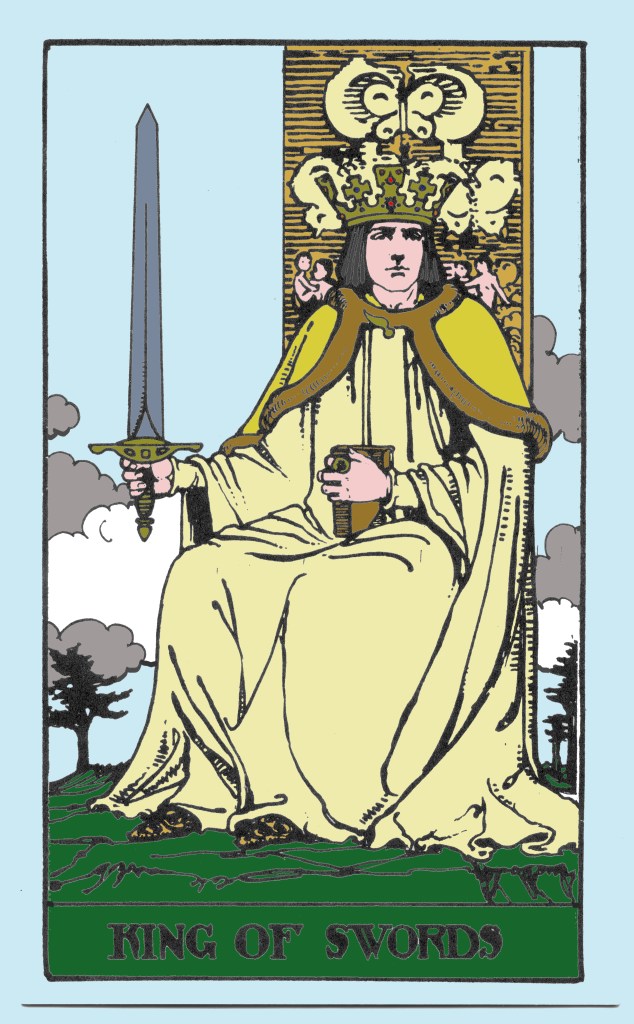
The King of Swords from the Builders of the Adytum (BOTA) tarot deck

Paul Foster Case (and Ann Davies)

The time period is from the beginning of the last decanate of Virgo to the end of the second decanate of Libra, September 13 to October 12, under the combined rulerships of Venus in Taurus, Venus in Libra, and Saturn-Uranus in Aquarius. Meanings: a man of strong and powerful imagination; hard worker and having authority; keen in understanding law and capable of excellent cooperation; somewhat distrustful and suspicious and therefor e hard to convince. He sometimes surprises his friends by sudden changes of attitude, although he is usually overcautious and analytical. In a divinatory lay-out:
Well Dignified: he is friendly to the Querent and will cooperate with him. lll Dignified: he is inimical, harsh, malicious and plotting, obstinate and wholly unreliable.
Dark hair and dark eyes.
(From the Oracle of Tarot course)

A. E. Waite

He sits in judgment, holding the unsheathed sign of his suit. He recalls, of course, the conventional Symbol of justice in the Trumps Major, and he may represent this virtue, but he is rather the power of life and death, in virtue of his office. 
Divinatory Meanings: Whatsoever arises out of the idea of judgment and all its connexions-power, command, authority, militant intelligence, law, offices of the crown, and so forth. 
Reversed: Cruelty, perversity, barbarity, perfidy, evil intention.
(From The Pictorial Key to the Tarot)

Aleister Crowley

(Note: Crowley and the Golden Dawn swapped around King and Knight. This is in part true of Waite as well.)

The Knight of Swords represents the fiery part of Air; he is the wind, the storm. He represents the violent power of motion applied to an apparently manageable element. He rules from the 21st degree of Taurus to the 20th degree of Gemini. He is a warrior helmed, and for his crest he bears a revolving wing. Mounted upon a maddened steed, he drives down the Heavens, the Spirit of the Tempest. In one hand is a sword, in the other a poniard. He represents the idea of attack.

The moral qualities of a person thus indicated are activity and skill, subtlety and cleverness. He is fierce, delicate and courageous, but altogether the prey of his idea, which comes to him as an inspiration without reflection.

If ill-dignified, the vigour in all these qualities being absent, he is incapable of decision or purpose. Any action that he takes is easily brushed aside by opposition. Inadequate violence spells futility. “Chimaera bombinans in vacuo”.

In the Yi King, the fiery part of Air is represented by the 32nd hexagram, Hang. This is the first occasion on which it has been simple to demonstrate the close technical parallelism which identifies Chinese thought and experience with that of the West. For the meaning is long continuance: “perseverance in well-doing, or continuously acting out the law of one’s being”, as Legge puts it in his note on the hexagram; and this seems incongruous with the Qabalistic idea of violent energy applied to the least stable of the elements. But the trigram of Air also indicates wood; and the hexagram may have Suggested the irresistible flow of the sap, and its effect in strengthening the tree. This conjecture is supported by the warning in line 6: “The topmost line, divided, shows its subject exciting himself to long continuance. There will be evil.”

Allowing this, the image of “the extended flame of mind”, as Zoroaster calls it, may well be subjoined to the former description. It is the True Will exploding the mind spontaneously. The influence of Taurus makes for steadiness, and that of the first decanate of Gemini for inspiration. So let us picture him, “integer vitae scelerisque purus”, a light-shaft of the Ideal absorbing the entire life in concentrated aspiration, passing from earthy Taurus to exalted Gemini. Here, too, is shewn (as in the Yi) the danger to the subject of this symbol; for the first decan is the card called “Interference”; or, in the old pack, “Shortened Force”.
(From the Book of Thoth)

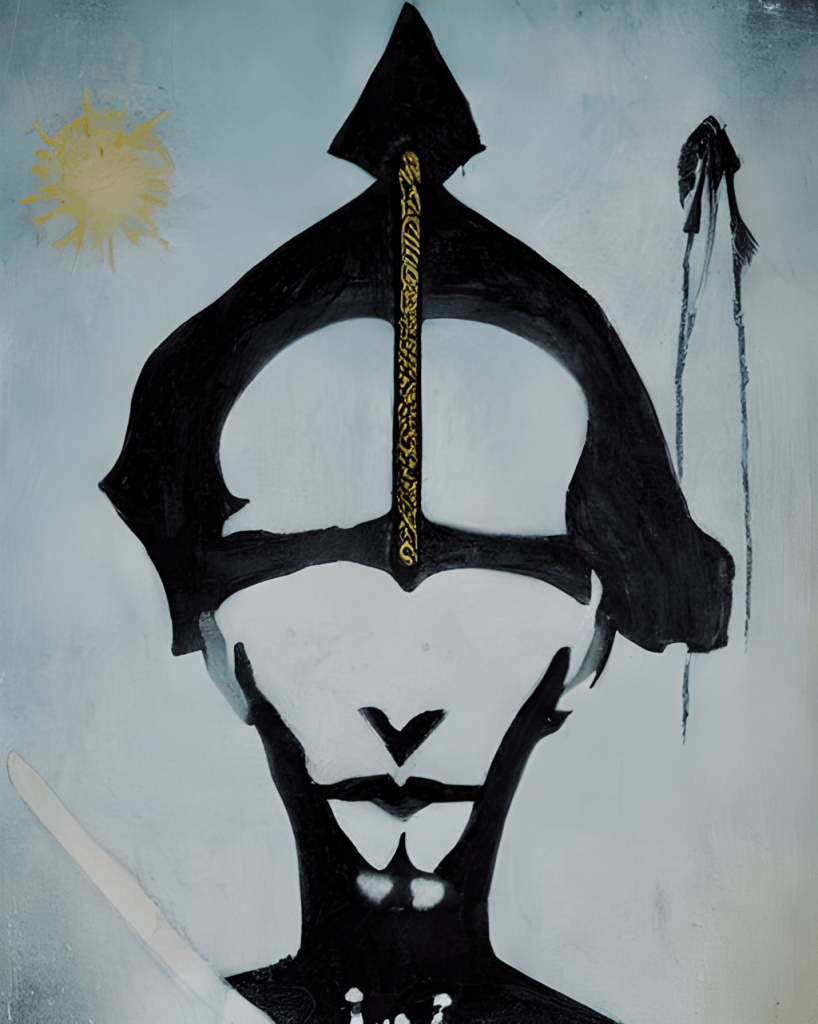
Oddly Bismarckian AI-generated Illustration for the King of Swords

Golden Dawn’s Book T

A WINGED Warrior with crowned Winged Helmet, mounted upon a brown steed. His general equipment is as that of the Knight of Wands, but he wears as a crest a winged six-pointed star, similar to those represented on the heads of Castor and Pollux the Dioscuri, the twins Gemini (a part of which constellation is included in his rule). He holds a drawn sword with the sigil of his scale upon its pommel. Beneath his horse’s feet are dark-driving stratus clouds. He is active, clever, subtle, fierce, delicate, courageous, skilful, but inclined to domineer. Also to overvalue small things, unless well dignified. If ill dignified, deceitful, tyrannical and crafty.
Rules from 20 Degree Taurus to 20 Degree Gemini.

Etteilla

Man in Uniform
Upright: This card, as far as the medicine of the spirit is concerned, means, in its natural position: Man in Uniform, Man of the Law, Judge, Councilor, Assessor, Senator, Business Man, Medical Practitioner, Lawyer, Prosecutor, Doctor, Physician. – Jurist, Law-making. – Litigant [= Party to litigation], Jurisconsult.
Reversed: Malicious, Maliciousness, Perversity, Perfidy, Crime, Cruelty, Atrocity, Inhumanity.

MQS

Tarot Encyclopedia – The King of Coins or Pentacles

(Note: this is a collection of the meanings attributed to the cards by some occultists in the past centuries. It does not reflect my own study or opinion of the cards. It is only meant as a quick comparative reference as I develop my own take.)

The King of Coins or King of Pentacles from the Builders of the Adytum (BOTA) tarot deck

Paul Foster Case (and Ann Davies)

The time period is from the beginning of the last decanate of Sagittarius to the end of the second d ecanate of Capricorn, De cember 12 to January 9. This period combines the rulerships of the Sun, Saturn and Venus .
Well-Dignified: the ability to see the workings of Divine Law in the phenomena of the physical plane – thus rulership. In divination, a dark man, friendly to the Querent, practical, steady and reliable. He is good at the practical application of ideas and theories. Things tend to prosper and increase under his direction. He is slow to anger, but furious when aroused. Ill-Dignified: good theoretical insight into the workings of Divine Law, but inability to apply it to everyday experiences. In divination, a man selfish and materialistic. Such a man could have some power to solidify evil forces and express them but is nevertheless somewhat stupid.
(From the Oracle of Tarot course)

A. E. Waite

The figure calls for no special description. The face is rather dark, suggesting also courage, but somewhat lethargic in tendency. The bull’s head should be noted as a recurrent symbol on the throne. The sign of this suit is represented throughout as engraved or blazoned with the pentagram, typifying the correspondence of the four elements in human nature and that by which they may be governed. In many old Tarot packs this suit stood for current coin, money, deniers. I have not invented the substitution of pentacles and I have no special cause to sustain in respect of the alternative. But the consensus of divinatory meanings is on the side of some change, because the cards do not happen to deal especially with questions of money. 
Divinatory Meanings: Valour, realizing intelligence, business and normal intellectual aptitude, sometimes mathematical gifts and attainments of this kind; success in these paths. Reversed: Vice, weakness, ugliness, perversity, corruption, peril.
(From The Pictorial Key to the Tarot)

Aleister Crowley

(Note: Crowley and the Golden Dawn swapped around King and Knight. This is in part true of Waite as well.)
The Knight of Disks represents the fiery part of Earth, and refers in particular to the phenomena of mountains, earthquakes, and gravitation; but it also represents the activity of Earth regarded as the producer of Life. He rules from the 21st degree of Leo to the 20th degree of Virgo, and is thus concerned greatly with agriculture. This warrior is short and sturdy in type. He is clothed in great solidity of plate armour; but his helmet, which is crested with the head of a stag, is thrown back, for at the moment his function is entirely confined to the production of food. For this reason he is armed with a flail. The disk which he bears, moreover, is very solid; it represents nutrition. These characteristics are borne out by his horse; a shire horse, solidly planted on all four feet, as was not the case with the other Knights. He rides through the fertile land; even the distant hills are cultivated fields.

Those whom he symbolizes tend to be dull, heavy and preoccupied with material things. They are laborious and patient, but would have little intellectual grasp even of matters which concern them most closely. Their success in these is due to instinct, to imitation of Nature. They lack initiative; their fire is the smouldering fire of the process of growth.

If ill-dignified, these people are hopelessly stupid, slavish, quite incapable of foresight even in their own affairs, or of taking an intelligent interest in anything outside them. They are churlish, surly, and jealous (in a dull sort of way) of what they instinctively realize is the superior state of others; but they have not the courage or intelligence to better themselves. Yet they are always irritably meddling about petty matters; they interfere with, and inevitably spoil, whatever comes their way.

In the Yi King, the fiery part of Earth is represented by the 62nd hexagram, Hsiao Kwo. This is as important as its complement, Kung Fu (see under Prince of Cups); it is a “big Khan”, the trigram of Luna with each line doubled. But it is also suggestive of the Geomantic figure Conjunctio, Mercury in Virgo, corresponding very closely indeed with the Fire of Earth attribution in the Qabalistic system.

To the Chinese sages, moreover, the shape of the figure gave the idea of a bird. The meaning is, accordingly, modified by human influence of the more frivolous and irresponsible kind, Shakespeare’s “little wanton harlotry”, the French cynic’s “Souvent femme vane”, and the fickle mob of Coriolanus; indeed, of History itself. But Mercury in Virgo symbolizes Intelligence (and even creative Idea) applied to Agriculture; and this (once more!) harmonizes perfectly with the Ten of Disks, which is ruled by this Planet and this Sign. This adds to the superabundant mass of proof that this whole system of symbolism is based upon Realities of Nature, as understood by the materialist School of Science-if such a school survives in some obscure and obsolescent University! Such coherence, such introverted exfoliation, cannot be the chance parallelism of the dreams of nebulous philosophies.

The character described by this card is therefore exceeding complex yet admirably well-knit; but its dangers are indicated by the symbols of Luna and the bird. In the happiest cases, the qualities thus indicated will be romance and imagination; but overweening ambition, the pursuit of Ignis Fatuus, superstition, and the tendency to waste time in idle dreaming, are perils all too frequently found in such sons of the soil. Thomas Hardy has painted many admirable portraits of the type. Ill-starred indeed and black with bile are those who have profaned the Sacred Fire, not enkindling Earth to new, more copious, more varied life, but peering in deceptive moonlight, turning their faces from their mother Earth.
(From the Book of Thoth)

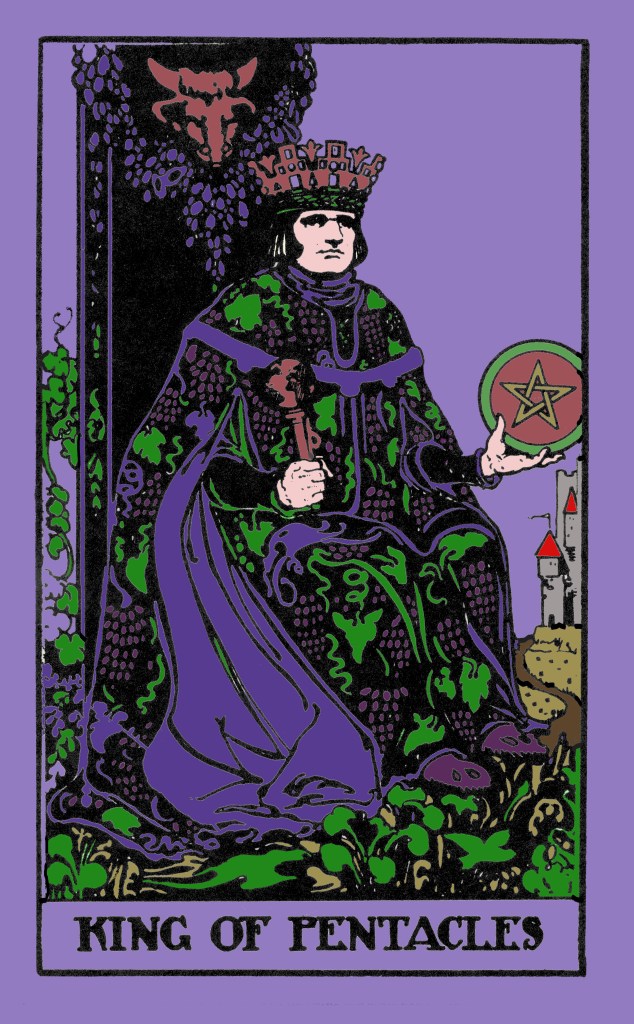
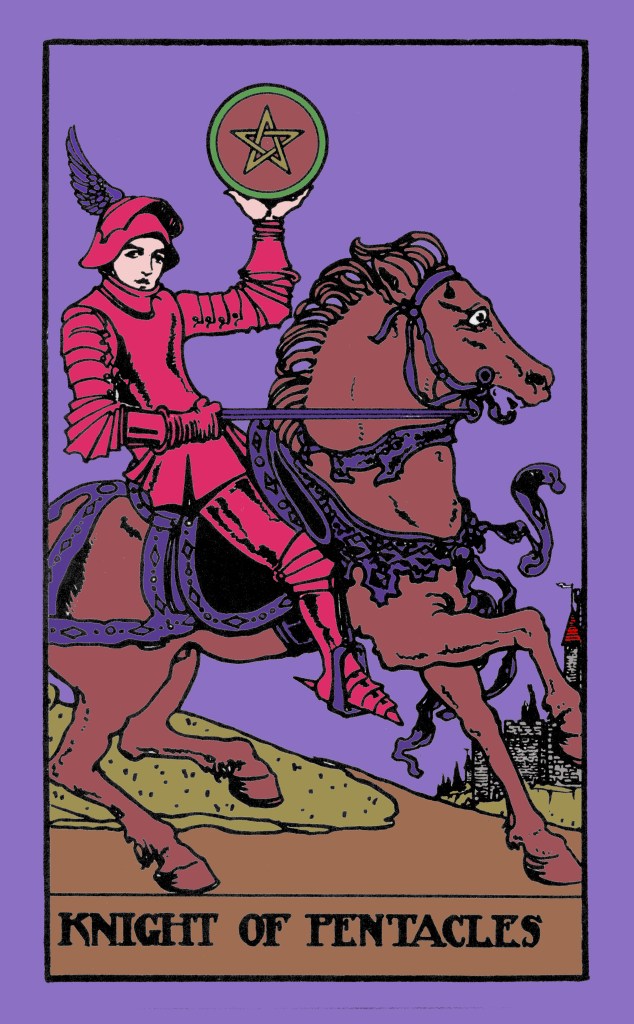
AI-generated King of Pentacles or King of Coins illustration

Golden Dawn’s Book T

A DARK Winged Warrior with winged and crowned helmet: mounted on a light brown horse. Equipment as the Knight of Wands.
The winged head of a stag or antelope as a crest. Beneath the horse’s feet is fertile land with ripened corn. In one hand he bears a sceptre surmounted by a hexagram: in the other a Pentacle like that of the Zelator Adeptus Minor.
Unless very well dignified he is heavy, dull, and material. Laborious, clever, and patient in material matters. If ill dignified, he is avaricious, grasping, dull, jealous; not very courageous, unless assisted by other symbols.
Rules from above 20 Degree of Leo to 20 Degree of Virgo.

Etteilla

Dark man.
Upright. This card, as far as the medicine of the spirit is concerned, means, in its natural position: Dark Man, Trader, Shopkeeper, Banker, Stockbroker, Calculator, Speculator. – Physics, Geometry, Mathematics, Science. – Teacher, Professor.
Reversed. Vice, Defect, Weakness, Defective, Defective conformation, Deformed nature. – Abnormality, Ugliness, Deformity. – Corruption. – Stench.

MQS

Tarot Encyclopedia – The King of Wands

(Note: this is a collection of the meanings attributed to the cards by some occultists in the past centuries. It does not reflect my own study or opinion of the cards. It is only meant as a quick comparative reference as I develop my own take.)

The King of Wands from the Builders of the Adytum (BOTA) Tarot

Paul Foster Case (and Ann Davies)

When well aspected the powers listed above are expressed by a personality represented by the King of Wands. However these same qualities when overly strong or intense can express as cruelty, oppression, ostentation and pride. Thus in Tarot divination, besides the basic principles expressed by Ab, the Father, and Yod, the Creative principle, the King of Wands has these specific meanings:
Well Dignified: an ardent, impulsive, influential man; one possessed of authority and strongly marked by the quality of leadership; somewhat hasty in temper but just, generous and friendly. lll Dignified: the same general type but cruel, ill-natured, intolerant and probably unfriendly to the querent.
(From the Oracle of Tarot course)

A. E. Waite

The physical and emotional nature to which this card is attributed is dark, ardent, lithe, animated, impassioned, noble. The King uplifts a flowering wand, and wears, like his three correspondences in the remaining suits, what is called a cap of maintenance beneath his crown. He connects with the symbol of the lion, which is emblazoned on the back of his throne. Divinatory Meanings: Dark man, friendly, countryman, generally married, honest and conscientious. The card always signifies honesty, and may mean news concerning an unexpected heritage to fall in before very long. Reversed: Good, but severe; austere, yet tolerant.
(From The Pictorial Key to the Tarot)

Aleister Crowley

(Note: Crowley and the Golden Dawn swap around King and Knight. This is in part true of Waite as well.)
The Knight of Wands represents the fiery part of Fire; he rules from the 21St degree of Scorpio to the 20th degree of Sagittarius. He is a warrior in complete armour. On his helmet for a crest he wears a black horse. In his hand he bears a flaming torch; a flame also in his mantle; and upon the flames does he ride. His steed is a black horse leaping.

The moral qualities appropriate to this figure are activity, generosity, fierceness, impetuosity, pride, impulsiveness, swiftness in unpredictable actions. If wrongly energized, he is evil-minded, cruel, bigoted and brutal. He is in either case ill-fitted to carry on his action; he has no means of modifying it according to circumstances. If he fails in his first effort, he has no resource.

In the Yi King, the fiery part of Fire is represented by the 51st hexagram, Kan. The signification there given is entirely in accordance with the doctrine of the Tarot, but great emphasis is laid on the startling, perilous, and revolutionary character of the events cognate. The Querent is advised to be apprehensive, yet cool, resolute and energetic: to beware of untimely action, but to go forward with tense confidence in his own ability.

All these correspondences of the Yi King are to be studied in that book (S.B.E. vol. XVI) and reference is here made to the text when important passages are too long to be conveniently quoted.
(From the Book of Thoth)

Oddly interesting AI-generated King of Wands illustration

Golden Dawn’s Book T

A KINGLY Figure with a golden, winged crown, seated on a chariot. He has large white wings. One wheel of his chariot is shewn. He wears corslet and buskins of scale armour decorated with a winged lion’s head, which symbol also surmounts his crown. His chariot is drawn by a lion. His arms are bare, save for the shoulder-pieces of the corslet, and he bears a torch or fire-wand, somewhat similar to that of the Zelator Adeptus Minor. Beneath the chariot are flames, some waved, some salient.
Swift, strong, hasty; rather violent, yet just and generous; noble and scorning meanness.
If ill dignified — cruel, intolerant, prejudiced and ill natured.

Etteilla

Country man
Upright. This card, as far as the medicine of the spirit is concerned, means, in its natural position: Country Man, Good and Stern Man, Well Intentioned Man, Honest Man. – Conscience, Probity. – Farmer, Worker, Cultivator.
Reversed. Good and stern man – Indulgence, Severity, Forbearance, Condescension.

Tarot Encyclopedia – The King of Cups

(Note: this is a collection of the meanings attributed to the cards by some occultists in the past centuries. It does not reflect my own study or opinion of the cards. It is only meant as a quick comparative reference as I develop my own take.)

The King of Cups from the Builders of the Adytum (BOTA) Tarot

Paul Foster Case (and Ann Davies)

The time period is from the beginning of the last decanate of Gemini to the second decanate of Cancer, June 11 to July 12, combining the rulers hips of Saturn and Uranus, the Moon and Mars.
Well Dignified: a man subtle and secretive, crafty, psychic, artistic; of strong, violent desires but calm exterior. He is friendly to the Querent and really wise. Ill Dignified: evil and merciless and likely to be attracted by occult studies promising power or knowledge for the satisfaction of desire and control of others; without purification of character. Usually fair-haired with blue eyes.
(From the Oracle of Tarot course)

A. E. Waite

He holds a short sceptre in his left hand and a great cup in his right; his throne is set upon the sea; on one side a ship is riding and on the other a dolphin is leaping. The implicit is that the Sign of the Cup naturally refers to water, which appears in all the court cards. Divinatory Meanings: Fair man, man of business, law, or divinity; responsible, disposed to oblige the Querent; also equity, art and science, including those who profess science, law and art; creative intelligence. Reversed: Dishonest, double-dealing man; roguery, exaction, injustice, vice, scandal, pillage, considerable loss.
(From The Pictorial Key to the Tarot)

Aleister Crowley

(Note: Crowley and the Golden Dawn swap around King and Knight. This is in part true of Waite as well.)
The Knight of Cups represents the fiery part of Water, the swift passionate attack of rain and springs; more intimately, Water’s power of solution. He rules the Heavens from the 21st degree of Aquarius to the 20th degree of Pisces. He is clothed in black armour furnished with bright wings which, together with the leaping attitude of his white charger, indicates that he represents the most active aspect of Water. In his right hand he bears a cup from which issues a crab, the cardinal sign of Water, for aggressiveness. His totem is the peacock, for one of the stigmata of water in its most active form is brilliance. There is here also some reference to the phenomena of fluorescence.

The characteristics of the person signified by this card are nevertheless mostly passive, in accordance with the Zodiacal attribution. He is graceful, dilettante, with the qualities of Venus, or a weak Jupiter. He is amiable in a passive way. He is quick to respond to attraction, and easily becomes enthusiastic under such stimulus; but he is not very enduring. He is exceedingly sensitive to external influence, but with no material depth in his character.

When the card is ill dignified, he is sensual, idle and untruthful. Yet with all this he possesses an innocence and purity which are the essence of his nature. But he is, on the whole, so superficial that it is hard to reach this depth. “His name is writ in water.”

In the Yi King, the fiery part of Water is represented by the 54th Hexagram, Kwei Mei. The commentary is singularly obscure, and somewhat sinister. It deals with the difficulties of rightly mating such opposites as fire and water (compare the Queen of Wands; but in that case Water is the calming and modulating influence, while here it is Fire which creates trouble.) Swiftness and violence ill suit a character naturally placid; it is rare indeed to meet with a person who has succeeded in harmonizing these conflicting elements. He tends to mismanage all his affairs; and unless sheer good fortune attend him, his whole career will be an unbroken record of failure and disaster. Often his mental “civil war” ends in schizophrenia or melancholy madness. The abuse of stimulants and narcotics may precipitate the catastrophe.
(from The Book of Thoth)

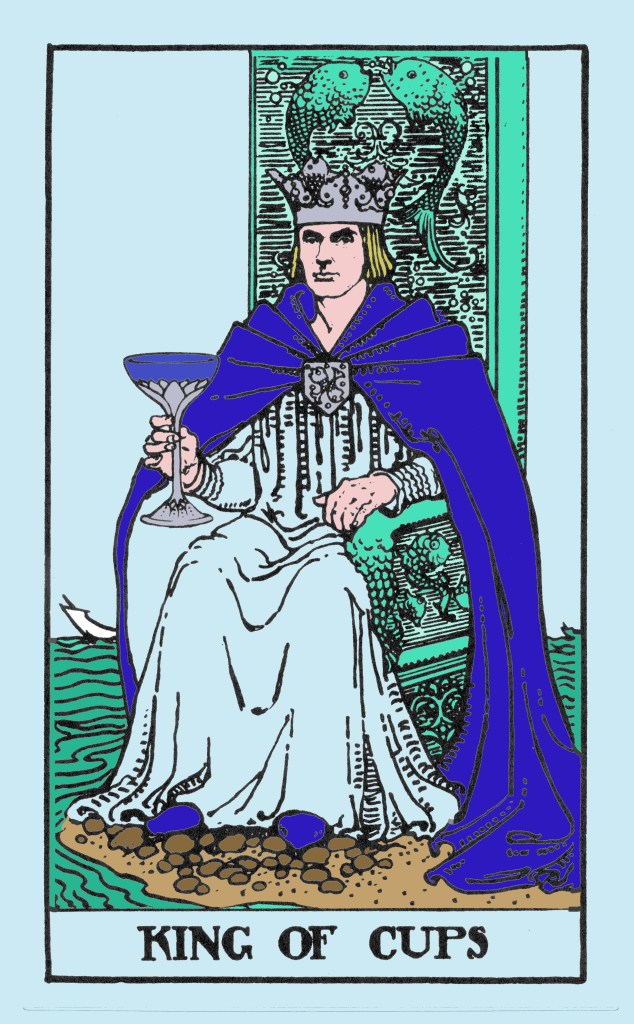
Creepy-ass AI-generated King of Cups illustration

Golden Dawn’s Book T

A BEAUTIFUL, winged, youthful Warrior with flying hair, riding upon a white horse, which latter is not winged. His general equipment is similar to that of the Knight of Wands, but upon his helmet, cuirass and buskins is a peacock with opened wings. He holds a cup in his hand, bearing the sigil of the scale. Beneath his horse’s feet is the sea. From the cup issues a crab. Graceful, poetic, Venusian, indolent, but enthusiastic if roused. Ill dignified, he is sensual, idle and untruthful.
He rules the heavens from above 20 Degree of Aquarius to 20 Degree of Pisces, thus including the greater part of Pegasus.
(from Book T)

Etteilla

Blond man
Upright. This card, as far as the medicine of the spirit is concerned, means, in its natural position: Blond Man, Honest Man, Probity, Equity, Art, Science.
Reversed. Man occupying a good position, Distinguished man, Honest man. – Dishonest man. – Exaction, Concussion, Injustice, Brigand, Thief, Dissimulator. – Vice, Corruption, Scandal.

MQS