Tag Archives: Aleister Crowley

Tarot Encyclopedia – The Eight of Swords

(Note: this is a collection of the meanings attributed to the cards by some occultists in the past centuries. It does not reflect my own study or opinion of the cards. It is only meant as a quick comparative reference as I develop my own take.)
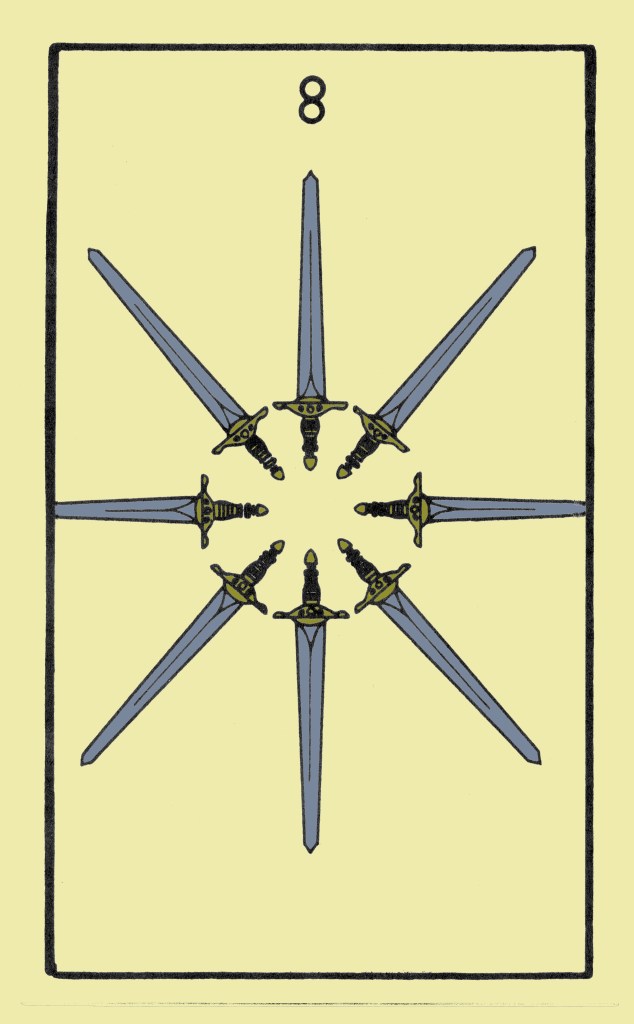
The Eight of Swords from the Builders of the Adytum (BOTA) tarot deck

Paul Foster Case (and Ann Davies)

The time period is the first decanate of Gemini, May 21 to May 31, under the rulership of Mercury.
Well-Dignified: even well-dignified, the excessive Mercurial influence expressing in the Yetziratic field of unstable forces and changing forms, symbolized by the Eight of Swords, gives a marked tendency toward ill-directed or wasted action. Meanings in divination: force wasted in petty affairs; too much talk; too much illdirected action; the state of being terribly busy without accomplishing much; over-careful about details; could possibly intimate a crisis in affairs, and probably much talk, correspondence and moving about.
Ill-Dignified: malice; ill-natured gossip; pettiness; too much concern with personalities; disagreements with brothers and sisters. This Key divinatorily expresses unbalanced or excessive Gemini qualities in third house affairs. The se negative Gemini qualities portend the need for balancing the quick-mindedness and penchant for action of this astrological type with the d e pth of feeling and emotional warmth corresponding to Netzach and Venus.
Keyword: Mediocrity
(From the Oracle of Tarot course)

A. E. Waite

A woman, bound and hoodwinked, with the swords of the card about her. Yet it is rather a card of temporary durance than of irretrievable bondage. Divinatory Meanings: Bad news, violent chagrin, crisis, censure, power in trammels, conflict, calumny; also sickness. Reversed: Disquiet, difficulty, opposition, accident, treachery; what is unforeseen; fatality.
(From The Pictorial Key to the Tarot)
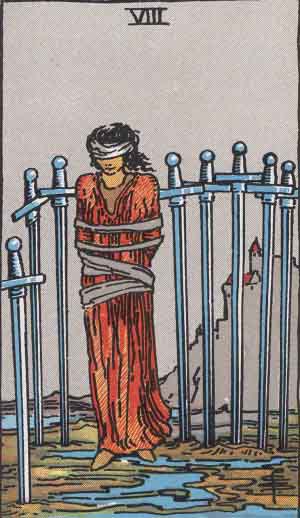
The Eight of Swords from the Rider Waite Smith tarot

Aleister Crowley

The Eight of Swords is called Interference. At first sight, it would seem easy to confuse it with the Eight of Cups; but the idea is, in reality, quite different. The card is attributed to Jupiter and Gemini; accordingly, there is no weighing down of the will by internal or external stress. It is simply the error of being good-natured when good-nature is disastrous. Gemini is an airy sign, an intellectual sign; Jupiter is geniality and optimism. This will not do in the world of Swords; if one must hit at all, a knock-out blow is best.

But there is another element in this card; that of unexpected (the Eights, being at heart Mercurial, are always that) interference, sheer unforeseen bad luck. Trivial incidents have often altered the destiny of empires, brought to naught “the best laid plans of mice and men”.

[…]

The number Eight, Hod, here signifies lack of persistence in matters of the intellect and of contest. Good fortune, however, attends even these weakened efforts, thanks to the influence of Jupiter in Gemini, ruling the Decan. Yet the Will is constantly thwarted by accidental interference.

The centre of the card is occupied by two long Swords pointed downward. These are crossed by six small swords, three on each side. They remind one of weapons peculiar to their countries or their cults; we see here the Kriss, the Kukri, the Scramasax, the Dagger, the Machete and the Yataghan.
(From The Book of Thoth)

The Eight of Swords from the Thoth tarot deck

Golden Dawn’s Book T

FOUR White Radiant Angelic Hands issuing from clouds, each holding two swords, points upwards; all the points touch near the top of the card. Hands issue, two at each bottom angle of the card. The pose of the other sword symbols is reestablished in the centre. Above and below are the Decan symbols Jupiter and Gemini.

Too much force applied to small things: too much attention to detail at the expense of the principal and more important points. When ill dignified, these qualities produce malice, pettiness, and domineering characteristics. Patience in detail of study; great care in some things, counterbalanced by equal disorder in others. Impulsive; equally fond of giving or receiving money or presents;

generous, clever, acute, selfish and without strong feeling of affection. Admires wisdom, yet applies it to small and unworthy objects.

Hod of HB:V (Narrow, restricted, petty, a prison).
Therein rule the Angels HB:VMBAL and HB:YHHAL.

Etteilla

Criticism
Upright. This card, as far as the medicine of the spirit is concerned, means, in its natural position: Criticism, Unfortunate position, Critical moment, Critical time, Decisive instant, Unfortunate situation, Delicate circumstance, Crisis. – Examination, Discussion, Research, Blame, Censure, Critical comment, Critical epilogue, Control, Disapproval, Condemnation, Cassation, Judgment, Contempt.
Reversed. Accident, Difficulty, Particular circumstance, Conjunction, Occurrence, Accessory, Unconscious, Obstacle, Delay, Hindrance. – Abjection. – Contestation, Contradiction, Opposition, Resistance, Divergence. – Unplanned, Unforeseen, Chance, Adventure, Occurrence, Destiny, Fatality, Accident, Misfortune, Symptom

MQS

Tarot Encyclopedia – The Eight of Cups

(Note: this is a collection of the meanings attributed to the cards by some occultists in the past centuries. It does not reflect my own study or opinion of the cards. It is only meant as a quick comparative reference as I develop my own take.)

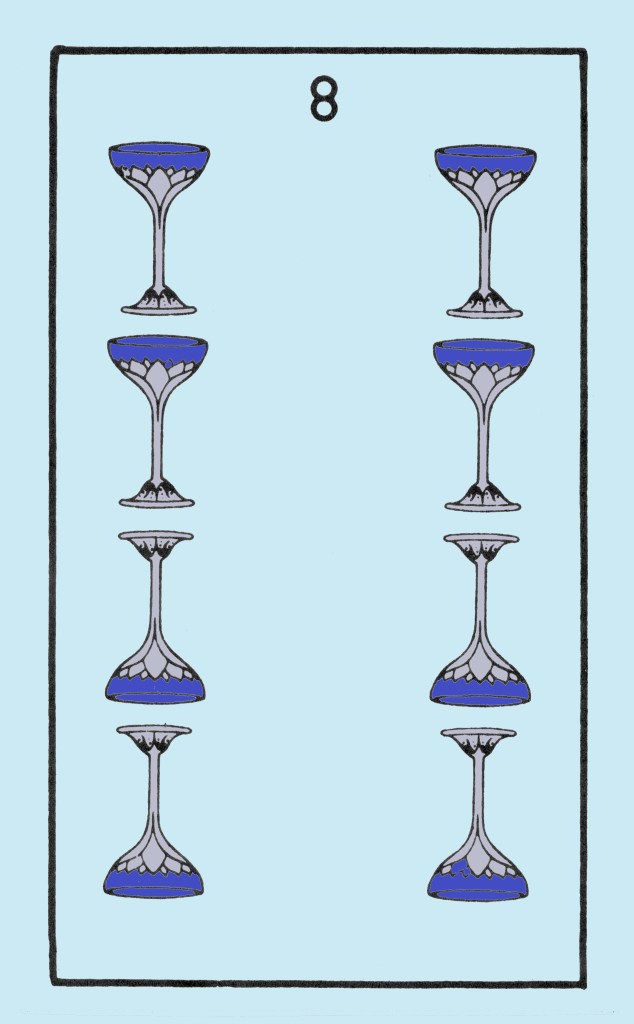
The Eight of Cups from the Builders of the Adytum (BOTA) tarot deck

Paul Foster Case (and Ann Davies)

The time period is the first decanate of Pisces, February 19 to February 28, ruled by Jupiter and Neptune.
Well-Dignified: renunciation of material success for something higher; interest in psychic and spiritual things; strong emotions; charity and helpfulness; love of travel and of scientific investigation.
Ill-Dignified: momentary success, but nothing lasting; the person to whom the card applies is overimpressionable, erratic and unsteady in his emotions; meaningless change of mood; purposeless journeying; querulous disposition.
Keyword: Instability
(From the Oracle of Tarot course)

A. E. Waite

A man of dejected aspect is deserting the cups of his felicity, enterprise, undertaking or previous concern. Divinatory Meanings: The card speaks for itself on the surface, but other readings are entirely antithetical–giving joy, mildness, timidity, honour, modesty. In practice, it is usually found that the card shews the decline of a matter, or that a matter which has been thought to be important is really of slight consequence–either for good or evil. Reversed: Great joy, happiness, feasting.
(From The Pictorial Key to the Tarot)

The Eight of Cups from the Rider Waite Smith tarot

Aleister Crowley

The Eight of Cups is called Indolence. This card is the very apex of unpleasantness. It is ruled by the planet Saturn; time, sorrow, have descended upon pleasure, and there is no strength in the element of water which can react against it. This card is not exactly “the morning after the night before”; but it is very nearly that. The difference is that the “night before” has not happened! This card represents a party for which all preparations have been made; but the host has forgotten to invite the guests; or, the caterers have not delivered the good cheer. There is this difference, though, that it is in some way or other the host’s own fault. The party that he planned was just a little bit above his capacity; perhaps he lost heart at the last moment.

[…]

The Eight, Hod, in the suit of Water, governs this card. It shows the influence of Mercury, but this is overpowered by the reference of the card to Saturn in Pisces. Pisces is calm but stagnant water; and Saturn deadens it completely. Water appears no longer as the Sea but as pools; and there is no florescence in this card as there was in the last. The Lotuses droop for lack of sun and rain, and the soil is poison to them; only two of the stems show blossoms at all. The cups are shallow, old and broken. They are arranged in three rows; of these the upper row of three is quite empty. Water trickles from the two flowers into the two central cups, and they drip into the two lowest without filling them. The background of the card shows pools, or lagoons, in very extensive country, incapable of cultivation; only disease and miasmatic poison can flourish in those vast Bad Lands.

The water is dark and muddy. On the horizon is a pallid, yellowish light, weighed down by leaden clouds of indigo. Compare with the last card; it represents the opposite and complementary error. The one is the Garden of Kundry, the other the Palace of Klingsor. In the psychopathology of The Path, this card is the German Measles of Christian Mysticism.
(From The Book of Thoth)

The Eight of Cups from the Thoth Tarot deck

Golden Dawn’s Book T

A WHITE Radiating Angelic Hand, holding a group of stems of lotuses or waterlilies. There are only two flowers shown, which bend over the two central cups, pouring into them a white water which fills them and runs over into the three lowest, which later are not yet filled. The three uppermost are quite empty.

U U U
U U
U U U

At the top and bottom of the card are symbols Saturn and Pisces.

Temporary success, but without further results. Thing thrown aside as soon as gained. Not lasting, even in the matter in hand. Indolence in success. Journeying from place to place. Misery and repining without cause. Seeking after riches. Instability.
Hod of HB:H (Success abandoned; decline of interest).
The Angels ruling are HB:VVLYH and HB:YLHYH.

Etteilla

Blonde girl
Upright. This card, as far as the medicine of the spirit is concerned, means, in its natural position: Blonde Girl, Honest Girl, Practical Girl, Honor, Modesty, Restraint, Timidity, Fear, Apprehension, Sweetness, Attraction.
Reversed. Satisfaction, Happiness, Contentment, Gaiety, Joy, Cheerfulness, Enjoyment, Fun, Celebration. – Apology, Reparation, Discompense. – Public Joy, Spectacle, Arrangement, Recollection, Preparations, Arrangements.

MQS

Tarot Encyclopedia – The Eight of Wands

(Note: this is a collection of the meanings attributed to the cards by some occultists in the past centuries. It does not reflect my own study or opinion of the cards. It is only meant as a quick comparative reference as I develop my own take.)

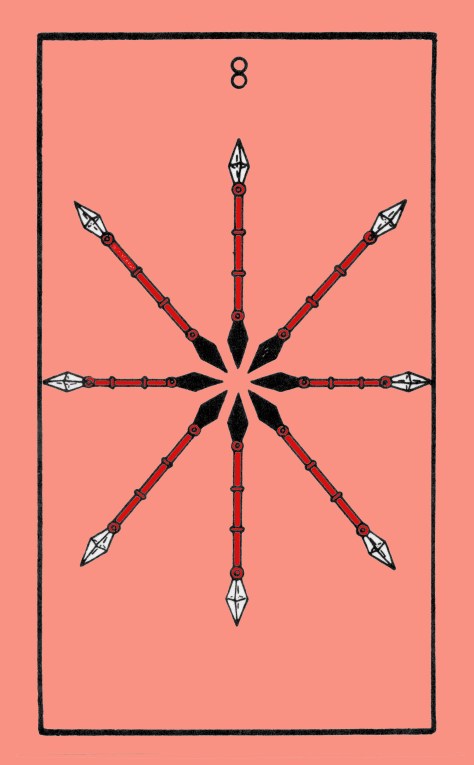
The Eight of Wands from the Builders of the Adytum (BOTA) Tarot deck

Paul Foster Case (and Ann Davies)

As the first decanate of Sagittarius, the Eight of Wands is the time period of November 22 to December 1, ruled by Jupiter, suggesting a combination of the powers of Mercury and Jupiter together with the zodiacal attributions of the sign Sagittarius and its natural 9th house. Well-Dignified: aspiration; foresight; rapid expression of force, but quickly expended; the acceleration of anything in which the querent is interested; generosity; confidence ; freedom.
Ill-Dignified: violence; warfare; rapacity; insolence; theft or robbery. These are suggested by some of the evil meanings connected with Hermes or Mercury associated with misuse of human intellect.
Keyword: Swiftness
(From the Oracle of Tarot course)

A. E. Waite

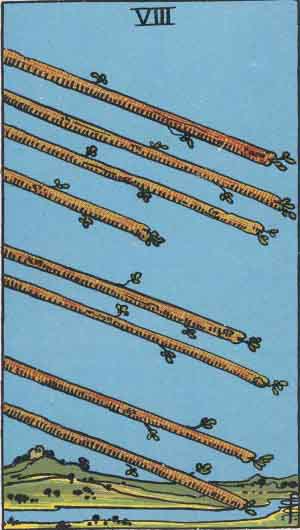
The card represents motion through the immovable-a flight of wands through an open country; but they draw to the term of their course. That which they signify is at hand; it may be even on the threshold. Divinatory Meanings: Activity in undertakings, the path of such activity, swiftness, as that of an express messenger; great haste, great hope, speed towards an end which promises assured felicity; generally, that which is on the move; also the arrows of love. Reversed: Arrows of jealousy, internal dispute, stingings of conscience, quarrels; and domestic disputes for persons who are married.
(From The Pictorial Key to the Tarot)

The Eight of Wands from the Rider Waite Smith tarot

Aleister Crowley

The Eight of Wands is called Swiftness, as one might expect from its attribution to Mercury and Sagittarius. This is an etherealization of the idea of fire; all gross elements have disappeared.

[…]

The remaining three cards of the suit belong to Sagittarius, which represents the subtilizing of the Fiery energy; and Mercury rules the card, thus bringing down from Chokmah the message of the original Will.

The card also refers to Hod, splendour, in the suit of Fire, whence it refers to the phenomena of speech, light, electricity. The pictorial representation of the card shows the Light-wands turned into electrical rays, sustaining or even constituting Matter by their vibrating energy. Above this restored universe shines the rainbow; the division of pure light, which deals with maxima, into the seven colours of the spectrum, which exhibit interplay and correlation.

This card, therefore, represents energy of high velocity, such as furnishes the master-key to modern mathematical physics. It will be noted that there are no flames; they have all been taken up into the wands to turn them into rays. On the other hand, the electric energy has created intelligible geometrical form.
(From The Book of Thoth)

The Eight of Wands from the Thoth Tarot

Golden Dawn’s Book T

FOUR White Radiating Angelic Hands (two proceeding from each side) issuant from clouds; clasped in two pairs in the centre with the grip of the First Order.
They hold eight wands, crossed four with four. Flames issue from the point of junction. Surmounting the small wands with flames issuing down them, and placed in the centre at the top and bottom of the card respectively, are the symbols of Mercury and Sagittarius for the Decan.

Too much force applied too suddenly. Very rapid rush, but quickly passed and expended. Violent, but not lasting. Swiftness, rapidity, courage, boldness, confidence, freedom, warfare, violence; love of open air, field-sports, gardens and meadows. Generous, subtle, eloquent, yet somewhat untrustworthy; rapacious, insolent, oppressive. Theft and robbery. According to dignity.

Hod of HB:Y (Hasty communications and messages; swiftness).
Therein rule the Angels HB:NThHYH and HB:HAAYH.

Etteilla

Countryside
Upright. This card, as far as its medicine is concerned, means, in its natural position: Countryside, Field, Plain, Agriculture, Cultivation, Landed Property, Immovable Property, Farm, Homestead, Garden, Orchard, Prairie, Forest, Grove, Foliage, Pleasure, Amusement, Leisure, Pastime, Recreation, Enjoyment, Peace, Calm, Tranquility, Innocence, Country Life. – Forest, Valley, Mountain, Battlefield.
Reversed. Inner dispute, Examination, Reasoning, Incomprehension. – Regret, Remorse, Repentance, Inner turmoil, Irresolution, Uncertainty, Indecision, Inconceivable, Incomprehensible, Doubt, Scruple, Fearful consciousness.

MQS

Tarot Encyclopedia – The Seven of Pentacles or Coins

(Note: this is a collection of the meanings attributed to the cards by some occultists in the past centuries. It does not reflect my own study or opinion of the cards. It is only meant as a quick comparative reference as I develop my own take.)

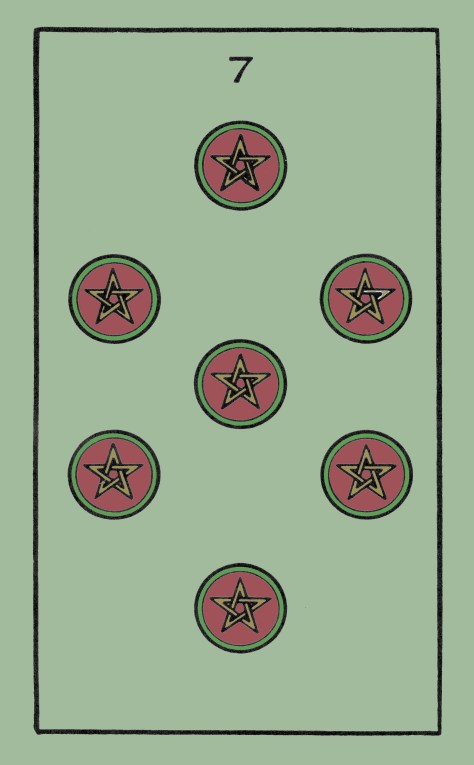
The Seven of Pentacles from the Builders of the Adytum (BOTA) tarot deck

Paul Foster Case (and Ann Davies)

The time period is the third decanate of Taurus, under the rulership of Saturn, May 11 to 20. Meanings:
Well-Dignified: slight gains, but of small account; much labor for small returns.
Ill-Dignified: something promising turns out badly; loss in speculation and unprofitable employment; financial restriction; unrealized hopes and
wishes.
Keyword: Loss
(From the Oracle of Tarot course)

A. E. Waite

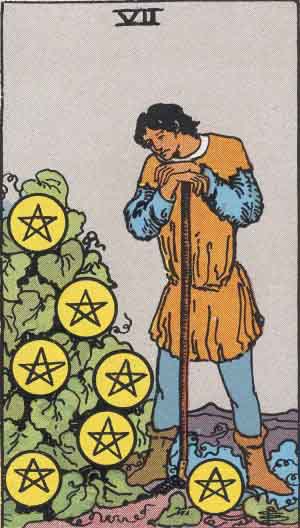
A young man, leaning on his staff, looks intently at seven pentacles attached to a clump of greenery on his right; one would say that these were his treasures and that his heart was there. Divinatory Meanings: These are exceedingly contradictory; in the main, it is a card of money, business, barter; but one reading gives altercation, quarrels–and another innocence, ingenuity, purgation. Reversed: Cause for anxiety regarding money which it may be proposed to lend.
(From The Pictorial Key to the Tarot)

The Seven of Pentacles from the Rider Waite Smith tarot

Aleister Crowley

The Seven of Disks is called Failure. This suit gives the extreme of passivity; there is no positive virtue in it below the Abyss. This card is ruled by Saturn. Compare it with the three other Sevens; there is no effort here; not even dream; the stake has been thrown down, and it is lost. That is all. Labour itself is abandoned; every thing is sunk in sloth.

[…]

The number Seven, Netzach, has its customary enfeebling effect, and this is made worse by the influence of Saturn in Taurus. The disks are arranged in the shape of the geomantic figure Rubeus, the most ugly and menacing of the Sixteen. (See Five of Cups.) The atmosphere of the card is that of Blight. On the background, which represents vegetation and cultivation, everything is spoiled. The four colours of Netzach appear, but they are blotched with angry indigo and reddish orange. The disks themselves are the leaden disks of Saturn. They suggest bad money.
(From The Book of Thoth)

The Seven of Disks from the Thoth Tarot

Golden Dawn’s Book T

A WHITE Radiating Angelic Hand issuing from a cloud, and holding a white rose branch. Seven Pentacles arranged like the geomantic figure Rubeus. There are only five buds, which overhang, but do not touch the five uppermost Pentacles. Above and below are the Decan symbols, Saturn and Taurus respectively.

Promises of success unfulfilled. (Shewn, as it were, by the fact that the rosebuds do not come to anything.) Loss of apparently promising fortune. Hopes deceived and crushed. Disappointment, misery, slavery, necessity and baseness. A cultivator of land, and yet a loser thereby. Sometimes it denotes slight and isolated gains with no fruits resulting therefrom, and of no further account, though seeming to promise well.

Netzach of HB:H (Unprofitable speculations and employments; little gain for much labour).
Therein HB:HRChAL and HB:MTzRAL are ruling Angels.

Etteilla

Money
Upright. This card, as far as the medicine of the spirit is concerned, means, in its natural position: Money, Wealth, Sum, Coin. – Silver. – Whiteness, Purity, Candor, Innocence, Naiveté, Moon. – Purgation, Purification.
Reversed. Restlessness, Torment of spirit, Impatience, Affliction, Remorse, Concern, Solicitude, Care, Attention, Diligence, Application. – Apprehension, Fear, Distrust, Misgiving, Suspicion.

MQS

Musings on Magical Tools

One of the great myths about magical tools is that magic has always used four of them: the wand, the cup, the sword and the pentacle. This is actually a rather modern consolidation of the magician’s toolkit. Throughout history (and even more throughout geography) many different implements have been preferred. Especially pentacles, at least in the modern understanding of them, seem to be quite new.

There is nothing wrong with newness and innovation, but it is good to know that something is new. Some traditions of magic didn’t even contemplate the use of tools, and were wholly talismanic in nature, while there are strands of folk magic (like some traditions of Italian witchcraft) that use many everyday items as tools (chairs, dishes, needles, dolls, brooms, etc.)

One recent-ish idea about tools that has essentially crystallized into a dogma is that the implements are simply extensions of the practitioner. This is largely a consequence of our current egocentric view of magic and of the world, and its helpfulness escapes me. I ain’t crap. Why should an extension of the crap I ain’t be of any value?

I also started out with that idea, partly because it was the most readily available to me, partly because it was taught to me by some of my mentors. But the more I study, practice and move forward, the less I see the implements as tools and the more I see them as thresholds on otherness.

Otherness is the forgotten component of our magical worldview. The idea of tools as extensions of the magus shrinks otherness by inflating the role of the magus’ self through those extensions.

But quite on the contrary, tools as thresholds become meeting spaces between self and other, between the magus’ consciousness and the powers he works with. In this sense they are also filters through which those powers come to us in ways that are fruitful and measured.

The magus himself is a good magus in as much as he becomes a (discerning, filtering) threshold, and in this sense, one’s magical consciousness is one’s most important tool. This is not to say, as is often repeated today, that our consciousness changes the way the universe is.

But the way we approach the universe does change the results we get, simply because it changes the shape our filtering system, of our inner threshold. It is akin to an app or computer program: software programs allow us to use certain functionalities of the computer that would be inaccessible by using another software. If you keep trying to write an email on the pinball minigame you’re in for a world of problems.

MQS

Tarot Encyclopedia – The Seven of Swords

(Note: this is a collection of the meanings attributed to the cards by some occultists in the past centuries. It does not reflect my own study or opinion of the cards. It is only meant as a quick comparative reference as I develop my own take.)

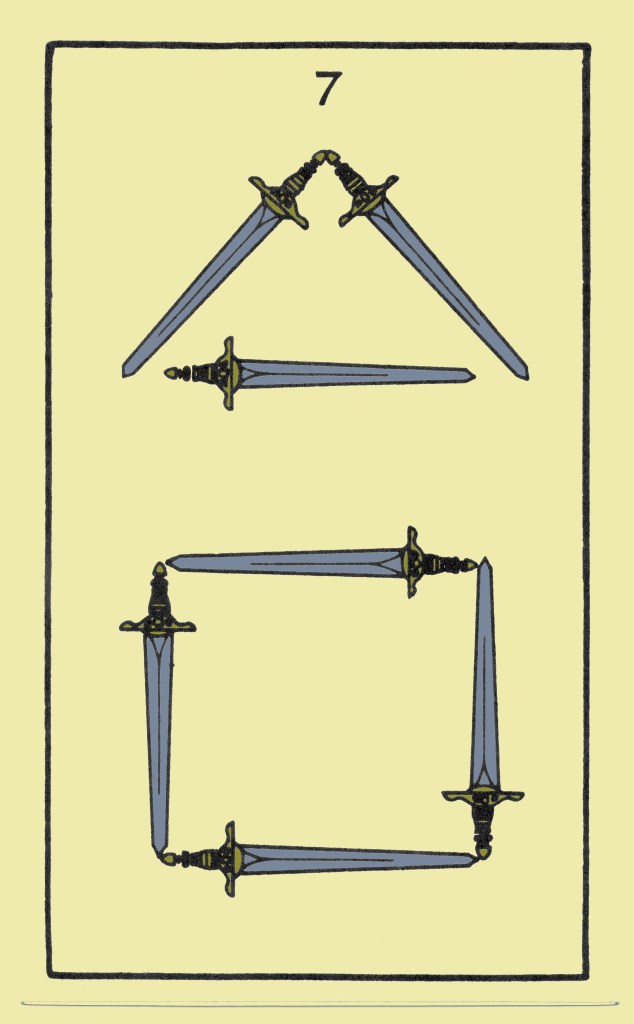
The Seven of Swords from the Builders of the Adytum (BOTA) tarot deck

Paul Foster Case (and Ann Davies)

The time period is the third decanate of Aquarius, February 9 to 18, under the rulership of Venus.
Well-Dignified: partial success; the Querent is too easy-going or does not draw sufficiently on his reserve force; he has good opportunities but may not make the most of them; he is likely to compromise too easily.
Ill-Dignified: love of ease and display cause loss; the Querent suffers from the insolence of others and may be insolent himself; there is danger that his own confidence may be betrayed, or that he may be led into betraying the confidence of others.
Keyword: Instability.
(From the Oracle of Tarot course)

A. E. Waite

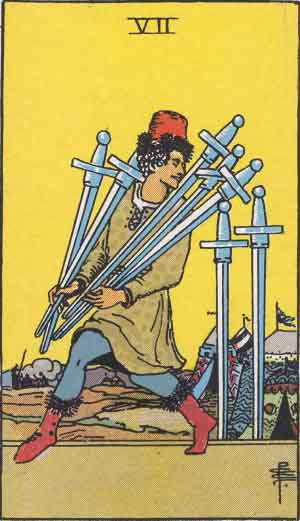
A man in the act of carrying away five swords rapidly; the two others of the card remain stuck in the ground. A camp is close at hand. Divinatory Meanings: Design, attempt, wish, hope, confidence; also quarrelling, a plan that may fail, annoyance. The design is uncertain in its import, because the significations are widely at variance with each other. Reversed: Good advice, counsel, instruction, slander, babbling.
(From The Pictorial Key to the Tarot)

The Seven of Swords from the Rider Waite Smith tarot

Aleister Crowley

The Seven of Swords is called Futility. This is a yet weaker card than the Seven of Wands. It has a passive sign instead of an active one, a passive planet instead of an active one. It is like a rheumatic boxer trying to “come back” after being out of the ring for years. Its ruler is the Moon. The little energy that it possesses is no more than dream-work; it is quite incapable of the sustained labour which alone, bar miracles, can bring any endeavour to fruition. The comparison with the Seven of Wands is most instructive.

[…]

Netzach, in the suit of Swords, does not represent such catastrophe as in the other suits, for Netzach, the Sephira of Venus, means victory. There is, therefore, a modifying influence; and this is accentuated by the celestial rule of the Moon in Aquarius.

The intellectual wreckage of the card is thus not so vehement as in the Five. There is vacillation, a wish to compromise, a certain toleration. But, in certain circumstances, the results may be more disastrous than ever. This naturally depends upon the success of the policy. This is always in doubt as long as there exist violent, uncompromising forces which take it as a natural prey.

This card, like the Four, suggests the policy of appeasement. The symbol shows six Swords with their hilts in crescent formation. Their points meet below the centre of the card, impinging upon a blade of a much larger up-thrusting sword, as if there were a contest between the many feeble and the one strong. He strives in vain.
(From the Book of Thoth)

The Seven of Swords from the Thoth tarot deck

Golden Dawn’s Book T

TWO Angelic Radiating Hands as before, each holding three swords. A third hand holds up a single sword in the centre. The points of all the swords “just touch” each other, the central sword not altogether dividing them.
The Rose of the previous symbols of this suit is held up by the same hand which holds the central sword: as if the victory were at its disposal. Symbols of Moon and Aquarius.

Partial success. Yielding when victory is within grasp, as if the last reserves of strength were used up. Inclination to lose when on the point of gaining, through not continuing the effort. Love of abundance, fascinated by display, given to compliments, affronts and insolences, and to spy upon others. Inclined to betray confidences, not always intentionally. Rather vacillatory and unreliable.
Netzach of HB:V (Journey by land: in character untrustworthy).
Herein rule the Great Angels HB:HHHAL and HB:Ma’aKAL.

Etteilla

Hope
Upright. This card, as far as the medicine of the spirit is concerned, means, in its natural position: Hope, Expectation, Expectation, Pretending, Founding, Overestimating, Founding, Designing, Willing, Wanting, Wishing, Vowing, Wanting, Taste, Fantasy.
Reversed. Wise opinion, Good advice, Salutary warnings, Instruction, Lesson. – Observation, Reflection, Note, Caution, Thoughtfulness. – Reprehension, Reprimand. – News, Announcement, Posting. – Consultation, Admonition.

MQS

Tarot Encyclopedia – The Seven of Cups

(Note: this is a collection of the meanings attributed to the cards by some occultists in the past centuries. It does not reflect my own study or opinion of the cards. It is only meant as a quick comparative reference as I develop my own take.)

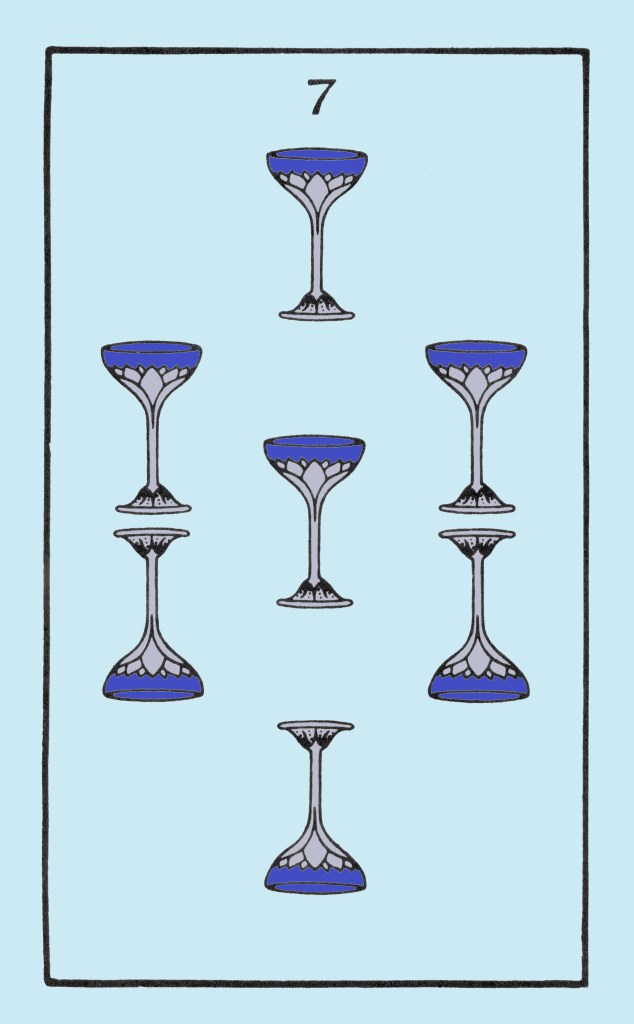
The Seven of Cups from the Builders of the Adytum (BOTA) tarot deck

Paul Foster Case (and Ann Davies)

The time period is the third decanate of Scorpio, November 11 to November 20, under the subrulership of the Moon.
Well-Dignified: possible victory, but the person to whom the card applies may be too indolent to take advantage of his opportunities for commanding circumstance. Success may be gained, but not followed up; necessity for choosing only the highest objectives.
lll-Dignified: illusionary success; lying and deceit; drunkenness; violence, even lust.
Keyword: Illusion
(From the Oracle of Tarot course)

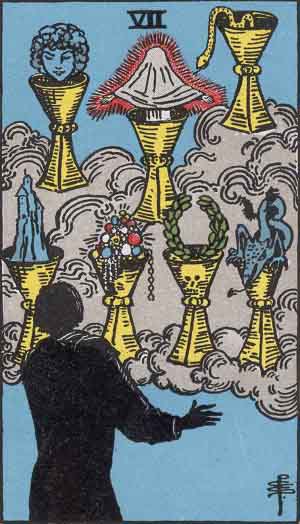
A. E. Waite

Strange chalices of vision, but the images are more especially those of the fantastic spirit. Divinatory Meanings: Fairy favours, images of reflection, sentiment, imagination, things seen in the glass of contemplation; some attainment in these degrees, but nothing permanent or substantial is suggested. Reversed: Desire, will, determination, project.
(From The Pictorial Key to the Tarot)

The Seven of Cups from the Rider Waite Smith Tarot Deck

Aleister Crowley

The Seven of Cups is called Debauch. This is one of the worst ideas that one can have; its mode is poison, its goal madness. It represents the delusion of Delirium Tremens and drug addiction; it represents the sinking into the mire of false pleasure. There is something almost suicidal in this card. It is particularly bad because there is nothing whatever to balance it-no strong planet to hold it up. Venus goes after Venus, and Earth is churned into the scorpion morass.

[…]

This card refers to the Seven, Netzach, in the suit of Water. Here recurs the invariable weakness arising from lack of balance; also, the card is governed by Venus in Scorpio. Her dignity is not good in this Sign; one is reminded that Venus is the planet of Copper, “external splendour and internal corruption”. The Lotuses have become poisonous, looking like tiger-lilies; and, instead of water, green slime issues from them and overflows, making the Sea a malarious morass. Venus redoubles the influence of the number Seven.

The cups are iridescent, carrying out the same idea. They are arranged as two descending triangles interlaced above the lowest cup, which is very much larger than the rest. This card is almost the “evil and averse” image of the Six; it is a wholesome reminder of the fatal ease with which a Sacrament may be profaned and prostituted.

Lose direct touch with Kether, the Highest; diverge never so little from the delicate balance of the Middle Pillar; at once the holiest mysteries of Nature become the obscene and shameful secrets of a guilty conscience.
(From The Book of Thoth)

The Seven of Cups from the Thoth Tarot

Golden Dawn’s Book T

THE seven cups are arranged as two descending triangles above a point: a hand, as usual, holds lotus stems which arise from the central lower cup. The hand is above this cup and below the middle one. With the exception of the central lower cup, each is overhung by a lotus flower, but no water falls from these into any of the cups, which are all quite empty. Above and below are the symbols of the Decanate Venus and Scorpio.

Possible victory, but neutralized by the supineness of the person: illusionary success, deception in the moment of apparent victory. Lying, error, promises unfulfilled. Drunkenness, wrath, vanity. Lust, fornication, violence against women, selfish dissipation, deception in love and friendship. Often success gained, but not followed up. Modified as usual by dignity.

Netzach of HB:H (Lying, promises unfulfilled; illusion, deception, error; slight success at outset, not retained).
Herein the Angels HB:MLHAL and HB:ChHVYH rule.

Etteilla

Thought
Upright. This card, as far as the medicine of the spirit is concerned, means, in its natural position: Thought, Soul, Spirit, Intelligence, Idea, Memory, Imagination, Understanding, Conception, Meditation, Contemplation, Reflection, Deliberation, Viewpoint, Opinion, Feeling.
Reversed. Plan, Design, Intention, Desire, Will, Resolution, Determination, Forethought.

MQS

Tarot Encyclopedia – The Seven of Wands

(Note: this is a collection of the meanings attributed to the cards by some occultists in the past centuries. It does not reflect my own study or opinion of the cards. It is only meant as a quick comparative reference as I develop my own take.)

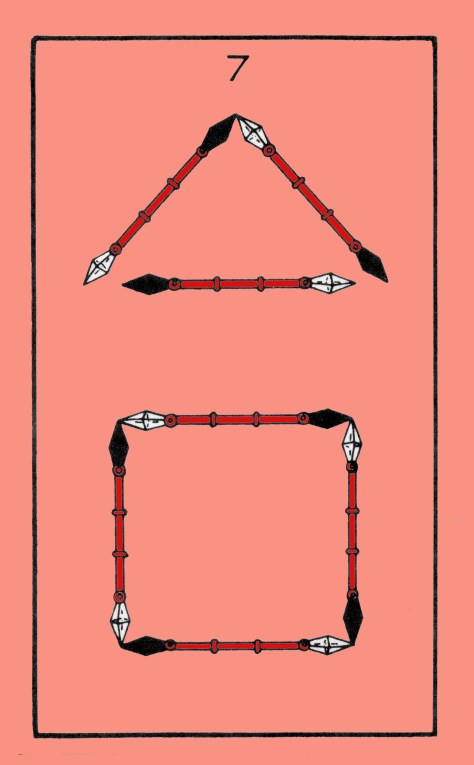
The Seven of Wands from the Builders of the Adytum (BOTA) tarot deck

Paul Foster Case (and Ann Davies)

Astrologically, the Seven of Wands, because it corresponds to the third decanate of Leo, is the time period from August 13 to August 22. In divination, the Seven of Wands combines the activities of the Keys listed in the Tableau [Empress, Sun, Tower, Strength, Emperor] together with ideas of pleasure and love connected with the fifth house in Astrology, the natural house of Leo.
Well Dignified: denotes pleasure in strenuous action; some danger through love affairs or self indulgence; also strength and magnanimity;
adventure; courage in the face of difficulties; influence over subordinates.
lll Dignified: indicates ignorance, pretense, vain-glory, quarrels and wrangling, threats and very determined opposition, especially from subordinates and open enemies.
Keyword: Valor
(From the Oracle of Tarot course)

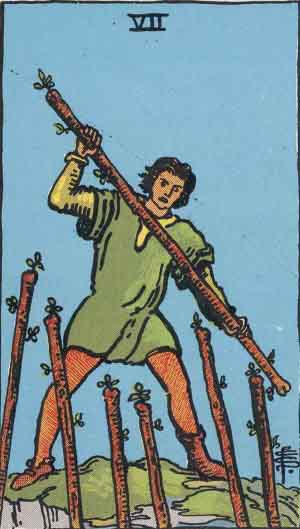
A. E. Waite

A young man on a craggy eminence brandishing a staff; six other staves are raised towards him from below. Divinatory Meanings: It is a card of valour, for, on the surface, six are attacking one, who has, however, the vantage position. On the intellectual plane, it signifies discussion, wordy strife; in business–negotiations, war of trade, barter, competition. It is further a card of success, for the combatant is on the top and his enemies may be unable to reach him. Reversed: Perplexity, embarrassments, anxiety. It is also a caution against indecision.
(From The Pictorial Key to the Tarot)

    The Seven of Wands from the Rider Waite Smith tarot deck

    Aleister Crowley

    The Seven of Wands is called Valour. Energy feels itself at its last gasp; it struggles desperately, and may be overcome. This card brings out the defect inherent in the idea of Mars. Patriotism, so to speak, is not enough.

    […]

    This card derives from Netzach (Victory) in the suit of Fire. But the Seven is a weak, earthy, feminine number as regards the Tree of Life, and represents a departure from the balance so low down on the Tree that this implies a loss of confidence.

    Fortunately, the card is also attributed to Mars in Leo. Leo is still the Sun in his full strength, but the marks of decadence are already to be seen. It is as if the wavering fire summoned the brutal energy of Mars to its support. But this is not enough to counter-act fully the degeneration of the initial energy, and the departure from equilibrium.

    The army has been thrown into disorder; if victory is to be won, it will be by dint of individual valour-a “soldiers’ battle”. The pictorial representation shows the fixed and balanced wands of the last card relegated to the background, diminished, and become commonplace.

    In front is a large crude uneven club, the first weapon to hand; evidently unsatisfactory in ordered combat. The flames are dispersed, and seem to attack in all directions without systematic purpose.
    (From The Book of Thoth)

    The Seven of Wands from the Thoth Tarot deck

    Golden Dawn’s Book T

    TWO hands holding by grip six wands, three crossed. A third hand issuing from a cloud at the lower part of the card, holding an upright wand which passes between the others. Flames leap from the point of junction. Above and below the central wand are the symbols of Mars and Leo, representing the Decan.

    Possible victory, depending on the energy and courage exercised; valour;
    opposition, obstacles and difficulties, yet courage to meet them; quarrelling, ignorance, pretence, and wrangling, and threatening; also victory in small and unimportant things: and influence upon subordinates.

    Netzach of HB:Y (Opposition, yet courage).
    Therein rule the two great Angels HB:MHShYH and HB:LLHAL of the
    Schemhamphorash.

    Etteilla

    Talking
    Upright. This blade, as far as the medicine of the spirit is concerned, means, in its natural position: Talking, Negotiation, Conference, Colloquy, Conversation, Dissertation, Deliberation, Discussion. – Word, Pronunciation, Language, Idiom, Dialect, Negotiation, Market, Exchange, Measure, Trade, Traffic, Correspondence. – Talking, Saying, Proferring, Conferring, Discussing, Chatting, Dividing, Chattering, Gossiping.
    Reversed. Indecision, Irresolution, Uncertainty, Perplexity, Inconstancy, Lightness, Variation, Diversity, Hesitating, Hesitating. – Temptation, Vacillation, Versatility.

    MQS

    Tarot Encyclopedia – The Six of Pentacles or Coins

    (Note: this is a collection of the meanings attributed to the cards by some occultists in the past centuries. It does not reflect my own study or opinion of the cards. It is only meant as a quick comparative reference as I develop my own take.)

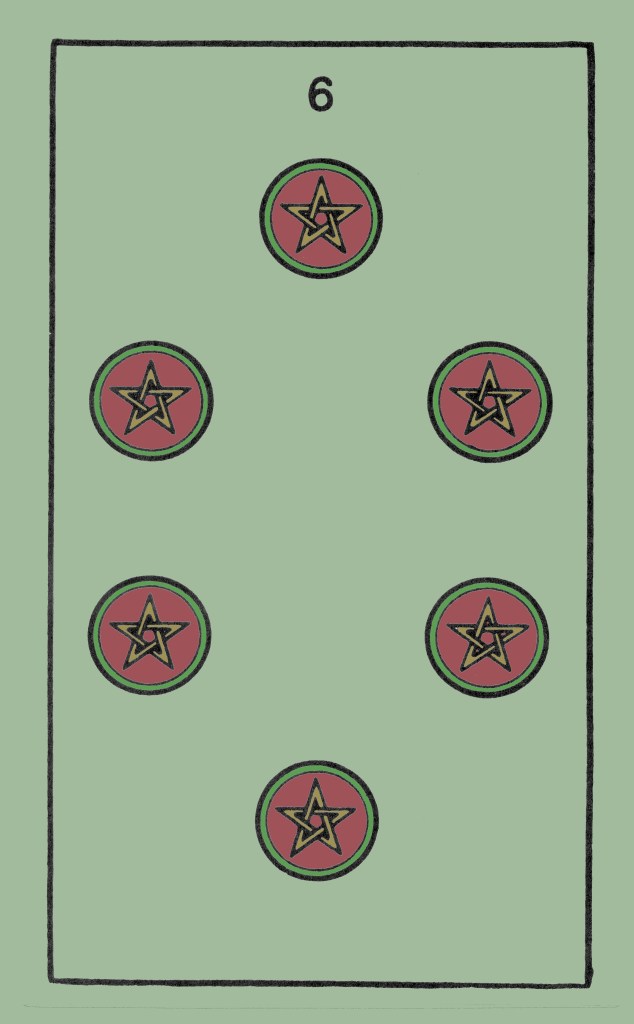
    The Six of Pentacles from the Builders of the Adytum (BOTA) tarot deck

    Paul Foster Case (and Ann Davies)

    The time period is the second decanate of Taurus, under the rulership of Mercury, from April 30 to May 10. Meanings:
    Well-Dignified: practicality and determination; discretion and diplomacy; gain by letters, writing, travel, speaking, teaching, commissions and through advertising, study, books and all things ruled b Mercury.
    Ill-Dignified: Loss through the same things.
    Keyword: Prosperity.
    (From the Oracle of Tarot course)

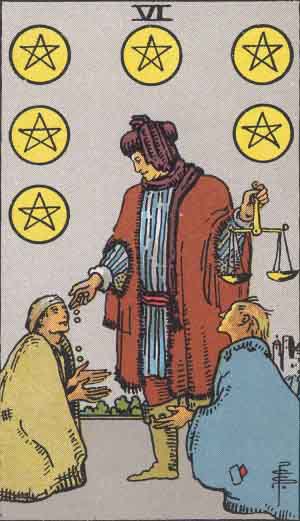
    A. E. Waite

    A person in the guise of a merchant weighs money in a pair of scales and distributes it to the needy and distressed. It is a testimony to his own success in life, as well as to his goodness of heart. Divinatory Meanings: Presents, gifts, gratification another account says attention, vigilance now is the accepted time, present prosperity, etc. Reversed: Desire, cupidity, envy, jealousy, illusion.
    (From The Pictorial Key to the Tarot)

    The Six of Pentacles from the Rider Waite Smith Deck

    Aleister Crowley

    The Six of Disks is called Success; the ruler is the Moon. This is a card of settling down; it is very heavy, wholly lacking in imagination, yet somewhat dreamy. Change is soon coming upon it; the weight of earth will ultimately drag the current down to a mere eventuation of material things. Yet the Moon, being in Taurus, the sign of her exaltation, the best of the Lunar qualities are inherent. Moreover, being a Six, the solar Energy has fertilized her, creating a balanced system for the time being. The card is worthy of the name Success. Remember only that all success is temporary; how brief a halt upon the Path of Labour.

    […]

    The Number Six, Tiphareth, as before, represents the full harmonious establishment of the Energy of the Element. The Moon in Taurus rules the card; and this, while increasing the approach to perfection (for the Moon is exalted in Taurus and therefore in her highest form) marks that the condition is transient.

    The disks are arranged in the form of the Hexagram, which is shown in skeleton. In the centre blushes and glows the light rose-madder of dawn, and without are three concentric circles, golden yellow, salmon-pink, and amber. These colours show Tiphareth fully realized on Earth; it reaffirms in form what was mathematically set forth in describing the Ace.

    The planets are arranged in accordance with their usual attribution; but they are only shown as disks irradiated by the Sun in their centre. This Sun is idolized as the Rose and Cross; the Rose has forty-nine petals, the interplay of the Seven with the Seven.
    (From The Book of Thoth)

    The Six of Disks from the Thoth Tarot deck

    Golden Dawn’s Book T

    A WHITE Radiant Angelic Hand holding a rose branch with white roses and buds, each of which touches a Pentacle. Pentacles are arranged in two columns of three each:

    * *
    * *
    * *
    Above and below are the symbols Taurus and Moon of the Decan.
    Success and gain in material undertakings. Power, influence, rank, nobility, rule over the people. Fortunate, successful, liberal and just.
    If ill dignified, may be purse-proud, insolent from excess, or prodigal.

    Tiphareth of HB:H (Success in material things, prosperity in business).
    Herein rule the Angels HB:NMMYH and HB:YYLAL.

    Etteilla

    The present
    Upright. This card, as far as the medicine of the spirit is concerned, means, in its natural position: Present, Presently, Now, Immediately, At the instant, At this time, Today, Attending, Witnessing, Contemporary. – Attentive, Careful, Vigilant.
    Reversed. Desire, Vow, Ardor, Haste, Passion, Searches, Cupidity, Want, Jealousy, Illusion.

    MQS

    Tarot Encyclopedia – The Six of Swords

    (Note: this is a collection of the meanings attributed to the cards by some occultists in the past centuries. It does not reflect my own study or opinion of the cards. It is only meant as a quick comparative reference as I develop my own take.)

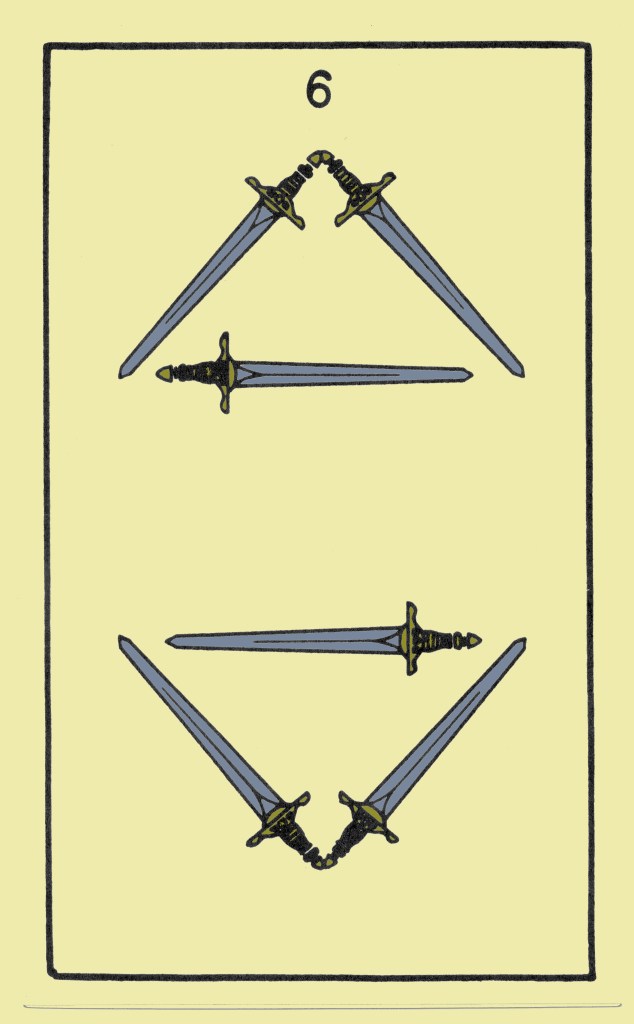
    The Six of Swords from the Builders of the Adytum (BOTA) tarot deck

    Paul Foster Case (and Ann Davies)

    The Six of Swords corresponds to the second decanate of Aquarius under the rulership of Mercury, January 30 to February 8.
    Well-Dignified: success after a period of trouble or anxiety; difficulties
    overcome; change of scene, possibly a journey by water; something
    mysterious effects a change o f circumstances for the better; success
    earned by the Querent’s laborious efforts.
    Ill-Dignified: sudden changes; circumstances dominate the Querent; he is in danger of being over-confident or conceited; too much effort expended for small results.
    Keyword: Patience
    (From the Oracle of Tarot course)

    A.E. Waite

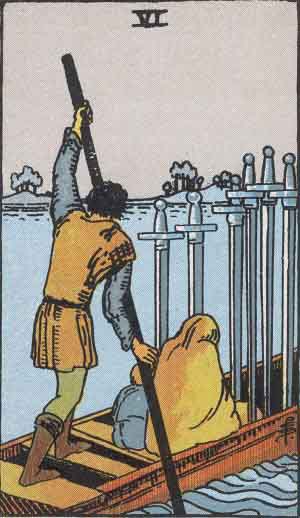
    A ferryman carrying passengers in his punt to the further shore. The course is smooth, and seeing that the freight is light, it may be noted that the work is not beyond his strength. Divinatory Meanings: journey by water, route, way, envoy, commissionary, expedient. Reversed: Declaration, confession, publicity; one account says that it is a proposal of love.
    (From The Pictorial Key to the Tarot)

    The Six of Swords from the Rider Waite Smith tarot

    Aleister Crowley

    The Six of Swords is called Science. Its ruler is Mercury, so that the element of success turns away from the idea of division and quarrel; it is intelligence which has won to the goal.

    […]

    Tiphareth shows the full establishment and balance of the idea of the suit. This is particularly the case with this card, as the intellect itself is also referred to the number Six. Mercury, in Aquarius, represents the celestial Energy influencing the Kerub of the Man, thus showing intelligence and humanity.

    But there is much more than this in the symbol. The perfect balance of all mental and moral faculties, hardly won, and almost impossible to hold in an ever-changing world, declares the idea of Science in its fullest interpretation.

    The hilts of the Swords, which are very ornamental, are in the form of the hexagram. Their points touch the outer petals of a red rose upon a golden cross of six squares, thus showing the Rosy Cross as the central secret of scientific truth.
    (From The Book of Thoth)

    The Six of Swords from the Thoth Tarot deck

    Golden Dawn’s Book T

    TWO hands, as before, each holding two swords which cross in the centre. Rose re-established thereon. Mercury and Aquarius above and below, supported on the points of two short daggers or swords.

    Success after anxiety and trouble; self-esteem, beauty, conceit, but sometimes modesty therewith; dominance, patience, labour, etc.

    Tiphareth of HB:V (Labour, work, journey by water).
    Ruled by the Great Angels HB:RHa’aAL and HB:YYVHL.

    Etteilla

    Road
    Upright. This card, as far as the medicine of the spirit is concerned, means, in its natural position: Road, Avenue, Walk, Course, Passage, Path, Way. – Path, Tract, Gait, Origin, Conduct, Means, Manner, Way, Expedient, Run, Career, Walk, Pattern to be followed, Track, Footprint, Sending, Commissary [= Deliveryman].
    Reversed. Declaration, Declaratory act, Development, Explanation, Interpretation. – Charter, Constitution, Diploma, Manifest law, Ordinance. – Publication, Proclamation, Ostensibility, Manifesto, Publicity, Authenticity, Notoriety. – Denunciation, Census. – Enumeration. – Knowledge, Discovery, Unveiling, Vision, Revelation, Apparition, Appearance, Admission, Confession, Protest, Approval, Authorization.

    MQS