Tag Archives: Aleister Crowley

Magic Beyond the Will

When one sets out on their magical journey, they are bound to come across views of magic based on the concept of Will. This is largely due to Aleister Crowley’s famous definition of magic as change according to the Will. But Crowley didn’t happen in a vacuum,1 and premonitions of his views are found in the cultural and philosophical atmosphere that preceded him. On the other hand, one would be hard pressed to find any mention, implicit or explicit, of the relevance of Will in pre-modern magic.

Let us keep in mind that every age’s view of magic is intimately bound to the philosophical paradigm of that age. Premodern magic is the efflorescence of a worldview where the universe is ruled by coherent forces that go beyond human control, and partly beyond human comprehension. These forces do not require human understanding or cooperation. It is inevitable, therefore, that most premodern views about magic require humans to simply conform to those outside forces.

Primacy is given to the universal source of power, which is seen as external to the individual, at least in our everyday understanding of individual life. Modern (and even more postmodern) magic, on the other hand, is magician-centric. This is because, in the old view of the cosmos, humans are nothing but an epiphenomenon of the interplay of objective and binding cosmic forces to which they must learn to conform. On the other hand, the modern (and postmodern) worldview is founded on the primacy of the individual’s subjective interpretation of the world and their ability to conform the world to this interpretation.

This shift mirrors the shift from ancient and medieval philosophy, where humans are largely tasked with apprehending reality as it is, without creative input, to modern philosophy (starting slowly with the Renaissance and Humanism), where humans project themselves onto the outside world as they come into contact with it, and finally to postmodern philosophy, where objective reality plays no role anymore, and the individual’s own inner world becomes the only one that matters.

PhilosophyOrientationHumans
Ancient PhilosophyObjectivist Humans as witnesses of a preexistent order wherein they must find their place. Intellect is exhalted as the tool to understand this order. The Will of the magus means little, acting merely as an instrument in motivating him or her.
Modern PhilosophySubjectivistHumans become increasingly aware of the difference between the objective qualities of the outside world and those qualities they project onto reality; become aware of their role in creating certain aspects of reality. Intellect and Will are at odds.
Postmodern PhilosophyNihilistHumans dismiss all notions of a preexistent order to which to conform. Everything is the result of a creative act of the subject. The Will is exhalted, while Intellect is relegated to an instrumental role in forming strategies to reach the aims of one will.

This tripartite distinction is rather rough (and, if taken too seriously, imprecise), but it will do for the purposes of this article.

The question is if the postmodern view of magic can seriously be the last possible view, or if there is something beyond it. My belief is that postmodernism must necessarily be overcome, together with its magical appendix, not because it is desirable to overcome it, but because it has within itself the seed of its own overcoming, just like every age and worldview before.

It is within the premises of postmodernism to to deny the existence of a self-consistent, objective reality. This is why it is usually accompanied by the deconstruction of all certainties, all values, all meaning, all views.

Obviously, this view is itself self-contradictory: in order to seriously assert itself, it has to deny itself as one of the certainties or views to be denied. This implies that the only way for postmodernism to realize its promise of suppressing all meaning is for it to even suppress itself in the end, in order to avoid becoming the meaning of reality. If this argument holds, then it is inevitable that postmodernism, together with its magical appendix, be overcome.

Far harder it is to imagine what will take its place.

One route that cannot be travelled is that of directly going back to the past. It is impossible to simply ignore hundreds of years of historical development to retreat into the safe haven of a glorified past. History, despite its ups and downs, has only one direction, and that is forward.

And yet, if we take the postmodern approach of denying all self-consistent realities beyond the magician’s will and take it to the extreme of even denying postmodernism itself, what we are left with does look very much like the old view of the cosmos, where the Will once again has little relevance. It is a form of going back by moving forward.

Magic, in this new and old sense, has nothing to do with having power to exert in conformity with the Will, and becomes the art of staying out of power’s way as it works itself. Intrinsic in this view is the notion (which all great occultists generally agree with) that the Magus does not have power, as in so many egoistic views of magic, but merely recognizes its currents in order to best position himself with respect to them.

MQS

  1. Furthermore, to be fair, Crowley’s notion of Will does not strictly correspond to that of individual volition, although it does encompass it. His idea of “pure Will, unassuaged of purpose” is very close to that of a transcendental Will sitting at the bottom of all individual acts of volition. Ultimately, though, it is merely Crowley’s way of incorporating the blind vitalism typical of his age into his system of magic ↩︎

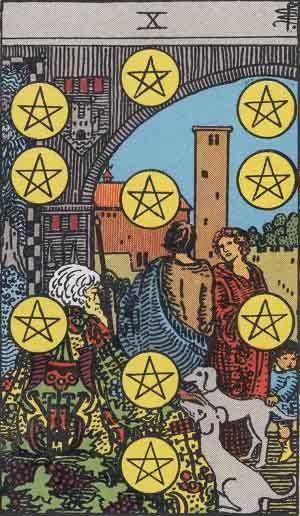
Tarot Encyclopedia – The Ten of Pentacles or Coins

(Note: this is a collection of the meanings attributed to the cards by some occultists in the past centuries. It does not reflect my own study or opinion of the cards. It is only meant as a quick comparative reference as I develop my own take.) 

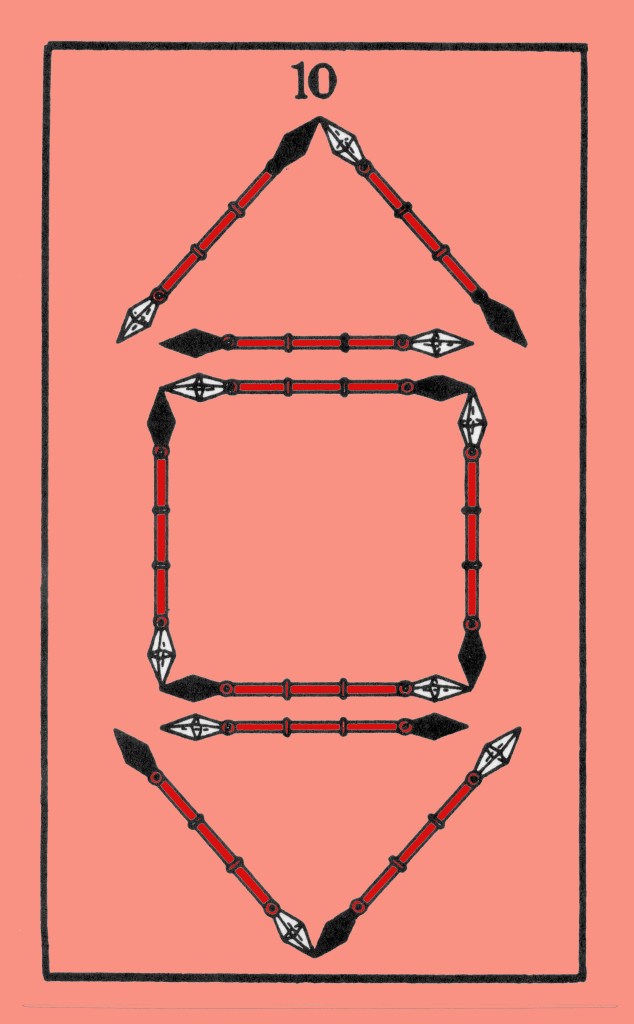
The Ten of Pentacles from the Builders of the Adytum (BOTA) tarot deck

Paul Foster Case (and Ann Davies)

The time period is the third decanate of Virgo, under the rulership of Venus, September 13 to September 22. Meanings:
Well-Dignified: money through servants or subordinates; gain in matters connected with medicine, drugs, food, nursing, farming or gardening;
completion in material gain and fortune, but nothing beyond.
Ill-Dignified: material success, but heaviness and dullness of mind;
sometimes loss through the matters listed above; slothfulness.
Keyword: Wealth.
(From the Oracle of Tarot course)

A. E. Waite

A man and woman beneath an archway which gives entrance to a house and domain. They are accompanied by a child, who looks curiously at two dogs accosting an ancient personage seated in the foreground. The child’s hand is on one of them. Divinatory Meanings: Gain, riches; family matters, archives, extraction, the abode of a family. Reversed: Chance, fatality, loss, robbery, games of hazard; sometimes gift, dowry, pension.
(From The Pictorial Key to the Tarot)

The Ten of Pentacles from the Rider Waite Smith tarot

Aleister Crowley

The Ten of Disks is called Wealth. Here again is written this constantly recurring doctrine, that as soon as one gets to the bottom one finds oneself at the top; and Wealth is given to Mercury in Virgo. When wealth accumulates beyond a certain point, it must either become completely inert and cease to be wealth, or call in the aid of intelligence to use it rightly. This must necessarily happen in spheres which have nothing whatever to do with material possessions, as such. In this way, Carnegie establishes a Library, Rockefeller endows Research, simply because there is nothing else to do.

But all this doctrine lies behind the card; it is the inner meaning of the card. There is another view to consider, that this is the last of all the cards, and therefore represents the sum total of all the work that has been done from the beginning. Therefore, in it is drawn the very figure of the Tree of Life itself. This card, to the other thirty-five small cards, is what the twenty-first Trump, The Universe, is to the rest of the Trumps.

[…]

The number Ten, Malkuth, as always, represents the final issue of the Energy. Here is great and final solidification. The force is completely expended and results in death. Mercury rules this card in Virgo; and this may imply that the acquired wealth, being inert, will be dissipated unless put to further use by devoting its power to objects other than mere accumulation.

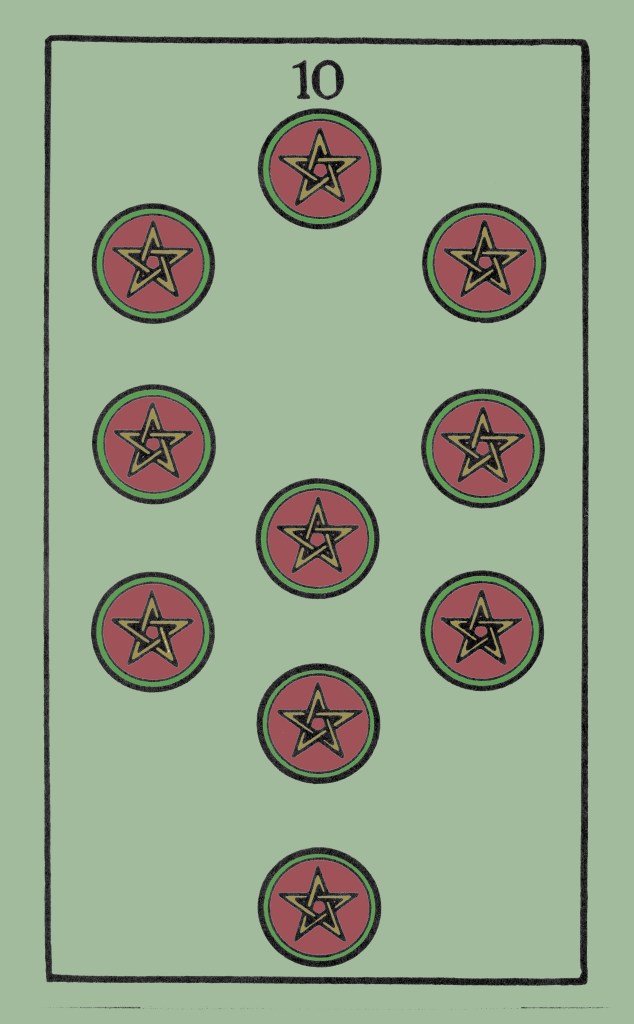
The disks, or (as they have now become) coins, are arranged on the Tree of Life, but the Tenth coin is much larger than the rest; the image indicates the futility of material gain.

These disks are inscribed with various symbols of mercurial character except that the coin in the place of Hod (Mercury) on the Tree is marked with the cipher of the Sun. This indicates the only possibility of issue from the impasse produced by the exhaustion of all the elemental forces. At the end of matter must be complete stagnation, were it not that in it is always inherent the Will of the Father, the Great Architect, the Great Arithmetician, the Great Geometer. In this case, then, Mercury will represent the Logos, the Word, the Will, the Wisdom, the Eternal Son, and Virgo the Virgin, in every implication of that symbol. This card is in fact a hieroglyph of the cycle of regeneration.

Among the Geomantic figures, Mercury in Virgo is Conjunctio. The meaning, conjunction, is shown plainly by the attraction of the descending (female) Triangle, the cipher of the Yoni, to the ascending (male) Triangle, that of the Lingam. This union completed, they appear interlaced, forming the figure of Capricornus, the Sign in which the Sun finds his rebirth. It is the holy Hexagram, the symbol of the uniting of the Macrocosm and the Microcosm, the accomplishment of the Great Work, the Summum Bonum, True Wisdom and Perfect Happiness. Sic sit vobis!
(From the Book of Thoth)

The Ten of Disks from the Thoth Tarot deck

Golden Dawn’s Book T

AN Angelic Hand, holding by the lower extremity a branch whose roses touch all the Pentacles. No buds, however, are shewn. The symbols of Mercury and Virgo are above and below.
The Pentacles are thus arranged:

* *
*
* *
* *
*
* *
Completion of material gain and fortune; but nothing beyond: as it were, at the very pinnacle of success. Old age, slothfulness; great wealth, yet sometimes loss in part; heaviness; dullness of mind, yet clever and prosperous in money transactions.
Malkuth of HB:H (Riches and wealth).
Herein are HB:LAVYH and HB:HHa’aYH set over this Decan as Angel Rulers

Etteilla

The house
Upright. In terms of spiritual medicine, this card, in its natural position, signifies: Home, Household management, Economy, Savings. – Dwelling, Domicile, Residence, Manor, Lodging, Regiment, Ship, Vessel, Vase. – Archive, Castle, Hut. – Family, Origin, Race, Posterity. – Cave, Cavern, Refuge.
Reversed. Lottery, Luck, Gambling, Chance, Accident, Ignorance, Fate, Destiny, Predestination, Fatality. – Fortunate or unfortunate opportunity.

MQS

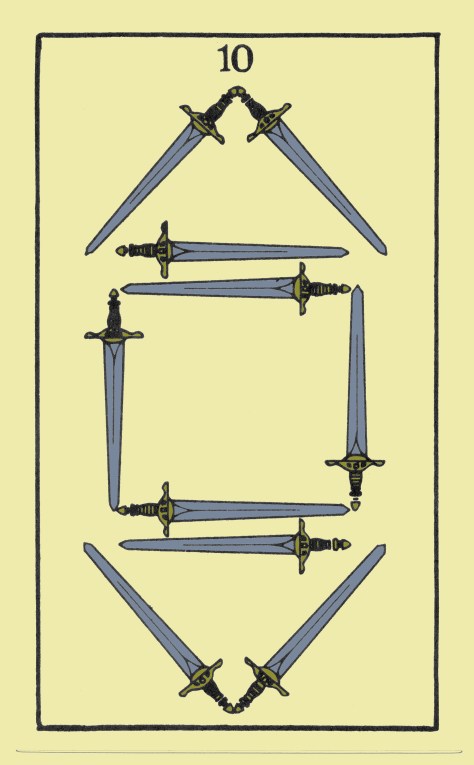
Tarot Encyclopedia – Ten of Swords

(Note: this is a collection of the meanings attributed to the cards by some occultists in the past centuries. It does not reflect my own study or opinion of the cards. It is only meant as a quick comparative reference as I develop my own take.) 

The Ten of Swords from the Builders of the Adytum (BOTA) tarot deck

Paul Foster Case (and Ann Davies)

The time period is the third decanate of Gemini, June 11 to June 21, under the rulership of Saturn and Uranus.
Well-Dignified: in spiritual matters, the end of delusion; the overthrow of limiting conditions; break-up of restrictions. In material affairs, sudden and unexpected changes, not always unfortunate in the long run, but disappointing when experienced: interference from from others. and.loss through indiscretion in writmg or signing contracts.
lll-Dignifled: failure, desolation, misery.
Keyword: Destruction
(From the Oracle of Tarot course)

A. E. Waite

A prostrate figure, pierced by all the swords belonging to the card. Divinatory Meanings: Whatsoever is intimated by the design; also pain, affliction, tears, sadness, desolation. It is not especially a card of violent death. Reversed: Advantage, profit, success, favour, but none of these are permanent; also power and authority.
(From The Pictorial Key to the Tarot)

The Ten of Swords from the Rider Waite Smith tarot

Aleister Crowley

The Ten of Swords is called Ruin. It teaches the lesson which statesmen should have learned, and have not; that if one goes on fighting long enough, all ends in destruction.

Yet this card is not entirely without hope. The Solar influence rules; ruin can never be complete, because disaster is a sthenic disease. As soon as things are bad enough, one begins to build up again. When all the Governments have smashed each other, there still remains the peasant. At the end of Candide’s misadventures, he could still cultivate his garden.

[…]

The number Ten, Malkuth, as always, represents the culmination of the unmitigated energy of the idea. It shows reason run mad, ramshackle riot of soulless mechanism; it represents the logic of lunatics and (for the most part) of philosophers. It is reason divorced from reality. The card is also ruled by the Sun in Gemini, but the mercurial airy quality of the Sign serves to disperse his rays; this card shows the disruption and disorder of harmonious and stable energy.

The hilts of the Swords occupy the positions of the Sephiroth, but the points One to Five and Seven to Nine touch and shatter the central Sword (six) which represents the Sun, the Heart, the child of Chokmah and Binah. The tenth Sword is also in splinters. It is the ruin of the Intellect, and even of all mental and moral qualities.

In the Yi King, Sol in Gemini is the virtue of the 43rd Hexagram, Kwai, the Watery modification of the Phallus; also, by the interlacing interpretation, the harmony of these two same Trigrams.

The signification is perfectly harmonious with that of the Ten of Swords It represents the damping down of the Creative impulse, weakness, corruption, or mirage affecting that principle itself. But, viewing the Hexagram as a weapon or method of procedure, it counsels the ruler to purge the state of unworthy officers. Curiously, the invention of written characters to replace knotted strings is ascribed among Chinese scholars to the use of this hexagram by the sages. Gemini is ruled by Thoth; 10 is the key of the Naples Arrangement; and Apollo (Sol) is the patron of literature and the arts: so his suggestion might appear at least no less suitable to the Qabalistic correspondences than to their double emphasis on Water and the Sun. Apart from this, however, the parallelism is complete.
(From the Book of Thoth)

The Ten of Swords from the Thoth tarot deck

Golden Dawn’s Book T

FOUR hands holding eight swords, as in the preceding symbol; the points falling away from each other. Two hands hold two swords crossed in the centre, as though their junction had disunited the others. No rose, flower or bud, is shewn. Above and below are Sun and Gemini, representing the Decan.

Almost a worse symbol than the Nine of Swords. Undisciplined, warring force, complete disruption and failure. Ruin of all plans and projects. Disdain, insolence and impertinence, yet mirth and jollity therewith. A marplot, loving to overthrow the happiness of others; a repeater of things; given to much unprofitable speech, and of many words. Yet clever, eloquent, etc., according to dignity.

Malkuth of HB:V (Ruin, death, defeat, disruption).
Herein the Angels HB:DMBYH and HB:MNQAL reign

Etteilla

Affliction
Upright. In terms of spiritual medicine, this card, in its natural position, signifies: Crying, Tears, Sobbing, Moaning, Sighing, Lamenting, Complaining, Afflictions, Regrets, Sadness, Pain, Wailing, Lamentations [= Poetic lamentations], Desolation.
Reversed. Advantage, Gain, Profit, Success. – Grace, Favor, Benefit. – Ascendant, Power, Empire, Authority, Might, Usurpation.

MQS

Tarot Encyclopedia – The Ten of Cups

(Note: this is a collection of the meanings attributed to the cards by some occultists in the past centuries. It does not reflect my own study or opinion of the cards. It is only meant as a quick comparative reference as I develop my own take.) 

The Ten of Cups from the Builders of the Adytum (BOTA) tarot deck

Paul Foster Case (and Ann Davies)

The time period is the third decanate of Pisces, from March 11 to March 20, under the sub-rulership of Mars in its Scorpio aspect.
The meanings are unfortunate unless the divination refers to spiritual
matters; for the combined forces of Mars, Jupiter and Neptune in Pisces on the physical levels, while they mean tremendous power of desire and sometimes the satisfaction of desire, point rather to unbalanced force than otherwise,
Well-Dignified: if relating to spiritual matters, permanent and lasting success through inspiration from higher levels of consciousness; high psychic development; realization of the highest aspirations; happiness. On questions at a lower level, even if well dignified: great ambition; ultra sensitiveness; great power of realizing desires, but equally great danger of misusing that power.
lll-Dignified: in spiritual questions, danger from psychism; probability of being injured mentally through unwise attempts at meditation. On all other questions: danger of self-undoing from psychism; prodigality; possibility of being influenced by others through the desire-nature; tendency to drug habits and drunkenness; disgust resulting from overindulgence; excess in pleasure.
Keyword: Excess .
(From The Oracle of Tarot course)

A. E. Waite

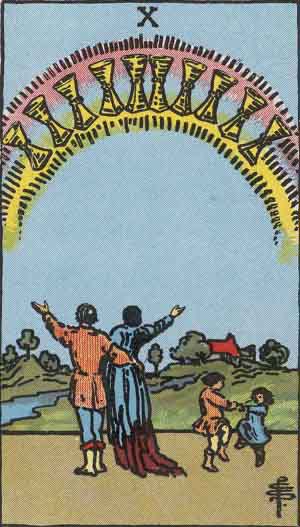
Appearance of Cups in a rainbow; it is contemplated in wonder and ecstacy by a man and woman below, evidently husband and wife. His right arm is about her; his left is raised upward; she raises her right arm. The two children dancing near them have not observed the prodigy but are happy after their own manner. There is a home-scene beyond. Divinatory Meanings: Contentment, repose of the entire heart; the perfection of that state; also perfection of human love and friendship; if with several picture-cards, a person who is taking charge of the Querent’s interests; also the town, village or country inhabited by the Querent. Reversed: Repose of the false heart, indignation, violence.
(From The Pictorial Key to the Tarot)

The Ten of Cups from the Rider Waite Smith tarot

Aleister Crowley

The Ten of Cups is called Satiety. Its attribution is Mars in Pisces. The watery sign has sunk into a stagnant dream, but in it broods and breeds the violent quality of Mars, to putrefy it. As it is written: “Until a dart strike through his liver.” The pursuit of pleasure has been crowned with perfect success; and constantly it is discovered that, having got everything that one wanted, one did not want it after all; now one must pay.

[…]

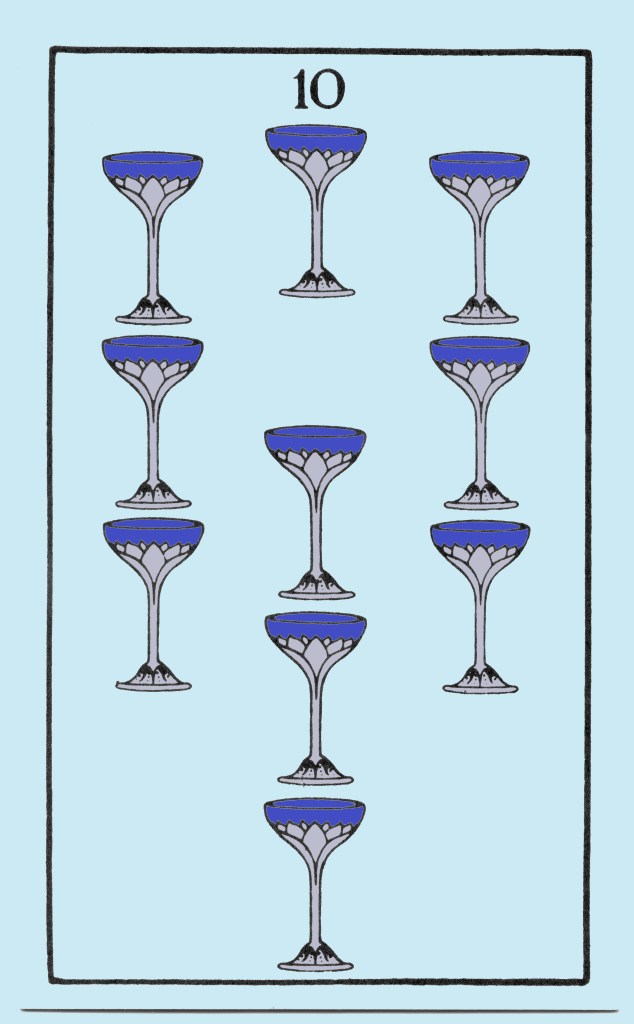
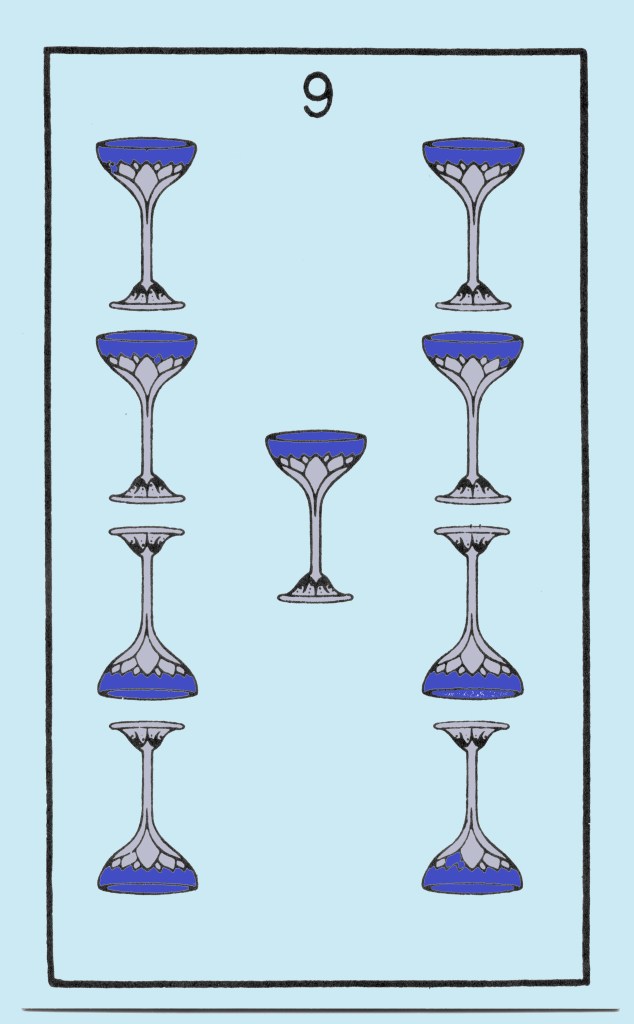
This card represents a conflicting element. On the one hand, it receives the influence of the Ten, Malkah the Virgin. The arrangement of the cups is that of the Tree of Life. But, on the other hand, they are themselves unstable. They are tilted; they spill the water from the great Lotus which overhangs the whole system from one into the other.

The work proper to water is complete: and disturbance is due. This comes from the influence of Mars in Pisces. Mars is the gross, violent and disruptive force which inevitably attacks every supposed perfection. His energy displays the greatest possible contrast with that of Pisces, which is both peaceful and spiritualized.
(From The Book of Thoth)

The Ten of Cups from the Thoth tarot deck

Golden Dawn’s Book T

HAND, as usual, holding bunch of water-lilies or lotuses, whose flowers pour a white water into all the cups, which “all run over.” The uppermost cup is held sideways by a hand, and pours water into the left-hand upper cup. A single lotus flower surmounts the top cup, and is the source of the water that fills it. Above and below the symbols Mars and Pisces.

Permanent and lasting success and happiness, because inspired from above. Not so sensual as “Lord of Material Happiness,” yet almost more truly happy.
Pleasure, dissipation, debauchery, quietness, peacemaking. Kindness, pity, generosity, wantonness, waste, etc., according to dignity.

Malkuth of HB:H (Matter settled: complete good fortune).
Herein the Great Angels HB:a’aShLYH and HB:MYHAL rule.

Etteilla

The city
Upright. In terms of spiritual medicine, this card, in its natural position, signifies: City, City Center, Homeland, Country, Town, Village, Place, Site, Dwelling, Home, Residence. – Citizen, Group of citizens, City dweller.
Reversed. Anger, Indignation, Agitation, Irritation, Outburst of rage, Wrath, Violence.

MQS

Tarot Encyclopedia – The Ten of Wands

(Note: this is a collection of the meanings attributed to the cards by some occultists in the past centuries. It does not reflect my own study or opinion of the cards. It is only meant as a quick comparative reference as I develop my own take.)

The Ten of Wands from the Builders of the Adytum (BOTA) tarot deck

Paul Foster Case (and Ann Davies)

The third decanate of Sagittarius is the time period from December 12 to December 21. In divination its meanings are those of the Tenth Sephirah combined with the planetary forces of the Sun and Jupiter, the zodiacal sign of Sagittarius together with its natural Ninth house of the Higher Mind.
Well-Dignified: generosity; success and honor in connection with the law, religion or philosophy; possibility of post of responsibility; gain through travel.
Ill-Dignified: ostentation; dogmatism; overbearing pride.
Note :- this card often carries the significance of a burden of responsibility of ‘too many irons in the fire’, or the need for a rearrangement of the Querent’s affairs or activities so as to get them in better order.
Keyword: Fullness of power.
(From The Oracle of Tarot course)

A. E. Waite

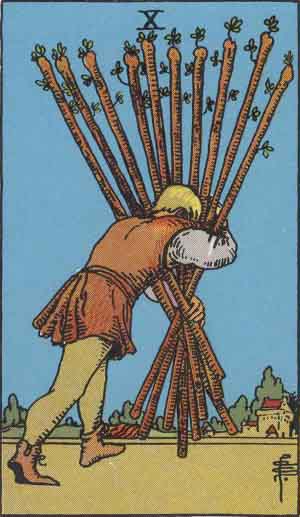
A man oppressed by the weight of the ten staves which he is carrying. Divinatory Meanings: A card of many significances, and some of the readings cannot be harmonized. I set aside that which connects it with honour and good faith. The chief meaning is oppression simply, but it is also fortune, gain, any kind of success, and then it is the oppression of these things. It is also a card of false-seeming, disguise, perfidy. The place which the figure is approaching may suffer from the rods that he carries. Success is stultified if the Nine of Swords follows, and if it is a question of a lawsuit, there will be certain loss. Reversed: Contrarieties, difficulties, intrigues, and their analogies.
(From The Pictorial Key to the Tarot)

The Ten of Wands from the Rider Waite Smith tarot

Aleister Crowley

The Ten of Wands is called Oppression. This is what happens when one uses force, force, and nothing else but force all the time. Here looms the dull and heavy planet Saturn weighing down the fiery, ethereal side of Sagittarius; it brings out all the worst in Sagittarius. See the Archer, not shooting forth benign rays, but dealing the sharp rain of death! The Wand has conquered; it has done its work; it has done its work too well; it did not know when to stop; Government has become Tyranny. One thinks of the Hydra when one reflects that King Charles was beheaded in White hall!

[…]

The number Ten refers to Malkuth, which depends from the other nine Sephiroth, but is not directly in communication with them. It shows the Force detached from its spiritual sources. It is become a blind Force; so, the most violent form of that particular energy, without any modifying influences. The flames in the background of the card have run wild. It is Fire in its most destructive aspect.

The card also refers to the influence of Saturn in Sagittarius. Here is the greatest antipathy. Sagittarius is spiritual, swift, light, elusive, and luminous; Saturn is material, slow, heavy, obstinate, and obscure.

The eight Wands are still crossed, showing the enormous power of the completed energies of Fire; but they have lost their patents of nobility. Their ends seem more like claws; they lack the authority and intelligence shown in the earlier cards; and in front are the two formidable Dorjes of the Two of Wands, but lengthened to bars.

The whole picture suggests Oppression and repression. It is a stupid and obstinate cruelty from which there is no escape. It is a Will which has not understood anything beyond its dull purpose, its “lust of result”, and will devour itself in the conflagrations it has evoked.
(From The Book of Thoth)

The Ten of Wands from the Thoth tarot deck

Golden Dawn’s Book T

FOUR hands holding eight wands crossed as before. A fifth hand holding two wands upright, which traverses the junction of the others. Flames issuant. Saturn and Sagittarius.

Cruel and overbearing force and energy, but applied only to material and selfish ends. Sometimes shows failure in a matter, and the opposition too strong to be controlled; arising from the person’s too great selfishness at the beginning. Illwill, levity, lying, malice, slander, envy, obstinacy; swiftness in evil and deceit, if ill dignified. Also generosity, disinterestedness and self-sacrifice, when well dignified.
Malkuth of HB:V (Cruelty, malice, revenge, injustice).
Therein rule HB:RYYAL and HB:AVMAL.

Etteilla

Betrayal
Upright. In terms of spiritual medicine, this card, in its natural position, signifies: Betrayal, Perfidy, Cunning, Deception, Trickery, Surprise, Misdirection, Dissimulation, Hypocrisy, Prevarication, Duplicity, Dishonesty, Darkness, Falsehood, Conspiracy, Collusion. – Imposture.
Reversed. Obstacle, Concern. – Barrier, Hindrance, Contradiction, Difficulty, Pain, Work. – Inconvenience, Abjection, Dispute, Complaint, Stumbling block, Enclosure, Entrenchment, Fort, Fortification.

MQS

A Note On The Ten Of Cups

I always maintain that the Golden Dawn were not great astrologers, largely because the XIX century astrology they had access to was not very good. Still, for the purposes of deriving symbolism for magical operations, their take was acceptable.

One thing that has always fascinated me about the Golden Dawn’s take on astrology was how they tried to synthesize it into their tarot system. Aside from the attributions of Zodiac signs and planets to the Hebrew letters and of the Hebrew letters to the major trumps, they also assigned the thirty-six decans to the thirty-six minor cards two through ten and, in different ways, to the aces and court cards as well.

This way of allocating the symbolism was not unique to them, but (as someone who doesn’t like to mix cartomancy and astrology) I must say that it probably produced the most coherent system.

Crowley generally doesn’t stray too far from the GD interpretation of the minors, but there are a couple of exceptions, the most obvious of which is the Ten of Cups.

For the GD, the Ten of Cups is an excellent card (which is what inspired Waite’s take on it). Crowley, however, disagrees on account of the decan assigned to the card, which is the third decan of Pisces, ruled by Mars. This leads Crowley to argue that this is a card ruled by two disarmonious symbols (Pisces and Mars) and so it produces bad results.

The problem with Crowley’s take is that he constantly, throughout the book, mistakes decan rulership with the influence of a planet in a sign. This is wrong. Rulerships represent affinities of a planet with a sign or subdivision of the sign.

For instance, Aries is ruled by Mars, which means there is an affinity and so when Mars is in Aries it is said to be well-dignified, at least according to the astrological practice that developed in the middle ages. The Sun is also exalted in Aries, which means there is also an affinity. Then we have the three decans: the first ten degrees ruled my Mars, the second ten by the Sun and the last ten by Venus.

Now, Venus is in detriment in Aries, which means there is disharmony between Venus and Aries, so Venus is ill-dignified in it. She is like a dainty ballerina stranded in a war-torn country. It’s not her place. However, in the last ten degrees of Aries, Venus has subrulership by decanate. This means that, even though she is the anti-venusian environment of Aries, she has a small room where she is a bit more comfortable, though not by much: it’s as if our dainty ballerina had been hired to entertain the troops in the barracks. She’s still in the wrong place, but in a less uncomfortable subplace.

Therefore, when Crowley says that Mars is not compatible with Pisces he is saying something that is irrelevant: by definition, the fact that Mars rules the third decan of Pisces means that Mars is at least a bit comfortable in the last ten degrees of the sign. This is because the last decan of Pisces has some kind of Mars-like quality to it: it is the part of Pisces that expresses through Mars.

This is not to say that his system is more right or wrong than the GD (one can stretch symbolism in almost any direction by abusing it long enough), but his misunderstanding runs through the whole minor arcana section, and I thought it would be interesting to bring it up.

MQS

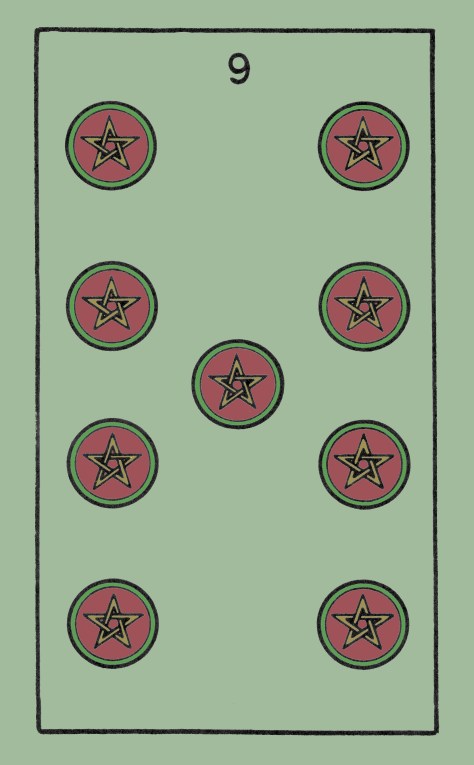
Tarot Encyclopedia – The Nine of Pentacles or Coins

(Note: this is a collection of the meanings attributed to the cards by some occultists in the past centuries. It does not reflect my own study or opinion of the cards. It is only meant as a quick comparative reference as I develop my own take.)

The Nine of Pentacles from the Builders of the Adytum (BOTA) tarot deck

Paul Foster Case (and Ann Davies)

The time period is the second decanate of Virgo, under the rulership of Saturn, September 3 to September 12. Meanings:
Well-Dignified: reserve, discretion, caution, frugality; some worries over money matters because of slow-maturing of plans; gain through careful investment. Occasionally when this card is especially welldignified, and other cards in the layout confirm it, this Key represents inheritance, material gain and much increase of goods, corresponding to the positive meanings of Saturn in Capricorn.
Ill-Dignified: discouragement; troubles through theft and knavery.
Keyword: Harvest.
(From the Oracle of Tarot course)

A. E. Waite

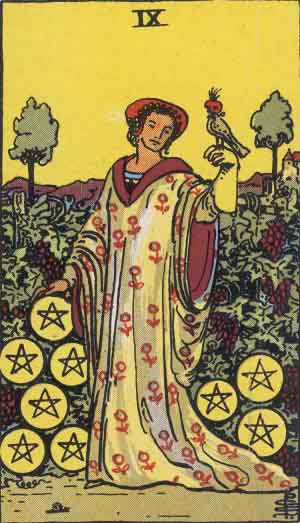
A woman, with a bird upon her wrist, stands amidst a great abundance of grapevines in the garden of a manorial house. It is a wide domain, suggesting plenty in all things. Possibly it is her own possession and testifies to material well-being. Divinatory Meanings: Prudence, safety, success, accomplishment, certitude, discernment. Reversed: Roguery, deception, voided project, bad faith.
(From The Pictorial Key to the Tarot)

The Nine of Pentacles from the Rider Waite Smith tarot

Aleister Crowley

The Nine of Disks is called Gain. The suit of Disks is much too dull to care; it reckons up its winnings; it does not worry its head about whether anything is won when all is won. This card is ruled by Venus. It purrs with satisfaction at having harvested what it sowed; it rubs its hands and sits at ease. As will be understood from the consideration of the Tens, there is no reaction against satisfaction as there is in the other three suits. One becomes more and more stolid, and feels that “everything is for the best in the best of all possible worlds”.

[…]

The number Nine, Yesod, inevitably brings back the balance of Force in fulfilment. The card is ruled by Venus in Virgo. It shows good luck attending material affairs, favour and popularity.

The disks are arranged as an equilateral triangle of three, apex upwards, close together; and, surrounded at some distance by a ring, six larger disks in the form of a hexagon. This signifies the multiplication of the original established Word-by the mingling of “good luck and good management”. The three central disks are of the magical pattern as in earlier cards; but the others, since the descent into matter implies the gradual exhaustion of the original whirling energy, now take on the form of coins. These may be marked with the magical images of the appropriate planets.

As a general remark, one may say that the multiplication of a symbol of Energy always tends to degrade its essential meaning, as well as to complicate it.
(From The Book of Thoth)

The Nine of Disks from the Thoth tarot deck

Golden Dawn’s Book T

A WHITE Radiating Angelic Hand, holding a rose branch with nine white roses, each of which touches a Pentacle. The Pentacles are arranged thus

* *
* *
*
* *
* *


and there are rosebuds on the branches as well as flowers. Venus and Virgo above and below.

Complete realization of material gain, good, riches; inheritance; covetous; treasuring of goods; and sometimes theft and knavery. The whole according to dignity.
Yesod of HB:H (Inheritance, much increase of goods).
Herein those mighty Angels HB:HZYAL and HB:ALDYH have rule and
dominion

Etteilla

Effect
Upright. In terms of the medicine of the spirit, this card, in its natural position, signifies: Effect, Realization, Positive, Accomplishment, Success.
Reversed. Deception, Fraud, Disappointment, Empty promises, Vain hopes, Failed projects.

MQS

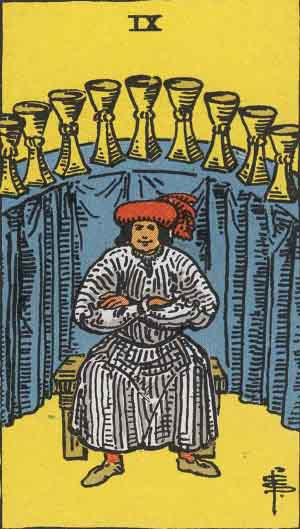
Tarot Encyclopedia – The Nine of Cups

(Note: this is a collection of the meanings attributed to the cards by some occultists in the past centuries. It does not reflect my own study or opinion of the cards. It is only meant as a quick comparative reference as I develop my own take.)

The Nine of Cups from the Builders of the Adytum (BOTA) tarot deck

Paul Foster Case (and Ann Davies)

The time period is the second decanate of Pisces, March 1 to March 10, under the subrulership of the Moon.
Well-Dignified: complete realization of desires; almost perfect pleasure and happiness; wishes fulfilled; physical well-being.
lll-Dignified: vanity, conceit, egotism; foolish generosity or ostentatious expenditure; the
person to whom the card applies is too easily led; one spoilt by
prosperity.
Keyword: Desire fulfilled.
(From the Oracle of Tarot course)

A. E. Waite

A goodly personage has feasted to his heart’s content, and abundant refreshment of wine is on the arched counter behind him, seeming to indicate that the future is also assured. The picture offers the material side only, but there are other aspects. Divinatory Meanings: Concord, contentment, physical bien-être; also victory, success, advantage; satisfaction for the Querent or person for whom the consultation is made. Reversed: Truth, loyalty, liberty; but the readings vary and include mistakes, imperfections, etc.
(From The Pictorial Key to the Tarot)

The Nine of Cups from the Rider Waite Smith tarot

Aleister Crowley

The Nine of Cups is called Happiness. This is a peculiarly good card, because happiness, as the word implies, is so much a matter of luck: the card is ruled by Jupiter, and Jupiter is Fortune.In all these watery cards, there is a certain element of illusion; they begin by Love, and love is the greatest and most deadly of the illusions. The sign of Pisces is the refinement, the fading away of this instinct, which, begun with dreadful hunger and carried on with passion, has now become “a dream within a dream”.

The card is ruled by Jupiter. Jupiter in Pisces is indeed good fortune, but only in the sense of complete satiety. The fullest satisfaction is merely the matrix of a further putrefaction; there is no such thing as absolute rest. A cottage in the country with the roses all around it? No, there is nothing permanent in this; there is no rest from the Universe. Change guarantees stability. Stability guarantees change.

[…]

The Number Nine, Yesod, in the suit of Water, restores the stability lost by the excursions of Netzach and Hod from the Middle Pillar. It is also the number of the Moon, thus strengthening the idea of Water. In this card is the pageant of the culmination and perfection of the original force of Water.

The Ruler is Jupiter in Pisces. This influence is more than sympathetic; it is a definite benediction, for Jupiter is the planet of Chesed which represents Water in its highest material manifestation, and Pisces brings out the placid qualities of Water. In the symbol are nine cups perfectly arranged in a square; all are filled and overflowing with Water. It is the most complete and most beneficent aspect of the force of Water.

The Geomantic Figure Laetitia is ruled by Jupiter in Pisces. For its meaning consult the “Handbook of Geomancy” (Equinox Vol I, No.2). Laetitia, Joy, gladness, is one of the best and most powerful of the sixteen figures; for the Solar, Lunar, and Mercurial symbols are, at the best, ambiguous and treacherously ambivalent; those of Venus portend rather relief than positive beneficence; Saturn and Mars are seen at their worst; and even the stable-companion of Laetitia, Acquisitio, has its unpleasant aspects, and even its dangers. But the consonance of Laetitia with this card amounts to little less than an identity; the wine is poured by Ganymede himself, unstinted vintage of true nectar of the Gods, brimful and running over, an ordered banquet of delight, True Wisdom self-fulfilled in Perfect Happiness.
(From The Book of Thoth)

The Nine of Cups from the Thoth tarot

Golden Dawn’s Book T

A WHITE Radiant Angelic Hand, issuing from a cloud holding lotus or waterlilies, one flower of which overhangs each cup; from it a white water pours. Cups are arranged in three rows of 3. Jupiter and Pisces above and below.

Complete and perfect realization of pleasure and happiness, almost perfect; selfpraise, vanity, conceit, much talking of self, yet kind and lovable, and may be self-denying therewith. High-minded, not easily satisfied with small and limited ideas. Apt to be maligned through too much self-assumption. A good and generous, but sometimes foolish nature.

Yesod of HB:H (Complete success, pleasure and happiness, wishes fulfilled).

Therein rule the Angels HB:SALYH and HB:a’aRYAL.

Etteilla

Victory
Upright. This card, as far as the medicine of the spirit is concerned, means, in its natural position: Victory, Success, Achievement, Advantage, Gain. – Pump, Triumph, Trophy, Preeminence, Superiority. – Spectacle, Arrangement, Equipment.
Reversed. Sincerity, Truth, Reality, Loyalty, Good faith, Frankness, Naiveté, Candor, Openness of heart, Simplicity. – Freedom, Science, Overconfidence, Familiarity, Boldness, Looseness, Debauchery

MQS

Tarot Encyclopedia – The Nine of Wands

(Note: this is a collection of the meanings attributed to the cards by some occultists in the past centuries. It does not reflect my own study or opinion of the cards. It is only meant as a quick comparative reference as I develop my own take.)

The Nine of Wands from the Builders of the Adytum (BOTA) tarot deck

Paul Foster Case (and Ann Davies)

In Tarot divination this Key combines the forces of the Moon, Mars and Jupiter and the zodiacal influences of Sagittarius and Aries, together with the Ninth house of the Higher Mind.
Well Dignified: well placed in a divination, this Key suggests originality, independence and daring. It has meanings that include strength in reserve; health after illness; success, but attended with some strife.
Ill-Dignified: danger; violence in foreign places or during long journeys; difficulties with relatives of the marriage partner; conflict with persons prominent in religion or law; obstinancy.
Keyword: Preparedness
(From the Oracle of Tarot course)

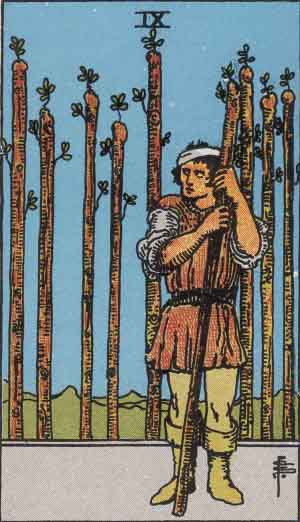
A. E. Waite

The figure leans upon his staff and has an expectant look, as if awaiting an enemy. Behind are eight other staves–erect, in orderly disposition, like a palisade. Divinatory Meanings: The card signifies strength in opposition. If attacked, the person will meet an onslaught boldly; and his build shews, that he may prove a formidable antagonist. With this main significance there are all its possible adjuncts–delay, suspension, adjournment. Reversed: Obstacles, adversity, calamity.
(From The Pictorial Key to the Tarot)

The Nine of Wands from the Rider Waite Smith Tarot

Aleister Crowley

The Nine of Wands is called Strength. It is ruled by the Moon and Yesod. In “The Vision and the Voice”, the eleventh Aethyr gives a classical account of the resolution of this antinomy of Change and Stability. The student should also consult the works of any of the better mathematical physicists.

Of all important doctrines concerning equilibrium, this is the easiest to understand, that change is stability; that stability is guaranteed by change; that if anything should stop changing for the fraction of a split second, it would go to pieces. It is the intense energy of the primal elements of Nature, call them electrons, atoms, anything you will, it makes no difference; change guarantees the order of Nature. This is why, in learning to ride a bicycle, one falls in an extremely awkward and ridiculous manner. Balance is made difficult by not going fast enough. So also, one cannot draw a straight line if one’s hand shakes. This card is a sort of elementary parable to illustrate the meaning of this aphorism: “Change is Stability.”

Here the Moon, the weakest of the planets, is in Sagittarius, the most elusive of the Signs; yet it dares call itself Strength. Defence, to be effective, must be mobile.

[…]

This card is referred to Yesod, the Foundation; this brings the Energy back into balance. The Nine represents always the fullest development of the Force in its relation with the Forces above it. The Nine may be considered as the best that can be obtained from the type involved, regarded from a practical and material standpoint.

This card is also governed by the Moon in Sagittarius; so here is a double influence of the Moon on the Tree of Life. Hence the aphorism “Change is Stability”.

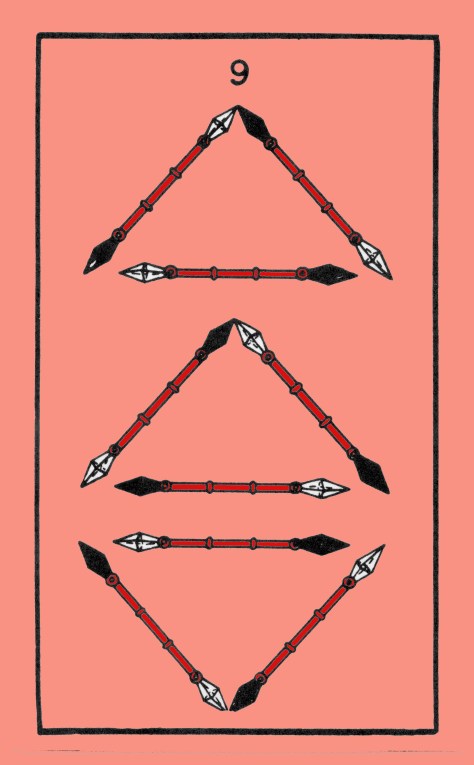
The Wands have now become arrows. There are eight of them in the background, and in front of them one master arrow. This has the Moon for its point, and the Sun for the driving Force above it; for the path of Sagittarius on the Tree of Life joins the Sun and Moon. The flames in the card are tenfold, implying that the Energy is directed downwards.
(From The Book of Thoth)

The Nine of Wands from the Thoth tarot deck

Golden Dawn’s Book T

FOUR hands, as in the previous symbol, holding eight wands crossed four and four; but a fifth hand at the foot of the card holds another wand upright, which traverses the point of junction with the others: flames leap herefrom. Above and below are the symbols Moon and Sagittarius.

Tremendous and steady force that cannot be shaken. Herculean strength, yet sometimes scientifically applied. Great success, but with strife and energy.
Victory, preceded by apprehension and fear. Health good, and recovery not in doubt. Generous, questioning and curious; fond of external appearances: intractable, obstinate.

Yesod of HB:Y (Strength, power, health, recovery from sickness).
Herein rule the Angels HB:YRThAL and HB:ShAHYH.

Etteilla

Delay
Upright. This card, as far as the medicine of the spirit is concerned, means, in its natural position: Delayed, Dilated, Removed, Suspended, Stretched, Slowed, Slowly.
Reversed. Travail, Obstacle, Impediment, Contrariness, Disadvantage, Adversity, Penalty, Accident, Misfortune, Calamity.

MQS

Tarot Encyclopedia – The Eight of Pentacles or Coins

(Note: this is a collection of the meanings attributed to the cards by some occultists in the past centuries. It does not reflect my own study or opinion of the cards. It is only meant as a quick comparative reference as I develop my own take.)

The Eight of Pentacles from the Builders of the Adytum (BOTA) tarot

Paul Foster Case (and Ann Davies)

The time period is the first decanate of Virgo, under the rulership of Mercury, from August 23 to September 2. Meanings:
Well-Dignified: skill in the management of material affairs; industry; gain in subordinate positions through writing, clerical work or travel; gain of ready money in small sums.
lll-Dignified: avarice and hoarding; penny wisdom and pound foolishness; meanness in money matters; loss through travel or writings; the Querent is likely to be in difficulties with superiors and also with inferiors; he may lose through trying to overreach somebody else.
Keyword: Prudence
(From the Oracle of Tarot course)

A. E. Waite

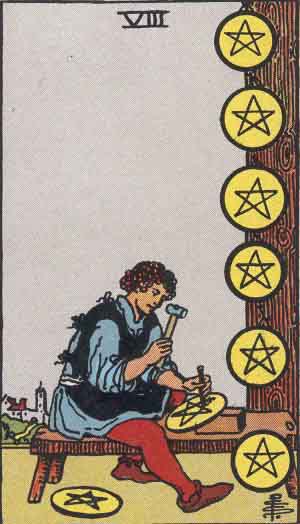
An artist in stone at his work, which he exhibits in the form of trophies. Divinatory Meanings: Work, employment, commission, craftsmanship, skill in craft and business, perhaps in the preparatory stage. Reversed: Voided ambition, vanity, cupidity, exaction, usury. It may also signify the possession of skill, in the sense of the ingenious mind turned to cunning and intrigue.
(From The Pictorial Key to the Tarot)

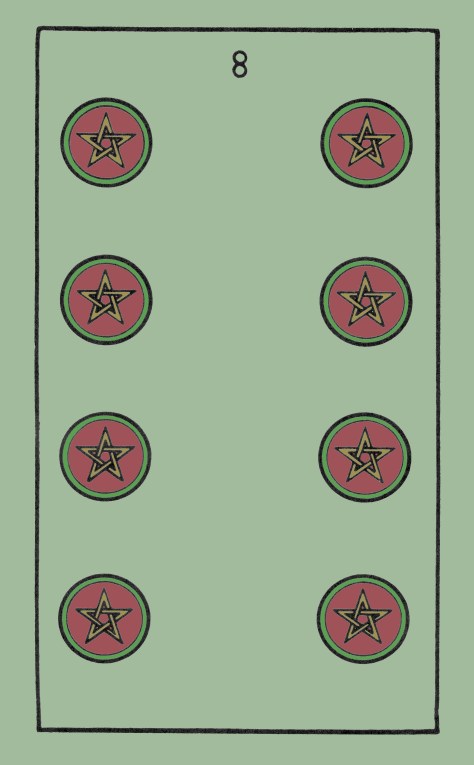
The Eight of Pentacles from the Rider Waite Smith tarot

Aleister Crowley

The Eight of Disks is called Prudence. This card is a great deal better than the last two [Eights], because, in purely material matters, especially those relating to actual money, there is a sort of strength in doing nothing at all. The problem of every financier is, first of all, to gain time; if his resources are sufficient, he always beats the market. This is the card of “putting something away for a rainy day”.

[…]

The number Eight, Hod, is very helpful in this card, because it represents Mercury in his most spiritual aspect, and he both rules and is exalted in the sign of Virgo, which belongs to the Decan, and is governed by the Sun. It signifies intelligence lovingly applied to material matters, especially those of the agriculturalist, the artificer and the engineer.

One might suggest that this card marks the turn of the tide. The seven of Disks is in one sense the fullest possible establishment of Matter-compare Atu XV-the lowest fallen and therefore the highest exalted. These last three cards seem to prepare the explosion which will renew the whole Cycle. Note that Virgo is Yod, the secret seed of Life, and also the Virgin Earth awaiting the Phallic Plough.

The interest of this card is the interest of the common people. The rulership of the Sun in Virgo suggests also birth. The disks are arranged in the form of the geomantic figure Populus. These disks may be represented as the flowers or fruits of a great tree, its solid roots in fertile land.

In the Yi King, Sol in Virgo is represented by the 33rd Hexagram, Thun, “Big Air”. It means “retiring”; and the commentary indicates how best to make use of that manoeuvre. This is congruous enough with the essence of Virgo, the secret withdrawing of Energy into the fallow Earth. Populus, moreover, is the Moon retiring from manifestation to her conjunction with the Sun.
(From The Book of Thoth)

The Eight of Disks from the Thoth tarot

Golden Dawn’s Book T

A WHITE Radiating Angelic Hand, issuing from a cloud, and grasping a branch of a rose tree, with four white roses thereon, which touch only the four lowermost Pentacles. No rosebuds even, but only leaves, touch the four uppermost disks. All the Pentacles are similar to that of the Ace, but without the Maltese cross and wings. They are arranged like the geomantic figure Populus:

* *
* *
* *
* *

Above and below them are the symbols Sun and Virgo for the Decan.
Over-careful in small things at the expense of great: “Penny wise and pound foolish”: gain of ready money in small sums; mean; avaricious; industrious; cultivation of land; hoarding, lacking in enterprise.
Hod of HB:H (Skill: prudence: cunning).
Therein rule those mighty Angels HB:AKAYH and HB:KHThAL

Etteilla

Brunette Girl
Upright. This card, as far as the medicine of the spirit is concerned, means, in its natural position: Brunette Girl, Passive, Great Night.
Reversed. Empty aspiration, Avarice, Usury.

MQS