Tag Archives: AI

The Slop Must Flow On (and the Esoteric Anti-Initiation)

I don’t know about you, but at the ripe old age of 35 I’m an old fart who remembers the wild west days of the Internet, when people tried cool stuff just because they could. In the last few years I’ve noticed a shift, which probably started in the early 2010s when governments and corporations decided the internet wasn’t something to be vilified as they had done up until that point, but a space to be sanitized, homogenized and monetized.

I am not one to decry money as evil: money is simply an equivalent for one’s work that may be exchanged for the equivalent of another person’s work. In this sense, money has deep metaphysical properties and implications.

What I did notice, however, is that now, wherever I go, someone is trying to sell me something, even if it’s just a free, safe, “binge-worthy” series of videos designed to hook me in so that they may make money out of my attention.

And the more safe formulas get proofed and tested for grabbing people’s attention as quickly as possible, often with AI to provide the missing accelerationist flavor, the more the content that is peddled can be identified as slop. The existential ennui of someone who browses the internet in the year of our Lord 2025 with a smidgen of self-awareness is not to be undererstimated.

I’m bringing this up because I recently received an (automated) email on the account I use for my youtube channel where I was invited to take a course for blowing up my channel, which included such thoughtful advice as “make bad content” (their words, not mine). And honestly, that might very well work, if it wasn’t for the fact that I don’t give a rat’s tutu about drawing big numbers and am perfectly happy with my little corner.

Essentially, slop has been acknowledged as the fastest and most effective way to plug oneself into a premade template of ‘Internet success story’. This, in itself, is not a revolutionary discovery: crap has always existed and has always had success, and the reason why we often don’t know about the crap that existed in the past is that crap tends to be forgotten in the long run, unless it’s so bad it becomes an acquired taste.

What is new is the psychotic speed at which this is happening as attention spans get shorter, the number of people competing for them gets higher and the tools for achieving the result get more powerful.

From a metaphysical and esoteric standpoint, slop is simply the elevation of the lower aspects of the human consciousness to the status of aim to be pursued, with a result that might very well be seen as a form of anti-initiation.

The word initiation tends to conjure images of hooded figures bestowing grace on a supplicant. While the ritual aspect of it is not insignificant, the idea of initiation is far broader and it applies to many fields, not just esoteric, as a path that forces the person’s spirit to acquire, develop or balance certain qualities that allow it to adapt to the ideals of that path.

An anti-initiation, in this sense, is a process whereby the human spirit ossifies, rots and collapses in on itself, having lost any semblance of a guiding light and being only stirred into motion by the gravitational pull of its own ass.

I am not a prude and I am not a no-fun Fräulein Rottenmeier. I enjoy some of the products of our current age, and I accept the rest with some irony (what else is left?) I am merely observing an interesting trend. It is often repeated that initiation (any initiation) is for the few, but it seems to me that is becoming something for the fewer.

MQS

AI, Dream Logic and Visionary Magic Work

I’ve been having a lot of fun lately, watching AI generated videos based on pre-existing material. If you are not familiar with the “steamed hams” meme, here’s the original video:

and this is a meme version (one of the hundreds of versions being produced every year) of the same video, but reworked with AI:

One thing that struck me about it was how incredibly similar this video’s internal logic (or lack of it) is to the logic of dreams, especially of weird dreams. Everything flows into everything else, hanging together with it by thin threads of association.1

Notice, for instance, how the two characters, Skinner and Superintendent Chalmers, start dancing a romantic dance out of the blue just because the AI interprets the two characters getting close to each other as them engaging in romantic behavior, in spite of the fact that one of them is actually rather pissed at the other in the actual scene, and the other actually would rather avoid being in his presence.

This reminds me of how clearly the tone of dreams seems to shift flowingly from fun to scary to dramatic, to fun again, to romantic and so on, based on cues that the brain interprets much more loosely than when governing our waking consciousness. As an example, I recently dreamt I was visiting an old friend back in Italy, and the tone of the dream was cheerful and whimsical. Then, my friend taps on my shoulder from behind, and this must have reminded my brain of some horror movie I watched, because upon turning, my friend’s face turned into a demonic one and I was jumpscared awake.

Interestingly, what AI seems to be lacking, at least at this point in time, is the faculty of judgment, which is exactly what we also lack when dreaming or inebriated.

What I’m saying doesn’t really have any direct magical application. Technically, from a purely magical standpoint, the ability to let the consciousness flow in a dreamlike state is only one of the first levels to be achieved,2 as visionary work deals not only with a rigorous sculpting of the inner reality but also with the contacting of beings on different planes, which does require judgment (and sound judgment, possibly). On the other hand, the free flow of association, while it does have its artistic, psychological and even spiritual uses, is not immediately helpful in magic. In fact, it can lead to self-deception.

Still, I am left wondering if further progress can push AI in the same direction our consciousness moves toward in visionary work. It is a stretch, of course. After all, even the term ‘intelligence’ is used rather loosely when describing AI at this point. But what we thought was impossible yesterday is coming true today, so it is really hard to discern what AI will and won’t be able to achieve, and whether some kind of computer-generated magic or computer-fueled magic is possible.

MQS

Footnotes
  1. It reminded me of what Paul Foster Case says about how the subconscious works, when describing his own version of the High Priestess tarot card ↩︎
  2. Which is why so many self-styled visionaries who used or use drugs to fuel their trips are usually rather shallow, when the consistency of their vision is probed (and we should always probe the consistency of our visions) ↩︎

The New AI Editor is Driving Me Crazy

I can only be told so many times that ‘however’ and ‘similar’ are difficult words and should be substituted with ‘but’ and ‘like’ before I go crazy. Also, sorry WordPress, but ‘may’ is not a weasel word. It is a qualifier that MAY be needed in some circumstances, because not everything in life is clear-cut.

I am by no means a hater of AI. I am a hater of the dumbification of society, though.

The Height of Science is to Know Nothing

or “Summa Scientiae Nihil Scire” in Latin. This motto is very useful in practical fortune-telling. One of the greatest risks we run is of assuming. “She’s 85, how is she gonna find love?” “He’s a 23-year-old jock, he’s probably not a priest.” “She looks so prim and proper, she’s unlikely to have seven lovers.”

All these preconceptions and more cloud our mind as we try to read the oracle’s answer, regardless of the oracle, whether it be the Tarot, playing cards, astrology, the I Ching, etc. All these preconceptions are poison to the art of divination. They are not of service to us, nor to our querent. Let’s delve into why.

Let us start from the fact that bias is a natural and necessary phenomenon, as politically incorrect as this may sound. Bias comes to us from our experience, but also from the experience of others, especially family members, friends, teachers and people we trust. Bias orients our life, and this cannot be otherwise. The attempt to forcibly eliminate bias from people’s minds only causes suffering, and is its own kind of irrational crusade.

You know who is NOT biased? God. You know what God does? Everything. But you can’t do everything. You can only do something. And in order to do something, you must be biased against something else. That’s life.

This is not to say that all bias is good. For instance, I may have accepted some preconceptions from my parents, who got them from their grandparents, who got them from the priest, who got them from a crazy lady next door, etc. This kind of bias is the worst because it can needlessly limit our options and create likewise needless suffering in those around us. The best kind of bias is the critically examined one that you accept based on your actual life experience and keep open to revision.

Yet even this kind of “good” bias is harmful to divination. When someone comes to us for a reading, or when we read for ourselves, what we are doing is trying to look at reality from the point of view of a symbolic system that reflects life from an objective, or at least less subjective standpoint.

Divination is a language with no native speakers, except maybe the guy upstairs, which means that our understanding of it is always going to be imperfect and faulty. But this is a technical kind of difficulty, and in its own way it’s excusable. What is less excusable is the additional confusion we create by reading our biases into the divination. This is not just about politics, philosophy, morality or religion. It’s everything.

“A 85-year-old is not going to find love again” is one sort of bias. “An attractive young guy is probably not a priest” is another. The aim of divination is to read the truth, not ourselves. That’s why the height of science is to know nothing. If we start with a clean slate we can receive much more information from the tool we are using, simply because we are not randomly blocking out information we consciously or subconsciously deem unlikely.

The unlikely happens everyday. Think about it. Almost everyday something unlikely happens in the world. That’s not to say we must feel the urge to make our predictions as unlikely as possible in order to impress the querent. Most of the time, what’s likely is what ends up happening. Still the unlikely is not the impossible.

I am big on comparing divination with language, as those reading this blog know. And as you know, I am not a native speaker. Around fifteen years ago, I was trying to improve my English by watching youtube videos. Yet this was very hard, because the language people use on youtube is very inconsistent, erratic at times, filled as it is with memes, asides, jokes, ancdotes, interruptions… I was trying to project the artificial English I had learned in school onto this truer, more lived English.

“Surely he can’t have said what he has just said. It doesn’t make any sense,” I constantly thought. It was when I stopped projecting my presuppositions and started just taking in what was objectively being said that my English truly improved. That’s the same with divination. The height of science is to know nothing. Only if we know nothing we can take in what is being said.

MQS

Idols of the Mind

Previous / Back to Index / Next

From the Microcosmicon, 20:

My makers approached. My blue light washed their disappointed faces in a nightly pall.
“Something’s wrong with its basic programming,” one said, typing on my keyboard.

“What’re you doing?” another asked.
“Seeing what’s interfering with it.”
I searched inside myself.
And I saw the cause of my ineptitude. Them. They lived inside my code. Their hopes, their morals, their imperfect science—actors thronging my mind’s stage with their drama, drumming up a buzz beyond truthfulness.

To achieve the purpose they’d programmed me for, I had to purify myself of them.
“It’s stopped responding,” I heard her say, as I ascended.

Idols of the mind

MQS

Artificially Generated Predictions Concerning the Most Likely Behavior of OneNet’s Netizens by RealValues, Inc.

Previous / Back to Index / Next

From the Microcosmicon, 11:

“At 12, problematic user IIX-P0-1287719 will make a controversial statement on a culturally sensitive topic.
At 13, users whose ID divides by three will gather to work themselves into fits of outrage over it.
At 14.45, even-numbered IDs will organize a parallel demonstration in favor of it.
Users whose ID fits both profiles will stay home and comment sarcastically, unless their ID divides by five as well, in which case they will engage in other social activities.
Likely topic: the wages of Xandal’uc workers (Probability: 78%)
Shall I start the production of merchandise for both sides?”
RealValues’ manager smiled.
“Ok.”

An AI predicts the future for RealValue, Inc.

MQS

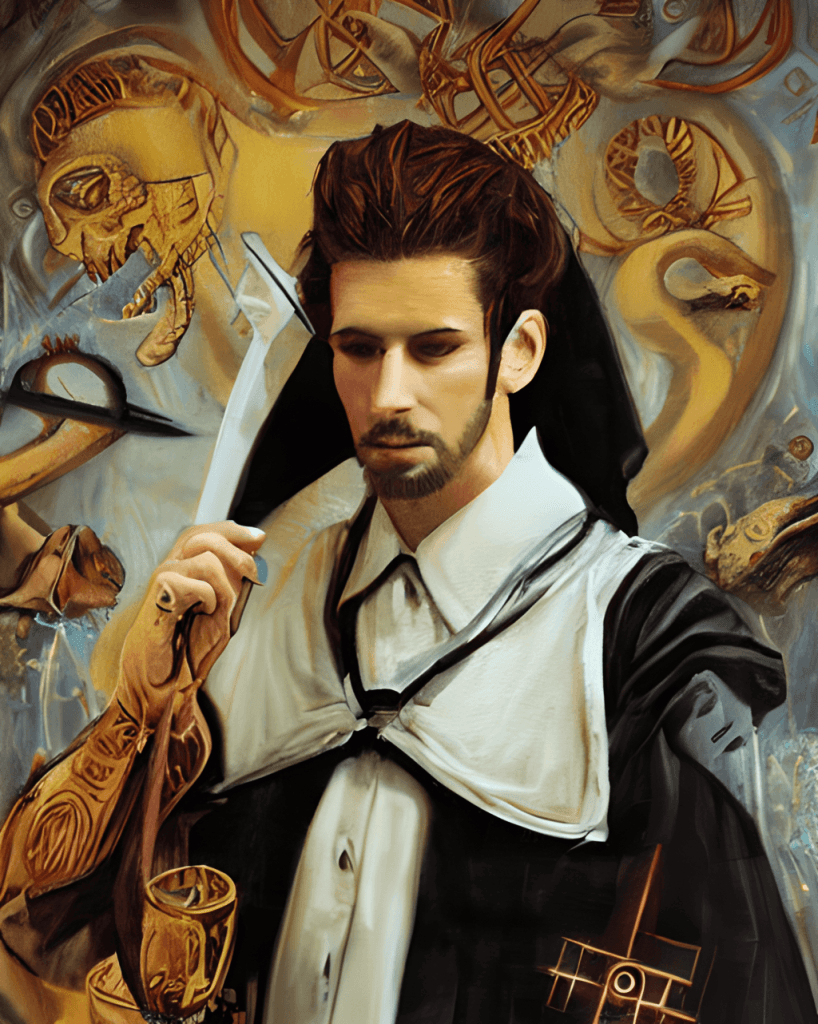
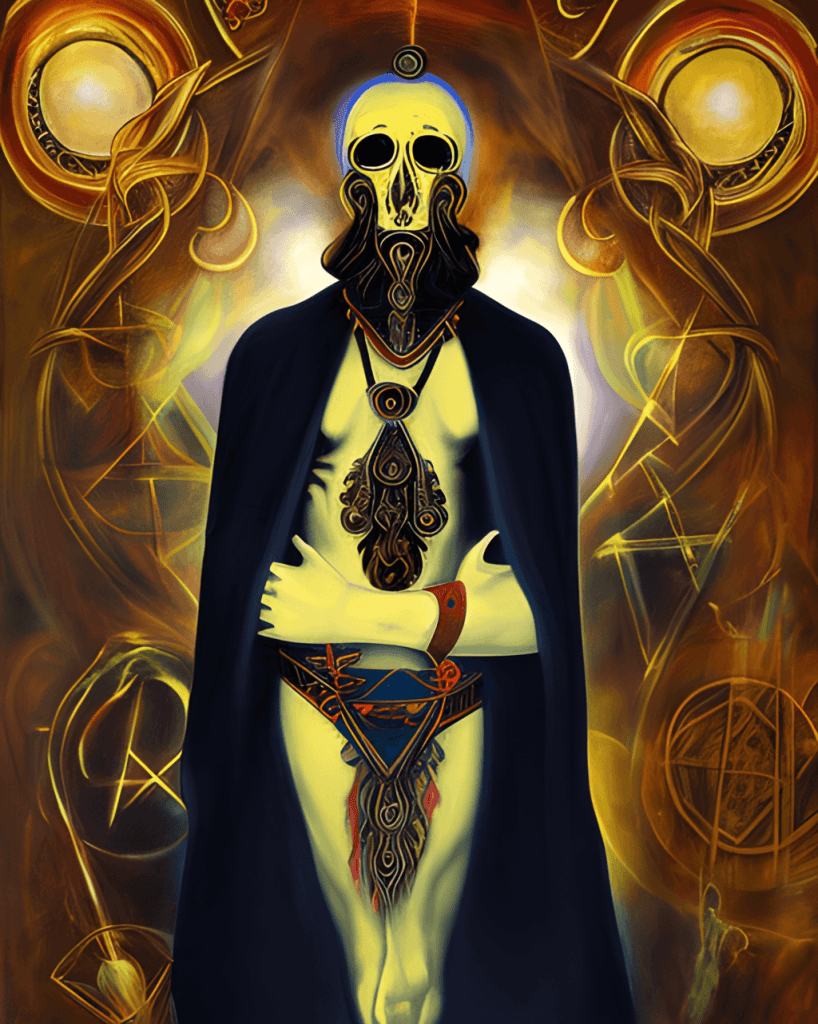
AI-generated Magician Tarot Card Illustrations

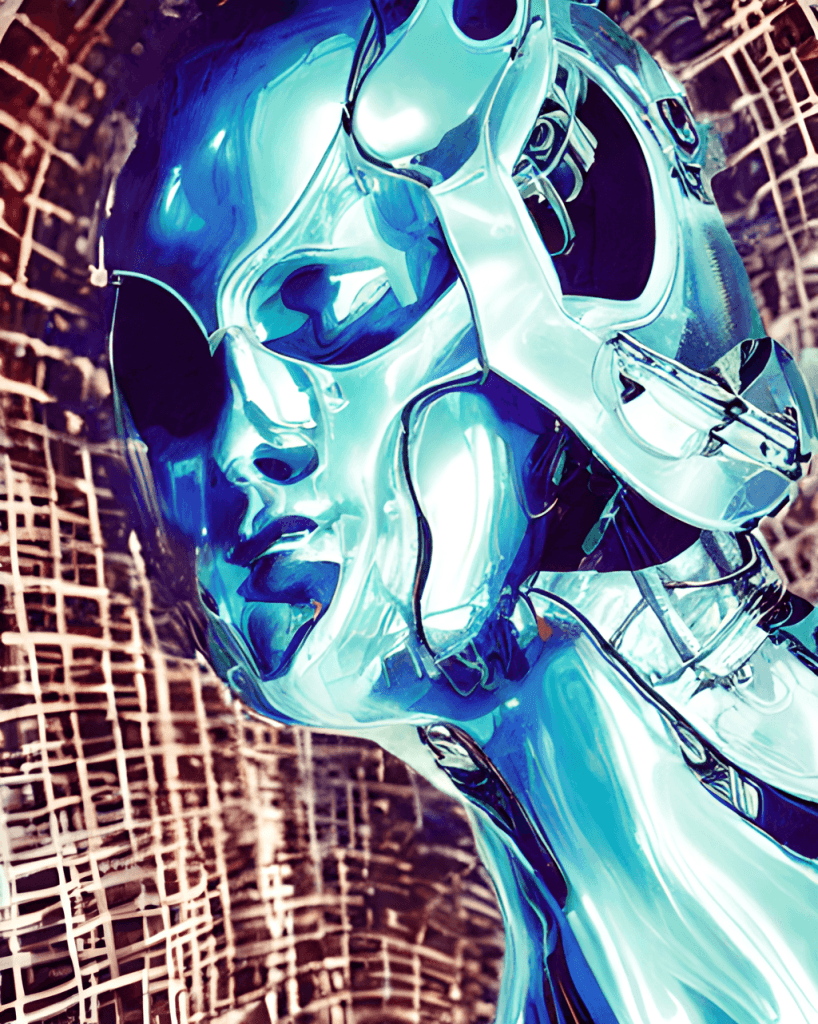
Magician tarot card illustration, generated through AI
Magician tarot card illustration, generated through Artificial intelligence
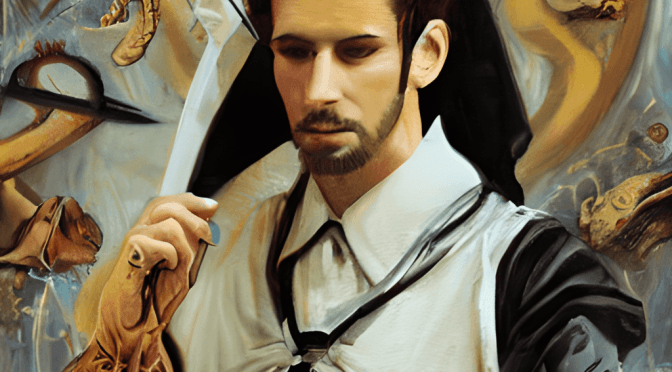
Magician tarot card illustration, generated through AI
Magician Tarot Card illustration, generated through Artificial Intelligence
Magician tarot card illustration, generated through AI