Tag Archives: Ace of Hearts

The Table – A Deep Dive Into Cartomancy

You’ve got to appreciate how folk cartomancy takes the objects of our everyday life and turns them into means for predicting the future. This is, after all, probably how cartomancy started: people needing to know what tomorrow would bring adapting the symbolism of the decks to which they had access (tarot, playing cards and later oracle cards) to the objects and situations that constituted their daily lives and their symbolic interpretation.

From a philosophical perspective this shows great acumen and observational ability on their part. They may not have had a piece of paper that qualified them to count angels dancing on pinheads, but they were possessed of great perception–which is only natural, considering that on their perception depended their survival.

From an occult standpoint, it further indicates that they were perfectly acquainted with the power of symbols to connect the inner and outer realms, which is the foundation of all forms of magic.

One of the recurring symbols of folk cartomancy is the table. In the system of cartomancy with playing cards that I was taught, this corresponds to the Four of Clubs, certainly due to the squarish (Four) and social (Clubs) nature of the card. The Four of Clubs is chiefly the card of words and talks, but it extends to all contacts we develop with others: we can sit at the table with them and talk, negotiate, have fun, etc.

In the Vera Sibilla, we must distinguish between the table in general and the festive table. The former is assigned to the Ace of Hearts, the Conversation. This is also the card of words and talks, but being the Ace of Hearts it is also representative of your family or the people you live with. Furthermore, the table here can also be seen as the table you eat at, due to the connection of the card with the hearth and with everything to do with your mouth and throat. The festive table is more a prerogative of the Nine of Clubs, which is connected with celebrations, fun and banquets.

The first written record of the cartomantic concept of the table is found in the earliest recorded system of reading the Bolognese tarot with 35 cards: here the table is given to the Ace of Coins. This is a meaning that still exists in all traditions I am aware of, although the card has also doubled down as the card of big money in the 45-card system I know, the card of official documents and letters for Germana Tartari and of work for Ingallati.

I am unclear as to why the Ace of Coins was chosen, but I guess the round shape of the heavily stylized coin could be seen as a round table or as a centerpiece. Broadly, the table in the Bolognese tradition is seen as the place of direct contact with others, of conviviality and of business transactions. The card also symbolizes ‘l’ora di tavola’, the time of day you sit at the table, usually lunch time and therefore, more generally, the day as opposed to the night.

The second earliest recording of the symbol of the table comes from Etteilla, whose source attributed it to the Ace of Cups. Here Etteilla and his students tried to extend the meaning of the table beyond the common experience of it by playing on the other meanings of the word ‘table’, so that for instance, the Ace of Hearts for him can also be the table of laws (as in, the one Moses received).

I am unaware of whether the Lenormand or Kipper traditions contemplate the symbolism of the table, though the symbol is not obviously represented in the cards. What I do know is that the symbol is also present in most Italian playing card system, so that I am aware of at least one where the Four of Coins indicates the table.

MQS

The Home – A Deep Dive Into Cartomancy

Following my deep dive into the symbols of the door knockers and the road in divination by cards, I want to tackle the symbol of the home. This, too, like the road, is a widespread symbol that is almost never absent from any divination system of a practical nature (I am aware of systems for playing card divination based on Rider Waite symbolism, but they have very little practical use).

The popularity of the symbol of the home is simply a consequence of its importance in people’s lives. The home or house card is, in most systems, a ‘topic’ or significator card indicating the querent’s or someone else’s house, and the cards surrounding it show us the atmosphere or happenings of the household. Its practical value, therefore, is immense.

In the earliest recorded system for reading the tarot, which is Pratesi’s guide for the Bolognese tarot, the house card is the Ace of Cups. This meaning is retained in the more modern variants of the method. This is also an almost universal constant in cartomancy, since the Ace of Cups or Hearts is almost always taken as a symbol of the home.

Whether this association originates with the Bolognese tarot I don’t know. It is possible that the symbolism is simply suggested by the shape of the Ace of Cups. In the Visconti tarot, the Ace of Cups is a water spring similar to a baptismal font, but in many old decks it can look similar to a walled structure. If we add to this the fact that the function of the cup is to contain, it may be that this could have suggested the idea of the house to old cartomancers, since a house is a large (the ace is large) containment structure.

Similarly, in almost all card reading systems using Italian regional cards, the Ace of Cups is the home, although I am aware of a couple where the meaning is attributed to the Four of Cups, possibly due to the squarish form suggested by the arrangement of the pips. The Ace of Cups is also the house card in the Sibilla regionale, which is the second-most widespread sibilla deck in Italy.

Why the same idea of home as the Ace was suggested by people using regular playing card suits is unclear, since the Ace of Hearts does not look like anything but a heart. Still, if the system I was taught is anything to go by, the main idea is that hearts deal with one’s emotional life and nourishment, and the home is the origin and source (ace) of our emotional life, the place where our first (ace) needs are met. As a matter of fact, the person who taught me cartomancy with playing cards often insisted that the Ace of Hearts is not just any house (though it can be, in practice) but especially one’s home, where we come from (the ‘spring’ we come from, in the Visconti sense), which is why an extended meaning of the house card is often one’s family.

The same attribution of the Ace of Hearts to the home is found in most systems I am aware of, including German cartomancy and most English and French methods. As far as tarot is concerned, we find that, in some earlier tarot documents, the Tower is simply called ‘casa’ (house), before being called House of God or House of the Devil in some other decks (the title ‘Tower’ is actually a rather late innovation).

Etteilla assigned the house to the Ten of Coins, which Waite retains in his illustration of the Ten of Pentacles, while Paul Case generally matched the house with the Two of Cups, among other things. However, this was more of an accidental consequence of the Golden Dawn attribution of the first cards of the suit of Cups to the zodiac sign of Cancer and, according to the sign/house equivalence theory, to the fourth house, which is the house of the father and therefore of one’s fathers and one’s family/house.

The Sibilla is a partial exception to the rule of the ace as the home, as the House card is given to the Two of Hearts. The meaning of origin (which metaphorically, depending on the reading, can also indicate the origin of a problem) is retained. Still, the Ace of Hearts is also given to the family and to people living together, among other meanings.

The Sibilla, like the Kipper cards, distinguishes between a House card and a Room card. This is probably because both decks seem to have been consolidated from earlier German or Austrian decks which also had similar cards, although the makers of the Sibilla also took playing cards into consideration.

I cannot speak to the Kipper cards (nor to Lenormand, where there is a House card, attributed to the King of Hearts), but in the Sibilla, the Room can represent a small(er) apartment, as well as a place in general, but it doesn’t usually have a connection with the emotional side of life, like the House, although it can represent intimacy, since it is connected with rooms in general, but with the bedroom specifically.

MQS

Cartomancy with Playing Cards | Ace of Hearts

The Ace of Hearts (A♥) is almost universally known as the house card. I do not know why this is the case. Since I recently talked about the Bolognese Tarot, I will note that the Ace of Cups (which correspond to Hearts) is called the House in that system, which goes back many centuries, even before Etteila (who, after all, admits to having learned from Italian card readers, although he ended up switching some cards around).

The way I have rationalized the Ace of Hearts in my system is that Hearts represent all things inner and intimate and aces have to do with beginnings. They are in a way the source of the theme they speak of. The source of our inner side, of our intimate side, is our family, our house, the place where we consider ourself “inside” rather than “outside”.

The Ace of Hearts is the card of the Querent’s house, and usually describes it in a neutral to slightly positive way. The house can be intended as the physical place of residence or as the group that inhabits it, thus signifying the querent’s family. A Court Card falling near the Ace of Hearts can show a family member (or, depending on the question, a person who wants to start a family with the querent).
However, if the Ace is attended by Spades, it shows a negative environment or tears at home. These can very well end up affecting other aspects of the querent’s life.

Illustration of the Ace of Hearts in cartomancy with playing cards

Broadly, the Ace of Hearts can show a positive beginning to anything, and something that is solid and stable or brings stability to the querent. It also shows serious intentions in all aspects of life. For instance, if a perspective business partner shows up with the Ace of Hearts next to him, it doesn’t necessarily mean he has the hots for the querent. It can simply mean he’s serious and dependable, solid.
Because the Ace of Hearts shows positive beginnings, it is auspicious for pregnancies.

Psychologically and spiritually, the Ace of Hearts is a card of protection, but more broadly it signifies the querent’s inner side, his intimate feelings and perceptions, which may be described by the surrounding cards. Thus, the card can shed light on the whys and wherefores of his behavior.
With Diamonds preceding it, the Ace of Hearts can show money being invested in the family or in the house. With Clubs it can point to family activities or plans, while with other Hearts it shows harmony in the house. Spades, as already said, bring strife in the family.

Some Combinations:

A♥ – 2♥ = family visits | broadly, it refers to relatives | it can signify the arrival of something positive
A♥ – 9♥ = traditionally it signifies greetings in the family, but more generally it shows a great joy about one’s intimate and family life
A♥ – 6♠ – Q♣ or K♣ = can mean an inherited desease or more generally catching an illness from a family member
A♥ – 3♣ = married life, a strong family bond
3♦ – A♥ – 5♦ = spending money on renovations

Playing Cards and Numerology – The Aces

One word of caution: back when I was taught to read playing cards, I was simply given their meanings. Just like for the Sibilla, there were no number meanings. The numerology was something I came up with to make sense of the meanings, remember them better and further expand upon them. You are free to come up with different associations, or even to disregard numerology entirely.

Aces in playing cards are connected to beginnings, obviously, but also to how and where things begin based on the associations of the suit.

In the suit of Hearts, the Ace is famously the House card. This is because our emotional sphere begins at home. The walls of the house protect us from what is outside. Thus, the Ace of Hearts represents the idea of inside. The house is the core of our individuality, where our roots are (it can also signify our origins, and the idea of origins, source, spring, well in general). It is also connected with positive beginnings or the beginning of positive things.

In the suit of Clubs, beginnings are interpreted differently. Here things begin objectively, they take root concretely out there in the world and not just inside of us, hence the Ace of Clubs’ connection with outside buildings and the idea of “outside” in general. More broadly, the Ace of Clubs is a card of production, commitment, activity, vigor and willpower. It also signifies signing papers, which is how documents become objectively valid.

In the suit of Diamonds, the beginning is seen in more absolute terms. This is the card of things starting out, of new things and, because the suit is connected to information and impulses, to news. It is also the card of all things that are first or of the highest value, such as diamonds, jewels, gold, a capital city, the sun, etc. The card can herald changes of phase, usually positive, and it is great for starting new ventures.

The suit of Spades is negative, so the beginning turns into an ending. Thus, this is almost universally the Death card. It heralds change, but painful change, change which is seen as the ending of something rather than the beginning of something else. It’s connected to all things that confine us. On a broader level it can even signify a country’s borders because that’s where the country ends. It is the card of cuts and knives. Broadly, this is the card of bad things beginning or of bad beginnings. It is also connected to all things that are last or of least value, and to where things end or end up.

Vera Sibilla | Ace of Hearts – The Conversation (Conversazione)

Name: Conversation
Italian Name: Conversazione
Playing Card: A♥
Polarity when Upright: Neutral with positive undertones
Core Meanings: Words, Conversation, Meeting, Expression | Groups of people leaving together, Tight-knit group
Polarity when Reversed: Neutral to negative
Reversed Core Meanings: Change, Transformation | Lack of communication, negative communications

Card Description: a group of people talking around a table. There seems to be great complicity among them.

Suit and Number: Aces all have to do with news and with how people come together to interact. In the suit of Hearts, this translates as information received by interacting with other people. The interaction is positive (or at least neutral) as words imply the mediation between different points of view, values, desires, etc.

UPRIGHT A♥

General: the card is neutral in itself, but it has positive undertones. It is concerned with words. Words are what we use to express what we have inside, to mediate with others, to get a point across, to discuss situations, to find solutions, and so on. Words, of course, imply the existence of at least two people, so this card can also represent meetings of any kind. Since Aces represent unity, the Ace of Hearts is connected with groups of people who live under the same roof, or at least are quite tight-knit. There is a sense of community to this card, and a general undertone of harmony, tranquillity and stability.

Love and Relationships: the oral aspect of the subject matter (yes, this can include oral sex, though it’s not, of course, the primary meaning). In general, this card shows meetings, dates, appointments and has a strong interpersonal component. It heralds declarations, explanations, clarifications and the like. Near negative cards, though, it brings strife (usually only arguments). In love, if the person is single, the card’s appearance will often predict the meeting of someone new, or, if sandwiched between negative cards, show that the person has difficulties with people or expressing himself. If a person’s relationship is hitting the rocks, the Conversation card can show the attempt at stitching it back together, and in itself shows the ability to find compromises, since words are what we use to connect what’s inside of me to what’s inside of you, and therefore mediate.

Work and Money: the most obvious way this card will show up is to show talks, meetings, interviews and roundtables, contacts and networking. Again, it is a neutral to positive card, easily influenced by the surrounding cards, so while it can herald opportunities, negative cards surrounding it may warn us that we are going to be talked into something bad.
Another important meaning concerns the querent’s relationships on the job, that is, whether he gets along with people or not. Naturally, the Ace of Hearts has an affinity with all careers where one is constantly around people or uses language, and it is an important card to check when one is looking to win over clients. In fact, the proximity of negative cards to the Conversation can show an inability to reach people or clearly present a product, or an unwillingness of people to come to the store and buy it.

Other: in countries like Italy, where many school exams and tests are almost exclusively oral, this is an important card to check to see how it will go. Artists also want the Ace of Hearts surrounded by good cards, as it shows their ability to express themselves and give voice to what they have inside (but depending on the context and question, it may also represent their core audence or the public). Psychologically, the Conversation can represent a people-person or someone who is capable of connecting with others (if with good cards, that is). In general, it represents openness, but with cards that hint at lies, manipulation and the likes it will show the opposite, while with cards of hardship it can point to the inability to open up about something. Spiritually, it’s the card of prayers and can represent religious or spiritual gatherings and communities.

Important Combinations:

A♥ + 4♥ = a declaration of love, a date
A♥ + K♦ = job interview, a work meeting
A♥ + 4♦ = lies, wrong information, wrong crowd
A♥ + 3♥ = traditionally an engagement, but more in general it can be a talk that yields results
A♥ + 10♠ = secret meeting (especially with the 10♠R) | lack of openness, difficulties expressing yourself | a foreign language | can also be a lie

REVERSED A♥R

General: The card remains vaguely neutral, but much more open to the influence of negative cards. It’s the kind of neutral that makes you raise an eyebrow. In its main traditional meaning, it is the card of change, because it reverses the upright sense of harmony and stability. Change can be good or bad, of course, depending on what changes and into what. Furthermore, the card takes the concept of words and applies the more negative connotation of a reversed card to it, bringing arguments, battles, communication barriers or lack of communication.

Love and Relationships: When it heralds changes to the querent’s love life, the A♥R usually either allows a single person to break a spell of solitude (if it’s followed by cards showing romance) or it can engender changes that tear a couple apart. Either way, this card does not favor stability and will normally shake things up quite noticeably, unless the cards are used to investigate some more subtle interpersonal dynamics, in which case it is can show changes of attitude, etc.
Sometimes, the Conversation Reversed highlights a lack of communication, misunderstandings, the inability or unwillingless to compromise or, with the appropriate cards, arguments. Often, there is a sense of incompleteness or lack of fulfillment, the kind of which makes you look at the other person and say “who are you really?” Alone, this is not a card that will break a couple or a family or group of friends, but it can be the cause that leads to the breakup. It also does not favor new meetings

Work and Money: when it signifies change, again, this card is neutral, its meaning fully depending on the cards that follow and precede this one. It can bring you out of a rut or hurl you into one, it can lift you up or slam you down, and the changes it herald are normally of some moment, although usually either less radical or less painful or less all-encompassing than the Death card. It can bring changes to the workplace, or changes of career field.

Under the influence of the Ace of Hearts Reversed, meetings and interviews usually either do not happen at all or do not go well. It can refer to difficulties getting along with the coworkers or luring clients to your products. Sometimes it may even show that you are not representing your product well, with the consequence that it is either not bought or it is bought under false assumptions, causing dissatisfaction.

Other: Psychologically, the Conversation Reversed is a card of instability, of lack of openness to the outside, of communication barriers that keep one from reaching out or revealing one’s most intimate ideas and feelings. It therefore can cause a sense of dissatisfaction. On the other hand, in the right context, it can allow one to develop new ideas by changing their mind. Much depends on the context of the question and the other cards.  Artistically it is generally not good, as it normally implies the inability to tap your inner creativity and express it or to find an audience.
Spiritually, it can bring conversions or loss of faith. It may reveal a lack of relationship with the divine. The Upright Conversation can in itself show the discussion of a court case, but when reversed, the card can highlight it even more, if pertinent.

Important Combinations:

A♥R + K♠ = a legal battle
A♥R + 8♣R = inability to get along
A♥R + 2♥ = can show home renovations
A♥R + 7♣ = can be a change of status
A♥R + K♦ = changes on the job

Other Combinations: Vera Sibilla | Examples of Combinations – The Aces
Vera Sibilla | Examples of Combinations – The Aces

In this article you will find some examples of combinations using the Vera Sibilla. Most or all of these combinations are handed down by tradition. Studying and decoding combinations is a very good way to improve your cartomantic vocabulary, but bear in mind that the exact meaning of a combination depends on many other factors, such as the context of the question and the other cards in the spread, so I would encourage you to keep an open mind. As a rule, you will find that if you do not pose a question and these combinations come up, they will mean what the tradition says they mean 3 times out of 5. Also, keep in mind that it’s useless to try to combine every card with every other card beforehand so that no surprises will ever come up in a spread, just as it is useless to try to combine every word in a dictionary with every other to study a language. That time is best spent actually practicing.

NOTE:
R = Reversed
U/R = Upright or Reversed (doesn’t matter)
* = This combination has to come up in this specific order
3 = The Gift (Omaggio)
8 = The Handmaid (Donna di Servizio)

Ace of Hearts (A) – Conversation (Conversazione)

A + 2 = The querent’s own home or family | Talking at home | Talking about real estate
A + 3 or 5 = An engagement or being hired for a temporary job (depending on the question and the other cards)
A + cards referring to a certain topic = Talking about that topic (e.g. + 4 declaring your love; + 6 money or investment; + 7 a contract or some intellectual thing; + A♣ marriage or a contract or partnership; + 7♣ business or work; + K can be an interview)
A + 8 = A meeting by the water | a hoped for meeting will take place or will be successful
A + 10 = can be a successful meeting or discussion | It can mean confidence in interpersonal relationships

A + 2 + 3 = Long-distance communications (including over the internet)
A + 8♣ = A reconciliation, talking things over | An appointment, meeting, date, etc.
A + 9♣ = A party
A+ 9♣R = Meetings falling through | Be careful about too much indulgence with what you put in your mouth
A + 10♣ = Chatting about nothing in particular | Careful who you meet or what you say (look around for the J♠ or Q♠)

A + 4 = Lies or, at best, incomplete information | Being around the wrong people, either because they are wrong in themselves or because they are wrong for your purpose (barking up the wrong tree)
A + 6 = It might be an oral examination or an aptitude test (+10 or positive cards, you pass) | Opening up about what’s going on in your mind
A + 3♠ = Difficulty of interaction with others, Social isolation | A meeting that won’t happen

A + 10♠ = Lies | An argument | Being guarded or defensive when with others
A + 10♠R = More probably a secret meeting (this can also be the case if the 10 is upright, although less likely)
A + K♠ = Talking with an authority | Traditionally, a trial taking place (but this is more common if the Ace or the King are reversed or if other relevant cards appear)
AR + A card signifying a certain topic = Change, revolution or renovation in that topic
AR + Cards of argument or disagreement = Reinforces the idea of disagreement

Ace of Clubs (A♣) – Marriage (Imeneo)

A♣ + 2 = The couple’s life (or a firm’s/company’s life, in a career reading). This is a very important combination, when it comes up. Look at the cards surrounding this combination or falling between them to see what’s going on
A♣ + 4 or 9 = A marriage of love
5 + A♣* = It may mean an engagement to be married very soon
A♣ + 7♣ = A business contract | Marriage to a rich person
A♣ + 2 + Happy cards = an invitation to someone’s marriage

A♣ + K or 8 = A job contract (if it’s the 8, it’s more usually employed work)
A♣ + 9 = Litigiousness between partners of any kind | Don’t sign anything
A♣ + 10 = Someone is trying to snatch your partner away | if you are planning a wedding, it will not take place (not necessarily because of cheating, look around), or if positive cards follow, things will happen that will make plans change in some respect
A♣ + 3♠ = Abandoning a partner (this is a very traditional combination)
A♣ + 7♠ + K♠U/R = Divorce

A♣ + 8♠ = A critical moment in the marriage (if the Ace is reversed, it’s beyond saving)
A♣ + K♠R = Also divorce, but depending on the context it might mean other things, for instance the government or public authority causing problems to a partnership
A♣ + Person card = It may imply that the person is married
A♣R + Person card = It may imply that the person is divorced or separated

A♣R + 2R = A couple’s daily life is perceived by the person as stifling and they would like to get away from it | A firm/company unravelling
A♣R + 6 = Riches
A♣R + 7♣ = Real estate
A♣R + 10 = One’s assets (+2♣ + 3, you probably have money to burn)
A♣R + 8 (+2♣)= A noble person, an aristocrat

A♣R + A = Sex (+ A oral; + 5 (+7) with much foreplay; +9♠ can be anal; +10♣ casual or without protection; + 8R and/or J♣R sleazy or very kinky, someone who likes debasement or being dominated (K♣ or Q would be the master/mistress), with 7♣R shaming plays a role, with 7♠R it borders on abuse or a very extreme slavery kink; +9 + 4R (+ reversed people cards) group sex; +5R and other negative cards it might be incestuous; +QR or J♣R + 6U/R or 8R, with a hooker; +9♣R drugs are being used in the context; +4R and/or 7R, sexual depravity is implied; +4R +3R + 4♠ careful about STDs, if also 5♠, it might be AIDS (you may find A♠ or JR instead of 3R, showing the “communication” of something bad); +A♠ or 10♠, violence might be part of the thing, but 10♠ can also be a uniform kink (e.g. + J♣); + Q♣R traditionally the loss of virginity)
A♣R + 4R + 3R = A traditional combination of sexual abuse
A♣R + 7 = Conception of a child
A♣R + 7R or 2♠R + 9♠ = Difficulties getting off, impotence or frigidity

Ace of Diamonds (A) – Room (Stanza)

A + A = a private talk
A + A♠ = the news received confidentially is bad
A + 2 = One’s home
A + 4 = A private meeting between lovers
A + 6 and/or 6♣ and/or 7♣ = material prosperity
A + K = may be an office or a shop | confidential information concerning the job

A + 7 = a professional’s office | a den or office
A + 9 = sexual encounter (the Nine implies giving oneself completely to the other, so it’s probably not a random encounter)
A + 10♣ = careful whom you trust with your secrets
A + 4 = what you tell/are being told is false | the pantry
A + 4♠ = spending time in bed due to illness | in love, it can mean the intimate sphere is “sick”

A + 7♠ = can be a domestic accident (look around for the 10♣ showing carelessness) | what you’ll be told will anger you | the electrical system or the stove, depending on the other cards
AU/R + 7♠R = Wringing a confession out of someone
A + 9♠ = a traditional combination meaning intimacy. It’s not negative
A + 10♠R = A private meeting of a secret nature
AU/R + 7♠ + A♠ and/or 10♠ + 5♠ = the confession of a homicide

2 + A = The querent’s bedroom
A + 3 = a museum or cinema or place where you look at things | the balcony | the point of view
A + 3 + 10♠R + 4R = A peep show
A + 2 = private writings | a desk
A + 5 = the garden, a park, if it makes sense in the context

A + 6 = can be a literal safe or vault
A + A = can be a living room or dining room (8♣ might also show the living room)
A + 9♣ = more probably a dining room
A + 3♣ = can be a garage, a hotel room or moving into an apartment (especially if 2♥ follows the 3)
A + 3♠ = the cellar (+8R, the plumbing, a sewer)

A + 10♣ = the attic, the roof
A + 8 = the kitchen
A + 5♠ = a mortuary
A + 7♠ = a place in ruin
A + 8♠ = a place of bad memories, a place of desperation and low energies
A + K♠ = the seat of an authority | a confessional
(Note: there are many other combinations showing places, with a little practice you’ll be able to detect them easily. Also, depending on the context you will need a different interpretation for these combinations. Be flexible)

AR + 9♠ = problems of intimacy
AR + K♣R = an unpleasant diagnosis
AR + 4R = a coming out | the discovery of a sexual secret
AR + 10♣ = being busted due to carelessness
AR + 4 = the shocking secret is false

AR + 10♣R + J♠ or Q♠ + 2 = unpleasant secrets spread over the internet by trolls, fake news
AR + 7 = a traditional combination showing the recognition of an illegitimate child
AR + K♠ = Another traditional combination, showing the possibility of legal action

Ace of Spades (A♠) – Sorrow (Dispiacere)

A♠ + 4♠ = a mental breakdown
K + A♠ + 5♠ = loss of employment
A♠ + 2 = bad news via letter or telephone
A♠ + 10♠ = can represent violence (but look around for other cards confirming it)
A♠ + 6 = depressing thoughts | psychological violence

8 + A♠ = a hope or wish that will not be realized
A♠ + 7♠ + 9 = can be a brawl
A♠ + 4♠ + K♣U/R = a traditional combination showing that the person will develop a physical defect due to an illness (+7♠, after a surgery)
7♠ + A♠ = the traumatizing disruption of a situation | with other cards showing violence, the 7♠ becomes a card of wrath)
2 + A♠ + J♣R + 10♠ + 7♠ + 5♠ = receiving news that a son has died in war
J♠ or Q♠ + A♠ + 7♠ + 5♠ (+10♠) = a murderer

A♠R + A or 8♣ or 9♣ = many outings, a good social life
A♠R + 10 = success after much toil
A♠R + 10 + 7 = birth of a child (I once drew 2♦ + A♠R + 10♥ as a daily spread and on the same day we received a postcard telling us of the birth of a distant cousin’s daughter)
A♠R + A♣ and/or 2 and/or 7 = the signing of a document
A♠R + 2 + 4 = forgery of signature | signing something you’d be better off not signing

A♠R + 3♣ = many occasions to travel
A♠R + 8 or 6♣ = many occasions to receive money
A♠R + 8R = many expenses | paying something in installments (+10, you finally pay off something)
2 + A♠R + 10 = extension of a mortgage, remortgaging
6 + A♠R + 10 = extension of loan

8 + A♠R + K = Holding down two jobs
K + 2♠ + A♠R + 7or A♣ = renewal of a job contract (the 2♠ is the job reaching its natural conclusion)
10♣R + A♠R = many occasions to win money or a lucky streak in general
9♠ + A♠R = labor (the one before birth), if 10♣ or 6♣ before the 9♠, it will come sooner than expected
Bad cards + A♠R + Good cards = end of a sorrowful period

Vera Sibilla and Numerology – The Aces

The Aces of the Vera Sibilla. Like and subscribe to my YT channel support my work.

The four aces, like the aces in many cartomancy systems, deal with the idea of newness. This can mean news or simply something new. However, in the Vera Sibilla they also add a further layer: they show people coming together in a unity of some kind. This can overlap with the meaning of news. In a way, it is as if the Sibilla was asking: “Oh wise reader, if you were to reduce the meaning of each of the suits to a single spark or seed idea, what would that be?” In this sense, the newness is how the suit first manifests, how it comes into being. And the way it comes into being is by containing the interaction between people, or between inside and outside, in a single unity.

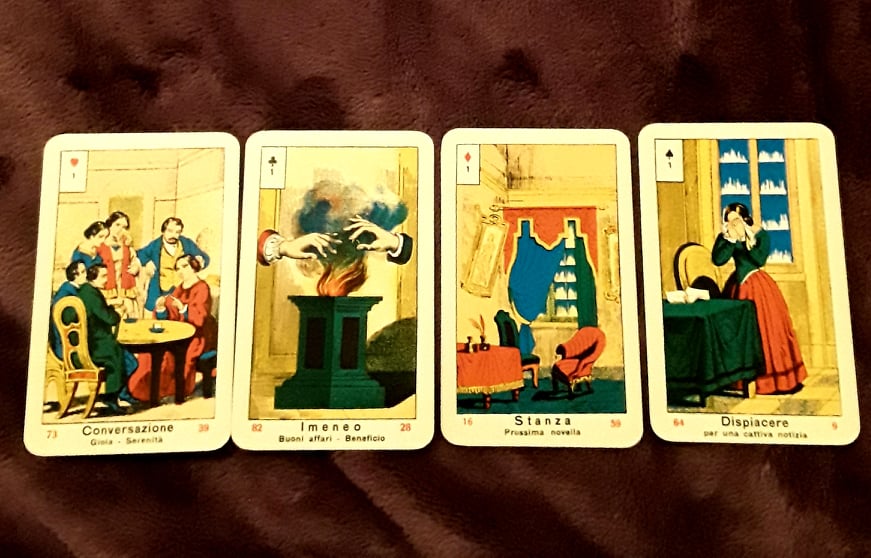
The four Aces of the Vera Sibilla: Ace of Hearts (Conversation), Ace of Clubs (Marriage), Ace of Diamonds (Room), Ace of Spades (Sorrow).

The Ace of Hearts, Conversation, is a good example of this overlapping of newness, news and relationship between people. This is the card of words and interpersonal relationships. The type of unity between people that this card shows is one of peace: word is an alternative to violence, and it allows us to find compromises, hence the further meaning of negotiation. Additionally, it represents people coming together in a further sense, as it is the card of people living under the querent’s same roof.

Note how, in a more metaphorical sense, the Ace of Hearts represents the idea of opening up to other people, or simply to a new situation, in that talking means connecting with the outside world in a peaceful, positive way. It describes a type of work where you need to stay in contact with people, and also the ability to communicate, to mediate, to make people understand where you are coming from.

The Ace of Spades, Sorrow, is in more than one sense the opposite of the Conversation card. It represents, first and foremost, sad tidings, the precise nature of which is shown by the cards nearby. Something from the outside comes to the I, and the I is saddened by it. From this comes a whole set of meanings assigned to the Ace of Spades, from grief to tears etc.

The difficulty that this card shows in interpersonal relationships is typified by one of its other meanings: violence. This is one of the cards that can show people coming together not, as in the previous card, with good intentions, or with the idea of finding a compromise, but holding a big club behind their back.

In between the two extremes, we have other types of news and unity. With the Ace of Clubs, Marriage or “Hymenaios”, the coming together is a legal one: it shows two or more people joined in a venture that requires a signature. From marriage to contracts, partnerships, this is a card of prosperity, and unless other cards modify it for the worse, it promises good. It shows something that is legally valid and legally binding because it has been intersubjectively been agreed upon.

From this we have further secondary meaning of this card. The Ace of Clubs represents everything that materializes, and becomes concrete, that is not just a vague abstraction, but is grounded in the outside world. In this sense, it shows how the inner and outer sides of reality are joined together.

Finally, the Ace of Diamonds, the Room, shows yet a different type of news and a different type of coming together. It is the card of intimacy and of the querent’s privacy and private sphere. While it is certainly a good card for material affairs, its most important meaning is that of confidential news and of intimate relationships.

As card of privacy, it represents something close to the querent, something that remains within their sphere of influence, and it shows property. From this a whole host of meanings related to intimacy, hanky panky (especially with the Ace of Clubs, and especially if it is reversed) and so on. Note how the Room card and the Marriage card complement each other: the Ace of Clubs shows a “masculine” type of energy which is projected outwardly, from subjectivity into intersubjectivity, while the Ace of Diamonds, with its symbology of Room, shows retreat and welcoming inside.

To sum up, the Ace of Hearts shows words and new situations of a peaceful kind (unless other cards show otherwise) and peaceful unity among people; the Ace of Clubs shows contractual unity and, if other cards concur, a beginning of prosperity; the Ace of Diamonds is the card of news coming from a confidential source and intimate unity among people; the Ace of Spades is the card of bad news, sorrow and violence, i.e. people joined by their hands pulling the other person’s hair.