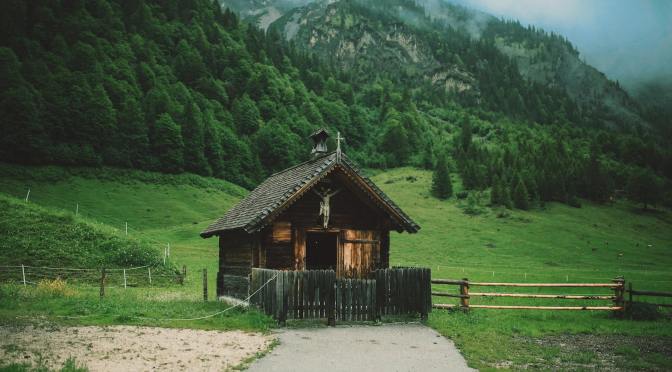
Following my deep dive into the symbols of the door knockers and the road in divination by cards, I want to tackle the symbol of the home. This, too, like the road, is a widespread symbol that is almost never absent from any divination system of a practical nature (I am aware of systems for playing card divination based on Rider Waite symbolism, but they have very little practical use).
The popularity of the symbol of the home is simply a consequence of its importance in people’s lives. The home or house card is, in most systems, a ‘topic’ or significator card indicating the querent’s or someone else’s house, and the cards surrounding it show us the atmosphere or happenings of the household. Its practical value, therefore, is immense.
In the earliest recorded system for reading the tarot, which is Pratesi’s guide for the Bolognese tarot, the house card is the Ace of Cups. This meaning is retained in the more modern variants of the method. This is also an almost universal constant in cartomancy, since the Ace of Cups or Hearts is almost always taken as a symbol of the home.
Whether this association originates with the Bolognese tarot I don’t know. It is possible that the symbolism is simply suggested by the shape of the Ace of Cups. In the Visconti tarot, the Ace of Cups is a water spring similar to a baptismal font, but in many old decks it can look similar to a walled structure. If we add to this the fact that the function of the cup is to contain, it may be that this could have suggested the idea of the house to old cartomancers, since a house is a large (the ace is large) containment structure.
Similarly, in almost all card reading systems using Italian regional cards, the Ace of Cups is the home, although I am aware of a couple where the meaning is attributed to the Four of Cups, possibly due to the squarish form suggested by the arrangement of the pips. The Ace of Cups is also the house card in the Sibilla regionale, which is the second-most widespread sibilla deck in Italy.
Why the same idea of home as the Ace was suggested by people using regular playing card suits is unclear, since the Ace of Hearts does not look like anything but a heart. Still, if the system I was taught is anything to go by, the main idea is that hearts deal with one’s emotional life and nourishment, and the home is the origin and source (ace) of our emotional life, the place where our first (ace) needs are met. As a matter of fact, the person who taught me cartomancy with playing cards often insisted that the Ace of Hearts is not just any house (though it can be, in practice) but especially one’s home, where we come from (the ‘spring’ we come from, in the Visconti sense), which is why an extended meaning of the house card is often one’s family.
The same attribution of the Ace of Hearts to the home is found in most systems I am aware of, including German cartomancy and most English and French methods. As far as tarot is concerned, we find that, in some earlier tarot documents, the Tower is simply called ‘casa’ (house), before being called House of God or House of the Devil in some other decks (the title ‘Tower’ is actually a rather late innovation).
Etteilla assigned the house to the Ten of Coins, which Waite retains in his illustration of the Ten of Pentacles, while Paul Case generally matched the house with the Two of Cups, among other things. However, this was more of an accidental consequence of the Golden Dawn attribution of the first cards of the suit of Cups to the zodiac sign of Cancer and, according to the sign/house equivalence theory, to the fourth house, which is the house of the father and therefore of one’s fathers and one’s family/house.
The Sibilla is a partial exception to the rule of the ace as the home, as the House card is given to the Two of Hearts. The meaning of origin (which metaphorically, depending on the reading, can also indicate the origin of a problem) is retained. Still, the Ace of Hearts is also given to the family and to people living together, among other meanings.
The Sibilla, like the Kipper cards, distinguishes between a House card and a Room card. This is probably because both decks seem to have been consolidated from earlier German or Austrian decks which also had similar cards, although the makers of the Sibilla also took playing cards into consideration.
I cannot speak to the Kipper cards (nor to Lenormand, where there is a House card, attributed to the King of Hearts), but in the Sibilla, the Room can represent a small(er) apartment, as well as a place in general, but it doesn’t usually have a connection with the emotional side of life, like the House, although it can represent intimacy, since it is connected with rooms in general, but with the bedroom specifically.
MQS