Enneagram Type Seven and Enneagram Type Nine share some similarities, and can therefore be confused. Sevens are a Head type and seek to avoid anxiety and fear by being hyped about things they can enjoy. Nines are a Body type who maintain their sense or independence by being agreeable and positive to avoid causing trouble that might come back to haunt them.
Both Sevens and Nines are known to have a hard time selecting a single thing that they can be or do. Sevens thrive on pursuing variety as this allows them to continue skimming the surface of life in search of the next big thrill and avoid staying with negative emotions for too long. However, Sevens tend to have a rather strong sense of self and of their wants and needs.
Nines on the other hand have a diffuse sense of their identity and do not feel comfortable defining themselves, often sensing that they can resonate with almost anything and anyone. By avoiding taking on a sharp identity, Nines protect themselves from potential trouble by simply passively flowing through it instead of bumping against it.
variety
Both Sevens and Nines have a broadly optimistic worldview. To a Seven, the world is their oyster and they look forward to the next thing to be hyped about. They are excitable and quick, and even when in a situation that they dislike, they can learn to tolerate it in anticipation of something better to come.
Nines by contrast move at a slower pace and have a sense of placid and unassuming satisfaction about them. They do not demand much from life and do not spiral into the manic frenzy of Sevens. In fact, they are very wary of anything that might cause excessive reactions in them. Their sense of optimism takes the form of a generalized, vague it’s-fine-ness that they adopt to avoid having to take a stronger stance, which might open them up to trouble and strife with others.
Both types can be rather superficial. Sevens are superficial in the sense that they remain on the surface of the things that they get excited about and avoid settling down so as to not miss out on the next thing that excites them. Nines are superficial in the sense that they avoid deep emotional or intellectual commitments that might put them in a corner or pit them against others, and so prefer to remain flexible and deal in generalities, which may sometimes sound deep but aren’t.
Enneagram Type Seven and Enneagram Type Eight can be very similar and are often confused. Sevens are a Head type, who cope with their fear, pain and anxiety by getting lost in a world of pleasure-seeking and fun distractions. Eights are a Body type, and they seek to protect their independence by being assertive and bold and forcing others to deal with them and take them into account.
Both Sevens and Eights are very assertive and outgoing on the surface. Sevens find it easy to attract interesting people and adventures, since remaining confined in a routine can cause them to become restless or even to suffer. Eights are more guarded and do not trust people very much, but they do come out of their inner fortress to mark their territory against others and to let them know that they (the Eight) are not to be messed with. Thus they often end up either submitting others or guiding them.
Both types tend to have a somewhat materialistic view of reality and seek earthly pleasures. Generally speaking, Sevens seek variety and change in order to be constantly dazzled and stimulated and stay hyped about something positive, so that they can avoid being sucked into a cycle of fear. Eights on the other hand usually seek intensity in powerful experiences, as they enjoy the feeling of having something outside of them offer them resistance, and they enjoy conquering it in the end, to prove that they are the ones who are still standing (it is typical, for instance, for alcoholic Eights to want to prove that they can handle one more glass).
passion
Both types often come across as action-oriented. Eights attack problems from an instinctive standpoint, throwing brute force (either literal or metaphorical) against the obstacle until it is destroyed. Sevens are more intellectually versatile (not necessarily more intelligent) and they often quickly come up with plans to overcome obstacles in order to reap the rewards, the rewards usually being meterial comfort and/or the ability to pursue their many passions.
Socially, average Eights operate on a friend/enemy level: they quickly sort other people out in either one of the two camps. For them, life is a battle and they need to know whom they are going to defend and whom they are going to attack. Sevens are not naive, but they see the world more as their oyster, and while they know that there are difficult people in the world, they seek to look past them in anticipation of the fun time to be had after dealing with them.
Eights tend to be more unshakably dedicated to the small handful of people they call friends. Sevens are also very good friends, but they also often look to create different groups of friends based on their interests (the group they go dancing with, the group they watch movies with, etc.) although they too often have a small core of best friends.
Enneagram Type Six and Enneagram Type Seven are quite distinct, but they do share a number of traits, especially on a superficial level. Both are Head types. Sixes feel insecure in the world, and therefore seek guidance from someone or something. Sevens also act from a place of insecurity, but they flip the script by moving toward the world with endless ideas in mind on how to enjoy it to avoid staring too much at their inner disquiet.
One of the most obvious common traits is that both Sixes and Sevens tend, on average, to come across as very likeable. Both have often a strong sense of humor (average Fives also have a sense of humor, but it tends to be used to put down others). Sixes tend to want to ingratiate themselves to others to show that they are worth defending or at least not harming. Sevens tend not to be afraid of others but they do tend to look for the entertaining side of their experience of life.
Of the two types, Sixes are the more community-oriented or other-oriented, largely because they feel that effective networking is a positive response to the uncertainties of existence. However, their skeptical side can also end up undermining their efforts as they often blow things out of proportions in an effort to make sure they can trust others, and they are very good (sometimes too good) at poking holes in everything.
humor
Sevens are not necessarily more trusting of others, but their efforts do not revolve around trying to see who they can trust. Instead, Sevens are rather self-reliant go-getters. They know that not everyone can be trusted, but they do not sleep over it, just like they tend not to lose sleep over most negative thoughts, unless they are experiencing peculiar circumstances.
On the other hands, Sevens can sometimes become too relaxed lose their grip on their life by going into almost manic phases of unwarranted optimism, whereas Sixes are cautious and will have thought about most if not all of the consequences of their actions.
Ultimately, Sixes and Sevens move from the same inner experience of anxiety and fear, but react to it in vastly different ways: Sixes by trying to looking for remedies, Sevens by distracting themselves.
Enneagram Type Five and Enneagram Type Seven are very different, but they do share some connections, so much so that Seven is the stress point of Five and Five the growth point of Seven. Both are Head types. Fives are intellectual individualists who remove themselves from the world to feel safe from it. Sevens are exciteable planners who seek to escape their inner sense of fear or pain by taking refuge into the opportunities the world seems to offer them.
Both Fives and Sevens are Head-driven, but in vastly different way. Fives are THE brainy type, as they spend the majority of their time in their heads, thinking odd ideas and formulating concepts almost as an aim in itself. For Sevens the mind is declassed to the rank of means in formulating plans for enjoyment and flight from (or rationalization of) the things the Seven fears.
Both Fives and Sevens are very good at establishing connections between disparate things, subjects and ideas that few would ever think of mentioning in the same sentence. Still, they do it in vastly different ways and following different avenues. Sevens usually move on the surface of things, casting a wide net on their multiplicity in a bid to explore as many of them as the Seven wishes to. They enjoy this sense of variety and love having options and freedom, and this almost inevitably leads them to heaping up odd experiences and ideas in never-before-seen patterns. They are, in a way, the Renaissance men and women of the Enneagram.
Fives, on the other hand, delve deeply, with an almost surgical focus, into a single abstruse and socially disregarded idea that interests them until they have broken it into its smallest possible components, which they can reassemble, often with a taste for paradox, into widely different ideas. Then they break them apart again and start over in the same endless process of analysis and synthesis. Since, at the end of the day, everything in the universe is connected with everything else, Fives end up (or at least aim at) possessing the Whole within a single concept by leveraging a single, obsessively developed core idea that allows them access to all other ideas. In other words, Sevens tend to be exploratory, Fives tend to be conceptual.
The Mind’s Eye
Socially, the two types are very different. Sevens, while not necessarily extroverts, are outgoing, in the very real sense that they go out of themselves and toward others, often directly if not bluntly. Fives tend to withdraw from social contact in a hermit-like fashion.
Furthermore, both types have a keen awareness of their needs, but take care of them in starkly different ways. Fives generally minimize their needs in order to avoid offering themselves up to the vagaries of good and bad fortune, but in pursuing this course they often end up withered and emotionally dry. Sevens on the other hand are usually anything except minimalistic, tending more toward extravagance, as they fear confinement, because confinement and lack of external fulfillment force them to bear witness to a less than happy inner reality that, in one way or another, they refuse to confront.
Enneagram Type Four and Enneagram Type Seven are quite different from one another, and not easy to confuse. Fours are a Heart type whose main focus is on what’s missing and what they are lacking. Sevens are a Head type, and they are generally focused more on finding exciting ways to fill up their time to distract them from life’s unpleasant aspects.
In general, Fours tend to have a relatively pessimistic view of life, and especially of their own life. Sevens are not necessarily optimistic, but they do tend to seek distraction from the negative side of things, which they usually acknowledge only in their more sober moments.
Fours tend to see beauty in what they don’t have, which is the basis of their envy. Some Fours may not even know what it is that they feel they are missing, they just know they don’t have it. They tend to focus on the past (what is lost and unrecoverable). Sevens on the other hand have an anticipatory mindset (they are the “looking forward to” type), whereby they get hyped about new possibilities for enjoyment. Fours can also focus on the future, but they also often know from experience that when the future comes, if it comes at all, it is generally a letdown.
Experience
Fours and Sevens are also very different around people. Sevens are people magnets, even when they don’t want to be. Stuff just tends to happen around them. Fours are usually ill-at-ease around people, though they long for contact and meaningful relationships. Furthermore, Sevens generally don’t question people’s motives too much unless they are given reason to, whereas Fours often overinterpret people’s behavior around them as a negative reaction to them and as proof that they don’t belong and are misunderstood (note that Four’s overinterpretation is different from, say, a Six’s questioning of people’s motives).
It is not rare for both Fours and Sevens to appreciate peculiar experiences and have a marked aesthetic appreciation. Sevens tend to have a quick pace, and they usually “eat life” at a high speed. While they can have a small handful of favorite activities, they are generally on the go and will always incorporate new ones into their routine to avoid it getting stale. They also tend to be somewhat hedonistic and materialistic.
Fours, on the other hand, usually like to savor a more limited range of things and activities for a more protracted period of time, tend to have a slower pace and are less materialistic and more concentrated with depth, as they tend to have an almost spiritual dedication to their practices. This is not to say that Sevens are necessarily shallow (though less healthy Sevens certainly are). Many Sevens can extract all there is to extract from something in a very short time and then move on collecting new experiences. The moving on part is what Fours struggle with, as they often feel the need to create and recreate the same kind of experience to evoke certain (usually negative) feelings.
Enneagram Type Three and Enneagram Type Seven can on occasion be lookalikes, so distinguishing them may be treaky. Threes are a Heart type, and seek recognition for their (real or perceived) merits and for their excellence. Sevens are a Head type, concerned with achieving security by filling their life with distractions and exciting projects.
Let us never forget that the quest for recognition is part of our human makeup: it is how we work as social beings, regardless of our Enneagram Type. The same can be said for security and for looking out for exciting new things. Everyone needs security.
Threes, though, are essentially social in their psychological framework, even when they are introverted, simply because their usual way of acting is aimed at meeting criteria that have been set up for them by society or family. Thus, their actions and plans always imply the presence of other people, even when those people are not there. Sevens, on the other hand, may very well attract colorful and interesting people due to how they behave and may enjoy their praises, but they are ultimately interested in filling their lives with novelty and excitement to avoid looking at what they fear or causes them pain.
Threes are status-seekers, Sevens are pleasure-seekers.Sevens tend to have a strong materialistic streak and find comfort in owning stuff. Of course, they often want the cool new stuff, and coolness is generally a socially defined concept, but the comfort this stuff gives them is that they can use it to fill their lives with thrills and stimulations. Threes, on the other hand, want to be praised more than anything else. Of course, in our society, praise is often linked to the ability to have material possessions (prizes, wealth, etc.) but for Threes stuff matters mostly for what it means for their status.
Action
Both Threes and Sevens can be very hard and efficient workers. Sevens usually need more clearly to be in a line of work that stimulates them, but lacking this, they can put up with a job they don’t like that will allow them to fuel their extravance. Ultimately, their fear is of finding themselves in a situation of scarcity and being left without options, alone with their pain and a sneaking sense of void, meaninglessness and gloom. Threes tend to pursue paths that they deem themselves good at. Of course, if they like the path, all the better, but Threes can go down career paths they despise as long as they can stand out and gain approval. Their fear is mainly that of failure.
Both Threes and Sevens can have a grandiose sense of self. In Sevens, this is due to their disconnection (momentary or permanent) from the negative side of life, which often lauches them into phases of mania where they can become dangerously foolhardy and have unrealistic feelings of invincibility. Average Threes are grandiose about their sense of self, which is almost the sole reason, together with social or familial conditioning, why they get into careers or other life paths even if they don’t particularly like them, simply because they are looking for something that will give them a recognition they deem adequate to their view of themselves.
Ultimately, the grandiosity of an average Three does not blind them to reality, but merely fuels their plans, while the grandiosity of a Seven tends pravail in particularly unbalanced phases of their life and can cause them to make grave blunders (again, it is like a mania).
Enneagram Type Two and Enneagram Type Seven are quite different in many respects, but they also share some similarities. Twos are a Heart type and want to be recognized by others as loveable and meaningful to their life. Sevens are Head types, and they focus more on security, which they achieve by planning situations and activities that divert or comfort them.
Both types have it easy with others, as both tend to be very likeable and to attract people due to both being very demonstrative and communicative. Even here, though, there are some key differences. Twos seek depth of connection, while Sevens seek variety and tend to be contented with shallower interactions (though they are also likely to have a selected few besties).
More specifically, Twos’ emotional engagement is more intimately connected with their sense of self and their attempt to convince others to mirror it to them, while for Sevens engagement (including, but not especially, emotional engagement) is more a byproduct of the interaction and their attempt to create an ‘experience’ for themselves and the ones they are entertaining.
Positivity
As such, Twos are far more reluctant to be less than positive (even saccarine at times) with others, whereas Sevens, being less attached to their feelings, can let them go in more directions.
The lovebirds of the Enneagram, Twos generally try to create a unity with the other person. Sevens can go along for a ride or two with others, but they are highly independent and hate being bogged down and restricted, all things that create anxiety, or even panic, since it jams their mechanism.
All the complex apparatus of codependence that makes average Twos gush would be enough to make a Seven hyperventilate, as Sevens need and respect independence. On the other hand, since average Sevens tend to live life skimming the surface, they sometimes fail to provide others with the same emotional depth as a Two once the initial glamour of their fun personality wears off.
Enneagram Type One and Enneagram Type Seven are very much unlike each other, so much so that they are each other’s arrow: Ones grow at Seven, Sevens stress at One. Ones are a Body type, and their primary focus is on right action as autonomous beings; Sevens are a Head type, and they focus mainly on security, which they seek to achieve by planning their comfort and diversions.
Both Ones and Sevens are, in a sense, idealistic, but their idealism has different roots and different effects on their worldview: Ones believe in high ideals and standards and, by consequence, see the world as imperfect and fallen; Sevens idealize their potential for future enjoyment and so see the world as their oyster, full of cool stuff to be hyped about.
Ones are known for their harsh inner critic, which constantly nags them about what they are doing wrong and why. Everyone, including Sevens, may have a strong inner critic depending on their particular life story, but what’s usually even stronger than any inner critic in a Seven’s mind is their inner Yes-Man, a voice that constantly justifies and encourages their desire for more and broader avenues of enjoyment.
Ideals
In a social context, Ones and Sevens are also very different. Average Ones are generally restrained and somewhat uncomfortable. They may love to try to be more personable and warm, but they also feel that something is holding them back and doesn’t allow them to just relax and enjoy others’ company. Even Ones that have worked a lot on themselves usually retain a degree of inner tension.
Sevens, on the other hand, are people magnets (even when they don’t want to be). They love quick and witty banter with others, and even more introverted Sevens relate to others with peculiar ease, and are often capable of making fun of themselves and of odd or paradoxical everyday situations in a way that Ones would find disconcerting.
The difference between Sevens and Ones is the difference between fun and duty: they are notoriously tricky to reconcile. Unhealthy, stressed Sevens who have strayed too far may suddenly try to save their wanton selves from their mistakes by suddenly developing the rigidity of a One, but in more regular circumstances they are positive, upbeat and open to the world’s possibilities. Healthy Ones, by contrast, are usually capable of incorporating some Seven traits in their behavior by becoming more serene and developing a more positive attitude, but in general they remain tense perfectionists.
Enneagram Type Seven, sometimes called the Epicurean or the Enthusiast, belongs to the Head triad. Those of this Enneatype are usually positive, upbeat, energetic and fun-loving. They are mainly driven by the desire to avoid negative sensations and to maximize their options of experiencing the world and its potentials without being held back or restricted. They often make lots of plans and are engaged in many projects, activities, side activities, etc, some of which are bound to be left incomplete. They are usually possessed of quick wits and have an aptitude toward picking up new skills and interests. They rarely focus on the negative side of life, and even when they do, they tend to snap out of it quickly (or more quickly than other people.)
Enneagram Type Seven
Enneatype Seven Grows: Move to Five
One of the common themes in most Sevens’ lives is their fear of being confined to just one option, which will lead them (in their perception) to not experiecing life to the fullest or to not having back-up plans if one option fails. This tendency can cause Sevens to remain perpetually stuck on the surface of life, to the point that some unhealthy Sevens believe the surface is all there is. Sometimes this belief can cause Sevens to make rash decisions out of fear of being chained down in one place or situation.
As they grow and learn to relax their mechanism, though, Sevens start to develop a keener appreciation for the depth and complexity of life and a greater focus in pursuing certain options as more obviously right for them as opposed to others. In this, they start to take on some of the better qualities of Enneagram Type Five. Fives are the intellectuals of the Enneagram. They rarely make rash decisions and are often laser-focused, as though their mind were a blade that they use to cut through the surface of things to reach their core. They also don’t shy away from the negative side of life.
In general, even healthy Fives tend to lead a more sober life than their Seven friends, with a preference for a few well-chosen activities (or a few well-chosen possessions, friends, etc.) as opposed to the epicurean sludgeflow that usually clutters the lives of unhealthy Sevens. This is not to say that Sevens must become minimalistic, but as they grow they do become more stably anchored to their own core.
As they do so, Sevens realize that they are not necessarily foregoing anything essential if they choose to pursue one option to the exclusion of another, and instead they learn to cultivate what they do choose with care and persistence, while bringing their sense of humor, childlike wonder and almost endless adaptability with them.
Sobriety, the Virtue of Enneagram Type Seven
Enneatype Seven Under Stress: Move to One
Perceptive Sevens can sometimes feel that they are being led on a leash by their fear of restriction and pain. While healthy Sevens face their demons directly (like all healthy types) less healthy individuals can become absorbed in an endless whirlwind of meaningless novelty-chasing and hype traps, whereby they drop their toy as soon as the next shiny trinket catches their attention.
Because Sevens are very sharp-witted, they usually notice this trend, but they also feel that they must keep going, because stopping for a second (they feel) would cause more obscure feelings and fears to catch up with them. Unhealthy Sevens generally know that they are caught in a loop, but they feel that it’s too late to stop (Sevens in general have a tendency to excuse away their lack of restraint).
In moving toward their direction of stress, Sevens can pick up some of the less healthy qualities of Enneatype One. Like unhealthy Ones, they become critical and rigid, usually toward those around them who refuse to jump on the next hype train with them. Furthermore, perceiving the futility of their behavior, Sevens may also try to organize themselves to bring more structure to their life and activities (especially if it is spiralling out of control due to poor decision-making), but they tend to organize them to death, until all the wonderful Seven-ish spontaneity is sucked out of them and all that is left is the unhealthy One’s grayish sense of bureaucratic doom.
Often Known As: Epicurean, Enthusiast, Entertainer, Joker (note that names are as limiting as they are revealing.) Sin/Passion: Gluttony Focus: on options to experience pleasure Fear: of suffering and being left without options Energy Center: Head (energy is transformed) Social Stance: Assertive Key Positive Traits (embodied at their best): Positive, Fun, Friendly, Active, Good planner, Anticipating, Excited and exciting, Energetic, Colorful, Playful, Spontaneous, Casting a wide net, Smart (and often street-smart), Multifaceted, Practical, Quick-witted, An enjoyer of life, Entertaining, A magnet for people and for odd, whimsical adventures Key Negative Traits (embodied at their worst): Shallow, Manic, Falling for every silly novelty, Excusing away own lack of restraint, Scattered, Wasteful, Materialistic, Impatient, Delusional in assessing own abilities, Hyperactive, Making rash decisions that come back to bite them, Sense that if they stop one second something “wrong” or “bad” may surface within them Growth and Stress Directions: to Five and One respectively
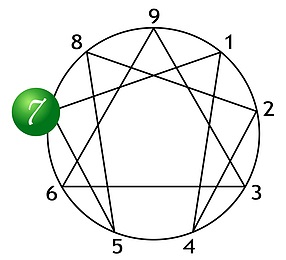
Enneagram chart with Type Seven highlighted
Introduction
Everyone has someone in their life who always seems to be in the right place for something odd, fun or remarkable to happen to them. Even when they relate their experience as if it were a nuisance, these people manage to put a funny spin on it, turning it into the subject of a story that everyone can laugh at. These people may be Sevens on the Enneagram.
Sevens are always seemingly upbeat and positive. Possessing an endless reservoir of energy and as wide an array of interests toward which to funnel this energy, they appear to go through life in search of the next exciting thing.
Sevens don’t necessarily look for the spotlight, but still they often shine in group settings, where they grab people’s attention with their colorful personality and their ability to connect over their many interests. In fact, Sevens tend to cultivate a variety of hobbies and personal interests, often achieving more than other people in a shorter period of time.
A Seven is not someone who “one day” would like to go see that concert. A Seven is the person who’s already scouring the internet for tickets and accomodation solutions, even if they’ve promised themselves they would wait a couple of months before spending that much money again.
Sevens love making new experiences and hate feeling held back or limited in their options. They live for the thrill and they are often found planning the next one. When the experience is over, they may be a little sad, but low moods rarely last very long with Sevens. They always find a way to cheer up and move on to the next thing. This may sometimes cause trouble as it leaves negative feelings unelaborated and may end up in rash decisions.
The colorful parrot, a good symbol for Enneagram Type Seven
Core Mechanism
On the Enneagram, Sevens belong to the Head triad. This may seem strange, as they do not give off intellectual vibes (note that ‘intellectual’ does not necessarily mean ‘intelligent’). Sevens appear very much to be doers. And yet, Sevens are also great planners. Just as Fives seek to anticipate the world as a whole and Sixes seek to anticipate what might cause them pain or fear, Sevens seek to anticipate pleasure. This is how they use their head.
In Sevens, the urge for safety that characterizes all Head types is transformed into an active quest for enjoyment. Sevens fear pain and sorrow. Thus, they fill their lives with what philosopher and mathematician Blaise Pascal called ‘divertissements’, that is, distractions. Although Sevens appear hardy and resilient, they actually have a low tolerance for inner pain or existential dread. Therefore, their lust for adventure is actually a flight from these conditions.
This is behind Sevens’ tendency to “skim” through life, fueled by their fear of missing out and being stuck with the present. Not that the present is inherently bad for them. They can appreciate it. But they appreciate it in so far as it is one of the many things they can and will enjoy. When it becomes the sole thing, then Sevens’ attention, being confined within the narrow space of existing conditions, turns toward the more negative side of their life, which is what they want to avoid.
And yet, the more they force variety and diversity into their life, the more this variety becomes shallow. Since Sevens are often anything but stupid, they perceive this, and they are prompted to flee even further into more meaningless variety.
Passion
Gluttony is the passion of Enneagram Type Seven. As with all types, we must read the term ‘gluttony’ figuratively. The gluttony of Type Seven manifests in their general tendency to seek variety and always new experiences to ‘consume’, and always being afraid of remaning stuck with the thing you have and missing out on the world out there.
Sevens want to fill their life with experiences. The idea of staying put is very much alien to them, because as soon as their life begins feeling stale or samey, a sense of wrongness begins to surface, and the negative feelings that they seek distraction from become loud.
Interestingly, Sevens usually fear being in a situation of lack, want or dearth. They tend to have a sensual, materialistic streak. However, their gluttony can jeopardize their sense of security if left unbridled, as the person may end up overspending, overeating, overdoing, developing addictions, etc.
Healthy Sevens are generally capable of exerting some self-restraint when needed, but unhealthy ones feel that lack of variety and change makes the world close in on them. This can cause them to drop the toy they are playing with as soon as they eye the next shiny trinket. It is not uncommon, for instance, for Sevens to try to initially compromise with themselves: “I’ll get the new thing I want when the paycheck comes” only to be unable to help themselves and just going in the red. This is just an example, of course, but it paints an accurate picture.
Gluttony, the passion of Enneagram Type Seven
Misconceptions
A common misconception about Sevens is that they cannot make commitments and are unreliable friends. This is not true. Though Sevens may have a number of acquaintances and fair-weather friends with whom they do not care to take things very far, they are extremely loyal to the people they consider important in their life.
As with people, so with activities. It is true that Sevens may often be unwilling to persevere in things (some hobbies, for instance) once the rush wears off unless they have managed to organize their life around it, but there is almost always a handful of activities to which a Seven devotes themselves wholeheartedly.
Another typical misconception is that Sevens are always extroverted. Extroversion is not something that the Enneagram can measure. Although there may be a statistical correlation between introversion with certain types and extroversion with certain other types, there is never a causal connection.
Sevens move toward people not necessarily because they are extroverted (though they may be) but because their behavior leads to them interacting with people, even when it is not the main goal.
Finally, I’ve come across descriptions, especially on socials, that state that Sevens are never depressed. As depression is a mental condition, it can develop in anyone with a mind, and has no connection with one’s Enneagram type.
Wings
7w6: Sevens with a Six wing often have a more noticeable anxious note. Excellent planners, their quest for entertainment often ends up involving other people, as this subtype tends to be in high demand among potential friends and acquaintances. Friendly and upbeat, they often appear approachable. Compared to the other wing, 7w6 may sometimes be held back by fear from going after what they want, though often they end up going after it anyway and worry later.
7w8: Sevens with an Eight wing have a stronger presence, and can have the eightish air of someone you don’t want to mess with. Compared to the other wing, they are more likely to jump eagerly into situations without forethought, and will often quickly go get what they want. These Sevens often have a decidedly sensual bent, and want to surround themselves with all the means of satisfying their desires.
(note that wings can have some minor descriptive power in terms of superficial behavior, but they are irrelevant in terms of what motivates the person. Many people have no noticeable wing, while few show signs of both.)