Category Archives: Vera Sibilla

Vera Sibilla Cards That Indicate People

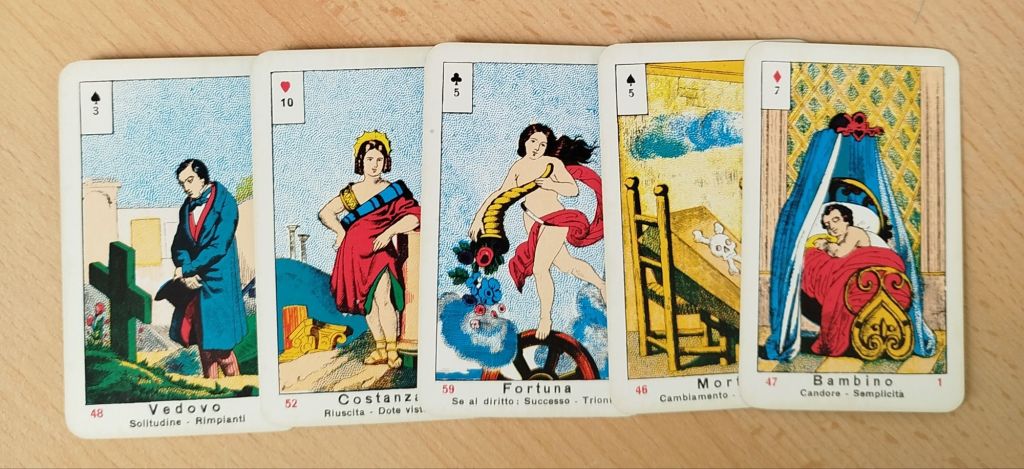
There are plenty of cards, in the Vera Sibilla, that can indicate individuals (see here for groups). Here are the most common (keeping in mind that most of the cards have other associations as well, and may indicate concepts or situations):

Seven of Hearts – The Scholar
The Scholar can represent the figure of a lawyer, a notary, or more in general a professional. Traditionally he is said to be in his 40s or early 50s, but we need to be flexible with age. He can also be a member of the family or even a partner.

Eight of Hearts – Hope
There are two schools of thought concerning the Hope card. According to some it doesn’t represent a woman, while according to others it can (traditionally, a younger or blonde woman). I have found that it is rare for this to be the case, but it could happen.

Nine of Hearts – Faithfulness
The Faithfulness card can represent support, and occasionally it will show up alone indicating a concrete someone, i.e., a friend, who shows us support.

Jack of Hearts – The Boyfriend
It is common for this card to indicate an actual person, often the unmarried male querent or a male who is in love, or positive, or belonging to the family.

Queen of Hearts – The Girlfriend
Same as with the Jack, only applying to women.

King of Hearts – The Gentleman
The King of Hearts is traditionally the figure of a protector or benefactor, someone who aids us. He is typically in a good position to do so. He can be a father or loving husband (when upright), but can also represent the married male querent or a boyfriend who is older or has a position in society.

Four of Clubs – The Friend
The Friend card can represent friendship as a concept, as well as partnerships and other situations where people come together for a common goal. However, it can often indicate a female friend or relative.

Jack of Clubs – The Servant
The Jack often represents a younger man, one up to 30 years of age, or unmarried. However, it can also represent a colleague or friend, regardless of age. It can also indicate a son, if relevant. Usually he is already known to the querent (the Italian word ‘domestico’ can mean servant but it also implies familiarity with the house).

Queen of Clubs – The Maiden
The Maidan can be the female counterpart of the Servant, showing a younger unmarried woman, sometimes a daughter.

King of Clubs – The Doctor
The Doctor card often indicates health issues or the need to take care of something. However, it can also represent a man with a certain social position or with a degree (if next to a female card, then he turns into a woman with those characteristics). It can show the figure of a professional whose advice or help will be required, or a boss.

Seven of Diamonds – The Child
Often it is a metaphorical child, but sometimes the Seven of Diamonds can represent a literal one, usually very young (toddler). It can combine with other cards (the Servant or Maiden, for instance) to indicate a teenager. It is the card of pets as well.

Eight of Diamonds – The Handmaid
A card strongly connected with the coming and going of money and with work, the Handmaid can also be the figure of a female colleague or a female servant (like a cleaning lady). Traditionally she is from a different town, but this is not always the case. She can also be a stranger or a foreigner.

Ten of Diamonds – The Thief
Rarely a literal person, but in connection with negative cards it can show someone who steals, either literally or metaphorically.

Jack of Diamonds – The Messenger
Rarely a person card, the Messenger often heralds the arrival of news and the knowledge of facts. However, it can occasionally represent a young man, traditionally dark-haired.

Queen of Diamonds – The Wife
A card that often represents what it says on the tin, the wife shows a woman who is married and may have children. It can indicate a woman who has achieved some level of success (could be a colleague or boss).

King of Diamonds – The Merchant
Usually this card signifies the querent’s work life. However, it occasionally signifies a literal merchant or someone who a transactional view of life and relationships.

Two of Spades – The Old Lady
Often one of the most complex cards in the deck, the Old Lady has a whole host of metaphorical meanings. The literal meaning, though, is that of representing an older woman, a grandmother, a widow, someone close to retirement, a woman of 60+, and so on. The card can also stand for an ex (your old woman).

Three of Spades – The Widower
As with the Old Lady, so with the Widower, but for men. It can represent an older man, a grandfather, an ex, a widower or divorced man. It is somewhat rarer for the Widower to be a literal person, compared to the Old Lady.

Ten of Spades – The Soldier
Another often cryptic card to interpret, the Soldier can also indicate a young man, in his 30s or early 40s (again, taking it with a pinch of salt), who is muscular or sexy or who wears a uniform. It can also indicate a stranger or a foreigner.

Jack of Spades – The Enemy (male)
The male enemy card can stand for a literal enemy, or for someone who is against the querent for some reason, either as a rule or in a particular situation (your uncle whose car you crashed into a tree can be your enemy too, when he finds out). It can also represent a place where people are inimical to the querent.

Queen of Spades – The Enemy (female)
Same as with the Jack, but for women.

King of Spades – The Priest
The King of Spades often indicates an institution, the government, a judge, etc. It can also sometimes represent an older man who is not inimical to the querent, but who is somewhat cold toward him or her, but is still fair (unless the card is reversed).

MQS

Psychological Hang-Ups of Diviners and Querents

When a person sits in front of a diviner, a number of preconceptions have often already been set off in their mind, and sometimes even in the mind of the diviner.

We must always remember that, nowadays, many people don’t visit an astrologer or card reader by chance, nor (usually) as their first go-to choice. Often, they have made a deliberate choice to step outside of the norm, for better or for worse, meaning that they have found the norm to be lacking in its ability to provide certainty. For many, therefore, the underlying presupposition seems to be: “I accept to take part in something that operates outside of consensus reality as long as it gives me the certainty I can’t find any other way.”

As diviners, we instinctively know it, and we may feel pressured to play into this presupposition or swim directly against it, thus falling into the opposite error.

Some diviners may feel they need to provide the querent with the unreasonable all-knowledge that only God can gift them with, only to end up providing uncertain information with unreasonable confidence. Others may push in the direction of vague self-help: We may not know if Mr. Right is behind the corner for our love-starved querent, but her divine feminine or other buzzword can still derive important lessons and “aha moments” from reflecting on the whole situation.

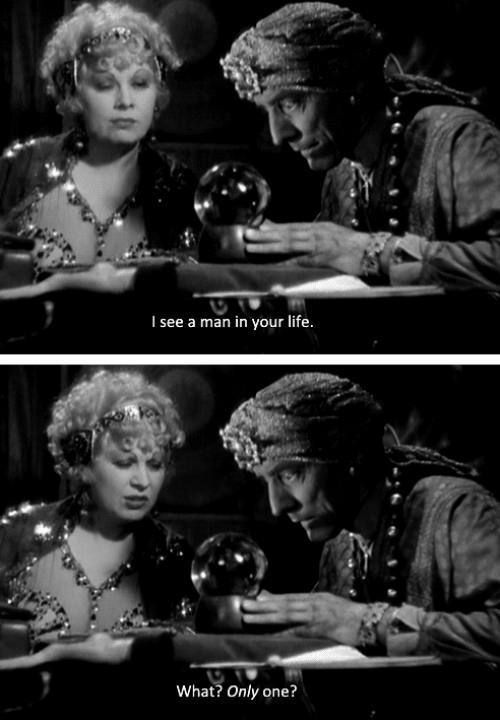
Mae West said it best. Picture by Sophie Charlotte on Pinterest

There are many dimensions to divination, some of which are indeed very deep. However, as far as our relationship with querents is concerned, we are simply an added means of intelligence-gathering, which, like all tools at our disposal, may fail for a variety of reasons, not the least of which is the diviner’s limited knowledge (our knowledge is always limited).

“But I came here to have undebiable, clearcut answers,” one might argue. To which I anwer: Tough titties! If you want undeniable clearcut answers shake a magic eightball. Divination is, quite literally, a divine language, and is not always so cleacut, either in itself or due to our limitations, or sometimes simply because the situation isn’t clearcut in itself. This is especially the case for issues involving human emotions.

As a rule, honesty is the best policy. I believe in voicing my procress to the querent, and the querent has a right to as clear an answer as I am capable of giving them, but we should never feel pressured to give them more certainty than we can truly see in the oracle.

It is perfectly acceptable to talk to the querent about our doubts or about the possible interpretations we are seeing in the oracle. For instance, it is ok to say “it seems like x, but y is also a possibility, while z seems less likely and w is out of the question.” It is also acceptable to say “these cards seem to point to such and such being the case, but I’m uncertain, as this other interpretation might also be right”. More often than not, the querent will say that both interpretations apply, and when this is not the case they can help us disambiguate the oracle.

Ultimately, the fact that divination has no legitimate place in our society implies as a consequence that, because our society believes itself to be held together by reasonable rules and processes, then divination must be either complete poppycock for delusional idiots or it must be capable of unreasonable fits of prowess in other to justify its existence in spite of its current ostracism.

This in turn creates expectations and hang-ups on both ends of the divination process that need to be analyzed and clarified to avoid them subconsciously ruling our practice. Doing so can make divination much more valuable and much more enjoyable.

MQS

The Past Is In The Past (Example Reading)

Sometimes we spend a lot of time stuck in one phase of our life, only to be surprised by fate when we’d given up hope. This is a career reading for a man in his 40s:

Vera Sibilla – A career reading

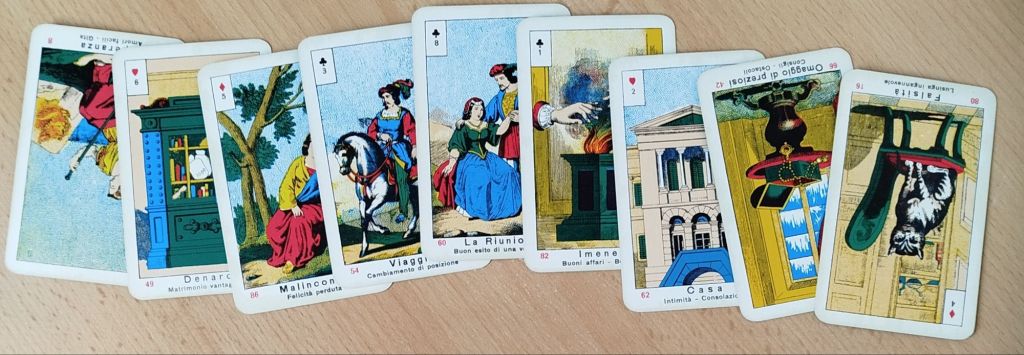
I started with three cards and then kept adding. The first three cards are Hope reversed, Money and Melancholy. It is true that the Six of Hearts, Money, generally has to do, well… With money. However, it is also the card of the past. The Five of Diamonds, Melancholy, also broadly describes the past, especially when occurring this early in the spread. However, it describes the past in a more negative light, as having somehow scarred us and left us dissatisfied or wounded.

Two cards talking about the past reinforce the idea of past. What has wounded the querent in the past? A reversal of his hopes (Eight of Hearts reversed) concerning his career!

Then we find the Three of Clubs, the Journey. The Journey can be literally about travelling, but it can also herald a transition from one phase to another. The Melancholy card itself, when not followed by evil cards, shows that the melancholy won’t last forever, but is just a phase. Once again: two cards talking about a transitory phase reinforce the idea of transitory phase!

What does the Journey bring? A meeting concerning a business or firm! The Ace of Clubs, Marriage, with the Two of Hearts, the House, can represent a relationship where we live together with the partner, but also a business or firm. Since we are talking about career, it must be the latter.

Finally, two reversed cards seal the spread in a positive way. Reversed cards have a bad reputation, but in this case they are life-savers: the reversed Gift card shows solution of problems, the reversed Falsehood card shows relief and supports the idea of a positive solution.

MQS

“Christening” The Significator – In Folk Cartomancy and “High” Divination

There is a tradition in Italian cartomancy (and possibly in other forms of folk cartomancy as well) that concerns the so-called christening of the querent’s significator. This is possibly done in order to have the divination be more certainly about the querent who comes for a reading.

Some systems, like my system for reading playing cards, have a fixed significator for the querent (the Queen or King of Clubs),1 while others (like the Vera Sibilla) do not. Either way, once the significator is known, a small magical operation takes place to connect the cards to the querent. This is what is called ‘battesimo’ or baptism/christening of the card.

There are many traditional ways of doing so. One is called ‘getting the card drunk‘ and it consists in taking the card that represents the querent and rotating it seven times (some say three times) while repeating the querent’s name each time. Another one I’ve seen used looks more similar to an actual christening, and it consists in again taking the querent’s significator and drawing a small cross symbol on the figure’s head with one’s thumb while saying “You are *name of the querent*”. There may be other systems I’m not aware of.

The practice of using a significator has largely fallen out of favor in modern tarot practice, mostly because reality has fallen out of favor with too many tarot readers, who no longer aim at describing it. This is not to say that a good tarot reader necessarily uses significators (I know some who are really good and don’t use them), but significators are a reminder that the tarot pack is a microcosm of reality, and reality contains actual people. Interestingly, many people recently became aware of the concept of significators because of traditional fortune-telling is experiencing a small resurgence.

However, it is noteworthy that the Golden Dawn and its offshoots and representatives, who greatly influenced modern tarot, did use significators. For instance, Waite recommended to select a significator even for the Celtic Cross in his Pictorial Key to the Tarot. The traditional Golden Dawn spread, The Opening of the Key, hinges on selecting a significator and counting and pairing the cards from it.

The Opening of the Key instruction recommends a brief ritual that serves to make the divination valid. This is not exactly the same as the christening I talked about, because it usually involves targeting the whole pack rather than just a card. However, I have seen GD diviners who take some time to connect the significator to the querent.

This is especially interesting to me because it shows a correspondence between folk magic and high magic (which is a distinction I don’t believe in, since ‘high’ magic is usually high only in the sense that it is practiced by people who are often high, and not just on their own farts). In part, this is because the GD, in his attempt at preserving and consolidating the whole Western tradition, often took folk traditions very seriously. In part, however, I believe that there must necessarily be such a correspondence, in as much as many streams often come from a single original spring.

MQS

  1. Same goes for the Bologna Tarot, where the Queen and King of Wands are the significators ↩︎

Understanding the Order of the Cards

One thing that I often receive messages about is how to understand the order in which the cards fall. Whether it’s the Vera Sibilla or playing card, there is one fundamental rule that applies in the majority of cases: later cards modify those that fall before.

Keep in mind that divination with cards is like the reading of a book, so the cards build the equivalent of sentences with their own grammatical structure. This is why I prefer to read the cards together rather than in isolation, as would happen in many contemporary positional spreads, where to each position corresponds one card.

In the tradition I come from, there can be positions, but there are always at least three cards, and sometimes five, covering one position. When we have two or more cards together, it becomes possible to “agglutinate” their meanings.

“Boy” and “run” becomes “the boy is running.” “Boy” and “friend” becomes “the boy is with a friend” or “the boy is a friend.” “Boy” and “Australian” becomes “the boy is Australian.”

Similarly, if we put two playing cards together such as the Three of Clubs (Union, marriage) and the Ten of Hearts (Happiness) they say: the marriage is happy. In the Sibilla, if we put the Ace of Club (Marriage) and the Four of Hearts (Love) together, it becomes “a loving marriage” or “a marriage of love.”

These are the first steps only. There are many more nunaces. However, the basic thing we must ask ourselves when interpreting two or more cards together is whether they add to each other or they contradict each other.

When they add to each other, the sequence in which they fall doesn’t matter that much (though it may add shades of meaning). “A beautiful girl” is roughly the same as “A girl who is beautiful.” But if we have “War” and “Peace”, saying “Peace and then war” is very different from saying “War and then peace”.

In the Sibilla, Fortune + Death is the end of fortune (literally, “the fortune meets its end”), whereas Death + Fortune is an end that brings fortune. Generally speaking, the cards falling after have the power to modify those that fall before.

That being said, divination is an art more than a science: we should never apply our rules so rigidly that we stop thinking about what the cards are saying. In most cases, in the Sibilla, Thief + Marriage has a similar meaning as Marriage + Thief: someone or something is interfering with the marriage.

Ultimately, each spread is a world in itself and the specific key to it must be found by following the clues that the cards leave behind.

MQS

Handling Bad News

No matter what kind of divination we practice: if it’s worth its salt and is not just some feelgood angel therapy oracle, it has the potential to deliver bad news. How we handle bad news is a mark of how helpful we are capable of being as diviners.

People can come to us for a variety of reason. They may need reassurance, hope, advice or just a quick look ahead. They may even come to us for fun or curiosity, and as long as they are not disrespectful, there is nothing wrong in indulging them.

The principle of respect for our querent stems from seeing them as a whole person rather than a sack of meat endowed with more than its fair share of doubts. We, as diviners and as handlers of odd devices (decks, charts, counters of various kinds) hold a degree of power over them. It is symbolic power, for sure, but reality itself is symbolic (that’s how magic works), therefore symbolic power is real power, and must not be misused.

Finding the right balance between informing the querent and respecting them can be difficult. It’s all well and good as long as the cards talk about pleasant trips and job interviews. But occasionally we recognize messages that we know are going to deeply upset our querent.

Causing unnecessary anguish is a no-no, and there are things that cannot be said without causing unnecessary anguish (“You’ll die soon”, “You’ll lose the baby). Even less serious topics (at least, less serious than death), such as marital infidelity must be treated with caution. We cannot just destroy whole families willy-nilly simply because our cards seem to hint at untoward dealings.

We must also distinguish whether a querent directly asks for something or something unpleasant simply shows up in the cards. Usually, if the querent asks for something, we can be more forthcoming, if we can speak with tact. If they ask “Will I get the job?”, they need to be able to accept “I’m not infallible, but it seems they appear more inclined to go with someone else.”

If they ask “Is my spouse faithful?” and the cards show clear signs of interference, an answer like “Remember that I could be wrong, but there does seem to be someone who’s trying whisk them away from you. Maybe it’s time to have an honest talk and try to solve the issue.”

Incredibly enough, even some taboo topics may occasionally be addressed in this guise. For instance, there are plenty of non-morbid reasons querents might want to know about death: “Do you think my elderly father going to survive long? I want to be able to visit him one last time but the situation at home is just crazy.”

While we must not delude the querent, we have no right to rob them of all hope. Aside from the mantra “Remember I’m a fallible human being”, and even aside from potential advice we might sometime give the querent to soften the blows of bad luck, there are occasionally ways of preparing the querent for a difficult situation without hurting them.

“Is the pregnancy going to go alright?” This is a question I am become more and more skeptical of answering as time goes by, because there is no way of saying anything other than “yes” and still be able to look at myself in the mirror. If we do find ourselves somehow coerced into answering it and the cards are less than positive, the only thing we may say is something to the effect of “Yes, but remember to take it easy, and the cards are saying you should pay extra attention to the doctor’s orders.”

Where all else fails, human empathy is our last line of defense. Helping the querent even for just some minutes by sharing their burden is part of what we may have to sign up for when we choose the path of divination.

MQS

Which Card Prevails?

I’m taking inspiration from a question I got asked recently to talk about an important topic in cartomancy. Sometimes (in fact, many times) the cards appear contradictory, with positive and negative cards mixed together. The question I was asked is, which cards prevail in the reading.

Before starting the interpretation, it is usually a good thing to get a general look at the cards to see the ‘tone’. Are they mostly positive? Are there places in the spread that seem difficult? Are there cards that answer the question directly? You don’t need to come up with the interpretation right away, but it’s good to be aware.

However, this general bird-eye view is not enough. Usually, in cartomancy, we read the cards from left to right as if they were a sentence, stringing the meanings together. Therefore, as a general rule, 5♥️ – 4♠️ is worse than 4♠️ – 5♥️. In the former case, the abundance is broken or blocked, while in the latter case the brokenness and blockage are overcome.

In this sense, it is important to pay attention to whether the negative points in the spread come at the beginning, in the middle or at the end, because. Even if there’s two negative cards out of five, if they come up at the end they can obstruct success. If they come at the beginning, it may be a passing problem.

Again, though, let us avoid purely mechanical rules. Suppose a five-card spread is all positive and shows the querent getting what he wants, and then at the end there is one negative card. This card may show not failure, but that the fulfillment of the wish comes with problems. In these cases it is always good to either add cards or do another spread.

Similarly, the cards are entirely negative and show failure, a single positive card at the end doesn’t necessarily show that the querent will get his way. It could be showing that there will be new opportunities. Again, additional cards or a new spread may be warranted.

When we ask a question and a card directly connected to it comes up in the spread, it is always important to look at the cards surrounding it, especially if they are of the same suit, and even more important are the cards following it, because they will show us what will happen to the significator of the question.

For instance, if the question is about a pregnancy, the 5♥️ followed by positive cards is encouraging. If the question is about work, the 8♣️ surrounded by Spades could show serious problems or even unemployment. In a marriage question, the 3♣️ surrounded by Hearts shows a loving union.

These are rules of thumb. Every spread is unique and must be judged on its own merits and in its own structure.

MQS

“Will I Ever Be Happy?” Or, How to Torture Yourself With the Cards

I’ve already written a couple of articles on unanswerable questions. Some of them are unanswerable for logical reasons, others because they ask about something on which no objective standard of measurement exists. Some are also unanswerable for ethical reasons (“Tell me when is the best time to rob the bank.”)

But occasionally someone comes along who asks a question that we instinctively feel is unanswerable, yet we can’t put our finger on why. It’s happened a couple of times to me that someone would ask me something to the effect of “Will I ever be happy?

Obviously no one whose life is coming up roses would seek out a diviner of all people to ask such a question. These queries are put to the cards or the skies in a moment of weakness. My experience in these situations is that the cards behave in one of three ways. They:

  1. Show the cause of the person’s unhappiness rather objectively, and whether the problem is likely to be overcome over the next few months (usually not)
  2. Are generically very negative, without a specific sense to them
  3. Are generically very positive, without a specific sense to them

In the first instance, the cards usually show the problem not getting resolved, not necessarily because it never will be, but because the person is still knee-deep in it. The fact that they chose to frame their question in such tragic terms tells us that, whatever the nature of their problem, it goes beyond its specific objective nature and it has wounded the person in their soul.

Extreme care is advised in dealing with people in such a state of difficulty. They come to us broken and they should, at the very least, not leave even more broken. Furthermore, it is not unlikely that they have started consulting many diviners, obsessively asking the same question in hopes of getting a magical solution to their issue dropped in their lap. It would be good to advise them to stay away from divination for a while, unless we are capable of pointing out a solution they haven’t thought about, which unfortunately is rare.

When the cards are generically positive or generically negative, they are merely reflecting the person’s state of confusion: the bleakness of their outlook or the irrational hope for unexpected redemption. I don’t think there is much that we can do in such situations, except telling them that their upset shows in the cards and that, life being a succession of phases, even this one will pass. Sometimes, in such situations, talking to them in our quality of human beings is better than talking to them in our quality of diviners. In extreme cases, having a hotline number handy may be helpful.

Really there isn’t much sense in asking this question except to torture ourselves. We as diviners should know this when asking our own questions, but many people don’t, so it’s best to be prepared.

MQS

Vera Sibilla Cards That Become Better When Reversed

In some card-based divination systems, reversals carry a negative connotation. Reversed cards are said to either decrease the influence or deteriorate the positive aspects of the card. The Vera Sibilla does not adhere to this view. Reversed cards have peculiar meanings which may sometimes be even unrelated to the upright counterpart, at least at first (in reality, if you think about it, you will almost always find the correlation).

Consequently, some Sibilla cards are actually better when reversed than when they are upright, at least generally speaking. Sometimes this better connotation is general, while at other times it refers to specific topics. Here are some examples.

Ace of Clubs – Marriage
The Ace of Clubs reversed is not automatically better than when upright, and on occasion it may even be worse. However, it carries a connotation of materiality that can be very welcome in readings about wealth or about physical relations (as opposed to legal/spiritual relations when the card is upright.)

Three of Clubs – The Journey
The Journey card in the Vera Sibilla usually refers to physical movement, though it can sometimes represent a change of heart or a change of pace. When it falls reversed in a reading, it can indicate trouble when journeying, but its broader meaning is that of positive evolution of a situation. The card is powerfully benefic and it can free us from vicious cycles and other sticky situations.

Four of Clubs – The Friend
When upright, the Friend card can refer to a literal (female) friend or to the idea of friendship and support in general. When it is reversed, it indicates help, recommendations, being taken care of. Usually, the help represented by the reversed card is more on the material side, or it can show in the form of a professional’s advice.

Ten of Clubs – Levity
The Butterfly is a problematic card in the deck, as it shows lack of focus, fleeting situations. Reversed, it can represent a serious effort, the ability to hold on to your money and, more broadly, to fleeting situations that bring positive chances. If I were to liken this reversed card to a geomantic figure, I would choose Fortuna Minor.

Three of Diamonds – The Gift
The Gift card is generally positive when upright. When it is reversed, however, it does not diminish, but rather increases its positive significance. It indicates the solution of problems, especially material problems. When it is upright, the gift usually comes from someone, whereas the reversed Gift card shows the gift coming to us from the situation itself, which becomes more positive or less complicated.

Four of Diamonds – Falsehood
The upright Falsehood card is rarely neutral and almost never positive. When it is reversed, however, it shows the positive unmasking of lying, the discovering (usually in time) of hidden factors that could have caused harm and, in general, it shows situations that end with a sigh of relief.

Ace of Spades – Sorrow
The Ace of Spades is a very difficult card to receive in one’s reading. When it is reversed, the blow is softened. The sorrow of the title is still there, but it is dimeanished diminished and can be overcome. It is also a symbol of toil and focused struggle or work as opposed with just crying with your head in your hands.

Four of Spades – Sickness
When it comes up reversed, the Four of Spades has a variety of meanings, some of which negative, though less legative than when the card is upright. However, when it is followed by positive cards, it can represent the end of a stagnant and blocked situation.

Six of Spades – Sighs
My experience has shown that the reversed Six of Spades is one of the most complex cards in the deck. Although it can have negative meanings (see here an example), broadly speaking it indicates the end of sighs. It shows moving on, overcoming torment, accepting what you cannot change, etc.

Nine of Spades – Prison
Like the Four of Spades, the Nine of Spades reversed can have a variety of meanings. However, in and by itself, this card represents the end of imprisonment, freedom and having paid your dues/done your time, literally or figuratively.

MQS

A Long Long Time (Reading Example)

Sometimes in readings it’s not immediately clear whether the cards start by describing the past, present or future. There are times when they jump immediately into the future, while at other times they only talk about past and present situations and we need to keep adding cards to find out what happens next. More often, though, the cards start with the past/present and then move on to the prediction, or at least this is my experience.

In this case I was asked by a querent if she would find a job. Note that I started with five cards and then added more to get more details, but I here want to concentrate on the first five:

Job Prospects. A Vera Sibilla Reading

The first four cards (Widower, Perseverance, Fortune and Death) deserve special attention. The Widower is the card of “being without”. It also has some affinity with the past, especially when it falls toward the beginning of the spread. The Perseverance card can sometimes indicate that something goes on for a long time (it perseveres). Usually this happens when the cards surrounding it have the same polarity or talk about the same thing.

In this case, the Fortune card is not the same polarity as the Widower, since the former is positive and the latter negative. However, Fortune is followed by Death, showing misfortune or lost chances. In this case, it’s as if Fortune + Death formed a single (negative) card, which is of the same polarity as the Widower.

Therefore the Perseverance card highlights the fact that the querent is without (work) and has been for quite a while, and has repeatedly lost chances or opportunities, or has had repeated misfortunes connected to her career. She confirmed to me that she hadn’t found a job since giving birth to her daughter a few years ago. Actually, she hadn’t looked that much for a job, but whenever she had she had been passed over in favor of someone else.

The Child card is a card of beginning, and in a way it shows the start of a new phase. This fact is highlighted by the Death card being at the end of a negative sequence, so that while it is a negative card in itself (because it follows the Fortune card) it also ends the negative period thanks to being followed by the Child.

The cards following the first five simply described the work environment and the various ups and downs she will face, but they are less interesting.

MQS