Category Archives: Vera Sibilla


Filling In The Blanks In Divination
If I were to start talking to you using just nouns, verbs and a small number of adjectives, your understanding of what I say would probably decrease, but not massively. The reason for this is that the lacking connecting words would probably be supplied by your mind. The context of what I say, furthermore, would allow you to pick mostly the right words based on your past experience, so while there would be a few problems here and there, you’d mostly be able to follow along.
In divination, we often find ourselves with blanks fill in between nouns, adjectives and verbs, which are generally represented by whatever the basic units of meaning are (cards in cartomancy, geomantic figures in geomancy, etc.) And while divination IS a language, the difference is that we have necessarily less experience with it than with natural languages, and that its vocabulary is necessarily more ambiguous.
Taking playing cards as an example, we essentially have only 52 words to play with, with the result that those 52 words must necessarily carry more possible shades of meanings than regular words in complex natural languages. These shades of meaning are generally given by the extended applications of the card’s main significations and other metaphorical takes on them.
The potential for errors, therefore, increases significantly, and that’s even before we take into account the fact that the connecting words are usually missing, and need to be supplied by our own interpretation. Finally, another factor is that the sentences of divination have much less context.
I often get questions by people who have been trying to get into divination but never seem to get a straight sentence out of their oracles. To be honest, it is an art, and like all arts it requires a ‘feel’ that can only be developed by banging your head against the obstalce long enough. However, another problem I often notice is that people tend to have excessive expectations of the type of answers they can get out of the oracle, especially at the beginning.
My philosophy is that I need to be only as specific as my current understanding and experience allows me to be. When you have a spread in front of you, don’t think you need to read a passage from Dostoevsky from it. Think more like having to make sense of the ramblings of a toddler. “Uhhh, something to do with three brothers and a question of faith” is good enough. In fact, it is much better to remain a bit vaguer than filling in the blanks the wrong way, which could potentially mislead the querent, especially since it is way to easy to let fantasy take over and take the interpretation in the wrong direction, and divination is NOT fantasy.
Skeptics might argue that this is way of trying to be right at all costs. It isn’t. It is, in fact, a perfectly philological method. I once did a reading for someone where I remember telling her something to the effect of “the cards seem to highlight something in the past connected with a person you were involved with and money issues with legal ramifications”. It turned out her ex had wasted most of their money in secret, and run away with the rest, triggering a divorce and other legal troubles. I could have filled in the blanks more thoroughly, but, at least based on my understanding at the time, I would have had to shoot in the dark.
The point is: do not feel you have to fill in all the blanks at all costs. You will always be able to be as specific as you need to be. Everything else is vanity.
MQS


Was That On Purpose? (Example Reading)
This one’s a quickie. A friend of mine who tends to take things way more seriously than she should asked if the boyfriend had really misplaced the small gift they had bought for her mother or if he had hidden it out of spite (he doesn’t like her mother). Knowing the dude I was quite sure she was overreacting. Still we asked the Sibilla:
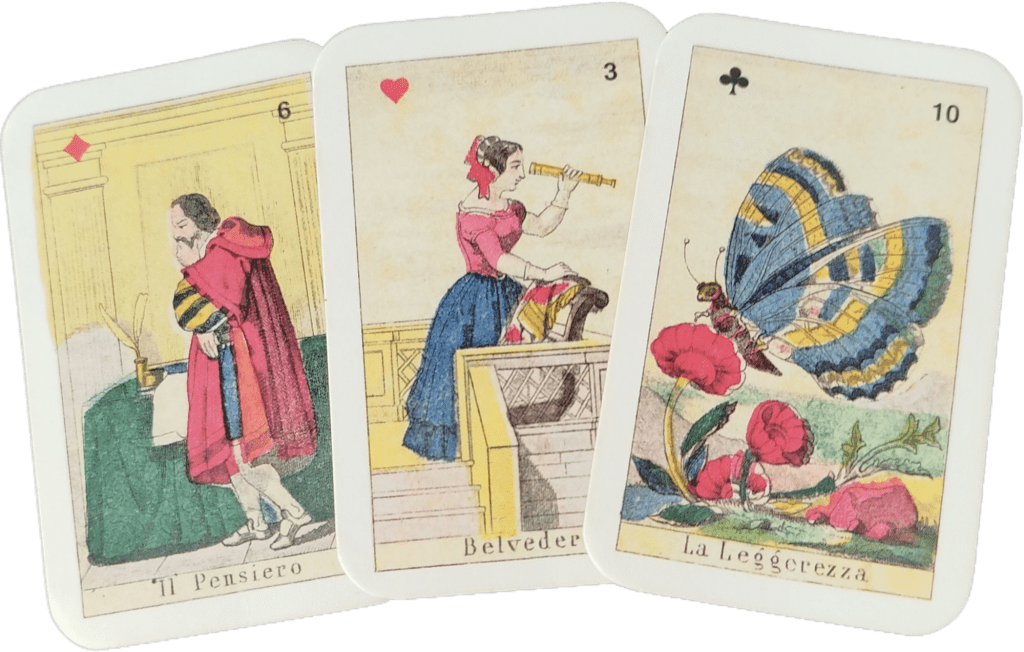
The Thought card is indicative of someone’s inner reality (their thoughts, plans, character, proclivities, etc). Since we asked about the boyfriend’s intention, the thought is his. The Belvedere card is usually associated with the arrival of something. However, it is also the card of sight. Next to the Ten of Clubs, which is a card of carefreeness, this seems to point to an oversight.
It turned out the gift had been left in the car, where it had lodged itself between the the two front seats. As silly as the reason for the reading is, it’s nice to have the cards confirm our suspicion.
MQS
How to Work With Wrong Readings
I had a nice exchange with a visitor, who asked how we can work with the readings we get wrong, so that we can improve our skill.
The first thing to take into account is that this is not always possible. We may say that we are accurate because 80-90% of our assertions end up being true, but that is calculated on those assertions for which we get feedback, and we don’t always get feedback.
Here, too, there is a lesson, I think: all we can do is be as good as we can be at the particular moment in which the reading takes place. If we think an interpretation is viable, there is no point in withholding it out of fear that we might get it wrong (unless the topic is sensitive and we choose to stretch the truth to avoid hurting the querent) because we might not get another chance to say it.
What happens after the reading is that some querents simply forget about it. Too many querents think that a reading needs to come true within a couple of weeks, when in fact it often takes months, so after the initial excitement (or dread) they simply move on, and they may only be reminded of it when it comes to pass, if at all.
Other readings are correct, but the querent thinks that’s just regular business, so they don’t bother to tell us, while other readings are wrong, and the querent either rubs that in our face as publicly as possible or they don’t talk about that anymore, thinking we are beneath them.
Then there’s the readings for which we do have feedback, which can be very positive (“everything was spot on, and you’re also kinda cute”), very negative (“it ended up being the exact opposite of what you said”), or mixed (“this and that came to pass, but this other thing not yet”).
Even the feedback we get needs to be taken with a grain of salt. Positive feedback can sometimes be a mix of wishful thinking and the desire to please, while negative feedback can sometimes be a mix of delusion (you said he wouldn’t call and he didn’t, but I know he loves me, so you’re wrong) and desire to hurt.
So, what do we do with the feedback we are given, if it is negative? The reasonable thing to do, in my opinion, is to check the spread (I usually take pictures and/or notes) and see where we might have screwed up.
Was there a point in the spread where the cards were a bit ambiguous and we forced the reading in the wrong direction? Was there a huge, smacking-your-forehead blunder? You simply cannot see what went wrong? Take notes on the reading. If you don’t think you can formulate a definitive theory on what went south, don’t. Leave things hanging. Add ‘maybe’ and ‘possibly’, and see if there are other readings you did on similar issues that can help you.
Even when going back to an older spread, we should never force it to say what the feedback said, if we just don’t see it: firstly, because, as I said, even feedback that exists must be treated with caution; secondly, because there is a tendency to want to read details into the reading that we would never have been able to guess beforehand, and that’s not divination.
Broadly speaking, the feedback we get, positive, negative or mixed, should be treated as raw data that needs to be studied carefully. That’s where a lot of growth can take place. Be especially thankful for mixed feedback, as usually it is the most honest kind: we rarely get 100% of the things right, either in our description of the past/present or in our predictions. As fallible humans, getting many things right many times should be enough to satisfy us, especially since we are doing something most people consider impossible.
MQS

The Home – A Deep Dive Into Cartomancy
Following my deep dive into the symbols of the door knockers and the road in divination by cards, I want to tackle the symbol of the home. This, too, like the road, is a widespread symbol that is almost never absent from any divination system of a practical nature (I am aware of systems for playing card divination based on Rider Waite symbolism, but they have very little practical use).
The popularity of the symbol of the home is simply a consequence of its importance in people’s lives. The home or house card is, in most systems, a ‘topic’ or significator card indicating the querent’s or someone else’s house, and the cards surrounding it show us the atmosphere or happenings of the household. Its practical value, therefore, is immense.
In the earliest recorded system for reading the tarot, which is Pratesi’s guide for the Bolognese tarot, the house card is the Ace of Cups. This meaning is retained in the more modern variants of the method. This is also an almost universal constant in cartomancy, since the Ace of Cups or Hearts is almost always taken as a symbol of the home.
Whether this association originates with the Bolognese tarot I don’t know. It is possible that the symbolism is simply suggested by the shape of the Ace of Cups. In the Visconti tarot, the Ace of Cups is a water spring similar to a baptismal font, but in many old decks it can look similar to a walled structure. If we add to this the fact that the function of the cup is to contain, it may be that this could have suggested the idea of the house to old cartomancers, since a house is a large (the ace is large) containment structure.
Similarly, in almost all card reading systems using Italian regional cards, the Ace of Cups is the home, although I am aware of a couple where the meaning is attributed to the Four of Cups, possibly due to the squarish form suggested by the arrangement of the pips. The Ace of Cups is also the house card in the Sibilla regionale, which is the second-most widespread sibilla deck in Italy.
Why the same idea of home as the Ace was suggested by people using regular playing card suits is unclear, since the Ace of Hearts does not look like anything but a heart. Still, if the system I was taught is anything to go by, the main idea is that hearts deal with one’s emotional life and nourishment, and the home is the origin and source (ace) of our emotional life, the place where our first (ace) needs are met. As a matter of fact, the person who taught me cartomancy with playing cards often insisted that the Ace of Hearts is not just any house (though it can be, in practice) but especially one’s home, where we come from (the ‘spring’ we come from, in the Visconti sense), which is why an extended meaning of the house card is often one’s family.
The same attribution of the Ace of Hearts to the home is found in most systems I am aware of, including German cartomancy and most English and French methods. As far as tarot is concerned, we find that, in some earlier tarot documents, the Tower is simply called ‘casa’ (house), before being called House of God or House of the Devil in some other decks (the title ‘Tower’ is actually a rather late innovation).
Etteilla assigned the house to the Ten of Coins, which Waite retains in his illustration of the Ten of Pentacles, while Paul Case generally matched the house with the Two of Cups, among other things. However, this was more of an accidental consequence of the Golden Dawn attribution of the first cards of the suit of Cups to the zodiac sign of Cancer and, according to the sign/house equivalence theory, to the fourth house, which is the house of the father and therefore of one’s fathers and one’s family/house.
The Sibilla is a partial exception to the rule of the ace as the home, as the House card is given to the Two of Hearts. The meaning of origin (which metaphorically, depending on the reading, can also indicate the origin of a problem) is retained. Still, the Ace of Hearts is also given to the family and to people living together, among other meanings.
The Sibilla, like the Kipper cards, distinguishes between a House card and a Room card. This is probably because both decks seem to have been consolidated from earlier German or Austrian decks which also had similar cards, although the makers of the Sibilla also took playing cards into consideration.
I cannot speak to the Kipper cards (nor to Lenormand, where there is a House card, attributed to the King of Hearts), but in the Sibilla, the Room can represent a small(er) apartment, as well as a place in general, but it doesn’t usually have a connection with the emotional side of life, like the House, although it can represent intimacy, since it is connected with rooms in general, but with the bedroom specifically.
MQS

Fixed Significators and Modern Issues
Some decks have variable significators, while others assign certain cards to always represent the querent and their partner. This can cause confusion when reading for people who would not have lived their life out in the open back when cartomancy emerged, such as gay or trans people. Following are some experimental notes on how to deal with such instances in the various decks I use.
I want to stress that these are based on my practical experience, not on that of someone else and not on some theory I am trying force onto the cards. My aim is to improve my accuracy as a diviner, not to pontificate on academic eventualities.
Vera Sibilla
The Sibilla doesn’t have fixed significators, meaning that the querent will, if at all, be represented by a court card that indicates their role in the situation and/or society at the moment of the reading, always compatibly with their sex.1
And this is already problematic nowadays. I haven’t read for too many trans people, but I have noticed that if the person has either transitioned, fully or in part, or has at least adapted considerably to the other sex, then they are represented by a court card of that sex (ftm as a male, mtf as a female).
To be blunt: Jane, cashier, who has been living as Jane despite being born as Jim, and lives out her concrete life as Jane, is described as a woman in the cards, although the cards may hint at the transition, if relevant in the context; Jim, cashier, who would like to become Jane and maybe one day will, is represented as a man, even if he’s started to play with makeup since watching Myra Breckinridge; Becky, professional TikTok cheese grater, special traits no personality, who thinks an androgynous look makes her stand out, still comes up as a woman even if she pretends to identify as a man on every day with an R in it.
This has nothing to do with politics or tolerance or “passing as the other sex” and everything to do with concrete life: divination mirrors life, but social media clout simply doesn’t transfer to the cards, and there’s nothing I can do about it, even if it may offend some. The good news is that indentification with a significator is just a divinatory device and lasts only for the fifteen minutes needed to conduct a reading, and then is over.
IMPORTANT: we are talking about trans people, not crossdressers. A crossdressing man is a man who cosplays as a woman for whatever reason, but remains a man and lives as a man, at least until that fake business trip to Atlanta that his wife knows nothing about.
Talking about gay people, the Sibilla is very straightforward. In the few readings I do for myself, I usually come up as the Boyfriend, my husband as the Gentleman, and some years ago I came up as the Helper and my husband as the Boyfriend.
As for “but what about…” particular cases about any of the identities that are created daily, the best I can offer is: I’ll cross that bridge when I get to it. I trust the cards to simply describe the situation as it is and I accept the risk of not being able to understand how complex it may be, either in reality or in someone’s perception.
Playing cards and Bolognese Tarot
In some systems of cartomancy with playing cards, significators are not fixed. The way I was taught, though, the male querent is the King of Clubs and the female querent the Queen of Clubs, and the other card is the person they love. Similarly, in the Bolognese tarot the male querent is the King of Wands and the female querent the Queen of Wands.
For trans people, I think what I said about the Sibilla still holds true. Again, all I can say is to keep your mind and your eyes open (on the cards, I mean. Looking if the querent has an adam’s apple doesn’t count.)
For gay people, I have generally found that a degree of flexibility is required on the diviner’s part. Some readers seem to believe that you can just dictate to the cards how to behave, including in the case of gay querents. If that works, then bully for you, but I have always found the cards to have a mind of their own, regardless of the conventions we try to establish for them, so all I can do is be flexible.
Some people think the querent is represented by the court card of their gender, the partner by the other main significator, regardless of their sex. This theory is predicated on the fact that the two main significators are meant to show those people, and the fact that they are of two different genders is accidental or a matter of historical bias.
This may sound convincing, but have I found it to be true in practice? Sometimes. Sometimes the partner will come up as the other Club/Wand figure and there is simply no way of interpreting it other than as the partner, even if the stuff under the dress doesn’t match. Sometimes the cards will represent the partner as a court card of another suit that matches them. Sometimes the cards will throw in both cards for good measure: hubby has come up as the Queen of Clubs + King of Hearts together on more than one occasion in the past. Talk about a big personality.
Tarot
This is like the Sibilla, and doesn’t require much discussion. The male querent is usually the Emperor or the Pope, the female querent is usually the Empress or the Popess. Two men in a relationship can be shown as Emperor and Pope.
MQS
- I am aware of the difference between the word ‘sex’ and the word ‘gender’, but I am going to use them quasi-interchangeably to avoid too many repetitions that hurt the ear. ↩︎
Vera Sibilla: Explanation of the Threes
MQS

A Quirk of the Thirteen-Card Spread
The last thirteen-card spread I posted was interesting for a couple of reasons. One reason I already talked about: the need to be flexible with significators.
Another reason is that it showcases what I suspect to be an interesting quirk of the thirteen-card spread. This is a purely experimental anecdote, so take it with a pinch of salt, but I have found it to be true on more than one occasion.
The quirk is that, in the thirteen-card spread (which I discussed here), the rows seem to be connected not just one after the other, but also alternately, i.e., the first row with the third row and the second row with the fourth row.
I cannot stress this enough: this is NOT a rule, it is simply something I have found to be true on occasion. There are situations where the thirteen-card spread is perfectly smooth from start to finish, reading like a little story with a beginning, a middle and an end. In this sort of situation we don’t need to pair up the rows 1-3 and 2-4.
However, sometimes we can recognize snippets of story mixed together in an odd way. I have found that pairing odd rows together and then even rows together can help sort these snippets out, giving them a more logical order.
In the example of the spread I posted, the second and fourth rows seemed to talk more about material issues, whereas the first and third were more centered on the person’s emotional life. Pairing them odd-with-odd and even-with-even, the spread became more clear.
If the spread is talking about more than one issue at once (which can happen), then this kind of pairing often makes sense. However, sometimes it makes sense even if there is only one topic in play, and this particular case the rows that we pair up talk about subtopics within the same topic.
It may be that this technique simply stems from my limitations as a reader, so that I find ways to circumvent difficulties in the interpretation of the spread. Still, I found this to be accurate enough to bring up, in case anyone wants to experiment with it.
Finally, it may simply be that we need to be very flexible with the rows, and take for granted that they may pair up in unlikely ways. Who knows, maybe I’ll find that the first and fourth row really go well together in some readings. The point is always that the techniques we apply need to shed light on the querent’s life, not simply add flourishes and complications to the interpretation.
MQS

Three Decks For One Inheritance (Example Reading)
We did a little experiment with a friend. She wanted to know if the bureaucratic process to get the inheritance from the recently deceased grandfather would finally come to an end, since there had been several delays (leave it to the Italian bureaucracy). We started with the Sibilla.
Sibilla
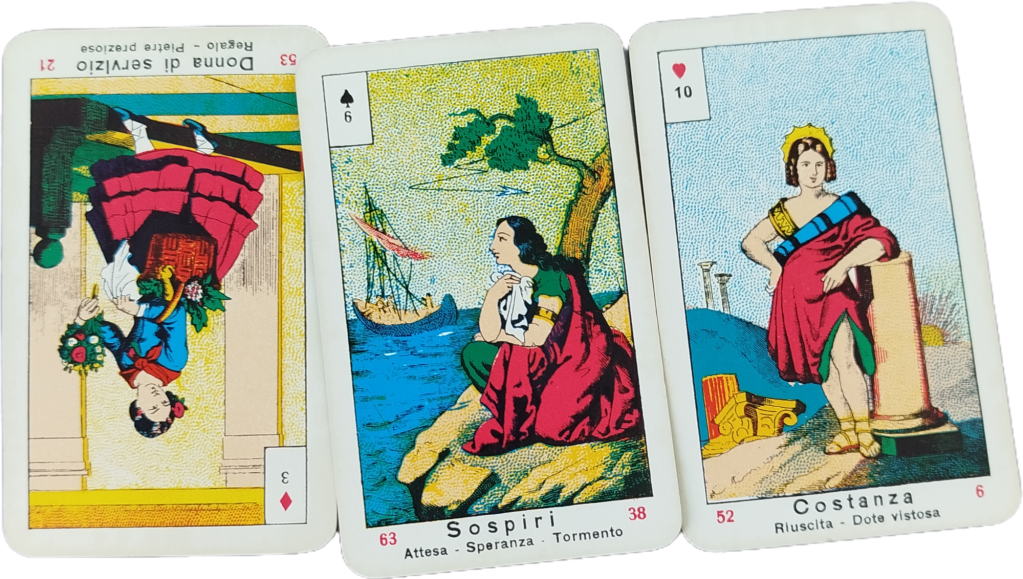
In this case, the Handmaid reversed indicates money going out (of the querent’s wallet). The Sighs card simply indicates that the person worries they’ll have to pay money. The Ten of Hearts here is not a positive influence, because it is a card that makes the uncertain certain (in the context of a trial, for instance, it might indicate the sentence being decided). So in this case the worries shown by the Sighs are confirmed.
I asked my friend if she was worried about having to pay some extra money, and she said that this was her and her dad’s worry, but that they had looked into inheritance law and thought they were safe and wouldn’t need to pay . Clearly the Sibilla begs to differ.
Playing cards
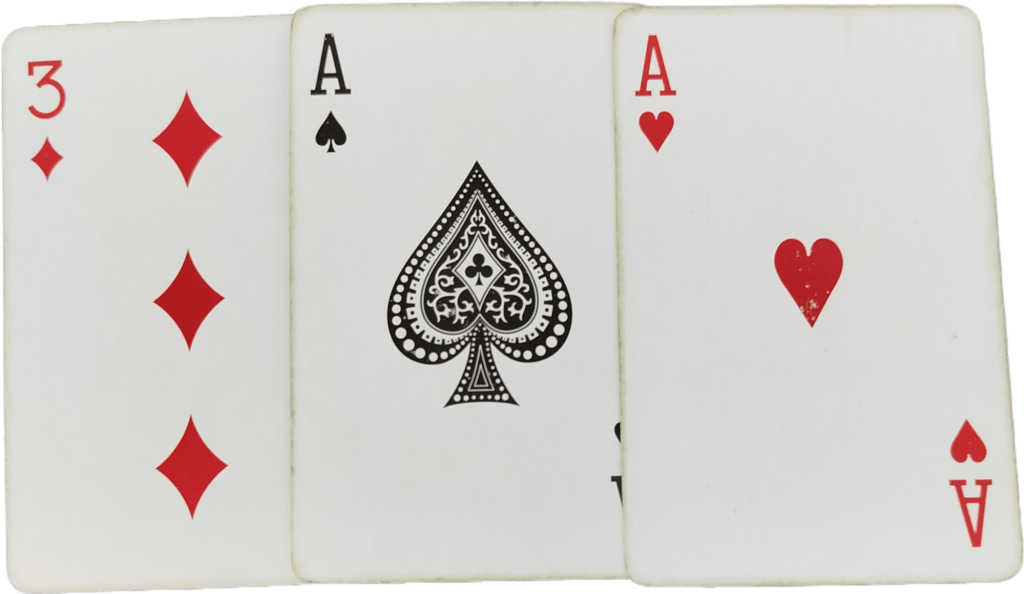
In this case we don’t have the querent’s state of mind (which the Sibilla talked about). However, we do have, once again, the loss of money, indicated by the Three of Diamonds being covered by the Ace of Spades. The Ace of Hearts shows us that the money going out is due to family issues, something which was absent from the Sibilla.
Skat cards
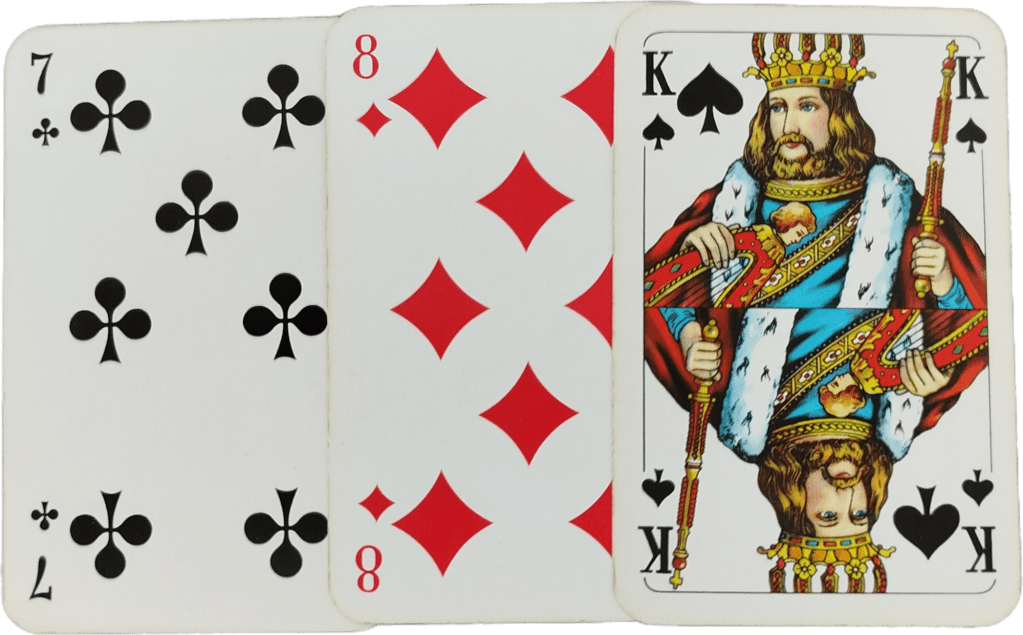
I decided to make an experiment with the Skat cards as well, just for kicks. The Eight of Diamonds is technically the card of work. However, if I understand the meanings correctly, it represents work because it shows the flow of money, money being exchanged. So it can represent, more broadly, the economy. With the Seven of Clubs, which indicates tears, the economy will take a hit. The King of Spades might be the office worker who will give the querent the news.
A week ago they received news that they needed to pay an extra 3000€ to unfreeze the granddad’s money. My friend doesn’t know if the office worker who worked on their case was a man (the King). Still I think the Skat cards were rather accurate.
MQS
How Long to Shuffle the Deck?
This may sound like a silly question, but it is one I get asked constantly in private. I think the reason is that, especially at the beginning, we are very unsure of how to go about the reading and we are afraid we may get it wrong on technical grounds even before the interpretation starts.
Unfortunately, there is no clear answer to this. I know of old-time diviners who shuffle the deck for a fixed (usually odd) number of times, like seven, nine or thirteen. I have never been able to get behind this way of doing things. It is, however, a traditional approach, so I thought it better to mention it.
I distinguish between when I’m reading for myself, or even for someone else, but who isn’t there; and when the person is with me, even just on the phone or on skype (I used to do skype readings for friends all the time when I was in college).
The second case is the easiest, so I’ll talk about it first: when I’m reading for someone and I am directly in contact with them, I simply ask them to think about the question and to give me a stop when they are ready. Meanwhile, I decide which spread to use, then I relax and I take on an attitude of calm focus, without strain.
The person may have me shuffle for two minutes, or they may tell me to stop after two shuffles. After the stop, if the person is physically there, I also let them cut the deck, otherwise I do it for them after knocking three times on its back (that’s my little ritual). As weird as it sounds, the cards always seem to fall into place very well regardless of how long it took to shuffle them.
I believe this is because, in a reading, there is more at play than just two eccentrics’ focus on a topic. We may like to concoct philosophies that give us ultimate power over external reality, but the fact remain that we live at the intersection of cosmic, personal and interpersonal currents, a number of which are beyond our control. Our focus may catalyze these forces, but they are more ingenious than our conscious awareness could be.
In the first case, i.e., when I’m reading for myself or for someone who isn’t there, I need to be especially at peace with myself. If I’m distracted, depressed, in a heightened mood or very sick, the reading won’t go well. Even when I am at peace, there is always a question mark at the end of my readings, like they are never as crisp as when I’m reading for someone else who is there with me.
So, how long do I shuffle in this case? The answer may be disheartening for some, but it’s: as long as I feel I need to. This is hard to explain, but one soon learns to recognize the feeling of a well-shuffled deck. Some may feel the deck becomes heavier, others seem to just get an undefined feeling.
For my part, I usually feel a sensation akin to being full after eating a hearty meal and being unable to take another bite, while at the same time the deck itself seems to oppose resistance to being shuffled as the cards lock into the right place. Your experience may vary.
MQS
