I’m pretty sure after today that the image for the Strength card was inspired by a dentist trying to yank a tooth out of a patient’s jaw. Anyway, it wasn’t the most pleasant half hour of my life, but there’s worse (for instance, having to live with tooth ache). Hopefully whatever wisdom I have managed to accrue in 34 years hasn’t snagged on the teeth and now I have to start from scratch!
I had a quick but interesting exchange of emails with a reader of this blog, and they asked me my perspective on the ethical side of prediction. One of the questions was if I share the belief that we shouldn’t answer questions that don’t directly relate to the querent and their actions, especially if they involve reading other people’s mind (e.g., “Is he thinking about his ex?”)
The Three Types of Diviners
First off we must recognize that, nowadays, there are many diviners who do not even think that prediction is possible. Then there’s those who think it’s possible but not desirable. And then there’s those who think it’s both possible and perfectly legitimate. If you know me, you can guess which camp I belong to.
The one thing almost all diviners of almost all strands can agree on is that divination should leave the querent with more information than before the reading took place. It is the nature of the information that is controversial. Many (most, perhaps) contemporary diviners believe the information should be of a mystical/ethical nature and should guide the querent’s action rather than foretelling future events or things the querent has no control over, such as other people’s thoughts beliefs, which is seen as prying. The idea is that to do otherwise is to disempower the querent by putting the center of power outside of them.
To which I say: We are not discrete atoms living each in its own self-made, self-referential reality, no matter what the manifesting girly-pops on Tiktok say. The center of power is not within us, at least not in the sense that most people think.1We exist enmeshed in an infinitely complex chain of actions and reactions, and our degree of control over them is objectively limited.
We seek to steer our life through the chaos of existence by levereging the information we have, including our knowledge of what (we think) other people’s beliefs and motivations are. In so far as divination gives us information and knowledge, it helps us increase the degree of control we have on our life (though this control can never be absolute). As such, it is perfectly legitimate to want to know what other people think.
The idea that we can only tell the querent what to do as a discrete, atomized individual is faulty for a variety of reasons. As said, the first reason is that we are not atoms. Only first world people with first world problems can seriously believe such postmodern crap (try to go to a starving child in a war zone and tell him he just needs to manifest harder). In reality, how other people think and act has very much to do with how the querent will or can behave, and so the querent’s expectation of being told such information is understandable.
The Two Should’s
The second important reason is that the idea itself that there is an objective cosmic measure of how we should act which the diviner must relay to the querent is silly. How people should act is between them and their god, and diviners are well advised to stay out of it instead of trying to play the role of ruler-wielding metaphysical pep-talkers (whenever you find someone who acts like this, run! Those who can live their life, do. Those who can’t, become life coaches.)
The word “should” has two different meanings: technical (“you should take the bus now if you want to get there on time”) and moral (“you should think about those less fortunate than you”). In the first sense, divination has some use, but only in the sense that the diviner, after assessing the situation as it emerges from the cards or chart, and taking what the querent hopes to achieve into consideration, gives them advice (I’ve talked about this here). In this sense, knowing what someone else thinks can be valuable (“he is not thinking about you and he won’t for the foreseeable future. Maybe you should start thinking about putting yourself back on the market”).
From a moral standpoint, divination’s use is very limited and it can become a dangerous tool of delusion or deceit. Example: “Should I have an abortion?” there is absolutely no way of answering that question. Some quick research online will show that there are all kinds of stances on abortion, ranging from believing it should never be had even if it means the woman will lose her life to believing it’s a moral duty of every woman to have one to stick it to the system, with a variety of more moderate solutions in between.
Since there is no consensus, such question essentially translates to “what is your stance on abortion?” Why you should regulate your life based on the personal moral beliefs of someone shuffling pretty cards on the internet is a question the answer to which is probably found somewhere in California.
“But isn’t divination a form of communion with the divine? Shouldn’t the divine know what’s right?”
Divination is most definitely a form of communion with the divine, but the idea that God has any kind of moral preference is, as far as I am concerned, questionable. People tend to patch their idea of God together from their moral and political prejudices. Somehow the God of the reactionary is always a hillbilly and the God of the revolutionary is always a hippy.
Divination lets us partake of a small share knowledge that one would usually get only if he were God, but this knowledge is very practical and is a tight condensation of that which happens, has happened or will happen in real life: Dante, in describing God, imagines it almost as a compressed version of all that happens in the created world, apprehended in the single blink of an eye.
The above doesn’t mean that it is always wise to answer any question the querent puts to us. “Is he thinking about someone else?” can be two very different questions depending on whether it is being asked by a person looking for closure or by a crazed monomaniac bombarding the diviner with the same query over and over. That divination tends to attract a less conservative clientele is not an earth-shattering revelation, so we do need to exert caution in choosing the questions we are comfortable answering.
Caring For Others
My one guiding principle is that divination implies care for another human being. But what does ‘care’ mean here? Does it mean caring for their ‘evolution’?
Well, no. First off, I think it is very questionable that the concept of evolution should be applied to spirituality. It is generally brought up to make pseudospiritual gibberish sound scientific–it’s a trend that dates back to the XIX century–yet those who use it end up employing a concept of evolution that is more Lamarckian (the giraffe stretches its neck to reach the leaf, thus evolving) than Darwinian (the giraffe born with the shorter neck simply starves, thus ridding the gene pool of its inadequacy, and can do nothing about it), and therefore completely unscientific.
Secondly, again, who am I to tell the querent what the next step in their evolution is supposed to be, especially since there is no consensus on objective standards? Divination can point out shortcomings in the querent’s behavior, but not in a moralistic sense. The cards, for instance, can say, “he left you because you tend to spread your legs more than a ballet dancer” but that’s a mere explanation of the causality behind an objective situation: Y derives from X. The cards are no bead-clutching confessor and I don’t aspire to be one either.
For me caring for another human being means seeing them in their struggle to reach their goals and offering them a bit of additional information that they are at liberty of using or leaving. The main question I ask myself when asked to do a spread is: am I offering information? In the example above of “Is he thinking about someone else?” the person looking for closure is asking for information, while the monomaniac isn’t. It is that simple.
I will certainly talk more about the issue in the future, but I think so far the main point is that divination is a tool for intelligence-gathering. As long as it offers intelligence it is a form of communion with the divine. If it doesn’t, it reinforces destructive trends and is best avoided, but this depends less on the question and more on the querent’s attitude.
MQS
From a philosophical standpoint I can accept the idea that the ultimate reality resides wholly within me, but if we accept this, then it is present just as much inside everything else, including in the people and situations that make my life miserable. ↩︎
Cartomancy has a rich tradition in Italy. It was believed until some years ago that cartomancy had been brought to Italy by Napoleon, but then some cartomantic meanings dating back to before the Napoleonic period were discovered, as well as even some scattered early modern literary references to tarot as a tool for fortune-telling in Italy.
Cartomancy (i.e., divination by cards) has always been a Folk tradition, as opposed to Astrology, which required an advanced knowledge of math. Therefore, the practice of cartomancy was always mingled with odd traditions, beliefs and superstitions. Here I gather a couple of folk anecdotes that were passed down to me and that I later discovered to be widespread. I don’t share these as rules (they aren’t) but only as interesting bits of trivia.
The Cards Must Have Been Used to Play Games
The cards were always originally used as game counters (including tarot). No esoteric woowoo. When I first started learning to read playing cards, my teacher told me to get a deck that was “giocato e bestemmiato“. This literally means, a deck that has been played with (giocato) and that players have used swearwords and profanities over while playing (bestemmiato).
This may sound curious, but it is a widespread belief among Italian fortune-tellers. I don’t have a definitive explanation for why this is so, but I do have a theory: the Church has always condemned card games as tools of the devil, because they caused people to gamble away their money (which they ought to give to the Church) and it tarnished their soul because it caused them to use swearwords and profanities.
When fortune-telling evolved out of card games, it was of course equally condemned as witchcraft and devil-worship, as it was believed that the devil moved the cards to form the messages. Therefore, some card readers must have believed that the cards that some people had used to play while using profanities had already acquired some kind of demonic connection with hell that made them work better (note that profanities are an important part of some strands of Italian witchcraft).
A more angelic variation of this belief is that the cards must have been used either by a virgin or by children, due to their purity.
Although I don’t think the cards have anything to do with demons, I must confess I always use used decks, simply because they feel better when I touch them.
The Little Spirit In The Cards
There is a widespread belief among old-time fortune-tellers that the cards work because they are inhabited by a little spirit or sprite that moves them through the reader’s hand (traditional folk beliefs in Italy, as well as around the world, tend to have animistic undertones.) Not only this, but it is believed that, in each deck, one particular card is home to the little spirit. For instance, in some Italian playing decks the spirit is said to inhabit the Ace of Swords, where a little angel is depicted.
In the regular playing deck, it is said that the spirit inhabits either the Ace of Hearts or the Ace of Clubs, depending on the tradition. My teacher also seemed to believe that, in the Sibilla deck, the spirit resides in the Peacock card, probably due to its esoteric connection.
Needless to say, it is widely believed that if the card inhabited by the spirit is lost or destroyed this is a portent of bad luck.
Passing Down The Meanings
In many Italian traditions it is said that the meanings of the cards must be passed down excusively either on Christmas Eve or in the week preceding Easter. The same holds true for many magic formulas. But don’t worry, the cards work regardless of when you learned to use them.
Knocking On The Deck
Possibly a consequence of the belief in the little spirit in the cards, many fortune-tellers have the habit of knocking on the deck before dealing out the spread as a way to respectfully ask the cards to speak the truth. I have preserved this habit from my teacher: I always knock three times (some even say seven) before dealing out the cards. It’s not that I think the cards wouldn’t answer anyway. It is just a tip of the hat to my tradition.
Paying For Consultations
There are, as usual, two contradictory schools. One says that readings must absolutely be free. The other, more common, is that readings must absolutely be paid to avoid incurring bad luck. This latter belief probably comes from the fact that cartomancy was a popular way for women to make some money, especially in the countryside, and this often led them to become both respected and feared.
Honestly, it was much more common for the old cartomancers to be paid not with money but in different ways: a chicken, a jar of preserve, a pie, some free repairwork. Cartomancers of old became integrated members of the community by offering their advice in exchange for other people’s goods and services.
Clearly, doing free readings is not really problematic from an esoteric standpoint. I’ve been giving free readings my whole life and I’m still alive. I’ll probably soon start offering paid reading from this site and I don’t think this will interfere much with my fate.
The Ace of Hearts
As in many systems of cartomancy with playing cards, in Italian cartomancy the Ace of Hearts is the house. There are many traditions connected to it. One of these traditions is that some fortune-tellers will have the Ace of Hearts blessed by a priest (if the priest is against such practices, then the Ace of Hearts is simply slipped under something else that the priest will bless) and then put somewhere in the home for protection. Usually this somewhere is next to the entrance door.
Leg-crossing
This isn’t exclusively Italian, but still interesting. Some fortune-tellers believe the querent should never cross their legs during the reading. While I don’t really believe this, the interesting thing is that in some countries, during the Middle Ages, judges were encouraged to cross their legs when ruling so as to avoid external interference. Fortune-tellers clearly want the querent to be energetically open, and so encourage the opposite.
Abano gives some examples of the possible meanings of Fortuna Major and Fortuna Minor in the various houses.
Fortuna Major
Fortuna Major in the first house means good luck for the querent, science, honor, fame, noble people, health, long life, good in all. In the second it means gain, good luck, science, victory, money, and good through women1 and animals. In the third it means good luck, happiness with brothers, relatives, friends, usefulness in travel and through women, obtaining what you wish.
In the fourht it means usefulness in stable things, inheritance, good things from one’s parents and older relatives. In the fifth it means good fame, friendship, good grace, happiness through children, good news, favors from women, obtaining your wish. In the sixth it means health, except for women, and gain through animals and servants.
In the seventh it means marriage, increase of wealth, good partnership with gain, overcoming your enemies, good and tranquil life. In the eighth it means gaining wealth through other people’s death, freedom from danger and from death, gain, increase of wealth. In the ninth it means travel with honor, gain through it, and through science in foreign countries and with foreign people, good change of place, quietude, divine spirit, true judgment.2
In the tenth it means honor, dignity, riches through one’s ingeniousness and speeches, and thanks to one’s mother, and in things related to God, good fame, gain through great and noble people, and through one’s job, and from prelates.3 In the eleventh it means good luck, gain, increase through friends, servants, kids, and from the King or from lords and prelates and noblemen. In the twelfth it means health, freedom from danger and fear, gain through animals and servants, but the sick person won’t heal and the prisoner won’t be released, or with difficulty.
In the thirteenth it means gain through travel or from the king or a lord, parties, banquets, and toils and difficulties to have health. In the fourteenth it means good luck in all you wish, and in animals, agriculture, buildings, long life.4 In the fifteenth it means good success, good outcome, succession, good friendship.
Fortuna Minor
Fortuna Minor in the first means King, Queen, lord, nobleperson, dignity, honor, fortitude, noblewoman, noble things, animals, good journey.5 In the second it means gain, gain through merchandise, and in selling and in buying, and from family or servants. In the third it means a sister or (female) relative or (female) neighbor, good luck, good science.
In the fourth it means bringing secret things to light, fixed term employment or office, inheritance, unmovable goods, buildings. In the fifth it means honor, dignity, spouses, happiness among the common folk, happiness through journey and children. In the sixth it means sickness of a servant, problems through them, female servants, gain through toil.
In the seventh it means marriage, congregation of people, but with problems, partnership, gain throguh movable things. In the eighth it means quick long travel bringing gain, but with danger of death, good fame followed by death, being killed. In the ninth it means change of place, honorable journey, peregrination, good sceince, occult things.
In the tenth it means empress, king, lord, dignity, magistrate, mother, judge, excellent master/teacher, law, institutions. In the eleventh it means happiness, chanting, dancing, various sounds, noble friends, fortitude, travel, obtaining your wish. In the twelfth it means honor and dignity, fear of enemies and subjects and servants and sick people, freedom from prison, good for animals.
In the thirteenth it means travel with honor, sacraments, faith, gain, quick positive results. In the fourteenth it means good luck and fortune in all you wish to gain. In the fifteenth it means good succession, fame, honor among people, obtaining or accumulating wealth.
MQS
Footnotes
It is not clear why women should be connected with the Second House or with Fortuna Major. ↩︎
It is not clear what the word ‘judgment’ refers to here. In some old astrology books the Ninth house represents the court in a court case, though usually, for instance in Horary, we take the Tenth house as the judge. Furthermore, the Ninth House represents the wise people whose judgment was held in great esteem in the community. ↩︎
Although some of these subjects are usually Ninth House matter, gain through them is the second from the Ninth, so the radical Tenth House. ↩︎
The associations of the two Witnesses are taken mostly, as I’ve already discussed, from the two houses they derive from on the Shield. ↩︎
Journeys are not normally associated with the First House, but Fortuna Minor is a mobile figure and the First House can represent the querent’s location and the means of transport they use to move (buggy, ship, etc.) ↩︎
In the Vera Sibilla, every card can indicate some type of feelings. I have singled out some of those that indicate positive feelings. As usual, the list is not meant to be exclusive.
Ace of Hearts (A♥️) – Conversation
This card is broadly connected with words and self-expression. However, when discussing someone’s feelings, they indicate someone who is capable of expressing their feelings to someone else and reaching some kind of communion with them. In general, it shows an attitude of openness toward others.
Two of Hearts (2♥️) – The House
Usually the Two is the card of the house and of places in general. However it is also connected with harmony between two people, and it shows a constructive attitude, especially, though not exclusively, in a love reading.
Four of Hearts (4♥️) – Love
The Love card is, wouldn’t you know, the card of love, but also of strong feelings of affection in all personal relationship. It is connected with the motions of our heart, and as such it shows emotions above and beyond reason. The caveat here is that this card is not stable, and it requires other more grounded cards to promise lasting happiness.
Five of Hearts (5♥️) – Happiness
The Happiness card indicates everything connected with joy and good intentions. Being the card of the bethrodal, it also shows a certain degree of commitment to someone, and is therefore also a symbol of fidelity.
Seven of Hearts (7♥️) – The Scholar
The Scholar is a rational card, one of planning and long term prospects. When not damaged by the presence of difficult cards it shows the desire to create something lasting, as well as a helpful attitude.
Eight of Hearts (8♥️) – Hope
Hope is the positive feeling par exccellence. It represents optimism, honesty, someone who takes the high road, is elevated, spiritual, reliable. The exception is when the Hope card is not supported by stronger cards, as in this case it tends to show flirts, due to its connection with ease and lack of trouble.
Nine of Hearts (9♥️) – Faithfulness
Contrary to popular belief, the Nine of Hearts (not the Four) is the best card when it comes to feelings. Not only does it show love, but unlike the Love card, it also represent a strong bond and commitment that goes beyond those feelings and is pursued systematically. It is the card of the diehard supporter, of the best friend, of the lifelong love commitment.
The Heart Court Cards
Court cards tend to be neutral. However, the Heart court cards, when upright, indicate a person who is in love or who has a positive attitude toward the question or the querent.
Four of Clubs (4♣️) – The Friend
Similar to the Nine of Hearts, the Friend can indicate friendship (when it doesn’t show a literal -female- friend). The difference is that the concept of friendship of the Four of Clubs is not as strong and it is often connected with practical matters. When reversed, the Friend card can indicate a helpful attitude that takes the form of tips, recommendations, etc.
Six of Clubs (6♣️) – The Surprise
The Surprise card is connected broadly with things that come to us easily. As such, it indicates people who are similar, have similar interests and find it easy to grow together and pursue similar activities. Relationships tend to flourish with this card.
Seven of Clubs (7♣️) – The Realization
In general, this card speaks of ambitions in a positive sense, so it can show people having common goals and projects.
Eight of Clubs(8♣️) – The Reunion
The reconciliation card of the deck, the Eight of Clubs is indicative of a willingness to compromise and to find common ground. Furthermore, it shows someone who is social and moves toward others with positive intents in mind.
Nine of Clubs (9♣️) – Merriment
In keeping with the energy of the suit, the Nine of Clubs indicate positive bonds, though not necessarily deep. It is a card of fun and of playing, drinking and having a good time together.
Ace of Diamonds (A♦️) – The Room
The Room has, among its meanings, that of intimacy. As such it represents someone who seeks closeness and contact. However it is not a card of love, as it is in the suit of Diamonds, not that of Hearts.
Seven of Diamonds (7♦️) – The Child
As the card of children, the Seven of Diamonds shows someone to be open, good-hearted and inoffensive, unless with cards that bring out the worst qualities of children (immaturity, etc.). It represents also someone who wants to start new things and is unprejudiced and innocent.
Eight of Diamonds (8♦️) – The Handmaid
This is the card of someone who is serviceable, dependable and hardworking. It is also a card of politeness and the desire of peace. It can show someone of a noble character who is helpful, friendly and improving himself to be better with others.
Two of Spades (2♠️) – The Old Lady
As pretty much the only card of this suit that is not outright negative, the Old Lady can indicate feelings of affection toward others, though these feelings tend to be tenuous and not very dynamic. It can also indicate someone who uses the wisdom and experience they gained in life to be of service to others in a detached, serene way
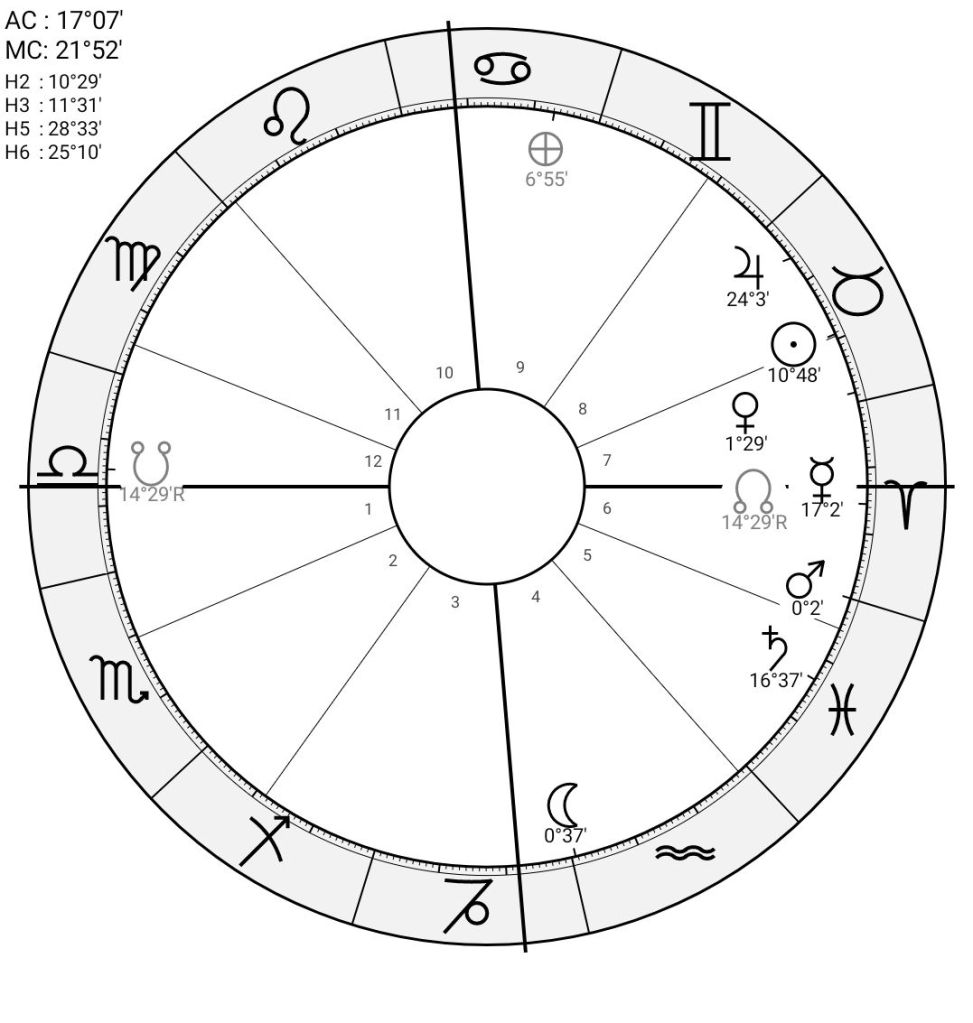
As most people reading this blog probably know at this point, we’ve recently bought our first home. A couple of weeke ago we scheduled the key handover with the previous owner, and I asked if everything would run smoothly. The result was a very interesting chart with a clear example or translation of light.
We are represented by Venus, ruler of Libra on the Ascendant. The previous owner is Mars, ruler of Aries on the Seventh. The Moon represents action. Notice the South Node of the Moon on the Ascendant, indicating troubles.
The second thing I noticed is that both Venus and Mars have recently changed signs, and especially that Mars has moved from Pisces, the sign of Venus’ exaltation, to its own sign, and Venus has moved from Mars’ sign to her own sign. Furthermore, the Moon has also just changed signs while being in the Fourth house which represents the property.
The Moon is the most interesting factor here: she is separating from a sextile with reception of Mars (back when she was in the last minutes of Capricorn) and applies to a square with reception of Venus from Aquarius. By this translation of light the Moon shows very well the passage from one owner to the other.
A square aspect is technically a negative indication, showing either friction or obstacles. The reception, though, allows the obstacle to be overcome. In his chapter on reception, the Medieval astrologer Guido Bonatti seems to hint at the idea that a square with reception is basically like a sextile without reception, but this doesn’t seem to be the case here: a square is a square, and it shows trouble, even though reception shows the overcoming of the difficulty.
And this is what happened: the owner cancelled on us two times for other appointments that took up a lot of his time, so the handover happened (reception) but with delay (square).
NOTE: the two aspects made by the Moon were both with reception: she was received by Mars in his exaltation and then received Venus in her (the Moon’s) own exaltation, thus smoothly transfering the ‘virtue’ she had received.
Enneagram Type Four and Enneagram Type Eight are vastly different, though they do share some common values. Fours are a Heart type and are concerned with finding meaningful connections that will redeem them from their tragic sense of abandonment in an alien world. Eights are a Body type, and they are mavericks with a warrior-like streak who will do anything to survive and preserve their independence.
Both Eights and Fours highly value their individuality and their difference from others. Fours generally cultivate an image of being special and different as a consequence of their suffering. Their feeling of alienation from the ‘commoners’ usually contributes to their passivity and sense of vulnerability and their need of being rescued. Eights on the other hand feel like they have fought, survived and won and that this has made them stronger–but also that they need to constantly patrol every inch of their independence to avoid losing it.
Both types also value authenticity. Fours are on a quest for authentically expressing what they perceive to be their authentic self. They don’t like affectation and social niceties when these prevent them from acting the way they feel is appropriate. However, they also sometimes tend to place excessive emphasis of some of their inner experiences as opposed to others, so that paradoxically they end up appearing inauthentic.
Eights have a strong instinctive perception of truth and authenticity in others and often quickly call out their BS. For them, this is a way of deactivating potential sneak attacks. However, their unwillingness to accept that some truths are more complicated than others (thus escaping their nose) can sometimes make them appear unreasonable or even dense.
Fairness is a common theme to Fours and Eights. Fours feel that life is unfair to them because it has inflicted on them more than their fair share of pain. This may or may not be objectively true, but subconsciously Fours need to believe it in order to sustain their image of being different, which in turn leads to more pain, etc. Eights believe that the world is unfair and that they are up against it, almost superhero-style, fighting for themselves and for those who are too weak to defend themselves. However, the excess choler they put into their actions can make them behave unfairly or even cruelly at times.
I’m going to write a few articles on the similarities and differences between cards in the Sibilla deck based on certain topics or concepts. Because I’m a positive person, let’s start with the concept of loss.
This list is not meant to be exclusive (for instance, most bad cards next to the Money card can show loss of money). Context is key, and each spread must be studied as its own thing. Furthermore, loss is not the only meaning of the cards I talk about here.
Five of Hearts Reversed (Happiness)
The 5♥R generally indicates failing to meet aims and failing to live up to promises and commitments. These ideas can easily be what leads to loss, whether material or in the field of relationship (though it also has a strong connection with cheating in the latter field).
Six of Hearts Reversed (Money)
This one doesn’t require much in terms of explanation. The Money card, when reversed, can indicate money troubles.
Eight of Hearts Reversed (Hope)
When upright, the 8♥ is connected with investments (things where there is a hope placed on future returns). When it is reversed, it often shows bad investments causing losses. It also indicates relationships that go up in smoke.
Ten of Hearts Reversed (Perseverance)
Traditionally, the 10♥R is really bad for commerce, as it shows loss of contracts and even of merchandise. More broadly, though, this card bodes ill for anything where you wish for smooth sailing.
Six of Clubs Reversed (Surprise)
When upright, the 6♣ represents a positive discrepancy between effort and returns: you get more than you hoped for based on your efforts. The 6♣R is the opposite: you put much effort into something but get little in return. It also shows excess confidence and ambition causing losses.
Five of Diamonds Upright or Reversed (Melancholy)
In general, this card represents unsatisfactory situations, but next to the card of something we hope to get it shows either we don’t get it or we are unsatisfied with it. When reversed it speaks more clearly of loss and debts.
Eight of Diamonds Reversed (Handmaid)
The 8♦R often speaks of the need of spending money or money going out in general. By itself not a tragic card, but its meaning can be exaggerated by the presence of other difficult cards. It also indicates lack of skill in balancing a checkbook.
Ten of Diamonds (Thief)
Obviously, a thief takes something from us, so we lose that something. The 10♦ represents all situations where we lose someone or something, and if other cards of dubious moral import add their meaning, foul play may be suspected.
Ace of Spades (Sorrow)
The A♠ is a strong card, which can modify most readings for the worse. It represents feelings of bereavement and loss, not necessarily material in nature. If it is material, it is likely to be a big loss, as it will shake the querent to the core, like a letter containing tidings of death (which is what the card represents). When reversed its meaning is lessened.
Three of Spades (Widower)
This is the ‘loss’ card. It represents the notion of ‘without’ and it brings loss to the fore as a concept. The loss doesn’t need to be material, so the 3♠ can show loss of friends or social support. As the title implies, it can show widowhood. When reversed the loss is more traumatic.
Five of Spades (Death)
The 5♠ is similar to the Widower in its depiction of loss, but the loss is sharper and is more likely to radically change (usually for the worse) the querent’s life.
Seven of Spades (Tragedy)
The 7♠ represents disruption, the surfacing of unaccounted or unexpected factors bringing the loss of what we hoped to achieve. As with most really bad cards, the Seven of Spades can add its meaning to other cards to bring most projects to their knees.
Eight of Spades (Desperation and Jealously)
The 8♠ is specifically connected with a crisis in material affairs (though of course it can bring problems to relationships as well). It is not uncommon to find it when the question is about investments or debts, showing a critical situation where the querent must tread carefully to avoid making mistakes they’ll deeply regret.
I had a short but interesting conversation with a visitor of this site. He quite liked many of my articles but was somewhat perplexed by my iconoclastic attitude toward the spiritual side of divination. I think this is a good time to clarify my views further, since the reason I am so scathing is not that I hate spiritual work, but that I take it seriously.
First off, let us distinguish inspired divination from technical divination. Inspired divination is the downloading of information, as it were, from a spirit, a deity, an inner contact or some such. This depends wholly on either the inborn talent or the level of initiation of the diviner.
Technical divination works for the same reason that stones fall: because that’s how things are. One learns it the same way one learns math: they must be predisposed to it and must put in the work. Of course, one can mix the two types of divination, but they are essentially different.
Either type can be used to obtain concrete information. Either type can be used to fool yourself or others (but especially yourself). The difference is that inspired divination, especially as a consequence of initiation, has the perk that the diviner must have somewhat balanced themselves out of many of the delusions typical of the spiritual community at large. Technical divination may be just as hard for other reasons, but the counters used in the prediction are available to everyone.
From here come the hordes of tarot readers and astrologers that (believe they) are using divination for spiritual aims, or inner work, when in fact they are sinking more and more into Delululand, as most of the time they aren’t really speaking to gods or angels or ancestors but rather to their own ego (have you ever heard any tarot reader or astrologer that uses this approach say something that goes against their convictions? How come their gods or ancestors always have their same values, their same political bias, their same preferences?)
The preconception here is that divination, in order to be spiritual, must be about spiritual topics. This is as a result of two widespread phenomena: 1) most people in our society see spirituality as something separate from concrete life, something that takes place in a bubble of white light 2) most people who become interested in divination are initially interested in concrete answers, but finding that getting these is hard and not immediately rewarding, they reframe divination as ‘not really to know the future but to improve yourself’. This is at the heart of the deadly divination/fortune-telling distinction that plagues our art.
In reality, divination is an inherently spiritual practice: 1) by the mere fact of working it deflates the modern ego 2) by its ability to pinpoint how the future is likely to pan out it puts a stop to the marketable but untrue ‘you are the master of your own destiny’ nonsense 3) by showing how the intricacies of real life can be mirrored in a microcosmic mirror it teaches the diviner to rise above himself and his preconceptions and adopt a more universal standpoint 4) by proving that some things are fated it teaches the practitioner to have compassion for themselves and others and to reevaluate their priorities.
Once again, a geographic analogy could help. A traditional diviner who seeks to understand life is like one using a map of a territory to find his way around. By studying it closely the traveler can eventually form a good understanding of the land he is in. A (pseudo)spiritual approach to divination though is like that same traveler painting the map with a uniform white paint because, at the end of the day, everything is one divine unity. That may very well be, but now the traveler is lost without the map and can only sink deeper in his preconceptions in trying to picture the route.
Background: hubby and I are on a weekly veggie delivery service from a nearby farm. Yesterday they told us they might come a bit later than usual (normally they deliver at around 12-13pm). As hubby needed to go to work and I had a ritual to carry out and carefully timed, I needed to know that I wouldn’t be disturbed during the ceremony. So I asked when the veggies would come.
Horary Astrology
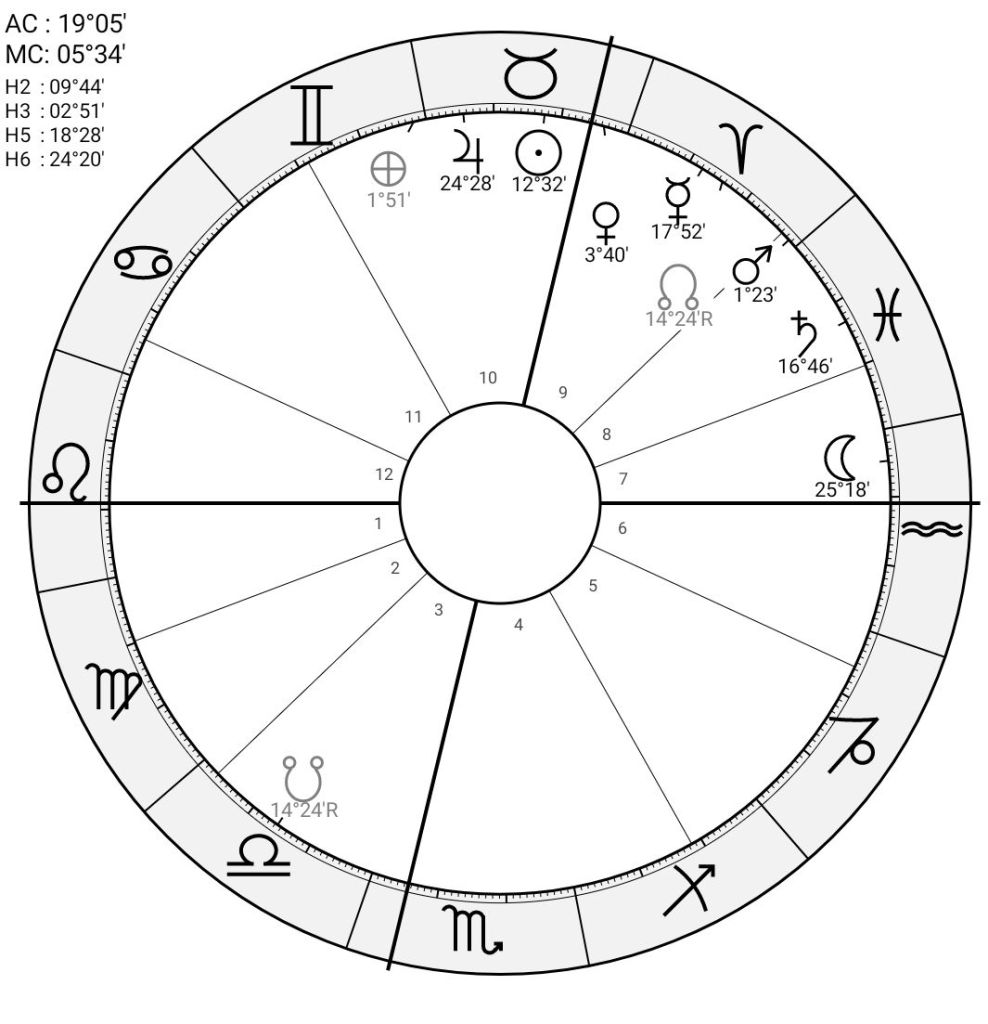
Here’s the horary chart (the time was 12:56)
Horary question: when will the veggies arrive? App used: Aquarius2go
Leo rises, so Leo’s ruler, the Sun, is my significator. The delivery service is our business partner, since we buy stuff from them and they bring it to us, so they are signified by the seventh house ruler Saturn (ruling planet of Aquarius). The veggies are their moveable possession, so they are indicated by the second house from the seventh, i.e., the eighth house, and its ruler Jupiter. The Moon is given to us as cosignificator and indicator of the flow of action.
Right off the bat we notice the Moon, weakly dignified in the seventh house, so action (obviously) starts from the delivery service. The Moon has separated from a square with reception with Jupiter, i.e., the veggies, and is now void of course. Clearly there are some problems (a square with reception is still a square). Still, there is a promising sextile (a positive aspect) between the Sun and Saturn, though it’s odd to see our significator applying to theirs (see the Outcome for why).
The Sun perfects the aspect at 17 degrees and 10 minutes of Taurus. The difference from its current position is of 4 degrees and 38 minutes, so they will come in 4 and 38 somethings. I would need to see serious testimonies to judge they won’t come. The Moon being void of course can delay them, but there is a clear aspect showing they’ll come. So they will come today, I thought.
Therefore, they will either come in 4 minutes and 38 seconds or in 4 hours and 38 minutes. I thought the second option was the most likely, so since the chart was cast at 12:56, and allowing some wiggle room for reality to follow astrology, I judged they’d come anywhere between 17.30 and 18, though I was somewhat skeptical, since this timing would have been unprecedented for them, and they’d told us they would come only a little bit later than usual. But at least this gave me plenty of time for my ritual.
Geomancy
After my ritual, which was timed for around 15 in the afternoon, I decided to have a look at what Geomancy had to say about this delivery:
The Geomantic court is positive, with the Judge Acquisitio showing we’ll get the veggies, but the Witnesses are mixed, showing problems. Albus is in the first, and it’s a good figure for commerce. A very unpromising Cauda Draconis is in the seventh house (which is also the left witness). I must say that I have seldom seen things resolved satisfactorily when Cauda is involved. However, Cauda does spring to the second house, perfecting. I was also relieved, but also a bit puzzled, to see Albus spring to the eighth, also perfecting the chart. Usually, the figure that moves makes the effort. In this case, it seems both of us will make some effort, and that our effort is better than theirs.
Outcome
They did come between 17.30 and 18 (around 17.45). However, they gave us the wrong delivery, which we only noticed when they’d already gone away. So we had to call them back and go meet them to exchange the wrong veggies for the right ones. Note how in the horary our significator applies to theirs and how, in the Geomantic chart, Albus moves to the eighth.
Lessons to be learned
1. Horary questions must not be idle, but they need not be life-changing. Knowing when a delivery service will arrive may seem idle curiosity, but I had a serious reason to want to know the answer (I take my magic work seriously)
2. The divination device, whatever it may be, ALWAYS knows best, though we may be fallible in interpreting it. People like to say that divination lets you contact your unconscious. I think there is altogether too much talk about the unconscious, and not enough talk about the superconscious. I saw from the Geomancy reading that there were problems connected with the delivery, though I could not pinpoint them exactly. In hindsight it is clear what the chart meant.
3. It is a humbling and inspiring experience to see how perfectly the cosmic mechanism works.