Category Archives: Uncategorized

Stuff You Don’t HAVE to Believe: Manifestation

When someone decides that conventional spirituality just doesn’t cut it and takes the logical next step, namely they start being told what to think by the Mind Body Spirit section of their local library (or its social media equivalent), they are often presented with a starter pack of beliefs and practices: lighting candles, burning sage, rubbing crystals, gazing mystically at their daily tarot card, manifesting. 

These are often handed out as some kind of miraculous tool for breaking free of the matrix (while in fact they are so commonplace that you scarcely find anyone in the corporate world who doesn’t practice them. You know you’ve become stagnant when corporations agree with you).

The concept of manifestation is especially popular, possibly because several popular aspirations find some type of answer in it: 1) the wish for a solution to one’s problems that is just one thought away; 2) the wish to be seen as doing something magical while not actually doing anything; 3) the wish to gain some sense of control over one’s life. Most of all, manifestation is often presented as the great inner secret™ practiced by successful people and taught by all great religions and philosophies.

In reality, through thousands of years of recorded magical practice there is no mention, explicit, implicit or implied, of the principle of manifestation as we understand it today, unless we stretch and misinterpret everything we read.

I have several objections to manifestation, some logical, some philosophical, some magical. I also think that, like many ideas I consider wrong, it does capture a fragment of truth, even though it twists it until it’s unrecognizable. Maybe I’ll explore all this in the future. But that’s not the point here.

I’m not in the business of telling people what to think. But always remember that there is a universe of teachings, practices and beliefs outside of the 1960s repackaging of Victorian esoteric fads that animates the current spiritual-but-not-religious community, and it’s fine to question, explore, expand, revise. Just because a belief is popular doesn’t imply you HAVE to accept it. If that were the case, you’d be served much better by conventional religion.

MQS

The Main Problem (Cross Spread Example Reading)

Those who read my Sibilla and Playing Cards sections are probably familiar with the cross spread I use with those decks. Turns out, the same spread can be used with the Bolognese tarot.

This querent is the same I read for here and had a crush on a colleague. The cross spread I present here is a prequel to that spread.

A general cross spread

The cross spread may be used to look at a person’s life in general or to answer general questions (“tell me about my career”). In this case it was general. I’ll keep it short:

  1. Above the head position (what the querent would like or is thinking about): King of Cups, Juggler/Magician, Ace of Cups. This screams “pucture perfect family” with a husband (King), children (Juggler) and a hearth (Ace of Cups)
  2. Under her feet (what she doesn’t want or what she has trouble with): Love, Ace of Wands and Eight of Wands. Love and Ace of Wands together represent a relationship, and the Eight of Wands is a road or path, so it could indicate a love life. Note that this position could indicate that she doesn’t want a relationship, but considering what the cards on her head are saying, it is more plausible that she wants a relationship but has trouble obtaining it.
  3. To her left (past or present): Star, King of Coins, Death. This position talks about work. After checking with her, I discovered she had lost her job in the months prior to the reading and had found a new one.
  4. To her right (near future): Page of Swords, Fool, Seven of Cups. This speaks generically about confusing messages concerning the home.
  5. Center (in her heart): Angel/Judgement, Devil and King of Wands. Well, Angel and Devil together represent, traditionally, great satisfaction, connected to a man. This seems to be the cards’ polite way of saying she’s turned on by him.
  6. To the side (for her): Ace of Swords, Knight of Coins, Ace of Coins. Speedy positive news about money. Probably connected to the near future position, but we didn’t look further into it.

And the reason we didn’t look further into it is that the most important cards (those comprising the central column, i.e., above, heart and below) are all connected with love. This is how the spread about the colleague was born. Note, however, that this spread, when done in general, can give us brief messages about the most disparate fields of life, and it is up to us then to expand on them by either adding cards or doing other spreads.

MQS

Zazu Says Hi (Example Reading)

After getting our little Ciuffy, we were on the lookout for another ‘tiel. I kept browsing through the ads for a young, tame male, but I kept seeing either clear scams or birds with other issues. I did a geomancy reading, asking if I would soon find one that fit the bill of what we were looking for:

Geomancy reading: will we find a young tame male? App used: simple geomancy

I am signified by the ruler of the Ascendant, Fortuna Minor. Small animals are a Sixth House matter. Technically, if this was a horary chart, I would have to turn the chart (will I get someone else’s bird? Sixth from the Seventh, i.e., the radical Twelfth). However, I have found that Geomancy is less prescious about this kind of stuff. Let’s see how the chart speaks and let us follow it instead of trying to impose ideas on it.

The Sixth House is occupied by Puer: a male! That bodes well. The Judge, however, is Populus, which doesn’t say much. Worse still, Populus comes from two Rubeus. Still, we also find that Fortuna Major connects the Ascendant ruler with the Sixth House, since it is found both in the Seventh and the Twelfth house. A positive figure connecting two positive figures is a positive sign (Puer is more neutral, but still good in context).

Fortuna Minor, furthermore, usually indicates shorter timespans, and it moves to an angle (the Tenth house), which is also a generally positive sign as far as time is concerned. 

The reading was done a couple of weeks ago, and we found Zazu yesterday.

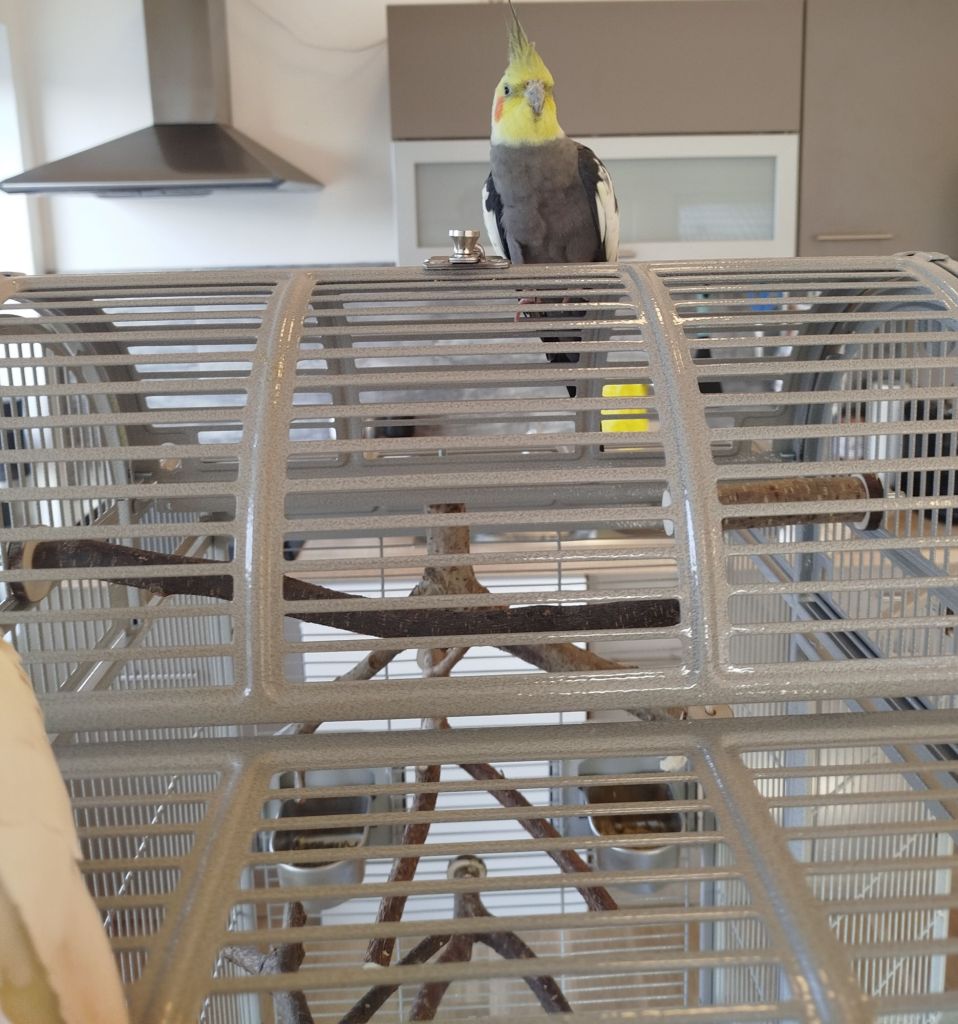
Zazu, also known as Pollo

I am still unsure about that Geomantic Court, with two Rubeus and Populus as judge. It is sometimes said that Populus has little to say, but I don’t believe that. One possible interpretation is that, since Rubeus has the quality of being excessive, the Populus resulting from two Rubeus might show too many birds (a crowd of too many), which is why the person I got it from wanted to get rid of him (or rather, his wife wanted to get rid of him). The court could also simply be warning about potential scams or questionable deals (and I had to sift through a fair share of those).

Be it as it may, I am not too worried about the Court, since the Judge of the Judge (Judge + First House) gives Fortuna Minor, a positive sign for the long run. I’ll update the post if something comes up.

MQS

Collection of Light in Astrology (with Example)

In another article, I discussed the technique called translation of light, which occurs when a planet collects the influence of one significator and translates it to the other.

There is another technique which is, in many ways, the opposite of translation, but has the same effect. This is called collection of light. It happens when a slower-moving planet has been in contact with a faster one, thus receiving its influence, and then another planet also comes into contact with the slow planet. Contact can happen by conjunction or by (usually) positive aspect, that is, sextile or trine, or at least with reception. As with translation, collection usually implies the presence of third parties or external circumstances bringing things together.

Whereas translation can only be effected by a fast planet, and therefore the Moon (or sometimes Mercury) is the most likely culprit, collection of light can only be caused by a slow planet, and therefore Saturn or Jupiter are the most likely intermediaries here.

Example: Is The Book Arriving At All?

My Bolognese Tarot teacher, who is now a good friend, has recently written a follow-up to her book on the 50-card method, and she wanted to send me a dedicated copy. She posted the parcel before Christmas 2024, but by January 6 it hadn’t arrived and I was worried it might have been lost or forgotten in some dispatchment center. So I asked the heavens.

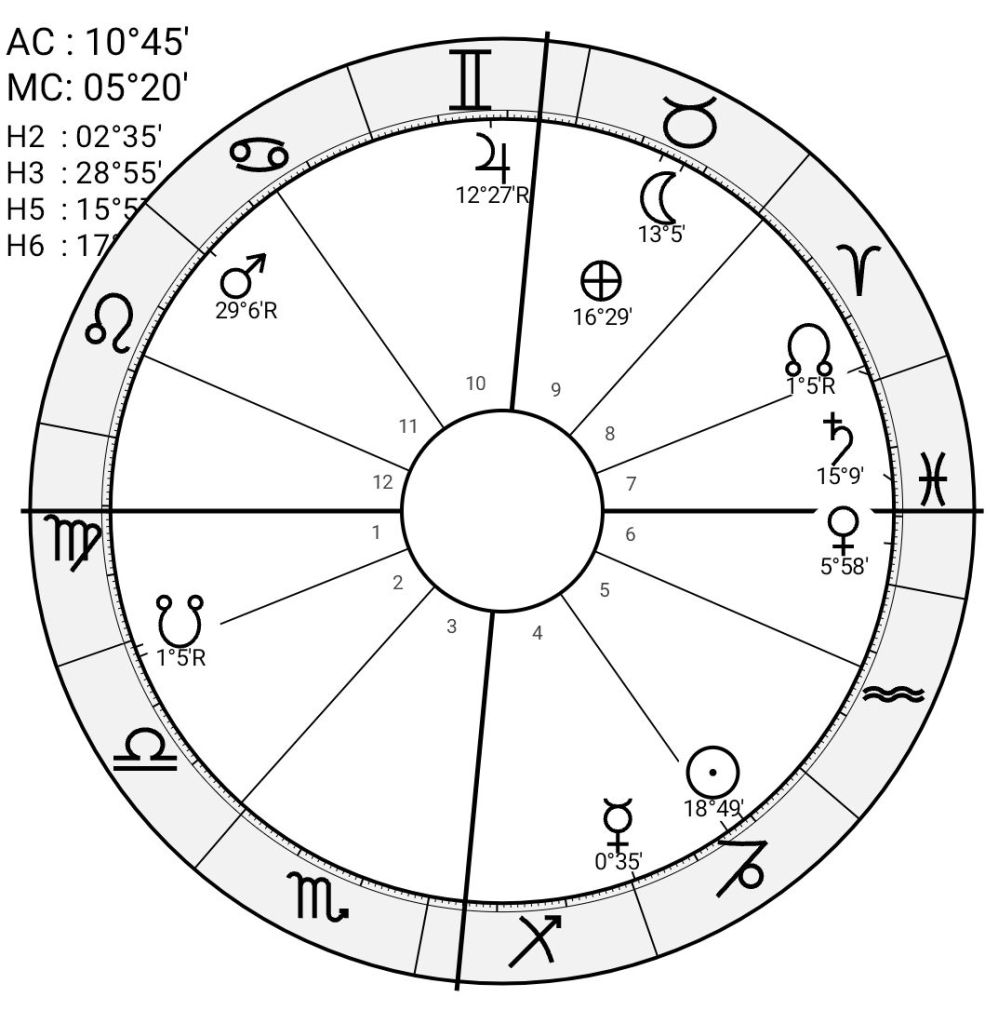
Is the gift arriving at all? App used: Aquarius2Go

I am signified by Mercury, ruler of the ascendant. My teacher sent me the book in her quality of personal friend (it wasn’t part of a course or anything), so she is signified by the Eleventh House ruler, the Moon. The Moon also represents the flow of the action (keep that in mind for later). Her gift for me is her second house, that is, the second house from the Eleventh, i.e., the radical Twelfth, ruled by the Sun. My stuff is signified by Venus, ruler of my second house.

So, ideally, we would want the Sun to be reached by Mercury. How do we get them together? Well, we don’t, clearly, or at least not for a while and not before the Sun has left Capricorn. That’s a problem.

However, we note that the Sun has just sextiled Saturn, having been received by it as well. What is Saturn? Well, it rules the Fifth and Sixth Houses, so the closest thing I can think of is the courier/delivery service (Sixth, house of servants).

What happens to Saturn next? It is sextiled by the Moon. The Moon is the ruler of the Eleventh, my teacher/friend, but it doesn’t make sense (she sent the book, she’s not gonna receive it). However, in most horary charts, the Moon also signifies the flow of the action. So the flow of the action moves favorably (sextile) with the courier (Saturn): the book hasn’t been lost. What happens next is that my significator (Mercury) and the significator of my stuff (Venus) almost simultaneously meet Saturn: Mercury by sextile with reception by sign, Venus by conjunction with reception by exaltation. Even if we chose to disqualify the Venus conjunction because Venus squares Jupiter first, Mercury makes no other aspect before the Saturn sextile.

Thankfully, the book arrived yesterday (I’m gonna review it in the near future). Note that timing in this chart seems to fail: the chart was made on January 8, the parcel arrived on January 15. If we take the Moon sextile it is two degrees away (two days, two weeks), if we take the Mercury sextile it is 15/16something degrees away (again, 16 days). The only aspect that seems to come closer is the Venus conjunction with around 10 degrees (10 days, though it took 7). It is probable that the chart was simply responding to my core question: yes, it will arrive, and took timing for granted. It could also be that I’ve misread the chart and got lucky. If you have an idea, drop a line!

Either way, we’ve finally answered the age-old question: Why is Saturn so fat and slow? The better to collect your light!

MQS

Psychological Hang-Ups of Diviners and Querents

When a person sits in front of a diviner, a number of preconceptions have often already been set off in their mind, and sometimes even in the mind of the diviner.

We must always remember that, nowadays, many people don’t visit an astrologer or card reader by chance, nor (usually) as their first go-to choice. Often, they have made a deliberate choice to step outside of the norm, for better or for worse, meaning that they have found the norm to be lacking in its ability to provide certainty. For many, therefore, the underlying presupposition seems to be: “I accept to take part in something that operates outside of consensus reality as long as it gives me the certainty I can’t find any other way.”

As diviners, we instinctively know it, and we may feel pressured to play into this presupposition or swim directly against it, thus falling into the opposite error.

Some diviners may feel they need to provide the querent with the unreasonable all-knowledge that only God can gift them with, only to end up providing uncertain information with unreasonable confidence. Others may push in the direction of vague self-help: We may not know if Mr. Right is behind the corner for our love-starved querent, but her divine feminine or other buzzword can still derive important lessons and “aha moments” from reflecting on the whole situation.

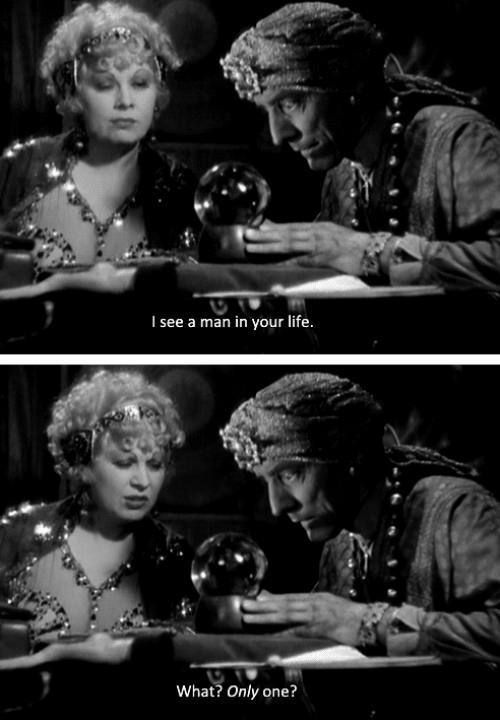
Mae West said it best. Picture by Sophie Charlotte on Pinterest

There are many dimensions to divination, some of which are indeed very deep. However, as far as our relationship with querents is concerned, we are simply an added means of intelligence-gathering, which, like all tools at our disposal, may fail for a variety of reasons, not the least of which is the diviner’s limited knowledge (our knowledge is always limited).

“But I came here to have undebiable, clearcut answers,” one might argue. To which I anwer: Tough titties! If you want undeniable clearcut answers shake a magic eightball. Divination is, quite literally, a divine language, and is not always so cleacut, either in itself or due to our limitations, or sometimes simply because the situation isn’t clearcut in itself. This is especially the case for issues involving human emotions.

As a rule, honesty is the best policy. I believe in voicing my procress to the querent, and the querent has a right to as clear an answer as I am capable of giving them, but we should never feel pressured to give them more certainty than we can truly see in the oracle.

It is perfectly acceptable to talk to the querent about our doubts or about the possible interpretations we are seeing in the oracle. For instance, it is ok to say “it seems like x, but y is also a possibility, while z seems less likely and w is out of the question.” It is also acceptable to say “these cards seem to point to such and such being the case, but I’m uncertain, as this other interpretation might also be right”. More often than not, the querent will say that both interpretations apply, and when this is not the case they can help us disambiguate the oracle.

Ultimately, the fact that divination has no legitimate place in our society implies as a consequence that, because our society believes itself to be held together by reasonable rules and processes, then divination must be either complete poppycock for delusional idiots or it must be capable of unreasonable fits of prowess in other to justify its existence in spite of its current ostracism.

This in turn creates expectations and hang-ups on both ends of the divination process that need to be analyzed and clarified to avoid them subconsciously ruling our practice. Doing so can make divination much more valuable and much more enjoyable.

MQS

The Great Spreads with the Bologna Tarot – The Staircase

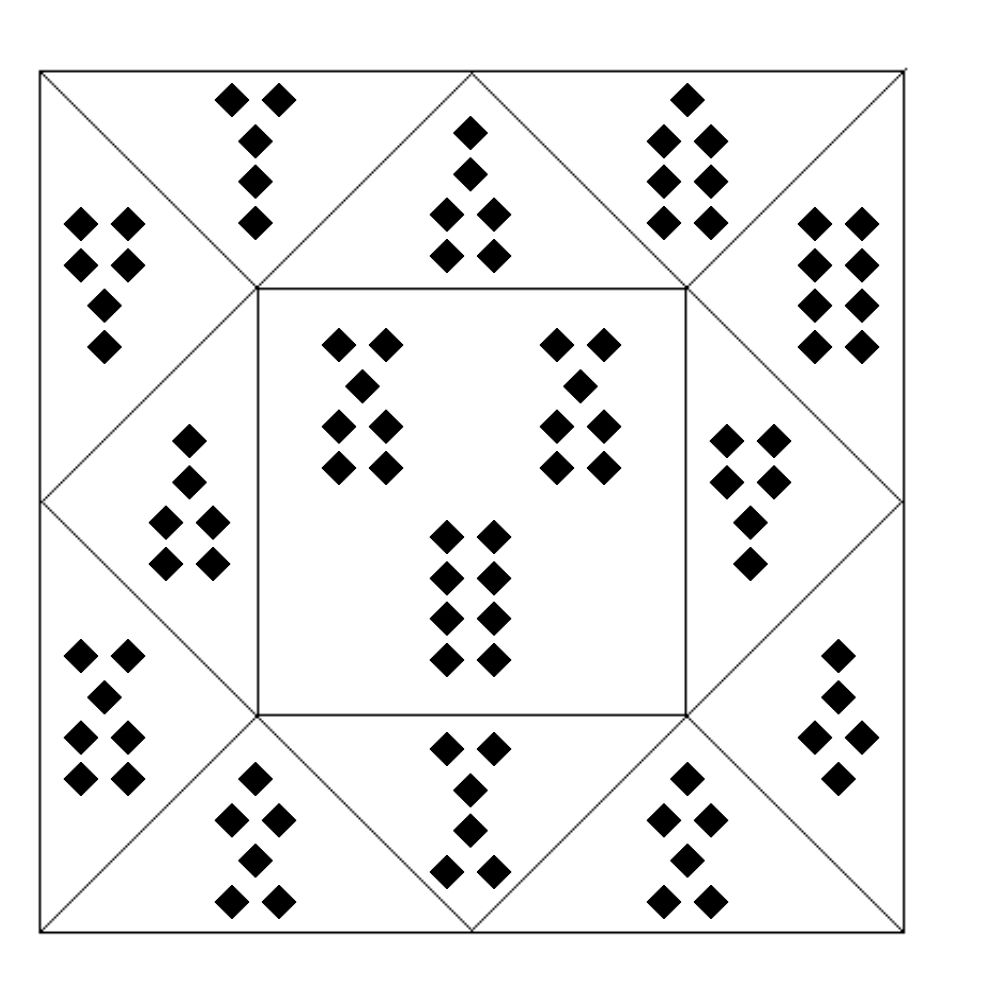
Following up on my previous post about the “bed sheet” spread with the Bologna tarot, I wanted to cover another full-deck spread: la scala, i.e., the staircase spread. You could also call it a pyramid spread, but I’ve never heard it being referred to as ‘pyramid’, possibly because pyramids were quite outside of the daily experience of the old ladies of Bologna. Here is the layout:

The staircase spread (la scala) with the Bologna Tarot

Note that this spread is intended for a 45-card deck. If you use a 50-card deck you’ll have five cards left over that you can put to the side as describing something imminent or something that is outside of the querent’s life (your choice).

The principles for interpreting this spread are the same as with the previous one: we look at the angles, then we locate the significator (Queen of Wands for a woman, King of Wands for a man). Generally speaking, anything above or before the significator shows the past, and anything after or under it shows the future, but we need to be flexible: sometimes we can just read the full column or row of the significator as a single sentence.

Furthermore, while the angles are important, we must not forcefully insert them into the reading: if they seem meaningful we can look at them, if they don’t, we can ignore them. Sometimes their significance becomes clear as the reading progresses.

Finally, we can look at the cards forming the outer diagonal side of the triangle as giving us one or more predictions concerning the future. In this case, the cards are read from the bottom to the top, walking up the stairs as it were.

In this case, let us suppose we are reading for a man. The angles of the spread are formed by Temperance, the Moor and the World. The cards are not especially clear. Let us move on for now. The King of Wands is found in the fourth column and third row. The row is quite negative: Justice is in the dark (Moon) causing suffering (Eight of Swords) at home (Ace of Cups) and confusion (Fool) that requires an expert (King of Coins). This could relate to something legal or bureaucratic.

In his column we find that there are messages and talks (Page of Swords, Page of Coins) with a woman who is close to him (Queen of Cups) and these communications are sad (Seven of Coins) but will be required to clarify some things (Queen of Coins).

Note that not everything we read in this spread must necessarily be connected to everything else, since this spread is supposed to be general. However, in this case we find that the querent’s card is close to the house card and the conversations happen with a family woman, so we can guess that the two things are related. Looking back at the angles, they cound indicate that this situation is requiring unexpected journeys.

Now let us look at the diagonal: the World and the Juggler could indicate a small trip or, considering the Ace of Wands is next to the Juggler, it might refer to hearing about a pregnancy. The Love card would confirm the joyful occasion. If we connect these cards, together with the Queen of Coins and the Strength card, to the issues we’ve seen relating the family, it could show the solution coming after a bit of uncertainty.

Considering the final cards on the stair, namely the King of Coins and the Chariot with the Moor, it could indicate an unexpected need to see a doctor (Chariot = sick bed, King of Coins = important man).

MQS

The Great Spreads With the Bologna Tarot – The Bed Sheet

The Bologna Tarot is typically read in large spreads. This is because each card has very simple meanings, so one cannot spend their time musing on them at length as often happens in contemporary tarot practice. The Bologna Tarot is closer to the Sibilla or to playing cards or Lenormand in this sense (or even to how regular tarot readings used to be).

Many general spreads done to tell a broad fortune use the whole deck. This is the case of the Lezuolata, or bed sheet spread. It is a 5×9 spread similar to the Lenormand or Kipper Grand Tableau (this is for the 45-card deck. If you use the 50-card deck just add a tenth row). Here is an example:

The Bed Sheet spread (Lenzuolata) with the Bologna tarot

This spread is typically used to “locate” the querent’s card (either the King or the Queen of Wands) and see how their general circumstances are. It is typical to start the reading by having a look at the four cards in the angles. In this case we have the Tower, the Hermit, the Ace of Coins and the Page of Cups. This could indicate money trouble relating to a young woman (maybe a daughter). If we interpret the Page figuratively, then it shows that the querent has no (bad cards) monetary (Ace of Coins) satisfaction (Page).

Let us suppose we are reading for a woman. The Queen of Wands is located in the second-to-last row and in the second-to-last column. She looks at the Moon, behind which there is the Ace of Cups (the house) and the Ace of Swords (relationships, or something close). Behind her is the King of Swords, a young man, and underneath her is the Juggler, which is a kid. So possibly she has kids (remember the Page of Cups), and she is worried about her financial situation at home.

Let’s look at the column where she appears. Broadly, this is a positive column, with a King and Queen of Cups possibly indicating figures in the family. Right above the Queen is the Chariot, which in this tradition indicates the sick bed, again reinforcing the idea of suffering (not necessarily physical). But the two figures of the Queen and King bring her the Ten of Cups, flourishing, and some minor good luck thanks to the Wheel.

Above the Wheel we find the Page of Wands, her thoughts, and the Seven of Cups, which also relates to the family, especially protection from the family. Possibly, therefore, the Queen is worried about having money for her kids, but her parents or another couple from her family are helping her.

As can be seen, this spread is not meant to let you talk at length, but it does give you a snapshot of the querent’s life at that moment.

MQS

On Sacrifice

Western occultism has an idiosyncratic relationship with the notion of sacrifice. On one hand we come from the Abrahamitic tradition, and especially the Christian one, where sacrifice plays a central doctrinal role (God sacrifices himself) and where the concept of sacrifice has often been used as a club against dissent or to elicit guilt and compliance.

On the other hand, the occult revival of the XIX century, especially but not only in its Crowleian branch, was incapable of integrating this concept in a positive way, largely as a form of juvenile reaction against the previous tradition. If the universe is pure and blind bliss there can be little place for sacrifice except in the most illusory sense. As long as occultism remains largely the occupation of misfits and oddballs, it must retain this juvenile attitude toward sacrifice (which largely explains the philosophical paucity of so much of the occult world).

But sacrifice comes from the Latin ‘sacer facere’, ‘to render sacred’. As such, there can be no spiritual path without sacrifice. Even the most atheistic and chaotic paths must render something sacred, whether it’s themselves and their ego or some abstract philosophical concept. Once something is made sacred, the rest is sacrificed to it as a means to an end, and thus also rendered sacred as a consequence.

In magic (and in religion as well), power can come from two sources: from formulas that have been solidified into a metaphysical building over the years (or centuries) or from contact with a direct source. In reality even the former path, if it is functional, must have had some direct contact at least at the beginning.

Therefore, much of one’s magical training consists in bridging the gap that exists between oneself and the source, that is, between micro- and macrocosm, between individual and universal. The aim is always to be able to embody the universal within oneself. To do so, we must necessarily sacrifice our singular nature, that is, we must empty ourselves of the decades of junk that have been filling our individual vessel since we were born, so that a higher power may come down and occupy it: after all, a pitcher must be emptied of muk before it can be filled with water.

This process necessarily implies sacrifice. As we grow up, we accumulate big and small vices, big and small dysfunctions and illusions, and anyone who has lived long enough and has developed enough self-reflection can probably recognize at least some of them as they keep reemerging.

All this needs to be purged from the system. In other words, it needs to be sacrificed, to be rendered sacred. One of my teachers’ mantras was “Offer it to the Divine“. It took me some years to understand what she meant. Whenever some of my vices, some of my illusions, pains, dysfunctions presented themselves, it was easy to simply abandon myself to them, to live them out in the solitary confinement of my individuality as a sort of chosen doom.

But “Offer it to the Divine” was the key to leaving that solitary confinement, of bridging the gap between the small world and the large world. It went beyond despair and guilt and all the typical associations of the word ‘sacrifice’. It required no judgement. It only required for me to stand back, allowing the sun to shine on that lower part of me.

This, I later learned, is the inner equivalent of what happens during rituals, when we sacrifice something to whatever power we are working with. It is part of what allows that apple offered to that spirit to be more than just a tip of the hat to a recipe found in a dusty grimoire.

MQS

Bolognese Tarot – Connecting the Cards

I’ve recently talked about understanding the order of the cards when using the Vera Sibilla and playing cards. The Bolognese tarot, being a traditional fortune-telling system, follows similar rules, and as such it is important to understand whether the cards add their meanings together or contradict each other. Example:

Page of Coins + Queen of Coins

The Page indicates words, while the Queen represents the truth. Therefore, in this case, we get “true words”, “trustworthy words”, and similar combinations.

Queen of Coins + Moon

The Queen of Coins is the truth, but it is followed by the Moon, which indicates negativity, falseness, secrets. Therefore the combination talks about hidden truths, and thus of potential lies to cover the truth.

Moon + Sun

In the Bolognese tarot, the Moon is the card of negativity, while the Sun is the card of positivity. Traditionally, the Sun and Moon together are called “the two red cards” (due to the color of the two celestial bodies in the card) or the sorrow combination. Since here the Moon comes first and is followed by the Sun, the sorrow is passing, the problem will be solved.

Sun + Moon

In this case, the Moon more decisively blocks the Sun, so the sorrow doesn’t stop, or at least will last longer.

Tower + Justice

The tower can represent a large building one would rather avoid. Justice represents the law. Together, the two cards can represent a courthouse (but they can also indicate that justice or fairness is impeded, if the reading is not about a trial).

Justice + Sun

The Sun affirms the positivity of something. Together with Justice, it shows justice, fairness, equilibrium, etc

Justice + Moon

This is the opposite. The Moon negates justice.

Justice + King of Coins

The King of Coins is an important person, usually one with a degree. With Justice, he becomes an attorney, a notary, someone who is competent in some area of law or bureaucracy.

Love + Hanged Man

The Love card indicates, of course, love. In the Bolognese Tarot, the Hanged Man represents betrayal (being hanged upside down was the punishment for traitors). Together, they can indicate some kind of dishonesty connected to love (with the figure of a third party, it would become a triangle).

Love + Ten of Cups

The Ten of Cups brings feasting and jollity, so this combination would describe a happy-go-lucky love that is blooming, and if we add the Fool, that’s obviously a very fun love with not much commitment.

Love + King of Coins + Justice + Tower

We’ve seen that the King of Coins with Justice indicates a lawyer, and Justice and the Tower indicate a court of law. Connected with Love, this combination could show a divorce.

World + Eight of Wands

The World card means “around the world” or journey. The Eight of Wands indicates a road or path. Clearly, the two cards together strengthen the idea of a literal journey.

World + Page of Cups

The Page of Cups can indicate a younger woman, while the World shows “from afar” or “from around the world”. So this young woman probably isn’t part of the querent’ life: she’s a stranger.

All in all, combining the cards of the Bolognese tarot is a relatively intuitive process, although there are some traditional combinations that we’ll need to talk about in a future post.

MQS

On Avoiding Food Poisoning (Example Reading)

As Christmas draws near I recently bought the ingredients for my home-made 5-hour lasagna sauce. Yesterday I set about preparing it, and I started noticing an odd smell coming from the minced meat, even though it was supposedly fresh.

At first it was barely detactable, so my Christmas spirit decided to interpret it as just a figment of the imagination. The immediate red flag was seeing my husband emerge from his den asking what the strange odor was. Hubby is extremely sensible to smells. Whenever I see him curling his nose I know something is off.

What’s worse, around three hours into the preparation the subtle whiff had turned into a miasma. So I did a geomancy reading, asking if the sauce would be safe to eat.

Before casting the reading I had some doubt on how I would interpret such a question: what astrological house rules food?

In old astrology and geomancy books, when a king asks if the food served at the banquet has been poisoned, usually the diviner consults the fifth house of parties and fun. On the other hand, astrologer John Frawley makes a compelling point that your food is what sustains your person and goes into your throat, which is the second house. I decided that it was useless to worry about these distinctions, and that the chart would find a way to show me the truth.

Is the sauce safe to it? Geomancy reading (app used: Simple Geomancy)

And show me it did. This is  a reading that requires very little interpretation. Tristitia is in the first house, portending trouble, and it springs into the sixth house, which is the house of sickness: neither the second house nor the fifth house were involved. The sauce is definitely unsafe.

True, the court is not negative, possibly showing that it wouldn’t cause any major trouble. On the other hand, the Way of the Point goes from the Judge Via to Cauda Draconis in the eighth house, and Cauda is a negative figure, but I doubt the sauce would be the end of us.

I still decided to dump everything out and start from scratch, meaning today I had to run to the market to get new ground meat.

MQS