Category Archives: Uncategorized

An Experiment (Example Reading)

A friend and I have decided to do a little experiment with the German skat deck. He has applied for a job and we wanted to see if he’ll be hired.

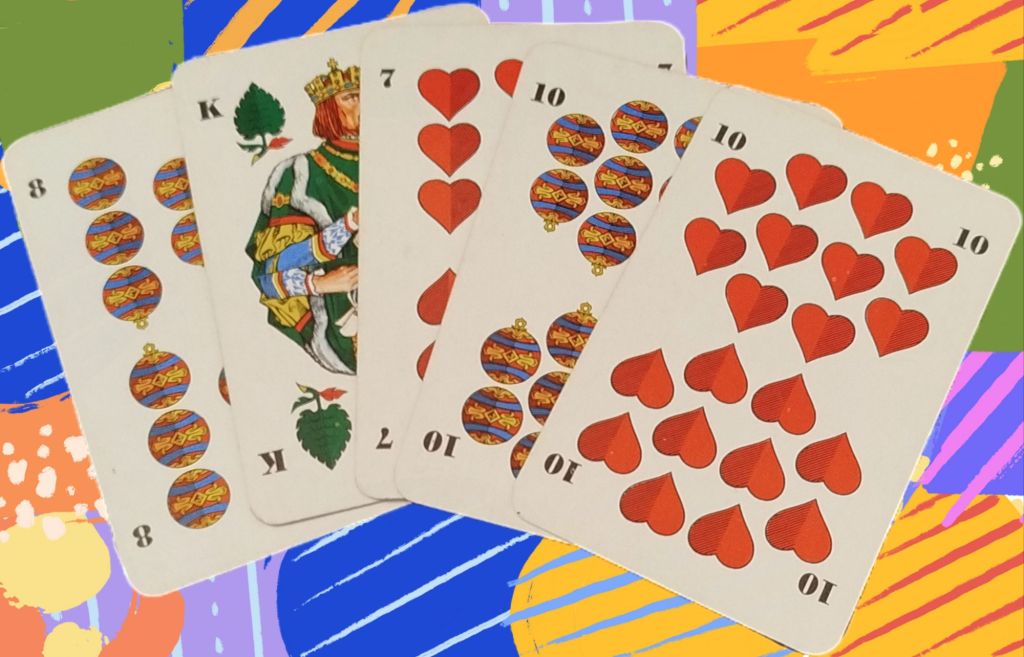
An Experiment with the German Skat deck

According to the meanings I’ve received, the Eight of Diamonds (here the Eight of Bells) is the card of work and business, so the cards seem to be on the ball. We also have the Ten of Hearts which is a contract (a marriage/union) with the Ten of Diamonds/Bells indicating it’s a relatively well-paid full-time opportunity. The Seven of Hearts here should indicate relief and pleasantness in general. It could also mean the querent is going to have fun, but considering it comes before the contract, I incline more toward the former interpretation.

There’s that King of Spades / King of Leaves there, which puzzles me. Technically the querent is the King of Hearts. This could show that someone else gets the contract, but this would be a really weird way for the cards to communicate (“Will I get the job?” “Someone else is going to be really pleased”). It can happen that the cards say someone else gets the job, but they would show this as a negative for the querent. Also, this cannot be the boss, because two women are the boss and are looking for someone to hire.

Maybe the King of Leaves could represent the type of job. It is in the medical field. Technically, medical subjects would be indicated by the Ten of Clubs/Acorns or the King of Clubs/Acorns, however I have seen many sources that assign the meaning of doctor to the King of Leaves / Spades. It could indicate that the job is going to have to do with lots of bureaucracy and office stuff, and that would true.

I will update this article when I get the result.

MQS

Three Decks For One Inheritance (Example Reading)

We did a little experiment with a friend. She wanted to know if the bureaucratic process to get the inheritance from the recently deceased grandfather would finally come to an end, since there had been several delays (leave it to the Italian bureaucracy). We started with the Sibilla.

Sibilla

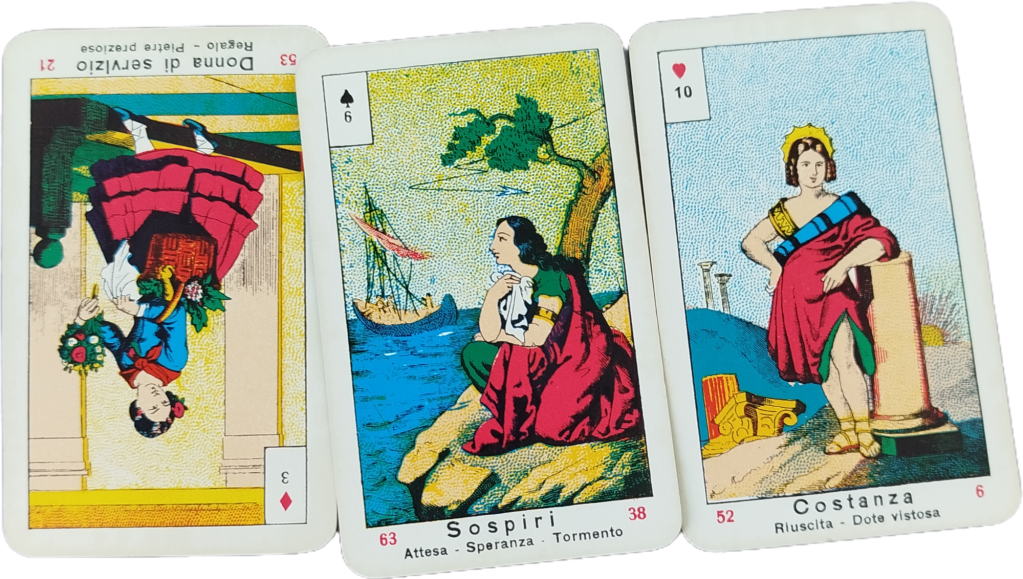
A three card reading with the Vera Sibilla

In this case, the Handmaid reversed indicates money going out (of the querent’s wallet). The Sighs card simply indicates that the person worries they’ll have to pay money. The Ten of Hearts here is not a positive influence, because it is a card that makes the uncertain certain (in the context of a trial, for instance, it might indicate the sentence being decided). So in this case the worries shown by the Sighs are confirmed.

I asked my friend if she was worried about having to pay some extra money, and she said that this was her and her dad’s worry, but that they had looked into inheritance law and thought they were safe and wouldn’t need to pay . Clearly the Sibilla begs to differ.

Playing cards

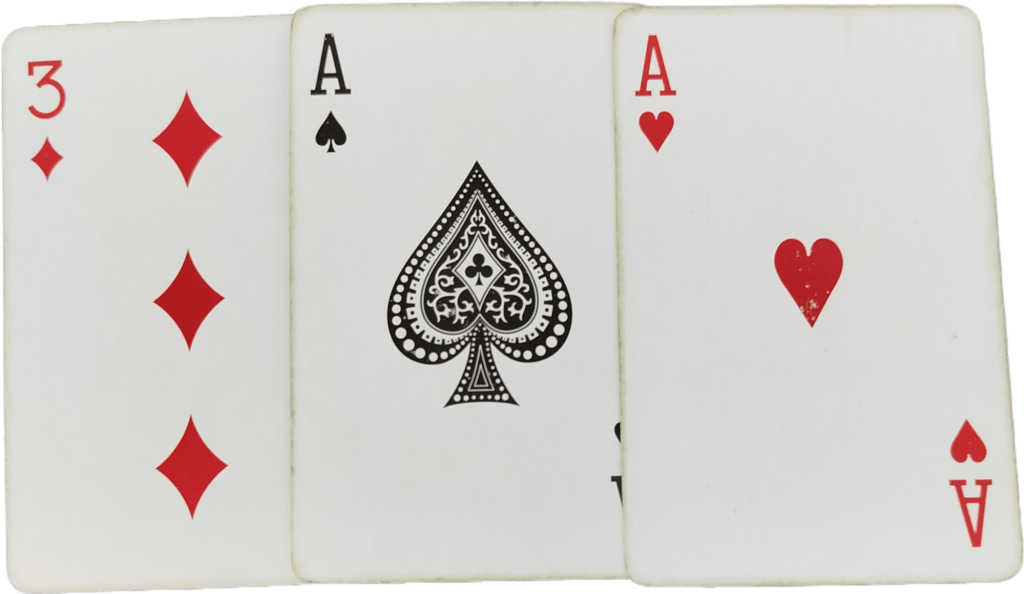
A three card reading with regular playing cards

In this case we don’t have the querent’s state of mind (which the Sibilla talked about). However, we do have, once again, the loss of money, indicated by the Three of Diamonds being covered by the Ace of Spades. The Ace of Hearts shows us that the money going out is due to family issues, something which was absent from the Sibilla.

Skat cards

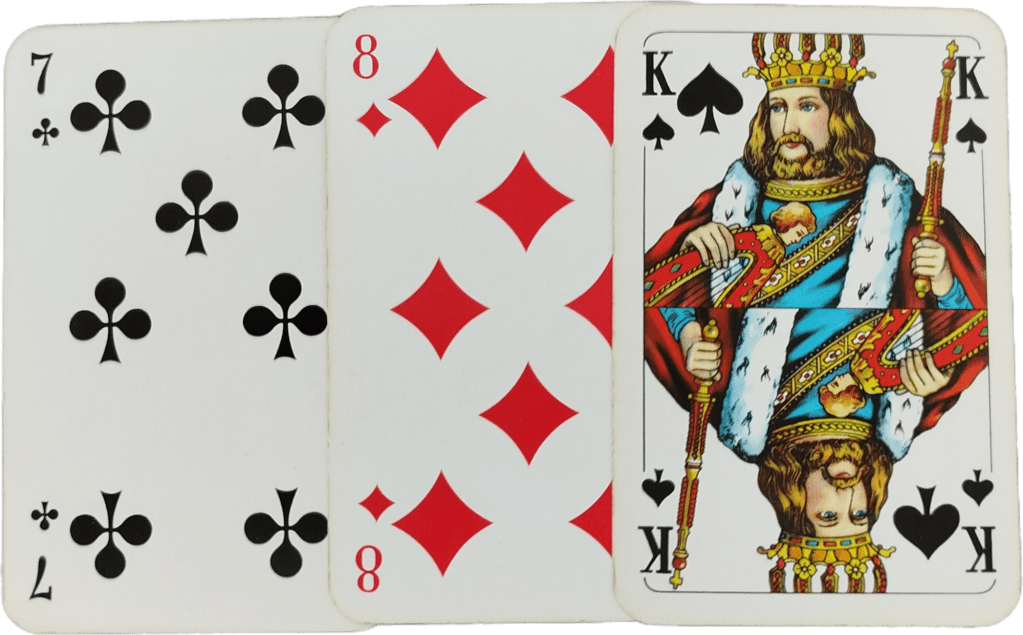
A three card reading with the Skat / Piquet deck

I decided to make an experiment with the Skat cards as well, just for kicks. The Eight of Diamonds is technically the card of work. However, if I understand the meanings correctly, it represents work because it shows the flow of money, money being exchanged. So it can represent, more broadly, the economy. With the Seven of Clubs, which indicates tears, the economy will take a hit. The King of Spades might be the office worker who will give the querent the news.

A week ago they received news that they needed to pay an extra 3000€ to unfreeze the granddad’s money. My friend doesn’t know if the office worker who worked on their case was a man (the King). Still I think the Skat cards were rather accurate.

MQS

How Long to Shuffle the Deck?

This may sound like a silly question, but it is one I get asked constantly in private. I think the reason is that, especially at the beginning, we are very unsure of how to go about the reading and we are afraid we may get it wrong on technical grounds even before the interpretation starts.

Unfortunately, there is no clear answer to this. I know of old-time diviners who shuffle the deck for a fixed (usually odd) number of times, like seven, nine or thirteen. I have never been able to get behind this way of doing things. It is, however, a traditional approach, so I thought it better to mention it.

I distinguish between when I’m reading for myself, or even for someone else, but who isn’t there; and when the person is with me, even just on the phone or on skype (I used to do skype readings for friends all the time when I was in college).

The second case is the easiest, so I’ll talk about it first: when I’m reading for someone and I am directly in contact with them, I simply ask them to think about the question and to give me a stop when they are ready. Meanwhile, I decide which spread to use, then I relax and I take on an attitude of calm focus, without strain.

The person may have me shuffle for two minutes, or they may tell me to stop after two shuffles. After the stop, if the person is physically there, I also let them cut the deck, otherwise I do it for them after knocking three times on its back (that’s my little ritual). As weird as it sounds, the cards always seem to fall into place very well regardless of how long it took to shuffle them.

I believe this is because, in a reading, there is more at play than just two eccentrics’ focus on a topic. We may like to concoct philosophies that give us ultimate power over external reality, but the fact remain that we live at the intersection of cosmic, personal and interpersonal currents, a number of which are beyond our control. Our focus may catalyze these forces, but they are more ingenious than our conscious awareness could be.

In the first case, i.e., when I’m reading for myself or for someone who isn’t there, I need to be especially at peace with myself. If I’m distracted, depressed, in a heightened mood or very sick, the reading won’t go well. Even when I am at peace, there is always a question mark at the end of my readings, like they are never as crisp as when I’m reading for someone else who is there with me.

So, how long do I shuffle in this case? The answer may be disheartening for some, but it’s: as long as I feel I need to. This is hard to explain, but one soon learns to recognize the feeling of a well-shuffled deck. Some may feel the deck becomes heavier, others seem to just get an undefined feeling.

For my part, I usually feel a sensation akin to being full after eating a hearty meal and being unable to take another bite, while at the same time the deck itself seems to oppose resistance to being shuffled as the cards lock into the right place. Your experience may vary.

MQS

Tarot Encyclopedia – The Eight of Swords

(Note: this is a collection of the meanings attributed to the cards by some occultists in the past centuries. It does not reflect my own study or opinion of the cards. It is only meant as a quick comparative reference as I develop my own take.)

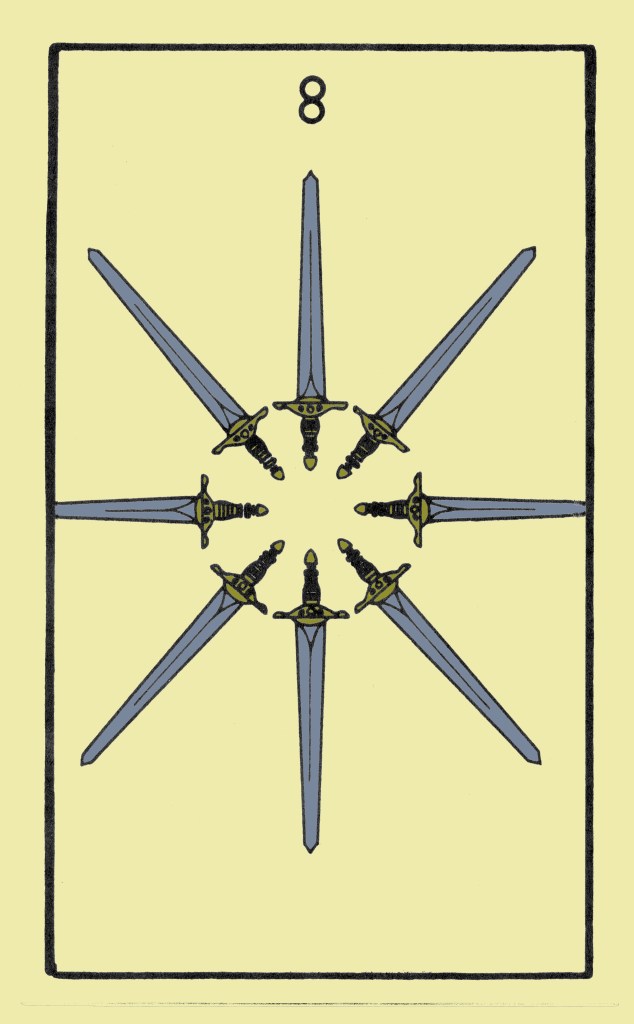
The Eight of Swords from the Builders of the Adytum (BOTA) tarot deck

Paul Foster Case (and Ann Davies)

The time period is the first decanate of Gemini, May 21 to May 31, under the rulership of Mercury.
Well-Dignified: even well-dignified, the excessive Mercurial influence expressing in the Yetziratic field of unstable forces and changing forms, symbolized by the Eight of Swords, gives a marked tendency toward ill-directed or wasted action. Meanings in divination: force wasted in petty affairs; too much talk; too much illdirected action; the state of being terribly busy without accomplishing much; over-careful about details; could possibly intimate a crisis in affairs, and probably much talk, correspondence and moving about.
Ill-Dignified: malice; ill-natured gossip; pettiness; too much concern with personalities; disagreements with brothers and sisters. This Key divinatorily expresses unbalanced or excessive Gemini qualities in third house affairs. The se negative Gemini qualities portend the need for balancing the quick-mindedness and penchant for action of this astrological type with the d e pth of feeling and emotional warmth corresponding to Netzach and Venus.
Keyword: Mediocrity
(From the Oracle of Tarot course)

A. E. Waite

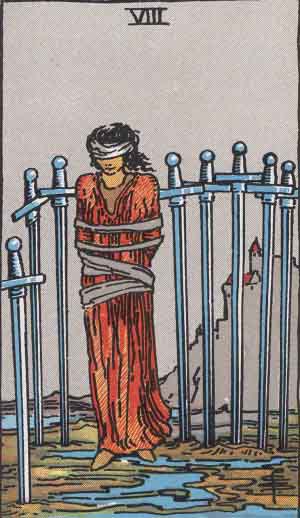
A woman, bound and hoodwinked, with the swords of the card about her. Yet it is rather a card of temporary durance than of irretrievable bondage. Divinatory Meanings: Bad news, violent chagrin, crisis, censure, power in trammels, conflict, calumny; also sickness. Reversed: Disquiet, difficulty, opposition, accident, treachery; what is unforeseen; fatality.
(From The Pictorial Key to the Tarot)

The Eight of Swords from the Rider Waite Smith tarot

Aleister Crowley

The Eight of Swords is called Interference. At first sight, it would seem easy to confuse it with the Eight of Cups; but the idea is, in reality, quite different. The card is attributed to Jupiter and Gemini; accordingly, there is no weighing down of the will by internal or external stress. It is simply the error of being good-natured when good-nature is disastrous. Gemini is an airy sign, an intellectual sign; Jupiter is geniality and optimism. This will not do in the world of Swords; if one must hit at all, a knock-out blow is best.

But there is another element in this card; that of unexpected (the Eights, being at heart Mercurial, are always that) interference, sheer unforeseen bad luck. Trivial incidents have often altered the destiny of empires, brought to naught “the best laid plans of mice and men”.

[…]

The number Eight, Hod, here signifies lack of persistence in matters of the intellect and of contest. Good fortune, however, attends even these weakened efforts, thanks to the influence of Jupiter in Gemini, ruling the Decan. Yet the Will is constantly thwarted by accidental interference.

The centre of the card is occupied by two long Swords pointed downward. These are crossed by six small swords, three on each side. They remind one of weapons peculiar to their countries or their cults; we see here the Kriss, the Kukri, the Scramasax, the Dagger, the Machete and the Yataghan.
(From The Book of Thoth)

The Eight of Swords from the Thoth tarot deck

Golden Dawn’s Book T

FOUR White Radiant Angelic Hands issuing from clouds, each holding two swords, points upwards; all the points touch near the top of the card. Hands issue, two at each bottom angle of the card. The pose of the other sword symbols is reestablished in the centre. Above and below are the Decan symbols Jupiter and Gemini.

Too much force applied to small things: too much attention to detail at the expense of the principal and more important points. When ill dignified, these qualities produce malice, pettiness, and domineering characteristics. Patience in detail of study; great care in some things, counterbalanced by equal disorder in others. Impulsive; equally fond of giving or receiving money or presents;

generous, clever, acute, selfish and without strong feeling of affection. Admires wisdom, yet applies it to small and unworthy objects.

Hod of HB:V (Narrow, restricted, petty, a prison).
Therein rule the Angels HB:VMBAL and HB:YHHAL.

Etteilla

Criticism
Upright. This card, as far as the medicine of the spirit is concerned, means, in its natural position: Criticism, Unfortunate position, Critical moment, Critical time, Decisive instant, Unfortunate situation, Delicate circumstance, Crisis. – Examination, Discussion, Research, Blame, Censure, Critical comment, Critical epilogue, Control, Disapproval, Condemnation, Cassation, Judgment, Contempt.
Reversed. Accident, Difficulty, Particular circumstance, Conjunction, Occurrence, Accessory, Unconscious, Obstacle, Delay, Hindrance. – Abjection. – Contestation, Contradiction, Opposition, Resistance, Divergence. – Unplanned, Unforeseen, Chance, Adventure, Occurrence, Destiny, Fatality, Accident, Misfortune, Symptom

MQS

The Oracle of the Silver Mirror

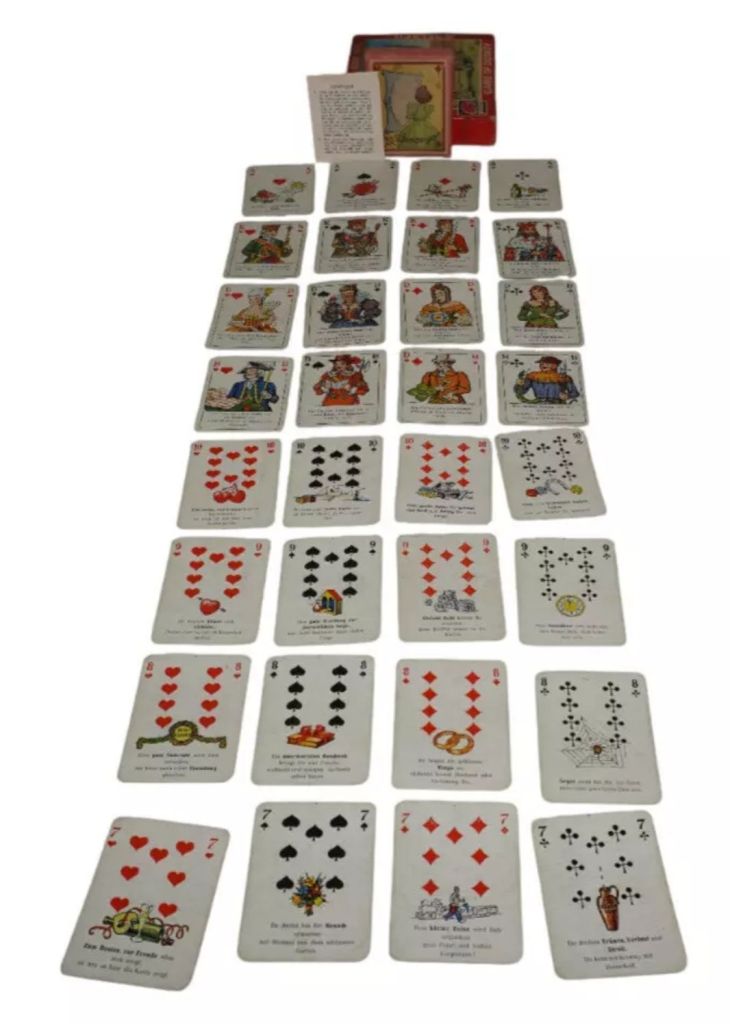
Well, Skat cards and I keep crossing paths. Ebay showed me this:

The Silberspiegel Orakel on Ebay

I won’t buy it, because there’s really no point in me owning it, but I’m going to post a personal translation of the meanings found on the cards, just as a comparison to the other systems I posted. Note: in German the descriptions rhyme (sort of). Since poetry is not among my many, many gifts, I’m not even going to try it in English. We’ll wait for the next Lord Byron to stumble upon this blog and give it a go. However, I will leave in bold type the words that are in bold in German, where possible.

The fact that some of the meanings coincide with the ones I posted, which I know to be traditional because I trust the sources, tells me that this Oracle of the Silver Mirror isn’t something someone just pulled out of his heinie, but they probably at least did some reaserch or had access to someone who could read skat cards. Still, I don’t want to exaggerate the importance of this deck: it is just a little bit of Skat trivia, in the long tradition of card fortune-telling as a parlor game.

The Silberspiegel Orakel is a fortune-telling deck about which very little is known. A source online says it’s from the 50s. Considering the old-fashioned language and the pre-reform orthography it might as well be true.

Silberspiegel Orakel (Oracle of the Silver Mirror)

A♥️ Soon an event will involve the house. It appears as though it is something good!
K♥️ The King of Hearts is your reflection in the mirror, or “He” who envelops you in his love
Q♥️ The Queen of Hearts is your reflection in the mirror, or “She” who envelops you in her love.
J♥️ The Jack of Hearts can be your son or your daughter, or just a child, broadly speaking.
10♥️ You can expect much love, much joy. The world becomes your enchanted garden.
9♥️ Kisses and love-making await you. Don’t lose your head, whether in December or in May. (This sounds much cuter in the original)
8♥️ A bit of good news is headed your way. It could also be an invitation.
7♥️ Everything turns out for the best and is cause for joy, as shown here in this card.

A♠️ Taxes, the courthouse or the government await you. Don’t pull a long face!
K♠️ There is a wealthy man (around you). He could be your father, who loves you very much
Q♠️ A well-meaning woman coddles you. She could be your mother, who protects you and takes care of you.
J♠️ The postilion brings you a letter or message with much excitement. He’s almost here!
10♠️ You are planning a long journey, toward new horizons (shores) and harbors.
9♠️ A positive change in your personal situation. That’s a certain thing.
8♠️ An unexpected gift will bring you much joy, perhaps tomorrow, maybe even today.
7♠️ You can expect a visit, with flowers from the most beautiful garden.

A♦️ An important letter or a merry celebration, perhaps a marriage or something from the stork’s nest.
K♦️ A blond man will propose to you. He may also be a relative (!!!)
Q♦️ You will go out with a blonde woman. If she’s a relative, forget about her (!!!)
J♦️ This is the big, big luck. Cut yourself a nice slice of it.
10♦️ You manage to accomplish something great, everything brings you success and lots of money.
9♦️ You may expect a bit of money. This is what the cards clearly show.
8♦️ You’ll have golden rings to wear. Maybe you’ll celebrate an engagement or a marriage.
7♦️ A small journey will restore you. Have a good journey and some fun!

A♣️ Affliction and a doctor are in your home, but a cheerful disposition can drive the devil out.
K♣️ An older man is around you. Maybe a father-in-law, maybe a public official.
Q♣️ An older woman is by your side. If she’s your mother-in-law, do as she says.
J♣️ A false person wants to charm you. Be careful, and you will charm the snake!
10♣️ Luck, affluence and a long life are gifted to you as treasures.
9♣️ Something will soon become certain. Now ask yourself what it may be.
8♣️ Aggravations are coming to your house. Someone may exploit your good will.
7♣️ Tears, loss and fights threaten you. You will overcome them with a merry disposition.

Spreads

In the LWB, two spreads are described. One is the classic große Tafel, the grand tableau of 8×4, where one reads the lines that intersect the querent’s card.

The other is a cross spread (once again), where the person’s significator is taken out, the cards fanned out and fifteen cards chosen: covering him (“Was dich deckt!”, i.e., “what covers you”), to his right (“Was dich schreckt!” i.e., “What scares you/shocks you”), below him (“Was du mit Füßen trittst”, i.e., “What you tread on with your feet”), to his left (“Was dir gewiß ist”, i.e., “what you hold for certain”) and above (“Was du im Kopfe trägst”, i.e, “What you have in your head”). The “what shocks you” position on the right is probably the opposite of the “what you hold for certain” position on the left. It probably indicates something the person doesn’t expect.

Clearly this is yet another variant of the cross spread that is so widespread across Europe, of which I was taught another variation.

The general tone of the LWB is very cautious and markedly negative toward divination, which reinforces the hypothesis that the deck originates from before the late 60s or early 70s. The reader is constantly encouraged to practice it only as a game with family members and not to practice professionally.

MQS

The Road – A Deep Dive into Cartomancy

Following my deep dive into the Door Knockers, which seems to be an exclusive symbol (or almost) of Italian cartomancy, let’s talk about a much more universal presence in many traditions: the Road. Still, even though the symbol is widespread, the interpretations may vary.

I was introduced to the symbol of the road when being taught to read playing cards. In the system I was introduced to, the Two of Clubs is the card of the steps. Actually, the word for it was “cammino”, which means a way, road or path, but it also implies the idea of people taking steps on it. That is, a ‘cammino’ is a road that exists because people walk on it, rather than being a road that has been created so that people may or may not use it. An example would be a path through a forest or a road created by pilgrims as they progress on their pilgrimage.

The Two of Clubs therefore implies forward motion toward a goal of some kind, and the taking of steps, whether literal or figurative. In this, it is similar to the Two of Wands in some Piacentine cards systems, which interpret the card as a road, largely due to its design showing two parallel staves, no doubt (although in some other Piacentine systems the road is the Knight of Wands).

The Vera Sibilla doesn’t have a road card per se, although it does have various cards connected with movement, journeying or taking steps/fighting for something. For instance, the Journey card is connected to traveling, while the Soldier may imply fighting to attain a goal (although, being a Spade card, the struggle is more accentuated).

Etteilla famously attributed the meaning of road to the Six of Swords, and his pupils developed a whole vocabulary of synonyms that extend the meaning into other areas. An example of this is the meaning of conduct, which is, figuratively speaking, the path of the person’s actions through life. Etteilla’s attribution of the meaning of road to the Six of Swords remained attached to tarot through the Golden Dawn, who preserved it in part as a possible meaning in their Book T, and then through Waite, who had Smith design the Six of Swords as a card of journey. Even in the Crowley tradition this attribution has in part been rediscovered in Eshlemann’s Liber Theta.

In the Bolognese tarot, the meaning of road is attributed usually to the Six or Eight of Wands. Some strands of the tradition also distinguish between an open road (Six/Eight of Wands) and a closed road (Nine of Wands or Ten of Swords). The road is in itself a card of forward motion, like the Two of Clubs, it can indicate short trips and it is a card of openness.

The road or path is also present in the Lenormand and Kipper traditions. I am unclear on the Lenormand meaning, as the interpretation seems to have evolved considerably through time. Most contemporary English-speaking sources seem to see it as a card of choice (with two paths, although I am unsure if this duality was intended in the original design). Most German sources interpret it differently. Since I am not a Lenormand reader, I will leave it at that.

As for the Kipper cards, they have a card called Ein langer Weg, a long road. In most of the sources I have consulted, the card is more static than in the other traditions, highlighting the element of time (some call it the Two Years card). Interestingly, in many German Skat systems of divination, the suit of Spades / Leaves is connected with movement, and the low-numbered cards, mostly the Seven and Eight, can show a short trip or something happening quickly, while the Ten is also called the long road, and it can indicate an actual journey or the need to wait a long time.

BONUS: The Road is obviously present in Geomancy as well. The Geomantic figure Via, attributed to the Moon, is a symbol of journey and change. It is the symbol with the least amount of points, only one in every position, so some sources also attribute it to the concept of ‘little’ and to the waning of something.

MQS

My Other New Skat Deck (With German Suits)

Ok, I swear this is the last deck I’m buying for a while, but it was only a couple of € on Ebay, and it was vintage, so yeah.

A Schafkopf deck

It is actually a Schafkopf deck (literally, sheep head), and it is comprised of 36 cards. As far as I can tell, not all Schafkopf reading traditions use all 36 cards, as some discard the sixes.

MQS

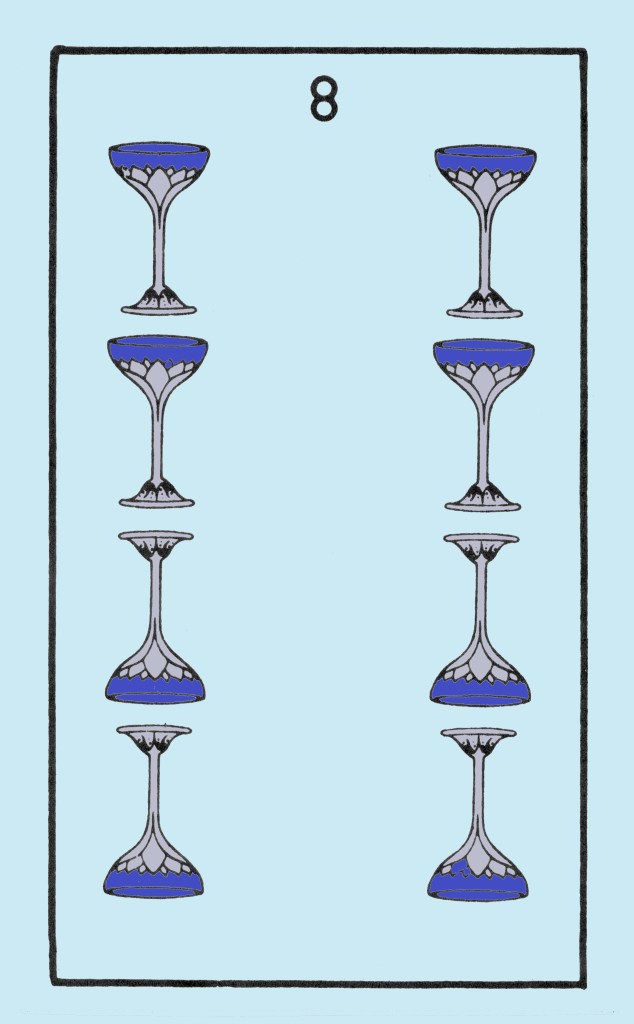
Tarot Encyclopedia – The Eight of Cups

(Note: this is a collection of the meanings attributed to the cards by some occultists in the past centuries. It does not reflect my own study or opinion of the cards. It is only meant as a quick comparative reference as I develop my own take.)

The Eight of Cups from the Builders of the Adytum (BOTA) tarot deck

Paul Foster Case (and Ann Davies)

The time period is the first decanate of Pisces, February 19 to February 28, ruled by Jupiter and Neptune.
Well-Dignified: renunciation of material success for something higher; interest in psychic and spiritual things; strong emotions; charity and helpfulness; love of travel and of scientific investigation.
Ill-Dignified: momentary success, but nothing lasting; the person to whom the card applies is overimpressionable, erratic and unsteady in his emotions; meaningless change of mood; purposeless journeying; querulous disposition.
Keyword: Instability
(From the Oracle of Tarot course)

A. E. Waite

A man of dejected aspect is deserting the cups of his felicity, enterprise, undertaking or previous concern. Divinatory Meanings: The card speaks for itself on the surface, but other readings are entirely antithetical–giving joy, mildness, timidity, honour, modesty. In practice, it is usually found that the card shews the decline of a matter, or that a matter which has been thought to be important is really of slight consequence–either for good or evil. Reversed: Great joy, happiness, feasting.
(From The Pictorial Key to the Tarot)

The Eight of Cups from the Rider Waite Smith tarot

Aleister Crowley

The Eight of Cups is called Indolence. This card is the very apex of unpleasantness. It is ruled by the planet Saturn; time, sorrow, have descended upon pleasure, and there is no strength in the element of water which can react against it. This card is not exactly “the morning after the night before”; but it is very nearly that. The difference is that the “night before” has not happened! This card represents a party for which all preparations have been made; but the host has forgotten to invite the guests; or, the caterers have not delivered the good cheer. There is this difference, though, that it is in some way or other the host’s own fault. The party that he planned was just a little bit above his capacity; perhaps he lost heart at the last moment.

[…]

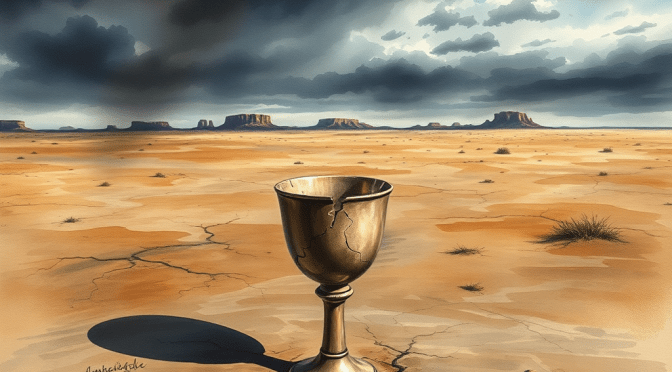
The Eight, Hod, in the suit of Water, governs this card. It shows the influence of Mercury, but this is overpowered by the reference of the card to Saturn in Pisces. Pisces is calm but stagnant water; and Saturn deadens it completely. Water appears no longer as the Sea but as pools; and there is no florescence in this card as there was in the last. The Lotuses droop for lack of sun and rain, and the soil is poison to them; only two of the stems show blossoms at all. The cups are shallow, old and broken. They are arranged in three rows; of these the upper row of three is quite empty. Water trickles from the two flowers into the two central cups, and they drip into the two lowest without filling them. The background of the card shows pools, or lagoons, in very extensive country, incapable of cultivation; only disease and miasmatic poison can flourish in those vast Bad Lands.

The water is dark and muddy. On the horizon is a pallid, yellowish light, weighed down by leaden clouds of indigo. Compare with the last card; it represents the opposite and complementary error. The one is the Garden of Kundry, the other the Palace of Klingsor. In the psychopathology of The Path, this card is the German Measles of Christian Mysticism.
(From The Book of Thoth)

The Eight of Cups from the Thoth Tarot deck

Golden Dawn’s Book T

A WHITE Radiating Angelic Hand, holding a group of stems of lotuses or waterlilies. There are only two flowers shown, which bend over the two central cups, pouring into them a white water which fills them and runs over into the three lowest, which later are not yet filled. The three uppermost are quite empty.

U U U
U U
U U U

At the top and bottom of the card are symbols Saturn and Pisces.

Temporary success, but without further results. Thing thrown aside as soon as gained. Not lasting, even in the matter in hand. Indolence in success. Journeying from place to place. Misery and repining without cause. Seeking after riches. Instability.
Hod of HB:H (Success abandoned; decline of interest).
The Angels ruling are HB:VVLYH and HB:YLHYH.

Etteilla

Blonde girl
Upright. This card, as far as the medicine of the spirit is concerned, means, in its natural position: Blonde Girl, Honest Girl, Practical Girl, Honor, Modesty, Restraint, Timidity, Fear, Apprehension, Sweetness, Attraction.
Reversed. Satisfaction, Happiness, Contentment, Gaiety, Joy, Cheerfulness, Enjoyment, Fun, Celebration. – Apology, Reparation, Discompense. – Public Joy, Spectacle, Arrangement, Recollection, Preparations, Arrangements.

MQS

Intuition – Do You Need The Gift of Prophecy?

I received a really sweet message from a fledgling occultist who wants to pick up some form of divination, but has been put off so far because they have been convinced that they don’t have “the gift”, as they put it, by which I think they meant intuition.

It is a fact of life that a certain predisposition can give you a head start. My high school chemistry teacher could explain to me every single step of how to balance a formula, and I would sort of understand it, but then, left to my own devices, I would still get it wrong. I certainly didn’t have the gift for it. But that doesn’t make chemistry hoplessly outside of my reach. If I had persevered instead of throwing my hands up and saying “oh well, at least I can read Plato in Greek” I would have definitely made some progress. It’s just that in life you’ve got to pick your battles, and I knew I wasn’t the next Marie Curie, and I did like Plato, so Plato it was.

The same holds true for the various esoteric disciplines. The kind of gift that is required to practice them is not different from the predisposition toward high school subjects. Yet there is this widespread belief something more is needed. Well, it isn’t needed.

Oracles, i.e., the various forms of divinations, are languages, and like all languages they require study and practice. The idea that all it takes is intuition is a result of the loss of understanding for occult practices that resulted from the scientific revolution, which confined anything that wasn’t understandable in terms of the rising empiricism to the realm of irrational superstition.

This new designation was either consciously or unconsciously accepted by those practicing divination, so divination became something irrational that requires non-rational tools to be practiced. This, in spite of the fact that, wherever you look around the world, and even in the West before the Enlightenment, divination is considered to be primarily made of rules to be studied and applied with intelligence.

True divination, like all parts of magic, is hopelessly technical. It has nothing to do with following your heart, much less your intuition. Speaking of which, actual intuition is a much more sacred thing than the “I can’t prove it but I know it’s true” that many make it out to be. “I just feel this is how it is” is how cults get started, which is probably why so many people who describe themselves as intuitive are so up their own asses and so full of unconscious prejudices.

That is not intuition: it is personal bias subtracting itself from scrutiny. Actual intuition is the prerogative of the great saints, and only to a lesser extent of people who are on a spiritual/esoteric path. It is rare and cannot be commanded. It is the result of brief moments of perfect union with the source of all, and for that reason it comes from outside the limitations of the individual vessel. What many call intuition are simply personal hunches that they cannot trace back to any line of reasoning.

And mind you: hunches ARE a thing. They can work, and sometimes they can help. They can also fail. Many people seem to believe that ‘intuition’ is never wrong. And fair enough, the intuition I talked about is in fact never wrong. But personal hunches CAN indeed be wrong, in the same way that a logical inference can be wrong: hunches, like reason, the senses and all other channels humans use to gather information, are fallible. The fact that many think their hunches are never wrong is simply the result of confirmation bias: if they concentrated on how often their hunches let them down on a daily basis they’d be crushed.

Another use of the term intuition is simply a cooler way of describing the facility that comes from experience. The experienced doctor comes in, eyeballs you, listens to a couple of your complaints and knows with a high degree of probability what is wrong with you. The experienced mechanic listens to the purr of your car and knows immediately it will break down in two weeks if you don’t do something about it.

That’s also not intuition, although it is far more valuable than what average psychics do. It is simply the result of having gone through the same process so often that you can skip some of the steps, at least consciously. It is the intellectual version of muscle memory.

So, can anyone become a diviner? Let me answer with a question: can anyone become a chemist? Well, no. If we all could, the human race would go extinct. But the only thing keeping you from studying chemistry is your decision and perseverance. So is with divination.

MQS

Calling Other People’s Demons By Name

In many supernatural movies about exorcism, the priest trying to free the victim needs to discover the demon’s name. This is actually founded in (part of) the real practice of exorcism and does have its roots in the magical belief of the power of names. For instance, there are certain practices in folk magic in Italy that require the magician to go to the christening of a child whose name translates to the effect he or she wants to achieve.

But belief in the power of names is not just found in Italy and it probably goes back to the most ancient and elemental relationship that humans established with the things around them in their attempt to dominate them. Traces of this fact are found in the doctrines of many Greek philosophers, sophists, poets and playwrights, and I have also found some similarities with Chinese Daoist literature. A wonderful fictionalized account of this belief is found in Ursula LeGuin’s Earthsea saga, which anyone interested in magic should read, in my humble opinion.

I am not one who seeks to psychologize occultism, although I believe that psychology is not at all a useless discovery and can be part of a modern magus’ training. I think that the attempt to reduce occultism to psychology is just as misguided as the attept to condemn anything that modernity has brought us as a deviation from an ancient splendor.

That being said, as someone who practices divination for others, there is also a certain sense in which naming works in a cathartic way. Most of the people that consult me are rather upfront about their problems, especially since I don’t ask for money and therefore feel no guilt in telling them to go sit on a cactus if they are trying to waste my time.

But people can be reticent about their issues for a variety of reasons, and malice is not always the motivation. Among the many possible reasons is the fact that people sometimes feel the need to have their demons driven out of them by someone outside of their regular field of experience.

Having someone discover our particular demon’s name without us feeding it to them can be a powerful and cathartic experience, because it smokes the demon out of the dark recesses of our subjective experience and into the light of objectivity, where it can be addressed as a definite and therefore limited issue, rather than being consumed by its overwhelming lack of contours.

Not every divination session calls forth such existential experiences, nor should we as diviners try to turn each session into a catharsis. We are not therapists and our duty is not to give people advice, although advice can certainly be given if required. Our role is to provide information, whatever that may mean in the context of each particular reading. For this reason, our language and that of our divination tool needs to be earthly, concrete and objective.

But sometimes informing the querent can mean gathering the diffuse knowledge that they already have festering inside of them and turning it into useable information by giving it its proper name.

MQS