Category Archives: Uncategorized

Boterkoek and Basterdsuiker

I mentioned around a year ago that I was learning Chinese. I still am, but after four months spent on the wrong side of mental health I decided I needed an easy win, and that’s not Chinese.

So I picked up Dutch, which, since I’m proficient in English and German, is proving to be remarkably easy. Think of it as German lite with extensive English overlaps. The grammar is essentially the same as that of German, but heavily simplified, and around 80% of the vocabulary is covered by English and German together, plus the occasional Latin influence (which is not a problem, since I’m Italian). The main challenge is pronunciation, and with it listening comprehension, but that will come with time.

When learning a foreign language it’s always a good thing to explore one’s interests through the lens of that language, and in my case that includes cooking. In short: I didn’t realize that Dutch sweets and cakes were so delicious! Within a few weeks of finishing the first Dutch course I found myself pulling up recipe after recipe from my bookmarks, until I settled on my first experiment.

My new love interest is called boterkoek, literally butter cake. The taste of the raw dough is not too dissimilar from that of Scottish shortbread, another favorite of mine. Like shortbread, the taste is heavily influenced by the butter (you don’t say) and by the interplay of sugar and the oh-so-important little teaspoon of salt.

One of the differences lies in the type of sugar that is used. As far as I know, shortbread requires regular sugar, while boterkoek, just like many other Dutch cakes and cookies, utilizes something called basterdsuiker. I am not sure what it is, exactly, but it is almost completely impossible to come by outside of Belgium and the Netherlands, so I made it myself. The result is akin to a wettish, aromatic, caramel-like sugar.

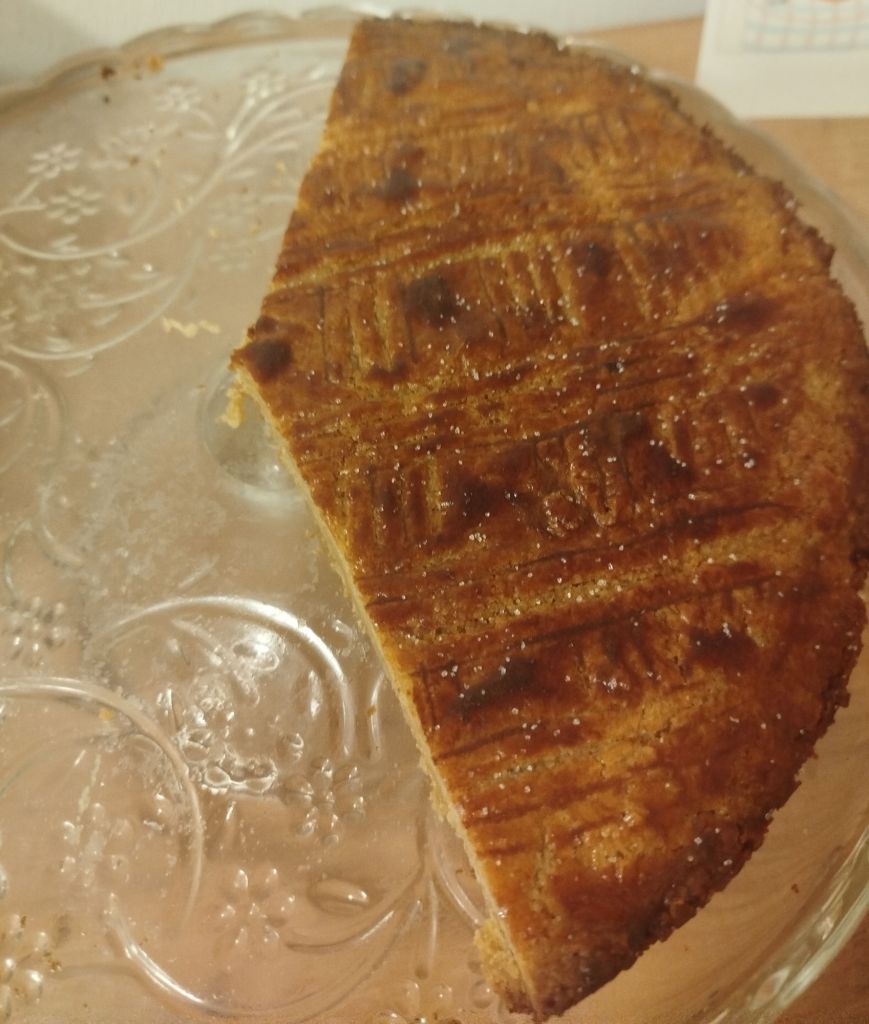
Boterkoek with basterdsuiker

The recipe I followed is this one, but since it’s in Dutch I’ll describe what I did.

To make the “bastard sugar” I poured 250g of sugar (8.8 oz) into a bowl and added 2.5 tablespoons of sugar beet syrup. I believe most other kinds of syrups will do, such as agave syrup or molasses. The recipe says you should be working with a fork to mix the two together, but I lost my patience after a few seconds and resorted to brute force with my hands. So it only took a minute to make the sugar and licking my hands at the end was extra fun.

For the cake, I mixed the basterdsuiker with 300g of all purpose flour (10.5 oz). Then I cut 250g of cold butter (8.8 oz) into small chunks, added it to the mix together with a good deal of lemon zest and 1.5 teaspoons of salt. Don’t skimp on the salt: it’s what creates the contrast with the sugar. I whisked a large egg and added a little more than half of it to the dough, then kneaded all together by hand. The final texture should be firm and sticky, not too dissimilar from raw cookie dough or shortcrust, but more moist than shortcrust.

I pressed the dough into a form lined with parchment, making sure to spread it evenly, then brushed the surface with the rest of the beaten egg and used a fork to create the design you see in the picture, and that you probably see better in the recipe I linked. Then off in the oven it went, at 180°C (355 Fahrenheit) for a little under 25 minutes (the recipe calls for 30 minutes, but my oven pulls no punches).

MQS

The Cards Won’t Tell You What’s Right

Morality is a complex thing, though this fact is lost in an age in which debates are reduced to exchanges of snarky remarks on social media. Morality is complex because it deals not in what is but in what ought to be, and what ought to be is invisible to the eyes. How ideas about what ought to be came to exist has kept philosophers and scientists occupied for thousands of years.

And this may account for a good deal of the blind desperation with which people seek something or someone who will tell them how to act. For those of a speculative mindset, reaching definitive conclusions is less a priority than exploring possibilities.

But most people feel the urgent need of external guidance. So some give themselves over to group leaders, others adhere rigidly to an ideology or religion. And those with a more woo woo view of life turn to oracles.

But divination is not a good judge of what’s morally right. If you want proof, when was the last time you laid out a spread that gave you advice that was based on moral principles completely incompatible with your own?

Having the stamp of approval of whatever projection we may make onto pretty bits of cardboards is not that good of an idea. It is a surefire way to delude ourselves and it can rob us of our agency and of our responsibility to think for ourselves.

Divination is good at telling us what is, or was, or has a good chance of being in the future. What ought to be is for us to make up our mind about.

MQS

On Managing Attention

You know the old adage that people who sell solutions need the problem to remain unsolved. I’m not talking about odd conspiratorial crap, like “the government is hiding the secret of immortality”. I’m talking about observable facts.

When influencers started becoming a thing, it was simply a bunch of kids in their rooms talking about stuff they were passionate about. Corporations then smelled the opportunity and ruined everything, as they usually do, by turning them into advertisers.

There is, obviously, absolutely nothing wrong in wanting to make money on the Internet. My mom, who was a journalist, used to say to people criticizing that she made money off of reporting tragedies, that it’s possible to do her job well with professionalism and strong ethics. A look at the Internet today shows me that most people are not my mom.

Whenever you end up in a rabbit hole on a particular topic on social media or youtube, your feed is going to fill to the brim with people trying to part you from your money. Even if they don’t want to part you from your money, they still want to part you from your attention, and your attention is one of the most precious things you have, so you should administer it well.

I’ve already talked about the pros I experienced from reducing Internet consumption, learning again to stay with myself. I’m not some kind of Luddite or Amish. I don’t dislike technical progress. I just think it should serve me rather than the other way around.

I generally try to spend less than an hour a day on the Internet (which, for a Millennial, is quite the achievement) not counting the time I spend working on the blog or yt channel. I’ve found that most days I can safely stay under 30 minutes.

What I’ve noticed in my journey toward reclaiming my own attention is that it is especially easy to spot someone trying to sell you something on the Internet. Again, I’m not saying it is wrong to sell goods and services, and in a way all is fair in love and marketing, but the point is that my aim of keeping my attention to myself and deploying it only for worthwhile pursuits is at odds with most people’s need to make a couple of bucks off of me.

You can immediately spot a youtuber (and probably tiktoker) who is out to get your attention and/or money because they have a distinctive (and very effective) way of serializing even the most minute unit of crappy information they are going to give you. For instance, if you watch a video about fitness, you’ll be swamped with videos all telling you how you are missing out on every possible secret hack.

You will always notice that their way of pushing out ‘content’ is to make it seem as though that video is always going to be exactly the one thing you need in whatever niche you’re exploring, and without which you will utterly fail or be lied to by invisible entities who won’t tell you the truth about it.

That is, until the next video, which will drop 24 hours later, and which will also be exactly the one thing you need and are missing and are being lied to by others and without which you’ll fail. Once you start spotting these trends it becomes almost amusing to see how much sludge can be manufactured with so little actual material.

MQS

How ‘Topic’ Cards Behave

In every deck there are what we might call topic cards, that is, cards that represent a specific field of life: family, work, money, health, love, the law, etc.

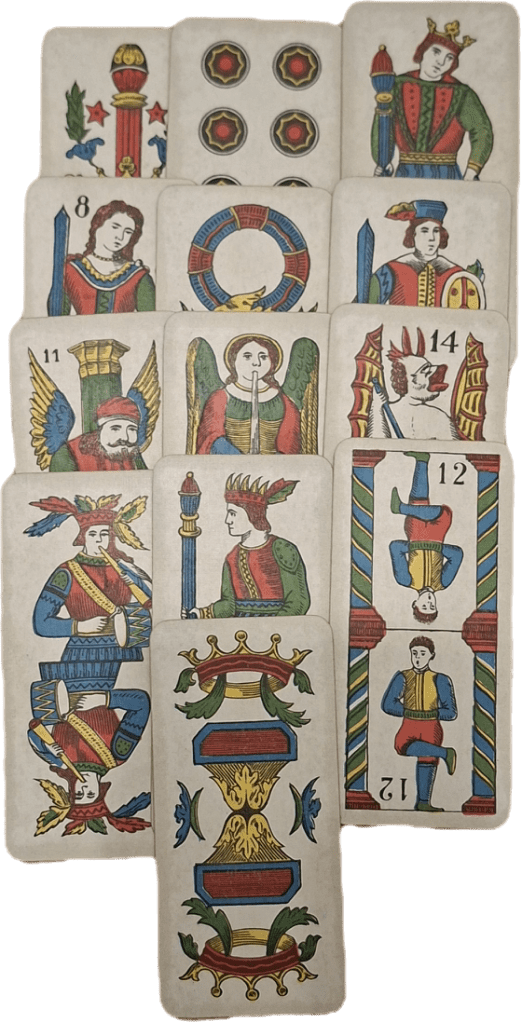
All or most of these cards also have general meanings that apply to various contexts. For instance, the Ace of Cups in the Bolognese Tarot is the home card (just like the Ace of Hearts in playing cards or the Two of Hearts in the Vera Sibilla), so it is the topic card for everything relating to family and house questions. But it can also indicate that someone belongs to the family, e.g., when it comes up next to a court card. It can also indicate the inner side of one’s experience of life, one’s inmost, intimate world, etc. So it can also show that something is close to us and touches us.

We need to distinguish between a card acting as a stand-in for a specific topic and the same card acting out a particular meaning. To keep with the Ace of Cups example, when it comes up in a question about work, it might show that the querent’s work life interferes with their family life or vice versa, or that they work from home, or that their work environment is family-like. In all these cases, the house card qualifies the other cards by adding details of its own.

But when the House card is simply a stand-in for the topic ‘home and family life’, the card says nothing about the topic itself. It doesn’t qualify the reading. It simply tells us, “this is the topic.” It is then the role of the other cards to describe the situation, qualifying it in a positive or negative way.

When we are doing a general reading with no question, or with all the cards down on the table, this is all well and good: we see if the person’s significator is next to any of the topic cards, showing that that topic is important, and then we read the cards surrounding the topic card relating them to the topic.

When the question has been specified, though, extra care must be taken trying to figure out if the topic cards that appear are qualifying the topic of the question or if they are coming up to ignore the question and talk about something else. This is not always easy.

Let’s say you asked about work, but the house card comes up. Why? Is it because the home is involved? Or is it because the cards have decided to bypass your question and discuss something else? Or is it both? (It CAN be both). One way to solve this issue is to see if there are topic cards relating to the question, or if at least the cards seem to be predominantly of a nature that seems more akin to the question asked (e.g., lots of Diamonds and Clubs in a work-related question).

The other way is to see if the cards next to the rogue topic card coalesce with it to form a coherent statement that has nothing to do with work, or if instead the topic card allows itself to be absorbed into the querent’s question.

The third way is simply to work with the querent. This is always a good idea. After all, our aim is to interpret the oracle correctly, not to impress people.

Cards that have the potential to be topic cards are always quite strong in a reading, so it is always good to observe them first. Often they form focal points in the interpretation of the spread. Sometimes some cards in some readings can even be ignored, but topic cards always seem to have something to say. We ignore them at our peril.

MQS

The Scrolling Mind

Back in my smoking days, I remember thinking that the biggest obstacle to quitting was not just the physical addiction to nicotine, but the fact that cigarettes had simply become a part of my day. Addictions slowly (or quickly) carve time for themselves in our life, so that even when we decide to stop engaging in the addictive behavior, there is a chasm left between the time before engaging in it and the time after engaging in it that needs to be filled. The hardest thing is beginning to reimagine our life as something whole even without the thing we stop doing.

I was talking to my husband’s little cousin the other day. She’s 16 and she is the typical fried-brained teenager who has been conditioned to expect that anything should be presented in small 15-second soundbites that you can scroll through if the gratification doesn’t hit within the first two seconds. By the way, I’m not saying this as a jab at the younger generations: my generation was fried-brained in a different sense, and besides, I know plenty of people older than me whose mind has been beaten to a pulp by the mechanisms of social media.

What I thought was funny, but also a bit worrying, was her fidgety demeanor whenever she had to spend more than a couple of minutes without fiddling with her phone. She was in principle no different than me after an hour of not smoking–except that the withdrawal symptoms kick in much more quickly. I asked her if she could fathom spending a day doing absolutely nothing that she didn’t have to do (e.g., going to school, help clean the house, etc.) and she looked at me as if I started speaking in tongues.

To be fair, asking this of most teenagers is asking too much, regardless of the generation, and she’s the ‘go go go’ type anyway. But yesterday I spent the day doing exactly that–nothing that I didn’t have to do. It was refreshingly hard to accomplish.

Coming to a point of stillness is difficult when we are constantly bombarded by stimuli. Plus, our conscience of other people’s awareness and attention has expanded in recent years from the couple of people around us to potentially the whole world.

The ringing silence I experienced was a reminder of how abstract this type of conscience actually is: I am not in front of an audience. I am alone, a point in the existence reflecting upon itself. It was one of the longest days I had in my recent memory, but not in a bad sense. I can start to see why so many ancient stoics said that each day can be treated as a lifetime in and of itself.

I feel this is a good exercise to do regularly, so I will incorporate it into my practice. It is not meant to be a flight from reality. It is a way of coming back to it so I don’t lose sight of its right proportions.

MQS

The Table – A Deep Dive Into Cartomancy

You’ve got to appreciate how folk cartomancy takes the objects of our everyday life and turns them into means for predicting the future. This is, after all, probably how cartomancy started: people needing to know what tomorrow would bring adapting the symbolism of the decks to which they had access (tarot, playing cards and later oracle cards) to the objects and situations that constituted their daily lives and their symbolic interpretation.

From a philosophical perspective this shows great acumen and observational ability on their part. They may not have had a piece of paper that qualified them to count angels dancing on pinheads, but they were possessed of great perception–which is only natural, considering that on their perception depended their survival.

From an occult standpoint, it further indicates that they were perfectly acquainted with the power of symbols to connect the inner and outer realms, which is the foundation of all forms of magic.

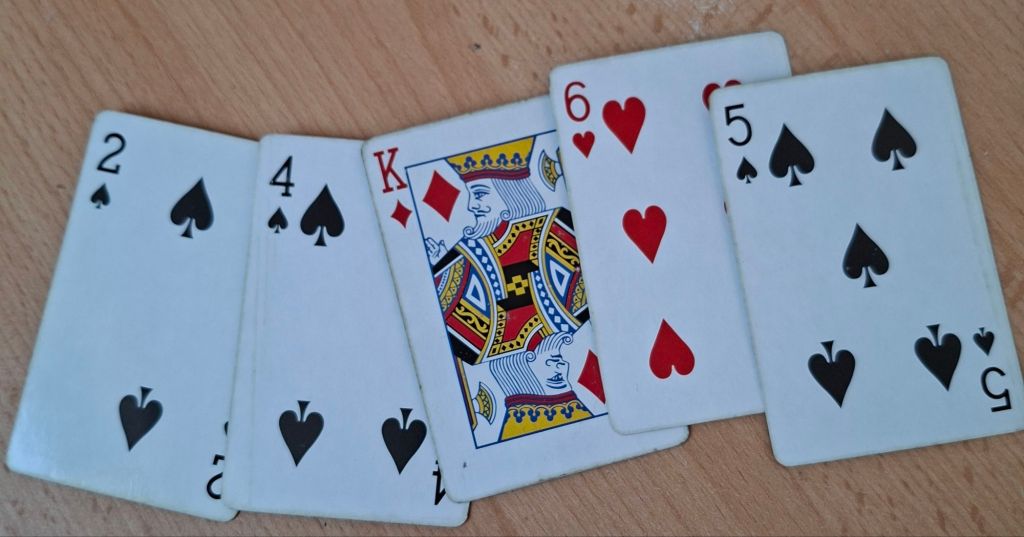
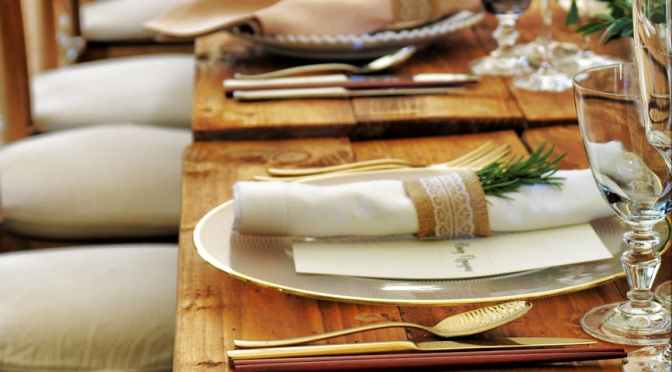
One of the recurring symbols of folk cartomancy is the table. In the system of cartomancy with playing cards that I was taught, this corresponds to the Four of Clubs, certainly due to the squarish (Four) and social (Clubs) nature of the card. The Four of Clubs is chiefly the card of words and talks, but it extends to all contacts we develop with others: we can sit at the table with them and talk, negotiate, have fun, etc.

In the Vera Sibilla, we must distinguish between the table in general and the festive table. The former is assigned to the Ace of Hearts, the Conversation. This is also the card of words and talks, but being the Ace of Hearts it is also representative of your family or the people you live with. Furthermore, the table here can also be seen as the table you eat at, due to the connection of the card with the hearth and with everything to do with your mouth and throat. The festive table is more a prerogative of the Nine of Clubs, which is connected with celebrations, fun and banquets.

The first written record of the cartomantic concept of the table is found in the earliest recorded system of reading the Bolognese tarot with 35 cards: here the table is given to the Ace of Coins. This is a meaning that still exists in all traditions I am aware of, although the card has also doubled down as the card of big money in the 45-card system I know, the card of official documents and letters for Germana Tartari and of work for Ingallati.

I am unclear as to why the Ace of Coins was chosen, but I guess the round shape of the heavily stylized coin could be seen as a round table or as a centerpiece. Broadly, the table in the Bolognese tradition is seen as the place of direct contact with others, of conviviality and of business transactions. The card also symbolizes ‘l’ora di tavola’, the time of day you sit at the table, usually lunch time and therefore, more generally, the day as opposed to the night.

The second earliest recording of the symbol of the table comes from Etteilla, whose source attributed it to the Ace of Cups. Here Etteilla and his students tried to extend the meaning of the table beyond the common experience of it by playing on the other meanings of the word ‘table’, so that for instance, the Ace of Hearts for him can also be the table of laws (as in, the one Moses received).

I am unaware of whether the Lenormand or Kipper traditions contemplate the symbolism of the table, though the symbol is not obviously represented in the cards. What I do know is that the symbol is also present in most Italian playing card system, so that I am aware of at least one where the Four of Coins indicates the table.

MQS

“I Do X But I Am Still Miserable”

I keep coming across people on the Internet who dabble either in magic or spirituality (generally alternative spirituality) who lament that after a while they still feel miserable. Although my heart breaks for them, I think there is great confusion surrounding the place of spirituality and, let’s say, alternative practices.

One of the very few perks of rigid orthodoxy is that it exists beyond individual’s will, so that each practitioner needs to adapt to it rather than adapting it to themselves.

Once the idea of orthodoxy crumbled, at least in the West, spiritual and other practices became a supermaket of parts that each person could adapt to their own whim, picking and choosing what currently fit their mental narrative.

Although with some discernment this power of personal choice  can yield great results, what in practice often ends up happening is that spirituality is reduced to a crutch for personal prejudices about oneself, others and the world.

In the end, each individual flavor of postmodern spirituality is more an inkblot test of what the person would be better off discussing with a therapist than a workable spiritual path.

What’s more, the expectation of finding a definitive cure for life is always dangerous: firstly, because life is not an illness; secondly, because spirituality is not a good substitute for therapy or other forms of support; and thirdly, and most importantly, because anything that promises to turn our life into happy trip is always to be looked at with skepticism. No serious spiritual or magical doctrine can promise that.

The life of someone who always smiles and is always happy is not balanced. If anything, it’s creepy. There is a time for happiness and there is a time for sorrow. A balanced person is someone who responds to life in an adequate manner depending on the concrete situation. Look at the traditional descriptions of wisdom in Daoism or ancient Western philosophy, and you’ll always note that the wise person is the one who always reacts in the adequate manner, with as little influence from their personal demons as possible.

It is unfortunate that these practices are often the go-to for people who would benefit from other types of help. Sometimes they simply cannot afford official help, and this is another conversation, so they simply look for something they can afford and promises them miracles.

MQS

On Papal Elections and the Power of Rituals

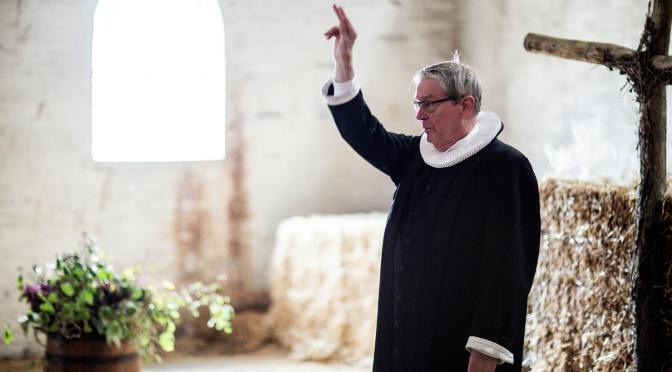
Regardless of what one thinks of the church as an institution, it is hard not to be impressed by the sheer power and majesty of its rituals and customs. As a non-Christian, or rather as a post-Christian, I am still convinced that the Catholic mass, especially in its older forms, is one of the best-constructed rituals in the history of humanity (I was reminded of it during my dad’s funeral last year).

When I talk about power I am not talking about political or social power, which are undeniable. I’m talking about the power to create a ritualized experience of reality that mobilizes real forces.

This, I’ve noticed, is something many people are not willing to concede, partly out of spite toward the institution (which I may understand), partly as a result of the typical view underpinning modern esotericism that anything goes, and so the rituals of the church have no particular quality compared to the ones anyone could make up on the go, except maybe that traditional religious rituals, being older, have become more powerful through engramming.

Let us leave aside for now the memetic esoteric aspect, which however is certainly present, especially with how Leo XIV’s election has literally been turned into one of the biggest memeplexes I’ve seen in recent times.

I think that the fundamental misconception that is at the root of so much esoteric junk is that something becomes true simply by way of repetition. Yet, in spite of the dogma, reality is not merely what we make of it, as anyone who tried to fly off a skyscraper won’t be able to testify.

True: just like the small mind (the human mind) the great mind (the larger universe) is endowed with a certain level of plasticity. Just like the small brain can be impressed with habits, so can the great brain be impressed with certain forms or procedures that wouldn’t naturally arise. That’s because there is a difference between different gradations of reality: my reflection in the mirror is, from a physical standpoint, just as real as me, but in another sense, being completely dependent on the form of the mirror and my own form, it is subordinated and can be changed, to a degree.

But good rituals are not powerful simply because they have been repeated enough times. While repetition does engram rituals with an authentic foundation, if we take the time to study various magical traditions, we notice that they often utilize the ritual blueprint of the dominant religion of their area, but bending it in other directions.

The spiritual “aeon” within which they operate is their source of authentic power, because most major religions and philosophical currents do capture something of the universal life and its might. Authenticity is the keyword.

In addition, there may sometimes be certain powerful experiences that allow different traditions to fuse together into new ones (take for instance some of the magical traditions created by the descendants of African slaves converted to Christianity).

But the root of magic is always an authentic source of power, which is ultimately always the same, but which is channeled and shaped through the form of the religious or philosophical tradition, and regardless of the how corrupt or unlikeable the representatives of that tradition become. Lacking it, the most one can conjure, if anything at all, are some cheap tricks of lower esoteric jugglery.

This is also why it’s important to take the time to soak into the traditions we want to work with. Eclecticism is pure vanity if it is divorced from understanding. If I had a euro for everytime I saw someone on social media simply plucking formulas left and right, one from the magical papyri, one from esoteric Daoism and so on, without understanding their philosophical contours… Well I wouldn’t be able to buy much, because I’m not often on social media, but a nice coat would probably be within my price range.

MQS

Stuff You Don’t HAVE to Believe: the Kybalion

It is probably one of the ironies of history that nowadays, many who become curious about Hermeticism bump into the Kybalion as their first text, either directly or indirectly through reelaborations of the same ideas. This in spite of the fact that the Kybalion has nothing to do with Hermeticism.

There are a couple of reasons for this: for one, because whoever wrote the Kybalion managed to fool some leading Occultists into believing it was an authentic text (most notably Paul Foster Case, but not only); for two, because the so called laws that are discussed in the text have become embedded into pop-alternative-spirituality since the late 60s. They are like invasive weeds that one can never truly get rid of.

Many people, even today, buy into the Kybalion in different ways. The first line of defense is asserting that it is an authentic text. As few people now can truly believe this in good faith, a more apparently reasonable approach has been to assert that the text is a forgery but its contents are an authentic distillation of Hermetic principles.

This is also demonstrably false. If you read any of the authors who are considered part of the Western philosophical or esoteric canon, you will find no similarity with the Kybalion’s ideas until, perhaps, well into American transcendentalism, unless you are desperate to force the texts to say what they don’t.

Certainly those ideas are not found in the Hermetica. True, there are superficial similarities of vocabulary, on occasion. For instance, you will often read the author(s) of the Hermetica ramble on about “the Mind”, so it would seem that the Kybalion’s emphasis on the mind would place it in the Hermetic tradition.

Too bad that the ancient concept of ‘mind’, as used in philosophical and magical texts, had almost nothing to do with the psychologized concepts of it that fall under the same name and that clearly show that the Kybalion is a modern text both in its authorship and in its content. In fact, it is pretty much a condensation of very fashionable late XIX century ideas, and little more beyond that.

Broadly speaking, no one with some level of historical awareness can believe the Kybalion is anything more than a rather straightforward summary of Victorian beliefs.

This is what leads another group of people to say that the Kybalion is neither an authentic text nor an authentically Hermetic text, but its principles are still valid. Of course you can believe what you please, but there is no necessity of believing in its “laws”, which are often either not laws at all or are simply superficial and partial observations about mental phenomena cast in a glamorous esoteric light. Nothing of what is described in that book is either self-evident, clearly logical or practically useful.

All in all there is nothing of special interest contained in the Kybalion. That it hasn’t been forgotten like the mass of esoteric booklets produced in the same period is largely due to the way it marketed itself and was marketed by others.

MQS