Category Archives: Tarot

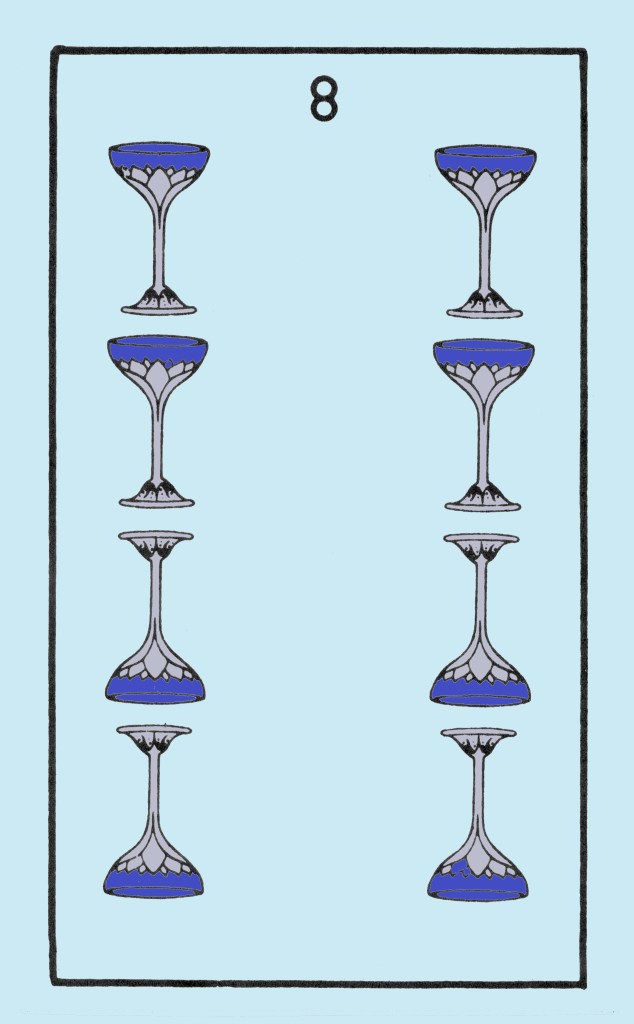
Tarot Encyclopedia – The Eight of Cups

(Note: this is a collection of the meanings attributed to the cards by some occultists in the past centuries. It does not reflect my own study or opinion of the cards. It is only meant as a quick comparative reference as I develop my own take.)

The Eight of Cups from the Builders of the Adytum (BOTA) tarot deck

Paul Foster Case (and Ann Davies)

The time period is the first decanate of Pisces, February 19 to February 28, ruled by Jupiter and Neptune.
Well-Dignified: renunciation of material success for something higher; interest in psychic and spiritual things; strong emotions; charity and helpfulness; love of travel and of scientific investigation.
Ill-Dignified: momentary success, but nothing lasting; the person to whom the card applies is overimpressionable, erratic and unsteady in his emotions; meaningless change of mood; purposeless journeying; querulous disposition.
Keyword: Instability
(From the Oracle of Tarot course)

A. E. Waite

A man of dejected aspect is deserting the cups of his felicity, enterprise, undertaking or previous concern. Divinatory Meanings: The card speaks for itself on the surface, but other readings are entirely antithetical–giving joy, mildness, timidity, honour, modesty. In practice, it is usually found that the card shews the decline of a matter, or that a matter which has been thought to be important is really of slight consequence–either for good or evil. Reversed: Great joy, happiness, feasting.
(From The Pictorial Key to the Tarot)

The Eight of Cups from the Rider Waite Smith tarot

Aleister Crowley

The Eight of Cups is called Indolence. This card is the very apex of unpleasantness. It is ruled by the planet Saturn; time, sorrow, have descended upon pleasure, and there is no strength in the element of water which can react against it. This card is not exactly “the morning after the night before”; but it is very nearly that. The difference is that the “night before” has not happened! This card represents a party for which all preparations have been made; but the host has forgotten to invite the guests; or, the caterers have not delivered the good cheer. There is this difference, though, that it is in some way or other the host’s own fault. The party that he planned was just a little bit above his capacity; perhaps he lost heart at the last moment.

[…]

The Eight, Hod, in the suit of Water, governs this card. It shows the influence of Mercury, but this is overpowered by the reference of the card to Saturn in Pisces. Pisces is calm but stagnant water; and Saturn deadens it completely. Water appears no longer as the Sea but as pools; and there is no florescence in this card as there was in the last. The Lotuses droop for lack of sun and rain, and the soil is poison to them; only two of the stems show blossoms at all. The cups are shallow, old and broken. They are arranged in three rows; of these the upper row of three is quite empty. Water trickles from the two flowers into the two central cups, and they drip into the two lowest without filling them. The background of the card shows pools, or lagoons, in very extensive country, incapable of cultivation; only disease and miasmatic poison can flourish in those vast Bad Lands.

The water is dark and muddy. On the horizon is a pallid, yellowish light, weighed down by leaden clouds of indigo. Compare with the last card; it represents the opposite and complementary error. The one is the Garden of Kundry, the other the Palace of Klingsor. In the psychopathology of The Path, this card is the German Measles of Christian Mysticism.
(From The Book of Thoth)

The Eight of Cups from the Thoth Tarot deck

Golden Dawn’s Book T

A WHITE Radiating Angelic Hand, holding a group of stems of lotuses or waterlilies. There are only two flowers shown, which bend over the two central cups, pouring into them a white water which fills them and runs over into the three lowest, which later are not yet filled. The three uppermost are quite empty.

U U U
U U
U U U

At the top and bottom of the card are symbols Saturn and Pisces.

Temporary success, but without further results. Thing thrown aside as soon as gained. Not lasting, even in the matter in hand. Indolence in success. Journeying from place to place. Misery and repining without cause. Seeking after riches. Instability.
Hod of HB:H (Success abandoned; decline of interest).
The Angels ruling are HB:VVLYH and HB:YLHYH.

Etteilla

Blonde girl
Upright. This card, as far as the medicine of the spirit is concerned, means, in its natural position: Blonde Girl, Honest Girl, Practical Girl, Honor, Modesty, Restraint, Timidity, Fear, Apprehension, Sweetness, Attraction.
Reversed. Satisfaction, Happiness, Contentment, Gaiety, Joy, Cheerfulness, Enjoyment, Fun, Celebration. – Apology, Reparation, Discompense. – Public Joy, Spectacle, Arrangement, Recollection, Preparations, Arrangements.

MQS

Intuition – Do You Need The Gift of Prophecy?

I received a really sweet message from a fledgling occultist who wants to pick up some form of divination, but has been put off so far because they have been convinced that they don’t have “the gift”, as they put it, by which I think they meant intuition.

It is a fact of life that a certain predisposition can give you a head start. My high school chemistry teacher could explain to me every single step of how to balance a formula, and I would sort of understand it, but then, left to my own devices, I would still get it wrong. I certainly didn’t have the gift for it. But that doesn’t make chemistry hoplessly outside of my reach. If I had persevered instead of throwing my hands up and saying “oh well, at least I can read Plato in Greek” I would have definitely made some progress. It’s just that in life you’ve got to pick your battles, and I knew I wasn’t the next Marie Curie, and I did like Plato, so Plato it was.

The same holds true for the various esoteric disciplines. The kind of gift that is required to practice them is not different from the predisposition toward high school subjects. Yet there is this widespread belief something more is needed. Well, it isn’t needed.

Oracles, i.e., the various forms of divinations, are languages, and like all languages they require study and practice. The idea that all it takes is intuition is a result of the loss of understanding for occult practices that resulted from the scientific revolution, which confined anything that wasn’t understandable in terms of the rising empiricism to the realm of irrational superstition.

This new designation was either consciously or unconsciously accepted by those practicing divination, so divination became something irrational that requires non-rational tools to be practiced. This, in spite of the fact that, wherever you look around the world, and even in the West before the Enlightenment, divination is considered to be primarily made of rules to be studied and applied with intelligence.

True divination, like all parts of magic, is hopelessly technical. It has nothing to do with following your heart, much less your intuition. Speaking of which, actual intuition is a much more sacred thing than the “I can’t prove it but I know it’s true” that many make it out to be. “I just feel this is how it is” is how cults get started, which is probably why so many people who describe themselves as intuitive are so up their own asses and so full of unconscious prejudices.

That is not intuition: it is personal bias subtracting itself from scrutiny. Actual intuition is the prerogative of the great saints, and only to a lesser extent of people who are on a spiritual/esoteric path. It is rare and cannot be commanded. It is the result of brief moments of perfect union with the source of all, and for that reason it comes from outside the limitations of the individual vessel. What many call intuition are simply personal hunches that they cannot trace back to any line of reasoning.

And mind you: hunches ARE a thing. They can work, and sometimes they can help. They can also fail. Many people seem to believe that ‘intuition’ is never wrong. And fair enough, the intuition I talked about is in fact never wrong. But personal hunches CAN indeed be wrong, in the same way that a logical inference can be wrong: hunches, like reason, the senses and all other channels humans use to gather information, are fallible. The fact that many think their hunches are never wrong is simply the result of confirmation bias: if they concentrated on how often their hunches let them down on a daily basis they’d be crushed.

Another use of the term intuition is simply a cooler way of describing the facility that comes from experience. The experienced doctor comes in, eyeballs you, listens to a couple of your complaints and knows with a high degree of probability what is wrong with you. The experienced mechanic listens to the purr of your car and knows immediately it will break down in two weeks if you don’t do something about it.

That’s also not intuition, although it is far more valuable than what average psychics do. It is simply the result of having gone through the same process so often that you can skip some of the steps, at least consciously. It is the intellectual version of muscle memory.

So, can anyone become a diviner? Let me answer with a question: can anyone become a chemist? Well, no. If we all could, the human race would go extinct. But the only thing keeping you from studying chemistry is your decision and perseverance. So is with divination.

MQS

Bolognese Tarot – The Love / Couple’s Spread (Three Variants)

The Bolognese Tarot tradition has several spreads for the couple. One that has been taught to me, and which I have also found is practiced by other Bolognese tarot readers, is the following:

123456
HeShe
789101112
131415

He and She are, of course, the King and Queen of Wands. However, we can explore the relationship between any two individuals. The cards above the two significators show what’s on their mind (1-2-3 his mind, 4-5-6 her mind, in this case).

The cards covering them (7-8-9 for him, 10-11-12 for her) are ambiguous. The way the method has been passed down to me, these cards show what’s going on with him and what’s going on with her, but I have found other readers (such as Rossella Giliberti) who say that these cards show what’s in his heart and what’s in her heart. Choose the variant you prefer, and remember that these are local methods, so there’s bound to be variations between one town and the other. The final three cards (13-14-15) show what’s happening to them as a couple in the near future, or if there is potential, or what connects them.

Another spread, which is found in Maria Luigia Ingallati’s book on the Bolognese Tarot (which I will review in the near future together with the few others that have been published). The layout is as follows:

HeShe
1231516178910
456181920111213
72114

Here we have cards 1 through 7 talking about what’s going on with him, cards 8 through 14 telling us what’s going on with her, and finally the group in the center (15 through 21) talking about them as a couple. Another reader I know (Monica Barbieri) uses thirteen cards for each group instead of seven.

Another variant is found in Lia Celi’s out-of-print book on the 45-card method. This is the layout:

He and She
12345
67 – 89
1011 12
13 – 14
15

As can be seen, this is a pyramid spread. Here, cards 1, 2, 6, 7, 10 and 13 talk about him, cards 4, 5, 8, 9, 12 and 14 talk about her, and cards 3, 11 and 15 talk about them.

These methods are specific for analyzing two people’s interaction, but nothing prevents you from using a simpler spread, like the thirteen card spread. To be honest, that’s what I do. Still, this is an interesting bit of traditional lore about the Bolognese tarot.

MQS

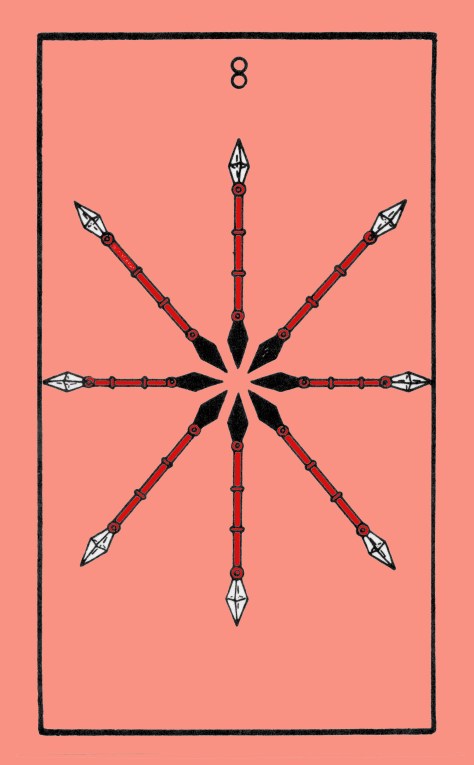
Tarot Encyclopedia – The Eight of Wands

(Note: this is a collection of the meanings attributed to the cards by some occultists in the past centuries. It does not reflect my own study or opinion of the cards. It is only meant as a quick comparative reference as I develop my own take.)

The Eight of Wands from the Builders of the Adytum (BOTA) Tarot deck

Paul Foster Case (and Ann Davies)

As the first decanate of Sagittarius, the Eight of Wands is the time period of November 22 to December 1, ruled by Jupiter, suggesting a combination of the powers of Mercury and Jupiter together with the zodiacal attributions of the sign Sagittarius and its natural 9th house. Well-Dignified: aspiration; foresight; rapid expression of force, but quickly expended; the acceleration of anything in which the querent is interested; generosity; confidence ; freedom.
Ill-Dignified: violence; warfare; rapacity; insolence; theft or robbery. These are suggested by some of the evil meanings connected with Hermes or Mercury associated with misuse of human intellect.
Keyword: Swiftness
(From the Oracle of Tarot course)

A. E. Waite

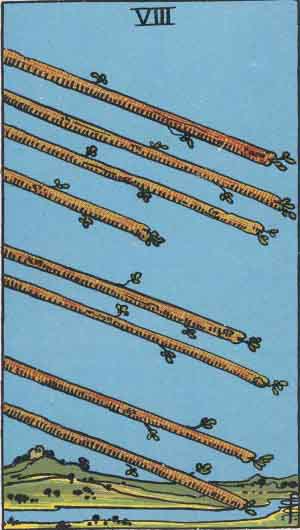
The card represents motion through the immovable-a flight of wands through an open country; but they draw to the term of their course. That which they signify is at hand; it may be even on the threshold. Divinatory Meanings: Activity in undertakings, the path of such activity, swiftness, as that of an express messenger; great haste, great hope, speed towards an end which promises assured felicity; generally, that which is on the move; also the arrows of love. Reversed: Arrows of jealousy, internal dispute, stingings of conscience, quarrels; and domestic disputes for persons who are married.
(From The Pictorial Key to the Tarot)

The Eight of Wands from the Rider Waite Smith tarot

Aleister Crowley

The Eight of Wands is called Swiftness, as one might expect from its attribution to Mercury and Sagittarius. This is an etherealization of the idea of fire; all gross elements have disappeared.

[…]

The remaining three cards of the suit belong to Sagittarius, which represents the subtilizing of the Fiery energy; and Mercury rules the card, thus bringing down from Chokmah the message of the original Will.

The card also refers to Hod, splendour, in the suit of Fire, whence it refers to the phenomena of speech, light, electricity. The pictorial representation of the card shows the Light-wands turned into electrical rays, sustaining or even constituting Matter by their vibrating energy. Above this restored universe shines the rainbow; the division of pure light, which deals with maxima, into the seven colours of the spectrum, which exhibit interplay and correlation.

This card, therefore, represents energy of high velocity, such as furnishes the master-key to modern mathematical physics. It will be noted that there are no flames; they have all been taken up into the wands to turn them into rays. On the other hand, the electric energy has created intelligible geometrical form.
(From The Book of Thoth)

The Eight of Wands from the Thoth Tarot

Golden Dawn’s Book T

FOUR White Radiating Angelic Hands (two proceeding from each side) issuant from clouds; clasped in two pairs in the centre with the grip of the First Order.
They hold eight wands, crossed four with four. Flames issue from the point of junction. Surmounting the small wands with flames issuing down them, and placed in the centre at the top and bottom of the card respectively, are the symbols of Mercury and Sagittarius for the Decan.

Too much force applied too suddenly. Very rapid rush, but quickly passed and expended. Violent, but not lasting. Swiftness, rapidity, courage, boldness, confidence, freedom, warfare, violence; love of open air, field-sports, gardens and meadows. Generous, subtle, eloquent, yet somewhat untrustworthy; rapacious, insolent, oppressive. Theft and robbery. According to dignity.

Hod of HB:Y (Hasty communications and messages; swiftness).
Therein rule the Angels HB:NThHYH and HB:HAAYH.

Etteilla

Countryside
Upright. This card, as far as its medicine is concerned, means, in its natural position: Countryside, Field, Plain, Agriculture, Cultivation, Landed Property, Immovable Property, Farm, Homestead, Garden, Orchard, Prairie, Forest, Grove, Foliage, Pleasure, Amusement, Leisure, Pastime, Recreation, Enjoyment, Peace, Calm, Tranquility, Innocence, Country Life. – Forest, Valley, Mountain, Battlefield.
Reversed. Inner dispute, Examination, Reasoning, Incomprehension. – Regret, Remorse, Repentance, Inner turmoil, Irresolution, Uncertainty, Indecision, Inconceivable, Incomprehensible, Doubt, Scruple, Fearful consciousness.

MQS

Is He Gay? (Example Reading)

A reading with the Bolognese Tarot. Like and subscribe to my YT channel to support my work

MQS

Calling Other People’s Demons By Name

In many supernatural movies about exorcism, the priest trying to free the victim needs to discover the demon’s name. This is actually founded in (part of) the real practice of exorcism and does have its roots in the magical belief of the power of names. For instance, there are certain practices in folk magic in Italy that require the magician to go to the christening of a child whose name translates to the effect he or she wants to achieve.

But belief in the power of names is not just found in Italy and it probably goes back to the most ancient and elemental relationship that humans established with the things around them in their attempt to dominate them. Traces of this fact are found in the doctrines of many Greek philosophers, sophists, poets and playwrights, and I have also found some similarities with Chinese Daoist literature. A wonderful fictionalized account of this belief is found in Ursula LeGuin’s Earthsea saga, which anyone interested in magic should read, in my humble opinion.

I am not one who seeks to psychologize occultism, although I believe that psychology is not at all a useless discovery and can be part of a modern magus’ training. I think that the attempt to reduce occultism to psychology is just as misguided as the attept to condemn anything that modernity has brought us as a deviation from an ancient splendor.

That being said, as someone who practices divination for others, there is also a certain sense in which naming works in a cathartic way. Most of the people that consult me are rather upfront about their problems, especially since I don’t ask for money and therefore feel no guilt in telling them to go sit on a cactus if they are trying to waste my time.

But people can be reticent about their issues for a variety of reasons, and malice is not always the motivation. Among the many possible reasons is the fact that people sometimes feel the need to have their demons driven out of them by someone outside of their regular field of experience.

Having someone discover our particular demon’s name without us feeding it to them can be a powerful and cathartic experience, because it smokes the demon out of the dark recesses of our subjective experience and into the light of objectivity, where it can be addressed as a definite and therefore limited issue, rather than being consumed by its overwhelming lack of contours.

Not every divination session calls forth such existential experiences, nor should we as diviners try to turn each session into a catharsis. We are not therapists and our duty is not to give people advice, although advice can certainly be given if required. Our role is to provide information, whatever that may mean in the context of each particular reading. For this reason, our language and that of our divination tool needs to be earthly, concrete and objective.

But sometimes informing the querent can mean gathering the diffuse knowledge that they already have festering inside of them and turning it into useable information by giving it its proper name.

MQS

The Door Knockers – A Deep Dive into Italian Cartomancy

In almost all cartomancy systems, Italian or otherwise, the Ace of Hearts/Cups is the house. Here the Sibilla is an exception, since it relegates the House to the Two of Hearts, although the Ace of Hearts still has connections to the idea of family and people living together. In the second most widespread Sibilla deck in Italy, which is the Sibilla Regionale, which uses the suits of the Neapolitan cards, the Ace of Cups is once again the house.

One thing I have so far never found in non-Italian systems, which on the contrary is very widespread in Italy, is the concept of the door knockers, also known as ‘close to home’. This is a meaning that is found in many regional Italian cartomancy systems, and keep in mind that almost everything in Italy is regional, since regions have a much older history as separate states than Italy itself, if we discount the Roman Empire.

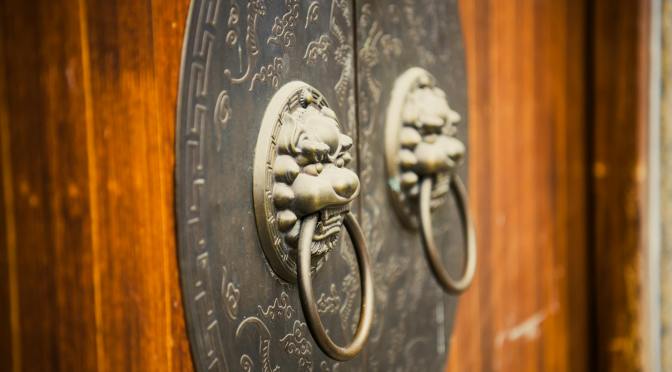
When I was taught to read playing cards, my teacher told me that the Two of Hearts is “al martel di porta”, knocking at the door. This refers to the way old house doors are made in many European countries, including Italy, where door knockers were used back when you couldn’t ring at the door. At least in Italy door knockers are still very much en vogue, though mostly as a decorative element.

The idea of the Two of Hearts as “the door knockers” is a reference to the fact that door knockers usually come in twos and to the fact that the Two of Hearts comes right after the Ace, which is the house, so that the Two is quite literally close to the home.

This meaning is also found in many systems for reading Piacentine cards, where the Two of Cups takes on that meaning (in some other systems this meaning is given to the Two of Wands) as well as in the Bolognese Tarot, where it’s the Ace of Swords that depicts it, due to the odd shape of the picture.

In some systems I am aware of, there are two distinct cards: the door knockers and the roof of the house. This is true for some systems employing Piacentine cards, where the Two of Cups is the door knockers and the Four of Wands is the roof.

This distinction is also found in the Bolognese tarot, where the Ace of Swords depicts the door knockers and the Seven of Cups the roof of the house. In the oldest surviving system for reading the Bolognese tarot, which dates back to before the French revolution (I talk about it here), the Knight of Wands indicated the door knockers and the Ten of Cups the roof of the house. Clearly, therefore, this symbolism is deeply ingrained in Italian cartomancy.

According to the person who taught me the 45-card system of Bolognese tarot, the Ace of Swords, the door knockers, tends to show something close to home in a temporal sense (about to happen) whereas the Seven of Cups, the roof, is more connected to everyday life, to our close environment and to the protection of people surrounding us, as well as to the family in a more extended sense. Germana Tartari, who initiated me to the 50-card system, which she was taught by her grandmother and by some of her grandmother’s friends, uses the Nine of Cups as ‘the staircase to the house‘, again mostly in a temporal sense as something about to happen.

On the other hand, in the system for reading playing cards that I was taught, the Two of Hearts covers both possibilities: it indicates something about to knock at the door or it can show family situations, people who are close to us etc.

I have never found this symbolism in other non-Italian systems. If you did, feel free to drop me a line, as it would be very interesting. Manuel Arcuri, an American reader who was taught to read playing cards by his Italian grandmother, says somewhere that his grandmother called the Two of Hearts “l’attesa”, which means waiting or expectation, as of something about to happen. He doesn’t mention door knockers though.

Furthermore, many card reading systems I have read about assign the meaning of “within two weeks” to the Two of Hearts, which once again gives us the idea of something about to knock at the door. Interestingly, Regina Russell‘s playing card system uses the Two of Hearts to indicate excitement for something that is about to happen, expectation and even pregnancy (expecting a child).

MQS

Tarot Encyclopedia – The Seven of Pentacles or Coins

(Note: this is a collection of the meanings attributed to the cards by some occultists in the past centuries. It does not reflect my own study or opinion of the cards. It is only meant as a quick comparative reference as I develop my own take.)

The Seven of Pentacles from the Builders of the Adytum (BOTA) tarot deck

Paul Foster Case (and Ann Davies)

The time period is the third decanate of Taurus, under the rulership of Saturn, May 11 to 20. Meanings:
Well-Dignified: slight gains, but of small account; much labor for small returns.
Ill-Dignified: something promising turns out badly; loss in speculation and unprofitable employment; financial restriction; unrealized hopes and
wishes.
Keyword: Loss
(From the Oracle of Tarot course)

A. E. Waite

A young man, leaning on his staff, looks intently at seven pentacles attached to a clump of greenery on his right; one would say that these were his treasures and that his heart was there. Divinatory Meanings: These are exceedingly contradictory; in the main, it is a card of money, business, barter; but one reading gives altercation, quarrels–and another innocence, ingenuity, purgation. Reversed: Cause for anxiety regarding money which it may be proposed to lend.
(From The Pictorial Key to the Tarot)

The Seven of Pentacles from the Rider Waite Smith tarot

Aleister Crowley

The Seven of Disks is called Failure. This suit gives the extreme of passivity; there is no positive virtue in it below the Abyss. This card is ruled by Saturn. Compare it with the three other Sevens; there is no effort here; not even dream; the stake has been thrown down, and it is lost. That is all. Labour itself is abandoned; every thing is sunk in sloth.

[…]

The number Seven, Netzach, has its customary enfeebling effect, and this is made worse by the influence of Saturn in Taurus. The disks are arranged in the shape of the geomantic figure Rubeus, the most ugly and menacing of the Sixteen. (See Five of Cups.) The atmosphere of the card is that of Blight. On the background, which represents vegetation and cultivation, everything is spoiled. The four colours of Netzach appear, but they are blotched with angry indigo and reddish orange. The disks themselves are the leaden disks of Saturn. They suggest bad money.
(From The Book of Thoth)

The Seven of Disks from the Thoth Tarot

Golden Dawn’s Book T

A WHITE Radiating Angelic Hand issuing from a cloud, and holding a white rose branch. Seven Pentacles arranged like the geomantic figure Rubeus. There are only five buds, which overhang, but do not touch the five uppermost Pentacles. Above and below are the Decan symbols, Saturn and Taurus respectively.

Promises of success unfulfilled. (Shewn, as it were, by the fact that the rosebuds do not come to anything.) Loss of apparently promising fortune. Hopes deceived and crushed. Disappointment, misery, slavery, necessity and baseness. A cultivator of land, and yet a loser thereby. Sometimes it denotes slight and isolated gains with no fruits resulting therefrom, and of no further account, though seeming to promise well.

Netzach of HB:H (Unprofitable speculations and employments; little gain for much labour).
Therein HB:HRChAL and HB:MTzRAL are ruling Angels.

Etteilla

Money
Upright. This card, as far as the medicine of the spirit is concerned, means, in its natural position: Money, Wealth, Sum, Coin. – Silver. – Whiteness, Purity, Candor, Innocence, Naiveté, Moon. – Purgation, Purification.
Reversed. Restlessness, Torment of spirit, Impatience, Affliction, Remorse, Concern, Solicitude, Care, Attention, Diligence, Application. – Apprehension, Fear, Distrust, Misgiving, Suspicion.

MQS

What’s the Bird Thinking? (Example Reading)

My two cockatiels couldn’t be more different from one another. Ciuffy, the white one, is a sweet cuddlebug who’ll do anything for a head scratch. He’s never nipped me, let alone bitten me. The only time he hurts me a little is when he tries to preen my ear.

“I’m the guy you want your daughter to bring home”

Zazu, the gray one, is a beaky, bossy, overbearing prick. He does have his sweet side, and considering I’ve had him for only a little over a month we’ve made huge progress, but when I have him on my shoulder I KNOW I’m going to get hurt at some point, and when he bites he really means it.

“I’m the guy your daughter brings home”

Now that I’ve set the scene and used the excuse to show you a couple of pics of my cutie pies, let’s get to the point. A couple of days ago, while Zazu was on my shoulder, he bit my earlobe incredibly hard out of nowhere (maybe he saw me move my head and didn’t like it).

I shooed him away with my hand, but he spooked and flew against a wall. Although he wasn’t hurt, he spent the day avoiding me and hissing (for those who don’t know, cockatiels can hiss, like cats).

I knew that the accident set some of that hard-won progress back, but I wanted to know Zazu’s perspective and how it would likely evolve. Here’s what the Bolognese Tarot had to say:

What’s the featherball thinking? Tarot reading

One thing that surprised me is the first row, where we have happiness (Ten of Cups) in the house (Ace of Cups) with me (King of Wands). I know I try to care for the two little balls of feathers as best I can, but Zazu is always grumpy and old-farty in his behavior, so I assumed he didn’t like me very much. Apparently that’s just his character.

The second row is interesting, since we have unexpected (Stranger) betrayal (Hanged Man) leading to negative emotions (Eight of Swords). Clearly his good vibes were somewhat disrupted by the incident.

The third has a path (Eight of Wands) toward Love with harmony or small satisfactions (Ten of Coins). So even though there was a setback, there is room for moving toward love. Obviously we should be very careful when projecting human sentimentalism onto animals, but then again, divination is a language understandable to humans, so the tarot is probably translating Zazu’s reality in terms that are understandable to me.

I have some doubts about the last line. The King of Swords might be Zazu himself (it could represent my husband, but my husband isn’t particularly involved). Technically, pets are represented by the Juggler, but then again, the King of Swords does have some characteristics of the Juggler, so it’s a possibility. At any rate, the King is next to the sickbed. There are no combinations talking explicitly about sickness, so I believe this just shows his being cranky or a bit uncertain, but the World card at the end of the row indicates that this uncertainty doesn’t cause breaks: the situation remains open and moving.

The Temperance card at the end simply shows that patience and time are needed. I expected no less.

For now, the reading seems to be accurate. The day after the little bastard had gone back to his old behavior, being just a little more shy than usual, and the day following that he was back to normal.

MQS