Category Archives: Tarot

Bolognese Tarot – Manuale Pratico di Lettura di Tarocchino Bolognese by Rossella Giliberti (Review)

In recent years, a small number of new books on the Bolognese tarot have been published to meet the demands of the small but growing niche of afficionados. This, as I explained, is largely the merit of Ingallati’s book, which, in spite of some limitations, managed to create that niche outside of Bologna.

Rossella Giliberti’s book is one of these new books. The title of the slim publication literally translates as ‘Practical Handbook for Reading the Bolognese Tarot’. It is a wonderful title, one that is likely to arouse hope in many people. Unfortunately, it has very little to do with the actual content of the book.

Giliberti uses a similar deck as Ingallati (49 cards plus the Joker). I have already explained in my review of Ingallati’s book why I don’t like this selection of cards, which however is unique to Ingallati’s style and must be accepted as such.

Seeing Giliberti’s choice of deck, one would think that she’s just a copycat of Ingallati. But this would be unfair to Giliberti. As short as it is, her book is filled to the brim with notes on combinations and meanings that Ingallati doesn’t talk about, plus she swaps certain cards for others. It is clear that Giliberti, despite obviously being inspired by Ingallati, also had other sources for learning the tarocco bolognese, and this alone makes her book worth buying if one is serious about this deck.

That said, there are some glaring issues with it. For starters, there is absolutely nothing practical or handbookish about it. It is a very (VERY) disorganized collection of notes which would have been fine as initial preparatory work for a book. After the skippable part (the initial chapter about history, which however is more interesting than that in Ingallati’s work) the book gives the usual rundown of the cards one by one, with their core meanings and a couple of classical combinations. For whatever reason, the picture of the Hanged Man is from the Marteau Marseille Tarot.

The merit of this section is that it is clearer, more concise and less fluffed up than Ingallati’s, and the symbolic interpretation more down-to-earth and more informed by Bolognese folklore, as it should be. The possible drawback is that there is space left for the reader to take notes, possibly in an attempt to make the book longer, with the result that the sections seem a bit disjointed and separated from one another. I guess that’s the ‘practical’ part of the book.

When Giliberti comes to the description of the minor arcana, the book starts to fall apart more clearly in terms of organization, with some cards often repeated, some out of order, lack of punctuation and proof-reading, tips on how to read the cards thrown in the mix in random places, some paragraphs all in caps lock, etc. At this point one would be excused for thinking the book is self-published, but it’s not. Some publisher took a look at this and said “yes, I want our brand to be linked to it”.

Giliberti also offers the meanings of the other minor arcana, the ones that are discarded from the 62-card deck. Unfortunately the meanings are taken from a famous discussion board post dating back several years, where one user had assigned the meanings of the Rider Waite deck to the discarded minor arcana.

Afterward there is a section on combinations, all rigorously in caps lock, all rigorously with huge amounts of blank space left between paragraphs. The wording of some of them even makes one think they were taken from other books that I shall review in the future. Some combinations make no sense (e.g., the Page of Coins and the Ace of Cups is a marriage). Some are repeated multiple times with different meanings. Typos and mistakes abound. Still, for all its limitations, an interesting section.

Then there is another section, organized differently in the form of a table, this time on… Combinations? And then there is another section, organized in yet another manner, which is about… Meanings and combinations, some of which have little to do with the ones presented in the first section, and which are more clearly taken “as is” from other sources.

At the end comes an extremely slim final section with some layouts, one of which is taken from Ingallati’s book (I do not mean the layout itself, which is traditional. I mean the actual spread, down to the cards shown in the example). The thirteen card spread is explained in two different ways. The cross spread is also explained in two different ways. You get the picture.

So, what to think of this book? It depends on how one sees it. As a ‘practical handbook’, as promised in the title, it is a bad joke bordering on false representation. As a disorganized mess of poorly edited notes taken from many different sources, some of which are credible, it is somewhat serviceable, especially if you know where and how to look, where and how to block out the information, and if there are no linguistic barriers between you and the text.

Whether it is worth your money depends on the level of autistic fixation you have for the Bolognese Tarot. As I am definitely on that spectrum, I’d rather have it than not, but I am not going to sit here and pretend it is a finished book worth 20€.

Where to buy: Amazon

MQS
Tarot Encyclopedia – The Eight of Pentacles or Coins

(Note: this is a collection of the meanings attributed to the cards by some occultists in the past centuries. It does not reflect my own study or opinion of the cards. It is only meant as a quick comparative reference as I develop my own take.)

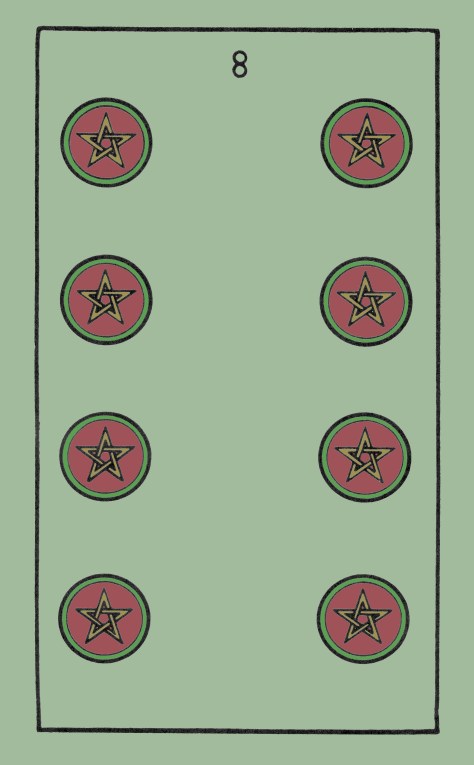
The Eight of Pentacles from the Builders of the Adytum (BOTA) tarot

Paul Foster Case (and Ann Davies)

The time period is the first decanate of Virgo, under the rulership of Mercury, from August 23 to September 2. Meanings:
Well-Dignified: skill in the management of material affairs; industry; gain in subordinate positions through writing, clerical work or travel; gain of ready money in small sums.
lll-Dignified: avarice and hoarding; penny wisdom and pound foolishness; meanness in money matters; loss through travel or writings; the Querent is likely to be in difficulties with superiors and also with inferiors; he may lose through trying to overreach somebody else.
Keyword: Prudence
(From the Oracle of Tarot course)

A. E. Waite

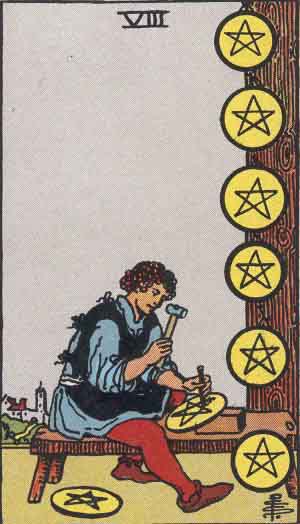
An artist in stone at his work, which he exhibits in the form of trophies. Divinatory Meanings: Work, employment, commission, craftsmanship, skill in craft and business, perhaps in the preparatory stage. Reversed: Voided ambition, vanity, cupidity, exaction, usury. It may also signify the possession of skill, in the sense of the ingenious mind turned to cunning and intrigue.
(From The Pictorial Key to the Tarot)

The Eight of Pentacles from the Rider Waite Smith tarot

Aleister Crowley

The Eight of Disks is called Prudence. This card is a great deal better than the last two [Eights], because, in purely material matters, especially those relating to actual money, there is a sort of strength in doing nothing at all. The problem of every financier is, first of all, to gain time; if his resources are sufficient, he always beats the market. This is the card of “putting something away for a rainy day”.

[…]

The number Eight, Hod, is very helpful in this card, because it represents Mercury in his most spiritual aspect, and he both rules and is exalted in the sign of Virgo, which belongs to the Decan, and is governed by the Sun. It signifies intelligence lovingly applied to material matters, especially those of the agriculturalist, the artificer and the engineer.

One might suggest that this card marks the turn of the tide. The seven of Disks is in one sense the fullest possible establishment of Matter-compare Atu XV-the lowest fallen and therefore the highest exalted. These last three cards seem to prepare the explosion which will renew the whole Cycle. Note that Virgo is Yod, the secret seed of Life, and also the Virgin Earth awaiting the Phallic Plough.

The interest of this card is the interest of the common people. The rulership of the Sun in Virgo suggests also birth. The disks are arranged in the form of the geomantic figure Populus. These disks may be represented as the flowers or fruits of a great tree, its solid roots in fertile land.

In the Yi King, Sol in Virgo is represented by the 33rd Hexagram, Thun, “Big Air”. It means “retiring”; and the commentary indicates how best to make use of that manoeuvre. This is congruous enough with the essence of Virgo, the secret withdrawing of Energy into the fallow Earth. Populus, moreover, is the Moon retiring from manifestation to her conjunction with the Sun.
(From The Book of Thoth)

The Eight of Disks from the Thoth tarot

Golden Dawn’s Book T

A WHITE Radiating Angelic Hand, issuing from a cloud, and grasping a branch of a rose tree, with four white roses thereon, which touch only the four lowermost Pentacles. No rosebuds even, but only leaves, touch the four uppermost disks. All the Pentacles are similar to that of the Ace, but without the Maltese cross and wings. They are arranged like the geomantic figure Populus:

* *
* *
* *
* *

Above and below them are the symbols Sun and Virgo for the Decan.
Over-careful in small things at the expense of great: “Penny wise and pound foolish”: gain of ready money in small sums; mean; avaricious; industrious; cultivation of land; hoarding, lacking in enterprise.
Hod of HB:H (Skill: prudence: cunning).
Therein rule those mighty Angels HB:AKAYH and HB:KHThAL

Etteilla

Brunette Girl
Upright. This card, as far as the medicine of the spirit is concerned, means, in its natural position: Brunette Girl, Passive, Great Night.
Reversed. Empty aspiration, Avarice, Usury.

MQS

A Quirk of the Thirteen-Card Spread

The last thirteen-card spread I posted was interesting for a couple of reasons. One reason I already talked about: the need to be flexible with significators.

Another reason is that it showcases what I suspect to be an interesting quirk of the thirteen-card spread. This is a purely experimental anecdote, so take it with a pinch of salt, but I have found it to be true on more than one occasion.

The quirk is that, in the thirteen-card spread (which I discussed here), the rows seem to be connected not just one after the other, but also alternately, i.e., the first row with the third row and the second row with the fourth row.

I cannot stress this enough: this is NOT a rule, it is simply something I have found to be true on occasion. There are situations where the thirteen-card spread is perfectly smooth from start to finish, reading like a little story with a beginning, a middle and an end. In this sort of situation we don’t need to pair up the rows 1-3 and 2-4.

However, sometimes we can recognize snippets of story mixed together in an odd way. I have found that pairing odd rows together and then even rows together can help sort these snippets out, giving them a more logical order.

In the example of the spread I posted, the second and fourth rows seemed to talk more about material issues, whereas the first and third were more centered on the person’s emotional life. Pairing them odd-with-odd and even-with-even, the spread became more clear.

If the spread is talking about more than one issue at once (which can happen), then this kind of pairing often makes sense. However, sometimes it makes sense even if there is only one topic in play, and this particular case the rows that we pair up talk about subtopics within the same topic.

It may be that this technique simply stems from my limitations as a reader, so that I find ways to circumvent difficulties in the interpretation of the spread. Still, I found this to be accurate enough to bring up, in case anyone wants to experiment with it.

Finally, it may simply be that we need to be very flexible with the rows, and take for granted that they may pair up in unlikely ways. Who knows, maybe I’ll find that the first and fourth row really go well together in some readings. The point is always that the techniques we apply need to shed light on the querent’s life, not simply add flourishes and complications to the interpretation.

MQS

How Long to Shuffle the Deck?

This may sound like a silly question, but it is one I get asked constantly in private. I think the reason is that, especially at the beginning, we are very unsure of how to go about the reading and we are afraid we may get it wrong on technical grounds even before the interpretation starts.

Unfortunately, there is no clear answer to this. I know of old-time diviners who shuffle the deck for a fixed (usually odd) number of times, like seven, nine or thirteen. I have never been able to get behind this way of doing things. It is, however, a traditional approach, so I thought it better to mention it.

I distinguish between when I’m reading for myself, or even for someone else, but who isn’t there; and when the person is with me, even just on the phone or on skype (I used to do skype readings for friends all the time when I was in college).

The second case is the easiest, so I’ll talk about it first: when I’m reading for someone and I am directly in contact with them, I simply ask them to think about the question and to give me a stop when they are ready. Meanwhile, I decide which spread to use, then I relax and I take on an attitude of calm focus, without strain.

The person may have me shuffle for two minutes, or they may tell me to stop after two shuffles. After the stop, if the person is physically there, I also let them cut the deck, otherwise I do it for them after knocking three times on its back (that’s my little ritual). As weird as it sounds, the cards always seem to fall into place very well regardless of how long it took to shuffle them.

I believe this is because, in a reading, there is more at play than just two eccentrics’ focus on a topic. We may like to concoct philosophies that give us ultimate power over external reality, but the fact remain that we live at the intersection of cosmic, personal and interpersonal currents, a number of which are beyond our control. Our focus may catalyze these forces, but they are more ingenious than our conscious awareness could be.

In the first case, i.e., when I’m reading for myself or for someone who isn’t there, I need to be especially at peace with myself. If I’m distracted, depressed, in a heightened mood or very sick, the reading won’t go well. Even when I am at peace, there is always a question mark at the end of my readings, like they are never as crisp as when I’m reading for someone else who is there with me.

So, how long do I shuffle in this case? The answer may be disheartening for some, but it’s: as long as I feel I need to. This is hard to explain, but one soon learns to recognize the feeling of a well-shuffled deck. Some may feel the deck becomes heavier, others seem to just get an undefined feeling.

For my part, I usually feel a sensation akin to being full after eating a hearty meal and being unable to take another bite, while at the same time the deck itself seems to oppose resistance to being shuffled as the cards lock into the right place. Your experience may vary.

MQS

Making Sense of Daily Readings

Daily readings are not my passion. Divination moves from the assumption that something is going to happen. But life is full of uneventful days, where time seems to stand still. Yet the oracle must necessarily tell us something, for the simple fact that we allow it to speak.

This is not to say that the cards (or other means) don’t mean anything, but often we need to tone down the interpretation to such a degree, or retrieve such inconsequential shades of meaning that, unless you are a god of divination, you aren’t going to be able to consistently predict much, and I am definitely not a god of divination.

On the other hand, daily readings can sometimes be easy to read into once the event has come to pass (see my recent example). Reading into the oracle always leaves us in danger of deluding ourselves. The question I always ask myself is: would I be able to see it if I didn’t know it? Often a vaguer prediction that is true to what we can see in the cards is preferable to a highly detailed account that simply regurgitates what we already know or what we have been fed.

Still, sometimes we can afford the luxury of reading-into after the fact, and daily readings can be one such instance, because at least we can learn something, if we are careful. In the example I posted about the pregnancy, the three cards, called at random to disclose a daily influence, could have meant a variety of different things, but news about a pregnancy is without a doubt one possible interpretation. Furthermore, sometimes if we know that something is bound to happen, we may gauge by the daily reading if it is likely to happen on a particular day, or if it is going to go well.

Another thing to consider is that limiting the timeframe is always somewhat arbitrary. Do you seriously think that if you ask the cards what is going to happen this week and in ten days something terrible or wonderful is bound to happen the cards are going to keep quiet about it? Just because you told them to keep it within the week?

Often, if you pull daily cards, a major event or major influence or vibe shift will start manifesting in the cards many days in advance. A romantic reunion happening next week may start manifesting with cards of love now, even if today or tomorrow aren’t especially romantic days.

What I personally prefer to do is occasionally pulling three cards for the day, while knowing that they may describe something happening further along the way. By occasionally I mean every two or three weeks, rarely every week. That way the cards are usually more meaningful than if I stress them every day on how the day is going to go. This doesn’t mean I’m going to be able to predict something, but the careful, tentative reading-into is going to be more certain and less based on wishful thinking.

MQS

Flexibility in Divination (and Other Occult Branches)

In my latest reading, an interesting phenomenon happened: I had to partly go beyond the basic rules of the oracle (in this case the tarot) in order to interpret its message.  Specifically, I had to get past the rule that only the Wand figures represent the querents and accept the Queen of Cups as an alternative version of the subject in question.

There is always a reason why something happens, and in this case I believe the possible reasons were 1) that I was asking about my mother, so the cards described her not only as the protagonist of the reading (Wand) but also as mother of the person asking the question (Cup) 2) the reading was, in part, about her still viewing herself as wife, even though she is widowed, so not only is she the protagonist (Wand) but also a wife (Cup).

I am pretty sure this sort of things (that is, the need to apply the ground rules with discretion) can happen in different respects with any deck. In fact, I think it can happen with any oracle. The late Robert Zoller often showed that good astrologers need to be guided by what the chart is saying, which often requires one to start from recorded knowledge and then stretch that knowledge to cover each individual case. William Lilly, possibly the most important horary astrologer in history, often repeated that one must “mix discretion with art”, that is, understand the rules and then apply them intelligently.

The thing is, divination is not an assembly line type of work: it’s a Hermetic art (where the word ‘Hermetic’ is understood in its classical sense, not the Kybalion-style crap). If even the rules of biology need to be interpreted smartly by doctors in order to cure the human body, then how much more flexible do we need to be to interpret a device whose permutations can give us the blueprint for anything that could happen?

Anything goes vs informed pragmatism

My understanding of divination is a never-ending journey. The way I currently see the rules of divination is as posts along the way in a thick snowstorm. If a post has been put somewhere, that means someone was there before and has figured out something. We do not discard such knowledge lightly, unless the contingent reality of our current situation makes us prefer another route.

This approach is very different from the ‘anything goes’ non-method used by so many, which is almost expected and even bragged about, largely due to the widespread rejection of rationality in our milieu. Too many people who dabble into esoteric subjects today seem to believe that throwing overboard logic is the first step on the journey. In part this is due to mistaken orientalist fantasies, in part to a post-modern Zeitgeist that sees all structures as dispensable, reactionary dead weight only good for restraining us– who wants to be restrained?

The way I currently see rules in the esoteric arts is neither reactionary nor revolutionary. It is an attempt at appraising reality through lenses as simple as possible and as complex as they need to be, a kind of pragmatism that is informed by the past but future-oriented in looking for concrete solutions to concrete issues.

As far as divination is concerned, it is a language, but it is a language with no native speakers, and for which no Rosetta stone exists, except the tentative hypotheses of those who have grappled with the language before. We don’t need to vest them with our superstitious awe, but we do owe them a serious, dispassionate look at the conclusions they have reached before either accepting them as they are, discarding them or expanding them with discretion.

MQS

Love Beyond the Grave? (Example Reading)

a reading with interesting implications. Like and subscribe to support my work

I thought this was a rather interesting reading, in part because of what it revealed and in part because it shows that divination requires rules and flexibility. I’ll probably talk about it again in an article.

MQS

Tarot Encyclopedia – The Eight of Swords

(Note: this is a collection of the meanings attributed to the cards by some occultists in the past centuries. It does not reflect my own study or opinion of the cards. It is only meant as a quick comparative reference as I develop my own take.)

The Eight of Swords from the Builders of the Adytum (BOTA) tarot deck

Paul Foster Case (and Ann Davies)

The time period is the first decanate of Gemini, May 21 to May 31, under the rulership of Mercury.
Well-Dignified: even well-dignified, the excessive Mercurial influence expressing in the Yetziratic field of unstable forces and changing forms, symbolized by the Eight of Swords, gives a marked tendency toward ill-directed or wasted action. Meanings in divination: force wasted in petty affairs; too much talk; too much illdirected action; the state of being terribly busy without accomplishing much; over-careful about details; could possibly intimate a crisis in affairs, and probably much talk, correspondence and moving about.
Ill-Dignified: malice; ill-natured gossip; pettiness; too much concern with personalities; disagreements with brothers and sisters. This Key divinatorily expresses unbalanced or excessive Gemini qualities in third house affairs. The se negative Gemini qualities portend the need for balancing the quick-mindedness and penchant for action of this astrological type with the d e pth of feeling and emotional warmth corresponding to Netzach and Venus.
Keyword: Mediocrity
(From the Oracle of Tarot course)

A. E. Waite

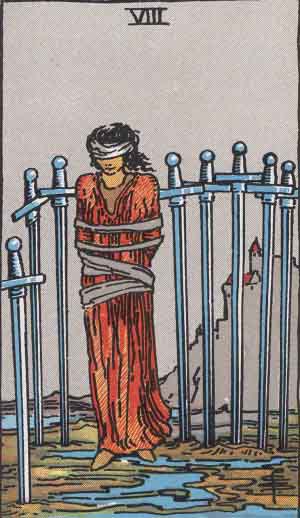
A woman, bound and hoodwinked, with the swords of the card about her. Yet it is rather a card of temporary durance than of irretrievable bondage. Divinatory Meanings: Bad news, violent chagrin, crisis, censure, power in trammels, conflict, calumny; also sickness. Reversed: Disquiet, difficulty, opposition, accident, treachery; what is unforeseen; fatality.
(From The Pictorial Key to the Tarot)

The Eight of Swords from the Rider Waite Smith tarot

Aleister Crowley

The Eight of Swords is called Interference. At first sight, it would seem easy to confuse it with the Eight of Cups; but the idea is, in reality, quite different. The card is attributed to Jupiter and Gemini; accordingly, there is no weighing down of the will by internal or external stress. It is simply the error of being good-natured when good-nature is disastrous. Gemini is an airy sign, an intellectual sign; Jupiter is geniality and optimism. This will not do in the world of Swords; if one must hit at all, a knock-out blow is best.

But there is another element in this card; that of unexpected (the Eights, being at heart Mercurial, are always that) interference, sheer unforeseen bad luck. Trivial incidents have often altered the destiny of empires, brought to naught “the best laid plans of mice and men”.

[…]

The number Eight, Hod, here signifies lack of persistence in matters of the intellect and of contest. Good fortune, however, attends even these weakened efforts, thanks to the influence of Jupiter in Gemini, ruling the Decan. Yet the Will is constantly thwarted by accidental interference.

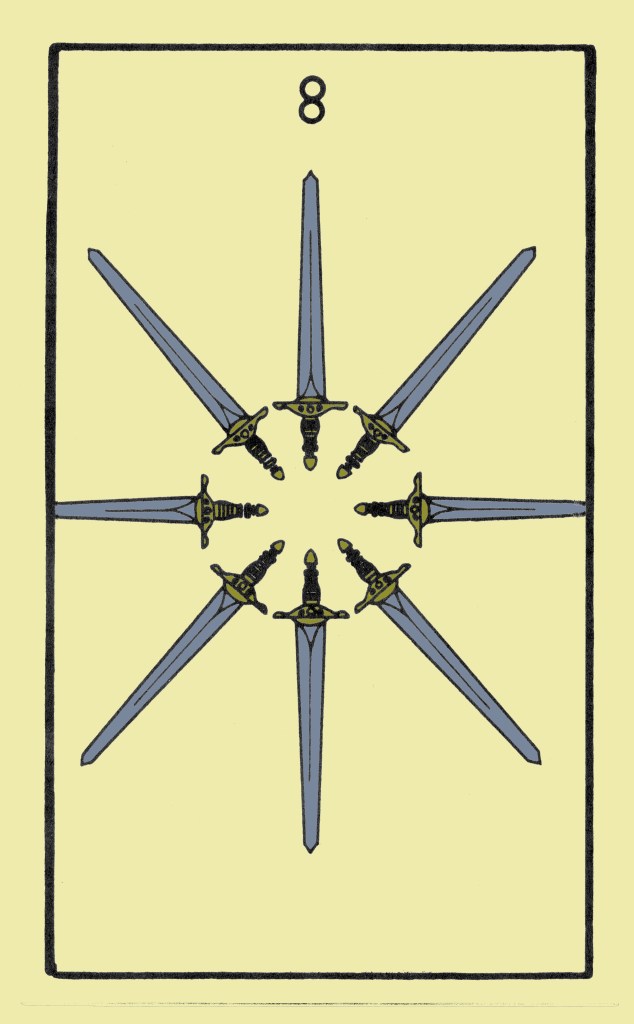
The centre of the card is occupied by two long Swords pointed downward. These are crossed by six small swords, three on each side. They remind one of weapons peculiar to their countries or their cults; we see here the Kriss, the Kukri, the Scramasax, the Dagger, the Machete and the Yataghan.
(From The Book of Thoth)

The Eight of Swords from the Thoth tarot deck

Golden Dawn’s Book T

FOUR White Radiant Angelic Hands issuing from clouds, each holding two swords, points upwards; all the points touch near the top of the card. Hands issue, two at each bottom angle of the card. The pose of the other sword symbols is reestablished in the centre. Above and below are the Decan symbols Jupiter and Gemini.

Too much force applied to small things: too much attention to detail at the expense of the principal and more important points. When ill dignified, these qualities produce malice, pettiness, and domineering characteristics. Patience in detail of study; great care in some things, counterbalanced by equal disorder in others. Impulsive; equally fond of giving or receiving money or presents;

generous, clever, acute, selfish and without strong feeling of affection. Admires wisdom, yet applies it to small and unworthy objects.

Hod of HB:V (Narrow, restricted, petty, a prison).
Therein rule the Angels HB:VMBAL and HB:YHHAL.

Etteilla

Criticism
Upright. This card, as far as the medicine of the spirit is concerned, means, in its natural position: Criticism, Unfortunate position, Critical moment, Critical time, Decisive instant, Unfortunate situation, Delicate circumstance, Crisis. – Examination, Discussion, Research, Blame, Censure, Critical comment, Critical epilogue, Control, Disapproval, Condemnation, Cassation, Judgment, Contempt.
Reversed. Accident, Difficulty, Particular circumstance, Conjunction, Occurrence, Accessory, Unconscious, Obstacle, Delay, Hindrance. – Abjection. – Contestation, Contradiction, Opposition, Resistance, Divergence. – Unplanned, Unforeseen, Chance, Adventure, Occurrence, Destiny, Fatality, Accident, Misfortune, Symptom

MQS

The Odd Strength Card

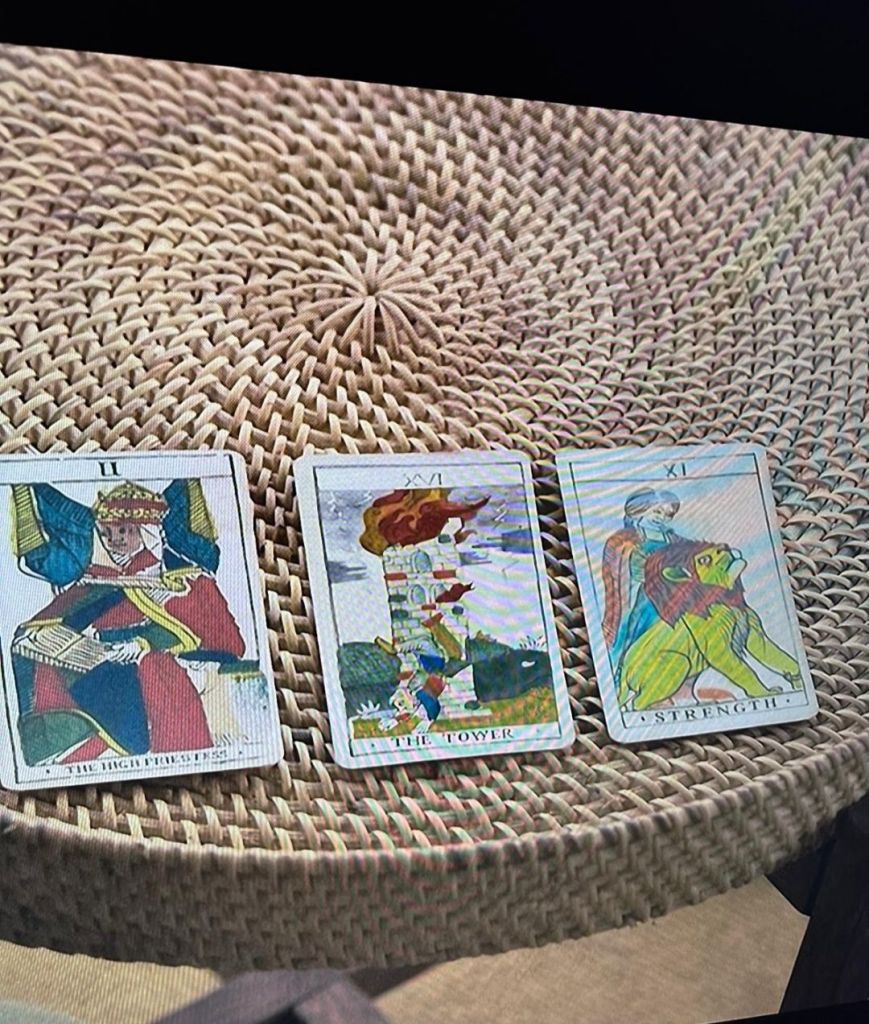
In the movie Kraven the Hunter there is a small tarot scene, where the girl starts playing around with the grandma’s deck and the grandma has her choose three cards from a Tarot of Marseilles-esque deck. We were discussing this scene in a Bolognese tarot group I’m part of.

It’s probable that the deck was commissioned for the movie. What I find interesting is that while the Popess is quite faithful to most Marseille renditions and the Tower sort of resembles the old decks (though the flames have probably been remade), the Strength card is completely new. My wild guess here is that, unless there is an old tarot I am unaware of that really depicts the lion like this, the lion in the Marseille deck would barely be recognized as a lion by casual vewers: it looks like confused smoke billowing out of the maiden’s privates.

Note that the details which have been changed the most (the flames of the Tower and the lion) are the ones that used to be stylized differently in the early modern period compared with today. This is what led people like Jodorowsky to pull the “it’s actually a bird’s tail flying out of the tower” theory out of their ass, even though a cursory look at medieval art would have shown that that was how flames and lightnings were depicted.

MQS

The Road – A Deep Dive into Cartomancy

Following my deep dive into the Door Knockers, which seems to be an exclusive symbol (or almost) of Italian cartomancy, let’s talk about a much more universal presence in many traditions: the Road. Still, even though the symbol is widespread, the interpretations may vary.

I was introduced to the symbol of the road when being taught to read playing cards. In the system I was introduced to, the Two of Clubs is the card of the steps. Actually, the word for it was “cammino”, which means a way, road or path, but it also implies the idea of people taking steps on it. That is, a ‘cammino’ is a road that exists because people walk on it, rather than being a road that has been created so that people may or may not use it. An example would be a path through a forest or a road created by pilgrims as they progress on their pilgrimage.

The Two of Clubs therefore implies forward motion toward a goal of some kind, and the taking of steps, whether literal or figurative. In this, it is similar to the Two of Wands in some Piacentine cards systems, which interpret the card as a road, largely due to its design showing two parallel staves, no doubt (although in some other Piacentine systems the road is the Knight of Wands).

The Vera Sibilla doesn’t have a road card per se, although it does have various cards connected with movement, journeying or taking steps/fighting for something. For instance, the Journey card is connected to traveling, while the Soldier may imply fighting to attain a goal (although, being a Spade card, the struggle is more accentuated).

Etteilla famously attributed the meaning of road to the Six of Swords, and his pupils developed a whole vocabulary of synonyms that extend the meaning into other areas. An example of this is the meaning of conduct, which is, figuratively speaking, the path of the person’s actions through life. Etteilla’s attribution of the meaning of road to the Six of Swords remained attached to tarot through the Golden Dawn, who preserved it in part as a possible meaning in their Book T, and then through Waite, who had Smith design the Six of Swords as a card of journey. Even in the Crowley tradition this attribution has in part been rediscovered in Eshlemann’s Liber Theta.

In the Bolognese tarot, the meaning of road is attributed usually to the Six or Eight of Wands. Some strands of the tradition also distinguish between an open road (Six/Eight of Wands) and a closed road (Nine of Wands or Ten of Swords). The road is in itself a card of forward motion, like the Two of Clubs, it can indicate short trips and it is a card of openness.

The road or path is also present in the Lenormand and Kipper traditions. I am unclear on the Lenormand meaning, as the interpretation seems to have evolved considerably through time. Most contemporary English-speaking sources seem to see it as a card of choice (with two paths, although I am unsure if this duality was intended in the original design). Most German sources interpret it differently. Since I am not a Lenormand reader, I will leave it at that.

As for the Kipper cards, they have a card called Ein langer Weg, a long road. In most of the sources I have consulted, the card is more static than in the other traditions, highlighting the element of time (some call it the Two Years card). Interestingly, in many German Skat systems of divination, the suit of Spades / Leaves is connected with movement, and the low-numbered cards, mostly the Seven and Eight, can show a short trip or something happening quickly, while the Ten is also called the long road, and it can indicate an actual journey or the need to wait a long time.

BONUS: The Road is obviously present in Geomancy as well. The Geomantic figure Via, attributed to the Moon, is a symbol of journey and change. It is the symbol with the least amount of points, only one in every position, so some sources also attribute it to the concept of ‘little’ and to the waning of something.

MQS