(Note: this is a collection of the meanings attributed to the cards by some occultists in the past centuries. It does not reflect my own study or opinion of the cards. It is only meant as a quick comparative reference as I develop my own take.)
The King of Wands from the Builders of the Adytum (BOTA) Tarot
Paul Foster Case (and Ann Davies)
When well aspected the powers listed above are expressed by a personality represented by the King of Wands. However these same qualities when overly strong or intense can express as cruelty, oppression, ostentation and pride. Thus in Tarot divination, besides the basic principles expressed by Ab, the Father, and Yod, the Creative principle, the King of Wands has these specific meanings: Well Dignified: an ardent, impulsive, influential man; one possessed of authority and strongly marked by the quality of leadership; somewhat hasty in temper but just, generous and friendly. lll Dignified: the same general type but cruel, ill-natured, intolerant and probably unfriendly to the querent. (From the Oracle of Tarot course)
A. E. Waite
The physical and emotional nature to which this card is attributed is dark, ardent, lithe, animated, impassioned, noble. The King uplifts a flowering wand, and wears, like his three correspondences in the remaining suits, what is called a cap of maintenance beneath his crown. He connects with the symbol of the lion, which is emblazoned on the back of his throne. Divinatory Meanings: Dark man, friendly, countryman, generally married, honest and conscientious. The card always signifies honesty, and may mean news concerning an unexpected heritage to fall in before very long. Reversed: Good, but severe; austere, yet tolerant. (From The Pictorial Key to the Tarot)
Aleister Crowley
(Note: Crowley and the Golden Dawn swap around King and Knight. This is in part true of Waite as well.) The Knight of Wands represents the fiery part of Fire; he rules from the 21St degree of Scorpio to the 20th degree of Sagittarius. He is a warrior in complete armour. On his helmet for a crest he wears a black horse. In his hand he bears a flaming torch; a flame also in his mantle; and upon the flames does he ride. His steed is a black horse leaping.
The moral qualities appropriate to this figure are activity, generosity, fierceness, impetuosity, pride, impulsiveness, swiftness in unpredictable actions. If wrongly energized, he is evil-minded, cruel, bigoted and brutal. He is in either case ill-fitted to carry on his action; he has no means of modifying it according to circumstances. If he fails in his first effort, he has no resource.
In the Yi King, the fiery part of Fire is represented by the 51st hexagram, Kan. The signification there given is entirely in accordance with the doctrine of the Tarot, but great emphasis is laid on the startling, perilous, and revolutionary character of the events cognate. The Querent is advised to be apprehensive, yet cool, resolute and energetic: to beware of untimely action, but to go forward with tense confidence in his own ability.
All these correspondences of the Yi King are to be studied in that book (S.B.E. vol. XVI) and reference is here made to the text when important passages are too long to be conveniently quoted. (From the Book of Thoth)
Oddly interesting AI-generated King of Wands illustration
Golden Dawn’s Book T
A KINGLY Figure with a golden, winged crown, seated on a chariot. He has large white wings. One wheel of his chariot is shewn. He wears corslet and buskins of scale armour decorated with a winged lion’s head, which symbol also surmounts his crown. His chariot is drawn by a lion. His arms are bare, save for the shoulder-pieces of the corslet, and he bears a torch or fire-wand, somewhat similar to that of the Zelator Adeptus Minor. Beneath the chariot are flames, some waved, some salient. Swift, strong, hasty; rather violent, yet just and generous; noble and scorning meanness. If ill dignified — cruel, intolerant, prejudiced and ill natured.
Etteilla
Country man Upright. This card, as far as the medicine of the spirit is concerned, means, in its natural position: Country Man, Good and Stern Man, Well Intentioned Man, Honest Man. – Conscience, Probity. – Farmer, Worker, Cultivator. Reversed. Good and stern man – Indulgence, Severity, Forbearance, Condescension.
(Note: this is a collection of the meanings attributed to the cards by some occultists in the past centuries. It does not reflect my own study or opinion of the cards. It is only meant as a quick comparative reference as I develop my own take.)
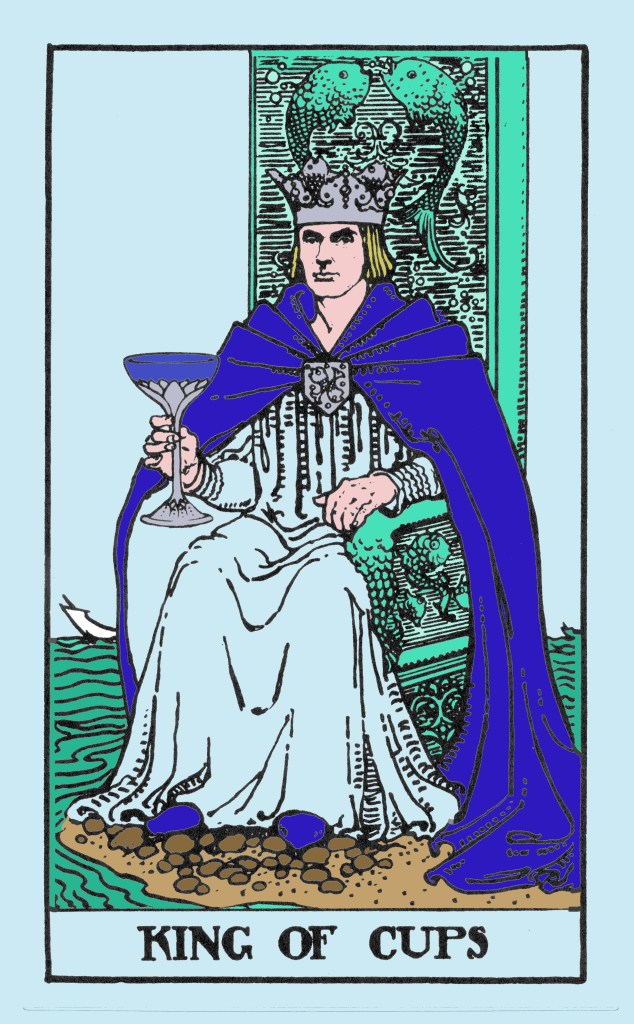
The King of Cups from the Builders of the Adytum (BOTA) Tarot
Paul Foster Case (and Ann Davies)
The time period is from the beginning of the last decanate of Gemini to the second decanate of Cancer, June 11 to July 12, combining the rulers hips of Saturn and Uranus, the Moon and Mars. Well Dignified: a man subtle and secretive, crafty, psychic, artistic; of strong, violent desires but calm exterior. He is friendly to the Querent and really wise. Ill Dignified: evil and merciless and likely to be attracted by occult studies promising power or knowledge for the satisfaction of desire and control of others; without purification of character. Usually fair-haired with blue eyes. (From the Oracle of Tarot course)
A. E. Waite
He holds a short sceptre in his left hand and a great cup in his right; his throne is set upon the sea; on one side a ship is riding and on the other a dolphin is leaping. The implicit is that the Sign of the Cup naturally refers to water, which appears in all the court cards. Divinatory Meanings: Fair man, man of business, law, or divinity; responsible, disposed to oblige the Querent; also equity, art and science, including those who profess science, law and art; creative intelligence. Reversed: Dishonest, double-dealing man; roguery, exaction, injustice, vice, scandal, pillage, considerable loss. (From The Pictorial Key to the Tarot)
Aleister Crowley
(Note: Crowley and the Golden Dawn swap around King and Knight. This is in part true of Waite as well.) The Knight of Cups represents the fiery part of Water, the swift passionate attack of rain and springs; more intimately, Water’s power of solution. He rules the Heavens from the 21st degree of Aquarius to the 20th degree of Pisces. He is clothed in black armour furnished with bright wings which, together with the leaping attitude of his white charger, indicates that he represents the most active aspect of Water. In his right hand he bears a cup from which issues a crab, the cardinal sign of Water, for aggressiveness. His totem is the peacock, for one of the stigmata of water in its most active form is brilliance. There is here also some reference to the phenomena of fluorescence.
The characteristics of the person signified by this card are nevertheless mostly passive, in accordance with the Zodiacal attribution. He is graceful, dilettante, with the qualities of Venus, or a weak Jupiter. He is amiable in a passive way. He is quick to respond to attraction, and easily becomes enthusiastic under such stimulus; but he is not very enduring. He is exceedingly sensitive to external influence, but with no material depth in his character.
When the card is ill dignified, he is sensual, idle and untruthful. Yet with all this he possesses an innocence and purity which are the essence of his nature. But he is, on the whole, so superficial that it is hard to reach this depth. “His name is writ in water.”
In the Yi King, the fiery part of Water is represented by the 54th Hexagram, Kwei Mei. The commentary is singularly obscure, and somewhat sinister. It deals with the difficulties of rightly mating such opposites as fire and water (compare the Queen of Wands; but in that case Water is the calming and modulating influence, while here it is Fire which creates trouble.) Swiftness and violence ill suit a character naturally placid; it is rare indeed to meet with a person who has succeeded in harmonizing these conflicting elements. He tends to mismanage all his affairs; and unless sheer good fortune attend him, his whole career will be an unbroken record of failure and disaster. Often his mental “civil war” ends in schizophrenia or melancholy madness. The abuse of stimulants and narcotics may precipitate the catastrophe. (from The Book of Thoth)
Creepy-ass AI-generated King of Cups illustration
Golden Dawn’s Book T
A BEAUTIFUL, winged, youthful Warrior with flying hair, riding upon a white horse, which latter is not winged. His general equipment is similar to that of the Knight of Wands, but upon his helmet, cuirass and buskins is a peacock with opened wings. He holds a cup in his hand, bearing the sigil of the scale. Beneath his horse’s feet is the sea. From the cup issues a crab. Graceful, poetic, Venusian, indolent, but enthusiastic if roused. Ill dignified, he is sensual, idle and untruthful. He rules the heavens from above 20 Degree of Aquarius to 20 Degree of Pisces, thus including the greater part of Pegasus. (from Book T)
Etteilla
Blond man Upright. This card, as far as the medicine of the spirit is concerned, means, in its natural position: Blond Man, Honest Man, Probity, Equity, Art, Science. Reversed. Man occupying a good position, Distinguished man, Honest man. – Dishonest man. – Exaction, Concussion, Injustice, Brigand, Thief, Dissimulator. – Vice, Corruption, Scandal.
I read somewhere that pregnancies cannot be predicted because it is impossible to bring someone into the equation who doesn’t yet exist. The cards (or any other method) supposedly cannot talk about inexistent people, and they may only be used to check on pregnancies that have already started.
I certainly agree that it may not be wise to use divination on health-related issues, especially on such delicate topics, since we diviners are fallible, and should never forget it.
That it *is* possible to use them to this end, though, is confirmed by experience. I believe I even discussed a spread where I predicted that a woman would become pregnant, even though the question wasn’t even about pregnancy.
The idea that the cards cannot talk about people that don’t exist, though, is poppycock. The child may not exist, but the woman’s body certainly does. If we can predict that the woman’s body will betake itself to a job interview, to the mall or to a date, it’s unclear why we shouldn’t be able to predict that an organism will start growing inside of it after a spirited round of nooky.
I have been a member of BOTA in the past, before delving deeper into traditional occultism. I always kind of liked their tarot deck, so to relax I started painting a digital version of it. Once the whole set is done I’m going to have it printed. A friend of mine recommended to me that I take to doodling or coloring scrap books as an aid to creativity, and I must say it does work.
Note: according to Paul Foster Case, the blade of the Sword should be deep yellow, in good old Golden Dawn tradition, but I can’t stand that, especially since in the Magician card the sword is colored in steel gray
As of today, I have officially doubled the amount of single visitors that reached my blog compared to last year and almost tripled the amount of page views, and for this I thank you wholeheartedly!
Fun facts: 1) despite my Sibilla section being older and therefore better indexed online, my playing cards section has been visited more. I am not surprised, as playing cards are more popular, but I am surprised that it happened so quickly. 2) I officially have visitors from all inhabited continents! 3) The US have by far overtaken Italy as the country that visits my blog the most 4) The UK, Brazil, Greece, Peru, Canada, Japan, South Korea and Malaysia also have a strong presence 5) In total 84 countries have visited! 6) I have no statistics for this, but I have also interacted with a lot more people through private messages. It’s always fun to exchange opinions and experiences
Future Projects
This year I have been active as never before. I started branching off in various directions that interest me, and I have plans for more. In addition to adding to the sections I have already opened, I plan to start talking more about Tarot, as well as a new interest of mine, the I Ching.
I also want to open a section on magic and occultism, as well as expanding the section on spirituality. I’ve been thinking about it a lot–I usually prefer to heed the old advice to keep silent about occult endeavors, but I don’t think there’s anything wrong.
A section on philosophy is also probably going to come, as I find it hard to separate serious occultism from philosophy, but it’s unlikely to come next year (though never say never). The thing is, my PhD in philosophy makes me rather anal when it comes to philosophical topics.
As I started dabbling in video editing, a small youtube channel may be coming at some point, but I don’t want to put myself under too much stress, so that’s just a thought at the moment.
Also, in my spare time I have started editing old manuscripts on various occult topics, which I plan to make available on amazon. In one case I simply updated the English, but I am also translating a couple of books from Italian, French and Latin.
Finally, I’ve been thinking of moving the blog from wordpress.com to wordpress.org, but I’m still undecided on the matter. One thing’s for sure: I want to get rid of the ads.
As I have a mind to start talking about Tarot in the very near future, I wanted to start by sharing the main meanings I apply to the major trumps. These are just basic guidelines, as the majors have almost no bounds, so this list is not exhaustive. The meanings I use are not especially weird, and they tend to be very practical.
The Fool Instability, Untrustworthiness, Freedom, Unpredictability, Lack of ties or bonds, Irresponsibility, Innocence, Lack of foresight, Lack of planning, Doing things on the spur of the emoment, Surprise, Irregularity, Chaos, Things and situations that are not well-defined or that are not clearly settled, Nothing, Nothingness, Mistake, Error, Oversight, Mental issues, Originality, Creativity, Deep feelings in love that could be a flash in the pan because they are unsupported by effort, Unpreparedness, Going on foot, Walking
The Juggler / Conman / Magician Beginning, Child, Son or daughter, New, Small, Initiative, Doing, Action, Work, Job, Play, Game, Playing, Studying, Youth, Competence, Ability, Adroitness, Project, Being aware, Doing by hand, Creativity, Charm, Fascinating, Tricks, A thief or con artist, Charlatan, Lie, Things done with good or evil intent (depending on the other cards) but not by mistake, Things that are planned, Immaturity, Tantrums, A charmer
The Popess / High Priestess A mature woman, A serious woman, precise, knowledgeable, reserved, A wife, A mother, An older sister, A female boss, A female doctor or professional, A woman with a degree, Conscience, Spirituality, Study, Knowledge, Deep understanding, Faith, Someone who knows what to say and what not to say, Silence, Reserve, Secret, with bad cards a superficial floozy, A gossip, Dogmatic, Strict, Ignorant, Inimical
The Empress A younger woman, Active, Creative, Communicative, Unmarried or, if married, still very much in love, Action, Abundance, Love, A younger sister, A young mother, A daughter, A coworker, An employee, A boss that works together with her employees rather than staying shut in her office, Well-being, Sex, Fascination, Beauty, Expansion, Amplification, Increase, Growth, With bad cards can be wastefulness, etc., Spring, The Earth element
The Emperor A younger man, Active, Creative, Dynamic, Unmarried, In love, Son, Young father, Brother (younger), Action, Law, Politics, Durability, Willpower, An active boss, With great directive ability, A coworker, An Employee, Managing, Organizing (in general, he is the male counterpart to the Empress), with negative cards can be tyrannical or a young man in difficulty, etc.
The Pope / Hierophant / High Priest Broadly the male counterpart to the Popess: Older man, Father, Boss, Older brother, Religion, An interpreter, A communicator, An intermediary, Wisdom, Faithfulness, A teacher, A guide, Responsible, Knowledgeable, Trustworthy, A ritual of some kind (religious, magical, etc.), A man with a degree, A man wearing a uniform or serving some official function, An agency
Love / The Lover / The Lovers Love, Attraction, Harmony, Desire, Preference, Being attracted to one thing, one person, one option, etc. A deal, A handshake, Compromise, Commitment, Getting along, Affinity, Vocation, Inspiration, The family, A group of people, A meeting, appointment, date, etc. The public, Sociability, The social aspect of life, A partnership, Something done with other people, Beauty, Esthetics, etc.
The Chariot Movement, Activity, Advancement toward a goal, Journey, Travel, Car, Means of transport, Going, Being determined, Going in one particular direction, Career, A public uniform, Audacity, Overcoming obstacles, Moving beyond difficulties, Attacking or tackling and, with positive cards, Winning, Victory, Recognition, Ambition, Self-discipline, Doing, Acting, Enterprise, Knowing where you want to go and going, Enthusiasm, Quickness, Velocity (for good or ill)
Justice Justice, Fairness, Equilibrium, Stability, Contract, Union, Marriage or living together as an established family, Legal and bureaucratic issues, Buying and selling, The law, Tests, Evaluations, Documents, Papers, The middle way, Half, Halving, Cutting in half, Evaluating the pros and cons, Developing contacts, Creating ties with others, with negative cards it can show separations, injustice, etc.
The Hermit One, Lonely, Unique, Old, Past, A long time, Slow, An older person (60+), Difficulties, Slowing down, Lack of communication, Secret, Moving behind the scenes, away from the public eye, Serious, A master or teacher, Weakening, becoming old, weak, extinguished, Spirituality, High culture, Study, Research, Not kidding around, No sense of humor, Being dependable, Taking very small steps, Deep reflection and thought, A premeditator, Cold places, Places of retreat, Solitude, Not wanting contact, Stinginess, Marginalized, With negative cards can show not being self-reliant, and by extension also being hooked on drugs or alcohol, Inability to communicate, Winter
The Wheel of Fortune Transition, Change, The regular flow of life, Luck, Opportunity, Success, Money, Gambling, Winning, A trip, Travel, Change of place, Situations that resurface at intervals, On and off, The unblocking of a stagnant situation for better or worse, Protection from above, Fatality, Changeability, Instability, Small animals, Changing route, Opening of avenues, Partial, Sometimes, Part-time, etc.
Strength / Fortitude Strength, Power, Influence, Intelligence, Being capable of steering the situation, Overcoming, Willpower, Stability, Strengthening, Manipulation, Savoir faire, Control, A situation that is strongly desired, Self-control, Discipline, Sport, Physical movement, Materialization, The signing of papers (materializing their effect), Knowing how to resist temptation, Intelligence, Rationality, Wild animals, with negative cards it can show impotence, anger, etc.
The Hanged Man Suffering, Blockage, Stillstand, Sacrifice, Confinement, Prison, Hospital, Not acting, Being still, A bond of some kind, with good cards it can show a positive bond (e.g., being committed to someone or something), Down, South, Below, Digging, Falling, Broken, Rotten, Suffering, Impotence, Inability
Death Death, Sharp change, Mortality, Ending, A short trip, Elimination, Unavoidability, Something that cannot be walked back, Point of no return, Destruction, Fatality, Danger, Discouragement, Gloomy thoughts, Sadness, Inability to accept change, Corruption, Alteration, Sharp instruments
Temperance Temperance, Moderation, Patience, Waiting, Tolerance, Adaptability, Giving and receiving, Avoiding extremes, Meeting halfway, Purity, Clean, Cleaning, Honesty, Angels, Spirituality, Protection, Gentleness, Respect, Consideration, Sincerity, Truthfulness, Male and female together, Mixing, Two in one, Duality, Education, Health, Healing, Conciliation, Inaction, Lack of activity, Indolence, Unemployment, Autumn
The Devil Evil, Antagonist, Opposition, Obstacle, Force, Energy, Great power, Magic, Strategy, Cunning, Being in chains, Strong chemistry, Fatal attraction, Great business, Big corporations, Stress, Enmity, Being very worried, Being forced to do something, Dictatorship, Subjugation, Vice, Sin, Addiction, Excess, Darkness, Dark, Blood, Illegality, Crime, Swindle, Jealousy, Possessiveness, Sexual attraction, Sex, Betrayal, Cheating
The Tower A place, A home, A building of some kind, Explosions, Explosive energies, Fire, Crumbling down, Ending, Closure, Departure from the old, Destruction, Crisis, Loss of name, Fragility, Things that suddenly don’t seem as strong as they used to be, Boldness, Anger, Sudden onrush,
The Star / The Stars Hope, Future, Serenity, Things clearing up, Truthfulness, Honesty, Purity, Art, Beauty, Gift, The Air element, Wind, Sky, Above, Over, Up, High-mindedness, Idealism, Promises, Guidance, Inspiration, Meditation, Harmony, Solution, Positive ending close at hand, Fulfillment of wishes, Pregnancy, Generosity, Shooting for the stars, Optimism, The soul, An investment, Influx of money, Getting back dividends or money you loaned, etc.
The Moon The night, Darkness, Silence, Not talking, Disappearing, Secret, Falsehood, Lies, Keeping in the dark, Water, Lake, Sea, Ocean, Dampness, Fantasy, Intuition, Mother, Mom, Maternity, Femininity, Clairvoyance, Influence on the world or on people, Worry, Preoccupation, Sadness, Disappointment, Depression, Gloominess, Refusal, Saying no, Negativity, Changeability, Inconsistency, The realm of shadows and of the dead, Mary mother of God and other lunar entities
The Sun The day, Light, Clarity, Visibility, Intelligence, Father, Fatherhood, Manly energy, Twins, Clarity, Truth, Discovering, Discovery, Finding, Clarifying, Explaining, Reaching the truth of the matter, Rationality, Logic, Experts, Knowledgeable people, News, Novelty, Renewal, Beginning, Gold, Money, Wealth, Success, Heat, Warmth, Love, Feelings, Happiness, Faithfulness, Sincerity, Glory, Visibility, Success, Self-confidence, Summer, Summery or hot places (beaches, etc.), Poetry, Literature, The realm of the living, Life, Jesus and other solar entities
Judgement / The Angel Information, News, Letters, Calls, Communication, Emails, Sociability, Social contacts, Contacts in general, Announcements, Inspiration, Feeling called, Leaving the old life behind, Coming out of the old, Renewal, Return, Reconciliation (but with negative cards definitive ending), Healing (but with negative cards it can signal death), A definitive turning point, Family members, Music, Hearing
The World Everything, All, Total, Full, Filled, Full-time, Fat, Obese, The Whole, Complete, Large, Big, God, Totality, The Soul of the World, Paradise, A situation that is complete in itself, such as a full family, a marriage or stable partnership (usually one that already exists), A company or firm, Glory, A wreath, A ring, Completion of a project, Completion of a journey (e.g., graduating, tying the knot, etc.), The querent’s country, A country in general (with some other cards a foreign country and foreign lands in general), A city or the querent’s city, The world out there, A perfect picture, A picture or image in general, The population, Masses, Crowds
This post is part of my Notes on Divination series.This gets somewhat philosophical and is rough and not organized, so bear with me.
I already talked about the limitations of free will in divination. Undoubtedly I will need to talk a lot more about it in the future. For now, though, I want to discuss the other side of the coin, namely predestination.
Predesination is the idea that the future is predetermined. This is already vague, because the way in which the future is supposed to be predetermined changes based on the particular view: the way in which a flower necessarily follows from a seed is not the same way as the ending of a movie necessarily follows its beginning. No matter how many times you rewind, Baby Jane always snaps. She cannot do otherwise, for her life has been scripted and it plays out from beginning to end according to the script.
In the case of the seed, although there are contingent factors at play (for instance, the quality of the soil or the amount of water it receives) we are talking about a form of internal necessity. Baby Jane’s life, though, is determined by external factors: she is nothing more than what the author of the book and those of the movie wanted her to be.
The question is: could Baby Jane understand that her life is so predetermined, if someone told her? Let us suppose that the writers had added a scene where she consults a diviner and has her fortunes told to her. The diviner is a good one, and correctly tells her what is going to happen to her, her sister, etc.
Does this change things? The answer, in this case, is no. It doesn’t change anything, because the fortune teller’s scene has also been scripted and plays out for the same reason every other scene in the movie plays out. From an external standpoint, the meeting with the diviner would be no different than any other part of the movie. It would be just another link in the chain.
The Fatalist
But this is not how divination works in real life. In real life, we don’t have the privilege of an external poit of view from which to witness our existence in the same way as when we watch a movie. We can watch a movie because we are not in any meaningful sense part of it.
But we are part of life. We are part of the flow of existence. More specifically, we are that section of existence that is capable of reflecting on existence itself, or, if we want to get trippy, we are the section of existence through which existence reflects on itself: we are existence’s self-consciousness.
This has enormous consequences on our freedom. Let us suppose someone tried to argue that our life is predetermined by a kind of external destiny that uses us like sockpuppets in the same way a character is written by a writer.
The first and most important consequence is that the very fact that they are saying that we are predetermined would itself be predetermined. That is to say, the person does not believe that we are predetermined because it is true that we are predetermined, but because he or she has been written as a fatalist.
Of course, the person in question would like to argue back that they are a fatalist because it is true that we are predetermined. But in defending this view, what they are truly saying is “everything is predetermined, except me when I argue that everything is predetermined.” This is obviously inconsistent: a theory–any theory–must be consistent with its own uttering. But fatalism cannot be truly uttered without incurring self-contradiction. The moment one says “Everything is predetermined,” they place themselves outside of the destiny they try to describe.
This happens for a subtle reason. Consciousness is inherently the place of freedom. It would take me a whole treatise to discuss this (and maybe I will write one at some point) but to be concise, we cannot be conscious of something without placing ourselves outside of it and beyond it. If I am conscious of this pen or this flower, this pen or this flower are the object of my attention, and I am the subject. No matter how strictly connected subject and object are, they are not the same, and when they are, there is no consciousness.*
If you read a few paragraphs back, I said that we are essentially existence’s self-consciousness. This means that through us existence perceives itself as its own object. Furthermore, in being conscious of itself, existence moves beyond necessity, exactly in the same way that any person (even a fatalist) places themselves outside of their own fatalism by being conscious of it.
In the next blog post I will discuss more closely how the ideas I just presented impact divination.
MQS
* I know that mystics like to argue that the subject-object distinction is artificial, but I’ll leave this for another post. My short answer is that without duality, unity is barren, while without unity, duality is inconsistent and inconceivable.
In the previous article I started talking about free will and prediction. There I talked about some factors that influence our freedom of decision.
Another incredibly important aspect is information. We orient ourselves by interpreting available information. If our free will were absolute, our knowledge of how the world works and how we move in it would not matter, because we’d be able to reach any result regardless of the initial conditions.
This is patently absurd, yet it is maintained by some diviners (appropriately, those who are incapable of deriving specific information from the divination process). It kind of reminds me of one of the definitions of God in the Book of the 24 Philosophers, where it says that God is that whose will is equivalent to his power and knowledge (or wisdom).
This was a fancy way of saying that God’s every action is always exactly the right one at the right moment because the fact that he wants it is the same with the fact that it can be done and also the fact that it is the right thing to do. This may be very true of God, and if we conceive (as I do) that the divine is immanent in the world, it is also true of humans, but only in so far as they understand themselves as limited fractions of this whole process. In so far as we crave things and don’t know how to get them, this view of the world is fairly deceiving, especially if you plan on charging people who expect to be given reliable information.
From a more mundane and practical standpoint, we have limited knowledge (or wisdom) and this always changes from moment to moment. As our information changes, so do our decisions. This has nothing to do with “destiny”: if we did not adjust our behavior to match our knowledge we’d already have died out. It is about survival.
The First Spread
Here’s an example. As I mentioned in my journal section, my husband and I are looking for a bigger home. We had eyed an apartment some weeks ago that seemed perfect, and upon visiting it, we were even more convinced to buy it. Some days ago I asked the tarot if we would be able to buy it.
“Will we be able to buy the apartment?” Tarocchi di Layla, design by Elisa Scerrato
As can be seen from the cut (Strength and Justice) we were very determined (Strength) to buy (Justice).
The opening of the spread repeats the statement by showing that we are gung-ho about buying the apartment (Stars and Chariot) but that we are not considering everything (Moon) as we head toward the handshake (Lovers)
The second line shows the clarifying (Sun) intervention of a woman (Empress) who will bring certain less than pleasant aspects to light (Devil). The result is that my husband (Pope) will lose all interest in buying (Hanged Man)
This is exactly what happened. Two days after I did this spread, my husband came home and told me that one of his friends from an Enneagram group he is in has some experience with real estate and could help us decide. We set up a Zoom meeting with her, where she went through the apartment’s documents with us and raised some serious red flags we had completely missed that would have turned buying that apartment into a financial and bureaucratic nightmare. Needless to say, my husband (and I) lost all interest after that.
As you can probably guess, nobody forced us NOT to buy. Nor did destiny force our hand. In fact, we probably could have gone on with the deal, and fairly quickly (Strength + Justice in the cut of the first spread can signify a signed contract). But we would have been idiots.
And note how skewed my question was: we were completely besotted with the place, so I asked if we would be able to buy it, not if it was a good idea to buy it. The tarot clearly overrode my question and told me that certain unknown facts would surface that would influence our decision. Note also that the tarot did not say that we should not buy (my experience is that divination reflects reality, not what reality should be). The tarot said that we would change our mind.
The question is: were we destined to change our mind? Well, it is complicated, and the complication arises from the fact that the moment of divination is a very special moment, where spirit reflects on itself through the diviner. I will need to come back on this issue in more detail in some future articles.
The thing is, though, that we were not forced to change our mind: we simply realized it was the smart thing to do. Sure, you may say, if we had been more gullible, or if the apartment had completely blinded us out of our wits, we would have gone on with the deal anyway and regretted it later.
But being gullible or not is neither a choice nor an imposition: it is part of one’s being, at least to an extent, even if it is originally a learned behavior. The tarot simply computed the available information, both that which we could change and that which we had no control over, added the information about who we are at our core, and came to the conclusion that someone like my husband and I, in such a situation, would probably change their mind upon receiving better data.
The tarot predicted our behavior in the same way your mom who knows you are obsessed with chocolate icecream can predict you had chocolate icecream for dessert after dinner with your friends: it is a prediction based on knowledge of your nature and of the available information. The difference between your mom and the tarot is that the tarot (like all oracular forms) has a wider and deeper view of reality. The Tarot is, in a way, like a cosmic botanist who knows a red rose bush will sprout from this or that seed, even though this knowledge does not force the rose to be red. It is simply part of its nature.
The Second Spread
By the way, today before writing this article, I did a second spread just for kicks (the tarot is very tolerant of my shenanigans) to ask if that apartment was seriously off the table, as I am still a bit in love with it. Here’s the result
“Is the apartment really off the table?” Tarocchi di Layla, design by Elisa Scerrato
In the cut we have Death and the Wheel: definitive change (the Death card can never be undone, just like real death). The spread itself is even more blunt. The Devil and the Moon show hidden dangers, and the contract, signified by Justice, is blocked (Hanged Man) thanks to a woman (Popess / High Priestess). Note how much more concise and harsh the spread is compared to the first one: it’s as if the cards were saying “Dude, really, knock it off already…”
Side note: I don’t know exactly why my husband’s friend came up as Empress in the first spread and as Popess in the second one. My best guess is that the tarot didn’t want me to get confused in the first one: if she had come up as the Popess, I would have linked her to the Pope, and would not have interpreted him as my husband, but since in the new spread neither I nor my husband show up, the cards were free to use a more natural significator for her.