Category Archives: Tarot

Self-Fulfilling Prophecies And How to Avoid Them

A couple of weeks ago I received a message about the question of whether we, as readers, risk causing self-fulfilling prophecies with our predictions. For instance, if I tell a querent that the relationship she is in is going to end, I may end up causing the break-up. What follows is a slight elaboration on my response.

First off, we need to recognize that some things we can change or at least improve, others we can’t and they will happen regardless of what we do and what a reader tells us. Most people who go about their life with their brain switched on can recognize this. It is only when we get into delulu territory and body-mind-spirit-section pseudomysticism that we encounter people who deny the existence of unavoidable happenings.

On the other hand, sheer fatalism is also a gross misunderstanding. Consider simply this fact: if two people X and Y are exactly the same and go exactly through the same life experience, except that X also uses divination or consults a diviner, this is enough to tell them apart.

The fact that X knows about what is going to happen in advance is enough to make him a different individual, which in turn is enough to change the nature of his fate, because our ability to change a situation is contingent on our knowledge of what the situation truly is. Even if X cannot change a certain fact in any meaningful way, but knows about it enough in advance that he can make his peace with it, the same event Z won’t be the same if X’s attitude toward it changes, because X is part of the event that takes place in his life, and so if X change, the event changes. Even if X cannot bring himself to accept Z, his knowledge of Z is enough to change Z, because X with knowledge of Z is not equal to X without knowledge of Z.

Fate patterns are a difficult topic to tackle without a previous sound philosophical and occult discussion, and I plan on starting that discussion at some point, once I’ve organized my notes. For now, it suffices to say that we, as readers, can play a rather important role in the querent’s life if we are consulted at the right moment.

Yet, this doesn’t mean that we are capable of empowering querents to always turn their life around, and I don’t even think empowering is our mission: our mission is to provide information. On a number of occasions, especially when I was less experienced, I gave querents the wrong prediction on purpose because I didn’t want to disappoint them, even though the cards were clearly negative: Yes, you’ll get the job, yes the relationship is going to last and be wonderful. But it didn’t happen. 

On some of those occasions you may even think that because I didn’t bring up the negative aspects, the querent wasn’t prepared to tackle them, so my not bringing them up may have been just as bad as another diviner handing out negative predictions willy-nilly. That’s because I wasn’t able to give accurate information.

It is nice that some things can be changed even if some things can’t, but unfortunately we don’t always know which is which. Therefore, we must also recognize that we have a degree of power over our querent just by virtue of using odd, mysterious counters to give our predictions, and we must not abuse this power. 

Whenever possible, we should either frame our predictions as potentials and/or accompany them with positive suggestions. These suggestions, though, must ALWAYS be based on what the oracle describes, never on vague self-help platitudes. Sometimes (many times) it is best to highlight critical points so that the querent can become conscious of them (e.g., “you know, this relationship is headed down a pumpy road. You should address x, y and z if you want to try to make it work”) while avoiding drastic predictions unless necessary.

Furthermore, we must never frame our predictions in such way as to take away all hope. It is not our right to do so. Deluding and disillusioning are the two capital sins that we must avoid, even though striking the right balance is sometimes hard. There is plenty of space between being a pushover to our querent’s wishes and being an insufferable sassy tough-love prick.

If there are positive aspects to a situation, we should emphasize those and try to put them at the center of the querent’s life so that they can address the negative points more positively.

Finally, we ought to always remind our querent that diviners are people and are therefore fallible. In a world where doctors, lawyers, judges, scientists and bakers can get things wrong it would be absurd to expect diviners to always be right. Always encourage the querent to take your predictions as an additional input. 

MQS

An Overview of the Opening of the Key Spread

A recent exchange in the comment section made me go back to some notes I’ve been sitting on for a while about how different card spreads used to be in the past, compared to how they tend to be nowadays. A good example for this is the famous spread used by the Golden Dawn, which has become known as the Opening of the Key.

The Opening of the Key is a complex, multi-stage spread that was (and still is) used within the Golden Dawn system and has been adopted by Paul Foster Case’s and Crowley’s followers as well.

From a magical standpoint, the allure of this spread is that it mirrors within its layouts the whole GD system, being therefore a tool for learning it. Since I do not particularly advocate the Golden Dawn system, I’ll leave this aspect to your consideration, should you be so inclined.

From a purely divinatory standpoint, though, the interesting aspect of the Opening of the Key is that it affords us a glance at how card spreads used to work in traditional cartomancy.

Nowadays we are used to what many call “positional spreads“, that is, spreads where each single card is read more or less independently from the others based on the meaning of the position. The most famous positional spread is certainly the Celtic Cross, also taken from the GD system and popularized by Waite. Over time, though, more and more ridiculous spreads have emerged, with positional meanings as abstracted from actual reality as possible.

If we take a look at many books on divinations published before the 60s, when the Rider Waite deck truly took off, and with it the Celtic Cross spread, we find very different spreads.

Many traditional spreads, used both for tarot and for playing cards, share the following characteristics:

  1. They tend to be large and unwieldy. Many of them take up a whole table. In part, this reflects the old idea that you wouldn’t be potentially in contact with your go-to fortune-teller 24/7 via social media, and so the diviner ought to be able to cover as much of your life as possible in one go. There was also a certain old-fashioned mistique to these spreads, it being the idea that your life unfolds like a book that can be read page to page. Furthermore, the way of reading the cards was different: you didn’t waste too much time on each single card, but simply used it as a building block to be added to the others. Therefore, you needed many building blocks.
  2. Very few positional meanings. Many old spreads used to be either sequential or tableau-like, or a mix of the two. If certain chunks of spread did have a particular positional meaning attached to them, such positions were always covered by more than one card (usually three or more). The cross spread I was taught to use with playing cards is one such example.
  3. Strange techniques. In the English-speaking world, the idea that there are special reading techniques has largely gone lost for over half a century, as tarot became a tool for psychological masturbation that eschews all technicality in favor what one’s heart palpitations. This was until some people, tired of how ineffectual and watered-down the new-age version of the tarot had become, discovered Lenormand cards. In reality, reading techniques have been part of many cartomancers’ toolkit for centuries. Two of the most common techniques (though not the only one) used in old tarot and playing card divination were card counting (starting from a card and counting a certain number of cards to land on the next card to be read) and card pairing (pairing the cards on the opposite sides of a row two by two.)
  4. More than one stage. It was not uncommon for many spreads to have more than one stage to them. Back then, divination was not seen as something to run to for every minor inconvenience, but rather as something affording a general overview of one’s main issues and prospects. Cartomancy was, at least in part, a parlor game, though a serious one, with serious implications.

One of the characteristics of the early Golden Dawn, before it became a battle of egos, was its (relatively intelligent) syncretism, as well as its attempt to act as a reservoir of everything the occult Western tradition had created over the centuries. Many of the founding members of the Golden Dawn were very well acquainted with, and even contributed to the then-growing literature on fortune-telling.

It comes therefore as little surprise that THE Golden Dawn spread, the Opening of the Key, is just as much an occult compendium as it is a compendium of quaint fortune-telling techniques. Let’s read the original instructions together (From Book T):

A Method of Divination by the Tarot

  1. THE Significator.
    Choose a card to represent the Querent, using your knowledge or
    judgment of his character rather than dwelling on his physical
    characteristics.
  2. Take the cards in your left hand. In the right hand hold the wand over
    them, and say: I invoke thee, I A O, that thou wilt send H R U, the great
    Angel that is set over the operations of this Secret Wisdom, to lay his hand invisibly upon these consecrated cards of art, that thereby we may obtain true knowledge of hidden things, to the glory of thine ineffable Name. Amen.
  3. Hand the cards to Querent, and bid him think of the question attentively, and cut.
  4. Take the cards as cut, and hold as for dealing.

“First Operation”
This shows the situation of the Querent at the time when he consults you.

  1. The pack being in front of you, cut, and place the top half to the left.
  2. Cut each pack again to the left.
  3. These four stack represent I H V H, from right to left.
  4. Find the Significator. It be in the HB:Y pack, the question refers to work,
    business, etc.; if in the HB:H pack, to love, marriage, or pleasure; if in the
    HB:H pack, to money, goods, and such purely material matters.
  5. Tell the Querent what he has come for: if wrong, abandon the divination.
  6. If right, spread out the pack containing the Significator, face upwards.
    Count the cards from him, in the direction in which he faces.
    The counting should include the card from which you count.
    For Knights, Queens and Princes, count 4.
    For Princesses, count 7.
    For Aces, count 11.
    For small cards, count according to the number.
    For trumps, count 3 for the elemental trumps; 9 for the planetary trumps;
    12 for the Zodiacal trumps.
    Make a “story” of these cards. This story is that of the beginning of the affair.
  7. Pair the cards on either side of the Significator, then those outside them, and so on. Make another “story,” which should fill in the details omitted in the first.
  8. If this story is not quite accurate, do not be discouraged. Perhaps the
    Querent himself does not know everything. But the main lines ought to be
    laid down firmly, with correctness, or the divination should be abandoned

“Second Operation”
Development of the Question

  1. Shuffle, invoke suitably, and let Querent cut as before.
  2. Deal cards into twelve stacks, for the twelve astrological houses of
    heaven.
  3. Make up your mind in which stack you ought to find the Significator,
    “e.g.” in the seventh house if the question concerns marriage, and so on.
  4. Examine this chosen stack. If the Significator is not there, try some
    cognate house. On a second failure, abandon the divination.
  5. Read the stack counting and pairing as before.
    “Third Operation”
    Further Development of the Question
  6. Shuffle, etc., as before.
  7. Deal cards into twelve stacks for the twelve signs of the Zodiac.
  8. Divine the proper stack and proceed as before.

“Fourth Operation”
Penultimate Aspects of the Question

  1. Shuffle, etc., as before.
  2. Find the Significator: set him upon the table; let the thirty-six cards
    following form a ring round him.
  3. Count and pair as before.

Fifth Operation
Final Result

  1. Shuffle, etc., as before.
  2. Deal into ten packs in the form of the Tree of Life.
  3. Make up your mind where the Significator should be, as before; but failure
    does not here necessarily imply that the divination has gone astray.
  4. Count and pair as before.

There are many characteristics to the Opening of the Key that mirror the checklist I’ve created above:

  1. The spread is large. Especially in its fourth operation, it requires a big table to perform.
  2. Few positional meanings. No individual card signifies anything in particular. What counts is the diviner’s ability to string the meanings together into coherent sentences that apply to the querent’s concrete life. The stacks themselves do have general meanings (business, pleasure, etc.) but these are broad, and you will never find yourself applying them to just one card.
  3. Techniques. These are, more specifically, card counting and card pairing, which are plucked straight out of the fortune-telling tradition.
  4. More than one stage. This is quite evident. Although many GD initiates ended up simplifying the method (more on this in a later article), the complete operation, which could take up upwards of two hours, consisted of five stages which offered a glimpse into the various facets of a situation.

Quite clearly, there is more to the Opening of the Key than what I’ve listed, aside from the heavy occult overlays. For one, the GD added a method for discerning whether the divination is valid: one needs to find the significator in the appropriate stack. This is in part due to the desire to import the notion of ‘radicality’ used by many horary astrologers, according to which certain charts cannot be judged if certain configurations are present or absent; and in part it is a system of magical checks and balances to avoid idle curiosity (again, more on this in a later post).

MQS

The Mystery of the Six of Pentacles

Following up on my article about the Seven of Swords, I want to take a look at another ambiguous card in Waite’s deck: the Six of Pentacles.

As usual, there is a folk intepretation of this card and there is what Waite meant. My comment is not meant to be disparaging of anyone’s interpretation: it is just philological in nature.

Generally, most people see the Six of Pentacles as a card of generosity, philanthropy and giving to others. This is rather odd at first, since for the meaning of the minor cards Waite follows the Golden Dawn system almost religiously (which is proof that he didn’t care much about the minors in the first place, see my article about his disdain for the minor arcana).

In the Golden Dawn system of tarot, all sixes represent the best expression of the suit and are assigned to the sephira Tiphareth, which is indicative of perfect harmony and equilibrium within the element. The harmony represents a balance between the closed stability of the Four and the chaos of the Five, with a direct influx from the Ace coming from above -shown, as it were, by the fact that the Six is directly in contact with the first Sephirah, Kether the Crown:

The Tree of Life as used within the BOTA and Golden Dawn tradition (and OTO as well, with minor changes). Number Six is right in the center

In the Golden Dawn system, the Six of Pentacles is called Material Success. The description of the meanings says (taken from Book T):

Success and gain in material undertakings. Power, influence, rank, nobility, rule over the people. Fortunate, successful, liberal and just.

If ill dignified, may be purse-proud, insolent from excess, or prodigal.
Tiphareth of HB:H (Success in material things, prosperity in business).

Clearly, Waite meant the Six of Pentacles to represent material success and influence/rank in that the merchant in the depiction has material success and has influence over the needy underneath him. The other important source of inspiration for Waite is Etteilla, who calls the Six of Coins the card of the “Present” understood as present time, now, immediately. This is in contrast to the Six of Cups, which Etteilla calls the card of the past (when upright) and of the future (when reversed).

With that in mind, let’s see what Waite has to say about this card (taken from The Pictorial Key to the Tarot):

A person in the guise of a merchant weighs money in a pair of scales and distributes it to the needy and distressed. It is a testimony to his own success in life, as well as to his goodness of heart. Divinatory Meanings: Presents, gifts, gratification another account says attention, vigilance now is the accepted time, present prosperity, etc. Reversed: Desire, cupidity, envy, jealousy, illusion.

Note how Waite stresses that the act of giving is “a testimony to his success in life”. Then he adds the divinatory meanings, and he says “presents, gifts”. Why? One may be tempted to say that he is taking this hint from the keywords “liberal and just” from Book T. In reality, Waite may have mistaken the word “present” in Etteilla, taking it as meaning “gift” rather than “now”.

Mistaken is probably an excessive word. Waite knew his French quite well, so it is unlikely he got the translation from Etteilla wrong. What he is trying to do is “drawing a harmony of meanings”, as he often says, between the various sources. This is why he adds the strange meaning “present prosperity”, which mixes the material success of the GD Six of Pentacles and the present time of Etteilla’s Six of Coins.

Note, furthermore, that Waite is not the first to add the keyword “presents, gifts” to the Six of Pentacles: MacGregor Mathers had already done so in his exoteric booklet on the tarot, a book Waite definitely used as a source. Of the two, if anyone was more likely to have misread the French it was probably Mathers, and Waite simply ran with it.

What is interesting about Waite’s interpretation of the card is that it is certainly colored by his Christian mysticism. He says that the merchant depicted in the card has success and “goodness of heart”, which mediates between the stable but unfruitful Earthly Power of the Four and the destitution and Material Trouble of the Five.

What results is a rather dynamic card which ends up representing material success not as something in itself, but as a means to help others, which is the most beautiful (Tiphareth) expression of the suit of Pentacles. This is in contrast to the Ten of Pentacles, which, in GD decks, is often described as “material wealth but nothing beyond”.

MQS

Tarot Encyclopedia – The Four of Wands

(Note: this is a collection of the meanings attributed to the cards by some occultists in the past centuries. It does not reflect my own study or opinion of the cards. It is only meant as a quick comparative reference as I develop my own take.)

The Four of Wands from the Builders of the Adytum (BOTA) Tarot deck

Paul Foster Case (and Ann Davies)

The Four of Wands is associated with the third decanate of Aries, the time period April 10 to April 19, ruled by Jupiter.
Well-Dignified: this card signifies success through personal merit, good
social standing, influential friends, the perfection of something built
up after labor, benefit through travel, shipping and business with foreign countries.
lll-Dignified: loss in the same things, or in consequence of unpreparedness or by hasty action.
Keyword: Perfected work.
(From the Oracle of Tarot course)

A. E. Waite

From the four great staves planted in the foreground there is a great garland suspended; two female figures uplift nosegays; at their side is a bridge over a moat, leading to an old manorial house. Divinatory Meanings: They are for once almost on the surface–country life, haven of refuge, a species of domestic harvest-home, repose, concord, harmony, prosperity, peace, and the perfected work of these. Reversed: The meaning remains unaltered; it is prosperity, increase, felicity, beauty, embellishment.
(From The Pictorial Key to the Tarot)

Aleister Crowley

In the Wand suit, the card is called Completion. The manifestation promised by Binah has now taken place. This number must be very solid, because it is the actual dominating influence on all the following cards. Chesed, Jupiter-Ammon, the Father, the first below the Abyss, is the highest idea which can be understood in an intellectual way, and that is why the Sephira is attributed to Jupiter, who is the Demiurge.

[…]

This card refers to Chesed in the suit of Fire. Being below the Abyss, it is the Lord of all manifested active Power. The original Will of the Two has been transmitted through the Three, and is now built up into a solid system:-Order, Law, Government. It is also referred to Venus in Aries, which indicates that one cannot establish one’s work without tact and gentleness.

The wands are headed by the Ram, sacred to Chesed, the Father-god Amoun-Ra, as also to Aries; but at the other end of the wands are the Doves of Venus.

In the symbol, the ends of the wands touch a circle, showing the completion and limitation of the original work. It is within this circle that the flames (four double, as if to assert the balance) of the Energy are seen to play, and there is no intention to increase the scope of the original Will. But this limitation bears in itself the seeds of disorder.
(From The Book of Thoth)

AI-generated illustration for the Four of Wands

Golden Dawn’s Book T

TWO White Radiating Angelic Hands, as before, issuing from clouds right and left of the card and clasped in the centre with the grip of the First Order, holding four wands or torches crossed. Flames issue from the point of junction. Above and below are two small flaming wands, with the symbols of Venus and Aries representing the Decan.
Perfection or completion of a thing built up with trouble and labour. Rest after labour, subtlety, cleverness, beauty, mirth, success in completion. Reasoning faculty, conclusions drawn from previous knowledge. Unreadiness, unreliable and unsteady through over-anxiety and hurriedness of action. Graceful in manner, at times insincere, etc.
Chesed of HB:Y (Settlement, arrangement, completion).
Herein are HB:NNAAL and HB:NYThHL Angelic rulers

Etteilla

Company
Upright. This card, as far as the medicine of the spirit is concerned, in its natural position means: Society, Association, Assembly, Relation, Confederation, Alliance, Union, Gathering, Circle, Community, Assembling, Multitude, Mass, Crowd, Troop, Band, Company, Cohort, Army. – Convocation, Accompaniment, Mixing, Mixture, League, Amalgamation. – Contract, Convention, Covenant, Treaty.
Reversed. Prosperity, Increase, Accretion, Advancement, Success, Succeeding, Fortune, Blossoming, Happiness. – Beauty, Beautification.

MQS

In Divination, If You Can’t Name, Describe!

I had a conversation with a reader of this website, and he told me that the main obstacle in learning how to read the cards is that he can’t put the meanings of the cards together to form a clear picture of the situation. The example he used was that it may be hard to tell a querent that they are at risk of getting fired, when in fact the cards may be predicting a fight with a coworker or a demotion, or some other work-related problem, but not a firing.

Divination is an art in itself, and it does require practice and patience. For the first couple of years after being taught cartomancy, I couldn’t put two card meanings together to save my life, even if it was obvious. I still remember my teacher’s dismayed expression when I couldn’t tell her that “talking” and “work” meant, quite obviously, “talking at work or talking about work”. Yes, it is obvious, just like it’s obvious that you first put one leg forward and then the other in order to walk, yet it takes us time to learn.

There are plenty of reasons why divination is hard, and lack of talent is only rarely an issue. Most of the times, we are simply experiencing the same hardships we would face when learning a new language, and most people can learn a second language if they put their mind to it.

Furthermore, I find that we often feel the need to overperform in order to convince the querent we are not frauds, and we do so by wanting to give them an absolutely accurate, unambiguous and immediately recognizable picture of the future. Of course, it would be nice if every divination session was as clear, but we are limited beings and we must be grateful for what we can do with the hand we are dealt (quite literally).

What do you do if you want to say ‘apple’ in a foreign language but you just can’t remember the name? You get creative and go back to the language’s building blocks: you describe the apple. “A round, red thing to eat.” This may sound weird and it is a bit vague, as there are other round red things we can eat, but it does help you narrow down the thing you want.

The same happens with divination. Sometimes we just can’t put the building blocks together into a single unambiguous picture (“you are at risk of getting fired”). But we can always describe what the cards are telling us: “I see some potentially upsetting circumstances surrounding your career.”

This is very vague, but it’s a start. Once we have narrowed down the topic, we can look for cards and combinations that give us additional clues: “These upsetting circumstances seem to involve a man, possibly a boss, who causes you trouble, and as a result I see the potential for some money problems.”

This is still not unambiguous: there are plenty of events that fit the description, e.g., being fired, being demoted, being assigned to an unrewarding task, a boss being replaced by another one that is so terrible the querent chooses to quit, etc.

Yet in spite of only describing the outline of a situation instead of naming it specifically, this is already very helpful to our querent, because we are giving them rather specific information they can use in preparing for difficult times ahead in their career.

We can also come up with a number of likely scenarios that fit the description as examples for our querent, and often they will help us fill the blanks (“Oh right, there’s that new project coming up no one wants to take on” or “Oh right, my boss has been talking about relocating for some time now”)

Note, also, that it is perfectly acceptable to voice our insecurity to the querent: “It is something between X1 and X10, and it seems to me like X1 to X3 are more problable, but I could be wrong”.

Once the prediction has come to pass, it is always possible to go back and see if perhaps we couldn’t have been more specific. This is a very important part of learning: there’s always something we miss, some turn of phrase of the cards we have misread or some meanings we have misapplied or even forgotten.

Still, the aim of divination is to provide help to people, not to impress them, and we are of service in the measure that we can point them in the right direction. If we can’t give them precise indications on the path ahead, “Between North and West, but more West than North” is good enough.

MQS

The Mystery of the Seven of Swords

Waite the Juggler

The Rider Waite’s minor arcana (which I already talked about here) are based on the Golden Dawn’s correspondences and titles found in Mathers’ and Felkin’s Book T. Yet Waite, who was very fond of showing off his erudition, made it a point to look for as many similarities as possible between the Book T system and other lists of meanings such as Etteilla’s, Christian’s and others.

This is reflected in the accompanying book to his deck, The Pictorial Key to the Tarot, where he tries to find similarities between various sources for each minor card. He never mentions the Golden Dawn material, despite the fact that knowing the GD’s card names would clarify most of the designs.

The 1 to 1 correspondence between GD meanings and Waite’s minor arcana is self-evident, and once it is noted it cannot be unseen. Yet in his book he makes it a point to just rely on non-esoteric sources, or at least on non-GD sources.

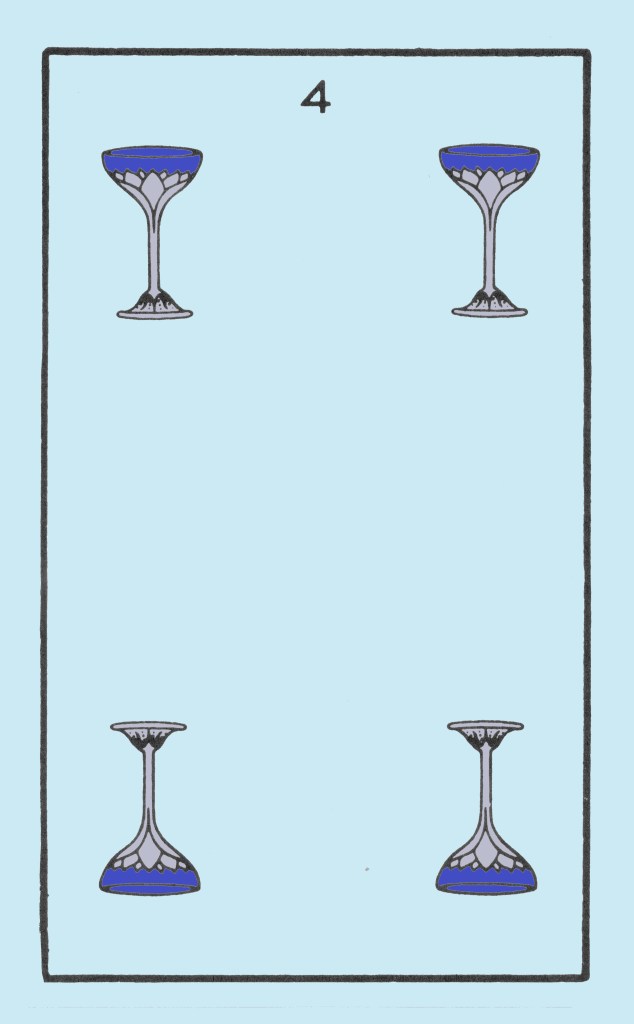
Note that the Golden Dawn did something similar, despite the claim that the card titles were revealed to them. Take the Four of Cups, for instance, which technically should be ascribed to the rulership of the Moon in the third decan of Cancer and to the sephira Chesed (mercy). All these things sound very promising. Yet the card is called Blended Pleasure and it is less positive than the previous two, largely (I believe) in an attempt to accomodate Etteilla’s relatively negative interpretation of the Four of Cups as a card of boredom, annoyance, etc.

Similarly, the Golden Dawn retained certain meanings found in traditional fortune-telling, such as ‘travel by water’ for the Six of Swords. This can be seen as part of the GD’s attempt at summarizing the whole of the Western magical tradition in a new synthesis.

Going back to Waite, it is clear that in his book he is also trying to balance various sources, but if in doubt about which one to follow, he will stick (without saying so explicitly) to the GD tradition. An example I already discussed is the Five of Pentacles, which Etteilla calls the card of the lovers, but the Golden Dawn called it ‘Material Trouble’.

Another example is the Two of Wands, which Etteilla calls a card of sorrow, but for the GD it is a card of Dominion, so Waite goes with the GD but tries to stretch the interpretation in his text by saying that it could be the sorrow of a great leader, like Alexander the Great, at the height of his power.

But What About the Seven of Swords?

With that in mind, what the hell is going on with the Seven of Swords? Let me explain: most people who pick up a Rider Waite tarot deck, even today, have no idea about the esoteric stuff behind it, so they base their interpretation on the design (which, incidentally, Waite thought very little of). This is how, for instance, the Two of Pentacles, the Lord of Harmonious Change according to GD, became the card of juggling, or how the Seven of Cups, the Lord of Illusionary Success, became the card of options.

In this new folk approach to the Waite deck, the Seven of Swords became known as the thief card due to the design.

Yet Waite does not even mention thieves in his description. He says:

A man in the act of carrying away five swords rapidly; the two others of the card remain stuck in the ground. A camp is close at hand. Divinatory Meanings: Design, attempt, wish, hope, confidence; also quarrelling, a plan that may fail, annoyance. The design is uncertain in its import, because the significations are widely at variance with each other. Reversed: Good advice, counsel, instruction, slander, babbling.

The meanings he gives are from Etteilla, where the Seven of Swords is one of the few non negative Sword cards. The description of the card, however, is far more consonant with what we find in Book T, which is:

The Lord of Unstable Effort […]Partial success. Yielding when victory is within grasp, as if the last reserves of strength were used up. Inclination to lose when on the point of gaining, through not continuing the effort. Love of abundance, fascinated by display, given to compliments, affronts and insolences, and to spy upon others. Inclined to betray confidences, not always intentionally. Rather vacillatory and unreliable.
Netzach of HB:V (Journey by land: in character untrustworthy)

This thing with the yielding when victory is within grasp is clearly depicted in the card, where the thief takes away most of the enemy’s swords, but not all, as Waite clearly states.

But why did Waite (and, maybe, Smith) decide to depict a thief in the Seven of Swords despite it being so thematically different from Waite’s actual inspiration (Book T) and even his cover-up inspiration (Etteilla)?

The only hints we find in Book T that seem to point in this direction are “to spy upon others” and “in character untrustworthy”. In an attempt to accomodate Etteilla, Waite probably saw the man looking longingly at the swords he left on the ground as a symbol of hope, which is Etteilla’s meaning for the card.

One possible explanation is that Waite and/or Smith probably thought the type of action that is best suited to the Suit of Swords is the kind of sneaky, underhanded action depicted in the final design of the card. Be it as it may, this is one of the cards that always stood out to me when studying the history of this deck, because it takes a very non-obvious approach to its theme.

MQS

What Makes Readings Go South

A recent comment by a visitor of this website has inspired me to write an article about what makes divination go south, whether it’s card reading or something else. I have already shared one or two readings I got wrong, but in the future I would like to share more of my hardships as well as my successes, for two reasons: 1. it gives a fairer representation of how divination works and 2. it doesn’t discourage those who are studying the material I provide (I often get messages from people despairing they will ever be good diviners)

The reality is that divination is a human activity, and like all human activities it can go wrong. In a world where lawyers, scientists and doctors can be wrong (and not seldom), it’s unclear why we would expect fortune-tellers to be infallible.

There can be a variety of factors that make a reading go south. Here’s a bunch, in no particular order.

The querent is too emotionally volatile

Usually, the querent’s attitude doesn’t matter that much. However, it has been my experience that when a querent is in a state of utter and extreme desperation or emotional volatility, they will skew the reading in one direction or the other. This is rare, but it does happen on occasion. Once a friend who was looking for a job and was absolutely desperate asked for a reading and he pulled ALL spades. He still got a job around a month later. The cards were just reflecting his emotional turmoil.

Emotional involvement is also usually not good when reading the cards for ourselves. My personal experience is that if I read for myself about a topic I don’t care too much about, the reading will be largely accurate, while if I read about something I care very much about, the cards will show me either what I hope or what I fear.

Note though that there are divination tools that work better when the querent is very emotionally involved. This is the case, for instance, for Horary Astrology, where there are no counters to manipulate and therefore a relatively strong emotional push is required for question and answer to align.

The reader isn’t grounded enough

This is more common. Divination is not an assembly line type of occupation. We are dealing with a world that is, in a very real sense, divine and that eschews the mechanic and repetitive.

The diviner needs to be relatively at peace with themselves before performing a divination. I say ‘relatively’ because we don’t need to always be at our best (otherwise we’d never be able to divine). Certainly we need to be capable of detaching at least momentarily from our deepest worries and hopes. Fits of ecstasy and cheap mysticism are also to be avoided, as the best attitude is one of sober helpfulness toward the other.

There are some partial exceptions for ‘inspired divination’, such as mediumistic spiritism, but I don’t cover these topics on this website as I avoid these practices like the plague (I had a distant relative who was an excellent natural psychic and ruined her life in her attempt at constantly staying in the required state of passive receptivity).

The reader simply doesn’t always interpret the medium right

This is obvious, and I’ve talked about it at length, but it bears repeating. Divination is a language with no native speakers. We must learn it as if it were a foreign language. or, if you are romantic about the universe and think divination is our original language, then we must relearn it, but the end result doesn’t change. Like with all secondary languages, we are bound to make mistakes.

The best we can do about it is strive to correct our mistakes and be upfront with our querents that we are not offering miracles but just help in widening their view of their own life, of where it’s coming and where it’s directed.

Drawing wrong conclusions from right premises

This is another important pitfall, and it is a particular variety of ‘not reading the medium right’. As diviners we must understand that certain things can be changed and certain things can’t. Most divination tools are very upfront about it. If they say the thing you want cannot be achieved, then it cannot be achieved (unless we are interpreting the medium wrong, see above). If it says the thing you want will fall in your lap, then it will fall in your lap. Period. But if the medium says what you want is hard, it doesn’t mean it’s impossible, just as when it says it’s easy it doesn’t mean you’ll achieve it.

As diviners, sometimes, we feel we must give our querents more certainty than we are entitled to give them based on our divination tools. If the querent wants to become a writer and the cards show that writing comes easy to them, it doesn’t mean they will become a writer if they don’t put in the effort. Usually, in such cases, the lack of effort does come up in the cards as a warning, so that the prediction will sound like: you are very talented, but unless you actually spend time honing your craft, you won’t amount to much. This, too, is a valid prediciton.

All in all, we must be careful to distinguish what the medium says from what we want to tell the querent.

MQS

Tarot Encyclopedia – The Three of Pentacles or Coins

(Note: this is a collection of the meanings attributed to the cards by some occultists in the past centuries. It does not reflect my own study or opinion of the cards. It is only meant as a quick comparative reference as I develop my own take.)

The Three of Pentacles from the Builders of the Adytum (BOTA) deck

Paul Foster Case (and Ann Davies)

The time period is the second decanate of Capricorn, under the rulership of Venus, from January 1 to January 9.
Well-Dignified: construction; increase, growth; financial gain; the building up of favorable conditions; gain in commercial transactions; rank or prestige in vocation or business; beginning of matters to be perfected later.
Ill-Dignified: selfishness; cleverness in business, but lack of scruples;
narrowness and prejudice; too much ambition.
Keyword: Constructiveness.
(From the Oracle of Tarot course)

A. E. Waite

A sculptor at his work in a monastery. Compare the design which illustrates the Eight of Pentacles. The apprentice or amateur therein has received his reward and is now at work in earnest. Divinatory MeaningsMétier, trade, skilled labour; usually, however, regarded as a card of nobility, aristocracy, renown, glory. Reversed: Mediocrity, in work and otherwise, puerility, pettiness, weakness.
(From The Pictorial Key to the Tarot)

Aleister Crowley

The Three of Pentacles, in a similar manner, exhibits the result of the idea of Earth, of the crystallization of forces; and so the Three of Pentacles is called the Lord of Work. Something has definitely been done.

[…]

The influence of Binah in the sphere of Earth shows the material establishment of the idea of the Universe, the determination of its basic form. It is ruled by Mars in Capricornus; he is exalted in that Sign, and therefore at his best. His energy is constructive, like that of the builder or engineer. The card represents a pyramid viewed from above the apex. The base is formed by three wheels-Mercury, Sulphur, and Salt; Sattvas, Rajas, and Tamas in the Hindu system; Aleph, Shin, and Mem-Air, Fire, and Water-the three Mother letters of the Hebrew alphabet.

This pyramid is situated in the great Sea of Binah in the Night of Time, but the sea is solidified; hence the colours of the back-ground are mottled, a cold thin dark grey with a pattern of indigo and green. The sides of the pyramid have a strong reddish tint, showing the influence of Mars.
(From The Book of Thoth)

AI-generated illustration for the Three of Pentacles or Coins

Golden Dawn’s Book T

A WHITE-WINGED Angelic Hand, as before, holding a branch of a rose tree, of which two white rosebuds touch and surmount the topmost Pentacle. The Pentacles are arranged in an equilateral triangle. Above and below the symbols Mars and Capricorn.
Working and constructive force, building up, creation, erection; realization and increase of material things; gain in commercial transactions, rank; increase of substance, influence, cleverness in business, selfishness. Commencement of matters to be established later. Narrow and prejudiced. Keen in matters of gain; sometimes given to seeking after impossibilities.
Binah of HB:H (Business, paid employment, commercial transaction).
Herein are HB:YChVYH and HB:LHChYH Angelic Rulers.

Etteilla

Important
Upright. This card, as far as the medicine of the spirit is concerned, means, in its natural position: Noble, Considerable, Famous, Important, Great, Major, Extended, Vast, Sublime, Renowned, Famous, Powerful, Elevated, Illustrious. – Excellence, Consideration, Greatness of mind, Nobility of conduct, Generous deeds, Magnificently, Splendidly.
Reversed. Puerility, Childhood, Infantilism, Frivolity. – Weakening, Lowering, Diminishing, Education, Modicity, Mediocrity, Minuity, Inezia, Frivolity, Lowness, Vileness, Poltrony, Rampant, Small, Puerile, Petty, Low, Servile, Vile, Abject, Humble. – Abjection, Humility, Humiliation.

MQS

Tarot Encyclopedia – The Three of Swords

(Note: this is a collection of the meanings attributed to the cards by some occultists in the past centuries. It does not reflect my own study or opinion of the cards. It is only meant as a quick comparative reference as I develop my own take.)

The Three of Swords from the Builders of the Adytum (BOTA) tarot deck

Paul Foster Case (and Ann Davies)

The time period is the second decanate of Libra, under the combined rulership of Saturn and Uranus, October 3 to October 12. Because Libra is involved, remember that the qualities of the Seventh house are prominent.
Well-Dignified: this is nevertheless a Key depicting sorrow, disappointment and tears, but it can be the beginning of deep understanding as to the basis and cause of our problems; disruption of friendship; interruption of cherished projects; quarrels; occasionally the position in the layout may indicate platonic friendships; in money matters this card is almost always a symbol of loss, but indicates that whatever money matters are under consideration have been fair and honest, so that no blame attaches to anyone for the loss.
Ill-Dignified: slander; selfishness and dissipation; deceit with respect to promises; loss in legal affairs.
Keyword: Sorrow
(From the Oracle of Tarot course)

A. E. Waite

Three swords piercing a heart; cloud and rain behind. Divinatory Meanings: Removal, absence, delay, division, rupture, dispersion, and all that the design signifies naturally, being too simple and obvious to call for specific enumeration. Reversed: Mental alienation, error, loss, distraction, disorder, confusion.
(From The Pictorial Key to the Tarot)

Aleister Crowley

The idea of division, of mutability, the idea of the airy quality of things, manifests itself in the Three of Swords, the Lord of Sorrow. Here one is reminded of the darkness of Binah, of the mourning of Isis; but this is not any vulgar sorrow dependent upon any individual disappointment or discontent. It is Weltschmerz, the universal sorrow; it is the quality of melancholy.

[…]

Binah, the Great Mother, here rules the realm of Air. This fact involves an extremely difficult doctrine which must be studied at length in The Vision and the Voice: Aethyr 14.
Binah is here not the beneficent Mother completing the Trinity with Kether and Chokmah. She represents the darkness of the Great Sea.
This is accentuated by the Celestial Lordship of Saturn in Libra.
This card is dark and heavy; it is, so to speak, the womb of Chaos. There is an intense lurking passion to create, but its children are monsters. This may mean the supreme transcendence of the natural order. Secrecy is here, and Perversion.
The symbol represents the great Sword of the Magician, point uppermost; it cuts the junction of two short curved swords. The impact has destroyed the rose. In the background, storm broods under implacable night.
(From The Book of Thoth)

A gruesome AI-generated illustration for the Three of Swords

Golden Dawn’s Book T

THREE White Radiating Angelic Hands, issuing from clouds, and holding three swords upright (as though the central sword had struck apart the two others, which were crossed in the preceding symbol): the central sword cuts asunder the rose of five petals, which in the previous symbol grew at the junction of the swords; its petals are falling, and no white rays issue from it. Above and below the central sword are the symbols of Saturn and Libra.

Disruption, interruption, separation, quarrelling; sowing of discord and strife, mischief-making, sorrow and tears; yet mirth in Platonic pleasures; singing, faithfulness in promises, honesty in money transactions, selfish and dissipated, yet sometimes generous: deceitful in words and repetitions; the whole according to dignity.
Binah of HB:V (Unhappiness, sorrow, and tears).
Herein rule the Great Angels HB:HRYAL and HB:HQMYH as Lords of the Decan.

Etteilla

Removal
Upright. This card, as far as the medicine of the spirit is concerned, means, in its natural position: estrangement, Departure, Absence, Discarding, Dispersion, Remoteness, Delay. – Contempt, Repugnance, Aversion, Hatred, Disgust, Horror. – Incompatibility, Contrariness, Opposition, Unsociability, Misanthropy, Incivility. – Separation, Division, Breaking, Antipathy, Section, Cutting off.
Reversed. Misdirection, Dementia, Vanity, Alienation of spirit, Distraction, Insane conduct. – Error, Miscalculation, Loss, Deviation, Discard, Dispersion.

MQS

Tarot Encyclopedia – The Three of Cups

(Note: this is a collection of the meanings attributed to the cards by some occultists in the past centuries. It does not reflect my own study or opinion of the cards. It is only meant as a quick comparative reference as I develop my own take.)

The Three of Cups from the Builders of the Adytum (BOTA) tarot deck

Paul Foster Case (and Ann Davies)

The Three of Cups is astrologically related to the second decanate of Cancer ruled by the Scorpio aspect of Mars, time period July 2 to July 12. The distinct meanings in divination combine the pleasure and emotion associated with the suit of Cups and the sex magnetism of the Scorpio aspect of Mars, together with Cancerian practicality and penchant for attachments.
Well-Dignified: activity, determination, practicality; fondness for pleasure and comfort; attachments and attractions to the opposite sex; pleasure, merriment, eating and drinking, plenty of new clothes, etc.
Ill-Dignified: danger of the ‘triangle’ situation; trouble through attachments to the opposite sex; midunderstandings; prodigality; sensuality.
Keyword: Enjoyment
(From the Oracle of Tarot course)

A. E. Waite

Maidens in a garden-ground with cups uplifted, as if pledging one another. Divinatory Meanings: The conclusion of any matter in plenty, perfection and merriment; happy issue, victory, fulfilment, solace, healing, Reversed: Expedition, dispatch, achievement, end. It signifies also the side of excess in physical enjoyment, and the pleasures of the senses.
(From The Pictorial Key to the Tarot)

A marvellous AI-generated illustration for the Three of Cups

Aleister Crowley

The Three of Cups is called the Lord of Abundance. The idea of love has come to fruition; but this is now sufficiently far down the Tree to introduce a very definite differentiation between the suits, which was not previously possible.

[…]

This card refers to Binah in the suit of Water. This is the card of Demeter or Persephone. The Cups are pomegranates: they are filled bountifully to overflowing from a single lotus, arising from the dark calm sea characteristic of Binah. There is here the fulifilment of the Will of Love in abounding joy. It is the spiritual basis of fertility.

The card is referred to the influence of Mercury in Cancer; this carries further the above thesis. Mercury is the Will or Word of the All-Father; here its influence descends upon the most receptive of the Signs.

At the same time, the combination of these forms of energy brings in the possibility of somewhat mysterious ideas. Binah, the Great Sea, is the Moon in one aspect, but Saturn in another; and Mercury, besides being the Word or Will of the All-One, is the guide of the souls of the Dead. This card requires great subtlety of interpretation. The pomegranate was the fruit which Persephone ate in the realms of Pluto, thereby enabling him to hold her in the lower world, even after the most powerful influence had been brought to bear. The lesson seems to be that the good things of life, although enjoyed, should be distrusted.
(From The Book of Thoth)

Golden Dawn’s Book T

A WHITE Radiating Hand, as before, holds a group of lotuses or water-lilies, from which two flowers rise on either side of, and overhanging the top cup; pouring into it the white water. Flowers in the same way pour white water into the lower cups. All the cups overflow; the topmost into the two others, and these upon the lower part of the card. Cups are arranged in an erect equilateral triangle. Mercury and Cancer above and below.
Abundance, plenty, success, pleasure, sensuality, passive success, good luck and fortune; love, gladness, kindness, liberality.
Binah of HB:H (Plenty, hospitality, eating and drinking, pleasure, dancing, new clothes, merriment).

Etteilla

Success
Upright. This card, as far as the medicine of the spirit is concerned, means, in its natural position: Success, Science, Happy outcome, Happy solution, Victory. – Healing, Cure, Relief. – Accomplishment. – Perfection.
Reversed. Dispatch, Sending, Execution, Completion, End, Conclusion, Termination, Fulfillment.

MQS