Usually I’m not a huge fan of readings done on someone else without them knowing, not for ethical reasons but because I always feel there is more wiggle room for error if the person is not present. This is just my experience, but that’s how it works for me. Still, when a friend of mine started getting paranoid that his job contract might not get renewed I decided to ask, even though he didn’t feel like getting a reading (especially since we don’t live in the same country)
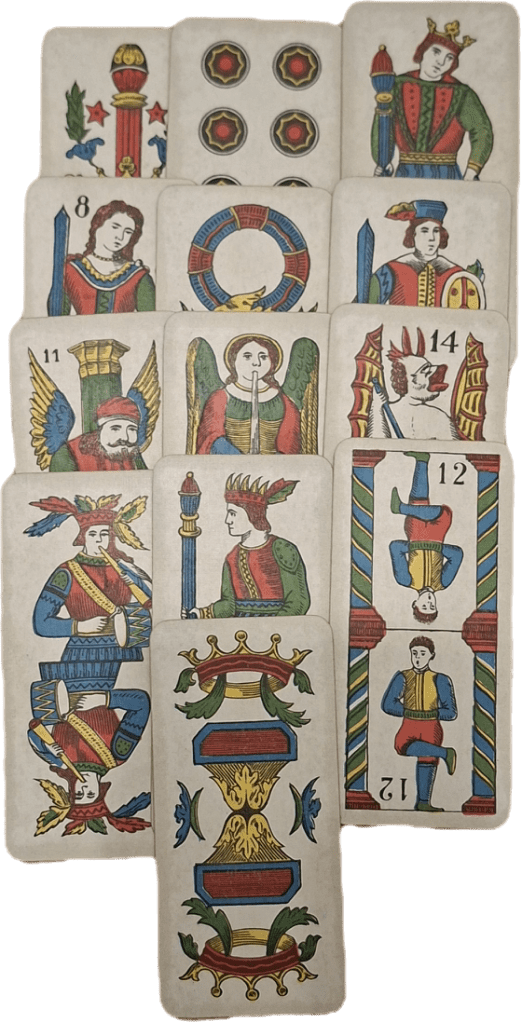
I used the Bolognese tarot, since this is the deck I’m currently studying, and the thirteen card spread, which is the most common spread with this deck.
Will the contract be renewed?
I believe the line that gives us a positive answer is the third, with the Hermit, the Angel and the Devil. Angel and Devil is one of those rare traditional combos that cannot be reduced to the basic meaning of the cards: it represents great news or great satisfaction. In general, when they fall together, they can be a hint at a yes.
Since the Hermit opens the line though, this is going to take some time (and it did: he was waiting for an answer any day from the date of the reading, instead it took two months). And the answer WAS positive, so the Hermit only influenced the time element, but it didn’t block the good news.
What about the other cards? Well, I believe the first two lines are simply describing the situation: in the first line we have the querent, my friend (the King of Wands) together with the little money card and the Ace of Wands. This can be interpreted as him having actually little (Ten of Coins) interest (Ace) for the job aside from needing it or, more positively, that the job brings him success (Ace) in little amounts (Ten of Coins). Both interpretations are actually true.
The second line has Justice and the Ace of Swords, which together can talk about a legally binding (Justice) contract (Ace of Swords). Then comes the letter card (the Page of Swords) which is followed in the next line by the Hermit, the blockage. This is where the delay was created.
What about the last line? Here I’m not sure. The cards talk about a woman, the Queen of Wands, possibly belonging to the family (she sits right on top of the Ace of Cups). She is surrounded by confusion (Fool) and betrayal (the Hanged Man). My only thought was that a woman close to him wasn’t at all expecting the contract to be renewed, was taken by surprise. I wasn’t able to confirm this detail, but there you go.
(Note: this is a collection of the meanings attributed to the cards by some occultists in the past centuries. It does not reflect my own study or opinion of the cards. It is only meant as a quick comparative reference as I develop my own take.)
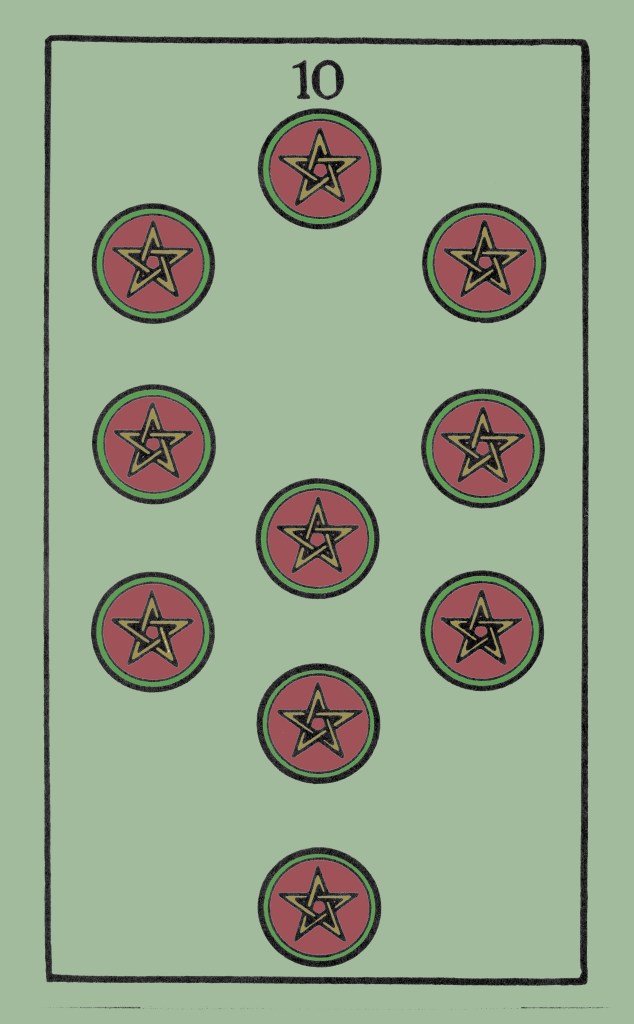
The Ten of Pentacles from the Builders of the Adytum (BOTA) tarot deck
Paul Foster Case (and Ann Davies)
The time period is the third decanate of Virgo, under the rulership of Venus, September 13 to September 22. Meanings: Well-Dignified: money through servants or subordinates; gain in matters connected with medicine, drugs, food, nursing, farming or gardening; completion in material gain and fortune, but nothing beyond. Ill-Dignified: material success, but heaviness and dullness of mind; sometimes loss through the matters listed above; slothfulness. Keyword: Wealth. (From the Oracle of Tarot course)
A. E. Waite
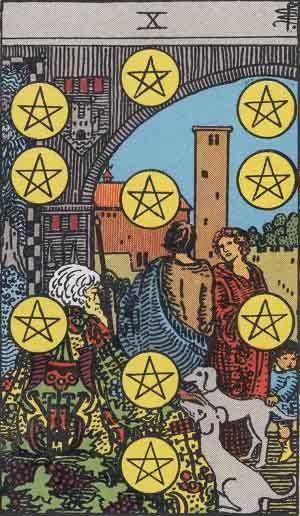
A man and woman beneath an archway which gives entrance to a house and domain. They are accompanied by a child, who looks curiously at two dogs accosting an ancient personage seated in the foreground. The child’s hand is on one of them. Divinatory Meanings: Gain, riches; family matters, archives, extraction, the abode of a family. Reversed: Chance, fatality, loss, robbery, games of hazard; sometimes gift, dowry, pension. (From The Pictorial Key to the Tarot)
The Ten of Pentacles from the Rider Waite Smith tarot
Aleister Crowley
The Ten of Disks is called Wealth. Here again is written this constantly recurring doctrine, that as soon as one gets to the bottom one finds oneself at the top; and Wealth is given to Mercury in Virgo. When wealth accumulates beyond a certain point, it must either become completely inert and cease to be wealth, or call in the aid of intelligence to use it rightly. This must necessarily happen in spheres which have nothing whatever to do with material possessions, as such. In this way, Carnegie establishes a Library, Rockefeller endows Research, simply because there is nothing else to do.
But all this doctrine lies behind the card; it is the inner meaning of the card. There is another view to consider, that this is the last of all the cards, and therefore represents the sum total of all the work that has been done from the beginning. Therefore, in it is drawn the very figure of the Tree of Life itself. This card, to the other thirty-five small cards, is what the twenty-first Trump, The Universe, is to the rest of the Trumps.
[…]
The number Ten, Malkuth, as always, represents the final issue of the Energy. Here is great and final solidification. The force is completely expended and results in death. Mercury rules this card in Virgo; and this may imply that the acquired wealth, being inert, will be dissipated unless put to further use by devoting its power to objects other than mere accumulation.
The disks, or (as they have now become) coins, are arranged on the Tree of Life, but the Tenth coin is much larger than the rest; the image indicates the futility of material gain.
These disks are inscribed with various symbols of mercurial character except that the coin in the place of Hod (Mercury) on the Tree is marked with the cipher of the Sun. This indicates the only possibility of issue from the impasse produced by the exhaustion of all the elemental forces. At the end of matter must be complete stagnation, were it not that in it is always inherent the Will of the Father, the Great Architect, the Great Arithmetician, the Great Geometer. In this case, then, Mercury will represent the Logos, the Word, the Will, the Wisdom, the Eternal Son, and Virgo the Virgin, in every implication of that symbol. This card is in fact a hieroglyph of the cycle of regeneration.
Among the Geomantic figures, Mercury in Virgo is Conjunctio. The meaning, conjunction, is shown plainly by the attraction of the descending (female) Triangle, the cipher of the Yoni, to the ascending (male) Triangle, that of the Lingam. This union completed, they appear interlaced, forming the figure of Capricornus, the Sign in which the Sun finds his rebirth. It is the holy Hexagram, the symbol of the uniting of the Macrocosm and the Microcosm, the accomplishment of the Great Work, the Summum Bonum, True Wisdom and Perfect Happiness. Sic sit vobis! (From the Book of Thoth)
The Ten of Disks from the Thoth Tarot deck
Golden Dawn’s Book T
AN Angelic Hand, holding by the lower extremity a branch whose roses touch all the Pentacles. No buds, however, are shewn. The symbols of Mercury and Virgo are above and below. The Pentacles are thus arranged:
* * * * * * * * * * Completion of material gain and fortune; but nothing beyond: as it were, at the very pinnacle of success. Old age, slothfulness; great wealth, yet sometimes loss in part; heaviness; dullness of mind, yet clever and prosperous in money transactions. Malkuth of HB:H (Riches and wealth). Herein are HB:LAVYH and HB:HHa’aYH set over this Decan as Angel Rulers
Etteilla
The house Upright. In terms of spiritual medicine, this card, in its natural position, signifies: Home, Household management, Economy, Savings. – Dwelling, Domicile, Residence, Manor, Lodging, Regiment, Ship, Vessel, Vase. – Archive, Castle, Hut. – Family, Origin, Race, Posterity. – Cave, Cavern, Refuge. Reversed. Lottery, Luck, Gambling, Chance, Accident, Ignorance, Fate, Destiny, Predestination, Fatality. – Fortunate or unfortunate opportunity.
The literary landscape in Italy is rather dismal, as far as the occult arts are concerned, even though in recent years something seems to be changing. But Il Tarocchino di Bologna (the Little Tarot of Bologna) by Andrea Vitali and Terry Zanetti is not a very recent book, and this makes its outstanding quality even more of a surprise.
The book is divided into several sections, some authored by Vitali and some by Zanetti. Andrea Vitali is possibly the greatest living tarot historian (and a damn good diviner too), the one who has shed the most light on the history and origins of the tarot, bursting a lot of bubbles in the process. His section is, as usual, well documented and written, and generally aims at showing that the tarot probably originated not in Milan but in Bologna.
But, as undisputed as Vitali’s expertise in the field, our focus in this review is Zanetti’s section on cartomancy. This is well organized and competently written. Aside from a brief preamble, the largest part of her section of the book is dedicated to the meanings of the cards, which she has researched in various ways, including by looking for old decks with the meanings written on them.
Zanetti, like Celi (and currently like me), uses a 45-card deck. The deck, however, differs: instead of one Stranger, she uses two, one of them taking the place of the Ten of Coins. As I mentioned elsewhere, these discrepancies are to be expected from a tool of popular divination that was invented in a non-globalized world of isolated villages and streets. Even some of the meanings differ, as I explained in this post, where I talked about the fact that she interprets the Page of Swords not as a letter but as a young man.
Each card is presented with their Italian and Bolognese dialect name, a brief iconographic rundown, the list of meanings, an example reading with a three-card method, a saying from the Bolognese popular tradition that illustrates the meaning of the card, and a combination. Some combinations are exceedingly curious and stray far way from the original meanings of the cards.
The spreads covered by Zanetti are also interesting and worth studying. One is a variation of the great staircase spread I talked about, but Zanetti gives very specific and somewhat rigid rules for interpreting it. She then covers a pyramid spread and a variation of the cross spread, the thirteen card spread and, finally an oracle made up of only three cards.
The only small concern is the rigidity with which Zanetti treats combinations of two cards. My experience is that cards must be first and foremost combined logically based on the context of the question and the other cards, but she asserts that when two specific cards come together they always have a specific meaning regardless of everything.
This, I have found, may be true when many cards come together. For instance, even if you ask about love, if someone in your life is about to drop dead, lots of cards will amass in that regard, not just two. Yet Zanetti treats two-card combos as if they were powerful enough to transcend the question (and yes, she does give a combination about death). Again, this is a question of method and personal experience. It does not detract from the validity of her experience, but it does highlight one of its peculiar traits.
So is this book worth having? To this my answer is a big fat yes!
When someone teaches someone else the traditional meanings of the cards, they often don’t waste too much time giving them a rundown of all the applications of the one or two keywords they give them, especially at the beginning. Keep in mind that in many traditions, at least in Italy, the initial instructions for card reading are passed down on Christmas Eve, so the explanations must be quick enough to fit into one evening where you have plenty of other stuff to do.
Usually, the initial instruction is followed up by a more thorough explanation later, but the new reader is also expected to “lavorare le carte”, literally to “work the cards“. This means that while they are being given a vocabulary (the keywords) and some grammar and syntax (the various spreads and combinations) they are supposed to develop their own language.
Think about it: we all speak English on this blog, yet each of us speaks a different version of it, not only because some of us are native speakers while some aren’t, and not just because some come from the US, some from GB, some from Australia, etc. but also, and especially, because each speaker of a language has their own slightly different version of it, owing to their character, personal history, experiences, education, talents and many other factors.
This may sound like an admission that language is random and infinitely pliable at will, but it isn’t. Your own language is an emanation of you as a person, but who you are as a person is not fully under your control. In fact, the diviner and occultist in me believes that it is only very slightly under your control.
What is true for regular speech is true for the speech of the cards. Once you are given the meanings of the cards, it is not a matter of reinventing them, but rather of discovering how the meanings work for you, of understanding what your particular, individual dialect is. This is a never-ending process, because the language of divination is a difficult second language to learn and because there is no human native that can help us.
But let’s discuss an example of how you take a single keyword and turn it into a web of interrelated meanings. In the Bolognese Tarot, which is my current obsession and is quickly becoming one of my favorite systems, the Queen of Coins is called “the truth”. There. If you were sitting on grandma’s lap on Christmas Eve and she were passing the meanings down to you, that’s what she would say. The truth. Period.
The truth is a complex thing, and throughout history different people have understood it to be something different. In itself, it is an abstract concept. After receiving it, you need to make it concrete, i.e., you need to discover how the word “truth” is used in your particular divination dialect. Let’s give it a try (and this is my dialect, obviously. It may or may not overlap with yours).
The truth is what truthful people tell, so obviously the card qualifies people as truthful, dependable, reliable. Next to a person card, the person will be all these things, probably.
Once you know the truth about something, you know about it. Knowledge is therefore another aspect of truth. Who has knowledge? Professors, for sure, and people who have studied something. One might counter that so many graduates today are ignorant fools filled with prejudices they never questioned. And one would be right. Archetypally, though, the connection (the ‘signature’) holds, similarly to how astrologically scholars are ruled by Mercury, even if scholars are often up their asses.
Study, teaching, learning, explaining, science, discovering, bringing to light, intellectual (or at least not physical) occupations seem to also be concepts that beautifully complement that lonely keyword “truth”. But all these aren’t just descriptions for abstract knowledge. What is a less abstract form of knowledge? Expertise, for sure. If you call the plumber, he may not be able to tell you how the categories of Aristotle’s logic apply to your toilet, but he sure knows how to stop it puking out scum. And that’s a good deal more helpful. So a plumber with the truth on his side is certainly a plumber you want to hire.
Today, the word wisdom is almost forgotten, or relegated to describing dubious practices with no scientific stamp of approval. But wisdom used to be deeply connected to knowledge. The Queen of Coins, therefore, surely describes the ability to lead your life the right way, or to lead others the right way.
Especially in the West, the idea of truth has always been connected with the ability to see. “I see” we say, when we understand something. This may sound shallow, but it actually has its roots in the old Greek notion that the truth is what the mind sees beyond the illusions of the senses. The word “idea”, which is what we have in our minds and which we hope to be a truthful representation of reality, comes from the root ‘vid-‘, which is the same root as the latin ‘videre’, to see. So the Queen of Coins stands for sight and for the eyes, and for windows, which bring light (understanding) into the home and from which we see how the world outside looks like. And so on and so forth.
These associations can be discovered by practice and by decoding the combinations that are usually passed down. Again, it is not a matter of making up. It is, literally, a process of discovery.
I often get messages from people asking me how to learn the tarocchino. This makes me happy, because it means this extremely old divination tradition is slowly getting the attention it deserves.
I had the blessing of knowing a great teacher, Germana Tartari, whose first book I reviewed (and whose two other books I shall review in the near future). She taught me how to read the 50 card method.
For those interested, a course by her will start on 15 January. You can read more about it on the website of the Accademia degli Studi Ermetici
(Note: this is a collection of the meanings attributed to the cards by some occultists in the past centuries. It does not reflect my own study or opinion of the cards. It is only meant as a quick comparative reference as I develop my own take.)
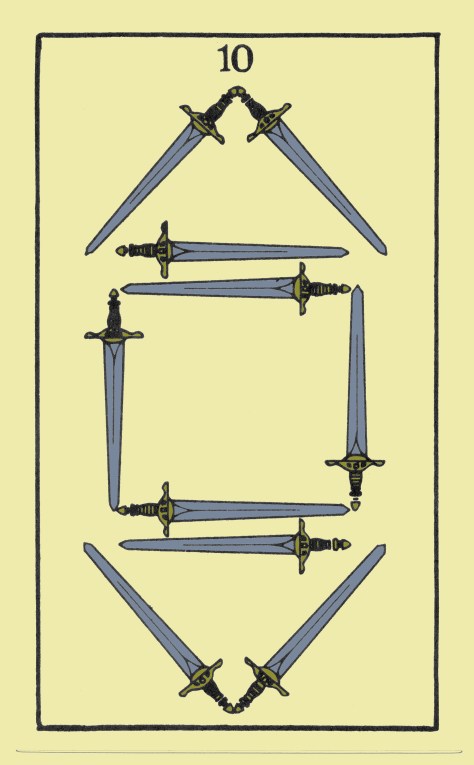
The Ten of Swords from the Builders of the Adytum (BOTA) tarot deck
Paul Foster Case (and Ann Davies)
The time period is the third decanate of Gemini, June 11 to June 21, under the rulership of Saturn and Uranus. Well-Dignified: in spiritual matters, the end of delusion; the overthrow of limiting conditions; break-up of restrictions. In material affairs, sudden and unexpected changes, not always unfortunate in the long run, but disappointing when experienced: interference from from others. and.loss through indiscretion in writmg or signing contracts. lll-Dignifled: failure, desolation, misery. Keyword: Destruction (From the Oracle of Tarot course)
A. E. Waite
A prostrate figure, pierced by all the swords belonging to the card. Divinatory Meanings: Whatsoever is intimated by the design; also pain, affliction, tears, sadness, desolation. It is not especially a card of violent death. Reversed: Advantage, profit, success, favour, but none of these are permanent; also power and authority. (From The Pictorial Key to the Tarot)
The Ten of Swords from the Rider Waite Smith tarot
Aleister Crowley
The Ten of Swords is called Ruin. It teaches the lesson which statesmen should have learned, and have not; that if one goes on fighting long enough, all ends in destruction.
Yet this card is not entirely without hope. The Solar influence rules; ruin can never be complete, because disaster is a sthenic disease. As soon as things are bad enough, one begins to build up again. When all the Governments have smashed each other, there still remains the peasant. At the end of Candide’s misadventures, he could still cultivate his garden.
[…]
The number Ten, Malkuth, as always, represents the culmination of the unmitigated energy of the idea. It shows reason run mad, ramshackle riot of soulless mechanism; it represents the logic of lunatics and (for the most part) of philosophers. It is reason divorced from reality. The card is also ruled by the Sun in Gemini, but the mercurial airy quality of the Sign serves to disperse his rays; this card shows the disruption and disorder of harmonious and stable energy.
The hilts of the Swords occupy the positions of the Sephiroth, but the points One to Five and Seven to Nine touch and shatter the central Sword (six) which represents the Sun, the Heart, the child of Chokmah and Binah. The tenth Sword is also in splinters. It is the ruin of the Intellect, and even of all mental and moral qualities.
In the Yi King, Sol in Gemini is the virtue of the 43rd Hexagram, Kwai, the Watery modification of the Phallus; also, by the interlacing interpretation, the harmony of these two same Trigrams.
The signification is perfectly harmonious with that of the Ten of Swords It represents the damping down of the Creative impulse, weakness, corruption, or mirage affecting that principle itself. But, viewing the Hexagram as a weapon or method of procedure, it counsels the ruler to purge the state of unworthy officers. Curiously, the invention of written characters to replace knotted strings is ascribed among Chinese scholars to the use of this hexagram by the sages. Gemini is ruled by Thoth; 10 is the key of the Naples Arrangement; and Apollo (Sol) is the patron of literature and the arts: so his suggestion might appear at least no less suitable to the Qabalistic correspondences than to their double emphasis on Water and the Sun. Apart from this, however, the parallelism is complete. (From the Book of Thoth)
The Ten of Swords from the Thoth tarot deck
Golden Dawn’s Book T
FOUR hands holding eight swords, as in the preceding symbol; the points falling away from each other. Two hands hold two swords crossed in the centre, as though their junction had disunited the others. No rose, flower or bud, is shewn. Above and below are Sun and Gemini, representing the Decan.
Almost a worse symbol than the Nine of Swords. Undisciplined, warring force, complete disruption and failure. Ruin of all plans and projects. Disdain, insolence and impertinence, yet mirth and jollity therewith. A marplot, loving to overthrow the happiness of others; a repeater of things; given to much unprofitable speech, and of many words. Yet clever, eloquent, etc., according to dignity.
Malkuth of HB:V (Ruin, death, defeat, disruption). Herein the Angels HB:DMBYH and HB:MNQAL reign
Etteilla
Affliction Upright. In terms of spiritual medicine, this card, in its natural position, signifies: Crying, Tears, Sobbing, Moaning, Sighing, Lamenting, Complaining, Afflictions, Regrets, Sadness, Pain, Wailing, Lamentations [= Poetic lamentations], Desolation. Reversed. Advantage, Gain, Profit, Success. – Grace, Favor, Benefit. – Ascendant, Power, Empire, Authority, Might, Usurpation.
I recently received some questions from a visitor to this website. One of them was in which sense the Sibilla is considered “chiacchierina”, i.e., chatty.
This is an interesting question, because it gets to the heart of how divination works (and not just divination with cards). I don’t want to foster the belief that the Sibilla is more capable of conveying information than other divination systems. This would be false advertising. Every deck and every system is capable of informing us.
But the way in which the Sibilla informs us is rather unique. Here we get into the specific character that each deck and system has. The Sibilla is like an off-beat aunt with a poor sense of boundaries.
A girl once asked me how her crush for a guy would develop. The girl had moved in with her grandma and the grandma disapproved of the guy. The Sibilla started off not with an answer to the question, but by telling me that the girl’s grandma disapproved of the situation. If I had asked another one of the decks I work with, I probably would have gotten a more straightforward answer.
It takes working with each deck in order to understand their language and personality, but these always emerge sooner or later. This is also probably why old folk diviners believed that each deck has a spirit attached to it that lives inside its cards and infuses them with its peculiar traits, a belief that I tend to share, since it explains this phenomenon much better than the impersonal Jungian theory of synchronicity.
The reality is that each (valid) divination system is chatty in its own way. I’ve heard the Bolognese tarot being referred to as chatty, and as I work with it I understand that its chattiness really is a factor, even though it is less chaotic than the Sibilla.
I did a reading recently with the Bolognesw tarot that I unfortunately forgot to record. It was one of those instances of “of course I will remember it.” The one thing I do remember is that the Tower featured prominently in the reading and did not take on a nefarious meaning, instead just indicating a place other than the home.
This gave me the idea of collecting here the combinations I have actually experimented in practice so far.
Tower + Queen of Coins (Truth) = School, Place of learning (this combo was in the reading I did recently)
Tower + World (big) = A palace (in the example of the reading I did, it was a tourist attraction)
It is not an endless list, as you can see, but then again the Tower doesn’t always come up in a reading, and when it does it doesn’t always indicate a place, and when it does it isn’t always clear what kind of place it represents, based on the other cards. But this short list is what my experience has borne out so far, and it clearly shows how the cards operate as small particles of meaning that gravitate toward each other to create complex structures.
Obviously, much depends on the context and on the other cards. The Ace of Coins, for instance, is the table, but it is also a big money card, so with other material cards it could turn the Tower into a bank instead of a restaurant. What I can say for certain at this point is that my experience with the Bolognese tarot shows the Tower isn’t necessarily an evil place (like a hospital or a prison) as some strands of the tradition seem to indicate, but its meaning can be modified by the presence of positive cards.
The bed symbolism is almost as widespread in cartomancy as that of the table, of which it is a natural counterpart. The table often stands for conviviality, nourishment, feasting and interpersonal contact, and it often represents situations happening during the day. The bed, by contrast, is a nocturnal symbol of retreat and rest, and can stand for sickness, but also for physical intimacy, depending on the other cards. As usual, it is admirable how the card readers of yore used to weave simple and effective symbols of daily life in their reading systems, which allowed them to talk about reality.
The oldest mention I could find of a card representing the bed is in a little-known system for reading Italian regional playing cards with a reduced pack of 25 (instead of the full deck of 40). In this method, the Four of Coins is the bed card. It tends to represent situations becoming static or sick, or it can talk about passion, depending on the other cards. It can also indicate that something happens in the evening or at night. Interestingly, in another system I’m aware of, this time utilizing the full pack, the Four of Coins is the table, while the Five of Wands is the bed.
In the Bolognese Tarot, which is the oldest used divination deck we have written records of, the Chariot is the bed card. This has got to be one of the most puzzling bits of symbolism of the deck: a card that is usually indicative of forward movement, travel, progress, launching forward is seen as a card of static sickness, likely due to how the chariot is represented, with the horses crouching at the sides, as if the forward movement had stopped.
Truth be told, in the oldest extant document on divination with the Bolognese tarot, which dates back to the Pre-Napoleonic period, the Chariot is still considered a card of journey, but shorter than the World card, which is assigned the meaning ‘long journey’. This may indicate that the meaning of the card evolved through time, from ‘little journey’ to ‘little movement’ to ‘not much movement’ to ‘staticity’. Another likely possibility is that different meanings were used by different strands of the tradition, one of which hadn’t yet been put down in writing. This latter possibility is confirmed by the fact that there are readers who who assign both meanings to the Chariot, depending on the cards that surround it (static cards activate the static meaning, active cards the moving, active meaning).
The bed card is also present in some of the oracle decks that originated in the XVIII century as parlor games. In the Sibilla we have two bed cards: one is the Four of Spades, the Sickness card, which interprets the symbolism of the bed in its more static and negative sense of needing to interrupt one’s routine and of situations that are not healthy. The other bed card is the Ace of Diamonds, the Room, which can indicate any room in a building, but which in itself stands for the bedroom. As an extended meaning, it is the card of intimacy, so the presence of cards indicating love or physical contact can lead to rather hot interpretations.
The Kipper deck does not have two bed cards, but it does contemplate the symbol of the bed in the card “a short sickness”, which depicts a patient in bed being visited by a doctor. This is mostly a card of sickness, but many German-language sources I’ve read consider it also an ingredient in combinations about intercourse, partly due to the presence of the bed and partly due to the doctor touching the sick man’s wrist, which is supposed to be indicative of physical contact, if supported by other cards.