Category Archives: Spirituality and Psychology

To Understand Divination You Need to Understand Its Place in the World

While in Italy for the holidays, I retrieved my first notes from when I had started learning cartomancy from the person who taught me to read playing cards and the Sibilla. It’s just a couple of loose sheets on the basic meanings of the playing cards, the main combinations and two spreads (the row of cards, hardly a spread at all, and the cross).

This brought back so many memories of that period, but most of all it reminded me of how eminently practical divination used to be before its current glamorization. Of course, over time I learned a lot more from that lady than what is on that couple of now yellowed sheets, but the core of the system is there, and I believe she must have passed it on to me in no more than two sittings, if not just in one.

People who spend their time musing on the arcane meaning of the splotch of color on this or that card in the latest glossy and overly ornate oracle deck may laugh at how bare-bones that system is, but they would forget what significance divination had for the regular folks that used it to solve everyday matters.

Folk systems of fortune-telling, especially by cards, were designed to be quickly memorizable in their main lines, because they formed part of every housewife/househusband’s toolkit of remedies to the difficulties and uncertainties of life.

When an elderly person passed their meanings on to you, they did so not to introduce you to a different world detached from the real one, where you could dilly-dally with pleasant platitudes, but to send you into this life with another string to your bow. In principle, they revealed their system to you for the same reason that they taught you how to make preserves and liquors and how to best cultivate your garden.

Folk fortune-telling, in a word, was just another traditional remedy to the complexities of life. It did not involve stepping into a different plane of existence, because the everyday one was already enough, and it was looked on with the same pragmatic, solution-oriented gaze that was cast on all other problems people faced back in the day. “Don’t forget to add a small pinch of sugar to your tomato sauce. The Ace of Spades is a thorn in the heart.”

This is an attitude toward life that is hard to recapture nowadays. The idea of divination being useful has been so utterly eradicated from our mind that, when we approach it again, we do it as if it were an exotic, quaint, arcane world separate from our own. Our immediate reaction is therefore to keep it separate from our life, divorcing it from veriafiable prediction.

This stance is fatal, because it implies that our world is not inherently meaningful as it is; that meaning is found elsewhere and cannot be reconciled with our real life; that in order to find it, one must learn to look at one’s everyday struggles as illusions or as silly preoccupations not worthy of the attention of those in the know about the cosmic mechanism. All this ends up debasing both life and divination, because once life is debased, divination, which is the language of life’s drama, becomes a meaningless mirror only reflecting vague vapors.

MQS

Enneagram Comparisons | Type One and Type Two

Enneagram Type One and Enneagram Type Two are quite different, although they can share some traits. Ones are a Body type, meaning they are chiefly concerned with autonomy, while Twos are Heart type, whose main preoccupation is recognition by others. Ones defend their autonomy by abiding by rules and trying to enforce them so as to justify their actions. Twos seek recognition in the eyes of others by being ‘helpful’ to them, that is, they try to carve themselves a place in another person’s life.

These different motivations can lead both Ones and Twos to similar activities and superficial behavior, such as being altruistic and of service to others, taking care of things the right way and just generally being a goody-two-shoes.

However, the two types are vastly different in most respects. Ones are dry, unemotional and often suppress their subjective preferences in the name of their ideal, while Twos are very wet in their behavior, being emotional and subjective, and they are less interested in how things are supposed to be than in doing what it takes to receive the love and appreciation they need.

Enneagram Type Two and Enneagram Type One
Service

Ones are famous for telling people off (“this is against the rules”) and are somewhat pessimistic, while Twos usually limit themselves in this regard, at most advising you in a motherly way (“that’s not good for you”) and tend to be upbeat and positive. Furthermore, Ones are more formal and rigid, while Twos tend to be informal and almost flirty with others, seeking close contact with them. Ones rarely unclench and are highly methodical, while Twos love to be in a flow in all their activities. Also, ultimately, Twos tend to be self-serving, even though an average Two would never admit it, even to themselves, while Ones usually deny themselves for the ideal they serve.

Interestingly, both types tend to have a problem with anger, but for different reasons: Ones can’t let the choler flow unhindered through them, so they put it in the service of a law (“it’s only ok to be angry if I get angry at things not being right”) which leads them to passive-aggressive behavior; Twos usually shy away from anger altogether because they feel it would endanger their relationship with the object of their desire, and only when they move to Eight under stress can they explode into a fit of rage if they feel scorned, unseen or when they see that their attempts at creating complicity (or codependence) with others are failing. But this rarely lasts.

Both Ones and Twos, though, tend to feel shame after a bout of anger: Twos almost always, because they fear their behavior has made them unlovable and unworthy of appreciation; Ones when they feel the anger wasn’t perfectly justified.

MQS

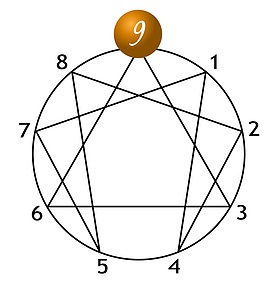
Enneagram Type Nine – Growth and Stress

Enneagram Type Nine, sometimes called the Mediator, belongs to the Body triad. People of this Enneatype tend to be nurturing, accepting, agreeable and flexible. They are usually very good at holding space for other people, and they often manage to find common grounds with others. They are generally driven by a desire to avoid conflict, because they fear that conflict will make others fail to see them as independent individuals. They much prefer to work together with others, sometimes giving up on their own agenda to avoid rocking the boat, but also exerting a kind of silent passive resistance against things they don’t want to do or accept.

Enneagram Type Nine

Enneatype Nine Grows: Move to Three

Nines have a tendency to ‘disappear’, but not necessarily because they are shy or because they retreat from others in a traditional sense (like a Five avoiding draining contact or a Four witholding themselves to lick their wounds). Instead, average Nines fail to emerge as individuals in the eyes of others (and even in their own eyes): they often find it hard to articulate their preferences, projects and views out of fear of clashing with the people around them.

So while Nines are usually the most sociable of the three withdrawing types (Nine, Four, Five) they still withdraw from others by not opposing them or putting their foot down. This way of remaining merged with other people’s preferences and ideas and going with their flow can cause pain to the Nine as they may feel that they are being stepped on, even though they never drew a line to begin with, which makes it hard even for well-meaning friends to respect their boundaries.

However, as they develop and relax their mechanism, Nines learn to assert themselves more clearly. They learn that there is nothing wrong with having their own agenda, aims and views, and that in fact life cannot be meaningfully lived without choosing one’s path rather than remaining stuck in an all-encompassing mystical haze. Nines thus take on some of the qualities of healthy Threes.

Threes are very assertive people, with a strong desire to emerge and embody exceptional qualities. As one of the most driven Enneatypes, Threes’ way of getting the social acceptance they seek is not to blend in, but to stand out. As they take on some of these qualities, healthy Nines learn to take action by themselves, even if it means risking conflict with others by defending their own identity, their boundaries and their vision.

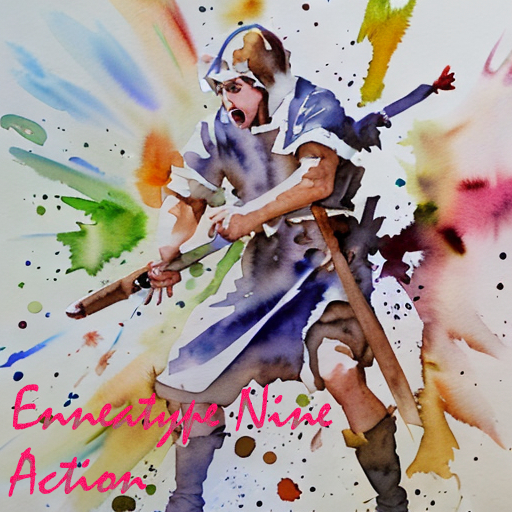
Action, the virtue of Enneagram Type Nine

Enneatype Nine Under Stress: Move to Six

Average Nines generally have a rather diffuse sense of self. Their ideal of a good day is one spent in peace, though not necessarily in inaction, as Nines can be very active people. What gives them peace is the idea that everything has its neat little place, everyone is a good neighbor, pleasantries are exchanged and no one causes any trouble. As long as everything goes like this, Nines don’t feel pressured into taking uncomfortable stances and they can simply occupy themselves with comforting thoughts.

Obviously, since life rarely takes place in Hobbitville, the Nines’ ideal rarely comes true, especially because many people don’t share Nines’ worldview. Nines usually go with other people’s flow as long as it doesn’t cause them any trouble and the even surface of their life is not ruffled. When someone threatens to bring serious change into their placid routine, Nines often engage in passive sabotage until the ‘agitator’ gives up in the face of the futility of their effort.

When this typical strategy fails though, Nines can become seriously stressed out as it becomes impossible for them to sweep every problem and irregularity under the rug. This is when they reach their stress point at Six. Enneatype Six is usually the opposite of Nine’s serene peace. High-strung and catastrophizing, they seek to poke a hole into every possibility and theory in order to find the one that will give them the certainty they are looking for.

In embodying some of Six’s negative traits, unhealthy Nines often become cynical toward those trying to bring change in their life. They will often conjure up endless amounts of excuses for why whatever has been proposed is silly or doesn’t work. In extreme cases, others may even be treated as threats to the Nine’s way of life and dealt with accordingly.

Enneagram Type Eight – Growth and Stress

Enneagram Type Eight, sometimes called the Boss or the Challenger, belongs to the Body triad. Those of this Enneatype tend to be powerful, assertive and present in their body. They have seemingly endless endurance and stamina. They highly value their own independence and hate submitting to people, especially if they consider them unworthy. Their best defense is often offense, in the form of being imposing and challenging, but they also have a sense of duty toward their friends and associates, especially if they feel they need to defend them.

Enneagram Type Eight

Enneatype Eight Grows: Move to Two

Average Eights are known for their power-exuding, in-control behavior. In a way, they go through life as if they were a fortress constantly redying for war (and occasionally attacking a neighboring country to be on the safe side). They generally seem to believe that the best way of maintaining their autonomy is to behave in an assertive, hands-on way.

In general, Enneagram Type Eight is deeply aware of a weakness or softness within them that they feel they need to defend from exploitation and aggression. This is what leads them to being defensive (or aggressive, depending on the circumstances) and to wanting to establish themselves above other people, because once they know that they are the reference point for everyone else in the room, they know how to deal with them directly and head-on, which is Eight’s favorite kind of confrontation, as it leaves little space for subtlety and underhandedness.

As they grow and learn to relax their mechanism, Eights become capable of taking care of their soft side in a more nurturing way. They learn to see that not everyone is out to get them and that, in fact, other people have a tender, weak spot too that is deserving of love and protection. As they recognize this, maturing Eights take on some of the healthy traits of Enneagram Type Two.

At their best, Twos are caring, interpersonal, giving, motherly and see the needs of others as theirs to take care of. In growing toward Two, Eights become capable of putting their warrior qualities to a higher use in honoring others’ need and defending them. They become extremely giving (in a more neutral, less manipulative way than unhealthy Twos) and their energy is expressed in a way that is innocent because it places itself beyond the rigid distinction between friend and foe.

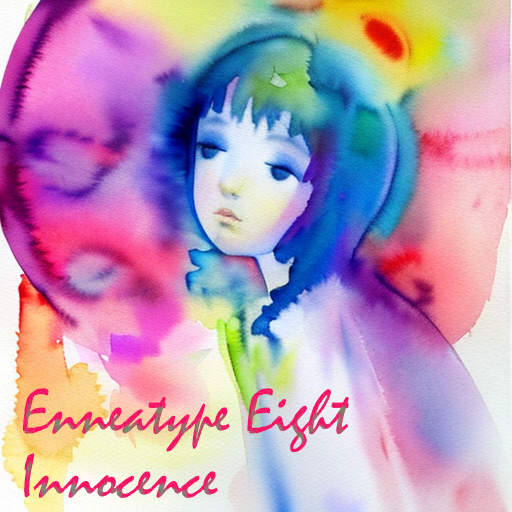
Innocence, the Virtue of Enneagram Type Eight

Enneatype Eight Under Stress: Move to Five

All Eights tend to act assertively in order to protect a part of them that they consider vulnerable and tender. In a way, it is as if they were padding the space around that vulnerable point with their boldness and in-your-face behavior, so that others can’t take advantage of it.

Unfortunately, it is not always possible for them to succeed in this effort. Sometimes their vulnerability comes to light, especially in the form of not feeling adequate or smart enough or strong enough to meet the challenges of life. While average to healthy Eights can enjoy meeting the resistance of the world and can appreciate worthy sparring partners, unhealthy Eights can feel that big challenges threaten their independence as individuals. In these circumstances, receiving a reaction that is equal to or stronger than the action they exert can cause Eights to lose their balance.

When this happens, Eights move to their stress point, where they develop some of the less healthy traits of Enneagram Type Five. Seeing an Eight move to Five is like seeing a bloated baloon letting out the air all at once. Suddenly all the assertive energy of Type Eight implodes toward the center of their being and they become insecure, silent and almost invisible.

Eights, like average to unhealthy Fives, now tend to feel exposed and in need of putting distance between them and the threat, and it is not uncommon for stressed out Eights to physically remove themselves from others’ presence. In doing so, Eights hope to regain some power and energy and to strategize a way out of the impasse.

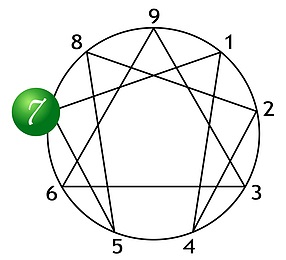
Enneagram Type Seven – Growth and Stress

Enneagram Type Seven, sometimes called the Epicurean or the Enthusiast, belongs to the Head triad. Those of this Enneatype are usually positive, upbeat, energetic and fun-loving. They are mainly driven by the desire to avoid negative sensations and to maximize their options of experiencing the world and its potentials without being held back or restricted. They often make lots of plans and are engaged in many projects, activities, side activities, etc, some of which are bound to be left incomplete. They are usually possessed of quick wits and have an aptitude toward picking up new skills and interests. They rarely focus on the negative side of life, and even when they do, they tend to snap out of it quickly (or more quickly than other people.)

Enneagram Type Seven

Enneatype Seven Grows: Move to Five

One of the common themes in most Sevens’ lives is their fear of being confined to just one option, which will lead them (in their perception) to not experiecing life to the fullest or to not having back-up plans if one option fails. This tendency can cause Sevens to remain perpetually stuck on the surface of life, to the point that some unhealthy Sevens believe the surface is all there is. Sometimes this belief can cause Sevens to make rash decisions out of fear of being chained down in one place or situation.

As they grow and learn to relax their mechanism, though, Sevens start to develop a keener appreciation for the depth and complexity of life and a greater focus in pursuing certain options as more obviously right for them as opposed to others. In this, they start to take on some of the better qualities of Enneagram Type Five. Fives are the intellectuals of the Enneagram. They rarely make rash decisions and are often laser-focused, as though their mind were a blade that they use to cut through the surface of things to reach their core. They also don’t shy away from the negative side of life.

In general, even healthy Fives tend to lead a more sober life than their Seven friends, with a preference for a few well-chosen activities (or a few well-chosen possessions, friends, etc.) as opposed to the epicurean sludgeflow that usually clutters the lives of unhealthy Sevens. This is not to say that Sevens must become minimalistic, but as they grow they do become more stably anchored to their own core.

As they do so, Sevens realize that they are not necessarily foregoing anything essential if they choose to pursue one option to the exclusion of another, and instead they learn to cultivate what they do choose with care and persistence, while bringing their sense of humor, childlike wonder and almost endless adaptability with them.

Sobriety, the Virtue of Enneagram Type Seven

Enneatype Seven Under Stress: Move to One

Perceptive Sevens can sometimes feel that they are being led on a leash by their fear of restriction and pain. While healthy Sevens face their demons directly (like all healthy types) less healthy individuals can become absorbed in an endless whirlwind of meaningless novelty-chasing and hype traps, whereby they drop their toy as soon as the next shiny trinket catches their attention.

Because Sevens are very sharp-witted, they usually notice this trend, but they also feel that they must keep going, because stopping for a second (they feel) would cause more obscure feelings and fears to catch up with them. Unhealthy Sevens generally know that they are caught in a loop, but they feel that it’s too late to stop (Sevens in general have a tendency to excuse away their lack of restraint).

In moving toward their direction of stress, Sevens can pick up some of the less healthy qualities of Enneatype One. Like unhealthy Ones, they become critical and rigid, usually toward those around them who refuse to jump on the next hype train with them. Furthermore, perceiving the futility of their behavior, Sevens may also try to organize themselves to bring more structure to their life and activities (especially if it is spiralling out of control due to poor decision-making), but they tend to organize them to death, until all the wonderful Seven-ish spontaneity is sucked out of them and all that is left is the unhealthy One’s grayish sense of bureaucratic doom.

MQS

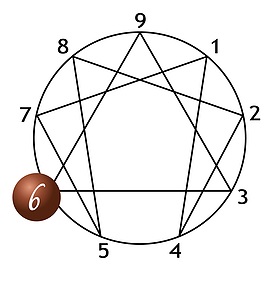
Enneagram Type Six – Growth and Stress

Enneagram Type Six, sometimes called the Loyalist or the Skeptic, belongs to the Head triad. Those of this Enneatype tend to feel the need for an external source of security, whether it be in the form of social connections, love, a political ideology or religion, etc. They are often friendly and want to show themselves as dependable and trustworthy to avoid danger and controversy, but they also have a skeptical streak that undermines their ability to find the security they need. They are often given to catastrophizing, questioning and poking holes into everything in hopes of finding the one thing that they can trust, but once they feel they have found it, they rarely question it.

Enneagram Type Six

Enneatype Six Grows: Move to Nine

The beginning of a Six’s fear lies in their inability to give themselves the security and stable ground that they need. Because they lack a sense of inner guidance, they usually look outside of themselves, finding it in people, institutions, systems of all type, etc. Ultimately, Sixes want their anchor to be beyond doubt (that is, in a way, perfect).

This is obviously a problem, since an honest look at anything and anyone will reveal their flaws. Although some Sixes manage to convince themselves to stick to something even if imperfect, the nagging sense of uncertainty remains.

When a Six learns to trust themselves, their decisions, their own processes and learn to see the difference between a healthy dose of skepticism and an excessive one, they can also relax and, in doing so, they pick up certain qualities of healthy Nines. Enneagram Type Nine is often trusting of others and allows space for honest interaction without the drama that average Sixes often stir up when they haven’t yet sorted a person in trustworthy or dangerous.

Usually, Nines tend to see beyond division and can capture the unitary essence of all processes, including interpersonal ones. In integrating aspects of Enneatype Nine, Sixes, usually become much calmer and more capable of seeing the simple essence of a situation without getting lost in a myriad contradictions and doubts. More importantly, healthy Sixes develop the kind of self-assurance that they usually lack.

Courage, the Virtue of Enneagram Type Six

Enneatype Six Under Stress: Move to Three

Enneatype Six tends to create secure and stable social connections, which they reinforce by being trustworthy and friendly. Largely they do it to reduce the uncertainty of life (it wouldn’t be a stretch to say that the Six’s socially cohesive instinct is what brought humanity together and created the basis for society)

Unfortunately, this strategy is not always effective. Depending on their particular situation, Sixes may feel that their life is too unpredictable and dangerous. They may feel like they are swimming in a sea of ungraspable alternatives whose consequences they can’t pin down and anticipate. When this happen, a Six may still try to create certainty, but if the strategy fails, they will go to their stress point, where they embody the less healthy qualities of Ennneagram Type Three.

Threes are the workaholics of the Enneagram, constantly trying to emerge and establish themselves as worthy of respect. At their worst, Threes are unreasonably competitive and tend to see everyone as an opponent to outdo, outfox, outperform at any cost and using any trick possible. Stressed Six embody this more antisocial aspect of Type Three, as they feel they can no longer trust others and must therefore learn to compete with them.

Highly cynical and with a generally negative outlook, unhealthy Six can try to constantly undermine others, as though doing this was necessary to deactivate the potential threat associated with other untrustworthy human beings. This behavior is often seen together with panicked responses to every minor setback and a tendency toward authoritarianism as a coping mechanism.

MQS

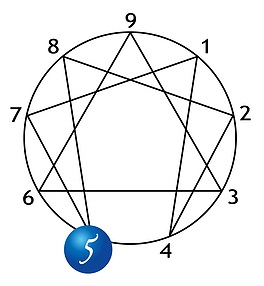
Enneagram Type Five – Growth and Stress

Enneagram Type Five, sometimes called the Observer, belongs to the Head triad. Those of this Enneatype are often recognizable for their tendency to withdraw from social contact and interaction with the world in order to observe it and accumulate knowledge and understanding. Fives tend to have a sense of energetic dearth, as though their inner resources weren’t enough for them to meaningfully impact the world, or even just to be in the world. Highly intellectual, they value objectivity and facts, which they often recombine in new and creative way, and are generally unsentimental and unbothered by social conventions.

Enneagram Type Five

Enneatype Five Grows: Move to Eight

Many Fives report that at some point they realized they were going through life as though they were constantly getting prepared for it, with the result that when they felt ready, life was already over. This is an understandably heartbreaking situation to be in, so it’s vital that Fives come to terms with it as soon as possible in order to live life before it’s gone.

A large chunk of a Five’s growth path comes from understanding that it is ok to get started without knowing everything, and that their marvelous mental abilities will inevitably go to waste if they don’t cultivate them in a practical setting and in the midst of real life action. Ultimately, Fives’ tendency to withdraw from others, withhold their presence and accumulate knowledge is a defense mechanism against fear, but as long as they withdraw they reinforce the implicit notion that the world is so fear-inducing that it must be seen from a distance.

The only way to break the cycle is for Fives to gradually let go of their tendency to let go of the world (it’s a letting go of the letting go) and to dive into it and take full charge of their body and their instincts, taking up space and showing up. In doing this, they start to embody the better qualities of Enneagram Type Eight, the most physically expansive and assertive of the nine type. Interestingly, Eights, like Fives, deal a lot with the idea of truth, but Eights have an instinctive awareness of it, whereas Fives have an analytical understanding of it.

In allowing their insights to take physical form, Fives reduce their tendency to detach from reality and become capable of bringing their objectivity and knowledge to fruition. Their ability to let go of things is used not to renounce the world, but to experience it all equally in all its transient permutations. Detachment thus becomes non-attachment.

Non-Attachment, the virtue of Enneagram Type Five

Enneatype Five under Stress: Move to Seven

Fives generally hate having to jump into things without preparation. They tend to plan ahead as if they possessed half the energy, time and resources they actually have and often don’t communicate their thoughts unless they have had the time to polish, proof and justify them. This is why going to war with a Five in a field they know a lot about is often a lost cause: they are always five or six steps ahead in the argument.

But, as much as they would like to be omniscient, Fives aren’t. The world is too complex to hold it all inside one’s mind before one ventures into it (which is how Fives get started on their journey of observation.) Variables are bound to intrude into one’s views. More importantly, Fives may not always have the chance to step back from quickly unfolding situations to take a breath and organize their mental response.

When this happens, Fives may initially still try to withdraw, but if their usual strategy becomes impossible, it is not uncommon to see them make fools of themselves, like unhealthy Sevens. This is not because Fives (or Sevens, for that matter) are actually fools, but because they panic at the prospect of not being able to employ their typical strategy.

Often, Fives that move to Seven under stress become volatile, scattered, given to missing the mark with odd jokes or comments. Because they haven’t had the time to establish clear boundaries within which they feel secure, they become erratic and aimless, thus lending credence to their own worst fear of being incompetent and needing to withdraw even further.

MQS

Fatalism and the Moment of Divination (Notes on Divination)

This post is part of my Notes on Divination series. This gets somewhat philosophical and is rough and not organized, so bear with me.

In the previous post in this series, I started discussing some general ideas on why fatalism is an inherently flawed view, while in the one before I had shown why pure free will makes just as little sense. To summarize, pure free will simply doesn’t take into account the fact that we don’t live and move within a blank space that we can change at whim.

On the other hand, pure fatalism cannot even be articulated as a view without contradicting itself: if fatalism is real, then my fatalism is not due to me assessing reality and forming a fatalistic worldview that corresponds to how reality factually is, but it’s due to destiny forcing me to be a fatalist. This implies that when I say I am a fatalist, I don’t really mean it. I *cannot* really mean it – It is conceptually impossible. In order to be a fatalist, I must have the freedom to develop a fatalistic worldview. This is a contradiction.

My view of the universe is consequently inherently libertarian, though it is a reasonable and limited libertarianism.* No matter how small our personal freedom is, it exists and is the place we our soul inhabits. Freedom is the consequence of consciousness. When I become aware of something, I posit it as the object of my awareness, outside of myself, and therefore incapable of completely determining my whole being.

Now let us ask: what happens during a (serious) divination session? What does divination do, at heart? At the very least, divination must either make us aware of unknown facts about the past, present or future, or it must shed new light on known facts, thus revealing them from a different, previously unknown point of view. A divination session that does not do this is not a divination session. It may or may not be helpful in other regards, but it is not divination.

The Moment of Divination

It is clear, therefore, that divination is inherently connected to consciousness and to increasing our conscious awareness of (our) reality. This is another reason why a (mildly) libertarian view of divination makes more sense. Suppose you cross the fortune-teller’s palm with silver and then you get told you will win over your crush: is the fortune-teller right because she actually sees this in the crystal ball or is she doomed to say this to you? If she is doomed to say it, then the fact that she is saying it has nothing to do with the statement being true and everything to do with destiny forcing her to say it.

Furthermore, in revealing your future to you, the fortune-teller cannot help but modify it. This has nothing to do with some odd theories I’ve read on the internet, about the fact that if you predict something you make it happen. If that were true, I could predict myself into a billionaire. Besides, even if the fortune-teller saw your future and didn’t tell you, she would still be modifying your future.

Reality is much more subtle. Suppose that X is going to happen to you. If the fortune-teller tells you, then you are aware of X happening. X happening with your awareness is different from X happening without your awareness. The fabric of the fact itself changes with your awareness of it, for the simple fact that something that happens with your knowledge is not something that happens without your knowledge.

The moment of divination, therefore, has a very important place in our life, because it is part of our life, but it is also a part of our life wherein our awareness of reality increases, thereby changing our reality. This does not automatically mean that divination can make us realize every whim that crosses our mind, nor that it can always save our butt. Sometimes the only choice possible is between accepting a fact and not accepting it.

I like to liken an oracle to a friend on top of a high building, who has a wider view of our surroundings than us as we move in a busy intersection of streets, and who texts us hints that increase our understanding of our reality and can help us make better choices, though sometimes the choices we can make are so severely limited as to border on predestination.

MQS

* I mean ‘libertarian’ from a metaphysical standpoint.

Enneagram Type Four – Growth and Stress

Enneagram Type Four, sometimes called the Individualist, belongs to the Heart triad. Those of this Enneatype generally feel a strong sense of deficiency compared to other people, and tend to recast this sensation of lack by perceiving themselves as special or unique. They have a complicated relationship with others, as they both feel a powerful need to belong, be seen and find deep and meaningful connections, while also feeling that they can never truly form such relationships. Because of their focus on their own deficiencies, they tend to be well-acquainted with the negative side of life.

Enneagram Type Four

Enneatype Four Grows: Move to One

Average Fours have a very diffuse sense of agency. Sometimes Fours feel like a cruel destiny has doomed them to a life of suffering, and the best they can do is bear this burden with artistic grace by exploring their inner landscapes. This is, of course, nonsense, just like all other Enneagram mechanisms. Still, it is not uncommon for average Fours to be incredibily mopey and defeated even in conditions that others would consider relatively normal, if not optimal.

The path out of this mechanism lies in giving up their habit of navel-gazing and actually planning their way to self-actualization. It happens often that aging Fours often pine over lost opportunities (If I just hadn’t quit those piano lessons) because all paths to success usually involve the kind of drudgery that Fours feel they are too sensitive or special to persevere in. This can lead to Fours feeling that they have wasted their life, which only reinforces their sense of being doomed.

If they give themselves a roadmap, though, Fours can become more principled and disciplined, like healthy Ones. Ennatype One is known for their ability to stick to plans and principles for dear life. Furthermore, Ones tend to put their own feelings on the backburner to take a hard look at how things truly are and how they can be concretely improved, and this attitude certainly benefits self-absorbed, feeling-oriented Fours.

In integrating One into their life, Fours learn to balance themselves and to see and perceive the whole spectrum of feelings, not just the negative ones, and learn that the positive side of life is just as authentic as the negative one.

Equanimity, the Virtue of Enneagram Type Four

Enneatype Four Under Stress: Move to Two

Fours are one of the most self-centered Enneatypes, not necessarily because they are egotistic, but because they relate everything to themselves and measure themselves against others and others against themselves. This is where their passion of Envy comes from. For a Four, life is like being on one dish of a pair of scales, with others on the other dish, and one dish cannot go up without the other going down.

This complicated relationship with other people results in a typical push-and-pull behavior which expresses the unresolved tension within the Four’s mechanism: others are both the object of desire and of spite. Furthermore, Fours usually see themselves as more authentic than others because of their acquaintance with their inner darkness and their sense of loss and grief, and this often causes them to want to show their own authenticity in front of others, without regard for proper time and place. Unhealthy Fours may even rub salt in people’s emotional wounds (which Fours are very good at sensing) both to make them feel what “real life” feels like and to make themselves feel a bit better by comparison.

When this inevitably leads to people becoming stressed out about their behavior, Fours are suddenly reminded that, ultimately, their own sense of self is highly dependent on others (as for all Heart types). In an effort to patch things up, the stressed Four abandons all emotional honesty and becomes clingy, unctuous and pleasing, like average to unhealthy Twos. Like Twos, they feel that they can only find meaning in the eyes of someone else and become accomodating to a fault.

MQS

Using Playing Card Divination on Psychological Questions (Example Reading)

There is a general stigma toward certain forms of divination such as cartomancy with playing cards, namely that they are good at discussing mundane issues, while the Tarot should be used for deeper questions. This presupposes two things: that deeper questions don’t take place in the same world as regular life and that the Tarot is too deep to talk about everyday occurences. Both these beliefs are wrong.

The Tarot is perfectly capable of talking about whatever it wishes, just like playing cards, the Sibilla deck and every other oracle. The first presupposition, though, is more insidious and requires a bit more discussion.

The oldest extant series of tarot meanings has been retrieved in Bologna. The meanings there are what you would expect from a fortune-telling deck: the Ace of Swords is a letter, the Ace of Cups the house, the Hermit an old person etc. Furthermore, some rare examples of tarot fortune-telling in pre-modern Italian literature confirm that the Tarot has probably been used for such aims long before the occult revival started by Court de Gébelin, which slowly removed the Tarot from real life and confined it to the realm of “higher metaphysics”, that is to say, of psychological onanism.

In order to justify this “higher” (I would say emptier) use, several hypotheses on the Tarot’s origins have been put forth, depending on what was considered fashionable and not too easily disproven at the time. First it was the Egyptians, then the Kabbalists, then the Cathars, etc. Instead of being seen for what it obviously is, namely a wonderful product of European Neoplatonic Christian art that anyone before the Enlightenment would have immediately understood and considered familiar, and that only the ignorance of our post-Enlightenment metaphysicians could try to disguise as a distant voice coming from distant secret masters to apply in the understanding of distant matters, rather than an immediately obvious tool to mirror immediately obvious real life situations, which are all instances of an eternal story that constantly tells itself.

So yes, the Tarot can talk about daily experience. In the same way, other, more apparently mundane forms of fortune-telling can talk about problems that some would consider ‘deep’. Just like the Tarot, they can talk about it in immediate terms, immediately understood by anyone with who has some understanding of symbols.

Here’s an example of playing cards used for a ‘deeper’ reading. The querent is a woman I met at an Enneagram convention. She asked what was the reason for her constant bouts of depression. These are the cards:

“Why am I always depressed?”

There is a sickness in her life, signaled by the Six of Spades. There are no cards of deep trauma, but something definitely needs healing. This card falling first sets the tone. The Jack of Hearts represents a child, a project, etc. Next we have the Nine of Diamonds, which is a card that represents the realization of ambitions, but more broadly can represent ambition. Then we have the Three of Spades and the Five of Diamonds. These two cards oftne indicate turning away from something. But the Three of Spades also comes directly before the ambition card. So she has turned away from some ambition. Two possible interpretations that came to mind are that she had the ambition of having a child but couldn’t or that she turned away from a childhood ambition.

I asked her, and it was the second possibility. She’d had big dreams for her life when was a child, but some disappointments had led to seeing them as unrealistic and she had let go of them. I told her that she hadn’t really let go of them, otherwise the Six of Spades wouldn’t have shown up: those ambitions still fester inside of her, and the fact that she is not doing anything about them could make her sick if she isn’t careful. These cards clearly show that she needs to go after her dreams, perhaps in her free time. Alternatively, if she doesn’t want to, she needs to truly let go of them and move on.

MQS