Category Archives: Spirituality and Psychology

Enneagram Type Three – A Quick Introduction

Often Known As: Achiever, Doer, Competitor, Performer (note that names are as limiting as they are revealing.)
Sin/Passion: Deceit
Focus: on what’s valuable or praiseworthy
Fear: of not embodying what’s valuable or praiseworthy
Energy Center: Heart (energy is suppressed)
Social Stance: Assertive
Key Positive Traits (embodied at their best): Energetic, Practical, Admirable, Driven, Well-presenting, Competent, Performing, Adaptable, Competitive, Attention-grabbing, Excelling, Hard-working, Busy, Organized, Has it together
Key Negative Traits (embodied at their worst): Inauthentic, Vain, Pleasing, Performative, Ruthless in competition, Obsessed with the prize at the end, Phony, Shallow, Shapeshifting, Attention-seeking, Self-aggrandizing, A facade with nothing behind
Growth and Stress Direction: to Six and Nine respectively

Enneagram chart with Type Three highlighted

Introduction

Everyone knows them. They are the well-adjusted cool kids, the popular ones with the winning smile, the employees of the month, those who are probably going to snatch the promotion from under your nose. Some people simply give off an aura of success, and Threes are those kind of people.

Hard-working, endlessly adaptable and capable of presenting themselves in the best light possible, Threes are often role models for many of us. They embody the ideal of the self-made man or woman who has it together and is going places in life. If they have a talent (and they usually have more than one) Threes are those who tirelessly cultivate it until it makes them shine.

Threes are also very good at picking up on social cues, which gives them the ability to integrate into a variety of environments and be always perceived as just the right person in the right place. And they like this, because admiration and validation is very important to them. You will rarely find them in contexts where there is little chance for them to earn praise.

Inwardly, Threes feel a constant drive to outdo themselves, and they are indefatigable in this. However, in the process they may sacrifice their authenticity, and they may even feel that they have lost themselves by adhering to their character too much. Sometimes this may lead to a real identity crisis, as they realize that the image that they have submitted to others for validation either doesn’t satisfy them or doesn’t match their inner reality.

the haughty peacock, a good symbol for Enneagram Type Three (the chamelon would have been another choice)

Core Mechanism

Threes’ focus tends to be on their image. They are an inherently social type, which doesn’t automatically mean that they are extroverted–they may be, but as far their Enneagram type is concerned, all this means is just that they derive their sense of worth from the social framework in which they move and act.

In this sense, Threes are one of the types that represent humanity at large, since obviously everyone’s sense of being valuable derives, at least in part, from social acceptance. However, the mechanism of a type Three centers exactly around this point, while that of other types tends to focus elsewhere.

Somehow, Threes have absorbed the message that their performance is more important than their authentic self. This can derive from a variety of personal, family and social backgrounds, but in general Threes find their validation as people comes only from either playing a part or pleasing others by achieving certain results, regardless of how this relates to the Three’s feelings.

The obvious message that the little Three got from this is that their feelings don’t count: presentation counts, doing counts, status counts, excelling counts. This realization, deeply absorbed and integrated into their worldview, sets Threes on their path of achieving whatever they believe is going to give them the validation that they intimately feel they won’t receive just by being themselves.

For some Threes, their true feelings are something that they “put away” for when they will have time to sort through them, that is, after they have done what they are supposed to do to achieve what they think they must achieve. Unfortunately, this moment rarely comes, as something more important always pops up.

Sin/Passion

The passion of Enneagram Type Three is Deceit. Sometimes it is called Vanity, Delusion or Falsehood. Deceit is not really a passion as much as one of the fundamental forces that drive human nature. We are creatures of dissimulation, for better or for worse (and there are indeed good sides to this.) It represents the fundamental act of creating a self-image and submitting it to others for approval.

This is done because a self-image is always a relatively arbitrary selection of personal traits that we decide we embody or ought to embody. Because of its arbitrary nature, a self-image is nothing unless it gains interpersonal acceptance so as to become stable. It is not unlike roleplaying, except we actually believe this.

Threes’ self-deception comes from overidentifying with this image and seeking always more validation for it. This leads others to sometimes perceive Threes as salesmen or saleswomen trying to sell them something–this something is actually nothing material, it’s this image. In this sense, Threes tend to try to drag others into their roleplay, which can lead from self-deception to deception of other people.

While healthy Threes can learn to laugh at themselves and their excessive attention to social standards, average to unhealthy Threes are perennially engaged in a sales pitch to sell themselves, or rather their successful self-image, trying to get the validation that they feel they lack. If this validation doesn’t come, the experience can be very hurtful for the Three, who will usually either double down or, if the cause is lost, they will seek other avenues.

Deceit, the passion of Enneagram Type Three

Misconceptions

Among the key negative traits I listed “a facade with nothing behind.” This was harsh, and it is not *really* true: structually, Threes do not differ from any of the other types. However, because of their emphasis on achieving, it is not uncommon for people to believe that Threes are actually rather empty once you peel off the veneer of success.

This would be really unfair. As long as the person does not suffer from some dark triad pathology, there is a real human being under the mask. Unfortunately, this is hard even for Threes to understand, as somehow they have absorbed the message that their performance is what truly matters about them.

It is not uncommon, in their path of self-discovery, for Threes to feel that, once they discard what they do to conform to certain standards, there isn’t much that they feel their being gravitates around, because they are not used to looking for it.

This leads us to another misconception: that of the Three as a machine without feelings, solely concentrated on achieving the end-result. Just like Fives, Threes tend to be seen as unsentimental, but unlike Fives, who are downright uncomfortable showing their emotional depth, Threes do show feelings when there are social cues that tell them it’s the appropriate time to show the appropriate feelings. It’s part of the performance.

This, in turn, can lead some to seeing Threes as inauthentic. But this doesn’t mean that Threes don’t have true feelings underneath the crust of socially acceptable feelings. It’s just that these feelings have been suppressed because devalued or scorned during the formative years.

Wings

3w2 Threes with a Two wing tend to have a sweeter, more pleasing demeanor. Their interpersonal qualities are usually cranked up, and their focus in obtaining validation has often more to do with fields that allow for helping others or that allow the person to feel useful and needed. They can have a stronger sense of community and of what holds the community together, but they are driven to excel within it. If 2w3 is the mom who organizes the neighborhood’s pie contest, 3w2 is the stereotype of the mom winning the award.

3w4 Threes with a Four wings usually stand out from the rest and are driven to stand out from the rest more decisively. Themes of uniqueness tend to surface, although it is still a somewhat stereotyped kind of uniqueness, the socially accepted kind. Furthermore, they tend to project a glamorous image and to have a rather refined taste. They are, in a way, the archetype of the hollywood star doing something outlandish at a screening or on the red carpet to get the first page.

(note that wings can have some minor descriptive power in terms of superficial behavior, but they are irrelevant in terms of what motivates the person. Many people have no noticeable wing, while few show signs of both.)

MQS

Enneagram Type Two – A Quick Introduction

Often Known As: Helper, Caregiver, Lover (note that names are as limiting as they are revealing.)
Sin/Passion: Pride
Focus: On other people’s needs
Fear: Of not being needed and/or loved
Energy Center: Heart (energy is asserted)
Social Stance: Compliant
Key Positive Traits (embodied at their best): Warm, Helpful, Loving, Empathetic, Personable, Giving, Accepting, Nurturing, Emotional, Capable of sacrificing themselves for others, Altruistic, Positive
Key Negative Traits (embodied at their worst): Manipulative, Codependent, Flattering, Possessive, Subtly tyrannical, Taking up space in others’ lives to find meaning, Clingy, Denying own needs, hopes and aims, Sense of being unworthy of love
Growth and Stress Direction: to Four and Eight respectively

Enneagram chart with Type Two highlighted.

Introduction

Twos are usually immediately recognizable for their marked interpersonal qualities. Sweet, caring and warm-hearted, Twos tend to take up the role of the good friend, the older sibling or the good parent in people’s lives. There is a wonderful softness to their way of dealing with others, which makes them appear more inviting and attractive.

Twos are the type of people who show up with that one thing you once mentioned in passing that you liked and never thought about it again. The Two, however, did think about it again, as they often keep their ear on the ground for signals of the other’s wishes, so that they may help them.

Twos take other people’s needs and problems very seriously, and treat them almost as a personal mission. If someone is ready to deprive themselves of something to make another happy, that’s Enneagram Type Two. Often, it seems as though possibilities suddenly become endless with the help of a Two, as they are capable not only of seeing the bright side of things, but also of acknowledging other people’s talents, possibilities and unrecognized options.

In general, Twos are capable of making other people flourish and they themselves flourish when taking care of others. However, with their focus on others’ needs, Twos can become too involved in others’ lives and may forget to take care of themselves, and occasionally this may lead to unspoken resentment toward others–unspoken, that is, until the other disappoints them.

The sweet puppy, a good symbol for Enneagram Type Two

Core Mechanism

Twos are deeply focused on other people’s needs, aims, and aspirations, and may even seem to deny their own in order to help others meet theirs. Out of all the Enneagram Types, Type Two is the one that comes the closest to the archetype of the mother or of the caregiver. They tend to make others feel embraced and seen, and are capable of consoling and helping them see the bright side of everything. In a way, Twos almost seem to exist solely to be in the other’s life.

And this is where problems start, because even though healthy Twos can be truly selfless, average Twos most certainly aren’t. Twos need to be needed, and this stems from their subconscious belief that they are, in themselves, unworthy of love, acknowledgment or consideration, or of having their own needs met.

In this sense, an average Two sees taking care of others as a required detour toward themselves and their own needs. This can lead to various forms of projection. For instance, in the past my husband, a Two, sometimes asked me if I needed to pee or if I was hungry, when what he truly meant was “I need to pee” or, “I’m hungry.” Because they have learned to put other people’s needs before theirs, Twos only feel justified in meeting their own needs by helping others. More dangerously, sometimes Twos manipulate others into believing they want what the Two wants.

Another notious consequence of the Two mechanism is that, in besieging the other with attentions, Twos usually attach quite a number of strings to their favors. In their attempt to meet the other’s needs and even to anticipate them, Twos often stretch themselves thin. What they want in return is not necessarily anything material, but it usually involves a constant and clear acknowledgment of the Two’s central importance in the person’s life. When something goes south (“I didn’t even ask for that”) Twos can feel slighted. They then engage in recriminatory behavior and in making the other feel unworthy of their care.

Sin/Passion

Type Two’s passion is Pride. At first this may sound strange, as Twos can sometimes appear, if not bashful, at least meek, and they usually have a tendency to put others on a pedestal or in the limelight, rather than themselves. However, this only appears to be the case at a superficial level of consideration.

Although healthy Twos really are meek, humble and loving, the core of an average Two’s psychological structure is the tendency to inflate their ego to negate the autonomy of outside reality and of other people. All Heart types struggle with their self-image. Twos want their self-image validated in some form by others, which in turn implies the dreadful possibility of not being acknowledged or recognized.

The mere possibility of this happening is intolerable for a Two, as not having their self-image validated can be akin to not being truly there, and therefore of dying, at least metaphorically. This is truly an existential threat, as once their image of themselves is shattered, Twos must face their aloneness and neediness, that is, their helplessness in front of reality.

To avoid this, proud Twos ‘inflate’ themselves to take up space in other people’s lives, meeting their needs and seeking to become their ‘all’, with the tacit aim of feeling important, loved, acknowledged, validated. They usually do this with sweetness, but also by manipulating others as the need arises, and trying to forge deep, symbiotic bonds. Pride is this inflation of the ego, in the attempt to substitute reality with it, so that there is no risk of disillusion. When the other seeks freedom from the Two’s clutches, the Two reacts by tearing down the other as unworthy of the Two’s attention. Here the pride becomes, from metaphorical, very real.

Pride, the passion of Enneagram Type Two

Misconceptions

One of the main misconceptions I see repeated on Type Two is that they always want to be with other people. Sometimes I even come across descriptions of Twos as party people. A Two may or may not be a party person, but this has little to do with the type mechanism itself.

The reality is that Twos simply are unable to be alone, but this doesn’t automatically mean they want to be with others. Twos’ awareness tends to concentrate on the point where their life intersect the lives of others. Even when they are alone in a room, they are rarely truly by themselves.

Many tasks that Twos perform while alone they often subconsciously justify in front of themselves as good for others. Even cultivating a personal hobby is twisted as a form of service toward others so that the Two can justify enjoying it. In fact, sometimes even the mere act of resting may be seen as ‘taking a breather so later I can take care of useful things better.’

Again, this says nothing about a Two’s willingless to be with people–let alone with many people. It simply shows that a Two, regadless of how introverted or extroverted they are, tends to justify their actions in terms of the needs of other people rather than their own. This is all part of the process whereby a Two decides their own reality, manipulating themselves into believing or doing something.

Wings

2w1 – Twos with a One wing tend to have a tidy, neat, organized streak. More driven by rules and ideals and a bit less by norms, they often put their great organizational skills and unending drive for improvement in the service of their self-image as helpers of others, usually seen as needy and incapable of taking care of themselves and their surroundings. This is true for any Two, but the One wing accentuates the aspect of seeing oneself as the one who can do things right, especially for the good of others.

2w3 – Twos with a Three wing have a more marked tendency toward keeping up appearances. They tend to be more driven by societal norms and notions of ‘nicety.’ Their image among their peers is usually quite important to them, and they often try to do as much as possible to improve it and polish it. The creation of interpersonal bonds is taken on with the additional aim of being seen in one’s best qualities. They are basically the stereotype of the mom organizing the neighborhood’s contest for best apple pie.

(note that wings can have some minor descriptive power in terms of superficial behavior, but they are irrelevant in terms of what motivates the person. Many people have no noticeable wing, while few show signs of both.)

MQS

Enneagram Type One – A Quick Introduction

Often Known As: Perfectionist, Reformer, Idealist, Judge, Critic (note that names are as limiting as they are revealing.)
Sin/Passion: Anger
Focus: What is right or good
Fear: Of being wrong, imperfect or at fault
Energy Center: Body (energy is transformed)
Social Stance: Compliant
Key Positive Traits (embodied at their best): Just, Fair, Idealistic, Perfectionistic, Consistent, Principled, Tidy, Moral, Orderly, Disciplined, Sober, Rational, Impartial, Objective, Organized, Straightforward, Driven by rules and ideals rather than by personal profit
Key Negative Traits (embodied at their worst): Critical, Judgmental, Angry, Moralistic, Authoritarian, Uncompromising, “On the right side of history”, Castrating, Controlling, Unbending, Nitpicky, Soapboxing, Self-Righteous
Growth and Stress Direction: to Seven and Four respectively

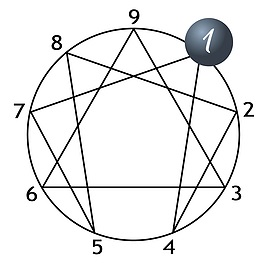
Enneagram chart with Type One highlighted.

Introduction

Type One is the person that walks toward you and you suddenly become aware that you have your zipper down. They have an incredibly keen eye for what needs to be done to improve the situation and to do things right. Nor do they stand by the wayside, but often get involved personally.

This ability that Ones have to see what ought to be done means that they are also keenly aware of what is wrong in every situation, that is, they immediately see when, where and how the standard is not being met. A healthy One is definitely someone whose advice you want to listen to, as they often have incredible foresight in predicting the consequences of letting small imperfections snowball into bigger and bigger ones.

Ones are usually fair in an impersonal and impartial sort of way. If anything, when they highlight your faults, they tend to do it out of love. They often cannot conceive how someone could be driven by anything except what’s right (either morally or technically), because they themselves seek to identify what they want with what is right.

However, Ones are famous in the Enneagram community for being the ones with the loudest and harshest inner critic. Their every action tends toward conformity with what the critic says. Whenever an action has been carried out (by them or by someone next to them) the inner critic’s sentence immediately highlights what has been done wrong and what could have been done better.

Although Ones can at times appear to be very mental or rational in their behavior, they have very strong beliefs that they rarely question, since these form the basis for their action in the world, and therefore removing them would remove One’s justification for acting. And Ones are, despite all, people of action.

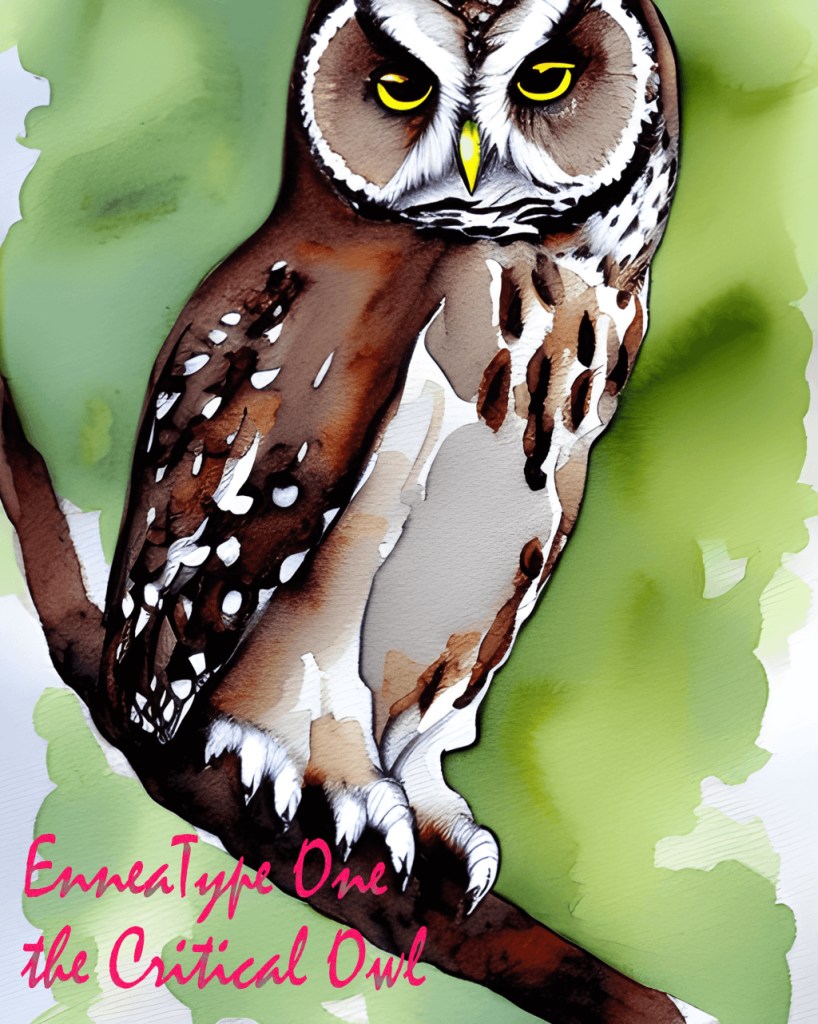
The Critical Owl, a good symbol for Enneagram Type One

Core Mechanism

Ones see the world as a place to reform or straighten out. Out of all the types, Ones most clearly embody the archetype of the reformer or the activist (although Sixes also fulfill this latter role, in another sense.) Ones give themselves ideals to follow and toward which to direct their great energy.

This happens because, on some level, Ones do not feel that they can just be in the world, but need to justify their own existence by complying with some higher standard. With Ones it is rarely “I want this” but rather “It ought to be this way”. They often seek to sublimate their subjective will by checking it against higher laws. The more Ones seek to sublimate themselves to match an ideal or to transform themselves and reality, the more they move the goalpost of what they consider to be perfect, or even just okay.

The world, and their own life, becomes by definition “not okay”, and while in average Ones this can be a stimulus to improve things, in more difficult cases it can lead to situations where the more Ones seek to perfect life, the more they become aware of every imperfection, leading them down spirals of self-hatred, puritanism and intolerance.

Sin/Passion

Type One’s passion is anger. All Body types (Eight, Nine and One) center around the issue of autonomy and self-assertion. Their basic energy is essentially choleric in the traditional sense. However, Ones are incapable of asserting themselves directly and immediately.

Instead, they seek to justify their self-assertion as autonomous beings by complying with standards, rules, morals, etc. Their unspoken contract with themselves is “I have a right to be here if I do my best to perfect myself or the world around me.”

Anger stems from their sense of impotence in making themselves and the world around them match the vision of them that would justify their existence. Ones see the difference between what is and what ought to be, and choler builds up in them. In other words, the normal flow of choleric energy that forms part of everyone’s bodily existence finds itself flowing through the strictures of One’s inner critic, turning from natural assertive drive into wrath–at themselves and at the world.

Ones are often very controlled in their behavior, exactly because their bodily energy is deviated in its course by normative structures, yet they often do not seem very relaxed. Their being in control of themselves usually betrays signs of an inner tension, an unresolved struggle for peace. Their anger often transpires as frustration toward life, themselves and others, depending on their particular life patterns and individual condition.

Anger, the Passion of Enneagram Type One

Misconceptions

The biggest misconception about Type One is that they delight in criticizing others. In fact, delight may be the last thing a One feels when being critical of what other people do. There is never anything personal in an average One’s criticism (this doesn’t necessarily make it ok, though.)

Although sometimes they may relish in being the ones who “told you so”, by and large Ones abide by standards and seek to enforce them, and often simply don’t see how others may either have different standards or not be dedicated to enforcing them. Usually, when a One criticizes you, it’s not the person that speaks: it’s the rule. By extension, Ones often believe they are helping you by criticizing you.

Furthermore, Ones’ attention to what you do and how you do it is often an indirect reflection of their own inner discourse toward themselves. Usually, their criticism of others and their criticism of themselves coincide. See it like this: in speaking on behalf of the standard or rule, Ones seek to become embodiments of it, and become aware of their own inability to ever bridge the gap between ideal and reality. In this process, they also become aware of your inability to do so, but often they fail to realize that this may not be your problem.

Wings

1w9 – Ones with a Nine wing tend to have a more laid-back demeanor, although One’s inner tension is still quite noticeable. They are often more accomodating on the surface, but their strictness usually manages to transpire anyway, especially in passive-aggressive ways (passive-aggressive behavior being something that Ones share with Nines, in different forms.) Also, the ideals they serve tend to be more all-encompassing and broad.

1w2 – Ones with a Two wing have a more marked interpersonal quality. They are usually highly involved in other people’s lives, on whose behalf and (supposed) best interest they act. Their actions, which are usually carried out in service of an ideal, can have an additional, albeit shallower, layer of motivation in pleasing others. Also, their activism tends to be based on solving concrete problems in their immediate surroundings.

(note that wings can have some minor descriptive power in terms of superficial behavior, but they are irrelevant in terms of what motivates the person. Many people have no noticeable wing, while few show signs of both.)

MQS

How to Discover Your Type (Enneagram Plain and Simple)

Discovering one’s Enneagram type can be easy or hard, depending on a veriety of factors. There are some who hear about their type and immediately know it’s them. If this is not you, read on.

I would love to be able to say that if you cultivate enough self-reflection you will know your type as soon as you stumble on a (good) description of it. This is not necessarily so.

It also depends on the quality of the self-reflection. Most people have some kind of inner discourse going on. But inner discourse is not self-reflection. A Six, for instance, has a very intense inner discourse surrounding all their sources of uncertainty. They are aware of these sources of worry, but they are not aware of their being aware of this mechanism. The same is true of all types.

Until we have become used to seeing our mechanism from an observational vantage point,* the type’s mechanism is to us like water to a fish: we are so deeply immersed in it that we don’t notice it. In fact, we may even think this is the last thing we’d do. If I had a buck for every Two who told me they’ve never been proud or for every Four who told me they’ve never been envious… Well, buying a house would be much easier.

One reason discovering one’s type can be hard is also that the core of the type is one of the nine passions, all of which are, to a degree, stigmatized, frowned upon or even swept under the rug. We train ourselves to think that, because we are good or right or ok, we cannot feel such feelings, and so we delude ourselves into believing we don’t. Usually, once the illusion is rent, we discover that our mechanism has always been in front of our nose and our passion has been in the driver’s seat of our life all along.

So? What do I do to discover my type?

Well, a good grounding in Enneagram theory is more or less a must, unless you let an expert type you. Even then, it would be advisable to educate yourself a bit so you can make your own self-discovery. You don’t need to read hundreds of books. One or two good ones, or even the information you find here or on other websites, is often more than enough to get you started. Usually, this will be already enough to discard at least one or two types (although, especially at the beginning, it pays to suspend judgment).

Once you know a bit about the core of each type, learn to take a step back from your life and observe it. Look at your reaction to things, people, happenings, memories, etc. Look at what motivates you. Don’t hurry. Your type is not running away from you. You can take all the time you need. Also look back at how you were in the past, both distant and recent. Journaling is a good option, if you are so inclined.

Even the way you react toward the Enneagram can be telling of your type. Though this is not a hard rule, often your mechanism will make you see the Enneagram in a certain light. For instance, a Four may see the Enneagram as a straightjacket, or, if they like it, as a magical symbol; a Five as a nice system to explore; Sevens will often (again, not always) dislike being confined to one type; Nines will feel they are a bit of everything and we are all the same; Eights may see the Enneagram as a useless trinket, etc.

Again, this is not always the case, and usually it is something that is only noticeable in hindsight. Still, it is an opportunity to practice self-observation. But this type of self-observation is not the only useful one.

An exercise in meditation

Meditation is a good way to find out your Enneagram type

One of the characteristics of our mechanism is that it always steers our attention toward certain things as opposed to other things. A great exercise would be to do some meditation and become aware of where your attention is constantly being lured.

Sit comfortably in a straight-backed chair. Take a couple of deep breaths and free your mind from all thoughts for a second. Then start breathing slowly, inhaling and exhaling as it feels comfortable. Let your attention concentrate on the process of breathing and its rising and falling rythm. Try to keep your attention on it.

Done? Well, no. Because as soon as you settle into this meditation, your mind is going to start wandering. No matter where it goes, bring it back to your breathing. However, sooner or later you are going to start noticing a pattern. All that distracts you tends to show a certain consistency. That’s because what distracts you is your type’s mechanism. Here is a (non exhaustive) list of what tends to catch the attention of each type.

TypeAttention
OneThings to perfect, to complete, things that are not as they should, that need straightening or correcting, sense of being wrong, of not doing what you’re supposed to be doing
TwoThings to do for others, how to improve yourself to be of better service or be liked more, how doing something you want to do will result in good for others, how others owe you for your help
ThreeThings to do, checklists, projects that will reflect well on your person, either in front of yourself or of other people, finding out what’s ‘wrong’ with you in this Enneagram thing so you can jump the obstacle and get to the prize
FourWhat’s missing, what is lacking or you are lacking, what other people have that you don’t, the happiness that you are missing, how unlucky you are, how beautiful life would be elsewhere, elsewhen, or how it used to be, or it might be
FiveImpersonal concepts, focused mental explorations, mental sculptures and constructs, convoluted inner discourses, how much energy you have or lack and how you are managing it or how you are being robbed of it
SixThings that worry you, the worst that might happen, can you trust that person, thing, idea, etc. are you doing this right? maybe you should double-check, or maybe that dude has it wrong, maybe you need to contact someone who knows better than you
SevenPlans, ideas, things you look forward to, Things you can’t wait to be doing, how many things you have to do but then something cool happens, diversions, or conversely, things you keep trying not to think about but they keep nagging you, prompting you to to look for a bright side
EightWhether you are strong enough or if you need to do something, whether you are pursuing the thing you want with all your might, whether you are wasting your time on something that doesn’t strengthen your position or “fill” you, sense of deflating unless you hurl your energy at a concrete obstacle or against someone or something, need to overcome someone or something, intense desire to go get what you want
NinePeace, pleasant but somewhat vague ideas, sense of wonder, sense of retreating from your individuality into an inner space where you are one with everyone or everything, ideas that make you feel at peace with yourself, with others or with the world, but also sometimes the sense of being invisible and disregarded by others
Where the attention of each type goes

Do not hurry. Don’t expect this exercise to bear fruit after one try.

Are Online Tests Accurate?

Ehhhhh… No. Most tests you’ll find online (or offline) will at most allow you to rule out one or two types, something which you probably already know. The problem with tests is twofold: on one hand, they engage only the most superficial side of our psyche, the one most likely to host the image of ourselves we want to believe we embody but which doesn’t necessarily correspond to our more deeply seated psychological mechanism; on the other hand, they tend to ask about very superficial things that can be easily misinterpreted, either willfully or subconsciously.

For the most part, tests are just there to massage our ego (“look! I think I am X, and this bunch of pixels on the screen agrees!”) If you don’t know enough about the Enneagram, they can lock you into the wrong box for a long time, while if you know enough they are futile. I am no one to tell you what you should or shouldn’t do. If you feel like taking a test, go ahead. Just remember that your own assessment is the last word, and that if you are still undecided between two or three types it’s ok to work with all of them for a while until you understand which one you are. Suspending judgment is better than committing too soon.

The best course of action is to educate yourself on Enneagram theory, learn to develop your inner observer, meditate a bit. There are also therapists who incorporate the Enneagram in their practice. If they are skilled, one sitting will be enough to at least narrow down the possibilities to a couple of types.

Can you be more than one type?

It is common for us to resonate with more than one type. For the longest time I was undecided between Four and Five (to this day I sometimes feel I’m the only representative of type Twenty.) And even before, all I knew was that I wasn’t a Two or a Six. Everything else was on the table.

This is normal. In fact, it is also fine to appreciate the parts of us that gravitate toward other types. However, this doesn’t mean that we can be more than one type. We come into being as individuals by losing touch with one side of reality. That side determines our type. At our core, our motivations will stem from it. Not from the other types. Not from wings. Not from tri-types. Self-reflection on our core type is enough for a lifetime of discovery. Everything else becomes a distraction.

* people sometimes ask whether Fives, who are detached and are often known as observers, have it easier in finding out their type. The answer is no. There is a difference between detaching from reality and detaching from your mechanism of detaching from reality. Fives are like every other type.

MQS

Focus, Fear and Conditional Self-Acceptance (Enneagram Plain and Simple)

Developing a personality means excluding something of the whole from one’s self-image. We cannot have a distinct sense of self without contracting our identity from ‘everything all the time’ to ‘some things some of the time’.

This partiality becomes the reason why we seek some things while avoiding other things. If we weren’t partial to pleasure rather than pain we wouldn’t look before crossing the street. If we weren’t partial to recognition we wouldn’t seek it, while avoiding shame, and so on. If the world were populated by enlightened sages, we would never have left our caves and we’d still be dying of the flu.

Each Enneagram type has its own mechanism, which revolves around a specific passion, as discussed previously. This mechanism drives us to the accomplishment of certain things, focus on certain aspects of ourselves and of reality, but it also, complementarily, leads us to fear certain other things. These two aspects are two faces of the same coin: one cannot strive for something without fearing the opposite outcome.

Therefore, each of us tends to justify their existence and their efforts by subconsciously adhering to propositions like “I am only ok if…” or “Everything will be alright if I…” We shall call this proposition the “contract with ourselves and with reality.” These are ways we use to subconsciously attempt to manipulate ourselves, reality, and others, dictating the conditions that allow us to accept ourselves. In other words, we accept ourselves on the condition that we fulfill the drive that is implicit in our mechanism. This, of course, colors the way we relate to other people, as we tend to project these subconscious issues outside of ourselves. Usually, this fear is counterbalanced by an opposite longing that we feel, in our lucid moments, to abandon the mechanism and simply be: “So what if I’m….” If the mechanism is a night of debauchery and drunkenness, this is the moment where sobriety kicks in.

The Nine Fears

TYPE ONE
One’s focus: Ones are highly self-critical, with a strong conscience. They tend to mediate their right to autonomy by measuring it in terms of how much they adhere to a certain ideal of how they should behave. Their focus is consequently on standards. They are keenly aware of the difference between their life as it is and their life as it ought to be in order for the ideals that move them to be fulilled. It becomes almost a mathematical subtraction: What ought to be – What I’m not doing to fulfill it = myselfmyself currently.
One’s fear: their basic fear is to be wrong, or rather, to act wrongly or badly. Note that a One’s idea of good or bad is not solely moral but also technical. In a One’s perspective, morality (what we ought to do) and procedural issues (how to carry it out) are deeply intertwined, and it is not always easy to disentangle them.
One’s contract with themselves and with reality: “I am only ok if I act rightly, all will be alright if I do the right thing.”
One’s projection toward others: it is widely reported that merely being in the presence of a One is enough to feel like something is wrong with our life. Ones who are not conscious of their mechanism tend to exude their sense of being in the wrong toward others.
One’s longing: to cut themselves some slack and have some respite form the inner critic. “So what if I’m not perfect?”

TYPE TWO
Two’s focus: Twos are deeply interpersonal. As a matter of fact, they basically live at the intersection between themselves and others. Their primary focus is on other people’s needs, and how they may anticipate those needs and take care of them.
Two’s fear: a Two’s basic fear is of being surrounded by a world that doesn’t take them into consideration, doesn’t validate them and that doesn’t love them with all their needs.
Two’s contract with themselves and with reality: “I am only ok when I put others ahead of myself , all will be alright if I meet others’ needs.”
Two’s projection toward others: Twos have a marked tendency to infantilize others, seeking unconsciously to deprive them of their autonomy, so that they will come to recognize that they need the Two. It is not uncommon to feel helpless and incapable of taking care of oneself in the presence of a Two. It is also not uncommon to develop a dirty conscience for nothing, especially for exerting one’s autonomy without the help of the Two. This is the same dirty conscience that Twos have when they think about themselves and their own needs without taking others into consideration.
Two’s longing: to be appreciated and loved for how they are, even if they are not needed. “So what if I think of myself?”

TYPE THREE
Three’s focus: Threes are showmen. They are constantly driven to excel in enterprises that will gain them validation and ammiration. Because they overidentify with their actions, rather than with their being, they tend to act within conventionally accepted fields so as to maximize the likelihood of being met with approval. Therefore, their focus is on what’s valuable.
Three’s fear: Obviously, their great fear lies in not being considered worthy or valuable. They fear that the activities they seek to impress others and win accolades with will be found lacking or, even worse, that they will be called out as fake or phony in some manner.
Three’s contract with themselves and with reality: obviously, this is “I am only ok if I earn respect, all will be alright if what I do gains recognition.”
Three’s projection toward others: being by nature very competitive, Threes easily hurt other people’s feelings, sometimes unwittingly, sometimes very wittingly. In their presence it is easy to feel like one doesn’t have their life together and isn’t worthy of respect, recognition or approval.
Three’s longing: to simply let go of the pretense, quit the charade and show their true selves honestly. “So what if I’m not some admirable hero?”

TYPE FOUR
Four’s focus: Fours see themselves as defective, as if everyone else has an undefinable something that makes their lives ok, while Fours lack it. This is what they focus on. Therefore, they perceive the normal instability of their personality as something dramatic, and they wish to be rid of this suffering by fashioning an identity for themselves.
Four’s fear: Four’s nemesis is their sense that they don’t have a stable identity to which they can point to to tell themselves they are significant. They fear the idea that they might be just another collection of whirring atoms catching dust while waiting for the inevitable. Because they attribute great importance to this unique identity, they fear that they won’t be loved unless they have it. if there is a word they flee from, it’s “ordinary.”
Four’s contract with themselves and with reality: “I am only ok if I am unique and have a deeply meaningful existence, all will be alright if I differentiate myself from others by finding my own self and expressing it.”
Four’s projection toward others: because Fours fear the possibility of being just another human being, they tend to project this fear toward others, making them feel coarse, ordinary, and that whatever suffering they experience, the Four has suffered more and is more justified in lamenting (or is more admirable for not lamenting)
Four’s longing: when in their own mechanism, Fours tend to spend a lot of time longing, but deep inside, the real longing is to be loved even if they are ordinary. “So what if I’m just another living thing?”

TYPE FIVE
Five’s focus: Fives are incredibly cerebral, which is a strategy they use to avoid the uncertainty they have about their own ability to live ‘in the world’ together with the rest of humanity. They feel they first need to retreat to stock up on resources, knowledge, time, competence, etc. Their focus is on competence and on resources, broadly construed.
Five’s fear: Five’s basic fear is of being incompetent, of lacking the skills required to succeed in life or even just to make a contribution to society. They tend to procrastinate on engaging the world until such time as they’ll be fully prepared. Inside, a sometimes unconscious, sometimes loud voice taunts them, “You are so dumb.”
Five’s contract with themselves and with reality: as a consequence, their contract with themselves is “I am only ok if I know exactly what I’m doing, all will be alright if I gain enough competence.” This usually leads Fives toward futile overspecialization, and to avoiding all situations where the particular branch of knowledge they are mastering won’t be of use.
Five’s projection toward others: Five’s emphasis on knowledge, competence and rationality tends to find expression in a sarcastic attitude toward others, who consequently often feel unjustifiably dumb or irrational when in a Five’s presence.
Five’s longing: to stop fiddling with empty concepts and join the world with simplicity. “So what if I’m not all-knowing?”

TYPE SIX
Six’s focus: Sixes can’t for the life of them stop questioning whatever it is that is giving them security, which they usually find outside of themselves. Obviously, their focus is on security, which keeps them poking holes in anything where a hole may be poked in hopes of finding something stable they can depend on.
Six’s fear: it shouldn’t come as a surprise that Six’s fear is fear itself. However, because they are working overtime to find something or someone that will allay the fear, their greatest fear is of not finding it, and that they will be left to their own devices, weak and small in a large, threatening world teeming with wolves.
Six’s contract with themselves and with reality: this reads, “I am only ok if I know something is beyond doubt, all will be alright if I find someone or something to trust without reservations”
Six’s projection toward others: Sixes are masters in destroying other people’s certainties. If the Six you have to do with is a hypochondriac, you’ll soon be one as well. Sixes, by the way, have the sense that they are being completely rational in worrying so much, so in instilling their fears into others they often feel that they are educating them or making them understand their situation, sometimes with the aim of showing them that they are similar, they are both (potential) victims, and should become allies. Either way, Sixes project their fears onto their peers.
Six’s longing: to simply turn off the ceaseless questioning and just accept reality and trust others to be decent human beings. “So what if I don’t know what tomorrow will bring?”

TYPE SEVEN
Seven’s focus: Sevens are excitable and quick-witted, focusing usually only on the positive side, and feeling that negativity would drag them down overmuch if they allowed their mind to dwell on it. Therefore, their focus is on planning diversions and pleasurable activities.
Seven’s fear: normally, Sevens are terrorized by the idea of experiencing want or pain or fear itself. That’s what sets them on their journey of pleasure-seeking. There is a sense that, unless they keep stuffing the hole in their soul full of pleasure, the gaping wound is going to start hurting.
Seven’s contract with themselves and with reality: “I am only ok if I stay positive, all will be alright if I plan something new to move toward.”
Seven’s projection toward others: as they tend to avoid less than positive feelings and states of mind, Sevens can be put off by others’ willingless to explore such issues when they arise in their own life. Yet, in a Seven’s presence one often feels that it’s not the time to be a Debbie Downer. Sevens can make others feel that they are being too negative or are taking life too seriously. They accomplish this both actively, by minimizing and joking about people when they open up, and more subconsciously by the way they carry themselves to drown everyone around them in mirth.
Seven’s longing: to stop the obsessive planning and consuming of life and acknowledge the deep wounds they carry. “So what if not everything is fine and I take care of my darker side?”

TYPE EIGHT
Eight’s focus: Eights go out into the world and conquer it for themselves. Each Eight is like a warring nation, constantly looking to increase their wins, minimize their losses and defend their borders. They feel the need to be strong and look for ways to prove it. Their focus is on power, on who has it, who lacks it, and how to exert it.
Eight’s fear: predictably, an Eight’s greatest fear is for their soft, weak side to come to light and be exploited or used against them. This prompts them to always keep their guard up and not sit on their hands: attack is the best defense.
Eight’s contract with themselves and with reality: this would be, “I am only ok if I am strong and unconquered, all will be alright if I make it clear I’m not to be underestimated.”
Eight’s projection toward others: anyone who’s seen a couple of Eights brawling in the streets knows the feeling of helplessness and weakness that comes from the experience. Eights tend to make other people feel the weakness that they want to hide from themselves.
Eight’s longing: to let their guard down and call a truce with life. “So what if I’m not a perfect fortress?”

TYPE NINE
Nine’s focus: Nines are diffuse and conciliatory. Being a body type, they are concerned with autonomy, but they achieve this by not creating struggles or problems or going against the flow. Their primary focus is therefore on peace and peacekeeping. As a former boss of mine, a Nine, once said, “how many problems have been avoided by people doing nothing!” (He said it while running his business into the ground out of inaction)
Nine’s fear: Nine’s fear is that, by rocking the boat, they will lose contact with others and not be acknowledged or ‘seen’ as a consequence. They fear that if they asserted themselves conflict would inevitably ensue.
Nine’s contract with themselves and with reality: “I am only ok if I remain passive, all will be alright if I just keep peace.”
Nine’s projection toward others: the narcotic properties of many Nines are almost legendary. In a Nine’s presence, other people often find that they have to struggle twice as much as they are used to in order to achieve their aims. This is partly due to Nine’s passive sabotage, partly due to Nine’s desire for pure, unadulterated, unmoving harmony that they tend to project outwards. They are not rocking the boat, and nobody should. Because Nines have trouble finding themselves, others can lose their sense of self in their presence.
Nine’s longing: to be seen as individuals with their aims even if they assert themselves. “So what if I do my own thing?”

The Nine Passions or Sins (Enneagram Plain and Simple)

In the magical land of Internet checkboxes, where everyone is entitled to a quick shot of emotional caffeine by being told just how quaint and whimsical they are, there isn’t much space for the darker side of life, unless it’s described in endearing terms. (If you are wondering where the sarcasm is coming from, I’m a core Millennial, the generation that was supposed to do away with labels, and instead presided over their multiplication. I’m allowed to be butt-hurt)

Few aspects of the Enneagram receive less emphasis in Internet discourse than the nine Sins or Passions. Wings, subtypes, tri-types are all overemphasized ad nauseam so as to allow the endless diarrhea of words that we keep ourselves occupied with to flow uninterrupted; yet the core aspect of the Enneagram is often forgotten or downplayed.

The reason is quite simple: the word ‘sin’ evokes images of imperfection and of moral authoritarianism; yet in the performative world of socials, where all that matters is that we find someone to whom we can submit our navel for them to contemplate in our stead, there is only space for heart-warming quirks and witty repartees. True, even in the sense used in Enneagram theory, the word ‘sin’ is to be taken metaphorically. Yet it does point to something that shouldn’t be overlooked.

Imagine a king in a wonderful castle. This king has nine sons whom he sends out to explore the world in nine different directions. Each direction has its own peculiar terrain, climate, beasts, cultures, etc., forcing each son to adapt in a different way and adopt different strategies. When the sons come back, they are vastly different people, who will act in ways that each of the other sons doesn’t fully grasp.

So is with the Enneagram. I’ve already discussed how personality develops as a point of view on reality, and this happens by a limitation of perspective. By developing a separate sense of self, we learn to employ strategies that overemphasize certain aspects of our experience to the detriment of others. This creates an imbalance in us. It is a necessary imbalance, without which we would never grow to be separate individuals. But it is, nonetheless, an imbalance. This is what Enneagram theory means by ‘sin’.

The nine Sins or Passions are the core of the personality exactly for this reason. They are like the motor of our psychological mechanism. These sins don’t require penance. They only require observation. By learning to observe ourselves we see when our mechanism is a good response to our current situation and when it is the vestige of an outworn survival strategy.

The Nine Sins or Passions of the Enneagram

The nine sins or passions of the Enneagram cause us to fracture off from reality and spiral into our own drama


Type One – Anger

Ones are in the Body triad, and anger is the overall passion of that center, since it is the natural complement of Body types’ drive for autonomy. However, Ones are often incapable of expressing this choler in a direct and, as it were, ‘clearcut’ way like Eights. Instead, they subject themselves to some kind of supposedly objective standard that they seek to embody and in whose service they put their drive. This leads to them cultivating a type of frustration with themselves which, in some serious cases, can even turn into self-hatred as they notice the impossibility of living up to their own standards. Needless to say, their harshness toward themselves is reflected in their strictness in dealing with others. The more they become angry at themselves and others, the more they see the ideal as unreachable, the more they become strict and therefore angry.

Type Two – Pride

Twos give active expression to the energy of the Heart triad, which has to do with connectivity and validation. The general passion of the Heart center is Deceit, i.e., the mistaking of personality for reality, of what is accidental for what is essential. To avoid the pain of discovering their helplessness as separate entities, Twos inflate their egos, which is what we usually call Pride. They seek to have their self-image validated by other people, and they do so by manipulating others (‘helping’) into being mirrors for them, trying to incorporate them into a symbiotic or co-dependent unity with them, so that nothing outside of themselves can emerge to take their self-image away from them, which would leave them vulnerable. Pride is this inflation of the ego to dissolve the outside potential for disillusion, and the discovery of being unneeded and helpless. The more proud they become, the more Twos perceive other people’s autonomy from them as a threat, the more they inflate themselves to become indispensable, infiltrating every nook and cranny of others’ lives, etc.

Type Three – Deceit

As the core type of the Heart triad, the passion of the Threes is Deceit itself. Deceit, sometimes called Falsehood, is essentially the mistaking of who you are for who you think you are, exactly as mentioned for Twos. Threes, however, suppress the Heart energy instead of expressing it. They therefore take the route of action, seeking validation for what they do and how they perform, and identifying strongly with their performance. Deceit may secondarily be a strategy toward other people, in as much as Threes seek to “sell” to other people the image of themselves that they attach to their own performance. Unfortunately, other people have a way of picking up on the inauthenticity of these cardboard cutouts that Threes try to pass off as the real self. Threes themselves tend to have an ill-defined but persistent sense that they are being phony in their self-presentation, either to themselves or to others, which prompts them to look for the next rabbit to pull out of the hat to dazzle themselves and others, etc.

Type Four – Envy

Fours are the last Heart type. They correctly identify the unstable nature of personality, in so far as it is a semi-arbitrary abstraction of a part from the whole. However, they are deceived into believing that this applies only to them. They come to feel that everyone else has it figured it out and so they feel singularly unlucky, like fallen creatures despised by the gods. They begin to look around with Envy in their eyes: they are missing something that other people have. Sometimes this is material, but much more often it is a sort of unspeakable quality of ‘just-right-ness’ that they feel they lack and everyone else has. All they long for they idealize in the form of fantastic images connected with a lost past, an alternate present or an unreachable future. This feeds the Four’s belief that they have been sentenced to a life of unhappiness, which in turn feeds their Envy of other people’s fortune, life and qualities.

Type Five – Avarice

Fives express very clearly the energy of the Head center. All Head types deal with the passion of Fear. Fives fear that there is not enough of them to go around. They perceive the outside world (especially, but not solely, the social sphere) as a threat. Everything feels too much for their limited resources and abilities, so they retreat into their heads, where they learn to identify with some carefully selected truths. The rest they let go of, feeling that they don’t have enough energy to keep it all together. Thus, their Avarice compels them to begin hoarding themselves, their energy, their knowledge, their time, withholding them from others, in hopes that one day they’ll have enough to finally join the real world and show their competence. But the more they retreat, the more they feel drained by the slightest contact or challenge, the more they need to develop their Avarice, and so on.

Type Six – Fear

Six is the hub of the Head triad, whose energy it suppresses. Sixes are animated by a visceral sense of uncertainty about their life, and are unable to become the source of their own certainty. Sixes are famous for their catastrophizing attitude (“what’s the worst that can happen?”) and they take some comfort in it, because it alleys the sense of not knowing what is going to happen. They often look outside of themselves for a source of security that will allow their Fear to subside. Once they have found one that seems to resist their skepticism, they become unshakable, even blind adherents. Their tasking other people, institutions, ideologies, etc. with their own safety, however, sets them up for failure, as that external source is doomed by the nature of reality to take a wrong step once in a while. Then, Six’s fears are reawakened, the source of security is torn down as untrustworthy, and the cycle continues.

Type Seven – Gluttony

Sevens are the last Head type, which means they, too, deal with Fear. They use their triad’s energy to come up with an endless variety of plans, ideas, projects that will keep them entertained and distracted from the sense of fear of want that even they sense is festering somewhere in their more muted recesses. They try to become blind to the negative side by remaining hyped to all the goodness that awaits them out into the world. This is their Gluttony, i.e., their urge to ‘eat life’ figuratively speaking. Sevens are notorious for their fear of being limited in their options or being limited by their own previous choices. Their emphasis is usually on variety rather than ‘specialization’ or commitment (though the idea that they cannot commit is also a stereotype.) The more this happens, the more the shallowness of the ‘divertissement’ becomes apparent, the more the inner fear of sorrow or pain becomes audible inside, the more they are led to doubling down, fleeing away from themselves.

Type Eight – Lust

Eights are the assertive Body type. Through them, the choleric quality of the Body center finds the most immediate expression and the drive toward autonomy is realized most coherently. Eights charge at the world with incredible intensity, a “Lust” for things, people, situations, power through which they may achieve a satisfaction of their urges. Although sexuality is often important to Eights, Lust is to be understood more generally as a craving for the intense experience of meeting a resistance outside of oneself and overcoming it through a display of power or energy. Eights use this ability they have to defend themselves from outside threats or ‘enemies’ and they do so also on behalf of those whom they consider friends. They do it to cater to their perceived need to be strong and not show any weakness, because they are usually aware of a tender spot inside of them that they need to protect at all costs. But this leads often to them exaggerating, which is typical of their ‘bulldozer’ stance. Their Lust is this very exaggeration, which leads to people becoming resentful of Eight’s aggressive, or at least conquering behavior, which leads to Eight feeling the need to protect their tender spot by exaggerating even more.

Type Nine – Sloth

Nines are the hub of the Body triad, where the Body energy is suppressed. Nines seek to secure their own autonomy by not causing trouble or rocking the boat, especially when others are in it with them. They become either oblivious or disregarding of their own aims and preferences, often giving precedence to those of others in hopes of ‘being seen’ and appreciated as autonomous beings. Their Sloth is not necessarily a lack of activity, physical or otherwise, but rather an attempt at not being fazed by life, becoming impervious to it and, at the same time, not creating problems to others so as to not lose connection with them. It’s a general ‘it’s not a big deal’ attitude. This self-denying, self-effacing strategy leads to them being disappointed when people fail to honor them as autononous, well-defined individuals or when they feel trampled over by more decisive people. This in turn leads to them exerting a sort of silent, passive resistance to other people’s actions that renders them even more still and ‘slothful’, which makes it harder for people to understand Nine’s boundaries, aims, etc., which leads to more passive resistance, and so on.

Some Remarks

A couple of things are worth noting, in ending this post. Firstly, note the beauty and elegant simplicity of the Enneagram of Passions, as opposed to the ever more baroque systems contrived in the attempt to complicate it and map out every minor shade of behavior. The Enneagram describes the inner motor of our personality, not the secondary psychological knick-kacks that clutter our waking consciousness. It is essential and specific.

Secondly, this motor of our personality tends to be a self-perpetuating cycle of general behavior, a general structure that can accomodate as many variations as there are people (again, without the need for conceptual complications.) This general structure tends to be the result of a survival strategy adopted by the person during the childhood, although the specifics are debatable.

Thirdly, what I said is not meant to be weaponized against people, like to accuse Sevens of being too excited, or Fives of being too cerebral, or Threes of being too driven, or Fours too mopey, etc. Whether they are too much of something or not is up to them to decide, unless they force it on you or cause you direct problems. All else is an attempt at manipulating others. But the Enneagram is also not meant to shame yourself. It merely brings to light less-than-conscious patterns so that you can observe them and at least tweak them. Let us also keep in mind the following: we are used to hearing things like, “This personality’s mechanism is a strength, but it is also a weakness.” But the opposite is also true: “this personality’s mechanism is a weakness, but it’s also a strength.” The world is made wonderful by Ones’ uprightness, Twos’ caring, Threes’ drive, Fours’ creativity, Fives’ ideas, Sixes’ reliability, Sevens’ positivity, Eights’ decisiveness and Nines’ all-embracing peacefulness.

Finally, I have only described the vicious cycle so far. However, there is also a virtuous cycle when the person becomes aware of what they are doing and learns to at least partially let go of outgrown patterns. Contrary to what life-denying mystics say, your individual existence is not a prison sentence.

The Enneagram Plain and Simple – Integration and Disintegration

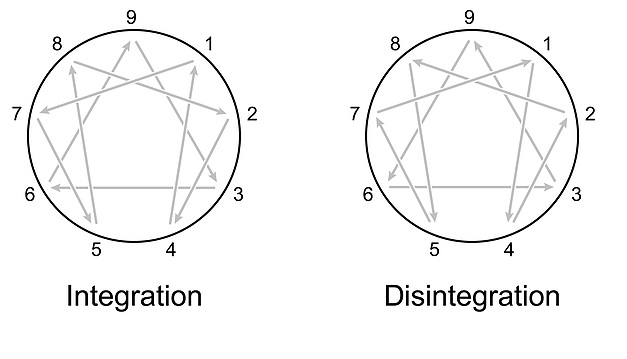
A unique feature of the Enneagram is that discovering one’s type is not the end of the journey, but merely the beginning. The goal of using the Enneagram is not to pigeonhole the individual into yet another box, but to hand him the tools to work on himself. The Enneagram comes with an inbuilt system of dynamic transformation, showing us what direction we tend toward when we learn to wear our type more lightly.

This is what is known as the path of integration. Basically, when you feel at ease, or when you learn to process your type’s challenges in a more mature way, you develop some of the healthy characteristics of another Enneagram type, namely the one connected to yours by the forward-pointing arrow. Note that you do not become a different type: your type is fixed and will stay with you as long as you live. You merely acquire some of the good traits of your integration direction.

One the other hand, when you are under stress or when you become more and more trapped in your mechanism, you tend to develop traits associated with the less healthy side of the type whose direction of integration you represent. This is known as your path of disintegration.

The Enneagram symbol with the arrows showing the directions of integration and disintegration

Note the two terms ‘stress’ and ‘relax’, as these are used with a specific meaning in Enneagram theory. Stress doesn’t simply mean having a busy schedule, just as relax doesn’t simply mean tanning on the beach. Stress is every situation that reinforces or incentivises the vicious cycle typical of your type, so that your type’s mechanism tightens its grip on you. Relax is the opposite–every situation that gets you out of your negative spiral or even leads you into your virtuous cycle.

Again, just as with integration, disintegration doesn’t make you change type. Furthermore, there is some indication that it is actually possible to work positively with your path of disintegration, although it tends to be hard, just as it is possible to use your direction of integration negatively. For instance, Fives may get a sense that they need to be more present in their bodies and act boldly, like Eights (Five’s integration), but because this is alien to their usual mechanism, they may end up doing it exactly when it is uncalled for; or a Four may have the idea of adhering more strictly to objective rules and mundane schedules, like Ones (Four’s integration), but they may end up doing it in an unhelpful or blind way that defeats the purpose of it, because they are trying to do something that is not typical for them.

These issues stem from a misunderstanding, namely that you need to start acting like a different type. This is not so. You are you. Work on yourself and on your type. The Enneagram symbol represents an uninterrupted flow of energy, while the types are like strictures on the road that partially block the flow. Working on yourself means loosening this stricture. This will lead you to naturally develop new attitudes, without you trying to be someone you are not. Keep in mind that the goal of every form of psychological and spiritual development is to be able to act appropriately now, and to react appropriately to what is happening now, without or with as little conditioning from your past preconceptions as possible. This is why the first thing is to learn your type, and then you start learning how wear it lightly.

The Nine Types with their Paths of Integration and Disintegration

Type One to Seven (Integration): Ones have a strong sense of duty. This is part of their subconscious deal with themselves: you are ok and are allowed to exist and act only if you do it right and in order to uphold an idea. As they relax, Ones move to Seven, learning to let go of the harshest aspects of their resentment toward themselves and others. They learn to look at the world with a sense of wonder, accepting a wider variety of points of view and sources of joy.

Type One to Four (Disintegration): when they become entangled in their own mechanism, Ones begin to despair at their inability to live up to their own ideal. They begin to see the world as impure or lost, and in moving to Four, they develop a marked melancholic or even depressive note, feeling that all is useless and they are shipwrecked in the wrong world, a world of chaos and lawlessness, without principles or order, a world that doesn’t listen to them. They tend to become resentful of others because they see in them the type of careless happiness that they secretly envy.

Type Two to Four (Integration): Twos exist, or rather, feel that they only have a right to exist in the interpersonal dimension, even when they are alone. As they develop, they move toward type Four, and acquire a greater sense of their own needs and a greater compassion for themselves. They learn to see themselves as valid, accepting and feeling their own urges without pushing them on other people, and experience and accept the hurt that comes from the realization that they are alone, like everyone else, and that connecting with others presupposes first being alone. They become their own primary focus of care and understand the legitimacy of this being so, which allows them to be more genuine and truly disinterested when helping others.

Type Two to Eight (Disintegration): despite their often sweet demeanor, Twos have an authoritarian streak that becomes apparent when the other resists Two’s attempt at creating a symbiotic unity with them by ‘helping’ them. When all else fails, and Two feels that reality is slipping away from their grip, they move to Eight, becoming hostile and aggressive, punishing the other in a demeaning way, as though the neutralization of otherness that they could not achieve with sweet manipulation they now seek to accomplish by turning overtly overbearing.

Type Three to Six (Integration): Threes tend to identify with their performance, achieving often marvelous feats that they seek to sell to others as the real image of who they are. They are extremely competitive and live in other people’s good impression of them. As they relax, however, Threes move to Six, they learn to be more ‘like others’, which doesn’t mean abandoning their drive, but using it together with others rather than to emerge at all costs. This is because they realize that their inner worth cannot be measured by how they perform. They often concentrate on creating meaningful social connections.

Type Three to Nine (Disintegration): every type has a vague feeling of what can go wrong with their mechanism, but often refuse to verbalize it in front of themselves because it’s a tough pill to swallow. Threes have it especially hard, because they perceive, at least on some level, the phoniness of the image of themselves that they submit for people to consider, but because the Heart energy is blocked in them, they don’t see or feel what else they could ‘truly’ be. This can lead them down a spiral that lands them at Nine, where they become lethargic and disillusioned about their own worth, sensing that they will never be anyone except, at most, frauds.

Type Four to One (Integration): Fours are extremely sensitive to their ever-changing inner emotional landscape. As they relax and move toward integration at One, they become more principled and appreciative of the mundane tasks that fill everyday life. They cease to long for the unattainable and become focused on practical plans for achieving what can be achieved and cultivating themselves more methodically. Emotions still find expression, but in a more measured and authentic way, without exaggerating. Authentic connections with others develop naturally.

Type Four to Two (Disintegration): Fours can throw hissy fits to express their disdain for the drab, gray, unfair world that surrounds them and makes them suffer. Furthermore, their envy leads them to being spiteful, often taking solace for their suffering in the suffering of other people. This leads to damaging personal relationships with snide remarks, underhandedness and all-around bitchy behavior. Yet when others are at the end of their rope with Four, Four becomes clingy, people-pleasing and unctuously accomodating at Two in an effort to patch the relationship back together.

Type Five to Eight (Integration): Fives live in their own head, where they identify with their own mental process and with some carefully selected truths or (often esoteric) areas of competence. As they relax, they move to Eight, learning to take up space in the world and inhabit their own body more fully. Their knowledge may find practical application or simply be more grounded, and they learn to listen to their guts when needed. They also learn to appreciate their own physical existence and realize that they have way more energy and resources (broadly construed) than they could ever imagine, which allows them to take action without first needing to hoard energies or time to devote to needless tinkering and fiddle-farting.

Type Five to Seven (Disintegration): When under serious stress, Fives find themselves incapable of using their typical strategy of retreating in preparation. This is especially the case when there are time constraints or when it is impossible to take a pause from social interactions (especially with people they know less well.) This leads them to become scattered and oddly unfocused, like unhealthy Sevens. Their typical sarcastic humor starts missing the mark, they often become incapable of saying what they think or thinking about what they are saying. They also tend to become airy in an ungrounded sort of way. They realize they’ve said something only after the fact, and realizing that what they said is stupid, or at least unrefined, they become even more scattered as panic sets in.

Type Six to Nine (Integration): Sixes are always looking for the one thing, idea, institution, person, group they can trust so much that they can finally turn off their brain and go on autopilot. Unfortunately, it takes little for them to start tearing down the object of their trust. When relaxing, Sixes move to Nine, where they become more trusting and calm. When watching a Six, I always have the sense that behind all their turbulent questioning there is a small white pearl of calmness that they are looking for and can’t seem to reach, despite it being right in front of them. Integrating to Nine means reaching that pearl. Relaxed Sixes allow space for the sense that all will be well and other people can be trusted even if they are not perfect.

Type Six to Three (Disintegration): under stress Sixes move to Three. As they lose their trust in others and despair of their possibility of finding safety in life, they become like fearful sheep realizing their need to fend for themselves as a pack of wolves attacks. They develop a desperate competitive edge, often exactly when it’s unwarranted or when doing so will cause even more uncertainty. Furthermore they may ‘puff themselves up’ in hopes of scaring away predators, trying to sell an exaggerated image of themselves to others.

Type Seven to Five (Integration): Sevens tend to flee from their inner sense of worry and their fear of pain. This often causes them to become engrossed in a superficial pursuit of distraction. When they relax, Sevens move to Five, developing a deeper stance and greater self-reflection. They learn to accept the darker side of life, like Fives do, and put their endless supply of energy to good use on long-term projects, staying focused while maintaining their typical cheerful demeanor. They are often able to confront their own shadow with great depth and tackling their problems soberly without slipping into hopelessness.

Type Seven to One (Disintegration): Sevens are constantly fleeing from worry, fear and pain. When this becomes impossible, or when they perceive the futility of it, or when all the issues that have been piling up finally explode, they tend to move to One, where they become highly critical of others for making it impossible to enjoy life, usually projecting their own failings onto them. Often they develop unrealistic plans to cleanse their life of all the problems they have been ignoring, which however could even make the situation worse, and they tend to take refuge and solace in ‘being right’ on things that are ultimately of no consequence.

Type Eight to Two (Integration): Eights have a bold, aggressive attitude, which they use to secure the borders of their ‘territory’. They can be confrontational and overly assertive with those they do not consider friends. In relaxing, Eights go to Two, where they become more giving and interpersonal. As a matter of fact, the average Eight already has a liberal, giving streak with the people they like. However, in relaxing their mechanism, they learn to stop dividing the world in friends and foes, and are capable to connect deeply with people, opening up about their vulnerable spots and showing their sensitive side. This ends up increasing their sense that there is a space for sweetness and nurturing in the world, and that sometimes it’s ok to let one’s guard down.

Type Eight to Five (Disintegration): under stress, Eights will usually double down on their typical strategy of pummeling the other to the ground to protect and assert themselves. However, when this strategy is defeated, we witness a real implosion of Eight, who seems to be sucked into a hole in the center of their being. This is their move to Five, which sees them fleeing reality and contact, becoming brooding and given to silly rationalizations of all that has happened. It is common for them to physically remove themselves from the presence of others, retreating into their den, going for a drive, etc. Usually they employ this time to build themselves back up, stocking up on energy and mental resources, as if their fortress had been cannoned full of holes they need to patch.

Type Nine to Three (Integration): Nines have a very diffuse sense of self, as they have learned to put their priorities behind those of others. As they relax, they move to Three, where they finally go through the normal process of developing a stronger self-image that has at least as much a right of being taken seriously as that of any other person. They typically become more active in their pursuit of their own aims and are more capable of setting up healthy boundaries. They learn that it is ok to emerge and to seek a place in the Sun. Because they become capable of openly saying no to things they don’t want, they have less need for passive resistance.

Type Nine to Six (Disintegration): Under stress, Nines tend to try to make reality disappear under a cottony coat of numbness. Those who have witnessed unhealthy Nines know how hard it is to get anything done that even partly depends on them. When this strategy breaks down, however, slothful Nines move to Six and suddenly become preoccupied and given to catastrophising. They also tend to become demeaning toward other people, poking holes in all they say and being skeptical of all they do, in hopes that all will go back to being still and motionless and all undertaking will be put off or abandoned. Like unhealthy Sixes, they also tend to fall into the “we poor little people against the evil guys upstairs” rhetoric.

The Three Social Stances (Enneagram Plain and Simple)

We’ve seen so far that the Enneagram tracks the development of our personality based on the central issue it revolves around. If we imagine reality to be a solar system with planets naturally revolving around the Sun, personality is the equivalent of a bit of one planet breaking off and revolving around said planet instead of around the Sun, like the Moon with the Earth.

Our personality colors our perception and our priorities and needs, as well as the strategies we develop to meet them. It also colors our stance toward other people. As most things in the Enneagram come in threes, we recognize three stances: assertive, withdrawing and conciliating or compliant. Each triad (Body, Heart, Head) has one assertive type, one withdrawing type and one compliant type.

This distinction ought not to be confused with the one discussed in the previous article on how each type relates to the energy of the center it belongs to. For instance, Type Two asserts the Heart energy, but in terms of social stance it is a conciliating type, not an assertive one. The expression of a center’s energy is the inherent motor of one’s personality, while the resulting social stance is more of a consequence, though an important one.

Assertive Types: Seven, Eight, Three

The three assertive types of the Enneagram: Three, Seven, Eight

In the Enneagram, assertive types tend to move toward the Other in a more or less bold fashion. They are usually daring and have a practical streak. They go get what they want or need, and do not let other people stand in the way. However, what they need is dictated by the center they belong to.

Type Three is a Heart type, meaning it is concerned with themes of recognition and attention. Three is definitely the show-off of the Enneagram. It asserts itself to emerge as worthy of validation within the system it finds itself in, whether it be school, work, family, etc.

Type Seven is a Head type, which means it desires security and safety, fearing pain and negative states of being. In fleeing from the inner potential for fear and pain, Seven asserts itself on the world around, looking for distractions and diversions, making plans for a thousand projects that keep it from the muted inner sense that all is not well.

Type Eight is a Body type, which means it wants autonomy. Eights are renowned for their ability to assert themselves on others and on reality in general. Even physically they have a certain presence (regardless of their body type) as they present themselves as the fixed point that can deviate the course of reality. Among the Enneagram types, Eight is the least reactive and most naturally active: an Eight doesn’t deal with you, you must deal with them.

In general, assertive types get into trouble with others by generating conflict (whether willingly or not) or by being excessive in their actions and sometimes deaf to other people’s reasons and perspectives.

Withdrawing Types: Nine, Four, Five

The three withdrawing types of the Enneagram: Nine, Four, Five

Withdrawing types do the opposite of assertive types: in order to get their needs met, they retreat from the Other. This is not to be confused with introversion, especially in a Jungian sense, as the Enneagram does not measure this. Any type can be introverted.

Type Nine is a withdrawing Body type. Its need for autonomy is met by not getting into situations of conflict or confrontation that might threaten its autonomous existence. The idea is, if I create a general mood of harmony, don’t demand anything and don’t go against the flow of other people, I will get what I want and won’t create problems for myself. This is the very opposite of what Eights do.

Type Four is a withdrawing Heart type. Fours withdraw into their fantasy, where they cultivate a rich world of images, moods and emotions, hoping that someone will notice them and whisk them away from a dreary, disappointing reality that doesn’t match their wishes. Instead of sucking the air out of a room like a Three, you’ll likely find Fours sulking in a corner, hoping to be asked what’s wrong.

Type Five is a withdrawing Head type. It retreats from the uncertain flow of the world into its mind, a universe filled with concepts, abstractions and logical reasoning. The idea is that, since the truth is the truth is the truth, the more a Five renounces its material and social existence to identify with impersonal, objectively valid thoughts, the less it will suffer from the uncertainty of reality. Dealing with concepts is easier than dealing with people. This is exactly what a Seven would never do.

In general, withdrawing types tend to get into trouble with other people by not being available to them or by being unclear and ungraspable, which can become a rather frustrating experience.

Compliant Types: Six, One, Two

The three compliant types of the Enneagram: One, Two and Six

Compliant types adopt rather complex strategies to fulfill their needs. They do not assert themselves like assertive types, nor do they retreat away from others like withdrawing types. Instead, they seek, as it were, to merit their needs being met, and as such their stance is markedly interpersonal (though not necessarily social.)

Type Six is a compliant Head type. Its core issues are related to security, and to the type’s inability to be the source of its own security. The solution is to find an authority to submit to by deserving their protection. This authority can be, but is not necessarily a person: it can also be an institution, an ideology, etc. Protection is deserved by being a good friend, partner, employee, believer, political activist, etc. As such, Six neither asserts itself like a Seven nor retreats like a Five.

Type One is a compliant Body type, whose need for autonomy is met by earning it. Ones don’t assert themselves unconditionally like Eights, nor do they shy away from conflict like Nines. Instead, they assert themselves on behalf of a higher goal or reason or idea. Being in the right gives Ones the credentials they need to demand other people’s obedience or respect.

Type Two is a compliant Heart type, concerned with recognition and attention. The way Twos seek to meet this need for recognition is by taking care of other people and meeting their (perceived) needs so as to gain a right to have their needs fulfilled. In this way, they neither withdraw for attention nor assert themselves, like Fours and Threes respectively, but instead seek to become indispensable for the other.

In general, compliant types tend to get into trouble with others by stipulating unspoken pacts with them and becoming angry, offended, hurt or scared when the other doesn’t meet their end of this unspoken bargain.

Energy CenterEnergy DynamicSocial StanceType
BodyAssertionAssertive8
BodySuppressionWithdrawing9
BodyTransformationCompliant1
HeartAssertionCompliant2
HeartSuppressionAssertive3
HeartTransformationWithdrawing4
HeadAssertionWithdrawing5
HeadSuppressionCompliant6
HeadTransformationAssertive7
The nine Enneagram Types with their social stance.

From the Three Centers to Nine Types (Enneagram Plain and Simple)

Everyone’s personality, regardless of their type, is founded on sustaining a separate existence from the whole. You cannot be your regular, daily self without being able to point at something that is not you. There is nothing wrong with separation and duality, in spite of what mystics may say, because it is through separation that unity blooms, pouring forth a thousand forms. More specifically to personality, it is through our consciousness of the universe that the universe perceives itself, and this, as I said, is only possible if the universe adopts our limited perspective through which it can explore itself, and without which it would remain blind.

This limitation takes place as we develop our character or personality, which involves us gravitating toward one of three centers of energy expression: Body, Heart or Head. Each center, as I discussed in the previous article, has its hub in one of the Enneatypes of the inner triangle: Nine (Body, Instinct), Three (Heart, Feelings), Six (Head, Intellect).

These three original types represent their respective center in a rather odd way: they don’t express the corresponding energy. Instead, they suppress it or filter it out. Type Nine, sometimes called the Mediator or Peacemaker, is a rather inconspicuous, self-effacing type, which is the opposite of the choleric drive behind our bodily urge for independence. Type Three, often called the Doer or the Achiever, seems at first anything but a feeling-oriented personality, concerned as it is with status, competition and practical plans. This seems to go against the Heart center’s urge for mending the bond between Self and Other. Type Six, normally referred to as the Skeptic or the Doubter, appears to be anything but oriented by a clear mind, caught up as it is in constantly catastrophizing and poking holes in its own certainties until all that is left is for it to blindly follow a trusted leader’s instruction. This seems contrary to the intellectual urge.

The full Enneagram, with its inner triangle (9, 3, 6) and the seven derived types.

In reality, though, we need to understand that the Enneagram does not really tell us who we are, but rather what we have a problem with at our core. Type 9 has a problem with its bodily presence, and therefore seems unable to assert itself; Type 3 has a problem with its true feelings, and therefore concentrates on achieving rather than being; Type 6 has a problem with its mind, being unable to trust itself and its own thinking, so it ends up being rather irrational or unreasonable.

But what we deny we imply. I cannot say “there is no flower here” without implying the notion of flower, and therefore the possibility for a flower to be here. So, in each Enneagram center, we also find a personality type that asserts the center’s energy. These are the types that come right before the ones that suppress the energy: Type 8 (coming before 9) asserts the instinctual energy of the Body; Type 2 (coming before 3) asserts the emotional energy of the Heart center; and Type 5 (coming before 6) asserts the intellectual energy of the Head center. In short, 8, 2 and 5 are the types that you spend five minutes with and you know immediately what they are about.

Type Eight, sometimes called the Boss, is assertive, powerful and has no problem going out and taking what its instincts tell it belongs to it. Through Eight, the Body center finds the kind of unobstructed expression that it seems to lack in type Nine. The Other is often either acknowledged as weaker and therefore in need of Eight’s protection, or as a target to direct attacks toward.

Type Two, sometimes called Helper, is relational, caring, interpersonal and motherly, often denying itself to please or help. Through Two, the Heart center expresses itself in a way that is not possible through Three. The Other becomes the object of the person’s attention, in hopes that, by creating a bond with them, Two’s identity and needs may be validated.

Type Five, often known as the Observer, is rational, unsentimental, objective, detached, always willing to follow a line of reasoning to its ultimate conclusions, regardless of how subjectively unpleasant it may be. Here the energy of the Head center asserts itself as it could never do at Six. The objectivity of the thought-process becomes a refuge from the uncertainty of life and the fear it engenders.

As in every dialectical model, where there is assertion and negation there is also a mediation between the two, and this happens in the types following the hub of each center. In all three cases the energy of the center is neither asserted nor negated, but transformed, and redirected, in one way or another, toward oneself. In Type 1 (coming after 9) the instinctive energy of the Body center finds a mediated expression; in Type 4 (coming after 3) the same happens in the Heart center; likewise, in the Head center Type 7 (coming after 6) mediates between affirming and negating intellectual energy.

Type One, usually called the Perfectionist, is strict, precise, law-abiding, just, disciplined. It represents a mediation between the unbridled assertion of instinctual energy of Type Eight and the suppresion of it in Type Nine. In Type One, the idea is: I can assert myself as long as I do it in the right way, or rather, as long as I assert the right thing. In doing so, however, One submits itself to this pervasive idea of right, becoming its own harshest critic.

Type Four, often called the Individualist or the Romantic, is self-involved, introspective, reserved, self-conscious. It mediates between Type Two and Type Three, introjecting the energy of the Heart center to sustain its own moods and cultivate a self-image with which it seeks to flee inward and away from a reality it perceives as tragic, or at least as unkind and unable to recognize it as it truly is.

Type Seven, known as the Joker or the Epicurean, is fun-loving, energetic, excited, unfocused. It represents a mediation between the assertion of mind energy of Type Five and its suppression in Type Six. Type Seven is concerned mainly with self-gratification, and it uses the Head energy to come up with endless ways of feeling entertained, positive and energized, which leads to fleeint out into the world in search of pleasure so as not to acknowledge inner fear.

TypeCenterEnergy DynamicDescription
8BodyAssertionAsserts itself physically and attacks obstacles
9BodySuppressionSuppresses its own individual energy
1BodyTransformationSubmits to rules that justify its own assertion
2HeartAssertionCares for the other to gain validation
3HeartSuppressionPerforms and achieves to emerge as worthy of recognition
4HeartTransformationCares for itself to cope with tragic reality that doesn’t “see” it
5HeadAssertionAbides by own mental skills to avoid uncertainty
6HeadSuppressionSeeks external support to avoid relying on own mental skills
7HeadTransformationPlans own gratification to avoid thinking about the negative side
The Nine Enneagram Types and their main energy dynamics

The Enneagram Plain and Simple – The Three Centers (Body, Heart and Head)

In my previous post I discussed the difference between reality and personality. The long and short of it is that an individual’s personality exists essentially by blocking out or filtering out a part of the whole. You cannot be yourself as a single, individuated person and take in everything all at once. Individuation and manifestation (what some occultists call life below the abyss) imply a limitation of perspective.

How we get from the One to the Two, from unity to duality, that is, from the Whole to Self versus Other, is an interesting question, one that cannot be answered satisfactorily in a few words. Saying that duality is an illusion is too simplistic, because even an illusion must be something that exists apart from the real, it must *be* something illusory that is not the real thing, so really this explanation doesn’t explain anything. I will tackle the issue if and when I decide to start talking about philosophy. For my part, all I can say at the moment is that we cannot really understand the One and the Two without taking into account the Zero.

Three Urges, Three Passions

Let us take for granted, though, that Two comes from the One. Individuals come into being as centers of awareness that are separate from the rest of the universe. This can only happen by taking some parts of the whole not to be part of oneself, that is, by filtering them out (“I am this, not that.”) This, according to Enneagram theory, can happen in three ways, depending on what it is that is being blocked out.

Conventionally, we recognize people as being made up of three things: Body, Heart and Head. The Body is sometimes called the Guts, the Heart is sometimes called the Soul, the Mind is sometimes called the Head or even Spirit. I shall stick with Body, Heart and Head.

The three centers: Body, Heart, Head

These three aspects of the human complexion are representative of three urges: autonomy, recognition and security.

Even the meekest individual seeks to maintain their autonomy, some degree of space for themselves, which requires that they assert themselves as organisms against the world surrounding them. This is Self versus Other in its purest form, where the self seeks to neutralize otherness and bring it under its command. Even in our painfully egualitarian times he who doesn’t want to starve will seek to conquer the world.

Recognition is a much misunderstood concept. It speaks to the junction between our personal and our social existence, and to our desire to match the image of ourselves that we think exists in other people’s perception, or, which is the same, the desire for them to have the image of us that we have of ourselves. This, however, implies that we maintain a self-image, that is, that we can point at certain definite characteristics we either display or wish to display and say, “This is me.” Only, we cannot really know why this is the case: our self-image hangs in the air somewhat, and feels arbitrary. Why are you only yourself when you are X, but not when you are Y? So, in order to validate it and make it real, we seek to reproduce it in other people’s perception to render it stable. Everyone needs recognition to an extent, and this includes hipsters.

The need for security is the need to know that one’s existence is preserved against imponderable forces that we see as alien to our being. If life consists of Self and Other, of Me and the World, there is no way of knowing whether tomorrow something will happen that will favor me against the world or the world against me. The urge for security is the urge to maximize my chances. It is, in a way, similar to the urge for autonomy in that it sees the Self against the Other, but in this struggle it concentrates more on regimenting and strengthening the Self than on conquering the Other.

These three urges come bundled with their negative side or passion. You cannot conquer the world to maintain your autonomy without anger, seen not necessarily as rage, but as a certain choleric disposition to treat that thing outside of you as a potential enemy or obstacle to be overcome. You cannot have recognition without attaching a great deal of value on the small segment of the universe that you call “me” and that you spruce up with wishes and exaggerations which you want other people to validate. This need for recognition creates the potential for lack of recognition and therefore for shame. Finally, you cannot be looking for security without experiencing fear, by which I do not mean any ordinary fear, but rather the sense of your being teetering on the brink of annihilation.

CenterUrgeDesired OutcomePassion
BodyAutonomySubduing the OtherAnger
HeartRecognitionConnecting Self and OtherShame
HeadSecurityPreserving the SelfFear
The Three Centers of the Enneagram

The Three Centers in the Enneagram: Types Nine, Three and Six

The three centers, i.e., the Body center, the Heart center and the Head center, work in a circle. You establish yourself as an individual body as opposed to the others, you sustain a self-image which you look to accredit in the eyes of your fellows so as to validate your existence, but you suddenly realize that your condition as a separate entity is precarious, so you use your mind to create survival strategies that lead to you being able to preserve yourself as an individual, and so on.

Of course, this cycle is the basis for everyone’s self-sustained existence as individuals, regardless of their particular proclivities. In a way, this is the minimum needed for you to be you, and not another person, or a bunch of moss gathering on a rock. However, this is also how the Enneagram comes into being as a system of nine types.

Types Nine, Three and Six, the hubs of the three centers

The circle represents the whole, the unbridled and undivided universe, as it were. The triangle indicates the three points in the Enneagram where the three centers have their hub: 9 is the hub of the Body center, 3 is the hub of the Heart center and 6 is the hub of the Head center. Energy flows uninterrupted from 9 to 3 to 6 to 9 (we will see in the next article how the other six types come into existence.)

I have described personality as a filtering system which blocks out certain aspects of reality to privilege others. Interestingly, the three Enneagram types which represent the hubs of the respective centers are qualified exactly by the fact that they block out, or suppress, the energy of their center.

In other words, Type 9, the hub of the Body center, suppresses its own bodily energy; Type 3, the hub of the Heart center, suppresses its own emotional energy; Type 6, the hub of the Mind center, suppresses its own intellectual energy. This has the interesting consequence that, unless you know the Enneagram, you would never guess that Nines are body types, since they seem soo airy and diffuse, nor would you recognize the willful and competitive Threes as heart-driven, nor the insecure Sixes, who never trust their judgment and are always looking for someone trustworthy to make decisions for them as head-driven.

Yet it is so. We will see in the next article that this is part of a dialectical or triadic movement that leads to the emergence of the other types.