Category Archives: Sibilla della Zingara

Vera Sibilla | Embracing Fallibility

Before moving on to the spreads, I should point out one last thing. For whatever reason, the psychic community seems often reluctant to admit that they are fallible (but then again, trying to get officially recognized experts to say “I’m sorry for having been full of shit” is also hard, possibly because expertise is turning into a new form of religion, but I digress).

I believe the reason for this is that, since there is no scientific certainty that divination “works”, then divination requires blind faith, and blind faith can never accept being called out. Doubt and reason, which have raised the human race above the others in so many ways (no, I am not anti-specist. Sue me) are seen critically among psychics because they open one to the possibility that not everything that leaves their mouth when they are not thinking about it is pure gold.

While it’s true that the sure hand is more likely to  shoot the arrow that hits the mark than the trembling one, reason and doubt are still your friends, if you use them wisely. And the first requirement of a reasonable practice is that you keep a log of your readings and check them for accuracy without holding back. Don’t dissolve into a puddle of tears as soon as you get something wrong–everyone does! No one is 100% accurate.

Accepting your fallibility frees up a lot of space in your psyche for other useful things, such as the ability to listen, to interpret, to feel, to empathize. It is also much less stressful than holding yourself up to an impossible standard. And it turns you into an honest experimenter in the psychic arts.

Vera Sibilla | Your Own Language

Divination systems are like languages. We’ve seen in the previous post how true this is. But it is even truer when we consider that whatever you learn from a book or a blog post is actually a standardized version of the language of the cards.

Now, standard language is an abstraction. Nobody speaks it. Shakespeare spellt the same word in two or three different ways over the course of the same play. The same goes for older writers in most languages. Standard language is an invention of the modern nation state, just like statistics. In order to exert clearer clontrol over their often large territory, the intellectual class of the various nations came up with rigid rules which are more or less helpful, but they are just that–made up rules that capture a measure of truth, but leave other things out.

Language is a more fluid phenomenon.
But you will find that no real person on the street actually speaks standard English or Italian or German, unless they are “highly educated”, which just means that they have absorbed more rules. I do noy mean to disparage rules. I’m merely observing that language is a living thing, which lives through the mouths of those who speak it. Therefore it is always a rather individual phenomenon: everyone has their dialect, their accent, their pet words, their filler words, those expressions that they constantly use because their grandma used them even though even other natives don’t use it, those expressions that mean something to the people in their hometown but something wholly different in a different region, etc.

The same is true for divination systems, especially complex ones like cards. You need to find your language with the cards. This can only be done by using them for yourself and even more for others. Studying meanings and combinations is useful to make up for the fact that you are not a “native speaker” (nobody is) and traditional meanings are usually passed down for the good reason that they are often valid. I have tried to make the traditional meanings as palatable as possible by creating a numerology to make sense of it (which I will revise as better ideas arise). But you can’t let yourself be drowned in rules, or you’ll never speak the language of the cards fluently. I’m still discovering my own language as it is a life-long endeavor.

To help you, I’m going to post some interpretations of some card spreads in the future, so that you may see how I do it. Take it as a jumping off point, not as something to slavishly adhere to. 

Vera Sibilla | The Moment of Silence

We’ve talked about some of the basics of interpreting the cards. The most important thing is to practice, though, as only your own practice can reveal how the cards communicate to you. In this light, I would like to address something that is not strictly speaking a point of interpretation, but which I find is still helpful. It’s what I would call “the moment of silence” and I believe it holds true for all card systems you study.

Especially at the beginning, when you get your hands on some cool material about the deck, your head is going to be brimming over with facts. This is a preliminary step which, I think, is unavoidable, just as it’s unavoidable, in learning a foreign language, to assimilate words and some grammar. You can go with the “natural approach”, but sooner or later, if you want to rise above mediocrity, you need some serious study.*

But study brings with it a new host of issues. Ever listened to a non native trying speak English (or your language) for the first time after completing a course? You can barely understand them. And for a good reason: they are constantly trying to reach for information in their heads that they haven’t assimilated in practice. They are trying to remember rules and exceptions and words and word connections, and the pronunciation of this or that words, all the while trying to understand what you, the native speaker, are telling them etc.

It’s a lot. Then, as they practice, they evolve toward a type of English (or any other language) that is hopelessly broken, but somewhat understandable. As they refine their skill, they assimilate in practice what they have had in their heads all the time, and their use of the language improves.

But just as you can have a bad hair day, you can also have a bad English day, or a bad German day, or a bad Italian day. It’s those days where you feel like you are here and your language skills are somewhere else and you need to constantly grope for them, which makes for some very clunky sentences and dialogues. If you are having one of those days, you need to relax, take in a deep breath, wait a moment, center yourself and stop *trying* to speak the language–and just speak it.

With divination it’s similar, with the added difficulty that there is no native speaker to learn from. But the concept of “waiting a moment” and centering yourself is still valid. Having three, five, fifteen, twenty one cards in front of you can intimidating, so you jump into it in a kind of panic and start assembling meanings. That’s not helpful. When you start a reading, always make sure to stop for a second and keep quiet. Not just quiet in the sense of not speaking, but also in the sense of not trying to have your attention drawn immediately by a tree as opposted to taking in the forest. The spread is a whole, and it must be approached as such. Take a deep breath, forbear from trying to read the cards. Let your eyes wander for a second over the whole spread without digging anywhere. Survey the territory in a kind of bird-eye view. And then speak.

* conversely, if you start with some serious study, you also need the natural approach.

Vera Sibilla | Cards That Modify the Reading

We’ve seen that the cards are generally read from left to right. Often, the last card in a row can change the meaning of the row itself completely. Sometimes, instead, it’s the card in the middle that changes the reading (when I say in the middle I don’t necessarily mean exactly in the middle, just not first or last). At other times, finally, a card can have a different meaning when it falls first.
Note: when I say the beginning or end of a sequence, this may or may not be the beginning or end of a row of cards: a sequence is a number of cards forming a coherent picture of a situation present, past or future. A single row can have more than one sequence.

Following are some examples.

The 2♥, the House, has the power to consolidate the meaning of the cards preceding it, so if the preceding cards show a well-defined situation for better or worse and the 2♥ comes up without any specific reason, it can mean that the situation is destined to consolidate itself in the direction signified by those cards.

The 4♥ coming up in the middle of a sequence and having no specific meaning can highlight the querent’s emotional involvement in the situation. This is also true when it’s reversed, in which case it’s negative involvement. The 4♥ coming up at the beginning or a sequence and having no specific connection to the rest of the reading can signify that the events shown are what the querent is attracting to himself or herself.

The 6♥R, coming up as the first card of a line and having no immediate obvious meaning can signify that the situation represented by the cards following it will happen unexpectedly and will be completely new. Coming up in the middle of a sequence and having no specific meaning it can highlight the duration of the situation into the future.
The 8♥ coming at the end of a row of cards or of a sequence shows that things will go as the querent hopes. If the cards preceding it are negative, it shows that there will be cause for hope nonetheless. If it comes up reversed, it shows situations going up in smoke.

The 10♥ coming up in the middle of positive or negative cards highlights their duration over time.

The 2♣ coming up at the end of a sequence shows divine intervention, protection, liberation from hardships.

The 3♣ coming up after difficult cards shows a change of direction in the querent’s life, usually for the better.

The 3♣R coming up in the middle of a sequence and followed by positive cards show the end of negative cycles and the end of hardships in general.

The 5♣ coming up at the end or a sequence shows a stroke of luck that will change the querent’s life in the field asked about.

The 6♣ coming up at the beginning of a sequence without apparent reason shows very quick events.

The 7♣ ending a negative sequence signifies a light at the end of the tunnel, especially when followed by positive cards.

The 8♣R coming up in the middle of a sequence without reason can signify things not going as the querent expects, for better or ill.

The A♦ coming up without reason at the beginning of a sequence can show dynamic change, new impulses, etc.

The 3♦R (the Gift) coming up at the end of a difficult sequence signifies the slow resolution of hardships. This is also true when it comes in the middle, but then you need to pay attention to the cards afterward.

The 4♦R coming up at the end of a negative sequence shows relief and positivity.

The 8♦ (the Handmaid) coming up for no reason at the beginning of a sequence can show that the sequence represents a new phase or evolution in the querent’s life. Coming up for no reason at the end, it shows that the querent evolves away toward a new phase.

The 10♦ coming up at the end of a sequence which seems promising steals the positivity away (but be careful, if it is a long, extremely positive sequence, the Thief alone is not strong enough to negate it). The 10♦R coming up at the end or toward the end of a negative sequence shows that there is nothing left to do. It’s over.

The J♦ coming up at the beginning of a series for no reason announces quick developments.

The A♠R coming up in the middle of a sequence and followed by positive cards shows the end of sorrow.

The 2♠U/R coming up at the end of a negative sequence shows the waning of the matter, more or less sharply depending on whether the card is upright or reversed.

The 4♠R coming up in the middle of a sequence and followed by positive cards shows the end of a period of standstill and blockage. Followed by negative cards shows the beginning or duration of the standstill.

The 5♠ coming up in the middle of a sequence and followed by positive cards shows a difficult but positive change. If followed by negative cards, it’s difficult and negative.

The 8♠R coming up in the middle of a sequence and followed by positive cards shows the end of a period of crisis.

The 9♠R coming up in the middle of a sequence and followed by positive cards signifies liberation and unblocking. Followed by negative cards it signifies the beginning of blockage.

Vera Sibilla | The Flow of the Reading

In general, the flow of the reading goes from left to right. For instance, let’s take the following situation: A♥ + K♦ + 6♠ + 7♣R. Here we might assume that there is, or there has been, a job interview (A♥ + K♥) followed by trepidation and waiting (6♠), but the waiting leads to nothing (7♣R).

However, if we reverse the spread as 7♣R + 6♠ + K♦ + A♥, then we have the opposite scenario: a situation where the querent for a long time is worried about their lack of realization is ended by a job interview (in this case we don’t know whether the interview will go well or not, but at least it’s something).

Notice how the placement of certain cards is relatively irrelevant: whether it’s K♦ + A♥ or A♥ + K♦, it is still likely to signify a job interview. This is because the two cards build a meaningful unit together. They strengthen each other. However, it is not irrelevant whether the negative cards come up before or after. In general, the placement of the cards is relevant in two situations: when the cards have different polarity; and when the cards describe situations that come logically one from the other. For instance, if the cards point to a birth and then to a pregnancy, it’s very different than if they describe a pregnancy followed by a birth. In the first case you end up with two babies, in the second with just one.

Another important point is whether the cards predict or they describe. This is a subtle thing to detect, and is not easy to see at first. Often, the cards describe a situation or state of affairs when you have cards showing the relationship between two face cards or between a face card and a certain field of life (e.g. love 4♥, marriage A♣, job K♦, etc). Also, they tend to describe more when there are strongly psychological cards. In this case, the flow of the reading is as if halted: the cards don’t come one after the other temporally, but at most logically.

The cards tend to predict specific happenings when there are strong cards showing action or, when you use longer spreads, when there has been a clear description of a situation in the first part, and then they move on to show how that situation will evolve. In part you also need to develop your intuition and your language with the cards. In these cases, the flow of the reading is relevant.

Sometimes (quite often) the description is nestled within the prediction. That is, the cards predict something and describe it. In this case, whether a card comes after the others may or may not be relevant. Example: granny kicks the bucket and leaves you some money.

Suppose it shows up like this: 2♠R + 5♠ + 3♠R + 5♥ + 7♥ + 6♥ + 6♣. In this case, it is relevant that the cards showing granny’s passing (2♠R, 5♠, 3♠R) come out before the others, because it is quite logical that death precedes the opening of the will. The 5♥ is the card of family and inheritance, the 7♥, in this case, is the lawyer and 6♥ + 6♣ shows the gaining of money. Again, it is relevant that the combination showing the inheritance comes up after the one showing death. But within these combinations, the position of the cards is relatively irrelevant. You could take the cards that go from 5♥ to 6♣, shuffle them around and it wouldn’t change much. Similarly, in the first combination, you could place granny (2♠R) somewhere else, maybe between the 5♠ and the 3♠R, and things wouldn’t change.

This is because the prediction includes descriptions.

Vera Sibilla | Interpreting Face Cards

Face cards are those that represent people. This is a more comprehensive notion than “court cards”, because not all face cards are court cards: for instance, the 2♠ can behave like a face card, a significator, but it is not a court card. Conversely, not all court cards necessarily behave like face cards: for instance, the K♦ is rarely a physical person, being a significator of the querent’s job.

Face cards are, for the most part, neutral. Heart cards tend to be slightly positive in themselves, but they also absorb the meaning of the cards surrounding them. Spade cards tend to be negative (though the K♠ is neutral when it is a face card) and being black they tend to assert their negativity over the positive meanings of other cards.

Face cards are neutral, and this means that they are heavily influenced by their surroundings. The cards immediately outside of a face card often give us the context and description of the person in terms of the situation. For instance, if the J♣ falls between K♦ and A♥, he can be a coworker or a work contact. If the same card falls between the 4♥ and the 9♥, he is either your best friend or your boyfriend. If he falls next to the A♣, he is probably a young husband. And so on.

When a face card does NOT appear in the spread even though you’d expect it to, that’s a sign. The person is not active in the events of the spread and is unlikely to be able to change them.

When a face card DOES appear in the spread, its suit will give us a hint of the role it takes on, if caring, helpful, disinterested, disingenuous, axe-grinding, inimical, if they are active, optimist, or passive and in need of help, etc. This is to be understood within the context of the question. For instance, a mature woman may occasionally show up as the Q♣ if she is either immature or in a precarious situation where she needs help.

When a face card appears as a suit that is not good for the question, the cards surrounding it may supplement positive connotations that the suit lacks. For instance, the Q♦ is a married woman, however when a married woman appears as the Q♦ in a love reading, her primary loyalty is not to the partner but to the marriage itself, which doesn’t mean she doesn’t love, but that she is primarily in the relationship out of inertia or tradition. However, if the Q♦ is next to the 4♥ or the 9♥, then she is very much in love, as though she were the Q♥.

When two face cards fall immediately next to each other, this is a sign that they know each other and interact (or will interact), unless other signs contradict this. Sometimes, if two face cards falling immediately next to each other are of the same sex, they can represent the same person. For instance, the Q♦ and Q♠ together can either signify two people or the same person, depending on the context. This is rarer when one of the two is reversed and the other isn’t, but it can still happen. Usually, when two face cards signify the same person it means the person has a dual role in the situation (in the example above, a wife who is inimical, maybe in the process of getting a divorce, etc.)

When two face cards have one or two or three cards between them (on occasion even more) those cards can be taken to describe their relationship and what unites them. For instance, J♣ + 9♦ + 5♠ + K♥ can show a very turbulent father-son relationship. Usually, when a combination showing the dynamics between two people fall between those people, they tend to have a less predictive effect. In the example above, if the 9♦ + 5♠ had fallen outside of the two significators it could have shown a breakup, and a rather painful one. But because it falls between them, it tends to only show how they relate to each other, and other cards will tell us whether or not they will fall out. If the sequence is followed by 8♣, there will be reconciliation, if 7♠, a break in the relationship.

When of two face cards one is reversed, they tend to be incompatible for whatever reason (look at the other cards). When they are both reversed they are still incompatible, but the incompatibility is more pervasive and visceral and less due to circumstances.

In general, a face card that is not the querent who is reversed signifies either someone who is in trouble or someone who works against the querent or, at least, disagree with them within the context of the situation.

When a face card is reversed, sometimes it signifies that the person has some type of issue related to the cards surrounding his significator. For instance, K♥R + 7♣ can signify a man who doesn’t feel realized. His card being reversed introduces a negation. It is similar to K♥ + 7♣R, the difference being subtle and somewhat psychological: if the face card is reversed, he is probably one who generally doesn’t feel realized. This notion however must be supported by other considerations.

Another example. Q♥R + 9♥ can signify a woman who is not faithful. The meaning is similar to Q♥ + 9♥R, but in the former case it is possible that she generally has a tendency not to be faithful–it is more rooted in her character than in the context of the situation. Again, you need to check for other signs.

When a slew of cards come up reversed (possibly all of them) it is a sign that the person’s world has been turned upside down.

Vera Sibilla | Split Combinations

To sum up what we’ve seen so far in terms of card interactions: 1) cards behaving neutrally are influenced positively or negatively by the cards following them 2) cards with the same polarity tend to strengthen each other for good or ill 3) cards of a similar polarity tend not to rely on their placement to create meanings 4) but when cards have the opposite polarity, the one falling last tends to influence the previous one more than vice versa 5) similarly, if cards have opposite meanings the one falling last tends to influence the previous one more and indicate the direction of the reading 6) and, generally, black cards tend to be stronger than red cards, which tend to be influenced more than they influence. These rules of thumb can and often do conflict with one another, which is where the art of reading comes in.

Another phenomenon that it is well to keep in mind is the one which might be termed that of split combinations. This phenomenon happens when two or more cards forming a unit of meaning are split up to include a third card. This is especially common with cards bearing the same suit or the same number or having similar meanings. It can also happen in more elaborate combinations where all or most cards point to a single concept.

The 3♠ and 3♣ have the notion of movement in common: the Journey card is movement and the Widower is a removal. Together they form a combination that signifies a journey away from someone or something. It is very common for a card to fall between then, such as a face card. But the cards must still be read together as a unit, and the card falling between them is the thing or person the querent gets away from (K♥ their husband, 2♥ their house, K♦ their job, 10♥ their town) in other words, you do not read the combination 3♠ + 2♥ + 3♣ as: there will be loss, then the querent will move into a home. You read them as: the querent will abandon their house (or another place).

The 9♠ and 9♦ form a combination signifying a vicious cycle or an addiction (the same is true substituting either one with the 9♣R). If the 10♣R falls between them, you do not read: there is a blockage, then an opportunity which however will be squandered. You read the combination as: the querent has a problem with slot machines (the 10♣R is associated with gambling).

The 5♠ and the 7♠ often fall together to signify a definite and rather traumatic ending. If the 4♥ falls between them, you do not read the cards as: the querent will go through a sharp change, then he will find love but it won’t last. You read it as: the querent will break up with someone.

Of course, we are only taking three cards into account, which is very limiting. When you find yourself with five or ten or more cards in front of you, deciding what kinds of geometry the cards are following can become more a matter of judgement. All I can say is that you need to develop an eye for what the cards are saying.

Suppose we have the following combination: 5♠ + 5♥ + 7♥ + 2♦. The placement of the cards is relatively indifferent. Four times out of five, this combination will signal the reading of a will. If the 2♠ falls  in the middle, you do not let the card interfere with the combination and break it up. You incorporate the card into the combination, applying the combination’s meaning to the card: the reading of an old lady’s will.

Another example. Suppose we have the following combination: 4♦ + 8♠ + 10♦. This combination signals, generally speaking, a swindle. If the 6♥ falls somewhere inside the combination, you do not read that there will be a swindle, then money will be gained and then lost. You read it simply as:a swindle concerning money.

Vera Sibilla | The Kings – Gentleman, Doctor, Merchant, Priest (Gran Signore, Dottore, Mercante, Sacerdote)

King of Hearts – The Gentleman (Gran Signore)

Design: a protective lord, his hand resting confidently at his hip

UPRIGHT K♥

The card tends to be positive, unless surrounded by cards that taint its meaning. In the main, it depicts a married man, often the querent, or a father, brother, grandfather, friend etc. The person is usually a positive influence in the querent’s life. He is the archetype of the philanthropist. All kings are connected with power, and the King of hearts is power wielded to do good, in general or in the specific context. It represent someone who protects or furthers the querent’s aims. Because it represents positive power, in spiritual readings he represents God (just as the Queen of Clubs represents the Virgin Mary or other figures of virginity). When a person who has power over the querent is represented by the King of Hearts, it’s a good sign.

REVERSED K♥

The card becomes negative, showing someone who is either troubled or the cause of trouble. When the man is a source of trouble, then he tends to be overbearing, manipulative, motivated only by the furthering of his own aims and often addicted to something. The notion of addiction attaches to the card as a general meaning even when it doesn’t stand for a man. It’s the archetype of the misanthrope or the apparent helper.

King of Clubs – The Doctor (Dottore)

Design: a well-meaning doctor taking a patient’s pulse

UPRIGHT K♣

A card with a plethora of meanings. All kings represent power, and the King of Clubs represents someone in a position of power in society, often with a degree (it can signify the degree itself, and university studies). He can be a boss or a professional of some kind, whose help will be required. It’s a more neutral power than that of the King of Hearts. Figuratively, the card often signifies that a situation requires someone’s authoritative help, because something is not right. Sometimes it means that there is a health issue, so he becomes a real doctor (a GP), at other times the sickness is figurative. Rarely, the card indicates a man in the querent’s life who is not violent, but certainly controlling, such as a father or husband. This is rare though. Broadly, it signifies that health will play a role in the querent’s life.

REVERSED K♣

It becomes an extremely negative card. When it does not represent a person, its most traditional meaning is that of wrong diagnosis or wrong help. Figuratively this can mean the querent is receiving help but it’s the wrong type of help and some mistakes are being made. Broadly it signifies the wrong path, strategy or choice. When it represents a person it reperesents an untrustworthy man who abuses their position. He can even be a criminal, a boss in the mafia sense. It signifies a man with a double life.

King of Diamonds – The Merchant (Mercante)

Design: a man with a turban waiting for his cargo to ship or to arrive

UPRIGHT K♦

One of the most important cards in the deck, it very rarely represents a person. It represents financial power, and where it comes from. It is connected to money, banks, buying and selling, calculating, maths etc., but its chief role is that of significator for the querent’s job. 4/5 of the times this will be the interpretation. Even in love it usually represents the fact that work and career have something to do with the question. Rarely, the King of Diamonds can stand for selfishness and a calculating character, and a man who is completely absorbed by his own interest and doesn’t do anything for nothing.

REVERSED K♦

The chief intepretation is that of trouble at work. It may be that the querent is unemployed, or doesn’t like their job, or is not good at it, or is not paid enough. The reason will be explained by the other cards. Just as, when upright, the Merchant is connected to maths and calculating exactly what you want to achieve, when reversed it represents incompetence and lack of good old common sense. It stands for wrong financial decisions. Rarely, it represents a man who is corrupt, sleazy, and potentially connected to crime, or at least to the gray area between what’s lawful and what isn’t.

King of Spades – The Priest (Sacerdote)

Design: a priest in a wintry courtyard.

UPRIGHT K♠

A neutral card whose meaning depends greatly on the context and on the other cards. It can stand for religion (not necessarily for faith, which is signified by the Eight of Hearts) but this is rare and usually only in the context of the question. Usually it represents authority. As all Kings are connected to power, the Priest, the King of Spades, has the power to punish or reward the querent. It represents the law and all lawful authority. It signifies all those rigid structures that layer themselves on society, beating it into shape (religion, politics, mores, institutions, bureaucracy, etc). More broadly it signifies the concept of justice, equilibrium, the right way. It can stand for a person with a degree, but its status is more prestigious than that of the Doctor card, and often signifies a specialist doctor. It signifies people who are strict and perfectionistic, but just and not evil. In love it stands for faithfulness, but it lacks passion. It can be a significator card for an older man. Sometimes the card behaves peculiarly. The cards the Priest shields himself from represent a problem or issue, something wrong or something that could get the querent into trouble. The cards the Priest points toward can represent the right way or what will be done. They represent the sentence, especially in a legal framework. This behavior of the card is rare.

REVERSED K♠

It often signifies legal trouble, a decision that is made against the querent, and injustice. It can signify lack of morality and bigotry, sometimes together. It can represent a dangerous individual who will not let what’s right stop them. Broadly, it implies having the law or the bureaucracy or the system against you.

Vera Sibilla | The Queens – Girlfriend, Maiden, Wife, Rival (Amatrice, Giovane Fanciulla, Donna Maritata, Nemica)

Queen of Hearts – The Girlfriend (Amatrice)

Design: a young woman is waiting for her boyfriend to arrive.

UPRIGHT Q♥

She is, generally speaking, the female variant of the Jack of Hearts. She represents a woman who is moved by positive feelings, usually single, or at least as in love with her husband (or wife) as she was when they were still dating. She can also be a member of the family, a dear friend, a positive female influence, etc. Rarely, when the Queen of Hearts does not represent a person  she represents fulfillment, acceptance, feeling nurtured, since all Queens represent receptivity and nurturing qualities.

REVERSED Q♥

Just like the Jack, she is either in trouble or she is trouble. When she is trouble, she represents a woman who does not love the querent, at best, or who is prone to cheating and lying. Who she is and what she does will be shown by the surrounding cards.

Queen of Clubs – The Maiden (Giovane Fanciulla)

Design: a young girl in a garden.

UPRIGHT Q♣

She is the female counterpart to the Jack of Clubs, the Servant. She represents a young woman, usually under 30, even a teen. She is usually innocent and sensitive and princess-like. She can be a daughter, a friend, a girlfriend, etc. Just like the Jack, when she represents the woman in a relationship it’s a sign that the story is unlikely to last forever, unless confirmed by other cards. She is generally kind, but also dominated by her emotions to make up for lack of experience, which may lead her to trouble. This last aspect can occasionally be signified by the card even when no young woman exists in the querent’s life, in which case the card is a warning. The card is connected to beauty and to virginity, as well as for needing protection, regardless of sex. Sometimes the card acts as a “pointer”, in which case the cards she points toward with her finger (those behind her back) represent a danger the querent isn’t paying enough attention to. All Queens signify receptivity. The Maiden represent receptivity to other people’s influence.

REVERSED Q♣

All face cards are either in trouble or they are trouble. The Queen of Clubs, however, is always more likely to be in trouble. She is going through some rough experience and feels neglected or unloved. Sometimes, when she IS trouble, she represents a woman who is childish and frivolous (regardless of age). In general, when she is not a person, the Queen of Clubs represents feeling overwhelmed and unable to act, and it points to lethargy and to depression and mental instability. She is still connected with inexperience.

Queen of Diamonds – The Wife (Donna Maritata)

Design: a housewife taking care of her children

UPRIGHT Q♦

She represents a mature woman and/or a married woman. Keep in mind that being married was the highest aspiration for a woman back when this deck was designed. More generally today the card represents a woman who is realized in life (can be a boss, for instance). More generally, though, she is married. Keep in mind that in love matters it’s always a bad sign when the significator does not show up as a Heart, so if the querent’s wife comes up as the Queen of Diamonds, she is not driven by feelings toward him. This doesn’t mean that she doesn’t have any positive feelings, but that her main loyalty is more to the marriage itself than to her partner: she stays in the relationship out of habit or out of tradition, although there may be affection. Of course this is not the case if cards such as Love or Faithfulness show up next to her, in which case she is in lovelove. In general, she is honest and practical. When she is not a person, the card represents wealth and good business growth. All Queens represent receptivity and nurturing, so the Queen of Diamonds can represent a positive environment to grow in, especially materially.

REVERSED Q♦

As repetitive as it may sound at this point, she is either trouble or in trouble.  One particular meaning of the card, though, is that it may represent an unmarried woman (or a divorced woman). It can also represent a woman who ends up in trouble to help the querent. Otherwise she is a petty, calculating woman who only thinks of herself.

Queen of Spades – The Rival (Nemica)

Design: a threatening woman with a knife in the act of donning a mask to hide her presence.

UPRIGHT Q♠

She is mainly the female counterpart to the Jack of Spades. Sometimes she represents the mother-in-law, in which case she is a neutral figure. More often, though she is a rival, a woman who loses if the querent wins and vice versa. She is a liar, a bitch or a woman who will try to harm the querent, or who does not see the querent with respect and dislikes him, either generally or in the situation. She is not well-intentioned. I should point out, and this is true for the Jack of Spades as well, that not everyone is constantly chased by a villain trying to tie them to the train tracks. Sometimes she is simply a woman angry at the querent, if the context allows for such interpretation. All Queens refer to receptivity. The Queen of Spades represents lack of acceptance and environments that are negative for the querent, privation, deprivation, lack of nourishment, starvation, hunger, lack of resources etc.

REVERSED Q♠

Just like the Jack, the Queen of Spades reversed is either an inimical woman losing her battle or a very stubborn inimical woman. She can be a woman who is bad because she is stupid.
When the card doesn’t represent a woman, it represents grave danger that is sometimes hard to avoid, feuds, plots, evil gossips etc. It also represents privation and lack of resources, like the upright counterpart, but worse.
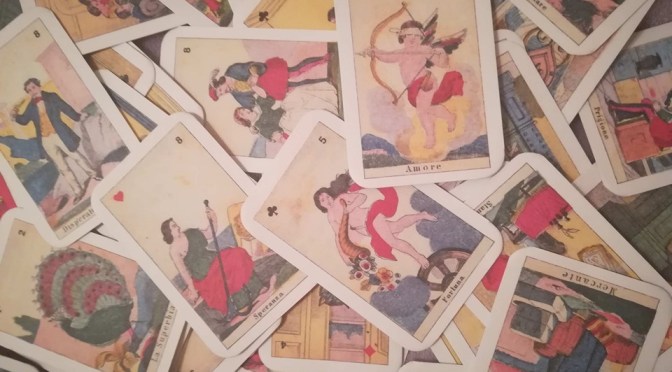
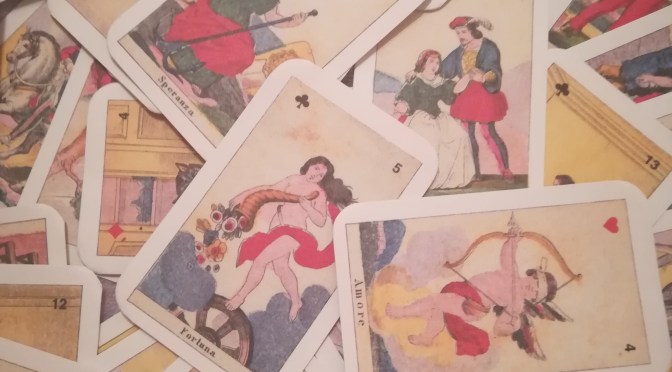
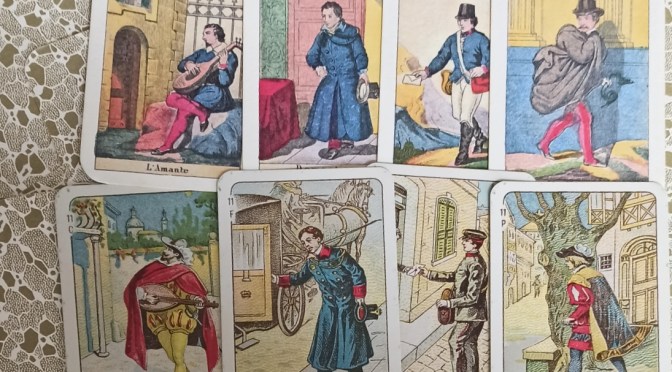
Vera Sibilla | The Jacks – Boyfriend, Servant, Messenger, Villain (Amante, Domestico, Messaggiero, Nemico)

Jack of Hearts – The Boyfriend (Amante)

Design: a handsome young man serenading under his sweetheart’s balcony.

UPRIGHT J♥

A generally neutral card with a slightly positive polarity. It shows a man (often the querent or the querent’s love interest) who is motivated by (positive) feelings. He is often single or at least not married. Its age range varies depending on what the cards what to emphasize. Traditionally he is between 20 and 40, but if the cards want to refer to the person’s role in the querent’s life (e.g. brother, son, friend, etc) then he may be of any age. He is a man who is capable of committing and has the querent’s best interest at heart. Only rarely this card does not represent a person, in which instance it shows the idea of “courting” something or someone, waiting for something to happen and longing for it. It is also a card of good news (all Jacks can represent news).

REVERSED J♥

All court cards, when reversed, show two types of people: negative or in distress. When it represents a negative person, the type of negativity they represent is based on their suit. The Jack of Hearts reversed is a seductor without scruples in all sectors of life. He is prone to cheating. Sometimes it shows simply a man who is not in love with the querent, but may not necessarily be negative, if with positive cards. In rare instances, when it does not represent a person, the Jack of Hearts reversed shows lusting after someone or something, and excessive desire.

Jack of Clubs – The Servant (Domestico)

Design: a helpful young man bowing to his master or mistress.

UPRIGHT J♣

A neutral card, but more neutral than the Jack of Hearts. In itself it signifies a young man, often younger than 30 or even in his teens. He is usually already part of the querent’s life (son, brother, friend), but other cards may imply otherwise. Its positive characteristics include being helpful and humble. He can be a friend. The card is connected with manual labor, service and employed work, and even when it does not represent a person it signifies the concept of help being given or offered. It can represent a student, a coworker, an apprentice. With negative cards helpfulness becomes servility, or it can turn into an inferiority complex. In love readings the person represented by this card is not necessarily negative, but the fact that he doesn’t come up as a Heart face card is a warning that the story is unlikely last, unless positive love cards make up for it in the spread (note, what I just said is not necessarily true for gay couples). The card signifies help all around, including advice and friendly words.

REVERSED J♣

The reversed Jack of Clubs is a negative card. It shows a man who behaves foolishly and is unruly, doesn’t know his place and is misguided. It signifies the concept of help being denied. The person can be debauched and, insteading of helping, latching on to the querent (a bum, a deadbeat son, etc). Sometimes it signifies a young man who is troubled and needs help. Upright and with positive cards it shows humbleness, reversed it can signified being humbled or forced to submit.

Jack of Diamonds – The Messenger (Messaggiero)

Design: a postman approaching to deliver the mail.

UPRIGHT J♦

This is very rarely a face card. More often than not it acts similarly to the Two of Diamonds, the Letter, showing the arrival of news and communication. In general, the Jack shows more important news or news more focused on the querent’s situation. It can also signify parcels. It is connected to mediation, agencies, go-betweens, ambassasors etc. It is connected with short trips, running errands and commutes. It is a quick card.

REVERSED J♦

The card signifies delay in the receipt of news or packages (which may become permanent delay with negative cards). This needn’t be tragic though. For instance, it once came up in a positive spread that announced a pregnancy in the family. Two months later my sister-in-law told us she was pregnant and that she had taken her time announcing it because she was afraid revealing it too soon would jinx the pregnancy.  The reversed Jack of Diamonds is also a card of gossip and sharp tongues. It can signify a bad mediator or go-between.

Jack of Spades – The Villain (Nemico)

Design: a stereotypical villain holding a snake and moving in the shadows.

UPRIGHT J♠

The card signifies a man who is moved by negative aims. The person doesn’t need to be evil, he just need to be inimical to the querent, even on just in the question at hand (if you break daddy’s card, don’t be surprised to see him come up as the Enemy). More generally, though, it can signify a man who is trying to disrupt the querent’s life. He can be a thief, a competitor, a meddler or a false friend. He is usually malicious and cunning. Whatever he proposes to the querent (a business deal, a contract, an investment, a one night stand) it is best refused. The one time the card is neutral is when it represents the father-in-law. It can show the arrival of unpleasant news.

REVERSED J♠

Near cards that show the querent’s victory, the reversed Jack of Spades signifies the demise of the enemy. When near negative cards it shows open enmity and someone who is hell-bent on destroying the querent, someone who is beyond help or redeption and will go to any length to see their plans through. Sometimes the card refers to a man who behaves badly out of stupidity or cowardice.