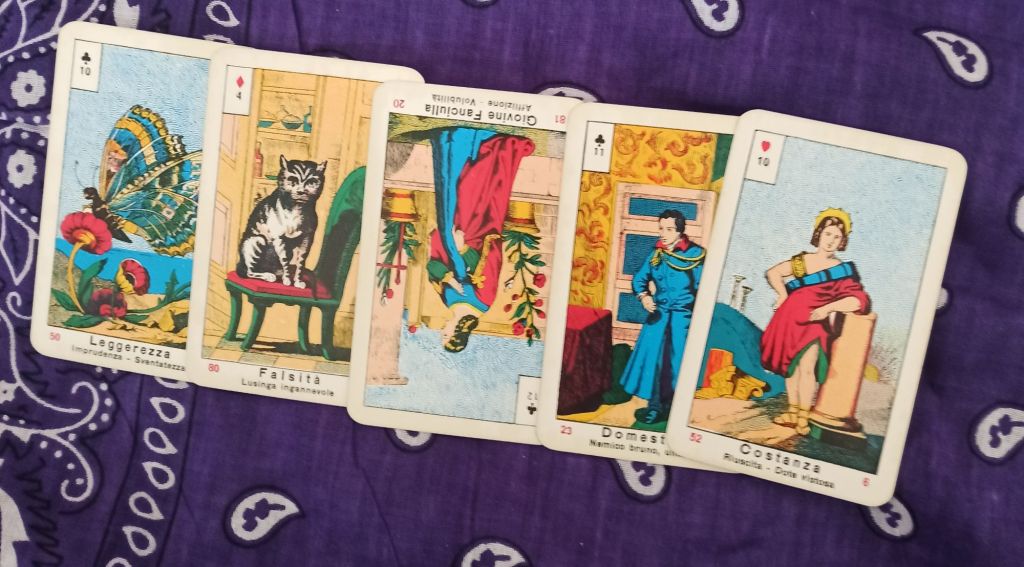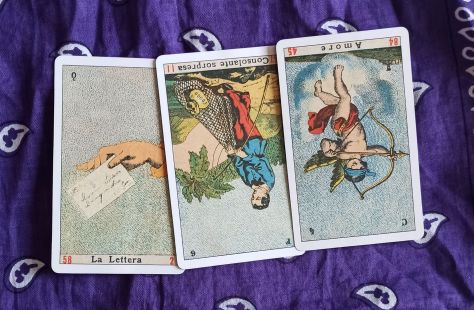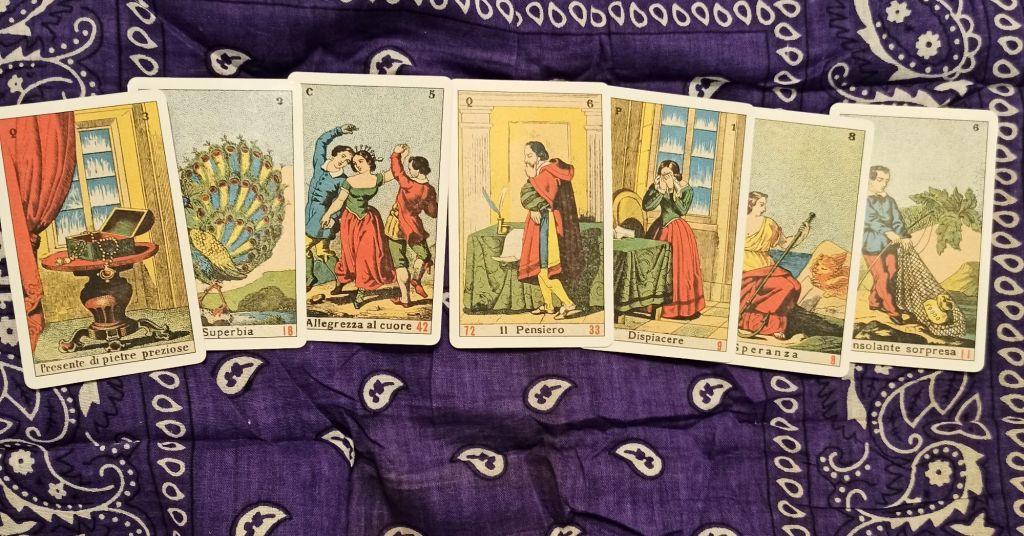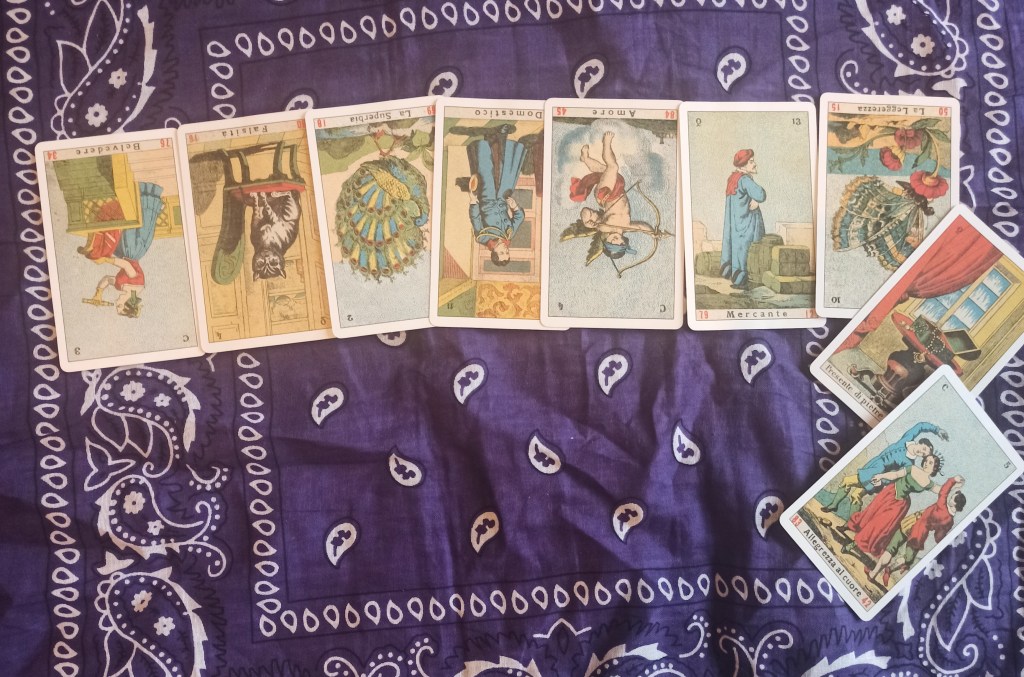
Following up on my previous post about Sibilla cards that show loss, today we discuss the opposite idea, i.e., that of gain. As usual, the list is not meant to be exclusive, and gain is not the only meaning of the following cards.
Six of Hearts (Money)
As the main significator card for money, the 6♥ often shows the querent’s (or another person’s) liquid assets. By itself it doesn’t necessarily show increase of money, but it can indicate that a situation will bring money, and so increase can be implied in the context.
Eight of Hearts (Hope)
The 8♥ can indicate investments, but more in general it shows a favorable situation, so if gain is looked for, it will probably come.
Ace of Clubs Reversed (Marriage)
When reversed, the Ace of Clubs can indicate wealth. However, it is a neutral card, so if followed by negative cards it can point to loss of wealth. By itself it speaks not only of money but of property in general.
Two of Clubs (the Peacock)
Being the talisman card of the deck, the 2♣ represents prosperity. It shows freedom from want and positive situations all around (the Peacock’s wheel is the counterpart to the World card’s garland in the tarot).
Five of Clubs (Fortune)
Both upright and reversed, the Fortune card shows positive situations and movement in the querent’s life, especially as it pertains to finances, so gain is implied. When reversed, the positivity is diminished or delayed.
Six of Clubs (Surprise)
Even in its design the card represents obtaining money. It can shows the querent’s income in general, but more specifically it indicates money coming in, usually without much effort on the querent’s part (it is a surprise, after all).
Seven of Clubs (Realization)
Although this card is geared more toward the querent’s patrimony or realization in the world, it can imply prosperous finances and its power is greater than that of the preceding card. When the 5♣, 6♣ and 7♣ fall together they represents major wealth.
Ten of Clubs Reversed (Levity)
When reversed, the Ten of Clubs indicates the ability to manage one’s finances wisely and to save. It can also represent lucky opportunities to make money, and by itself it can show a small sum of money coming in.
Ace of Diamonds (Room)
This one is a card of material prosperity. When upright, it can represent a well-balanced checkbook or positive upcoming news concerning one’s finances. Reversed it can show the same, but with bad cards it points to mismanagement.
Three of Diamonds (Gift)
It can be a literal gift, of course, but often it represents the act of receiving or being offered something. This can be very comforting for someone waiting for a loan to be approved. It is also a card of luxury, so gain is implied in some way.
Eight of Diamonds (Handmaid)
This one is the card of money coming and going. When upright, it usually shows money coming in, positive financial evolution and ascent. Like the Gift card, the 8♦ can represent the idea of receiving.
King of Diamonds (Merchant)
In the main this is the card of work and career. However, it is still a merchant, so it can be indicative of business, banking and money changing hands.
MQS