The way we do things, the way we say things, matters. The same apologetic arguments we find in Blaise Pascal’s most feverish and haunting pages would be enough to bring a doubter to conversion, yet when coming out of the lips of a cheap street preacher holding a sign, they are often received with distrust, when not with disgust.
The way we do and say things matters in occultism as well. The old texts of magical tradition, and even some old accounts of rituals and supernatural occurrences, are full of the frenzy-stillness dichotomy: some things seem to happen in a state of ecstasy, others in a state of torpor.
My path, both as diviner and as occultist, has been informed by the pursuit of stillness more than by that of frenzy. All the teachers I’ve had the honor to learn from have always required of me to reach a state of calm rather than one of heightened overexcitement.
In divination, there is always a moment of randomness required in order to break the barrier between what the personality thinks it knows and what is actually the case. Arranging the cards (or geomantic points, or whatever) consciously in the order we wish they would come out may teach us something about ourselves, but very little about the reality of a situation. Randomness ensures that our self-consciousness doesn’t interfere with the processof allignment between oracle and reality.
Whether through a frenzy or through calmness, randomness introduces itself into the process by bypassing the limits of our personality’s structure, with its limits and its biases. The choice between the “inspired” moment of frenzy and the “deadened” moment of calm rests on a partially different view of the relationship between individual and whole, between ourselves and the divine.
Ecstasy, which is the process of leaving oneself behind, occurs in both cases, but it occurs differently. By achieving a drunken confusion one simply rams through the walls of one’s personality, achieving contact with what is outside of it. By stilling oneself, one reaches the point within one’s core where individual and divine coincide.
Obviously, once each option is brought to an extreme, it bleads into its opposite. Pure frenzy becomes absence of limits and therefore absence of what is limited, and its movement resolves itself in calm. Pure calm is delivered from all difference from change, so it coincides with pure frenzy.
There are plenty of cards, in the Vera Sibilla, that can indicate individuals (see here for groups). Here are the most common (keeping in mind that most of the cards have other associations as well, and may indicate concepts or situations):
Seven of Hearts – The Scholar The Scholar can represent the figure of a lawyer, a notary, or more in general a professional. Traditionally he is said to be in his 40s or early 50s, but we need to be flexible with age. He can also be a member of the family or even a partner.
Eight of Hearts – Hope There are two schools of thought concerning the Hope card. According to some it doesn’t represent a woman, while according to others it can (traditionally, a younger or blonde woman). I have found that it is rare for this to be the case, but it could happen.
Nine of Hearts – Faithfulness The Faithfulness card can represent support, and occasionally it will show up alone indicating a concrete someone, i.e., a friend, who shows us support.
Jack of Hearts – The Boyfriend It is common for this card to indicate an actual person, often the unmarried male querent or a male who is in love, or positive, or belonging to the family.
Queen of Hearts – The Girlfriend Same as with the Jack, only applying to women.
King of Hearts – The Gentleman The King of Hearts is traditionally the figure of a protector or benefactor, someone who aids us. He is typically in a good position to do so. He can be a father or loving husband (when upright), but can also represent the married male querent or a boyfriend who is older or has a position in society.
Four of Clubs – The Friend The Friend card can represent friendship as a concept, as well as partnerships and other situations where people come together for a common goal. However, it can often indicate a female friend or relative.
Jack of Clubs – The Servant The Jack often represents a younger man, one up to 30 years of age, or unmarried. However, it can also represent a colleague or friend, regardless of age. It can also indicate a son, if relevant. Usually he is already known to the querent (the Italian word ‘domestico’ can mean servant but it also implies familiarity with the house).
Queen of Clubs – The Maiden The Maidan can be the female counterpart of the Servant, showing a younger unmarried woman, sometimes a daughter.
King of Clubs – The Doctor The Doctor card often indicates health issues or the need to take care of something. However, it can also represent a man with a certain social position or with a degree (if next to a female card, then he turns into a woman with those characteristics). It can show the figure of a professional whose advice or help will be required, or a boss.
Seven of Diamonds – The Child Often it is a metaphorical child, but sometimes the Seven of Diamonds can represent a literal one, usually very young (toddler). It can combine with other cards (the Servant or Maiden, for instance) to indicate a teenager. It is the card of pets as well.
Eight of Diamonds – The Handmaid A card strongly connected with the coming and going of money and with work, the Handmaid can also be the figure of a female colleague or a female servant (like a cleaning lady). Traditionally she is from a different town, but this is not always the case. She can also be a stranger or a foreigner.
Ten of Diamonds – The Thief Rarely a literal person, but in connection with negative cards it can show someone who steals, either literally or metaphorically.
Jack of Diamonds – The Messenger Rarely a person card, the Messenger often heralds the arrival of news and the knowledge of facts. However, it can occasionally represent a young man, traditionally dark-haired.
Queen of Diamonds – The Wife A card that often represents what it says on the tin, the wife shows a woman who is married and may have children. It can indicate a woman who has achieved some level of success (could be a colleague or boss).
King of Diamonds – The Merchant Usually this card signifies the querent’s work life. However, it occasionally signifies a literal merchant or someone who a transactional view of life and relationships.
Two of Spades – The Old Lady Often one of the most complex cards in the deck, the Old Lady has a whole host of metaphorical meanings. The literal meaning, though, is that of representing an older woman, a grandmother, a widow, someone close to retirement, a woman of 60+, and so on. The card can also stand for an ex (your old woman).
Three of Spades – The Widower As with the Old Lady, so with the Widower, but for men. It can represent an older man, a grandfather, an ex, a widower or divorced man. It is somewhat rarer for the Widower to be a literal person, compared to the Old Lady.
Ten of Spades – The Soldier Another often cryptic card to interpret, the Soldier can also indicate a young man, in his 30s or early 40s (again, taking it with a pinch of salt), who is muscular or sexy or who wears a uniform. It can also indicate a stranger or a foreigner.
Jack of Spades – The Enemy (male) The male enemy card can stand for a literal enemy, or for someone who is against the querent for some reason, either as a rule or in a particular situation (your uncle whose car you crashed into a tree can be your enemy too, when he finds out). It can also represent a place where people are inimical to the querent.
Queen of Spades – The Enemy (female) Same as with the Jack, but for women.
King of Spades – The Priest The King of Spades often indicates an institution, the government, a judge, etc. It can also sometimes represent an older man who is not inimical to the querent, but who is somewhat cold toward him or her, but is still fair (unless the card is reversed).
Sometimes we spend a lot of time stuck in one phase of our life, only to be surprised by fate when we’d given up hope. This is a career reading for a man in his 40s:
Vera Sibilla – A career reading
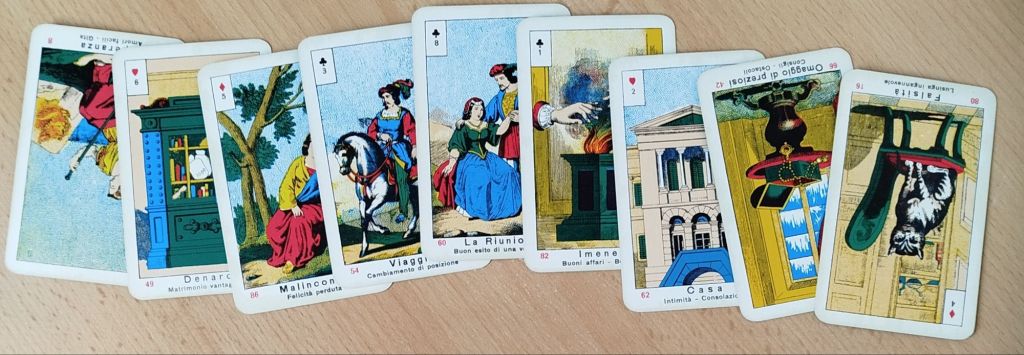
I started with three cards and then kept adding. The first three cards are Hope reversed, Money and Melancholy. It is true that the Six of Hearts, Money, generally has to do, well… With money. However, it is also the card of the past. The Five of Diamonds, Melancholy, also broadly describes the past, especially when occurring this early in the spread. However, it describes the past in a more negative light, as having somehow scarred us and left us dissatisfied or wounded.
Two cards talking about the past reinforce the idea of past. What has wounded the querent in the past? A reversal of his hopes (Eight of Hearts reversed) concerning his career!
Then we find the Three of Clubs, the Journey. The Journey can be literally about travelling, but it can also herald a transition from one phase to another. The Melancholy card itself, when not followed by evil cards, shows that the melancholy won’t last forever, but is just a phase. Once again: two cards talking about a transitory phase reinforce the idea of transitory phase!
What does the Journey bring? A meeting concerning a business or firm! The Ace of Clubs, Marriage, with the Two of Hearts, the House, can represent a relationship where we live together with the partner, but also a business or firm. Since we are talking about career, it must be the latter.
Finally, two reversed cards seal the spread in a positive way. Reversed cards have a bad reputation, but in this case they are life-savers: the reversed Gift card shows solution of problems, the reversed Falsehood card shows relief and supports the idea of a positive solution.
One thing that I often receive messages about is how to understand the order in which the cards fall. Whether it’s the Vera Sibilla or playing card, there is one fundamental rule that applies in the majority of cases: later cards modify those that fall before.
Keep in mind that divination with cards is like the reading of a book, so the cards build the equivalent of sentences with their own grammatical structure. This is why I prefer to read the cards together rather than in isolation, as would happen in many contemporary positional spreads, where to each position corresponds one card.
In the tradition I come from, there can be positions, but there are always at least three cards, and sometimes five, covering one position. When we have two or more cards together, it becomes possible to “agglutinate” their meanings.
“Boy” and “run” becomes “the boy is running.” “Boy” and “friend” becomes “the boy is with a friend” or “the boy is a friend.” “Boy” and “Australian” becomes “the boy is Australian.”
Similarly, if we put two playing cards together such as the Three of Clubs (Union, marriage) and the Ten of Hearts (Happiness) they say: the marriage is happy. In the Sibilla, if we put the Ace of Club (Marriage) and the Four of Hearts (Love) together, it becomes “a loving marriage” or “a marriage of love.”
These are the first steps only. There are many more nunaces. However, the basic thing we must ask ourselves when interpreting two or more cards together is whether they add to each other or they contradict each other.
When they add to each other, the sequence in which they fall doesn’t matter that much (though it may add shades of meaning). “A beautiful girl” is roughly the same as “A girl who is beautiful.” But if we have “War” and “Peace”, saying “Peace and then war” is very different from saying “War and then peace”.
In the Sibilla, Fortune + Death is the end of fortune (literally, “the fortune meets its end”), whereas Death + Fortune is an end that brings fortune. Generally speaking, the cards falling after have the power to modify those that fall before.
That being said, divination is an art more than a science: we should never apply our rules so rigidly that we stop thinking about what the cards are saying. In most cases, in the Sibilla, Thief + Marriage has a similar meaning as Marriage + Thief: someone or something is interfering with the marriage.
Ultimately, each spread is a world in itself and the specific key to it must be found by following the clues that the cards leave behind.
In some card-based divination systems, reversals carry a negative connotation. Reversed cards are said to either decrease the influence or deteriorate the positive aspects of the card. The Vera Sibilla does not adhere to this view. Reversed cards have peculiar meanings which may sometimes be even unrelated to the upright counterpart, at least at first (in reality, if you think about it, you will almost always find the correlation).
Consequently, some Sibilla cards are actually better when reversed than when they are upright, at least generally speaking. Sometimes this better connotation is general, while at other times it refers to specific topics. Here are some examples.
Ace of Clubs – Marriage The Ace of Clubs reversed is not automatically better than when upright, and on occasion it may even be worse. However, it carries a connotation of materiality that can be very welcome in readings about wealth or about physical relations (as opposed to legal/spiritual relations when the card is upright.)
Three of Clubs – The Journey The Journey card in the Vera Sibilla usually refers to physical movement, though it can sometimes represent a change of heart or a change of pace. When it falls reversed in a reading, it can indicate trouble when journeying, but its broader meaning is that of positive evolution of a situation. The card is powerfully benefic and it can free us from vicious cycles and other sticky situations.
Four of Clubs – The Friend When upright, the Friend card can refer to a literal (female) friend or to the idea of friendship and support in general. When it is reversed, it indicates help, recommendations, being taken care of. Usually, the help represented by the reversed card is more on the material side, or it can show in the form of a professional’s advice.
Ten of Clubs – Levity The Butterfly is a problematic card in the deck, as it shows lack of focus, fleeting situations. Reversed, it can represent a serious effort, the ability to hold on to your money and, more broadly, to fleeting situations that bring positive chances. If I were to liken this reversed card to a geomantic figure, I would choose Fortuna Minor.
Three of Diamonds – The Gift The Gift card is generally positive when upright. When it is reversed, however, it does not diminish, but rather increases its positive significance. It indicates the solution of problems, especially material problems. When it is upright, the gift usually comes from someone, whereas the reversed Gift card shows the gift coming to us from the situation itself, which becomes more positive or less complicated.
Four of Diamonds – Falsehood The upright Falsehood card is rarely neutral and almost never positive. When it is reversed, however, it shows the positive unmasking of lying, the discovering (usually in time) of hidden factors that could have caused harm and, in general, it shows situations that end with a sigh of relief.
Ace of Spades – Sorrow The Ace of Spades is a very difficult card to receive in one’s reading. When it is reversed, the blow is softened. The sorrow of the title is still there, but it is dimeanished diminished and can be overcome. It is also a symbol of toil and focused struggle or work as opposed with just crying with your head in your hands.
Four of Spades – Sickness When it comes up reversed, the Four of Spades has a variety of meanings, some of which negative, though less legative than when the card is upright. However, when it is followed by positive cards, it can represent the end of a stagnant and blocked situation.
Six of Spades – Sighs My experience has shown that the reversed Six of Spades is one of the most complex cards in the deck. Although it can have negative meanings (see here an example), broadly speaking it indicates the end of sighs. It shows moving on, overcoming torment, accepting what you cannot change, etc.
Nine of Spades – Prison Like the Four of Spades, the Nine of Spades reversed can have a variety of meanings. However, in and by itself, this card represents the end of imprisonment, freedom and having paid your dues/done your time, literally or figuratively.
Sometimes in readings it’s not immediately clear whether the cards start by describing the past, present or future. There are times when they jump immediately into the future, while at other times they only talk about past and present situations and we need to keep adding cards to find out what happens next. More often, though, the cards start with the past/present and then move on to the prediction, or at least this is my experience.
In this case I was asked by a querent if she would find a job. Note that I started with five cards and then added more to get more details, but I here want to concentrate on the first five:
Job Prospects. A Vera Sibilla Reading
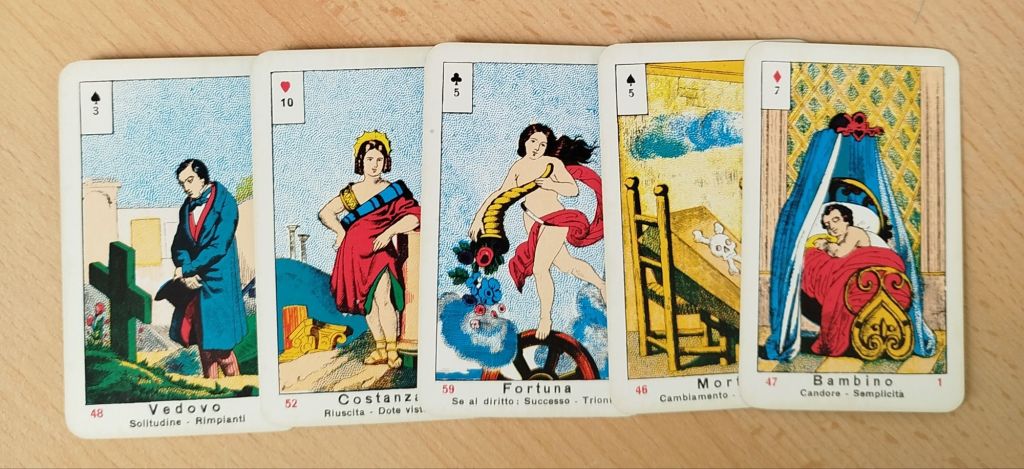
The first four cards (Widower, Perseverance, Fortune and Death) deserve special attention. The Widower is the card of “being without”. It also has some affinity with the past, especially when it falls toward the beginning of the spread. The Perseverance card can sometimes indicate that something goes on for a long time (it perseveres). Usually this happens when the cards surrounding it have the same polarity or talk about the same thing.
In this case, the Fortune card is not the same polarity as the Widower, since the former is positive and the latter negative. However, Fortune is followed by Death, showing misfortune or lost chances. In this case, it’s as if Fortune + Death formed a single (negative) card, which is of the same polarity as the Widower.
Therefore the Perseverance card highlights the fact that the querent is without (work) and has been for quite a while, and has repeatedly lost chances or opportunities, or has had repeated misfortunes connected to her career. She confirmed to me that she hadn’t found a job since giving birth to her daughter a few years ago. Actually, she hadn’t looked that much for a job, but whenever she had she had been passed over in favor of someone else.
The Child card is a card of beginning, and in a way it shows the start of a new phase. This fact is highlighted by the Death card being at the end of a negative sequence, so that while it is a negative card in itself (because it follows the Fortune card) it also ends the negative period thanks to being followed by the Child.
The cards following the first five simply described the work environment and the various ups and downs she will face, but they are less interesting.
A couple of weeks ago I received a message about the question of whether we, as readers, risk causing self-fulfilling prophecies with our predictions. For instance, if I tell a querent that the relationship she is in is going to end, I may end up causing the break-up. What follows is a slight elaboration on my response.
First off, we need to recognize that some things we can change or at least improve, others we can’t and they will happen regardless of what we do and what a reader tells us. Most people who go about their life with their brain switched on can recognize this. It is only when we get into delulu territory and body-mind-spirit-section pseudomysticism that we encounter people who deny the existence of unavoidable happenings.
On the other hand, sheer fatalism is also a gross misunderstanding. Consider simply this fact: if two people X and Y are exactly the same and go exactly through the same life experience, except that X also uses divination or consults a diviner, this is enough to tell them apart.
The fact that X knows about what is going to happen in advance is enough to make him a different individual, which in turn is enough to change the nature of his fate, because our ability to change a situation is contingent on our knowledge of what the situation truly is. Even if X cannot change a certain fact in any meaningful way, but knows about it enough in advance that he can make his peace with it, the same event Z won’t be the same if X’s attitude toward it changes, because X is part of the event that takes place in his life, and so if X change, the event changes. Even if X cannot bring himself to accept Z, his knowledge of Z is enough to change Z, because X with knowledge of Z is not equal to X without knowledge of Z.
Fate patterns are a difficult topic to tackle without a previous sound philosophical and occult discussion, and I plan on starting that discussion at some point, once I’ve organized my notes. For now, it suffices to say that we, as readers, can play a rather important role in the querent’s life if we are consulted at the right moment.
Yet, this doesn’t mean that we are capable of empowering querents to always turn their life around, and I don’t even think empowering is our mission: our mission is to provide information. On a number of occasions, especially when I was less experienced, I gave querents the wrong prediction on purpose because I didn’t want to disappoint them, even though the cards were clearly negative: Yes, you’ll get the job, yes the relationship is going to last and be wonderful. But it didn’t happen.
On some of those occasions you may even think that because I didn’t bring up the negative aspects, the querent wasn’t prepared to tackle them, so my not bringing them up may have been just as bad as another diviner handing out negative predictions willy-nilly. That’s because I wasn’t able to give accurate information.
It is nice that some things can be changed even if some things can’t, but unfortunately we don’t always know which is which. Therefore, we must also recognize that we have a degree of power over our querent just by virtue of using odd, mysterious counters to give our predictions, and we must not abuse this power.
Whenever possible, we should either frame our predictions as potentials and/or accompany them with positive suggestions. These suggestions, though, must ALWAYS be based on what the oracle describes, never on vague self-help platitudes. Sometimes (many times) it is best to highlight critical points so that the querent can become conscious of them (e.g., “you know, this relationship is headed down a pumpy road. You should address x, y and z if you want to try to make it work”) while avoiding drastic predictions unless necessary.
Furthermore, we must never frame our predictions in such way as to take away all hope. It is not our right to do so. Deluding and disillusioning are the two capital sins that we must avoid, even though striking the right balance is sometimes hard. There is plenty of space between being a pushover to our querent’s wishes and being an insufferable sassy tough-love prick.
If there are positive aspects to a situation, we should emphasize those and try to put them at the center of the querent’s life so that they can address the negative points more positively.
Finally, we ought to always remind our querent that diviners are people and are therefore fallible. In a world where doctors, lawyers, judges, scientists and bakers can get things wrong it would be absurd to expect diviners to always be right. Always encourage the querent to take your predictions as an additional input.
I already made a post about positive feelings. This is a follow-up on the other side of the coin. As usual, this isn’t meant to be exhaustive. Note that many cards indicating difficult feelings are just reversed cards whose upright meaning is positive.
Three of Hearts Reversed – The Balcony
When upright, the Three of Hearts relates to the sense of sight, both literally and figuratively. Reversed, it can represent someone who is blinded by emotion, especially such emotions as rage or lust (the “red” emotions). It can indicate the inability to control oneself as a result of such emotions.
Four of Hearts Reversed – Love
Aside from being an indication of depravity, the reversed Love card can, and in fact is more commonly found to relate to unrequited feelings, emotional dryness and deep emotional scars from disappointment, usually in love.
Seven of Hearts Reversed – The Scholar
Upright, the Scholar card represents the mind in its best aspects of intelligence, creativity and having a solid grip on reality and on one’s problems. When it is reversed, it represents either someone who is cold and calculating (the lower octave of the mind) or someone who feels impotent and easily overwhelmed by problems.
Eight of Hearts Reversed – Hope
When reversed, the Eight of Hearts is a harbinger of sorrow, disappointment and unfulfilled hopes and wishes. Being a card that is strongly connected with one’s inner optimism, the reversed Hope card becomes one of pessimism or even of mild depression (by itself).
Nine of Hearts Reversed – Faithfulness
Upright, the Dog card of the Sibilla indicates friendship and loyalty, as well as deep and strong attachment to someone, something or an idea. Reversed, it is an indicator of rebellion, unreliability and biting the hand that feeds you, from thankless teens to political activists depending on the context.
Ten of Hearts Reversed – Perseverance
Upright, the Ten of Hearts can indicate solid, reliable people, lasting feelings and certainty. When it falls reversed in a reading, the Ten of Hearts become an indication of turmoil and of not being able to control oneself, one’s instinct and one’s rage.
Two of Clubs Reversed – The Peacock
When it comes up reversed, the Peacock card embodies the negative side of the symbolism of the animal, namely pride, haughtiness, an inflated ego that is easily slighted and self-centeredness. Depending on the surrounding cards this can go from a mild drama-queen complex to serious pathological deviancy.
Seven of Clubs Reversed – Realization
The Upright Seven of Clubs represents our realization in the world, our ambitions and our sense of accomplishment. When it comes up reversed, it shows insecurity, dissatisfaction with one’s existence, and fear, especially understood as feeling under attack in one’s life projects.
Eight of Clubs Reversed – The Reunion
Reversed, the Reunion card has many difficult meanings relating to groups and one’s social contacts. However, it is also a card of disillusion, sadness and depression. It represents someone who has lost momentum and is prey to inner turmoil, self-doubt and similar feelings.
Nine of Clubs Reversed – Merriment
Coming up reversed in a reading, the Nine of Clubs reverses the hakuna matata feeling of its upright counterpart. It becomes a card of joylessness, and it can also represent feeling isolated from others, sometimes even as a consequence of other people taking shots at us.
Four of Diamonds –Falsehood
The Falsehood of this card must be understood broadly as a feeling of “wrongness” and negativity. In this sense it is the opposite of the Dog card. It represents being ill-disposed or displeased with something, and negative feelings brewing right below the surface.
Five of Diamonds – Melancholy
The title speaks for itself. Upright, the card can be an indicator of disappointment, sadness, pining, melancholy and dissatisfaction. By itself it is not a tragic card, but it does slow you down. Reversed, the card becomes much more impactful and its effects long-lasting.
Seven of Diamonds Reversed – The Child
When it falls reversed, the Child card embodies the negative side of children: childishness, in the main, but also a general sense of inexperience and that the world is too complex for us to understand and tackle.
Nine of Diamonds – The Fools
The Fools indicate feelings of unwarranted exaltation and self-confidence, mistaken conceptions, as well as easily aroused feelings of aggression. They depict a volatile atmosphere where things can go seriously south.
Ten of Diamonds – The Thief
The Thief is a card of betrayal, whether literal or metaphorical. It represents ill-will toward someone or something, and the desire to do wrong things. This needn’t be tragic, as there are many situations where the sneakiness of the Thief borders on amorality rather than immorality. Still, this card is always a warning.
Ace of Spades – Sorrow
The Sorrow card is the card of tears, of the broken heart and of the sense of being cut off from one’s source of happiness. In itself it is a very difficult card to go through, but when not piled on by other problematic cards it can show just a sense of discouragement that the person can muscle through with some mental discipline.
Three of Spades – The Widower
Another difficult card, the Widower represents isolation, loneliness and serious interpersonal issues. Being the card that signifies “oneness” and the single individual, sometimes it can show things done alone, with no negative connotation, but more often than not it foretells difficulties in one’s loneliness. When reversed, it becomes a rather tragic card.
Four of Spades – Sickness
Although this is the card that indicates literal sickness, it can also be interpreted metaphorically on occasion. It often signifies feeling sick, disturbed or down, but it can also be the card of sick and morbid feelings which cannot find a healthy expression.
Six of Spades – Sighs
Among the less difficult Spades in the deck, the Six of Spades represents everything we desperately long for and await, hoping it will come to us. It is a less serene version of the Eight of Hearts, as it contrasts its composure with a sense of uncertainty and fear of losing what one wishes to get.
Seven of Spades – Tragedy
Another card of “red” feelings, this one indicates anger and wrath. It shows explosive energy disrupting one’s life, which, from an emotional standpoint, usually signifies that we are feeling slighted or wronged or somehow unable to restrain our ire.
Eight of Spades – Desperation and Jealousy
In the main, the Eight of Spades is a card of literal jealousy and envy, but it can represent all those situations where we look at others with toxic feelings in our heart. It can also signify desperation and tears, and a sense of being trapped in a corner with no way out.
Sometimes the Sibilla’s chattiness is exasperating: there you are, trying to get a straight answer about whether he loves you or not, and she just wastes your time telling you about what his aunt thinks about the whole thing. At other times, though, the Sibilla is a drama queen in the type of language she uses. Here’s a simple example of the latter behavior.
It’s an old reading from at least ten years ago, when a friend and I were relatively fresh out of college. She had been desperately looking for work for some time but without success, and, like most desperate people, she’d started looking in unconventional places. She’d answered an ad that would require her to move to Poland or the Czech Republic (can’t remember) for a stage followed by a part-time offer if all went well.
The first contact was by phone, yet she had some suspicions. She didn’t seem to be able to get a straight answer out of the guy interviewing her. So she asked me to pull some cards on the dude, and here’s what came up:
Can I trust him? Vera Sibilla Reading
I don’t think we need much interpretation to see that there’s something fishy at best about the offer, and at worst it’s a total swindle. The Thief and the Enemy can obviously show anything from an actual thief to a mobster to an assassin, depending on the other cards. Here we have no hint of violence, so we’ll stop at swindle.
The most interesting card here, though, is the reversed Six of Spades. When it is upright, the Six of Spades represents someone who sighs after someone or something, whether because he or she longs for it or because they have pangs of conscience about it.
When it is reversed, the Six of Spades can be a good card if surrounded by positive cards: it can indicate letting go of an addiction, for instance, or of an unrequited love. Broadly speaking, it indicates not sighing anymore.
In this case, though, the reversed Sighs card is surrounded by terrible cards, cards that indicate someone who would hurt others, at least financially, for his own profit. Therefore, the Six of Spades reversed simply shows he has no pangs of conscience about it, which in turn makes him even more dangerous.
Well, my friend did some snooping around and she soon came into contact with other people who had answered the ad. By piecing together the information they had, it turned out that it was a swindle. I am not sure what would have happened, had they gone to the “stage”. Probably they would have been duped out of some money. Anyway, I’m sure glad she didn’t go.
A recent comment by a visitor of this website has inspired me to write an article about what makes divination go south, whether it’s card reading or something else. I have already shared one or two readings I got wrong, but in the future I would like to share more of my hardships as well as my successes, for two reasons: 1. it gives a fairer representation of how divination works and 2. it doesn’t discourage those who are studying the material I provide (I often get messages from people despairing they will ever be good diviners)
The reality is that divination is a human activity, and like all human activities it can go wrong. In a world where lawyers, scientists and doctors can be wrong (and not seldom), it’s unclear why we would expect fortune-tellers to be infallible.
There can be a variety of factors that make a reading go south. Here’s a bunch, in no particular order.
The querent is too emotionally volatile
Usually, the querent’s attitude doesn’t matter that much. However, it has been my experience that when a querent is in a state of utter and extreme desperation or emotional volatility, they will skew the reading in one direction or the other. This is rare, but it does happen on occasion. Once a friend who was looking for a job and was absolutely desperate asked for a reading and he pulled ALL spades. He still got a job around a month later. The cards were just reflecting his emotional turmoil.
Emotional involvement is also usually not good when reading the cards for ourselves. My personal experience is that if I read for myself about a topic I don’t care too much about, the reading will be largely accurate, while if I read about something I care very much about, the cards will show me either what I hope or what I fear.
Note though that there are divination tools that work better when the querent is very emotionally involved. This is the case, for instance, for Horary Astrology, where there are no counters to manipulate and therefore a relatively strong emotional push is required for question and answer to align.
The reader isn’t grounded enough
This is more common. Divination is not an assembly line type of occupation. We are dealing with a world that is, in a very real sense, divine and that eschews the mechanic and repetitive.
The diviner needs to be relatively at peace with themselves before performing a divination. I say ‘relatively’ because we don’t need to always be at our best (otherwise we’d never be able to divine). Certainly we need to be capable of detaching at least momentarily from our deepest worries and hopes. Fits of ecstasy and cheap mysticism are also to be avoided, as the best attitude is one of sober helpfulness toward the other.
There are some partial exceptions for ‘inspired divination’, such as mediumistic spiritism, but I don’t cover these topics on this website as I avoid these practices like the plague (I had a distant relative who was an excellent natural psychic and ruined her life in her attempt at constantly staying in the required state of passive receptivity).
The reader simply doesn’t always interpret the medium right
This is obvious, and I’ve talked about it at length, but it bears repeating. Divination is a language with no native speakers. We must learn it as if it were a foreign language. or, if you are romantic about the universe and think divination is our original language, then we must relearn it, but the end result doesn’t change. Like with all secondary languages, we are bound to make mistakes.
The best we can do about it is strive to correct our mistakes and be upfront with our querents that we are not offering miracles but just help in widening their view of their own life, of where it’s coming and where it’s directed.
Drawing wrong conclusions from right premises
This is another important pitfall, and it is a particular variety of ‘not reading the medium right’. As diviners we must understand that certain things can be changed and certain things can’t. Most divination tools are very upfront about it. If they say the thing you want cannot be achieved, then it cannot be achieved (unless we are interpreting the medium wrong, see above). If it says the thing you want will fall in your lap, then it will fall in your lap. Period. But if the medium says what you want is hard, it doesn’t mean it’s impossible, just as when it says it’s easy it doesn’t mean you’ll achieve it.
As diviners, sometimes, we feel we must give our querents more certainty than we are entitled to give them based on our divination tools. If the querent wants to become a writer and the cards show that writing comes easy to them, it doesn’t mean they will become a writer if they don’t put in the effort. Usually, in such cases, the lack of effort does come up in the cards as a warning, so that the prediction will sound like: you are very talented, but unless you actually spend time honing your craft, you won’t amount to much. This, too, is a valid prediciton.
All in all, we must be careful to distinguish what the medium says from what we want to tell the querent.