Category Archives: Sibilla della Zingara

Vera Sibilla and Numerology – The Aces

The Aces of the Vera Sibilla. Like and subscribe to my YT channel support my work.

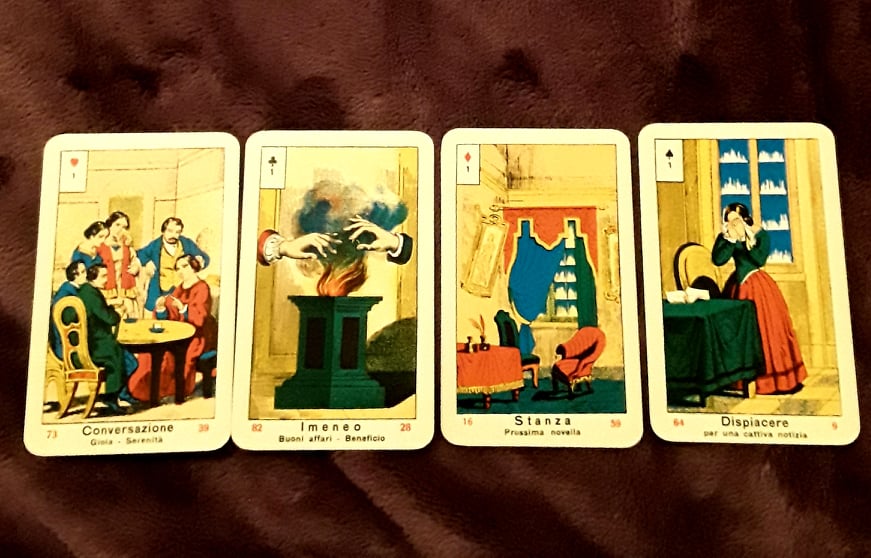
The four aces, like the aces in many cartomancy systems, deal with the idea of newness. This can mean news or simply something new. However, in the Vera Sibilla they also add a further layer: they show people coming together in a unity of some kind. This can overlap with the meaning of news. In a way, it is as if the Sibilla was asking: “Oh wise reader, if you were to reduce the meaning of each of the suits to a single spark or seed idea, what would that be?” In this sense, the newness is how the suit first manifests, how it comes into being. And the way it comes into being is by containing the interaction between people, or between inside and outside, in a single unity.

The four Aces of the Vera Sibilla: Ace of Hearts (Conversation), Ace of Clubs (Marriage), Ace of Diamonds (Room), Ace of Spades (Sorrow).

The Ace of Hearts, Conversation, is a good example of this overlapping of newness, news and relationship between people. This is the card of words and interpersonal relationships. The type of unity between people that this card shows is one of peace: word is an alternative to violence, and it allows us to find compromises, hence the further meaning of negotiation. Additionally, it represents people coming together in a further sense, as it is the card of people living under the querent’s same roof.

Note how, in a more metaphorical sense, the Ace of Hearts represents the idea of opening up to other people, or simply to a new situation, in that talking means connecting with the outside world in a peaceful, positive way. It describes a type of work where you need to stay in contact with people, and also the ability to communicate, to mediate, to make people understand where you are coming from.

The Ace of Spades, Sorrow, is in more than one sense the opposite of the Conversation card. It represents, first and foremost, sad tidings, the precise nature of which is shown by the cards nearby. Something from the outside comes to the I, and the I is saddened by it. From this comes a whole set of meanings assigned to the Ace of Spades, from grief to tears etc.

The difficulty that this card shows in interpersonal relationships is typified by one of its other meanings: violence. This is one of the cards that can show people coming together not, as in the previous card, with good intentions, or with the idea of finding a compromise, but holding a big club behind their back.

In between the two extremes, we have other types of news and unity. With the Ace of Clubs, Marriage or “Hymenaios”, the coming together is a legal one: it shows two or more people joined in a venture that requires a signature. From marriage to contracts, partnerships, this is a card of prosperity, and unless other cards modify it for the worse, it promises good. It shows something that is legally valid and legally binding because it has been intersubjectively been agreed upon.

From this we have further secondary meaning of this card. The Ace of Clubs represents everything that materializes, and becomes concrete, that is not just a vague abstraction, but is grounded in the outside world. In this sense, it shows how the inner and outer sides of reality are joined together.

Finally, the Ace of Diamonds, the Room, shows yet a different type of news and a different type of coming together. It is the card of intimacy and of the querent’s privacy and private sphere. While it is certainly a good card for material affairs, its most important meaning is that of confidential news and of intimate relationships.

As card of privacy, it represents something close to the querent, something that remains within their sphere of influence, and it shows property. From this a whole host of meanings related to intimacy, hanky panky (especially with the Ace of Clubs, and especially if it is reversed) and so on. Note how the Room card and the Marriage card complement each other: the Ace of Clubs shows a “masculine” type of energy which is projected outwardly, from subjectivity into intersubjectivity, while the Ace of Diamonds, with its symbology of Room, shows retreat and welcoming inside.

To sum up, the Ace of Hearts shows words and new situations of a peaceful kind (unless other cards show otherwise) and peaceful unity among people; the Ace of Clubs shows contractual unity and, if other cards concur, a beginning of prosperity; the Ace of Diamonds is the card of news coming from a confidential source and intimate unity among people; the Ace of Spades is the card of bad news, sorrow and violence, i.e. people joined by their hands pulling the other person’s hair.

Numerology and the Vera Sibilla – Introduction

Traditional oracle cards (Vera Sibilla, Kipperkarten, Gypsy cards, etc.) are sometimes thought to be somewhat shallow and pedestrian when compared to Tarot. Take the Vera Sibilla: here you have images like the Butterfly, the House, the Letter, the Room, the Soldier, etc. You even have someone about to blow their brains out in the Jealousy card. It all sounds like Soap Opera material. Compare it with the High Priestess, the Hanged Man, the Devil, all figures which seem to warrant a greater degree of symbolic interpretation in order to yield some tangible answer.

That seems to be why we often do not look for deeper layers of meaning in our oracle cards. It’s easy to disregard them (or to treasure them, depending on where you’re coming from) as the scullery maid that does Tarot’s dirty job while her master is locked in his tastefully decorated room, listening to Händel and thinking up philosophical abstractions.

I am certainly guilty of this sin. I have been studying the Vera Sibilla for some time now, and I had never even considered the possibility of there being some numerological factor at play. This, in spite of the fact that the Sibilla is a rare instance of a traditional oracle with four complete suits, Ace through Ten plus Jack, Queen and King.

The Suit of Hearts in the Vera Sibilla, Ace through King. Say “hi” to your strong lesbian aunt Martha there in the Ten of Hearts.

One of the reasons I tended to disregard numerology is that the way the Sibilla is taught is through its traditional meanings, upright and reversed, and then its combinations. Look at one of the very few valid books about the Sibilla out there, Alessandra Venturi’s Italian Cartomancy.

In her book, she devotes two to four pages to each card, but without any structure. All the meanings she relays are traditional, but they are thrown at the reader without any hint as to how to use them or how to prioritize them. She mentions numerology very briefly as a reason to prefer the attribution of the Handmaid card to the Eight of Diamonds, but she doesn’t explain why, and the subject of numerology is dropped altogether for all other cards.

I only started thinking about possible numerological structures when one of my favorite youtubers, the Italian card reader Etienne Valancourt, suggested in a couple of his videos that some cards with the same number do have some similarities. He makes the example of the Threes and the Fives, but he also suggests that other numbers do not seem to show any similarities among them. By the way, if you understand Italian I absolutely recommend his video course on the Vera Sibilla. I am personally waiting for his book like the second coming of Christ.

In this series of blog articles, I am going to (respectfully) challenge Etienne’s idea, and I am going to show how the core traditional meanings of all numerical cards can be boiled down to a numerological essence. Although I do use reversals, I am going to concentrate on the upright meanings only, for the simple fact the reversed meanings are often a modification of the upright ones, albeit not always.

Another important point I am going to mention is that I am not trying to say that every possible meaning of the cards can be reduced to numbers. The Two of Clubs, the Peacock, for instance, is traditionally the talisman card, the best in the deck. I suggest that the core meanings of this card, which are liberation, completion, help from above, etc. can be seen as a development of the meaning that the number Two seems to have in the Sibilla deck. But it also has other meanings, such as beauty, which seem to be derived from its iconography and archetypal essence more than from its numerical value.

In other words, I am not attempting to reduce everything to numerology, but show that numerology does play a role in this oracle deck. Nor am I suggesting that whoever drew the deck was trying to use a numerological system, but that the traditional set of meanings has, for some cosmic synchronicity, ended up developing according to a certain structure. Yes, it’s a very newagey explanation, and yes, I am ok with it.

Finally, I admit that, although I consider the system I am elaborating to be relatively well thought out, it is not necessarily perfect. I am sure that, as I keep studying this amazing deck, I will come up with more fitting numerological coordinates. I am aware of the fact that while most of my explanations fall perfectly in line with the meanings of the cards, some require a bit of mental gymnastics, which to me suggests that my system is going to have to be improved in the future.

Sure, I could take the easy way out and simply adjust the meanings to the numerology, but that would defeat my purpose of finding an order in this deck rather than beating the poor Sibilla senseless with my own preconceptions until it fits them. My aim is to use the traditional meanings of the cards, not to substitute them. My wish would be to make the Sibilla easier to assimilate and study, easier to remember in its enormous wealth of meanings than it currently is.