Category Archives: Review

Carte Piacentine. Divinare con le Briscole by Ernesto Fazioli – Review / Recensione

English Version (scroll down for the Italian version)

It is an exciting time to be practicing divination. Among the occult arts it is probably the most popular for its immediate practical usefulness. The tarot is enjoying a divinatory revival after being brought to its knees by decades of pseudodeep elucubrations, and even lesser known systems of fortune-telling are being slowly fished out the obscure underbelly of folk tradition.

And occult folk tradition is especially rich in Italy, a country which, in part due to its chaotic and conflicted history, can boast a huge diversity of divinatory systems, especially (but not exclusively) of the card-based kind. It is especially reassuring to see that, unlike in the past, people of considerable education are taking these folk systems seriously.

It’s the case with Ernesto Fazioli’s latest book: Carte Piacentine. Divinare con le Briscole (Piacentine Cards. Divining with Briscola* Cards), a book dedicated to one of the many dozens of cartomancy systems based on the many types of Italian playing cards — in this case, Piacentine Cards–

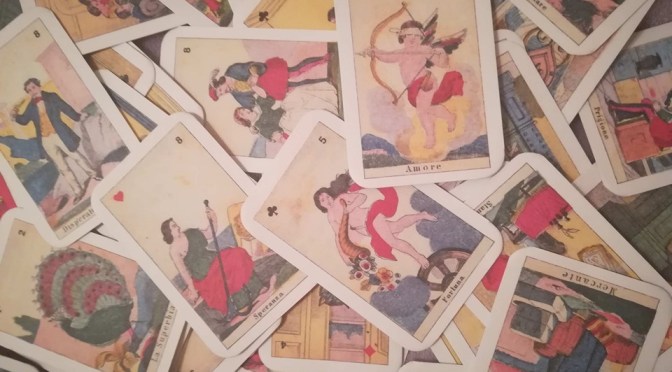
Carte piacentine, one of the most popular playing card decks in Italy

Fazioli’s book is part of the same series as Germana Tartari’s Book on the Bolognese Tarot and it shares some of its traits: it is short (84 pages) and goes straight to the point; it is prefaced by a very quick but well-documented historical introduction; finally, it is aimed at shining a light on a small part of the Italian folk tradition while giving the reader the tools to work with it in today’s world.

I could quibble on a couple of points that made me wrinkle my nose, such as the association of the four suits with the four elements following the Golden Dawn pattern (which is not rooted in folk tradition, Italian or otherwise) but in reality all this is of very little account, as it can be very easily overlooked. The bulk of the book is solid and it teaches a traditional and little-known method of fortune-telling using a reduced pack of 30 Piacentine cards.

Each of the 30 cards is dedicated a small paragraph, which is enough, considering that, in traditional fortune-telling, one doesn’t spend a great deal of time musing on the quaint design of this or that card based on the latest fashion. For what little I know about this deck, the meanings retrieved by Fazioli feel genuine and even show a degree of overlap with the meanings of the Bolognese tarot.

This should not be a surprise, as fortune-telling and divination were born as methods of “gathering intelligence” about the world, meaning that, whatever system one uses, one must be given access do an adequate vocabulary–that is, a vocabulary that is adequate to describing the real world.

The spreads that Fazioli present also come from the folk tradition, and vary from the easier ones (the five card spread) to the very complex (a tableau of all 30 cards).

All in all, I am very pleased with my purchase, and will probably be posting a spread or two following the system. I am especially surprised by the good amount of information that Mr. Fazioli could pack into such a short booklet, and am endlessly fascinated, once again, by how folk divination emerges in its quality of spontaneous and creative remedy to life’s uncertainty.

Where to buy: Amazon or Mutus Liber

* Briscola refers to one of the most popular game cards in Italy, usually played with Piacentine cards or a similar 40 card regional deck. For this reason, regional playing cards are often known as “carte da briscola” (briscola cards) in common parlance.

Versione Italiana

È un momento storico molto entusiasmante per chi pratica la divinazione. Tra le arti occulte è probabilmente la più popolare per la sua immediata utilità pratica. I tarocchi stanno vivendo un revival divinatorio dopo essere stati messi in ginocchio da decenni di elucubrazioni pseudointelletuali, e anche sistemi di cartomanzia meno conosciuti vengono lentamente ripescati dal ventre oscuro e creativo della tradizione popolare.

E la tradizione popolare occulta è particolarmente ricca in Italia, un Paese che, anche a causa della sua storia caotica e frammentata, può vantare un’enorme varietà di sistemi divinatori, soprattutto (ma non esclusivamente) del tipo basato sulle carte. È particolarmente rassicurante vedere che, a differenza del passato, persone di notevole cultura prendono sul serio questi sistemi popolari.

È il caso dell’ultimo libro di Ernesto Fazioli: Carte Piacentine. Divinare con le Briscole, un libro dedicato a una delle molte decine di sistemi di cartomanzia basati sui numerosi tipi di carte da gioco italiane – in questo caso le carte piacentine -.

Il libro di Fazioli fa parte della stessa collana del Libro sui Tarocchi Bolognesi di Germana Tartari e ne condivide alcuni tratti: è breve (84 pagine) e va dritto al punto; è preceduto da un’introduzione storica molto rapida ma ben documentata; infine, si propone di far luce su una piccola parte della tradizione popolare italiana dando al lettore gli strumenti per metterla a frutto nel contesto odierno.

Potrei cavillare su uno o due punti che mi hanno fatto storcere il naso, come l’associazione dei quattro semi con i quattro elementi secondo lo schema della Golden Dawn (che non ha radici nella tradizione popolare, italiana o meno), ma in realtà tutto ciò è di ben poco conto, perché può essere facilmente trascurato da chi non è interessato. Il libro ha solidi contenuti e insegna un metodo di cartomanzia tradizionale e poco conosciuto, utilizzando un mazzo ridotto di 30 carte piacentine.

A ciascuna delle 30 carte è dedicato un piccolo paragrafo, il che è sufficiente, considerando che, nella cartomanzia tradizionale, non si passa molto tempo a riflettere sul design pittoresco di questa o quella carta in base all’ultima moda. Per quel poco che so di questo mazzo, i significati recuperati da Fazioli nella sua attenta indagine sembrano genuini e mostrano persino un certo grado di similitudine con i significati dei tarocchi bolognesi.

Ciò non deve sorprendere, poiché la cartomanzia e la divinazione sono nate come metodi di “raccolta di informazioni” sul mondo, il che significa che, qualunque sia il sistema utilizzato, ci deve dare accesso a un vocabolario adeguato, cioè un vocabolario che sia adeguato a descrivere il mondo reale.

Anche le stese che Fazioli presenta provengono per lo più dalla tradizione popolare e variano da quelli più semplici (la stesa delle cinque carte) a quelli molto complessi (una stesa di tutte le 30 carte).

Nel complesso, sono molto soddisfatto del mio acquisto e probabilmente pubblicherò una o due stese seguendo il sistema. Sono particolarmente sorpreso dalla buona quantità di informazioni che Fazioli è riuscito a racchiudere in un libricino così breve e sono infinitamente affascinato, ancora una volta, da come la divinazione popolare emerga nella sua qualità di rimedio spontaneo e creativo all’incertezza della vita.

Dove acquistarlo: Amazon or Mutus Liber
Tarocchino Bolognese. Storia Divinazione, by Germana Tartari (A Short Review)

English Version (scroll down for the Italian version)

In this blog I haven’t yet talked about one of the decks I am most interested in learning, yet one about which very little material is to be found. I’m talking about the Bolognese Tarot, or Tarocchino Bolognese.

The word “tarocchino” is a diminutive form of “tarocco”, thus meaning “small tarot.” I am not going to cover the history of the cards here. There’s plenty of great sources online. The reason for the diminutive form is that the deck is actually a reduced pack, with some variations in the order and makeup of the Major Trumps.

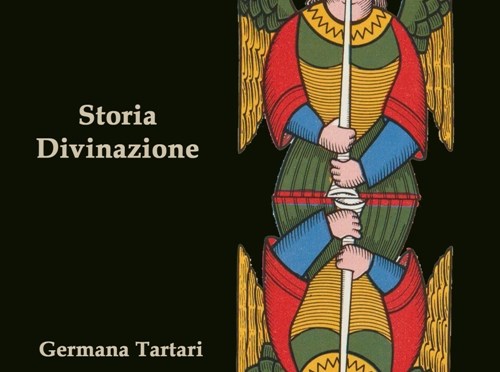
What I am going to discuss is a marvelous little book that has been recently published on the matter: Tarocchino Bolognese. Storia Divinazione, by Germana Tartari. The book is currently available only in Italian.

Miss Tartari has been taught to read the Bolognese Tarot by her grandmother, and has started teaching it in turn following what she describes as a call to spread the traditional meanings she has received.

The book is relatively short, but it succeeds as a comprehensive introduction for neophytes. As most books on the tarot, it starts with what I usually consider the “boring part”, i.e., the history of the cards. I say “boring” because most of the times, writers feel that it is bad to lead off with the juicy stuff and sense that it’s best to preface it with some historical remarks fished at random from the most dubious sources.

But this is not the case for Miss Tartari’s book. The historical introduction is not at all boring. It has been handled by the Museo Internazionale dei Tarocchi, and it is as succinct as it is interesting, as well as historically accurate.

Miss Tartari then goes on to describe her history and relationship with the cards in moving detail. The great passion that animates her shines through every single turn of phrase and choice of words. What also struck me was her understanding of cartomancy as an activity that is deeply embedded in the way people relate to one another: as described by her, cartomancy is almost an interpersonal skill, a way of caring for other people. I greatly enjoyed her take, and think most people who are into traditional tarot would profit from reading it.

The meat of the book consists of the divinatory meanings and combinations of the cards. As is usual for the Bolognese Tarot, the meanings have nothing grandiose and philosophical about them. There is no flight of fancy. There are no pseudo-deep elucubrations as usual among tarot readers who try to remove the tarot from observable reality by relegating it to a vapid mystical system.

The Bolognese Tarot is earthbound. It concerns the ordinary life of ordinary people. And, frankly, there is more depth in the recognition that the Sun means “by day” rather than in some obscure intellectual abstraction. As Miss Tartari put it in a video about the book, people once consulted the tarot about whether they would be able to put food on the table or not. They wanted to know whether the year’s crop would be good or poor. This is not to say that more spiritual concerns cannot be part of ordinary life, nor that the tarot cannot answer such questions, but its language remains clear, the language of simple people with their feet firmly planted on the ground.

The last part of the book describes two types of spread, and what distinguishes this book from many other books on the subject is that the writer describes some real readings she has done for querents. I thought this was a great way to demonstrate the great potentiality that the tarot has for describing real life and real concerns. In fact, I would gladly buy another book by Miss Tartari that his wholly focused on interpreting practical examples of real spreads.

In short: a must-have for anyone who is interested in the Bolognese Tarot, in the actual (and not fanciful) history of Tarot, and in one of the most traditional systems of divination in the West.

Where to buy: Mutus Liber

Versione Italiana

In questo blog non ho ancora parlato di uno dei mazzi che più mi interesserebbe studiare, ma sul quale si trova pochissimo materiale. Sto parlando dei Tarocchi Bolognesi, o Tarocchino Bolognese.

La parola “tarocchino” è una forma diminutiva di “tarocco”, quindi significa “piccolo tarocco”. Non tratterò qui la storia delle carte. Ci sono molte ottime fonti online. La ragione del diminutivo è che il mazzo è in realtà un mazzo ridotto, con alcune variazioni nell’ordine e nella composizione dei Trionfi.

Quello di cui parlerò è un meraviglioso piccolo libro pubblicato di recente sull’argomento: Tarocchino Bolognese. Storia Divinazione, di Germana Tartari. Il libro è attualmente disponibile solo in italiano.

La signora Tartari è stata educata alla lettura del tarocchino bolognese dalla nonna e ha iniziato a insegnarlo a sua volta seguendo quella che lei stessa definisce una vocazione a diffondere le conoscenze tradizionali che ha ricevuto.

Il libro è relativamente breve, ma riesce ad essere un’introduzione completa per i neofiti. Come la maggior parte dei libri sui tarocchi, inizia con quella che di solito considero la “parte noiosa”, cioè la storia delle carte. Dico “noiosa” perché la maggior parte delle volte gli scrittori ritengono che non sia appropriato iniziare con le cose più succose e pensano che sia meglio farle precedere da alcune osservazioni storiche pescate a caso dalle fonti più dubbie.

Ma questo non è il caso del libro della signora Tartari. L’introduzione storica non è affatto noiosa. È stata curata dal Museo Internazionale dei Tarocchi ed è tanto sintetica quanto interessante, oltre che storicamente accurata.

La signora Tartari descrive poi la sua storia e il suo rapporto con le carte con parole toccanti. La grande passione che la anima traspare ad ogni singolo passaggio e da ogni scelta di parole. Mi ha colpito anche il suo modo di intendere la cartomanzia come un’attività profondamente radicata nel modo in cui le persone si relazionano tra loro: così come da lei descritta, la cartomanzia è quasi una competenza interpersonale, un modo di prendersi cura degli altri. Ho apprezzato molto il suo punto di vista e penso che la maggior parte delle persone che sono appassionate di tarocchi tradizionali trarrebbero beneficio dalla sua lettura.

Il cuore del libro è costituito dai significati divinatori e dalle combinazioni delle carte. Come di consueto per i Tarocchi bolognesi, i significati non hanno nulla di grandioso e filosofico. Non ci sono voli pindarici. Non ci sono elucubrazioni pseudo-profonde, come di solito accade tra i lettori di tarocchi che cercano di allontanare i tarocchi dalla realtà osservabile relegandoli a un vago sistema mistico.

I Tarocchi bolognesi sono legati alla terra. Riguardano la vita ordinaria della gente comune. E, francamente, c’è più profondità nel riconoscere che il Sole significa “di giorno” piuttosto che in qualche oscura astrazione intellettuale. Come dice la signora Tartari in un video di presentazione sul libro, una volta le persone consultavano i tarocchi per sapere se sarebbero state in grado di mettere pane in tavola o meno. Volevano sapere se il raccolto sarebbe stato buono o meno. Questo non vuol dire che le preoccupazioni più spirituali non possano far parte della vita ordinaria, né che i tarocchi non possano rispondere a tali domande, ma il loro linguaggio rimane chiaro, il linguaggio di persone semplici con i piedi ben piantati a terra.

L’ultima parte del libro descrive due tipi di stesa, e ciò che distingue questo libro da molti altri libri sull’argomento è che la scrittrice descrive alcune letture reali che ha fatto per i propri consultanti. Ho pensato che questo fosse un ottimo modo per dimostrare la grande potenzialità che i tarocchi hanno nel descrivere la vita reale e preoccupazioni reali. In effetti, comprerei volentieri un altro libro della signora Tartari che si concentri interamente sull’interpretazione di esempi pratici di stese reali.

In breve: un libro imperdibile per chiunque sia interessato ai Tarocchi bolognesi, alla storia reale (e non fantasiosa) dei Tarocchi e a uno dei sistemi di divinazione più tradizionali dell’Occidente.

Dove Acquistarlo: Mutus Liber

Sibilla Originale 1850 by Il Meneghello – A Review

I was pleasantly surprised to discover the legendary Il Meneghello had come out with a new edition of their lovely Vera Sibilla deck. The Vera Sibilla is a traditional Italian divination deck. In its land of origin, the Sibilla is second in popularity only to Tarot cards, so much so that it is cheaply available at any of the numerous tobacco shops scattered in every town and city. It also seems to be slowly making its way to the rest of the world.

Sibilla cards are also affectionately called “chiacchierine”, which means something along the lines of “little chatty (cards)”. The word conjures up the image of a couple of saggy old grannies sitting outside late in the afternoon in a picturesque cobblestone alley, away from the noise of the main street, shelling beans while exchanging the latest news about the neighbor’s affair with the school teacher’s dog trainer, and what the florist’s daughter thinks about all this, being the prude that she is.

They are, in a word, nosy little f*ckers, these cards. Their astounding love for details is only equaled by their complete inability to keep their mouth shut. It is often wise to keep them on a short leash to avoid being overwhelmed. In my personal experience, a short-ish spread done with the Sibilla often gives the same amount of detail as a Kipperkarten or Lenormand Grand Tableau. This doesn’t mean that other decks are more limited. It is purely a question of “character”, and each deck has its own character. The Sibilla simply happens to be the hyperactive cousin with no grasp of boundaries, political correctness and social acceptability.    

Il Meneghello is renowned for its hand-made limited editions of historical decks. Master Menegazzi, the heart and soul behind IM, has been producing and reproducing decks for years now, and has become some kind of a legend amongst collectors and card readers. The products they publish are always guaranteed to be of high quality. This reproduction of the 1850s Vera Sibilla is no exception.

What’s inside

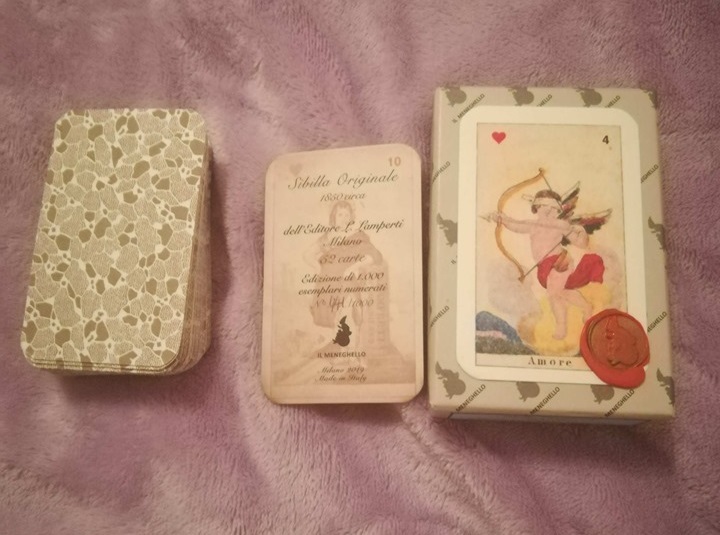
As usual for Il Meneghello, the deck comes packaged in a lovely reinforced cardboard box (see picture). I keep my other Sibilla decks in their original box, as I’m a practical dude and I can’t be bothered with finding a more “appropriate” accommodation for what is, at the end of the day, just a deck of cards. In this case, however, I wouldn’t be able to think of a better solution even if I wanted to. Not only is the box beautifully decorated (with a reproduction of the iconic Love card glued on the front), but it is also made to last.

The Deck, The Extra Card and the Box

Inside the box you’ll find the deck itself, an extra card, a Little White Book and a note. The note simply warns you that, since the product is hand-made, some imperfections are to be expected. Cool. The Little White Book is, like all Little White Books, pretty useless. You won’t find the meanings of the cards in it, although a simple five card positional spread is suggested.

Frankly, the Sibilla works at its best when read in rows or other geometrically inspired shapes (e.g. box, square, pyramid, tableau etc.) which are made up of multiple rows. This allows the cards to come together and form combinations and clusters. Using positions, and even worse, using one card per position is extremely limiting. Other than that, the LWB keeps its promise of being “little”, and it only adds some historical remarks in Italian and English. The extra card, which you can see in the picture, is a reproduction of the Ten of Hearts with some information about the edition.

All that’s left to talk about are the cards themselves. If you don’t know how a Vera Sibilla deck is structured, it is basically like a playing card deck, with four suits (Hearts, Clubs, Diamonds and Spades), but each card is assigned an image. According to Sibilla expert Etienne Valancourt, the Vera Sibilla deck has been created by taking the Italian system of reading playing cards and adapting it to the images of the famous Gypsy Cards which were popular in Germany and Austria back then.

Indeed, many images and names are very similar. However, since the Gypsy cards are 36, while the Sibilla has 52 cards, some images had to be split among various cards (for instance, the card of the Visit, where you can see a handmaid visiting an old lady, became the two cards of the Old Lady and of the Handmaid), while other images were added to the mix to fit the Italian system. Let’s look at the cards in this particular edition.

Pros

The cards themselves are a treat for the eye and, if I may, for the hand as well. Il Meneghello has chosen to sell this new edition of their Sibilla deck with the corners already rounded off. I believe this is a winning move: the cards come across as much gentler and “approachable” to the eye. They are just pretty, I wanna merry them. According to Kapherus of Art of Cartomancy, who owns a copy of the previous IM Sibilla reproduction, the square corners of that edition tended to peel off a bit too easily. I have been mistreating (really!) this deck for a couple of weeks now and it seems to be in perfect shape. If in doubt, choose this newer edition.

The backs of the cards in this edition (left) compared to the standard Masenghini edition (right). As you can see, they are not exactly reversible, but they are more reversible than the Masenghini ones.

There’s something extremely authentic and genuine in the experience of holding this deck in my hands. Although the size is the same as the popular Masenghini edition (see image), the deck as a whole takes up more space, simply because it is made of relatively irregular pieces of actual cardboard rather than of 52 identical pieces of plastic. Whenever I shuffle the deck, I feel immediately transported to a tearoom of old, where a funny-looking lady shuffles her self-made deck for her numerous clients.

Speaking of hand-made stuff, this deck is completely matte. I don’t have the previous Il Meneghello edition of the 1890 Sibilla, but I have been told by a Facebook friend that that edition is at least lightly coated. Not so with this 1850 edition. This certainly contributes to the feeling of authenticity of the deck.

Another important pro, in my opinion, is that this deck, like the previous edition (and like the original edition), has no annoying keywords on it as the Masenghini edition does. Bear in mind that the Masenghini edition came out only in the late 1970s and it was probably some rich old manager who’d never used the cards for divination and simply wanted to make them more appealing to bored teenagers that slapped the keywords on the cards.

Granted, I have learnt to disregard them, especially since they are very reductive, and many of them are extremely misleading, telling you the Jack of Clubs is an evil dude, even though he is actually traditionally the prototype of the good friend, son, student, coworker, and only becomes negative when reversed. Still, it feels liberating, and the font used for the title is also much prettier.

Some of the names of the cards, being the original ones, are slightly different from the Masenghini edition (e.g. Present of Precious Stones instead of Present of Jewels, Consumed with Jealousy instead of just Jealousy, etc.). Also, the Present and the Handmaid are swapped back to their original place. Finally, you can see that the colors in this edition are a bit more muted compared to the newer ones. I find them lovely, less fake. Note: this is not meant as a bashing of the Masenghini edition, which I adore and use. It’s just a comparison.

A comparison of the images on the cards of this 1850 edition (top) with those on the Masenghini edition (bottom). Notice how some names have been changed and the Eight and Three of Diamonds have been swapped back to their original placement.

Cons

Is this a wonderful deck to have if you are a Sibilla Reader? Absolutely! I don’t know how you could miss out on it.
Is this a great deck to have if you like traditional oracle decks in general? Yep, go ahead, buy it!
Is this a good addition to your collection if you are a collector? Hurry up, it’s limited!
Should this be the only Sibilla deck you own? Probably not.

Granted, it does seem sturdy enough to last me a lifetime. This doesn’t change the fact that it’s not meant to be as resistant as a mass-produced, heavily coated plastic deck, especially considering it’s a limited edition and it’s not necessarily cheap. If I ever chose to go pro, this wouldn’t be the deck I use with my clients, although I could probably keep it for my personal readings.

Since these are actual pieces of uncoated cardboard, you need to be careful around liquids, as I guess they will stain quite easily. Also, you need to get used to shuffling this deck, which wasn’t easy for me at the beginning. It’s not impossible, and with a little practice it is actually extremely pleasant, but don’t expect it to be the same as with the newer, plastic-y editions.

Final Thought: absolutely recommended!

Pros:
+ The Vera Sibilla Oracle at its best. If I had to choose my favorite edition, this would be it
+ Pleasantly matte pieces of cardboard in your hands
+ Rounded corners!
+ Seems very resistant
+ No keywords on the cards
+ It’s like gazing into images from a dream

Cons:
– You might need to be careful around liquids
– Initially difficult to shuffle, but you just need to get used to it
– It’s lovingly hand-made in a limited edition, so I don’t know if it would be suitable as a “power horse deck”. Perhaps if you are careful

Price: When I bought it, it cost 40€ plus shipping.

How to order it: It is not currently available on the website. However, you can order it by emailing Il Meneghello. Their customer service is quick and efficient.