Category Archives: Reading Example

Vera Sibilla | Interpreting Rows of Cards

We start off easy with spreads. And, in truth, I don’t use very convoluted ones.

The easiest way to answer a question with the sibilla is by drawing a line of cards. Any number will do, but I would limit the number to 7 at most, and in general, 5 is an ideal number. Contrary to some popular opinions, it is perfectly acceptable for the number of cards to be even, even though I find odd numbers more aesthetically pleasing. Be sure, when you settle on a number, that you stick to it unless you truly find that the answer is not complete (it can happen). In that case, add two cards to the tail of the reading.

Rows can be used without question, to get a glimpse into the future (or past) or they can be used to answer specific questions. Following are three examples of readings, one with three, one with five and one with seven cards. I suggest that you take out the cards I indicate, so you can better follow the explanation. If possible, try to give your own interpretation before reading mine.

Example with Three Cards, 1

A querent asked if the house he had seen would be the one he would move into. I don’t remember if I already posted this example, but it’s a good one. The following cards came up:
2♠ + J♦ + 10

The Old Lady and the Messenger together often mean a visit, a short trip or a movement of short duration. This is already not promising: we want the movement to be definitive. What seals the negative answer is the 10♣, Levity. This card is connected to everything that is not rooted in the querent’s life and is therefore passing. The visit he made will be passing. He did not move into the house.

Example with three cards, 2

The querent asked if the man she was seeing, a recent divorcé, still thought about his ex.
The cards that came up were
K♥ + 6♦R + Q♠R
The answer is quite obvious: yes, he is thinking about her, but not in a flattering way. His showing up as the Gentleman, furthermore, bodes well for the future of the relationship with the querent as, unless the it is afflicted, the K♥ is honorable and good. The Q♠ shows up reversed, which is quite typical of “my crazy ex” stories, when the ex is actually crazy.

Example with Five cards, 1

A querent asked if her husband liked his job because he wouldn’t give her a straight answer. The cards were:
6♦R + J♣R + K♥ + 2♣R + 7♣R

The predominance of reversed cards is not a great sign to begin with, but let’s dig further. The husband occupies the center of the spread, indicating that this spread is very much about his feelings and perceptions. The first card is the 6♦R showing a negative attitude. The negative attitude is toward the reversed J♣, which can be a younger colleague. I asked if the husband worked with younger people and, unexpectedly, the woman said the husband was a high school teacher. Clearly one or more students are giving him problems and his own attitude worsens the situation. He probably thinks too highly of himself (he shows up as the Gentleman and has the reversed Peacock card next to him) which prevents him from taking his students’ disrespect lightly. He thinks they are disrespecting him, which makes things worse. The reversed Gratification card shows lack of confidence, lack of fulfillment and confirms the husband’s fear for his own “reputation”. He doesn’t like the job.

Example with 5 cards, 2.

The querent asked if the his classmate’s father would be reelected as mayor of their town. The cards were: 8♣ + 10♥R + 9♥R + 9♣ + 2♣.
The ending of the spread is very positive, showing satisfaction, public honor and success with the public. The first three cards show the coming together of people (8♣) with negative intentions (10♥R) and not very clean methods (9♥R) to stop him. The man was reelected despite an attempt to dig up some dirt about him which turned out to be false.

Example with seven cards, 1

The querent asked if he would have to shut down his business forever. This spread was made during one of the lockdowns. The cards were:
K♠R + 9♠ + 6♦ + 7♦ + 10♠ + A♦ + 8♣
The first card, the reversed Priest, shows that the law is playing a negative role in the matter, quite obviously, and is creating a blockage (9♠). The querent, however, is in the position to come up with new strategies (6♦ + 7♦), the implementation of which will be an uphill battle (10♠), but they will bring economic renewal (A♦ + 8♣).  He won’t close his business down in the foreseeable future. Nor did he. He could expand his online presence and did it.

Example with Seven cards, 2

The querent asked if she would get a job she had applied for. The cards that came up were:
Q♣ + 10♣ + J♥R + A♣R + 7♦ + 5♦ + 8♥

Ready with your answer? Good. The cards have nothing to do with the question asked by the querent. It happens at times, if something important is imminent in the querent’s life. The cards hint at a flirty casual relationship with a man (Q♣, 10♣, J♥R). Since the Lover is reversed, the situation is completely devoid of love and is only sexual, confirmed by the reversed Marriage card which is the sex card par excellence. The A♣R plus the Child card indicate a pregnancy, and the girl won’t be too happy at the beginning (5♦), but she’ll come around and keep the baby (the Hope card falling last clearing the air of all sadness and trouble). I told the querent to be careful and take precautions when with men. She didn’t heed (the 10♣ next to the Queen of Clubs) and is now a happy mom who shares custody of her son with the father.

An Exercise To Do With New and Pre-Owned Decks

One fun little exercise I like to do whenever I get a new deck (any deck, of any tradition) is to ask them some questions to see if they are in tune with me. Some readers treat decks as if they were God-given artifacts. If that works for you, wonderful, no judgement, but I treat them as simple pieces of cardboard that are inserted into a universal mechanism of synchronicity. They are tools, and, like all tools, they need to be treated with some respect, but not to be revered as idols.

My own very personal experience with new decks is that the first few readings they give are often way off, until they enter into synchronicity with a particular reader and that reader alone. The only way for me to get past this phase of initial unreliability on their part is simply to use them a lot, until they get tuned to my subconscious language.

I will probably cover this in another article, but I staunchly believe that divinatory tools are like languages, and, like languages, their structure is perfectly objective, meaning that just as I cannot reinvent the English language as if it were a random convention, I cannot reinvent the meaning assigned to cards in a particular system (although there can be different systems, just as there can be different languages, and sometimes different systems use the same deck, just as sometimes different languages use the same alphabet or even similar words).

That being said, even though English is out there regardless of me, I will have my own take on the English language as I learn it, and you yours. Ever tried reading a Modernist author? Finnegan’s Wake is written in English, yet it is an English very few people who are not called James Joyce will understand. All this is to say that my own take on the issue is that card systems are objective, but you need to develop your own take on them in order for them to make sense in your particular universe (and you are your own universe).

The process of “developing your own take” cannot be decided rationally by convention, as in “From now on X will mean Y”. That’s part of the reason why Esperanto will never be a real thing aside from a laudable minority of dedicated learners. No, this process of development is largely a subconscious process of reciprocal adaptation between language and speaker, or between reader and reading system. It does take a little bit of time and patience, but then again, all things that are worth time take time.

As far as I am concerned, new decks need to be inserted into my mechanism of synchronicity. What about used deck? I have found that if a deck has been consistently used by someone else, it will take a bit more time for it to respond to me. Either way, the first question I will ask my new deck to answer is “Who is your master?” or, if you are not into kinky stuff, “Who do you respond to?” and I pull three cards. Usually, as soon as the cards start responding, I get a very clear description of myself as I am at the moment. Interestingly, if a deck belonged to someone else, I first get complete nonsense, then, as the cards start to respond to me, but not well enough, I almost always get the older owner’s description.

If you give this exercise a try, remember that the description you get of yourself needs to be beyond doubt. It’s like an “a-ha” moment. No vagueness. So, what happens if you don’t get the answer you are looking for? That is up to you and, in part, to your creativity. If you want to consecrate or cleanse your deck, go ahead. My own practice is to give the same question another couple of tries, and if the deck refuses to acknowledge me, or to let go of its previous owner, I leave it there for a couple of days, maybe spending some time shuffling it in the meantime, before giving it another try.

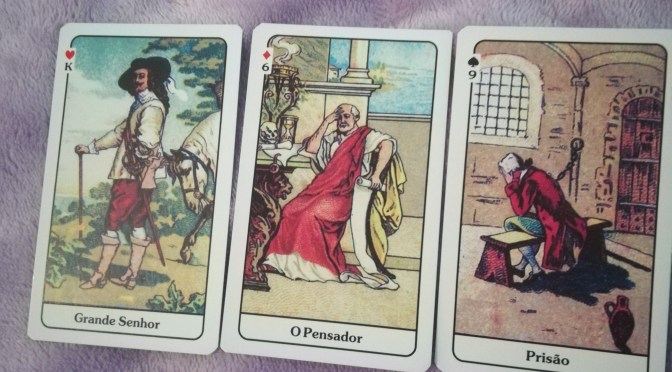
Here is what I did with my new Sibilla della Zingara deck. I asked “Who do you answer to?” and it answered perfectly on my first try, something that had never happened to me, except with my very first deck. I guess part of the reason is that it didn’t have a previous owner, as pre-owned decks tend to be a bit more stubborn, I have found. (Even then, don’t worry: my main deck was second hand, and it works perfectly now).

“Who do you answer to?” “To you, oh lord of all that’s sad, master of inner drought”

One thing you have to know about me is that I have a relatively strong depressive streak to me. I’ve always had it, and depending on the period it resurfaces. These days I was battling through a relatively strong depressive episode, and it definitely shows in the cards.

The King of Hearts is me. Usually I show up as the Jack of Clubs (unmarried man under thirty), but in the past I have come up as the Gentleman, mostly in relationship readings and in job readings, as I’m a teacher (protector/helper figure) and therefore the Jack of Clubs can represent the students. In this case I’m not sure why I showed up as Gentleman. It might be a very contingent reason, as upon searching the deck for the Jack of Clubs and the Jack of Hearts, I found them reversed. Apparently, the deck simply pushed the most serviceable significator into service.

The following combination is Six of Diamonds (Thought) + Nine of Spades (Prison). This is one of those combinations that can signal feeling down, or depressed, or oppressed. It can also signify psychological submission, but there would need to be other cards as well.

What’s interesting about this reading is that these past couple of days I had battled through the depressing feelings without even noticing them, but as soon as they came up in the reading I got my “a-ah” moment, “yep, that’s me”.

Other questions you might ask the cards are What’s going to happen in the next 24 hours?”, “What did I do yesterday?” or any other question whose answer can be easily verified within a very short timeframe. I personally would avoid questions like “What will you teach me?” or “What have you entered my life for?” as it’s all too easy to concoct a convenient answer out of any card combination, but I leave it for you to decide for yourself.

The point is: don’t feel bad if sometimes a new deck doesn’t seem to make any sense, it just takes some time to get in tune with it. At other times, however,, as in the example above, the synchronicity is perfect from the start.

Reading – Will the University Go Bust?

Here’s a reading from some time ago, which I recreated using my new Sibilla Originale 1850. The querent’s problem was: Will the university I work for go bust?

A pyramid spread on the question “Will the University I work for go bust?”

The first line is pretty interesting, as we get a chance to see the power of the Peacock card in action. The Two of Clubs is the best card in the deck, capable of lessening the blow of any negative card. And boy do we need it, as right before it we have the worst card in the deck, the Seven of Spades Reversed. Aside from being the card of tyranny and overbearing power, the reverse Seven of Spades talks about ruination and utter and final capitulation.

Why is the university going toward ruination? We have the Ace of Clubs, Marriage, and the Ten of Clubs, Levity. The Ten of Clubs is the card of “just a little”, while the Marriage card is about contracts and legal agreements. So, the university is at risk of going bust because there’s not enough students signing up, but the worst will be avoided thanks to the Two of Clubs, which can be visualized as a sort of divine hand grabbing the debris falling from a collapsing building and putting them back in place before they manage to fall on someone’s head.

The second line tells us something a bit more specific about what is going to save the university from the worst. The Seven of Diamonds, the Child, is about new things, and the Jack of Clubs, the Servant, is, among other things, the card of students, an interpretation which is confirmed by the Two of Diamonds, the Letter, which is one of the cards of studying and books, and when near the Servant it can identify a student. Here we are not talking about a specific student, but about students in general. There will be new (Child) students. At least enough to keep the whole thing going.

In this instance, we may also see the Child as falling between the Ace of Clubs, Marriage, and the Two of Hearts, House. Ace of Clubs + Two of Hearts is the card combo that, in job-related issues, represents a firm or a business. Here we are talking about a university, but the meaning still applies: universities don’t pay their employees in wisdom. They, too, need to make money, just like a business.

The presence of the Child inside this combination of business tells us that the university is preparing something new, perhaps new courses or maybe some new marketing ploy. The querent confirmed that they are looking to concoct some new study course that will make the university he works for more alluring.

The final three cards tell us that, although the university will manage to stay alive, it probably won’t be thriving, at least not in the next period. We need to understand “the next period” in the context of the question: we all know how public institutions tend to suck as much money as they can for as many years as they can without profit before actually being left to their fate, so in the context of a public institution, which this university is, the next period means the next few years, or at least that’s what I think.

The Two of Hearts, the House, shows the place itself, while the Nine of Diamonds, The Fools, and the reversed Three of Hearts, the Balcony, tell us something that seems to contradict the presence of the Peacock in the first line. It would be easy to interpret this combination as one pertaining to violent groups, but this wouldn’t mean anything in the context.

Aside from its usual connotations, the Nine of Diamonds talks about things proceeding irregularly, or without really looking where they are going, while the Three of Hearts is connected with sight, whether literal or figurative. Reversed, it becomes a lack of insight, so whatever it is that the university is coming up with is not going to be that good of a product for potential students to buy into.

Finally, let us look at the angles of the pyramid: Marriage, Peacock and Balcony Reversed. The business (Marriage) will stay open for the foreseeable future (Peacock), but this will not necessarily be a good thing, as the Balcony Reversed is also the card that points to a lack of positive developments.