Category Archives: Playing Cards

Divination vs Fortune-Telling: History of a False Dichotomy

The founder of BOTA, Paul Foster Case, proudly started his short book “Oracle of the Tarot” with the assertion that Tarot divination is not fortune-telling. The reason, he explains, is that fortune-telling is grounded in the belief in luck, chance or fate, while divination understands that everything is about our personality. The same statement is found at the beginning of the advanced BOTA course on tarot divination (Oracle of Tarot, without the ‘the’). Ann Davies clearly had a hand in rewriting it, considering how verbose the course is, but the substance was similar.

Paul Case was tapping into the spirit of the times when he made that statement. Since Tarot had the (mis)fortune of attracting the attention of XVIII and XIX century occultists, it hasn’t enjoyed a moment of peace: everyone wants to believe it to be not an obvious masterpiece of Renaissance art and Medieval philosophy, but an occult device made to transmit mystical knowledge unknown to most people (even though most people prior to the Enlightenment and the French revolution would have been able to tell you what the Tarot was about).

The same has happened to Astrology. Once a practical art for foretelling the ups and downs of actual life, it became the victim of the occult intelligentsia of the last couple of centuries and was turned into a hodgepodge of pseudomysticism, ill-digested psychoanalytic concepts and “it’s true if you believe it” New Thought crap.1

But this is not the whole story. If one takes the time to study, say, the Golden Dawn system, one quickly finds out that their traditional way of reading the Tarot is grounded in fortune-telling (just read MacGregor Mathers’ example of the Opening of the Key spread). Even the BOTA system, which derives from it, preserves very concrete meanings to be strung together into sentences, despite Ann Davies’ attempt to turn divination into a form of Kabbalistic meditation.

In other words, the occultist attempt at reappropriating the Tarot and Astrology (which in part continues to this day with some bogus theories about the so-called Tarot of Marseille, but more on this in another post) is only partly responsible for the divination/fortune-telling dichotomy. Much of contemporary occultism is grounded in the psychoanalyzation of magic and spirituality, which, in turn, is a defense mechanism against the death of the classical spiritual worldview. Yet, for all its shortcomings, it at least preserves some core tenets of the magical worldview.

But the problem with this is that while it does preseve in some ways the roots of the worldview in which divination can flourish, it has lost the intellectual basis for defending it. Intellectually speaking, even today occultism is largely stuck in the pre-WWII era, with its myths of scientific positivism, of constant historical progress and of magic as misunderstood technology (while I would argue the opposite, namely that technology is misunderstood magic).

Essentially, what has gone lost is the philosophical framework that allows us to keep together divination as spiritual practice and divination as uttering of concrete, verifiable truths.2 That’s largely because spirituality, in the post-XVIII-century Western world, was only allowed to survive as private indulgence in irrational behavior, a weakness to be tolerated.

Thus the split was born: 1) on one hand divination: a ‘serious’, and therefore unverifiable endeavor, a tool for vague self-reflection, cheap catharsis and shallow instagrammable aha moments. In other words, something that the small judgmental scientist constantly perched on most people’s shoulder could smile upon as at least benign, if not really true; 2) on the other hand fortune-telling: a crass or quaint superstition that is just a scam when it gets things wrong and just a coincidence when it gets them right. The little scientist can be free to frown on it. In other words, the distinction was born out of the guilty conscience of “spiritual” people, i.e., out of their subconscious scientism, as a way of telling themselves and society “I indulge in this silliness, but I am just quirky, not stupid.”

The occultists of yore were at least intelligent men and women who actually had something to say. They may have worked in an intellectually hostile environment, but they at least gave it their best shot, and for this they deserve leniency. What happened next is worse: that the already battered art of divination fell into the hands of stoned hippies and people with degrees in the most useless branches of socially acceptable knowledge. Then along came the Liz Greene’s and the Rachel Pollack’s (to make just two examples) who destroyed Astrology and Tarot even further. From then on it could only go in one direction: past life readings, divine feminine, empty motivationalism and strategizing, healing of generational traumas and all the attendant nonsense.3

Interestingly, the more contemporary divination’s fake husk rots, the more one needs to be intellectually dead to practice it, the more it becomes reintegrated in the higher spheres of society. I believe I already talked about a friend of mine who works for Google and has to endure meaningless meetings with tarot readers and astrologers because her boss is the manifestation-obsessed boss babe type. Nor are tarot readers a rarity in corporate America. This probably says something about how brain-damaged this kind of environments is. The nicest thing we can say about this part of society and this strand of divination is that they deserve each other.

MQS

  1. This is not to say that Astrology or divination were unanimously accepted, but the debate was much more complex. ↩︎
  2. This, by the way, is not a call to “go back” to some long lost good old times. I am no reactionary. Nor am I a progressive. I am a realist. ↩︎
  3. By which, of course, I do not mean that there is not a feminine side of the divine, nor that trauma cannot be a real thing. I only mean that these words correspond to nothing but the most vapid pseudointellectual nonsense when coming out of most people’s mouths nowadays. ↩︎
Is He An Atheist? (Card Reading Example)

Traditional cartomancy, like all traditional divination systems, is full of tips on how to handle spiritual topics. The difference with contemporary psychobabble is that in traditional cartomancy we deal with a spirituality that is rooted in the earth and in everyday life rather than in Mind/Body/Spirit section poppycock. As I often remark, in such systems spirituality is seen as the logical next step for someone who is acquainted with real life, not as a consolation prize for someone who is trying to avoid it.

The querent asked if her boyfriend believes in “a superior being”, by which I assume she meant God (“being” is probably a more reassuring term compared to “bearded guy holding a lightning bolt”). She places great importance on the topic, but he seems to avoid talking about it. This is a playing card reading. In the next days I will also post a Vera Sibilla reading done on a similar question by a different person some time ago.

A♥ – 8♣ – 9♣ – K♥ – 7♣

Seeing this, I asked the querent to draw three more cards to open the reading on the Ace of Hearts, which yielded the 2♠, the 2♣ and the 6♣.

The first thing I noticed was the complete absence of Spades (except in opening the spread, but that’s a very weak Spade). This generally bodes well for spirituality. However, there is also a majority of Clubs, which indicate struggles and difficulties. There is no need to interpret the spread card by card. The spread indicates a slow or difficult relation with the divine. Belief is not denied, but it is rendered heavy, problematic.

The first card is the Ace of Hearts, which can indicate “inner” issues, but because the first card in a spread can also represent the cause of a situation described by the following cards, I ventured to interpret it as issues relating to the home causing the querent’s boyfriend to falter in his faith. The three additional cards with which I opened the spread on the Ace of Hearts reinforced my idea that there must have been a difficult atmosphere at home surrounding the topic.

What about the King of Hearts? Is it the dad? Well, no. Traditionally, in spiritual readings the King of Hearts is God himself (just like in the Sibilla): he is the lord (King) of your inner life (Hearts). Surrounded by all those Clubs, the God-side of the boyfriend’s life suffers, is stifled. Yet it is there, since the King of Hearts comes up and is not surrounded by Spades.

I asked the querent to give another three cards to open the spread on the King of Hearts. These were the 10♠, the 4♣ and the 10♥. At night (Ten of Spades) he speaks (Four of Clubs) spiritually/finding consolation (Ten of Hearts). He prays to God at night.

MQS

On Death (Example Reading)

Of the many subjects that have been banished to the realm of shadows in contemporary divination, none have become more unspeakable than death. Under no circumstances should we be reminded of our mortality and finitude, largely because these are all things that fly in the face of the “you can be whatever you want” ideology that many diviners now espouse. Divination proves that no, we can’t be whatever we want. Certain patterns of our life are laid out for us and there is precious little we can do about them except, maybe, work on our ability to accept them.

Obviously, as diviners we wield a certain degree of power over our querents, and as such we ought not to abuse it to terrorize them. I don’t usually talk about death unless the question is specifically about it or unless the context somehow allows for such a discussion. But I am also no moralist lecturing the querent on what they should be asking. In this case I was asked by a woman about her father’s wellbeing after being diagnosed with a serious illness. I told her I would not diagnose anything, but I would merely look at the general flow of his life.

2♥ – Q♥ – Q♠ – K♠
10♠ – K♣ – 9♠
8♠ – Q♦
10♥

I said it largely to comfort her, but the cards have their own language that cannot be overruled by any consideration. The pyramid can largely be summarized in one word: “funeral“. There isn’t much to discuss or interpret. Look at that group of people cards: these are not specific individuals. They are just meant to indicate many people together.

Then we have the Nine of Spades, Eight of Spades and Ten of Speads interspersed. These show great evil, tears, darkness. You get the picture. In the context of this question, many people together for something tear-related is called a funeral. So there is going to be a funeral: the father won’t survive.

Due to the Two of Hearts, I thought this was going to be within two weeks (not the funeral, but the death). It ended up being almost a month (timing is always tricky). In general, I think the cards meant “soon”.

But what about the Ten of Hearts at the end? Shouldn’t it nullify the evil meaning of the other cards? Usually it does, but the Ten of Hearts also represents Heaven or paradise. In the context of readings about this sort of issues it indicates that death comes as a release from the sufferings of life. As such, as weird and unfathomable as this sounds to us in the realm of the living, the spread is positive: it ended well because it ended in death. As a matter of fact, I have been told that the father was serene and peaceful till the end.

Why Predict Death? Philosophical and Practical Implications

I hope I haven’t put off anyone with this post, but the fact is that death is possibly the most salient event in life, so it makes sense that divination should be able to address it. The readings I do about this sort of issues are very rare, and I generally warn the person that I am fallible and have been and will be wrong again.

Other readers may choose to avoid such questions altogether. This is a legitimate choice, as no one should be forced to read about topics they feel uncomfortable about. However, it is also important to recognize that such questions are legitimate and that there is nothing inherently dark about them. It all depends about the context and about the attitude of the diviner (and of the querent, of course).

One may ask what the point is of divining about death and other such topics, since the querent cannot do much about it. In reality, there is plenty of non-morbid reasons to want to know about it: one may wish to set their affairs in order, or simply get a head start in getting closure. In pre-modern Western astrology, as well as in Chinese astrology, the prediction of the native’s death, or at least of whether they had enough life force in them to lead a relatively long life, was one of the first things the astrologer looked for. This is obvious: you can’t predict fame to someone for next year if they’ll be gone tomorrow.

Most importantly, a sober and serviceable approach to such topics has the ability to make us appreciate life from the point of view of the eternal, from the recognition that many things escape our control and we are truly actors in a cosmic play.

MQS

On Prayer Before Divination

Some days ago I was talking to a fellow occult student and we were comparing notes on how we go about the process of divination. When I told her that I tend to say a little prayer before divination she was surprised, so I thought it would make for a nice topic.

First off, I do not think that praying before divination is mandatory, nor do I think that it’s the prayer that makes divination work. It doesn’t matter if it’s synchronicity, as Jung said, or if it’s the spirits that live inside the cards, as my first teacher told me, or if it’s the Soul of the World, as the Platonists believe, or if symbols are living beings, as I believe: the point is that the cards always rearrange themselves in a meaningful pattern, the planets always find themselves in the right aspects, the right geomantic figures always emerge, the right I Ching Hexagram always forms.

As such, in a way, divination is a natural activity, so much so that it’s probably one of the earliest activities humans have undertaken. The reading of symbols came much sooner than the reading of characters, because symbols occur naturally to the mind whenever we realize that X means Y. The moment the first men drew any kind or conclusion from any kind of observation, divination was born.

And yet, I believe that divination is also essentially extraordinary. In a way, divining is as normal as cleaning your cat’s litter box, but in another sense it is also very different. In divining we read a part of the whole (the divination system) to derive conclusions on the whole (life itself). Indeed most divination systems are universal languages that mirror the complexity of the Macrocosm.

As such, divination cannot be decoupled from a global understanding of life, and this global plane is where philosophy, spirituality and occultism unfurl their wings.

In my own view, occultism is divided into three branches: devotion, divination and magic. But these three aspects are not discretely separated. For instance, theurgy brings together magic and devotion. Divination and magic are often coupled together, such as in electing the right time to make a talisman or in asking if a magical action is warranted or advisable or effective.

Praying before divination brings together devotion and divination. It is a way of recognizing the extraordinary import of the action I’m about to take, despite this action being, in another sense, perfectly ordinary.

It helps me more than it helps the divination system itself. Nor does it have to be prayer. I know of some people who wash their hands before divining. In Imperial China official diviners had to cleanse themselves before attempting divination, and this is true all over the world.

No one divines willy-nilly. No one *should* divine willy-nilly. This has nothing to do with respect (unless you are receiving information from a particular spirit), it has nothing to do with asking deep questions (divination should always be practical) and it has nothing to do with not having a sense of humor (you can have a sense of humor, in spite of how bland and vapid many of us are). It does have to do with knowing what place divination has in the scheme of things and reaching that place. I do it through prayer, others may do it by just taking a second to clear their mind, but everyone does it one way or another.

MQS

Should Diviners Give Advice? Yes, But…

I come from a rather traditionalist school of divination. One of the ways I learned was that my teacher often told me to do a spread on an aspect of her past I knew nothing about to see if I managed to discover what happened. Another way was when she told me to do a spread to see what would be the problem of the next person going to her for a reading. Interestingly, I have met other people, who have taught me other techniques, who used the same method.

As can be expected, there was little room for anything other than the literal interpretation of the cards. This has helped me a lot to remain  with my feet on the ground as I forged my path, which is very good, considering how littered with nonsense the esoteric landscape is.

On the other side of the spectrum you have a sizeable chunk of diviners today, though the situation now is slightly more balanced than it was just twenty years ago. These readers simply interpret the cards (or the planets, or whatever) as if they were benevolent tips from the universe about some inner issue that the person needs to work through to progress.

The problem I have with this approach, aside from the fact that it leads to unverifiable predicitions, is that it presupposes a superstitious view of the universe as some kind of benevolent nanny that teaches you how you ought to behave. These people, I should remind you, are the ones who often loathe Christianity as a bundle of silly dogmas and think they are the reasonable ones.

If there is one thing that my study of philosophy as well as my experience as fortune-teller has taught me is that there is no such thing as an ‘ought’. There’s what is and what isn’t, what was and what wasn’t, what will be and what won’t be, as well as what can be, or is more or less likely to be. For instance, there is no way you ‘ought’ to eat. You either eat well or you don’t. Eating well only becomes an ought when your current diet is checked against your desire to minimize health risks. It’s your desires that create oughts, not the universe.

I already discussed how I believe that divination tools are essentially something that gives us a bird-eye view of existence, affording us a glance at a number of considerations about our situation that we might not otherwise have. To use my old analogy, it is like being in a crowded city center and talking to a person on a walkie talkie, this person looking at your position from the top of a skyscraper and therefore seeing things you cannot see.

It goes without saying that I believe divination tools never give advice.* As maps, they simply tell you what is. Advice is contingent on what either someone wants to do or what they believe a superior authority wants them to do. My view of the superior authority is that it is too occupied exploring all its potential through us to pick and choose what’s best for us.

Does it therefore mean that a diviner should not give advice? I actually believe advice is a perfectly fine thing, as long as it is not delusional advice. I think a good divination session should always be of help to the querent in living their own life better. This is done by checking the querent’s wishes (sometimes implied, sometimes stated outright) against the wider situation as portrayed by the oracle, with its potentials, its risks, its possibilities and impossibilities, its certainties and its uncertainties.

In other words, advice must come from the diviner on the backdrop of the oracle, and not be projected onto the oracle, which just pictures reality as it is, not as it should be (because there is no way reality should be, from an objective standpoint). Sure, sometimes I tell my querents “the cards are advising you to do X”, but this is short for “I am advising you to do X based on what the cards are telling me about your situation.”

Sometimes the right bit of advice at the right time can help the querent make a turn for the better in life. These are the readings I love the most. Sometimes it can improve a situation. Sometimes, though, the advice is not enough to change an objectively difficult situation. The more heroic and nietzschean reaction to these slings and arrows that life throws at us is that of amor fati: in knowing what’s coming, one can learn to love it, thus overcoming it, making it part of oneself instead it being an alien destiny. But this is not always possible. Sometimes, all the querent can get from a difficult reading is peace of mind. And peace of mind is a great thing, all too often undervalued until it’s no longer there.

MQS

* In this, divination tools are very different from inspired divinations caused by spirits or deities, since these actually do have their own particular views and preferences.

Is This Course for Me? (Playing Cards Reading and Horary Astrology)

I’m always on the look-out for opportunities to deepen my knowledge of esoteric topics. Since the esoteric world is filled to the brim with junk covering a couple of pearls on the bottom (but don’t worry, things don’t get much better outside of lalaland) it is very useful to know some forms of divination to supplement my bullshitometer.

I recently came across a certain course on traditional Italian witchcraft which passed all my preliminary tests (no mention of Wicca or neopaganism, relating anecdotes on practices I’m already familiar with and know are valid, etc.)

Still something was off, though I couldn’t put my finger on it. On thing was probably the reference to authors, like Raven Grimassi, who have been largely debunked. I asked the heavens for a sign, and then pulled some cards. Let’s start with the cards. They were:

4♣ – 2♠ – K♦ – 2♣ – 6♦

Right off the bat, I don’t like the teacher being represented by a King of Diamonds. The King of Diamonds is the merchant, the banker, the one whose end goal is money. If he had been the King of Hearts or even the King of Spades I would have been reassured. You may argue that obviously a course is offered to earn money, to which I respond that there is a difference between earning through your passion and earning through other people’s passion.

I am unsure about the preceding combination of Four of Clubs and Two of Spades, but it likely represents contradictory (2♠, arguments, going apart) doctrines (4♣, that which is told). The Two of Clubs and Six of Diamonds traditionally represent limping (insecure steps). The King of Diamonds is not secure enough in his knowledge. Limping is still better than being bed-ridden, so there is something good to the course, but probably not enough to offset the negatives.

Horary Astrology Reading

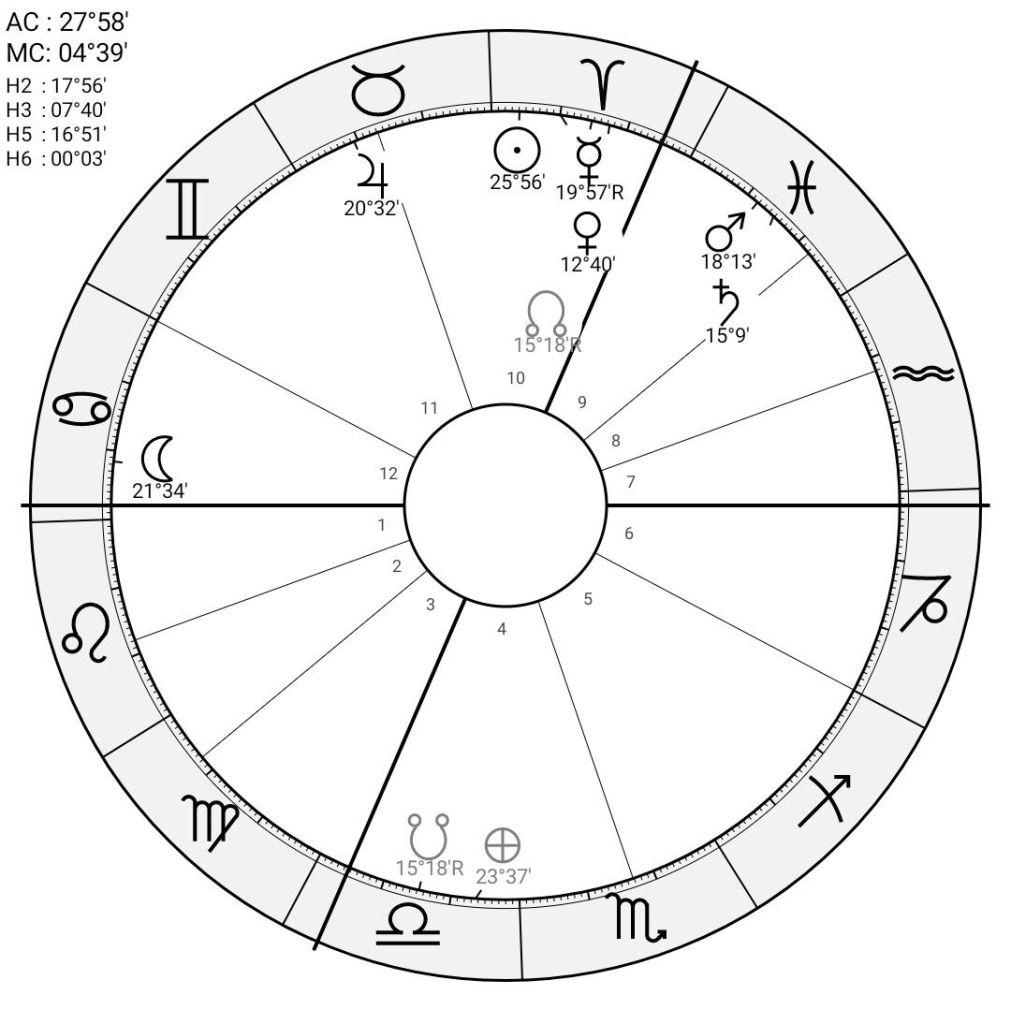
Let’s look at the horary chart:

Is the course good for me?

The Moon is the Lady of the Ascendant and thus represents me. Magic is higher knowledge, so it’s Ninth House. This is Jupiter. The two malefics Mars and Jupiter are present in the Ninth house, and are both peregrine, so they afflict the house.

The Moon is in her sign, but she’s also tucked away in the very malefic Twelfth house. Interestingly, the Twlefth house represents witchcraft, but only in the sense of something done behind the querent’s back to hurt him, not magic in general (which, again, is higher knowledge). So while I’d be capable of learning (Moon in own sign) my position is not good. There’s something iffy.

Jupiter is mildly dignified by term and in the succedent Eleventh house. The Moon is in sextile with Jupiter, which is technically good, but it is separating from it, indicating growing divergence. The Moon’s next aspect is a square of the Sun, which is negative. The Sun rules the second house, the house of money. So proceeding would put a strain on my finances. This isn’t necessarily to say that it costs too much in absolute terms, but it costs too much compared to its quality. Interestingly, Jupiter is disposited by Venus, which is in detriment and moving toward the Sun, which hurts her, so Venus has a rather excessive love of my money compared to the necessary love of knowledge.

All in all, based on both readings, I would say that the course would probably contain some valuable information, but would not be a great investment in my education.

MQS

Love Fool (Horary Astrology and Playing Cards Reading)

This is the first time I use my new interest, Horary Astrology, in conjunction with playing cards. Let’s see what they have to say. The question was asked by a friend of mine who just broke up with her girlfriend. He wants to know if there is a future. This reading was made a couple of days ago.

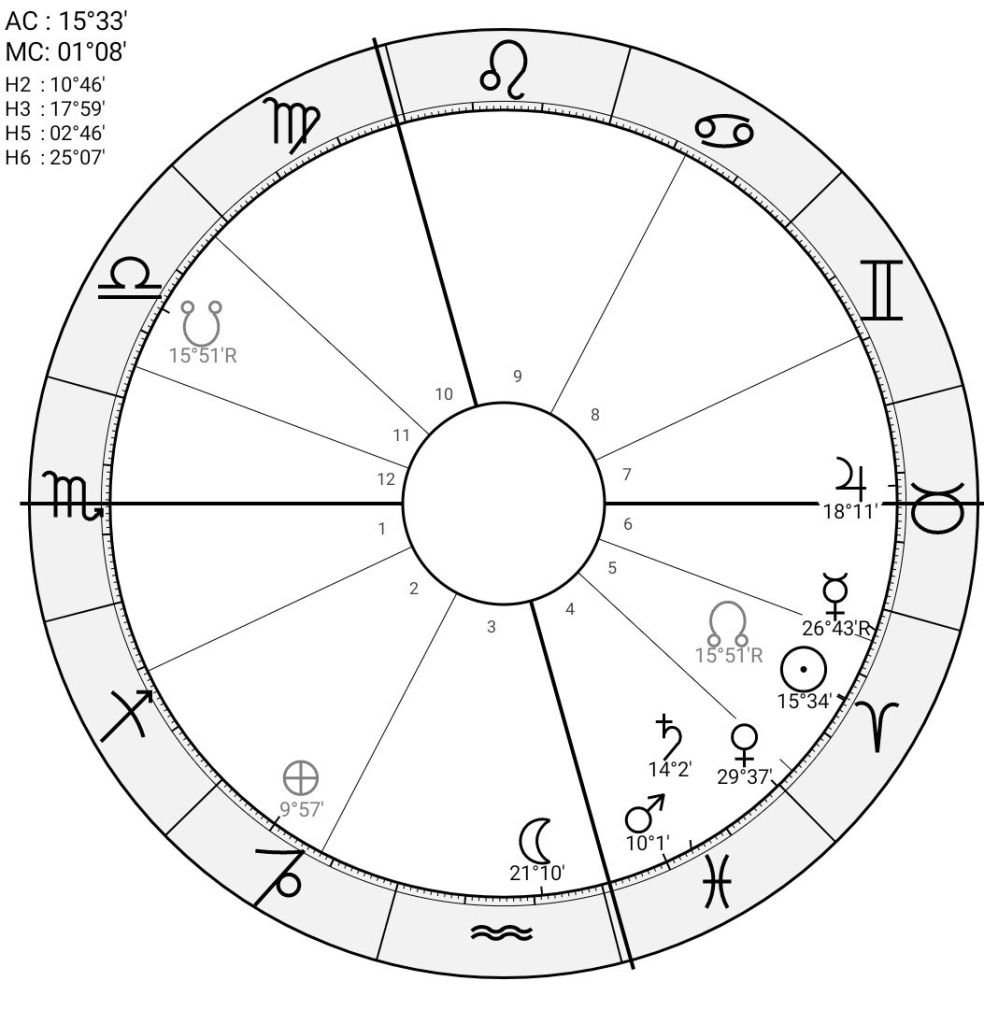
Relationship reading, is there a future?
Answered with horary astrology

The querent is Mars, lord of the Ascendant, while the quesited, i.e., the girlfriend, is Venus lord of the Seventh. The Moon indicates the flow of the action.

In a night chart, Mars is dignified by triplicity in Pisces, and is angular, while Venus is exalted, also in Pisces, and also angular. The first thing that strikes me is that Venus is moving away from Mars. Furthermore, the Moon is separating from a difficult square with Jupiter in the Seventh. I asked my friend if he had broken up with her or she had broken up with him, since from the chart it seems it was her initiative. He didn’t like to admit it, but said she had left him.

Note that Mars is in triplicity, so a decent Mars, but also conjunct Saturn. Saturn is peregrine. Also note that Venus, the girlfriend, is exalted, and exaltation is sometimes an indication of haughtiness. Clearly she thought she could do better than Saturn-like Mars as she moved away from him. My friend then told me she told him she didn’t like the fact she is to attached to her.

Well, CAN she do better? Venus is about to change sign, from Pisces to Aries, whereupon she will not only lose all her dignity, but she will also enter her detriment. Let us look at the Moon now. The Moon separates from the square with Jupiter and moves toward a sextile with Mercury Retrograde. Sextiles are positive aspects. If we put together the indications, we have: 1) Venus moving away but regretting her decision 2) A future positive contact 3) the contact is about things that go back (retrograde)

This seemed to me a sign of reconciliation. Just to be on the safe side, I had the querent pull three cards from the playing card deck. These were:

5♠ – Q♣ – 3♥

The cards are quite clear. The Five of Spades is a card of imprisonment, but it also indicates regret (which is what you are supposed to feel in prison). Then we have her significator, followed by the Three of Hearts. I would have preferred to see a Six of Hearts to show reconciliation, but the Three of Hearts will do. In this case, the added shade of meaning seems to be that the cards don’t even consider the breakup effective, because the Three of Hearts show things that flow positively without interruption.

I will update this post when I know the outcome.

MQS

Playing Card Multiples

I believe that in the development of divination techniques, the creation of meanings for multiples of cards of the same number must have probably come pretty early. When I was taught to read playing cards, the person who gave me the meanings passed also the signification of card multiples to me, with the caveat that she’d never found them to be very reliable, contrary to the rest of the method. I must confess that I almost never use them, except when the meaning can be derived from the meanings of the cards, which is why I never talked about them before. However, since someone asked me, I’ll retrieved them from my notes so that you can experiment with them.

Note that it does not matter which cards we are talking about as long as they have the appropriate number of pips. However, the presence of Spades in the combination is supposed to worsen the meaning, especially if the Spade card comes last.

Aces
2 = Surprise
3 = Positive Chance
4 = when together, death or great danger, when apart, glory or success

Twos
2 = Exchange
3 = Agreement
4 = Slowness, Boredom

Threes
2 = Tricks
3 = Increase or Progress
4 = Quick Communications

Fours
2 = Worry, Insomnia
3 = Situations speeding up, Unblocking
4 = Travel

Fives
2 = Small losses, Small torments
3 = Resolution
4 = Law

Sixes
2 = Nervousness
3 = Anger
4 = Violence

Sevens
2 = Development
3 = Sickness
4 = Dissatisfaction

Eights
2 = New acquaintances or learning something new
3 = Wedding bells
4 = Infamy

Nines
2 = Help from friends
3 = Triumph
4 = Glory

Tens
2 = Change of place
3 = Change of life
4 = Birth or rebirth

Jacks
2 = Fighting
3 = Litigation
4 = Danger

Queens
2 = Talks
3 = Gossip
4 = Slander

Kings
2 = Help
3 = Commerce
4 = Great Honor

MQS

Checking Talismans with Playing Cards

In one of my recent posts I discussed how playing cards can detect curses (of course, it’s not just playing cards that can do it). Today I wanted to add to this subject by discussing the esoteric use of Playing Cards to check if a spell (in this case, a talisman) is a good idea or has been successfully created and is working.

I should perhaps first explain that there is a modicum of belief in magic involved in all this. The modern worldview tends to react to the idea of magic in two ways: the skeptical way (“it’s not really true”) and the new age way (“it’s not really true, but I would really love for it to be true, so I’ll play make belief and tailor everything to my preconceptions”)

Either way, magic is reduced to the acceptable role of cathartic theater or psychological tool (unfortunately, even great minds within the occult scene, like William Gray, have partly fallen for this approach, or at least considered it viable). From here it has even found its way even into the corporate sphere (a friend of mine working for Google told me she was forced to attend a “magical” day with a psychic who talked to them about tarot and Wicca). You know something is crap when pandering megacorporations appropriate it.

At least since Aleister Crowley (but there are predecessors) magic has been understood as the way of the will. Granted, Crowley’s understanding of the word “Will” is not the same as how we understand it in our everyday life, which would rather be “whim“. His view resembles more closely Nietzsche’s view of the will, so it does have some nobility.

But this doesn’t detract from the fact that most people whose view of magic has been colored by Crowley’s (and that’s almost everyone today, whether they know it or not) don’t REALLY believe in magic. Instead, they tend to see it as, again, little more than a placebo. It’s true if you believe in it. It’s true if you want it to be true.

Still, it’s my experience that belief in magic is not really required for magic to work. In fact, one would be hard pressed to find any trace of the concept of the magician’s will in the traditional Western approach to magic (or in the Eastern approach, for that matter).

Because just believing in it was usually not considered a prerequisite for success, the use of divination to check the efficacy of magical workings has been advocated a long time. Besides, if belief is not enough, other, more objective factors must be checked. *

The Arab mages of old, for instance, invited people to do a horary reading to see if the use of planetary magic was warranted. Agrippa probably used geomancy for the same purpose. We don’t know about Abano, but it is not a stretch to think he would have consulted a geomantic shield to check how his spellwork was doing.

In general, all forms of divination take the reality of magic for granted within the worldview that informs their language. After all, why would divination work, but not magic? ** This is true for playing cards as well. Here is an example.

Last year while the Sun was in Leo I was working on a Sun talisman. I’m not going to disclose the aim of the talisman. It was nothing untoward, but I’d rather keep it to myself. After the creation of the talisman I set out to consecrate it. The number of days varies.

On the first day, after the first consecration, I got the following spread:

A♠ – 6♣ – 5♠

Definitely a bad start. And I wouldn’t have expected anything less. The majority is Spades, which is bad for anything but black magic.

6♣ – 8♣ – 10♣

Second day of consecration. A mash of clubs is not positive. It shows difficulties and toil without success. Still, Spades have abandoned the spread, which is a positive.

6♣ – A♦ – 3♠

This is the third day. Close but no banana. It is still a negative spread. It has the Six of Clubs in common with the previous spread, and it closes with an unpromising Three of Spades, which bring Spades and large obstacles back into the equation. Note that this is the third day in a row I get the Six of Clubs. But the Ace of Diamonds has appeared, which indicates success, talismans and even the Sun.

A♦ – 9♦ – 10♦

Fourth day. This is the sign I was waiting for. The Ace of Diamonds is back. This time it is well-placed. The Nine of Diamonds and Ten of Diamonds together just mean “it works”, whether we are talking about an object, a business plan or a spell.

MQS

* This is not to say that the old magi wanted you to do your homeworks half-heartedly. Marsilio Ficino talks about the importance putting your heart in your spellwork.

** this would lead us off into an interesting discussion of all those that practice divination without believing it to actually work (“it’s just a brainstorming method” being the most common rationalization)

Exploring Curses with Playing Cards

Most systems of divination can also be used to explore esoteric topics. For instance, I have answered the question “have I been hexed?” way more than I would like. The answer is no 95% of the times. Only two times in my life have I sent someone straight to see a priest because something supernatural was objectively at play. Most of the times, people use dark magic as a scapegoat to rationalize natural periods of bad luck.

Of the the two times I did detect a curse I can only find records of one (my notes tend to be rather messy). The girl in question asked me if she’d received the evil eye (malocchio). This was the spread:

10♠ – 5♠ – 5♥ – J♠ – Q♠

I added two cards to the queen, and I got the Q♦ and the 2♥. The reading is quite obvious: a woman cursed her (the Queen of Spades with the Jack) on behalf of a relative (the Queen of Diamonds and Two of Hearts) though probably not a blood relative. The Ten and Five of Spades, when read together with the other spades, indicate the use of negative occult powers, probably at night.

The Five of Hearts in the center of the spread probably showed the sector of the querent’s life that was impacted by the curse: the ‘abundance’ sector. The young woman had lost a ton of weight in a short timeframe, she looked wasted, had started losing her hair and her beauty, had started developing money problems (in that she couldn’t retain any money she made). Her significator is absent, meaning she was completely passive to the hex.

It seems her mother-in-law had gone to see a country witch to try to harm her. This is far more troublesome than the evil eye, which sometimes can even be cast inadvertently without a ritual. The hex was broken by a priest, or rather, thanks to a priest who put her in contact with a monk specializing in this kind of stuff.

I’m bringing up the topic because I was recently asked the same question by a friend of mine who is going through a rough patch (lost her job, broke up with her boyfriend, argued with her sister, etc), which she believed was due to some ‘bad vibes’ or the malocchio. The spread was:

3♠ – 6♣ – Q♣ – 7♠ – 5♦

This time we have the querent in the middle of the spread. This, coupled with the fact that there are no combinations of curse, is encouraging: the querent has not been displaced from the center stage of her life.

The cards are negative, but they don’t reference supernatural phenomena: the Three of Spades could indicate curses or evil eye in combinations, but here there is no such combo, so it just indicates problems, things that don’t go smoothly. The querent is surrounded by the Six of Clubs and the Seven of Spades, the latter showing unfortunate events, the former reiterating the idea of difficulties. The Seven of Spades connects to the Five of Diamonds to indicate a period of misfortune, that is, of natural bad luck, which will pass (there will be change, it won’t stay that way forever).

MQS