Category Archives: Playing Cards

In Divination, If You Can’t Name, Describe!

I had a conversation with a reader of this website, and he told me that the main obstacle in learning how to read the cards is that he can’t put the meanings of the cards together to form a clear picture of the situation. The example he used was that it may be hard to tell a querent that they are at risk of getting fired, when in fact the cards may be predicting a fight with a coworker or a demotion, or some other work-related problem, but not a firing.

Divination is an art in itself, and it does require practice and patience. For the first couple of years after being taught cartomancy, I couldn’t put two card meanings together to save my life, even if it was obvious. I still remember my teacher’s dismayed expression when I couldn’t tell her that “talking” and “work” meant, quite obviously, “talking at work or talking about work”. Yes, it is obvious, just like it’s obvious that you first put one leg forward and then the other in order to walk, yet it takes us time to learn.

There are plenty of reasons why divination is hard, and lack of talent is only rarely an issue. Most of the times, we are simply experiencing the same hardships we would face when learning a new language, and most people can learn a second language if they put their mind to it.

Furthermore, I find that we often feel the need to overperform in order to convince the querent we are not frauds, and we do so by wanting to give them an absolutely accurate, unambiguous and immediately recognizable picture of the future. Of course, it would be nice if every divination session was as clear, but we are limited beings and we must be grateful for what we can do with the hand we are dealt (quite literally).

What do you do if you want to say ‘apple’ in a foreign language but you just can’t remember the name? You get creative and go back to the language’s building blocks: you describe the apple. “A round, red thing to eat.” This may sound weird and it is a bit vague, as there are other round red things we can eat, but it does help you narrow down the thing you want.

The same happens with divination. Sometimes we just can’t put the building blocks together into a single unambiguous picture (“you are at risk of getting fired”). But we can always describe what the cards are telling us: “I see some potentially upsetting circumstances surrounding your career.”

This is very vague, but it’s a start. Once we have narrowed down the topic, we can look for cards and combinations that give us additional clues: “These upsetting circumstances seem to involve a man, possibly a boss, who causes you trouble, and as a result I see the potential for some money problems.”

This is still not unambiguous: there are plenty of events that fit the description, e.g., being fired, being demoted, being assigned to an unrewarding task, a boss being replaced by another one that is so terrible the querent chooses to quit, etc.

Yet in spite of only describing the outline of a situation instead of naming it specifically, this is already very helpful to our querent, because we are giving them rather specific information they can use in preparing for difficult times ahead in their career.

We can also come up with a number of likely scenarios that fit the description as examples for our querent, and often they will help us fill the blanks (“Oh right, there’s that new project coming up no one wants to take on” or “Oh right, my boss has been talking about relocating for some time now”)

Note, also, that it is perfectly acceptable to voice our insecurity to the querent: “It is something between X1 and X10, and it seems to me like X1 to X3 are more problable, but I could be wrong”.

Once the prediction has come to pass, it is always possible to go back and see if perhaps we couldn’t have been more specific. This is a very important part of learning: there’s always something we miss, some turn of phrase of the cards we have misread or some meanings we have misapplied or even forgotten.

Still, the aim of divination is to provide help to people, not to impress them, and we are of service in the measure that we can point them in the right direction. If we can’t give them precise indications on the path ahead, “Between North and West, but more West than North” is good enough.

MQS
A Water Spirit (Example Reading)

One cool thing about moving to our new place is that we now live much closer to the countryside. Although there are a couple of major cities around us, our district is basically a cluster of small pictoresque old German villages close to the woods. This is a very good place for a magic practitioner to settle down.

I also discovered that there is a small lake or large pond (depending on who you ask) nearby. It’s been my experience that old water places, just like old caves, tend to be stably inhabited by spirits. In fact, in a subtle way, these spirits *are* the place they inhabit.

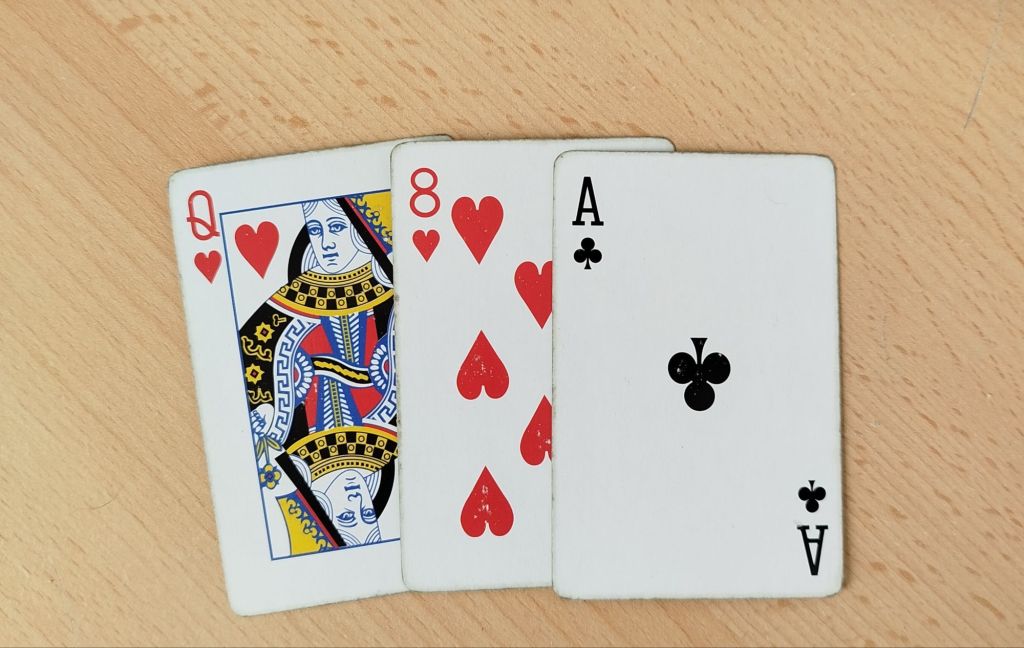
Before visiting the place I drew three cards to investigate, and these cards came up:

A water spirit – Cartomancy with playing cards

Obviously, the first thing to take note of is the presence of the Queen of Hearts, which is a motherly figure or a positive female entity. This is confirmed by the Eight of Hearts which can represent a water place, so in the context of an esoteric / magical reading it would represent a female entity of a broadly positive nature tied to water. The Ace of Clubs represents power, dominion, rulership. It indicates that the spirit has power over the place, so while she is positive, she is not the airy-fairy pushover type.

After doing the reading, I started researching local folklore. If you know of any such place near where you live, it may be wise to research local legends, as they often contain romanticized but accurate hints about the nature of the spirit.

What I discovered is that there is a medieval legend tied to the place, according to which a mother (!!!) once brought a local duke a basket of vegetables, in exchange for having a new irrigation system dug near where she lived. This irrigation system became the pond. There is no narrative reason why she should be characterized as a mother. Her being a mother serves no purpose in the legend, which makes it a very important hint in understanding the spirit: she is essentially motherly.

“But” you may be wondering “this is an artificial pond, how can it be magical?”

We must not draw strict boundaries between the world of humans and that of the great powers of nature. What we know from the legend is that a water spirit wanted to establish herself in this place and convinced the humans around her to cooperate by being motherly and nurturing toward them, and the humans were intelligent enough to accept her offer. There is nothing strange about this: in actuality, humans cooperate with nature all the time.

Note how the reading hints at a spirit that is positive (Queen of Hearts) but not submissive (Ace of Clubs). Had she been a difficult spirit she could have simply flooded the zone. There is altogether too much mischaracterization of water in the spiritual and magical community as something weak, vague and mystical. Water can be devastatingly powerful, so it is a good thing our local water spirit is a positive member of the community.

MQS

It Was Me All Along (Reading Example + Update)

Sometimes it is hard to predict your own future even while interpreting the cards correctly. In the past month, whenever I drew cards for my general future or to answer personal questions, I kept receiving this combination:

A♥ – K♠ – 6♠

The order of the cards changed, but they were always present, and if you’ve had a look at the meanings I use, it is quite clear that they refer to a health-related issue in the home.

This is where making assumptions is deadly: I know that my dad, being old, suffers from quite a vast array of issues, so I assumed the cards were talking about him.

Nope: it was me. Yesterday my wisdom teeth started screaming bloody murder in my mouth, so much so that I haven’t slept a bit. At 8 in the morning I dragged myself to the dentist, where I was given an appointment for tomorrow, likely to get those teeth pulled. This is probably going to be the longest 24 hours of my life.

Interestingly, the cards do not put my significator next to the combination of the doctor, so all I could say was that there would be a health issue at home, and I am, of course, part of my home.

NOTE: it is also fascinating that the teeth started aching exactly on the day before I was going to start a particular ritual work. This is not seldom the case: as soon as one approaches magic the whole of existence plots revenge.

MQS

What Makes Readings Go South

A recent comment by a visitor of this website has inspired me to write an article about what makes divination go south, whether it’s card reading or something else. I have already shared one or two readings I got wrong, but in the future I would like to share more of my hardships as well as my successes, for two reasons: 1. it gives a fairer representation of how divination works and 2. it doesn’t discourage those who are studying the material I provide (I often get messages from people despairing they will ever be good diviners)

The reality is that divination is a human activity, and like all human activities it can go wrong. In a world where lawyers, scientists and doctors can be wrong (and not seldom), it’s unclear why we would expect fortune-tellers to be infallible.

There can be a variety of factors that make a reading go south. Here’s a bunch, in no particular order.

The querent is too emotionally volatile

Usually, the querent’s attitude doesn’t matter that much. However, it has been my experience that when a querent is in a state of utter and extreme desperation or emotional volatility, they will skew the reading in one direction or the other. This is rare, but it does happen on occasion. Once a friend who was looking for a job and was absolutely desperate asked for a reading and he pulled ALL spades. He still got a job around a month later. The cards were just reflecting his emotional turmoil.

Emotional involvement is also usually not good when reading the cards for ourselves. My personal experience is that if I read for myself about a topic I don’t care too much about, the reading will be largely accurate, while if I read about something I care very much about, the cards will show me either what I hope or what I fear.

Note though that there are divination tools that work better when the querent is very emotionally involved. This is the case, for instance, for Horary Astrology, where there are no counters to manipulate and therefore a relatively strong emotional push is required for question and answer to align.

The reader isn’t grounded enough

This is more common. Divination is not an assembly line type of occupation. We are dealing with a world that is, in a very real sense, divine and that eschews the mechanic and repetitive.

The diviner needs to be relatively at peace with themselves before performing a divination. I say ‘relatively’ because we don’t need to always be at our best (otherwise we’d never be able to divine). Certainly we need to be capable of detaching at least momentarily from our deepest worries and hopes. Fits of ecstasy and cheap mysticism are also to be avoided, as the best attitude is one of sober helpfulness toward the other.

There are some partial exceptions for ‘inspired divination’, such as mediumistic spiritism, but I don’t cover these topics on this website as I avoid these practices like the plague (I had a distant relative who was an excellent natural psychic and ruined her life in her attempt at constantly staying in the required state of passive receptivity).

The reader simply doesn’t always interpret the medium right

This is obvious, and I’ve talked about it at length, but it bears repeating. Divination is a language with no native speakers. We must learn it as if it were a foreign language. or, if you are romantic about the universe and think divination is our original language, then we must relearn it, but the end result doesn’t change. Like with all secondary languages, we are bound to make mistakes.

The best we can do about it is strive to correct our mistakes and be upfront with our querents that we are not offering miracles but just help in widening their view of their own life, of where it’s coming and where it’s directed.

Drawing wrong conclusions from right premises

This is another important pitfall, and it is a particular variety of ‘not reading the medium right’. As diviners we must understand that certain things can be changed and certain things can’t. Most divination tools are very upfront about it. If they say the thing you want cannot be achieved, then it cannot be achieved (unless we are interpreting the medium wrong, see above). If it says the thing you want will fall in your lap, then it will fall in your lap. Period. But if the medium says what you want is hard, it doesn’t mean it’s impossible, just as when it says it’s easy it doesn’t mean you’ll achieve it.

As diviners, sometimes, we feel we must give our querents more certainty than we are entitled to give them based on our divination tools. If the querent wants to become a writer and the cards show that writing comes easy to them, it doesn’t mean they will become a writer if they don’t put in the effort. Usually, in such cases, the lack of effort does come up in the cards as a warning, so that the prediction will sound like: you are very talented, but unless you actually spend time honing your craft, you won’t amount to much. This, too, is a valid prediciton.

All in all, we must be careful to distinguish what the medium says from what we want to tell the querent.

MQS

A World of Odd Coincidences

Yesterday I was cleaning in my office. I took my playing card deck (the one I use for divination) and was about to put it on the windowsill to dust my desktop, when it fell to the floor and the cards went flying in all directions.

So I gathered the cards without thinking anything of it and went on with my day. Later on I realized that one of the cards was the wrong way around: the Six of Spades, the sickness card.

Around an hour later my husband was on the phone with my mother-in-law, when she suddenly started slurring her words and being unable to move one side of her face. Fearing a stroke, we immediately called an ambulance and they were there a few minutes later.

We are still not sure what it was, but it was thankfully gone. She seems to be doing fine now, but the paramedics told her to remain in contact in case the situation presents itself again.

It is a good thing that we were on the phone with her when it happened, and I find the way the cards forewarned me endlessly fascinating, though I didn’t put two and two together until after the fact.

MQS

Regina Russell’s Answer Spread (with Example Reading)

The Answer Spread was popularized by Regina Russell in her Card Reader’s Handbook.1 Here, Russell details a system of fortune-telling by playing cards that is different from mine, but still quite interesting as a reference. She also gives examples of some spread layouts, including a small one to answer specific question.

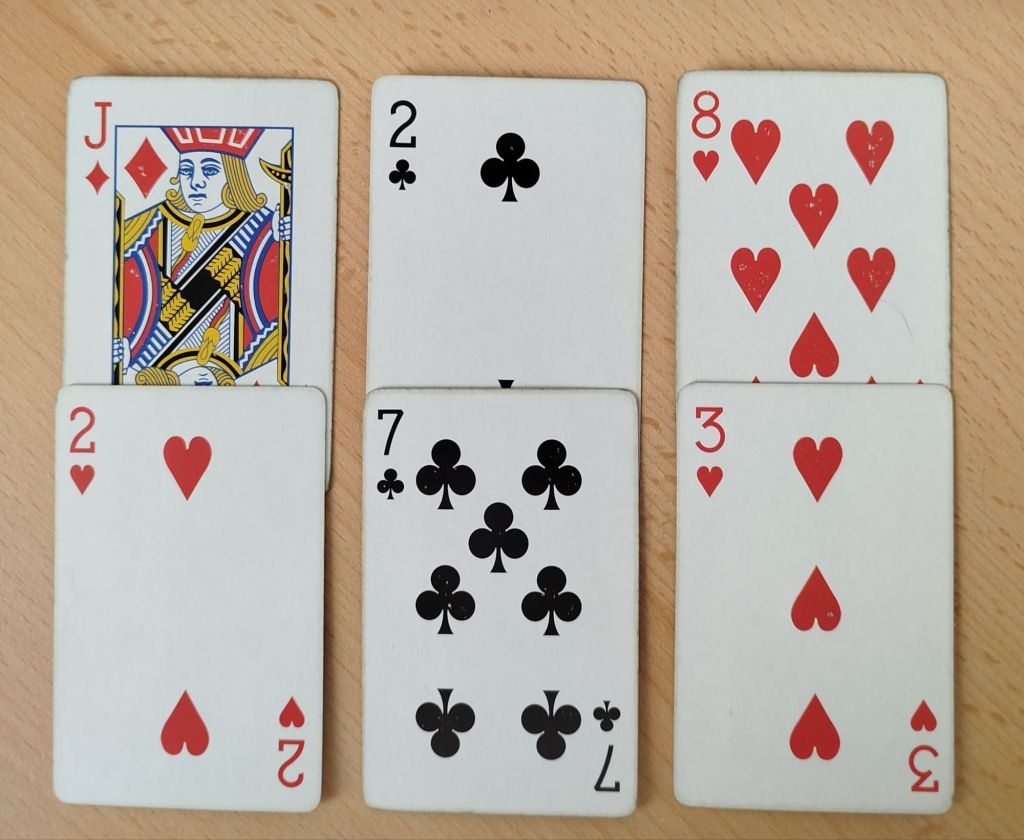
I have rarely used this spread, but I added it to my repertoire just for variety, and I have found it to be quite reliable. You’ll need to shuffle or have the querent shuffle the deck after formulating a clear question. Then, have the querent take out six cards from the fanned out deck (or pull them yourself, if you’re doing a phone reading). Lay the cards out in this order

123
456
Layout for Regina Russell’s Answer Spread

Russell explains that the cards are read exclusively in columns (1-4, 2-5, 3-6). Each column has a different meaning: the first (1-4) indicates the background of the question or the current situation; the second (2-5) answers the question; the third (3-6) adds information about the answer. The sixth card can on occasion be of special importance and may contain the answer or some information on which everything hinges, but I have generally found this not to be the case.

As you may have guessed, this is a very short spread to receive information quickly. Here is an example from the recent past with my husband as a guinea pig: his birthday was approaching and he wanted to know relatives would drop by unannounced to celebrate. These were the cards (note that I am not using Russell’s meanings, but those I am familiar with):

Will there be a surprise visit? Regina Russell’s Answer Spread

Since the question is so specific, you have the right to wonder why he thought they would throw him a surprise party. If we look at the column on the left, the one that talks about background information, we have the Jack of Diamonds and the Two of Hearts, an exciting message or a message from relatives. I didn’t know this at the time of hubby pulling the cards, but in talking to his family on his family chatgroup there had been odd remarks that had made him suspect something was being prepared. So this is the background information we need to understand the spread.

The answer, however, is somewhat disappointing. There are steps (Two of Clubs) being taken, so something is indeed being organized, but the Seven of Clubs causes trouble.

If we look at the right column, where additional information is found, we see a party (Eight of Hearts) and a gift (Three of Hearts). If these two cards had been in the center column, the answer would have been positive. As it stands though, these cards merely explains what steps had were being taken. So the answer is no, they won’t come on the day of his birthday.

It turned out that they did not come, though his brother would have liked to and was making plans for, because his mother was still recovering from a minor operation she’d had: this is the problem (Seven of Clubs). However, looking at this spread, I wouldn’t be surprised if a little celebration did take place next time we get together.

MQS

  1. Which you may buy here if interested. I’m not affiliated with them, I just think the book is a good reference to have. ↩︎

Answering Airy-Fairy Questions… Meaningfully (Example Reading)

As someone who advocates a grounded approach to divination, you’d expect me to scoff at questions that deal with more philosophical or spiritual themes. But this is not so. Airy-fairy is in the eye of the beholder, or rather, of the reader. Just like many airy-fairy readers can drown concrete topics in a deluge of commonplace spiritual-but-not-religious buzzwords, so can a grounded reader approach complex, ‘soulful’ topics from a grounded standpoint, while always following what the oracle says.

Someone asked me what was the goal of her current incarnation. Right off the bat we are confronted with a dilemma: firstly, the question presupposes that there is such a thing as reincarnation, which I don’t believe (at least, not in a sense that is compatible with what most people think of as reincarnation);1 secondly, it presupposes that this happens with a goal.

The first problem (reincarnation) we may circumvent by simply asking what’s the goal of the querent’s life. The second question (the goal) is trickier, but as I show in the example, it is not unanswerable.

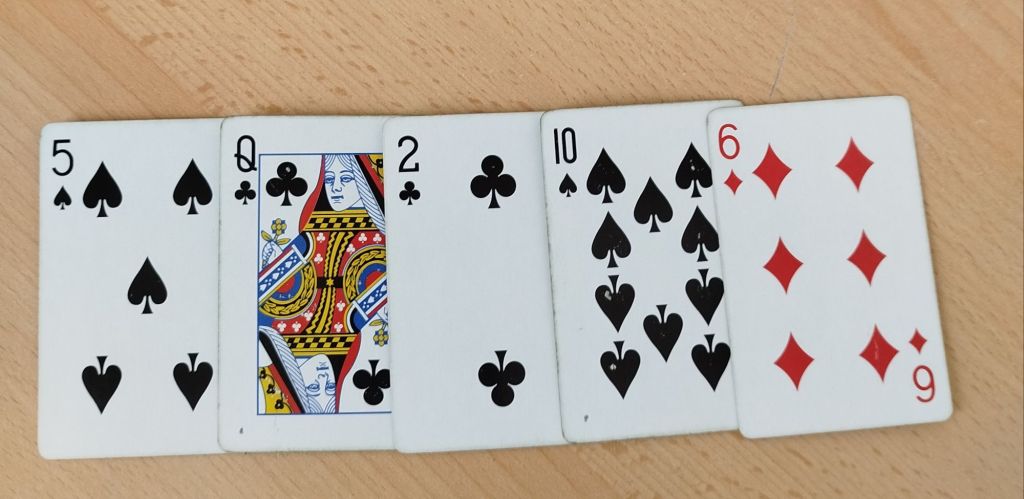
What is my life’s goal? Playing card divination

Since we have absolutely nothing to go off on, we can start by noting that the querent’s significator shows up (the Queen of Clubs), though not in a very good spot. She comes after the Five of Spades which is the card of sacrifice, imprisonment and the inability to move. So we can already sort of guess that the querent is feeling trapped in some form or another.

The spread ends with the Six of Diamonds, which represents worry, insecurity and the like. Often it shows financial problems, but not necessarily: it can be a card of general nervousness and uncertainty. The spread is now starting to reek of psychological hang-ups.

Usually, the Two of Clubs after a person card indicates the person taking steps. Toward what? Toward the Ten of Spades. This is the card of secrets, of the night and of unknown situations.

At this point I asked the querent if she’s someone who never leaps into unclear, unknown situations. She said that that was one of the things keeping her from enjoying life, since she always prefers to avoid risk or put off taking it until she feels prepared, which is never.

Bingo. This is the answer: she must learn to step into the dark, take risks and be ok with not having everything figured out. She must learn to swim by swimming rather than by reading up on how to swim. If she doesn’t do it, she will spend her whole life by the poolside waiting for every condition to be perfect.

So, have the cards talked about the purpose of the querent’s whole life? You may disagree with me, but I don’t think so. I do not think that this is the purpose of her whole life (I think there is much, much more to anyone’s life), nor do I think that this is the reason she was born or has reincarnated (if you believe in reincarnation at all). And I told the querent as much, in the spirit of transparency.

What I do mean is that, at least at this juncture in her life, this is a recurring pattern that weighs her down and that needs addressing because it influences her general quality of life. That’s already enough to be worth being mentioned by the cards.

Ultimately, almost every airy-fairy woo woo question is the voluntary or involuntary corruption and modernization of some kind of longing that is deeply seated in the human soul. Questions about the purpose of one’s life may be often answered with the usual mix of mind body spirit platitudes, but the human desire for purpose is not to be lightly dismissed, whether the purpose is really there or not. And divination can address this desire in some form or another.

I believe that divination should be able to run the whole gamut of the human experience, from the most concrete questions to the most abstract, because this is the extension of the human soul. The problem arises only when we try to reduce one order of problems (Will I the chicken cross the street?) to another order of problems (What kind of psychospiritual drama do you think caused the chicken to want to cross the street?)

MQS

  1. I will probably discuss it more at length in another section, but my belief is that there is only one, universal soul that is constantly incarnating and reincarnating through everything. ↩︎

Is He Coming Back? Example Reading

This is a super-quick reading I did for a friend of a friend. She doesn’t believe in the cards, which is fine, but decided to try them by asking a silly question. She asked if her ex would come back to her. Here are the cards:

K♣️ 3♣️ 10♥️

On the surface of it, the cards seem positive: they show the man she’s asking about, they show a union (the Three of Clubs) and they show happiness (the Ten of Hearts).

Unfortunately, what the cards seem to be saying is that he has a marriage going on, and he is happy in it. When I told the querent, she confirmed that they haven’t spoken in years and he is married and has children.

This is not the first time someone asks me a fake question, either purposefully or out of self-delusion, and it is not rare for people to ask about old sweethearts who have moved on.

It goes without saying that we, as diviners, must always come to terms with our finitude and fallibility, but the more the querent is deluded or insincere, the harder it becomes to interpret the cards. This time I was doubtlessly lucky that the cards came up very clear.

NOTE: if the querent had told me that the man she was asking about is not married, then I would have asked if they had just broken up. In this case, the spread would have probably meant that their relationship was still going on strong, and that the break-up was something so fleeting the cards didn’t feel the need to describe it.

MQS

The Ethical Limits of Prediction, Between Girly-Pops and Caring For Others

I had a quick but interesting exchange of emails with a reader of this blog, and they asked me my perspective on the ethical side of prediction. One of the questions was if I share the belief that we shouldn’t answer questions that don’t directly relate to the querent and their actions, especially if they involve reading other people’s mind (e.g., “Is he thinking about his ex?”)

The Three Types of Diviners

First off we must recognize that, nowadays, there are many diviners who do not even think that prediction is possible. Then there’s those who think it’s possible but not desirable. And then there’s those who think it’s both possible and perfectly legitimate. If you know me, you can guess which camp I belong to.

The one thing almost all diviners of almost all strands can agree on is that divination should leave the querent with more information than before the reading took place. It is the nature of the information that is controversial. Many (most, perhaps) contemporary diviners believe the information should be of a mystical/ethical nature and should guide the querent’s action rather than foretelling future events or things the querent has no control over, such as other people’s thoughts beliefs, which is seen as prying. The idea is that to do otherwise is to disempower the querent by putting the center of power outside of them.

To which I say: We are not discrete atoms living each in its own self-made, self-referential reality, no matter what the manifesting girly-pops on Tiktok say. The center of power is not within us, at least not in the sense that most people think.1 We exist enmeshed in an infinitely complex chain of actions and reactions, and our degree of control over them is objectively limited.

We seek to steer our life through the chaos of existence by levereging the information we have, including our knowledge of what (we think) other people’s beliefs and motivations are. In so far as divination gives us information and knowledge, it helps us increase the degree of control we have on our life (though this control can never be absolute). As such, it is perfectly legitimate to want to know what other people think.

The idea that we can only tell the querent what to do as a discrete, atomized individual is faulty for a variety of reasons. As said, the first reason is that we are not atoms. Only first world people with first world problems can seriously believe such postmodern crap (try to go to a starving child in a war zone and tell him he just needs to manifest harder). In reality, how other people think and act has very much to do with how the querent will or can behave, and so the querent’s expectation of being told such information is understandable.

The Two Should’s

The second important reason is that the idea itself that there is an objective cosmic measure of how we should act which the diviner must relay to the querent is silly. How people should act is between them and their god, and diviners are well advised to stay out of it instead of trying to play the role of ruler-wielding metaphysical pep-talkers (whenever you find someone who acts like this, run! Those who can live their life, do. Those who can’t, become life coaches.)

The word “should” has two different meanings: technical (“you should take the bus now if you want to get there on time”) and moral (“you should think about those less fortunate than you”). In the first sense, divination has some use, but only in the sense that the diviner, after assessing the situation as it emerges from the cards or chart, and taking what the querent hopes to achieve into consideration, gives them advice (I’ve talked about this here). In this sense, knowing what someone else thinks can be valuable (“he is not thinking about you and he won’t for the foreseeable future. Maybe you should start thinking about putting yourself back on the market”).

From a moral standpoint, divination’s use is very limited and it can become a dangerous tool of delusion or deceit. Example: “Should I have an abortion?” there is absolutely no way of answering that question. Some quick research online will show that there are all kinds of stances on abortion, ranging from believing it should never be had even if it means the woman will lose her life to believing it’s a moral duty of every woman to have one to stick it to the system, with a variety of more moderate solutions in between.

Since there is no consensus, such question essentially translates to “what is your stance on abortion?” Why you should regulate your life based on the personal moral beliefs of someone shuffling pretty cards on the internet is a question the answer to which is probably found somewhere in California.

“But isn’t divination a form of communion with the divine? Shouldn’t the divine know what’s right?”

Divination is most definitely a form of communion with the divine, but the idea that God has any kind of moral preference is, as far as I am concerned, questionable. People tend to patch their idea of God together from their moral and political prejudices. Somehow the God of the reactionary is always a hillbilly and the God of the revolutionary is always a hippy.

Divination lets us partake of a small share knowledge that one would usually get only if he were God, but this knowledge is very practical and is a tight condensation of that which happens, has happened or will happen in real life: Dante, in describing God, imagines it almost as a compressed version of all that happens in the created world, apprehended in the single blink of an eye.

The above doesn’t mean that it is always wise to answer any question the querent puts to us. “Is he thinking about someone else?” can be two very different questions depending on whether it is being asked by a person looking for closure or by a crazed monomaniac bombarding the diviner with the same query over and over. That divination tends to attract a less conservative clientele is not an earth-shattering revelation, so we do need to exert caution in choosing the questions we are comfortable answering.

Caring For Others

My one guiding principle is that divination implies care for another human being. But what does ‘care’ mean here? Does it mean caring for their ‘evolution’?

Well, no. First off, I think it is very questionable that the concept of evolution should be applied to spirituality. It is generally brought up to make pseudospiritual gibberish sound scientific–it’s a trend that dates back to the XIX century–yet those who use it end up employing a concept of evolution that is more Lamarckian (the giraffe stretches its neck to reach the leaf, thus evolving) than Darwinian (the giraffe born with the shorter neck simply starves, thus ridding the gene pool of its inadequacy, and can do nothing about it), and therefore completely unscientific.

Secondly, again, who am I to tell the querent what the next step in their evolution is supposed to be, especially since there is no consensus on objective standards? Divination can point out shortcomings in the querent’s behavior, but not in a moralistic sense. The cards, for instance, can say, “he left you because you tend to spread your legs more than a ballet dancer” but that’s a mere explanation of the causality behind an objective situation: Y derives from X. The cards are no bead-clutching confessor and I don’t aspire to be one either.

For me caring for another human being means seeing them in their struggle to reach their goals and offering them a bit of additional information that they are at liberty of using or leaving. The main question I ask myself when asked to do a spread is: am I offering information? In the example above of “Is he thinking about someone else?” the person looking for closure is asking for information, while the monomaniac isn’t. It is that simple.

I will certainly talk more about the issue in the future, but I think so far the main point is that divination is a tool for intelligence-gathering. As long as it offers intelligence it is a form of communion with the divine. If it doesn’t, it reinforces destructive trends and is best avoided, but this depends less on the question and more on the querent’s attitude.

MQS

  1. From a philosophical standpoint I can accept the idea that the ultimate reality resides wholly within me, but if we accept this, then it is present just as much inside everything else, including in the people and situations that make my life miserable. ↩︎

Folklore of Italian Cartomancy

Cartomancy has a rich tradition in Italy. It was believed until some years ago that cartomancy had been brought to Italy by Napoleon, but then some cartomantic meanings dating back to before the Napoleonic period were discovered, as well as even some scattered early modern literary references to tarot as a tool for fortune-telling in Italy.

Cartomancy (i.e., divination by cards) has always been a Folk tradition, as opposed to Astrology, which required an advanced knowledge of math. Therefore, the practice of cartomancy was always mingled with odd traditions, beliefs and superstitions. Here I gather a couple of folk anecdotes that were passed down to me and that I later discovered to be widespread. I don’t share these as rules (they aren’t) but only as interesting bits of trivia.

The Cards Must Have Been Used to Play Games

The cards were always originally used as game counters (including tarot). No esoteric woowoo. When I first started learning to read playing cards, my teacher told me to get a deck that was “giocato e bestemmiato“. This literally means, a deck that has been played with (giocato) and that players have used swearwords and profanities over while playing (bestemmiato).

This may sound curious, but it is a widespread belief among Italian fortune-tellers. I don’t have a definitive explanation for why this is so, but I do have a theory: the Church has always condemned card games as tools of the devil, because they caused people to gamble away their money (which they ought to give to the Church) and it tarnished their soul because it caused them to use swearwords and profanities.

When fortune-telling evolved out of card games, it was of course equally condemned as witchcraft and devil-worship, as it was believed that the devil moved the cards to form the messages. Therefore, some card readers must have believed that the cards that some people had used to play while using profanities had already acquired some kind of demonic connection with hell that made them work better (note that profanities are an important part of some strands of Italian witchcraft).

A more angelic variation of this belief is that the cards must have been used either by a virgin or by children, due to their purity.

Although I don’t think the cards have anything to do with demons, I must confess I always use used decks, simply because they feel better when I touch them.

The Little Spirit In The Cards

There is a widespread belief among old-time fortune-tellers that the cards work because they are inhabited by a little spirit or sprite that moves them through the reader’s hand (traditional folk beliefs in Italy, as well as around the world, tend to have animistic undertones.) Not only this, but it is believed that, in each deck, one particular card is home to the little spirit. For instance, in some Italian playing decks the spirit is said to inhabit the Ace of Swords, where a little angel is depicted.

In the regular playing deck, it is said that the spirit inhabits either the Ace of Hearts or the Ace of Clubs, depending on the tradition. My teacher also seemed to believe that, in the Sibilla deck, the spirit resides in the Peacock card, probably due to its esoteric connection.

Needless to say, it is widely believed that if the card inhabited by the spirit is lost or destroyed this is a portent of bad luck.

Passing Down The Meanings

In many Italian traditions it is said that the meanings of the cards must be passed down excusively either on Christmas Eve or in the week preceding Easter. The same holds true for many magic formulas. But don’t worry, the cards work regardless of when you learned to use them.

Knocking On The Deck

Possibly a consequence of the belief in the little spirit in the cards, many fortune-tellers have the habit of knocking on the deck before dealing out the spread as a way to respectfully ask the cards to speak the truth. I have preserved this habit from my teacher: I always knock three times (some even say seven) before dealing out the cards. It’s not that I think the cards wouldn’t answer anyway. It is just a tip of the hat to my tradition.

Paying For Consultations

There are, as usual, two contradictory schools. One says that readings must absolutely be free. The other, more common, is that readings must absolutely be paid to avoid incurring bad luck. This latter belief probably comes from the fact that cartomancy was a popular way for women to make some money, especially in the countryside, and this often led them to become both respected and feared.

Honestly, it was much more common for the old cartomancers to be paid not with money but in different ways: a chicken, a jar of preserve, a pie, some free repairwork. Cartomancers of old became integrated members of the community by offering their advice in exchange for other people’s goods and services.

Clearly, doing free readings is not really problematic from an esoteric standpoint. I’ve been giving free readings my whole life and I’m still alive. I’ll probably soon start offering paid reading from this site and I don’t think this will interfere much with my fate.

The Ace of Hearts

As in many systems of cartomancy with playing cards, in Italian cartomancy the Ace of Hearts is the house. There are many traditions connected to it. One of these traditions is that some fortune-tellers will have the Ace of Hearts blessed by a priest (if the priest is against such practices, then the Ace of Hearts is simply slipped under something else that the priest will bless) and then put somewhere in the home for protection. Usually this somewhere is next to the entrance door.

Leg-crossing

This isn’t exclusively Italian, but still interesting. Some fortune-tellers believe the querent should never cross their legs during the reading. While I don’t really believe this, the interesting thing is that in some countries, during the Middle Ages, judges were encouraged to cross their legs when ruling so as to avoid external interference. Fortune-tellers clearly want the querent to be energetically open, and so encourage the opposite.

MQS