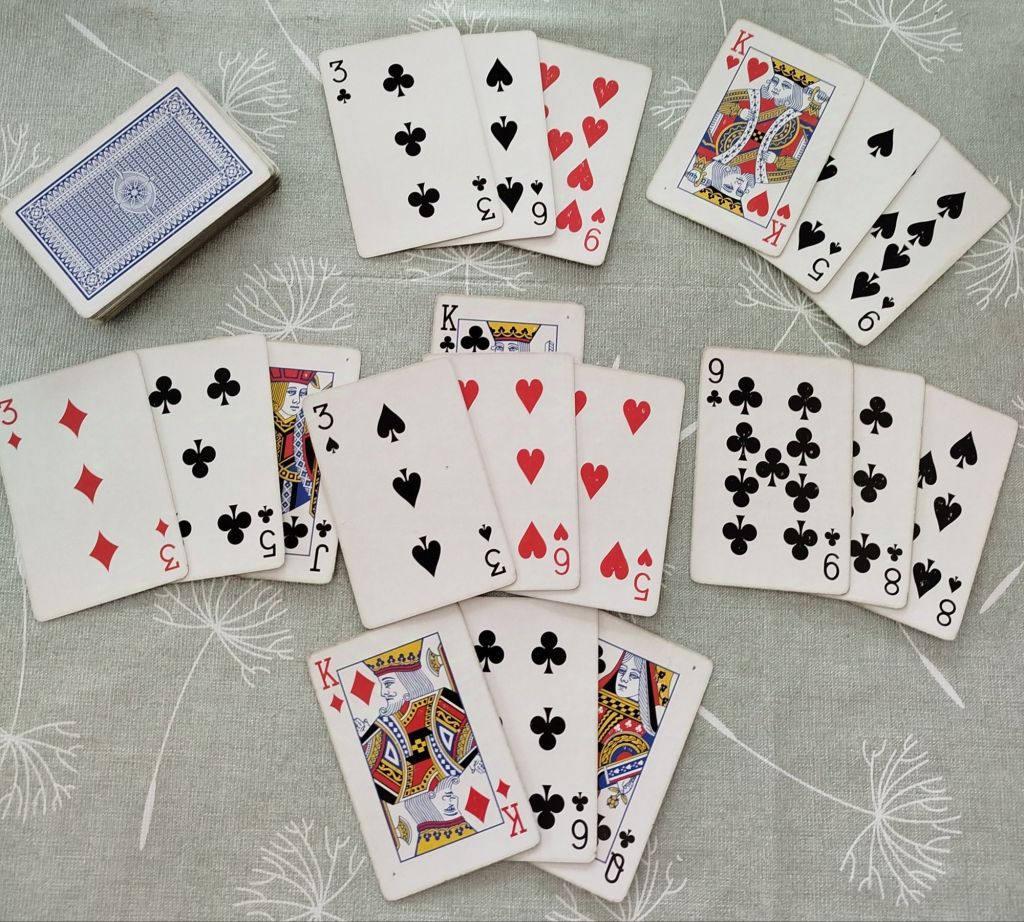
When I was taught to read playing cards, the cross spread was presented to me as a general spread. However, over time I discovered that it can also be used to answer specific questions of a general nature, or simply to explore certain compartments of the querent’s life. Here is a recent spread on a male querent asking about his career:
A career cross spread. Divination with playing cards
To summarise the main meanings of the various fans:
Left: past-present
Center: in the heart, sometimes present
Right: present-future
Above: thoughts, would like
Below: dislikes, problem
To the side: future/answer
The cool thing about larger spreads is that sometimes we can just identify a single spot that answers the question clearly, and everything else gives details that may or may not interest the querent. Here, the clear answer occurs in the right spot: 9♣️ 8♣️ 8♠️, which translates as “for a long time the job will give the querent tears”.
Now that we have identified a clear sentence, let’s fill out the details. Since the sentence is quite negative, let’s look at other negative spots. In his heart, the querent has the 3♠️ which brings difficulties, complications etc. But it is followed by cards that bring hopes of a solution (the two Hearts). Clearly there has been something that caused the querent to start hoping.
Now look at the fan above: he would like a contract (3♣️) that gives him happiness (10♥️). Between these two cards we find the sickness card (6♠️). This could indicate that it is a vain hope or a sick hope, one that is not grounded in reality. On the left we see that he has a small income (3♦️) but works hard (5♣️ J♣️) so it’s not that he doesn’t deserve job security. Below we see a difficult situation with a man that might be his boss or a superior. Clearly he is not the teacher’s pet (the Q♣️ simply shows that the querent’s troubles reflect badly on his love life).
The final fan unfortunately robs the querent of all hope, although it argues that there will be help from a man. To dig deeper I should have done another spread. As it stands, the detail is quite vague.
They are the bane of many a reader: Court Cards are seen as difficult to read, in part because they clearly represent people, and so refuse to be banished into the realm of woolly platitudes inhabited by way too many readers, in part because locating them within the querent’s life can be objectively difficult.
In cartomancy with playing cards, however, the inherent signification of the cards can help us: The Queen and King of Clubs are almost always the main protagonists (the querent and his/her significant other), though there may be exceptions. I know of cartomancy systems where the querents are represented by the Heart suit, but this is just semantics.
Then we have the Heart court cards, of which the Jack is a child, a pet or something fresh and immature and small and the Queen and King represent people close to the querent’s heart. This is actually a modern interpretation: traditionally, they would be people sharing the querent’s bloodline, but modern times require modern solutions. I have found that the Heart courts can simply indicate very dear friends. For gay people, usually the significant other is a Heart card of the same sex, although occasionally the cards simply use the Club cards. We need to stay open. The Jack of Clubs can indicate friendship, help, cooperation.
The Diamond suit represents people usually unrelated to the querent, though they can indicate relatives by marriage. More usually, they show colleagues, acquaintances, bosses, rich people or people who have a more neutral or even cold perspective of the querent compared to the Hearts. The Jack of Diamonds usually represents a message.
Finally, Spades show people who are downright inimical to the querent, or who wield power over the querent’s well-being and enforce an objective set of rules, such as the police, doctors, judges, etc. This is especially the case for the King. The Jack can represent enmity, scheming, etc.
All Jacks can indicate children or very young people, though in practice this is more likely with the Jack of Hearts.
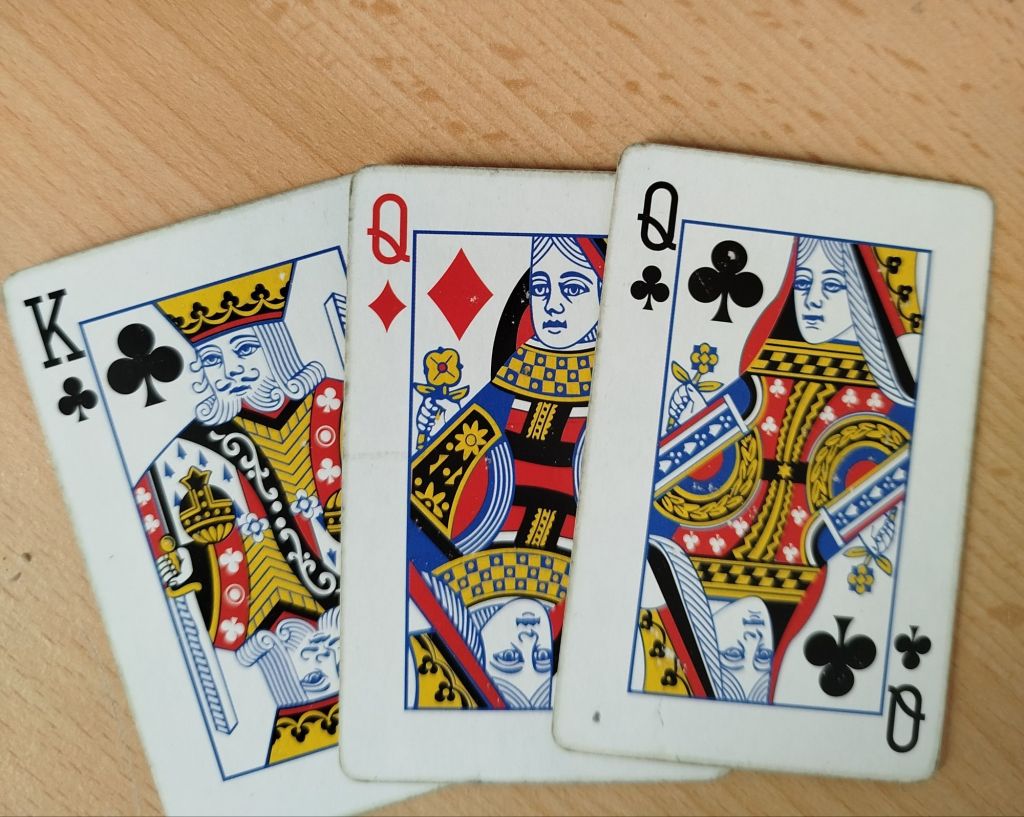
Usually, one court card within a reading is already more than we can tolerate, but sometimes we find that there are ONLY court cards. This is an example of a reading a did yesterday for a man who asked about his relationship:
A marriage-related three-card spread
When more than one court card shows up, it is important to look at the cards between them, as they show the nature of their relationship, or what’s between them.
It is easy to jump to conclusions here: there’s a woman between you two! You have a lover! This could very well be the case, actually, but it is always important to keep in mind that, with so few cards on the table, more than one interpretation is possible. Here are some possibilities:
There could actually be a woman between them. He may have a lover (or, more rarely, she may have a female lover)
It might be a threesome
There could be a woman who interferes but who is not a lover: it could be her mother, her friend, any other person.
There might be a person mediating between them in a positive way
He might know her from work or from a business context, since sometimes, two queens or two kings together can represent a single person, merging the qualities of two suits.
So, how do we know which interpretation applies? Well, first off, we ought never to play Nostradamus: in doubt, we ask. This may sound unimpressive, but our aim is not to impress, but to give accurate information. Still, with experience, we may rule out a couple of possibilities as being less likely:
This is a simple three-card spread. If the querent were in some kind of odd polyamorous arrangement, the cards would not lead off with three court cards, but by telling us the querent is weird. This may sound politically incorrect, but the cards are keyed to a rather traditional view of the world. This doesn’t mean they are a compass of morality: it’s just their language. They highlight the strange and untypical in rather clear ways. Three court cards together aren’t strange enough.
This is a simple three-card reading. If the querent had a hidden lover they would tell us the relationship is in danger, or at least they would highlight the lover by assigning her to the Queen of Spades rather than Diamonds (The Queen of Diamonds can be a lover, but it requires more hints from the surrounding cards). Even the Queen of Spades wouldn’t necessarily be a lover, but at least we’d know she’s trouble.
This is a simple three-card spread. If there were a positive influence mediating between them, the cards would have given her to the suit of Hearts, or they would have omitted the information altogether and told us the querent and his significant other are in a positive phase (the mediator isn’t that important, and a three-card spread only has space for what’s important).
With that in mind, I asked the querent if he knew his girlfriend from work or from a business context, and he denied this. I asked him then if there was a woman causing some issues between them. He smirked and said: “A friend of hers doesn’t like me, she’s trying to break us up.”
Obviously, this spread doesn’t tell us how it’s going to end. It just describes the situation rather than how it will evolve, and more cards should be drawn.
I’m taking inspiration from a question I got asked recently to talk about an important topic in cartomancy. Sometimes (in fact, many times) the cards appear contradictory, with positive and negative cards mixed together. The question I was asked is, which cards prevail in the reading.
Before starting the interpretation, it is usually a good thing to get a general look at the cards to see the ‘tone’. Are they mostly positive? Are there places in the spread that seem difficult? Are there cards that answer the question directly? You don’t need to come up with the interpretation right away, but it’s good to be aware.
However, this general bird-eye view is not enough. Usually, in cartomancy, we read the cards from left to right as if they were a sentence, stringing the meanings together. Therefore, as a general rule, 5♥️ – 4♠️ is worse than 4♠️ – 5♥️. In the former case, the abundance is broken or blocked, while in the latter case the brokenness and blockage are overcome.
In this sense, it is important to pay attention to whether the negative points in the spread come at the beginning, in the middle or at the end, because. Even if there’s two negative cards out of five, if they come up at the end they can obstruct success. If they come at the beginning, it may be a passing problem.
Again, though, let us avoid purely mechanical rules. Suppose a five-card spread is all positive and shows the querent getting what he wants, and then at the end there is one negative card. This card may show not failure, but that the fulfillment of the wish comes with problems. In these cases it is always good to either add cards or do another spread.
Similarly, the cards are entirely negative and show failure, a single positive card at the end doesn’t necessarily show that the querent will get his way. It could be showing that there will be new opportunities. Again, additional cards or a new spread may be warranted.
When we ask a question and a card directly connected to it comes up in the spread, it is always important to look at the cards surrounding it, especially if they are of the same suit, and even more important are the cards following it, because they will show us what will happen to the significator of the question.
For instance, if the question is about a pregnancy, the 5♥️ followed by positive cards is encouraging. If the question is about work, the 8♣️ surrounded by Spades could show serious problems or even unemployment. In a marriage question, the 3♣️ surrounded by Hearts shows a loving union.
These are rules of thumb. Every spread is unique and must be judged on its own merits and in its own structure.
I’ve already written a couple of articles on unanswerable questions. Some of them are unanswerable for logical reasons, others because they ask about something on which no objective standard of measurement exists. Some are also unanswerable for ethical reasons (“Tell me when is the best time to rob the bank.”)
But occasionally someone comes along who asks a question that we instinctively feel is unanswerable, yet we can’t put our finger on why. It’s happened a couple of times to me that someone would ask me something to the effect of “Will I ever be happy?“
Obviously no one whose life is coming up roses would seek out a diviner of all people to ask such a question. These queries are put to the cards or the skies in a moment of weakness. My experience in these situations is that the cards behave in one of three ways. They:
Show the cause of the person’s unhappiness rather objectively, and whether the problem is likely to be overcome over the next few months (usually not)
Are generically very negative, without a specific sense to them
Are generically very positive, without a specific sense to them
In the first instance, the cards usually show the problem not getting resolved, not necessarily because it never will be, but because the person is still knee-deep in it. The fact that they chose to frame their question in such tragic terms tells us that, whatever the nature of their problem, it goes beyond its specific objective nature and it has wounded the person in their soul.
Extreme care is advised in dealing with people in such a state of difficulty. They come to us broken and they should, at the very least, not leave even more broken. Furthermore, it is not unlikely that they have started consulting many diviners, obsessively asking the same question in hopes of getting a magical solution to their issue dropped in their lap. It would be good to advise them to stay away from divination for a while, unless we are capable of pointing out a solution they haven’t thought about, which unfortunately is rare.
When the cards are generically positive or generically negative, they are merely reflecting the person’s state of confusion: the bleakness of their outlook or the irrational hope for unexpected redemption. I don’t think there is much that we can do in such situations, except telling them that their upset shows in the cards and that, life being a succession of phases, even this one will pass. Sometimes, in such situations, talking to them in our quality of human beings is better than talking to them in our quality of diviners. In extreme cases, having a hotline number handy may be helpful.
Really there isn’t much sense in asking this question except to torture ourselves. We as diviners should know this when asking our own questions, but many people don’t, so it’s best to be prepared.
Here’s a quick one I thought was interesting. A querent wanted to know if her boyfriend would propose to him. This is the reading:
K♣️ – 3♦️ – J♥️ – Q♣️ – 2♣️
Notice that the two querent cards both come up in the reading. They are separated by the Three of Diamonds and the Jack of Hearts. I didn’t think the Jack could represent a literal child, but to be on the safe side I asked the querent and she said they have no children. If they did, it could have shown a relatively loose relationship but with children.
The Three of Diamonds represents small projects within the couple. It is not negative, but falling next to the querent’s boyfriend it made me think that he was still a bit immature (especially with the Jack) or at least that he didn’t have big projects in mind. However, we find the Queen followed by the Two of Clubs which represents some steps taken. To me it looked as though she would be the one to take action, either proposing herself or pressuring him to commit further.
What ended up happening is that the querent fell pregnant and told the boyfriend she wanted to at least move together. They are apparently making arrangements to find a place, and an engagement may be on the horizion in the next few years.
Could I have foreseen the pregnancy? Maybe, with the Jack of Hearts so central to the spread. Still, it didn’t feel like a pregnancy spread (and after all it wasn’t even the question).
What I find interesting about the spread is how it describes the nature of the querent’s relationship and who wants to take it to the next level
I’ve already discussed why I don’t do readings on public events and public figures, but it largely boils down to two reasons: 1) it would merely serve my ego 2) I would just be adding to the useless spectacle of divination being paraded around as a form of silly entertainment.
But something interesting happened that made me chuckle a little at the simple complexities of life. I heard from a friend of mine for whom I had done a short reading before she went back to the USA, where she resides. This was an unfocused reading, done more for fun than seriously. These were the three cards:
A♦️ – 3♦️ – 9♠️
Most people can guess that this spread was about money, and loss of money more specifically. With nothing to go off of, I simply warned her about the possibility of losing a small amount of money, as she would get news about it. She was rather perplexed as she wasn’t expecting anything of this kind.
Well, it turned out she had betted money on Harris in the presidential election.
So, am I saying that I predicted Trump’s reelection? Of course not. When I did the reading I had no idea it could be referring to it, especially since I don’t keep up with American politics that much. All I predicted was bad financial news for my friend who, unbeknownst to me, had a horse in that race, but life has a way of weaving the most disparate threads together in way we cannot foresee. Life is always a system if circles within circles, the smaller within the larger, by the hermetic principle. And the more I practice divination, the more I am grateful for the unpredictable side of things.
The spread used for this reading is a spread of thirteen cards that I’ve learned from the person who’s teaching me to read the Bologna Tarot, and it is typical of that tradition. It is a small tableau of cards that is generally used to explore a single issue (though nothing forbids you to use it for general readings.)
1
2
3
4
5
6
7
8
9
10
11
12
13
There are several traditions varying from town to town. According to one, the cards are to be read in columns only, with one indicating the past, one the present and another one the future. My teacher however reads them primarily in rows, though sometimes columns can be read too, and usually, the central column holds some importance. More often than not, the last card is especially important because it will either contain a general answer or give you an important detail, or determining factor.
Although this spread is especially linked to the Northern Italian tarot tradition, I’ve seen it used with regional playing cards as well, and I don’t think there is any reason why it wouldn’t work with any deck tradition you practice. I will certainly use it with the Sibilla as well, one of these days.
Will She Learn to Love Herself?
The querent in this case is an acquaintance of mine, but the question was not about her, but rather about her sister. The question was “Will she learn to love herself?” and it came with no further detail. This is fine, as often when a querent feels the need to talk there is a risk that they end up feeding me their perspective. So here are the cards that came out:
Will she learn to love herself? Divination with playing cards, thirteen-card spread
Right off the bat, we notice that the significator for the querent (the Queen of Clubs) is present, so since this is a tableau we might as well look at the cards surrounding it. She has the Jack of Hearts, the Queen of Spades and the Eight of Spades above her. These cards could mean a number of things, such as problems with a daughter or problems with an immature woman, or problems in the person’s childhood. Let’s file all this away and move on.
Next to the Queen of Clubs we have the Nine of Clubs and the Six of Clubs, which represent long-term toil and struggle. Clearly, whatever this is, it is not something that is going away soon. But the spread ends with the Nine of Hearts which indicates triumph. There is light at the end of the tunnel.
Technically, we already have our answer: the querent’s sister will struggle with self-love a long time, but she will improve. But the cards tell us more. Let’s turn to the first row, where we find the Queen of Hearts hemmed in by Spades. There is some kind of blockage or problem (Four of Spades) that causes the shedding of tears (Eight of Spades) relating to a woman (the Queen of Hearts).
Usually, the Queen of Hearts is either a relative or someone with our best interest at heart. In this case, though, she is strongly afflicted by the Spades. So I asked the querent if the issue relates to the sister’s poor relationship with her mother or another female figure close to her that impacted her self-love negatively. The querent confirmed that their mother was a raging alcoholic who worked overtime to tear them down when they were little. Note how the cards highlight the cause of the sister’s suffering by placing it right on top of the spread!
Right underneath we have the Queen of Spades, the Four of Clubs and the Five of Diamonds. This line was a little cryptic, and I must confess I did rely a little bit on my intuition, but the interpretation was still logical. There is a woman of spades who is saying words (Four of Clubs) that cause change (Five of Diamonds). Who is this woman? Usually the Spade suit is problematic, but it can also indicate certain professional figures (doctors, military figures, judges, etc.) It stood to reason that this figure could be a female therapist that is helping the sister. I asked and the querent confirmed to me that the sister is seeing a female psychologist who “means business but is very competent” (Spades).
The line just above the querent contains the Jack of Hearts, the Six of Hearts and the Three of Spades. This time I felt confident interpreting the Jack of Hearts as the sister’s “inner child” or, to avoid woo woo terminology, it represents the issues accumulated since childhood. The Six of Hearts talks about healing, and the Three of Spades indicates intrigue, but also in the metaphorical sense of a knot, something that needs to be unravelled or clarified. For the time being, therefore, the sister’s issue will persist, but the final Nine of Hearts is promising.
Not every question is fit for divination, and as diviners who get approached by people, discernment and, if necessary, gate-keeping is among our rights and duties. I say this not because I want to feel part of a superior caste of priests, but because our practice should be informed by two great principles: the well-being of our querents and the honor of our art.
It is perfectly fine to ask questions out of mere curiosity or for fun, but the ultimate decision on whether a question shall be put to the cards rests with us. I, for one, have dodged more questions about controversial politicians in the last couple of weeks than in the last couple of years altogether, largely because the question, when boiled down to its essential meaning, was “Is it true this politician I hate is a spawn of Satan?”
Such questions are unanswerable not merely because they are idle, but because they are ultimately unverifiable: unless you are that politician’s cleaning lady you have few ways of verifying my answer. Furthermore, consider this: if my answer is anything except “yes, you’re absolutely justified in your hatred,” the person is going to be inclined to dismiss my answer as superstitious nonsense. Why, then, whould a positive answer be of any value?
But unanswerable questions are not just those that belong to the “is it true that my particular preferences are absolutely valid and I don’t ever need to question them?” category. Some are more tragic. Recently I got asked something heart-breaking: “Is my life still worth living?”
No matter how we slice it, THIS is an unanswerable question, which doesn’t make it a meaningless string of sounds. On the contrary, it is a clearly formulated cry for help. As someone who has been struggling with depression since my teen years and has gone dangerously close to the edge on more than one occasion, I resonate strongly with it. But the fact remains that divination is not the tool to solve this issue.
I refused to open the cards on this question, obviously, but suppose I had, and suppose that, predictably, the cards had shown me the absolute mess that is this person’s life: does this make their life less worth living?
There is no answer. In this case, not because we cannot verify the details (I could easily point at the cards and say “your career is in shambles and your family life is a museum of red flags”) but because the reality of the situation has no bearing on the answer. Worth is subjective. The exact same set of circumstances that might drive someone to walk into a lake with stones in their pockets would be taken by someone else as life throwing a little challenge their way.
Therefore, in this case the question would translate as “What is your personal opinion on what makes life worth living and do you think I still meet those criteria?” I don’t think anyone would be foolish enough to even consider taking such a responsibility for themselves.1 It is much wiser to talk to the person, encourage them to open up and direct them to an appropriate source of (medical) help.
Again, though, the fact that the question cannot be answered does not imply that there isn’t a deep, real, visceral experience behind it. It is just that divination is not the way to go. It is like asking a pair of scales to measure whether you are pretty.
MQS
Furthermore, people in a seriously distressed state are especially prone to esoteric influences, and would to better to avoid them, even if it’s just a simple card reading ↩︎
I’m currently visiting my parents in Italy, so I’m going to keep this short and sweet. I lost my keys. As I probably already mentioned, I hate lost object readings because they are incredibly difficult to decipher, but I figured it wouldn’t hurt to try. The cool thing about playing cards is that most people have them at home. This is the reading that came up:
7♠️ – 8♥️ – 10♠️ – 2♦️ – J♦️
If I had to tell you I understood this reading I’d be lying. The one thing that seemed clear to me is that it was in a place made for people (Eight of Hearts), so the living room was an option, though it seemed strange, since I always keep my keys in my old bedroom. There were also those two diamonds indicating messages, which I didn’t understand.
Well, it turned out I suddely lost (Seven of Spades) the keys the previous evening (Ten of Spades) during a dinner (Eight of Hearts), and I was contacted by the owners through a friend of mine who knows them.
A couple of weeks ago I received a message about the question of whether we, as readers, risk causing self-fulfilling prophecies with our predictions. For instance, if I tell a querent that the relationship she is in is going to end, I may end up causing the break-up. What follows is a slight elaboration on my response.
First off, we need to recognize that some things we can change or at least improve, others we can’t and they will happen regardless of what we do and what a reader tells us. Most people who go about their life with their brain switched on can recognize this. It is only when we get into delulu territory and body-mind-spirit-section pseudomysticism that we encounter people who deny the existence of unavoidable happenings.
On the other hand, sheer fatalism is also a gross misunderstanding. Consider simply this fact: if two people X and Y are exactly the same and go exactly through the same life experience, except that X also uses divination or consults a diviner, this is enough to tell them apart.
The fact that X knows about what is going to happen in advance is enough to make him a different individual, which in turn is enough to change the nature of his fate, because our ability to change a situation is contingent on our knowledge of what the situation truly is. Even if X cannot change a certain fact in any meaningful way, but knows about it enough in advance that he can make his peace with it, the same event Z won’t be the same if X’s attitude toward it changes, because X is part of the event that takes place in his life, and so if X change, the event changes. Even if X cannot bring himself to accept Z, his knowledge of Z is enough to change Z, because X with knowledge of Z is not equal to X without knowledge of Z.
Fate patterns are a difficult topic to tackle without a previous sound philosophical and occult discussion, and I plan on starting that discussion at some point, once I’ve organized my notes. For now, it suffices to say that we, as readers, can play a rather important role in the querent’s life if we are consulted at the right moment.
Yet, this doesn’t mean that we are capable of empowering querents to always turn their life around, and I don’t even think empowering is our mission: our mission is to provide information. On a number of occasions, especially when I was less experienced, I gave querents the wrong prediction on purpose because I didn’t want to disappoint them, even though the cards were clearly negative: Yes, you’ll get the job, yes the relationship is going to last and be wonderful. But it didn’t happen.
On some of those occasions you may even think that because I didn’t bring up the negative aspects, the querent wasn’t prepared to tackle them, so my not bringing them up may have been just as bad as another diviner handing out negative predictions willy-nilly. That’s because I wasn’t able to give accurate information.
It is nice that some things can be changed even if some things can’t, but unfortunately we don’t always know which is which. Therefore, we must also recognize that we have a degree of power over our querent just by virtue of using odd, mysterious counters to give our predictions, and we must not abuse this power.
Whenever possible, we should either frame our predictions as potentials and/or accompany them with positive suggestions. These suggestions, though, must ALWAYS be based on what the oracle describes, never on vague self-help platitudes. Sometimes (many times) it is best to highlight critical points so that the querent can become conscious of them (e.g., “you know, this relationship is headed down a pumpy road. You should address x, y and z if you want to try to make it work”) while avoiding drastic predictions unless necessary.
Furthermore, we must never frame our predictions in such way as to take away all hope. It is not our right to do so. Deluding and disillusioning are the two capital sins that we must avoid, even though striking the right balance is sometimes hard. There is plenty of space between being a pushover to our querent’s wishes and being an insufferable sassy tough-love prick.
If there are positive aspects to a situation, we should emphasize those and try to put them at the center of the querent’s life so that they can address the negative points more positively.
Finally, we ought to always remind our querent that diviners are people and are therefore fallible. In a world where doctors, lawyers, judges, scientists and bakers can get things wrong it would be absurd to expect diviners to always be right. Always encourage the querent to take your predictions as an additional input.