Category Archives: Playing Cards

Why I Don’t Do Horoscopes, Taroscopes Or Interactive Readings

Some weeks ago I got asked why I only present readings I did for myself or others, and don’t do interactive readings which may be useful to more people. The question was asked in good faith and in good faith I answered. But I thought it made for a nice article. As usual, I will be brash and abrasive, because I’m not an easy person, but I mean no disrespect to any particular individual.

Horoscopes. In reality, horoscopes are more the invention of journalists than of astrologers: astrologers just unwittingly lent themselves to the farce. Horoscopes are predicated on the fundamental misunderstanding that the place the Sun occupies at birth automatically has something to say about us. This is a relatively modern invention in the long history of astrology, and anyone who thinks about it seriously for even five minutes must conclude that, in order to say anything at all about one twelfth of the world population purely based on their month of birth, one needs to water down everything one says to the point that nothing is said at all except playing into the belief that everyone is adorably quirky (oh those Aries boys who ram through everything, oh those Gemini girls always being nutty). That some astrologers, realizing this, feel the need to add Moon signs, Rising signs etc. into the equation does not improve matters at all: a fundamentally silly idea multiplied by itself remains silly.

Taroscopes. Taroscopes are an even more modern invention. They substitute or complement the reading of a sun sign chart with a broad card reading (usually tarot, hence the name). They started popping up on social media some ten years ago as a way of feeding the sludgeflow of nonsense that is required to keep the algorithm satisfied. I am pretty sure they started out as a silly game, then some saw that it was good for business. I am even aware of established readers who haughtily denounced taroscopes for the travesty of divination that they are, only to bend the knee once it was clear the current flowed in one direction only.

Interactive Readings. Interactive readings are the height of silliness, and the perfect exemplification of the words ‘internet slop‘. Choose between Deck One and Deck Two and listen to why he doesn’t deserve you because you are such a special, intuitive an free-minded queen. Choose between the butterfly and the butter knife and listen to why all the narcissists in your life hate you for being such an authentic empath (somehow those buying into this nonsense are always surrounded by narcissists, yet they are never narcissists themselves). That’s the essence of interactive readings as a further development from taroscopes.

The reality is that divination is already hard as it is, being an imprecise and complex art due to the amount of factors to be considered and the fallibility of humans in considering them. Trying to extend it to a whole swath of people who randomly happen to bump into your video or post is beyond ludicrous.

In attempting to justify this to themselves, some readers are eternally caught between two stances: “if you bump into it, it is meant for you” and “if it doesn’t resonate it’s not the right message”, logic being the first thing to fly out the window once someone decides to be a brave and empowered little witch. Of course you’ll always find someone who responds to an interactive saying “I chose the butterfly. That’s exactly it, that’s me to a T”. And those are the unlucky ones, because they get roped into a world of self-delusion and meaningless hype: the universe seems to be constantly cooking up something big for you, according to interactive readers, so you better stick around for the next video!

So yeah, that’s why I stick to traditional readings.

MQS
Frenzy or Stillness? – The Appropriate Behavior in Divination and Magic

The way we do things, the way we say things, matters. The same apologetic arguments we find in Blaise Pascal’s most feverish and haunting pages would be enough to bring a doubter to conversion, yet when coming out of the lips of a cheap street preacher holding a sign, they are often received with distrust, when not with disgust.

The way we do and say things matters in occultism as well. The old texts of magical tradition, and even some old accounts of rituals and supernatural occurrences, are full of the frenzy-stillness dichotomy: some things seem to happen in a state of ecstasy, others in a state of torpor.

My path, both as diviner and as occultist, has been informed by the pursuit of stillness more than by that of frenzy. All the teachers I’ve had the honor to learn from have always required of me to reach a state of calm rather than one of heightened overexcitement.

In divination, there is always a moment of randomness required in order to break the barrier between what the personality thinks it knows and what is actually the case. Arranging the cards (or geomantic points, or whatever) consciously in the order we wish they would come out may teach us something about ourselves, but very little about the reality of a situation. Randomness ensures that our self-consciousness doesn’t interfere with the process of allignment between oracle and reality.

Whether through a frenzy or through calmness, randomness introduces itself into the process by bypassing the limits of our personality’s structure, with its limits and its biases. The choice between the “inspired” moment of frenzy and the “deadened” moment of calm rests on a partially different view of the relationship between individual and whole, between ourselves and the divine.

Ecstasy, which is the process of leaving oneself behind, occurs in both cases, but it occurs differently. By achieving a drunken confusion one simply rams through the walls of one’s personality, achieving contact with what is outside of it. By stilling oneself, one reaches the point within one’s core where individual and divine coincide.

Obviously, once each option is brought to an extreme, it bleads into its opposite. Pure frenzy becomes absence of limits and therefore absence of what is limited, and its movement resolves itself in calm. Pure calm is delivered from all difference from change, so it coincides with pure frenzy.

MQS

Psychological Hang-Ups of Diviners and Querents

When a person sits in front of a diviner, a number of preconceptions have often already been set off in their mind, and sometimes even in the mind of the diviner.

We must always remember that, nowadays, many people don’t visit an astrologer or card reader by chance, nor (usually) as their first go-to choice. Often, they have made a deliberate choice to step outside of the norm, for better or for worse, meaning that they have found the norm to be lacking in its ability to provide certainty. For many, therefore, the underlying presupposition seems to be: “I accept to take part in something that operates outside of consensus reality as long as it gives me the certainty I can’t find any other way.”

As diviners, we instinctively know it, and we may feel pressured to play into this presupposition or swim directly against it, thus falling into the opposite error.

Some diviners may feel they need to provide the querent with the unreasonable all-knowledge that only God can gift them with, only to end up providing uncertain information with unreasonable confidence. Others may push in the direction of vague self-help: We may not know if Mr. Right is behind the corner for our love-starved querent, but her divine feminine or other buzzword can still derive important lessons and “aha moments” from reflecting on the whole situation.

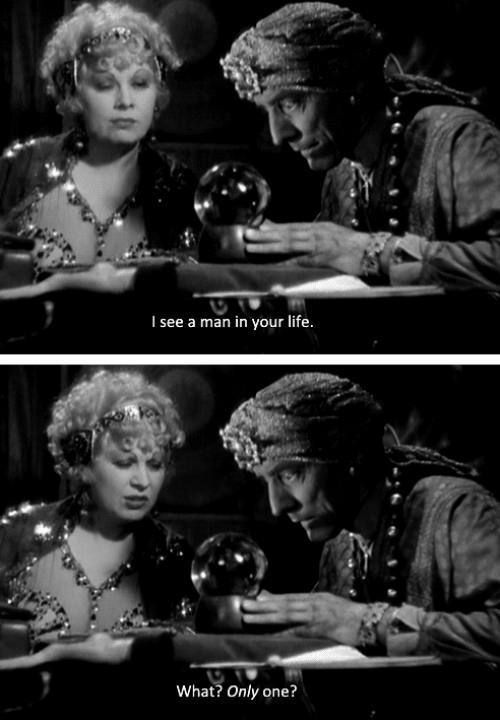
Mae West said it best. Picture by Sophie Charlotte on Pinterest

There are many dimensions to divination, some of which are indeed very deep. However, as far as our relationship with querents is concerned, we are simply an added means of intelligence-gathering, which, like all tools at our disposal, may fail for a variety of reasons, not the least of which is the diviner’s limited knowledge (our knowledge is always limited).

“But I came here to have undebiable, clearcut answers,” one might argue. To which I anwer: Tough titties! If you want undeniable clearcut answers shake a magic eightball. Divination is, quite literally, a divine language, and is not always so cleacut, either in itself or due to our limitations, or sometimes simply because the situation isn’t clearcut in itself. This is especially the case for issues involving human emotions.

As a rule, honesty is the best policy. I believe in voicing my procress to the querent, and the querent has a right to as clear an answer as I am capable of giving them, but we should never feel pressured to give them more certainty than we can truly see in the oracle.

It is perfectly acceptable to talk to the querent about our doubts or about the possible interpretations we are seeing in the oracle. For instance, it is ok to say “it seems like x, but y is also a possibility, while z seems less likely and w is out of the question.” It is also acceptable to say “these cards seem to point to such and such being the case, but I’m uncertain, as this other interpretation might also be right”. More often than not, the querent will say that both interpretations apply, and when this is not the case they can help us disambiguate the oracle.

Ultimately, the fact that divination has no legitimate place in our society implies as a consequence that, because our society believes itself to be held together by reasonable rules and processes, then divination must be either complete poppycock for delusional idiots or it must be capable of unreasonable fits of prowess in other to justify its existence in spite of its current ostracism.

This in turn creates expectations and hang-ups on both ends of the divination process that need to be analyzed and clarified to avoid them subconsciously ruling our practice. Doing so can make divination much more valuable and much more enjoyable.

MQS

The Hothead (Example Reading)

If you ever happen to receive a comment from someone whom the cards describe in the following way:

2♠️ – 6♦️ – 2♣️

you can safely flag all their future comments as spam. Their actions (Two of Clubs) presuppose (behind) a volatile and unstable temper (Two of Spades – Six of Diamonds). It is someone who is simply looking for a target to live out their idiosyncrasies depending on the fixation of the moment.

MQS

“Christening” The Significator – In Folk Cartomancy and “High” Divination

There is a tradition in Italian cartomancy (and possibly in other forms of folk cartomancy as well) that concerns the so-called christening of the querent’s significator. This is possibly done in order to have the divination be more certainly about the querent who comes for a reading.

Some systems, like my system for reading playing cards, have a fixed significator for the querent (the Queen or King of Clubs),1 while others (like the Vera Sibilla) do not. Either way, once the significator is known, a small magical operation takes place to connect the cards to the querent. This is what is called ‘battesimo’ or baptism/christening of the card.

There are many traditional ways of doing so. One is called ‘getting the card drunk‘ and it consists in taking the card that represents the querent and rotating it seven times (some say three times) while repeating the querent’s name each time. Another one I’ve seen used looks more similar to an actual christening, and it consists in again taking the querent’s significator and drawing a small cross symbol on the figure’s head with one’s thumb while saying “You are *name of the querent*”. There may be other systems I’m not aware of.

The practice of using a significator has largely fallen out of favor in modern tarot practice, mostly because reality has fallen out of favor with too many tarot readers, who no longer aim at describing it. This is not to say that a good tarot reader necessarily uses significators (I know some who are really good and don’t use them), but significators are a reminder that the tarot pack is a microcosm of reality, and reality contains actual people. Interestingly, many people recently became aware of the concept of significators because of traditional fortune-telling is experiencing a small resurgence.

However, it is noteworthy that the Golden Dawn and its offshoots and representatives, who greatly influenced modern tarot, did use significators. For instance, Waite recommended to select a significator even for the Celtic Cross in his Pictorial Key to the Tarot. The traditional Golden Dawn spread, The Opening of the Key, hinges on selecting a significator and counting and pairing the cards from it.

The Opening of the Key instruction recommends a brief ritual that serves to make the divination valid. This is not exactly the same as the christening I talked about, because it usually involves targeting the whole pack rather than just a card. However, I have seen GD diviners who take some time to connect the significator to the querent.

This is especially interesting to me because it shows a correspondence between folk magic and high magic (which is a distinction I don’t believe in, since ‘high’ magic is usually high only in the sense that it is practiced by people who are often high, and not just on their own farts). In part, this is because the GD, in his attempt at preserving and consolidating the whole Western tradition, often took folk traditions very seriously. In part, however, I believe that there must necessarily be such a correspondence, in as much as many streams often come from a single original spring.

MQS

  1. Same goes for the Bologna Tarot, where the Queen and King of Wands are the significators ↩︎

In The Name Of Love (Example Pyramid Reading)

Yesterday we had a nice reunion with some friends. One of them asked the cards if she has a shot with her dance instructor, whom she’s crushing hard on. These were the cards:

6♣️ – Q♣️ – 10♥️ – 9♠️
K♣️ – 10♣️ – Q♥️
A♥️ – 3♣️
8♠️

The first thing that jumped at me was that nasty Eight of Spades at the end, which literally says “it will end in tears.” If we take the three angles of the pyramid, they are the Six of Clubs, Nine of Spades and Eight of Spades. Bleak.

My querent’s card falls on the first line, together with the Six, the Ten of Hearts and the Nine of Spades. If we were to read this line as a literal sentence, it would be “Coming from a place of fatigue your happiness there’s not“. In other words, my friend is not just single, but lonely, has been for a while and she’s unhappy about it. This is interesting, because it shows that her crush is more like a compensation mechanism.

Then we come to him, the King of Clubs, who is on a journey (Ten of Clubs) with a loved woman (Queen of Hearts) that leads to a house (Ace of Hearts) of union (Three of Clubs). He is engaged. The final Eight of Spades does not say that he is unhappy about the engagement, but that the engagement brings tears to the querent.

MQS

Understanding the Order of the Cards

One thing that I often receive messages about is how to understand the order in which the cards fall. Whether it’s the Vera Sibilla or playing card, there is one fundamental rule that applies in the majority of cases: later cards modify those that fall before.

Keep in mind that divination with cards is like the reading of a book, so the cards build the equivalent of sentences with their own grammatical structure. This is why I prefer to read the cards together rather than in isolation, as would happen in many contemporary positional spreads, where to each position corresponds one card.

In the tradition I come from, there can be positions, but there are always at least three cards, and sometimes five, covering one position. When we have two or more cards together, it becomes possible to “agglutinate” their meanings.

“Boy” and “run” becomes “the boy is running.” “Boy” and “friend” becomes “the boy is with a friend” or “the boy is a friend.” “Boy” and “Australian” becomes “the boy is Australian.”

Similarly, if we put two playing cards together such as the Three of Clubs (Union, marriage) and the Ten of Hearts (Happiness) they say: the marriage is happy. In the Sibilla, if we put the Ace of Club (Marriage) and the Four of Hearts (Love) together, it becomes “a loving marriage” or “a marriage of love.”

These are the first steps only. There are many more nunaces. However, the basic thing we must ask ourselves when interpreting two or more cards together is whether they add to each other or they contradict each other.

When they add to each other, the sequence in which they fall doesn’t matter that much (though it may add shades of meaning). “A beautiful girl” is roughly the same as “A girl who is beautiful.” But if we have “War” and “Peace”, saying “Peace and then war” is very different from saying “War and then peace”.

In the Sibilla, Fortune + Death is the end of fortune (literally, “the fortune meets its end”), whereas Death + Fortune is an end that brings fortune. Generally speaking, the cards falling after have the power to modify those that fall before.

That being said, divination is an art more than a science: we should never apply our rules so rigidly that we stop thinking about what the cards are saying. In most cases, in the Sibilla, Thief + Marriage has a similar meaning as Marriage + Thief: someone or something is interfering with the marriage.

Ultimately, each spread is a world in itself and the specific key to it must be found by following the clues that the cards leave behind.

MQS

Is Her Mental State Going to Improve? (Example Reading)

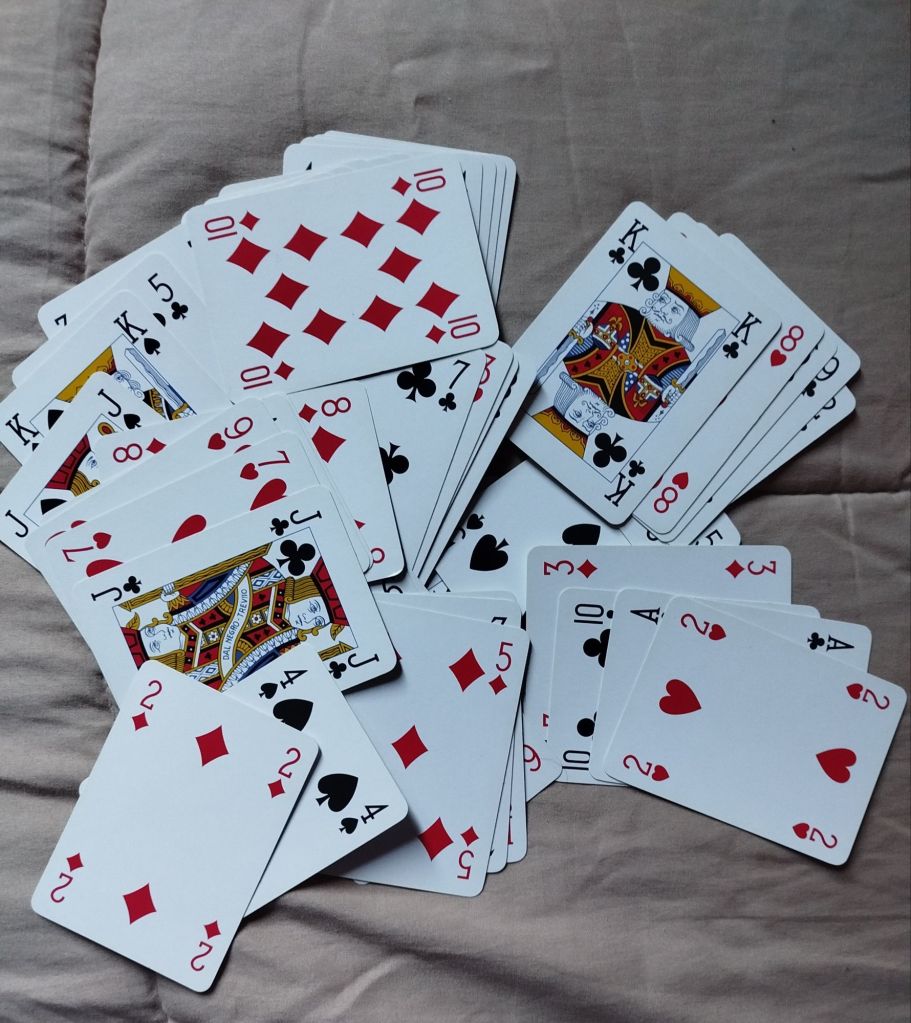
As you may have read in another post, I recently lost my dad. My mother has always been the worrier type, and taking care of him in this last period has exacerbated these traits. I’ve seen her not just depressed, which would be normal, but utterly confused. A couple of days ago, when I discovered my dad’s playing cards, I asked how her mental state would evolve, and if it would improve (I used this picture as header pic of that post):

Will her mental state improve?

There are two points in this spread that immediately jumped at me:

  1. The Two of Diamonds (2♦️) followed by the Four of Spades (4♠️). The Two is a card of communications, especially written, but it is also strongly connected with attitudes, mental states etc. Followed by the Four of Spades, it gives a critical point in her inner life.
  2. The Five of Diamonds (5♦️) squished between Spades. The Five of Diamonds indicates change, transformation, the ability to move on from one state to another. This ability is negated by the surrounding spades.

Clearly she has entered a rather dark tunnel. The following cards offer hope: the Two of Hearts with a Heart court card indicates someone close to us. It could be me, it could be my uncle. The fact that two hearts follow the Spades indicates healing. It may indicate that focusing on the family, especially me, is a source of positivity for her. It could show help from me and my uncle or other close male relatives and friends

The final two cards are the Six of Clubs and the Six of Hearts are interesting. If the 6♣️ hadn’t been present, the three consecutive Hearts would have shown full recovery from the problem. Tbe 6♣️ though, is a card of fatigue, tiredness and of things slowing down, and of problems that seemed solved resurfacing.

Therefore, as may be expected, while the 6♥️ promises improvement, the 6♣️ shows relapses and that scars will remain. I expected no less.

MQS

My Dad’s Cards

I’ve been helping my mom taking care of my dad’s affairs in the past few days. One thing that surprised us both is how bureaucratized death is. A pleasant surprise, on the other hand, has come in the form of my dad’s playing cards.

They are somewhat old, but it doesn’t show since they were rarely used, still they have the nice papery texture of old playing cards.

I’ve also found some interesting notes from back when I was learning to read them. I’ll be updating the playing card section when I’m back.

Handling Bad News

No matter what kind of divination we practice: if it’s worth its salt and is not just some feelgood angel therapy oracle, it has the potential to deliver bad news. How we handle bad news is a mark of how helpful we are capable of being as diviners.

People can come to us for a variety of reason. They may need reassurance, hope, advice or just a quick look ahead. They may even come to us for fun or curiosity, and as long as they are not disrespectful, there is nothing wrong in indulging them.

The principle of respect for our querent stems from seeing them as a whole person rather than a sack of meat endowed with more than its fair share of doubts. We, as diviners and as handlers of odd devices (decks, charts, counters of various kinds) hold a degree of power over them. It is symbolic power, for sure, but reality itself is symbolic (that’s how magic works), therefore symbolic power is real power, and must not be misused.

Finding the right balance between informing the querent and respecting them can be difficult. It’s all well and good as long as the cards talk about pleasant trips and job interviews. But occasionally we recognize messages that we know are going to deeply upset our querent.

Causing unnecessary anguish is a no-no, and there are things that cannot be said without causing unnecessary anguish (“You’ll die soon”, “You’ll lose the baby). Even less serious topics (at least, less serious than death), such as marital infidelity must be treated with caution. We cannot just destroy whole families willy-nilly simply because our cards seem to hint at untoward dealings.

We must also distinguish whether a querent directly asks for something or something unpleasant simply shows up in the cards. Usually, if the querent asks for something, we can be more forthcoming, if we can speak with tact. If they ask “Will I get the job?”, they need to be able to accept “I’m not infallible, but it seems they appear more inclined to go with someone else.”

If they ask “Is my spouse faithful?” and the cards show clear signs of interference, an answer like “Remember that I could be wrong, but there does seem to be someone who’s trying whisk them away from you. Maybe it’s time to have an honest talk and try to solve the issue.”

Incredibly enough, even some taboo topics may occasionally be addressed in this guise. For instance, there are plenty of non-morbid reasons querents might want to know about death: “Do you think my elderly father going to survive long? I want to be able to visit him one last time but the situation at home is just crazy.”

While we must not delude the querent, we have no right to rob them of all hope. Aside from the mantra “Remember I’m a fallible human being”, and even aside from potential advice we might sometime give the querent to soften the blows of bad luck, there are occasionally ways of preparing the querent for a difficult situation without hurting them.

“Is the pregnancy going to go alright?” This is a question I am become more and more skeptical of answering as time goes by, because there is no way of saying anything other than “yes” and still be able to look at myself in the mirror. If we do find ourselves somehow coerced into answering it and the cards are less than positive, the only thing we may say is something to the effect of “Yes, but remember to take it easy, and the cards are saying you should pay extra attention to the doctor’s orders.”

Where all else fails, human empathy is our last line of defense. Helping the querent even for just some minutes by sharing their burden is part of what we may have to sign up for when we choose the path of divination.

MQS