Category Archives: Playing Cards

The Door Knockers – A Deep Dive into Italian Cartomancy

In almost all cartomancy systems, Italian or otherwise, the Ace of Hearts/Cups is the house. Here the Sibilla is an exception, since it relegates the House to the Two of Hearts, although the Ace of Hearts still has connections to the idea of family and people living together. In the second most widespread Sibilla deck in Italy, which is the Sibilla Regionale, which uses the suits of the Neapolitan cards, the Ace of Cups is once again the house.

One thing I have so far never found in non-Italian systems, which on the contrary is very widespread in Italy, is the concept of the door knockers, also known as ‘close to home’. This is a meaning that is found in many regional Italian cartomancy systems, and keep in mind that almost everything in Italy is regional, since regions have a much older history as separate states than Italy itself, if we discount the Roman Empire.

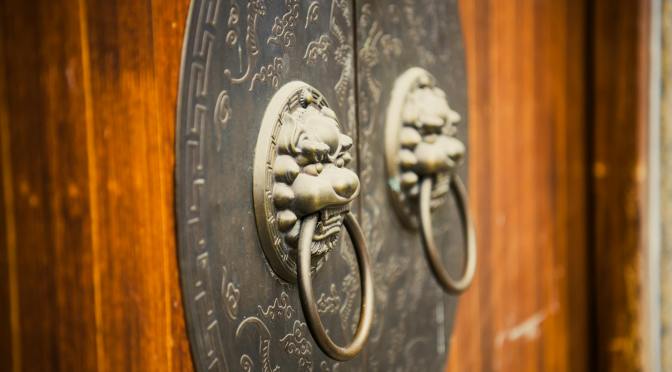
When I was taught to read playing cards, my teacher told me that the Two of Hearts is “al martel di porta”, knocking at the door. This refers to the way old house doors are made in many European countries, including Italy, where door knockers were used back when you couldn’t ring at the door. At least in Italy door knockers are still very much en vogue, though mostly as a decorative element.

The idea of the Two of Hearts as “the door knockers” is a reference to the fact that door knockers usually come in twos and to the fact that the Two of Hearts comes right after the Ace, which is the house, so that the Two is quite literally close to the home.

This meaning is also found in many systems for reading Piacentine cards, where the Two of Cups takes on that meaning (in some other systems this meaning is given to the Two of Wands) as well as in the Bolognese Tarot, where it’s the Ace of Swords that depicts it, due to the odd shape of the picture.

In some systems I am aware of, there are two distinct cards: the door knockers and the roof of the house. This is true for some systems employing Piacentine cards, where the Two of Cups is the door knockers and the Four of Wands is the roof.

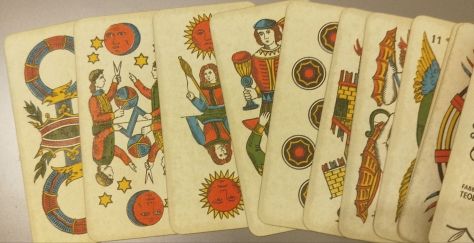
This distinction is also found in the Bolognese tarot, where the Ace of Swords depicts the door knockers and the Seven of Cups the roof of the house. In the oldest surviving system for reading the Bolognese tarot, which dates back to before the French revolution (I talk about it here), the Knight of Wands indicated the door knockers and the Ten of Cups the roof of the house. Clearly, therefore, this symbolism is deeply ingrained in Italian cartomancy.

According to the person who taught me the 45-card system of Bolognese tarot, the Ace of Swords, the door knockers, tends to show something close to home in a temporal sense (about to happen) whereas the Seven of Cups, the roof, is more connected to everyday life, to our close environment and to the protection of people surrounding us, as well as to the family in a more extended sense. Germana Tartari, who initiated me to the 50-card system, which she was taught by her grandmother and by some of her grandmother’s friends, uses the Nine of Cups as ‘the staircase to the house‘, again mostly in a temporal sense as something about to happen.

On the other hand, in the system for reading playing cards that I was taught, the Two of Hearts covers both possibilities: it indicates something about to knock at the door or it can show family situations, people who are close to us etc.

I have never found this symbolism in other non-Italian systems. If you did, feel free to drop me a line, as it would be very interesting. Manuel Arcuri, an American reader who was taught to read playing cards by his Italian grandmother, says somewhere that his grandmother called the Two of Hearts “l’attesa”, which means waiting or expectation, as of something about to happen. He doesn’t mention door knockers though.

Furthermore, many card reading systems I have read about assign the meaning of “within two weeks” to the Two of Hearts, which once again gives us the idea of something about to knock at the door. Interestingly, Regina Russell‘s playing card system uses the Two of Hearts to indicate excitement for something that is about to happen, expectation and even pregnancy (expecting a child).

MQS

Where the Court Cards Look

I was asked by a visitor if I take into account the direction court cards look. The idea that the direction faced by court cards gives us important details is ingrained in several strands of card divination. In recent decades it has even been appropriated by certain scam artists (like Jodorowsky and his various imitators) when trying to sell the Tarot of Marseille as a deep metaphysical tool rather than for what it has always been–a cheap gaming deck, which, like all tarot decks, is as good for divination as it is for playing at the local inn.

But directionality does have its place in certain legitimate divination traditions. It just happens not to be part of mine. I do not take into account the way court cards face when reading playing cards, as I have never found it useful or revealing.

To me, each card is a place-holder for a cluster of certain ideas that are called to mind when the card appears: the Ace of Hearts is a place-holder of a cluster of ideas relating to the home or family, and similarly the Queen of Spades is a place-holder for a cluster of ideas relating to problematic women or issues traditionally associated with the negative side of womanhood. In this cluster of ideas there is nothing inherently left-looking or right-looking. That’s just the fantasy of whoever drew the picture.

What matters most to me is not so much where the card looks, but in what relationship it is with respect to the other cards. Suppose we have:

Q♣️ – 3♣️ – K♣️

Here we have a typical sequence of marriage. Even if the two court cards were swapped, it would change nothing. Now let’s take:

3♣️ – K♣️ – Q♣️

This positioning of the cards may or may not be the same as the previous one. In itself it is just another sequence of marriage. But if it makes sense within the context of the spread, it could indicate that he is the one who is more attached to the marriage, because he falls closer to the card that symbolizes union. However, let’s now look at this:

Q♦️ – 3♣️ – K♣️ – Q♣️

Here it is very important that the King of Clubs fell next to the union, because through it he is united to another woman. This sequence shows that the female querent is the lover (it would be even more clear if the 10♠️ fell between the two Club court cards, as it would show that the married man sees the female querent in secret).

In all this, where the court cards face is of no consequence, because what truly matters is their dynamic interplay. That being said, I know of playing card traditions where directionality is taken into account and I have nothing against it. It just happens not to be part of my toolkit.

MQS

What Have I Done to Him? (Example Reading)

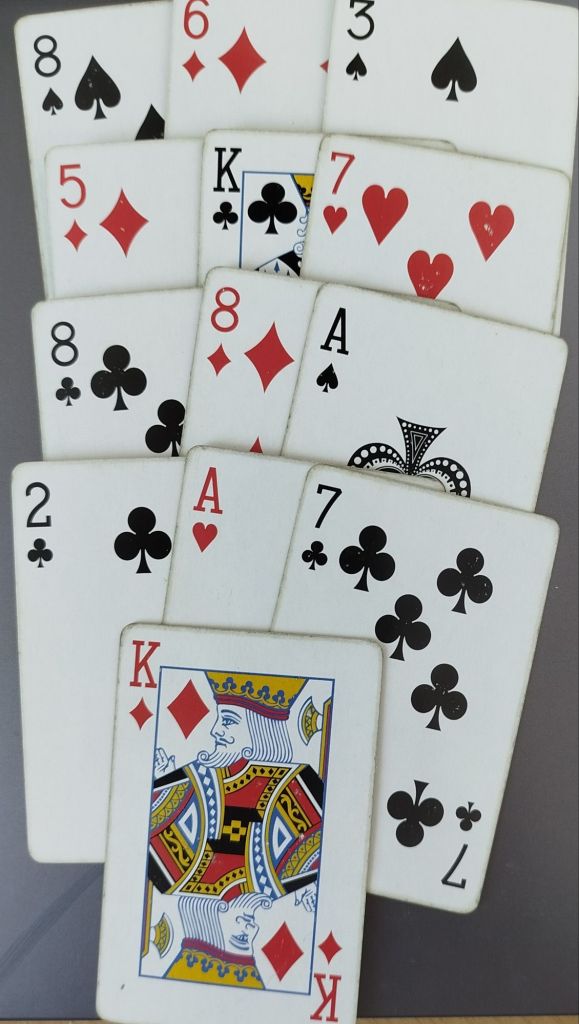
Here the querent is a friend of mine whose live-in boyfriend is acting aloof toward her. She was afraid that he was either having an affair or he was falling out of love with her, or that she had done something to him (he does have a tendency to keep things in until it’s time to explode).

Divination with playing cards: have I done something to him?

My querent doesn’t come up, so we can exclude that she has done something to him or that his love toward her is an issue. There is also a complete absence of mistresses, so we can immediately rule out that he is cheating, especially since there are no cards indicating sneakiness (like the Ten of Spades or the Jack of Spades). There is a Three of Spades, which might indicate intrigue, but clearly this is not what the spread is driving at, and the Three of Spades can also indicate a ‘knotted’, complex situation that doesn’t flow harmoniously.

His significator comes up in the second line, surrounded by cards that show positive development, so the situation is not permanent. However, the first line is a bit concerning, since we have tears, worry and the complex situation. Note that the worry card (the Six of Diamonds) is hemmed in by the spades, so it gives us a picture of the person being somewhat overwhelmed.

Then we have the two Eights and the Ace of Spades. As I wrote sometime ago, the Ace of Spades is often sterilized as a card of change, but at least in my tradition it shows great grief. The grief here is connected to cards of work and business, so this is the problem. The querent said that he doesn’t know if his temp job is going to be renewed. So that’s the problem.

Finally, to complete the picture, there is the house card with problems (Seven of Clubs) next to it. The steps (Two of Clubs) he takes at home (Ace of Hearts) are problematic, as a consequence of the issues shown in the cards above.

We have a final card, the King of Diamonds. We couldn’t identify him, although we suspect it’s either a colleague or a boss. We don’t know from the cards if his influence is positive or negative. It would require another spread, but it doesn’t matter since my friend’s worry was of a different nature.

MQS

There Is No Ghost (Example Reading)

When we give a reading about extraordinary questions like the occult or the paranormal, it is easy to fall into the trap of wanting to confirm the querent’s bias or subjective experience.

This is why I tend to avoid queries about such things as past lives: for one, I don’t believe in reincarnation, or rather, I believe that the soul of the world constantly reincarnates through every individual that is born, but I don’t believe in the existence of seprate or individual souls that reincarnate karmically; for two, I fail to see the importance of knowing about what one might have been in a previous life; for three, suppose I tell someone that they were an illiterate farmer, when another reader convinced them they were a cool witch who was burned at the stake for her mystical powers, how is the querent going to choose who is right apart from their whim of the moment?

Still, certain topics, such as magic or spirits, are within my tradition and I do believe in them, so I accept readings, but I warn querents that the likelihood of something of the sort happening in their life is very low even if they go looking for it, let alone randomly.

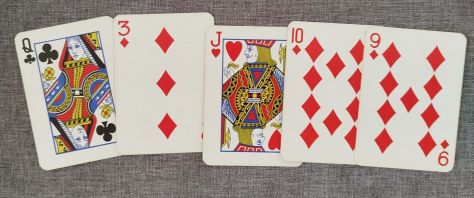
This one querent thought there is a ghost haunting the third floor of the building she moved to. This is the spread that came out:

A card reading about a ghost

As can be seen, even without interpreting the spread, there is no trace of haunting in the cards. The final two cards, the Nine of Diamonds and the Ten of Diamonds, are a lucky combination, they can show success, protection or even simply the fact that the “energy” is clean, not charged with magical or paranormal forces. The querent shows up at the beginning of the spread with the Three of Diamonds, which is a doubtful card in this context. It makes me think more about random things that she, the Queen, misinterpreted.

The Jack of Hearts is even more doubtful. It could show the presence of a child (a living child, that is) or an animal (again, a living one) who does something the querent misinterprets. The querent said that there are both children and animals in the building, so that’s a possibility. Frankly, I should have either added cards or done another spread.

Still, this is enough to make me think that there is a non-paranormal explanation for the querent’s experience, so the spread is enough to answer the question in that regard.

The funny thing is that, after the reading, the querent started talking to me like I am not very competent at reading cards. I am obviously open to being wrong, and I understand that it must be frustrating being told that one’s subjective experience is probably the result of a misinterpretation (it must feel like ‘gaslighting’, to employ an overused word). All I could do was trying to be as understanding as I could in delivering the answer.

After all, for every instance of real haunting or real magic (at least, real according to the oracle) there are thousands of cases of people who spend years burning sage to smoke out a presence that isn’t there, yet the ghost who isn’t there often ends up influencing their life more than those that are there.

MQS

Exploring the Present Or Scrying the Future?

As a diviner, I have no objection to making predictions about what is likely to happen. I see the current taboo about the future as a mix of delusion and ignorance. Our current culture comes at the tail-end of the myth of the self-made man that has animated much of our recent (and even not-so-recent) past. This myth has strongly influenced the Zeitgeist of the current occult wave, which started at the end of the XVIII century and continues, though declining–putrefying, even–to this day.

The occult developments have in turn trickled down into pop spirituality and have fostered the belief, now extremely popular, that all it takes to change one’s reality is to tune into the wavelength where one’s delusion corresponds to objective facts, and that nothing about one’s identity is more than a socially-conditioned self-identification that can be simply deconstructed and cast off like a cloak in favor of something else as the whim of the day dictates.

This implies the idea that the future is a completely blank slate and that therefore divination can only be used as a tool for self-reflection on the present to facilitate this process of self-making and self-remaking. Unfortunately, the self-reflection in question regularly resolves itself into simply telling the querent what they already think or would like to think of themselves, but packaged in empowering language within a context in which they assume they are communing with divinity. “Wow, the Gods think exactly the same as I do! How wise!”

Anyone who lives in actual reality and has spent five minutes reflecting on it know that this view of existence is demonstrably false (although, like many false things, it contains faint traces of truth). Each of us has a path in life that is unique, containing specific challenges and opportunities, possibilities and impossibilities. Divination is good at detecting these patterns and their likely outcome in the near future.

Still, I find that there is value in employing traditional divination in exploring the present. The language of traditional divination is frank, crisp and concrete, as it comes from a deep understanding of the fact that, if what is above is as what is below and what is within is as what is without, then what is above or within cannot be a metaphysical soup of saccarine inanities, but must correspond to the complex interplay of pleasure and sorrow of the below and without.

In other words, if a tiktok psychic might tell you that you always end up with the wrong guy because you have a soul contract that stipulates that you need to come into contact with your inner queen, traditional divination is more than happy to let you know that it’s because you are a basic harlot who chooses basic idiots.

This is not to say that there is a god or a spirit judging the querent through us or through the oracle: it is merely a dispassionate look at your life from a dispassionate observer on a simple example of causality. It also does not imply that we, as diviners, shouldn’t learn to speak with tact and diplomacy. However, the employment of actual divination techniques allows us to shed light on the querent’s present in terms that might actually be helpful to them.

We never leave a divination session unaltered. The knowledge we gain changes us necessarily: me knowing about X is not the same as me not knowing about it. If X is in my hands, then knowing about it can give me some power over it. If it isn’t in my hands, then knowing about it gives me awareness of the limits that define my unique path through life. That’s growth, too.

MQS

An Interesting Divinatory Phenomenon About The Past

This article is going to be as vague as it gets. It pertains to certain observations I’ve made over the course of the years practicing divination, first with playing cards and the Sibilla, then with regular Tarot and now with the Bolognese Tarot, but it is not a unified theory, and in fact, it is even hard for me to put it into words.

We all know how time is difficult to define in divination, especially by cards. Sometimes it’s even hard to say if the cards are describing the past, the present or they are directly starting off with the future. This is even more true when using non positional spreads, where one or more lines of cards are interpreted together. My observations are mainly about non positional spreads, and how sometimes they seem to signal that they are talking about the past.

In all decks (at least, in all decks I use) there are cards connected with the person’s thoughts, or at least with their inner or emotional world. A person’s inner world is a complex thing, since it is a mix of hopes for the future, memories of the past, illusions, dreams, traumas, etc. All decks I use also contain cards that show ending, death, disruption and radical change, indicating the end of a life path.

The thing I’ve noticed is that, when in the first couple of lines of a spread (or within the first couple of cards in a longish one-line spread) there is a card connected to the person’s inner world and then a card of ending, that section of the spread usually talks about the past, and more specifically the distant past (that is, not just a couple of months back). This is because the card of disruption tells me that the situation the cards are talking about is over, while the card relating to thoughts or emotions says that the thing exists only as a memory, something that has left a mark on the person’s soul.

I recently did a spread for someone with the Bolognese Tarot. Unfortunately I didn’t save a picture of it and forgot most of it (it was one of those “I’m sure I won’t forget it” moments). It was a question about love, and in it both querent and quesited (the love interest) showed up only as thoughts, followed by cards of disruption. It turned out they had been together eight years ago, she had left him on the advice of a friend who thought causing drama would strenghthen his commitment. Instead he moved on, and she was still waiting for him to come back. In this instance, the thoughts reenacting the break-up were like ghost impressions reliving that pivotal moment in her past.

Obviously, this sort of things tend to happen for major events, whether positive or negative, and it shows how our inner structure is a bit like a geological section, with different eras still present, but hidden from view.

MQS

My First YT Video: Cross Spread Tutorial

I finally decided that there was no point in learning the theory of how to make videos. Much better to make crappy ones until something goes right. So yea, here’s the first video on my channel.

Please be patient, I am a very special kid.

MQS

An Assault (Example Reading)

I don’t often pick three cards for the day, and usually when I do they show very minor situations, for the very good reason that most days are very minor in themselves. The day before yesterday I shuffled the Bolognese Tarot and this came up for the following day:

Three cards for the day

The Sun and Moon, in the Bolognese Tarot tradition, indicate sorrow or tribulation. Usually, when the Moon falls last, the sorrow is serious or lasting, while if the Sun falls last it eventually overcomes the Moon, so the sorrow is shorter or less impactful. Still, what we have here, is sorrow knocking at the door, even though it’s passing. Curious, I decided to deal out some other cards, even though I wasn’t sure the cards would keep talking about the same thing. This came up:

The rest of the deck

Clearly this is not a happy string of cards, and it seems to be dealing with a young woman (the Page of Cups). I wasn’t sure if the young woman had anything to do with me or was experiencing something herself, so I left it at that.

Yesterday, aside from being a mentally taxing day for me, a friend of mine was assaulted by a junkie while walking the dogs, but she managed to make it out of it with nothing more than a big scare and a broken fingernail. She alerted the police, and she asked me what I thought would come of it. This time I whipped out the playing cards.

What will be the consequences of the assault?

The Jack of Spades immediately calls attention to himself, showing a criminal in this case. It is surrounded by two Spades, so trouble or inconvenience for him. The Four is also a card of violence, but I don’t think it has anything to do with it: they are describing what happens to him. Then the spread takes a sharp turn for the better (for the criminal, that is): things change (Five of Diamonds) and he walks (Two of Clubs). I doubted there would be serious consequences. Note also the absence of the law (the King of Spades) or of the prison card (the Five of Spades).

The man was stopped, since he is known around town for being a weirdo, but my friend is probably not going to press charges since she was told there were no witnesses and it would turn into an endless battle of he-says-she-says for what, in the eyes of the law, was a minor scuffle on the streets between two adults. I’ll update the post if anything new happens.

MQS