The great thing about occultism being my life but not my job is that I get to do whatever I please. Well, right now it pleases me to talk about this deck, somehow.
MQS
The great thing about occultism being my life but not my job is that I get to do whatever I please. Well, right now it pleases me to talk about this deck, somehow.
MQS
Well, Skat cards and I keep crossing paths. Ebay showed me this:
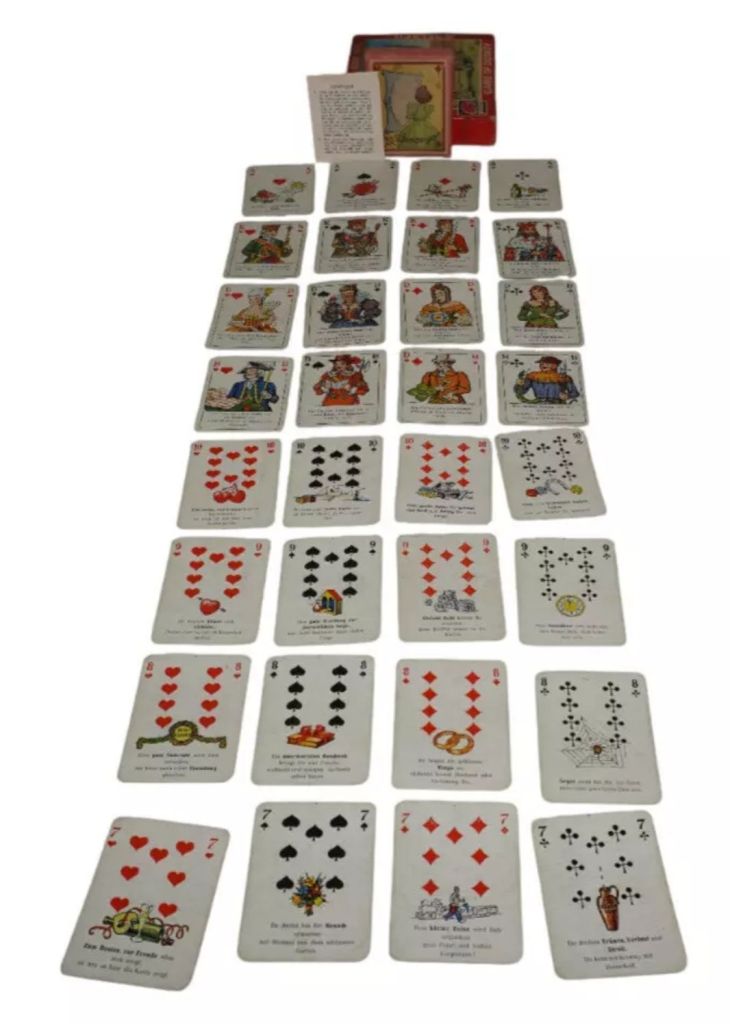
I won’t buy it, because there’s really no point in me owning it, but I’m going to post a personal translation of the meanings found on the cards, just as a comparison to the other systems I posted. Note: in German the descriptions rhyme (sort of). Since poetry is not among my many, many gifts, I’m not even going to try it in English. We’ll wait for the next Lord Byron to stumble upon this blog and give it a go. However, I will leave in bold type the words that are in bold in German, where possible.
The fact that some of the meanings coincide with the ones I posted, which I know to be traditional because I trust the sources, tells me that this Oracle of the Silver Mirror isn’t something someone just pulled out of his heinie, but they probably at least did some reaserch or had access to someone who could read skat cards. Still, I don’t want to exaggerate the importance of this deck: it is just a little bit of Skat trivia, in the long tradition of card fortune-telling as a parlor game.
The Silberspiegel Orakel is a fortune-telling deck about which very little is known. A source online says it’s from the 50s. Considering the old-fashioned language and the pre-reform orthography it might as well be true.
A♥️ Soon an event will involve the house. It appears as though it is something good!
K♥️ The King of Hearts is your reflection in the mirror, or “He” who envelops you in his love
Q♥️ The Queen of Hearts is your reflection in the mirror, or “She” who envelops you in her love.
J♥️ The Jack of Hearts can be your son or your daughter, or just a child, broadly speaking.
10♥️ You can expect much love, much joy. The world becomes your enchanted garden.
9♥️ Kisses and love-making await you. Don’t lose your head, whether in December or in May. (This sounds much cuter in the original)
8♥️ A bit of good news is headed your way. It could also be an invitation.
7♥️ Everything turns out for the best and is cause for joy, as shown here in this card.
A♠️ Taxes, the courthouse or the government await you. Don’t pull a long face!
K♠️ There is a wealthy man (around you). He could be your father, who loves you very much
Q♠️ A well-meaning woman coddles you. She could be your mother, who protects you and takes care of you.
J♠️ The postilion brings you a letter or message with much excitement. He’s almost here!
10♠️ You are planning a long journey, toward new horizons (shores) and harbors.
9♠️ A positive change in your personal situation. That’s a certain thing.
8♠️ An unexpected gift will bring you much joy, perhaps tomorrow, maybe even today.
7♠️ You can expect a visit, with flowers from the most beautiful garden.
A♦️ An important letter or a merry celebration, perhaps a marriage or something from the stork’s nest.
K♦️ A blond man will propose to you. He may also be a relative (!!!)
Q♦️ You will go out with a blonde woman. If she’s a relative, forget about her (!!!)
J♦️ This is the big, big luck. Cut yourself a nice slice of it.
10♦️ You manage to accomplish something great, everything brings you success and lots of money.
9♦️ You may expect a bit of money. This is what the cards clearly show.
8♦️ You’ll have golden rings to wear. Maybe you’ll celebrate an engagement or a marriage.
7♦️ A small journey will restore you. Have a good journey and some fun!
A♣️ Affliction and a doctor are in your home, but a cheerful disposition can drive the devil out.
K♣️ An older man is around you. Maybe a father-in-law, maybe a public official.
Q♣️ An older woman is by your side. If she’s your mother-in-law, do as she says.
J♣️ A false person wants to charm you. Be careful, and you will charm the snake!
10♣️ Luck, affluence and a long life are gifted to you as treasures.
9♣️ Something will soon become certain. Now ask yourself what it may be.
8♣️ Aggravations are coming to your house. Someone may exploit your good will.
7♣️ Tears, loss and fights threaten you. You will overcome them with a merry disposition.
In the LWB, two spreads are described. One is the classic große Tafel, the grand tableau of 8×4, where one reads the lines that intersect the querent’s card.
The other is a cross spread (once again), where the person’s significator is taken out, the cards fanned out and fifteen cards chosen: covering him (“Was dich deckt!”, i.e., “what covers you”), to his right (“Was dich schreckt!” i.e., “What scares you/shocks you”), below him (“Was du mit Füßen trittst”, i.e., “What you tread on with your feet”), to his left (“Was dir gewiß ist”, i.e., “what you hold for certain”) and above (“Was du im Kopfe trägst”, i.e, “What you have in your head”). The “what shocks you” position on the right is probably the opposite of the “what you hold for certain” position on the left. It probably indicates something the person doesn’t expect.
Clearly this is yet another variant of the cross spread that is so widespread across Europe, of which I was taught another variation.
The general tone of the LWB is very cautious and markedly negative toward divination, which reinforces the hypothesis that the deck originates from before the late 60s or early 70s. The reader is constantly encouraged to practice it only as a game with family members and not to practice professionally.
MQS
Following my deep dive into the Door Knockers, which seems to be an exclusive symbol (or almost) of Italian cartomancy, let’s talk about a much more universal presence in many traditions: the Road. Still, even though the symbol is widespread, the interpretations may vary.
I was introduced to the symbol of the road when being taught to read playing cards. In the system I was introduced to, the Two of Clubs is the card of the steps. Actually, the word for it was “cammino”, which means a way, road or path, but it also implies the idea of people taking steps on it. That is, a ‘cammino’ is a road that exists because people walk on it, rather than being a road that has been created so that people may or may not use it. An example would be a path through a forest or a road created by pilgrims as they progress on their pilgrimage.
The Two of Clubs therefore implies forward motion toward a goal of some kind, and the taking of steps, whether literal or figurative. In this, it is similar to the Two of Wands in some Piacentine cards systems, which interpret the card as a road, largely due to its design showing two parallel staves, no doubt (although in some other Piacentine systems the road is the Knight of Wands).
The Vera Sibilla doesn’t have a road card per se, although it does have various cards connected with movement, journeying or taking steps/fighting for something. For instance, the Journey card is connected to traveling, while the Soldier may imply fighting to attain a goal (although, being a Spade card, the struggle is more accentuated).
Etteilla famously attributed the meaning of road to the Six of Swords, and his pupils developed a whole vocabulary of synonyms that extend the meaning into other areas. An example of this is the meaning of conduct, which is, figuratively speaking, the path of the person’s actions through life. Etteilla’s attribution of the meaning of road to the Six of Swords remained attached to tarot through the Golden Dawn, who preserved it in part as a possible meaning in their Book T, and then through Waite, who had Smith design the Six of Swords as a card of journey. Even in the Crowley tradition this attribution has in part been rediscovered in Eshlemann’s Liber Theta.
In the Bolognese tarot, the meaning of road is attributed usually to the Six or Eight of Wands. Some strands of the tradition also distinguish between an open road (Six/Eight of Wands) and a closed road (Nine of Wands or Ten of Swords). The road is in itself a card of forward motion, like the Two of Clubs, it can indicate short trips and it is a card of openness.
The road or path is also present in the Lenormand and Kipper traditions. I am unclear on the Lenormand meaning, as the interpretation seems to have evolved considerably through time. Most contemporary English-speaking sources seem to see it as a card of choice (with two paths, although I am unsure if this duality was intended in the original design). Most German sources interpret it differently. Since I am not a Lenormand reader, I will leave it at that.
As for the Kipper cards, they have a card called Ein langer Weg, a long road. In most of the sources I have consulted, the card is more static than in the other traditions, highlighting the element of time (some call it the Two Years card). Interestingly, in many German Skat systems of divination, the suit of Spades / Leaves is connected with movement, and the low-numbered cards, mostly the Seven and Eight, can show a short trip or something happening quickly, while the Ten is also called the long road, and it can indicate an actual journey or the need to wait a long time.
BONUS: The Road is obviously present in Geomancy as well. The Geomantic figure Via, attributed to the Moon, is a symbol of journey and change. It is the symbol with the least amount of points, only one in every position, so some sources also attribute it to the concept of ‘little’ and to the waning of something.
MQS
Ok, I swear this is the last deck I’m buying for a while, but it was only a couple of € on Ebay, and it was vintage, so yeah.

It is actually a Schafkopf deck (literally, sheep head), and it is comprised of 36 cards. As far as I can tell, not all Schafkopf reading traditions use all 36 cards, as some discard the sixes.
MQS
In the latest reading I presented, an interesting phenomenon occurred. At some point during the reading, two cards came up that seemed very negative, but which actually had nothing to do with the reading in itself. Instead, they simply acted as some form of punctuation. This happens especially with simple methods like the one I used, called ‘alla zdoura’ (literally, ‘method of the housewife’, or ‘like the housewives do it’ in dialect), where we start with a very limited number of cards, usually one, two or three, and then we keep adding them without following a specific layout.
In this type of reading, if the cards need to signal that we are changing topics and moving on to a new one, they may use cards or combinations that show an ending (sometimes even just the Death card). Of course, I had a huge deal of luck in this reading, because it came up clear. It isn’t always like that. Often, these combinations look really bad, but if we look around we see that they feel out of place.
In playing cards, the same can happen when the Four of Spades and Five of Spades, or the Ace of Spades, or the Five of Diamonds come up. Usually, in these situations, it pays to zoom out of the reading and catch the general flow of it: it will become apparent, generally, whether these cards are part of the reading or if they act as punctuation.
I am also experiencing a similar phenomenon while experimenting with the Bolognese tarot. For instance, in the first few lines of a thirteen- card spread, it may happen that the Angel and Death cards come up together, and then the cards seem to discuss other topics. In this case, the cards seem to be answering the question positively and quickly, only to introduce new discussions. At other times, the Queen of Coins comes up to say “and that’s the truth about it, period.” or the Justice card, to say “and that ok the way it is.” Of course, I need to experiment a little more, especially to see if apparently negative combinations can act in the same way.
MQS
At some point in life something’s got to give, so I don’t think I will use this deck very much, but I was browsing on Ebay and I came across a vintage Skat deck. I am sucker for vintage decks just as much as a hate the new ones more or less uniformly, plus I had just published my new article on reading this type of deck, so I took it as a sign and bought it. I love the papery texture of the cards. They probably wouldn’t survive aggressive use, but it will be enough to experiment with on occasion. Interestingly, if we take the King of Hearts to represent me and we use the meanings I received, this großes Blatt (grand tableau) describes my recent past quite accurately.

MQS
A couple of years ago I published a series of three articles on the Skat deck. This is not a system I use, merely one that has been kindly passed down to me, together with the premission to translate it. I came into contact with another reader, who also kindly accepted to share her system, which she learned from a friend some years back. This is another German system, which is recognizable in that Spades tend to be neutral and Clubs negative. There are also many similarities with the previous system I published, which is not surprising since the various systems tend to be regional, and both readers come from the same region ( the Südpfalz). Still, there are some interesting differences. What follows is my translation of the meanings, combinations and reading method. Thanks to Anke for this method.
Ace – The Home
King – The Man (Herzensmann, the man of my heart)
Queen – The Woman (Herzensfrau, the woman of my heart)
Jack – Thoughts, Projects, Hopes, Positive Feelings/Thoughts (gute Gesinnung)
Ten – Great Joy, Wish Fulfillment, Wedding Bells (Hochzeitsglocken)
Nine – Joy, Love, Sympathy, Affection / Inclination (Zuneigung)
Eight – A Relationship, Harmony, Accord / Deal, Reconciliation
Seven – Fun, Entertainment (Fröhlichkeit, Spaß)
Ace – Office (Amt), understood as official things, Bureaucracy, Documents, Laws, Lawsuits, etc.
King – A friend or relative, Can be an office worker
Queen – A friend, relative or office worker (Büroangestellte)
Jack – Message, Contacts
Ten – Journey, A long period of time, The Long Road (auf dem langen Weg), An important change (Umbruch)
Nine – Uncertainty, Uncertain timeframe, Jealousy, Unwarranted turmoil, at the end of a sequence it improves the situation (the worry is unwarranted)
Eight – A short timeframe, Also the card of society (Gesellschaftskarte)
Seven – Very short timeframe, Discussions and Talks, The Short Road (auf dem kurzen Weg)
Ace – Letter, Invitation or Gift
King – A Man of position, Respected (angesehener Mann), Someone who counts
Queen – A woman of position, Respected, Who counts
Jack – The Jack of Good Luck (Glücksbube)
Ten – Big Money
Nine – Success, Ambition, Idealism
Eight – Work, Also buying and selling, Business (Geschäftskarte)
Seven – Small Money, A child
Ace – Shock (Schreck), Fear, Fright, Suffering or Loss
King – A lonely man, Older or inimical, Father-in-law
Queen – A lonely woman, Older or inimical, Mother-in-law
Jack – The Jack of Bad Luck (Pechbube), Bad/evil ideas / feelings / disposition (böse Gesinnung)
Ten – Great sorrow, Illness
Nine – Falseness, Antipathy (Abneigung), Dislike
Eight – Arguments, Fights, The need to fight, Obstacles
Seven – Tears
Ace of Hearts – Ace of Spades – Ten of Hearts = Wedding
Ace of Spades – Ten of Clubs – King of Clubs = Hospital stay
Any Queen – Seven of Diamonds – Ten of Clubs = Pregnancy (apparently pregnancy is seen as a sickness)
Ace of Clubs – Ace of Spades – Evil card (especially the Jack of Clubs) = death
Ace of Spades – Eight of Clubs – King of Clubs = Court case
Ten of Spades – Person card = Someone who comes from afar (but can also be someone who is away)
There are two phases to a general reading. The first is a cross spread not unlike the one I use. Lay out the querent’s card (King or Queen of Hearts), but with some slight variations. Let’s say you are reading for a woman:
| 4 | 9 | 14 | ||||||
| 2 | 7 | 12 | QH | 3 | 8 | 13 | ||
| 1 | 6 | 11 | ||||||
| 5 | 10 | 15 |
The positions’ meanings are quite similar, although the order of laying out the cards differs: above are the thoughts, underneath the problems or what she has command over, behind is the past, in front is the next future. The second stage is as follows:
| 3 | 8 | 13 | 4 | 9 | 14 | |||
| QH | ||||||||
| 1 | 6 | 11 | ||||||
| 2 | 7 | 12 | 5 | 10 | 15 |
This second spread is called the Rundum Blick, literally the comprehensive view or all-around view. The cards covering the Queen are supposed to be the most important ones, while the others all cover the future, with those to the left being a bit closer than the ones to the right, unless the Ten of Spades (the long time card) is present, in which case it can change the timeframe.
I didn’t receive any instructions on how to read the cards for answering specific questions, which is not surprising, since many folk methods of divination were simply meant to talk generally about what was ahead. Still, I am quite sure you can devise your own strategy.
MQS
I received a really sweet message from a fledgling occultist who wants to pick up some form of divination, but has been put off so far because they have been convinced that they don’t have “the gift”, as they put it, by which I think they meant intuition.
It is a fact of life that a certain predisposition can give you a head start. My high school chemistry teacher could explain to me every single step of how to balance a formula, and I would sort of understand it, but then, left to my own devices, I would still get it wrong. I certainly didn’t have the gift for it. But that doesn’t make chemistry hoplessly outside of my reach. If I had persevered instead of throwing my hands up and saying “oh well, at least I can read Plato in Greek” I would have definitely made some progress. It’s just that in life you’ve got to pick your battles, and I knew I wasn’t the next Marie Curie, and I did like Plato, so Plato it was.
The same holds true for the various esoteric disciplines. The kind of gift that is required to practice them is not different from the predisposition toward high school subjects. Yet there is this widespread belief something more is needed. Well, it isn’t needed.
Oracles, i.e., the various forms of divinations, are languages, and like all languages they require study and practice. The idea that all it takes is intuition is a result of the loss of understanding for occult practices that resulted from the scientific revolution, which confined anything that wasn’t understandable in terms of the rising empiricism to the realm of irrational superstition.
This new designation was either consciously or unconsciously accepted by those practicing divination, so divination became something irrational that requires non-rational tools to be practiced. This, in spite of the fact that, wherever you look around the world, and even in the West before the Enlightenment, divination is considered to be primarily made of rules to be studied and applied with intelligence.
True divination, like all parts of magic, is hopelessly technical. It has nothing to do with following your heart, much less your intuition. Speaking of which, actual intuition is a much more sacred thing than the “I can’t prove it but I know it’s true” that many make it out to be. “I just feel this is how it is” is how cults get started, which is probably why so many people who describe themselves as intuitive are so up their own asses and so full of unconscious prejudices.
That is not intuition: it is personal bias subtracting itself from scrutiny. Actual intuition is the prerogative of the great saints, and only to a lesser extent of people who are on a spiritual/esoteric path. It is rare and cannot be commanded. It is the result of brief moments of perfect union with the source of all, and for that reason it comes from outside the limitations of the individual vessel. What many call intuition are simply personal hunches that they cannot trace back to any line of reasoning.
And mind you: hunches ARE a thing. They can work, and sometimes they can help. They can also fail. Many people seem to believe that ‘intuition’ is never wrong. And fair enough, the intuition I talked about is in fact never wrong. But personal hunches CAN indeed be wrong, in the same way that a logical inference can be wrong: hunches, like reason, the senses and all other channels humans use to gather information, are fallible. The fact that many think their hunches are never wrong is simply the result of confirmation bias: if they concentrated on how often their hunches let them down on a daily basis they’d be crushed.
Another use of the term intuition is simply a cooler way of describing the facility that comes from experience. The experienced doctor comes in, eyeballs you, listens to a couple of your complaints and knows with a high degree of probability what is wrong with you. The experienced mechanic listens to the purr of your car and knows immediately it will break down in two weeks if you don’t do something about it.
That’s also not intuition, although it is far more valuable than what average psychics do. It is simply the result of having gone through the same process so often that you can skip some of the steps, at least consciously. It is the intellectual version of muscle memory.
So, can anyone become a diviner? Let me answer with a question: can anyone become a chemist? Well, no. If we all could, the human race would go extinct. But the only thing keeping you from studying chemistry is your decision and perseverance. So is with divination.
MQS
This is a cool reading because it shows that the cards tend to describe a situation and take their time to do so, so that trying to immediately get a yes or no out of them can be problematic and cause mistakes (though making mistakes is part of the human condition, obviously). This is the reason why, talking about the Bolognese tarot, I tend to disregard the yes and no rule of the Death card. It is also the reason why I don’t believe in the yes and no value of playing card colors. To me, that’s just a coin flip, and coin flips don’t work as reliably as actual divination, which is a language.
Here the question was if an unemployed man would get a job.
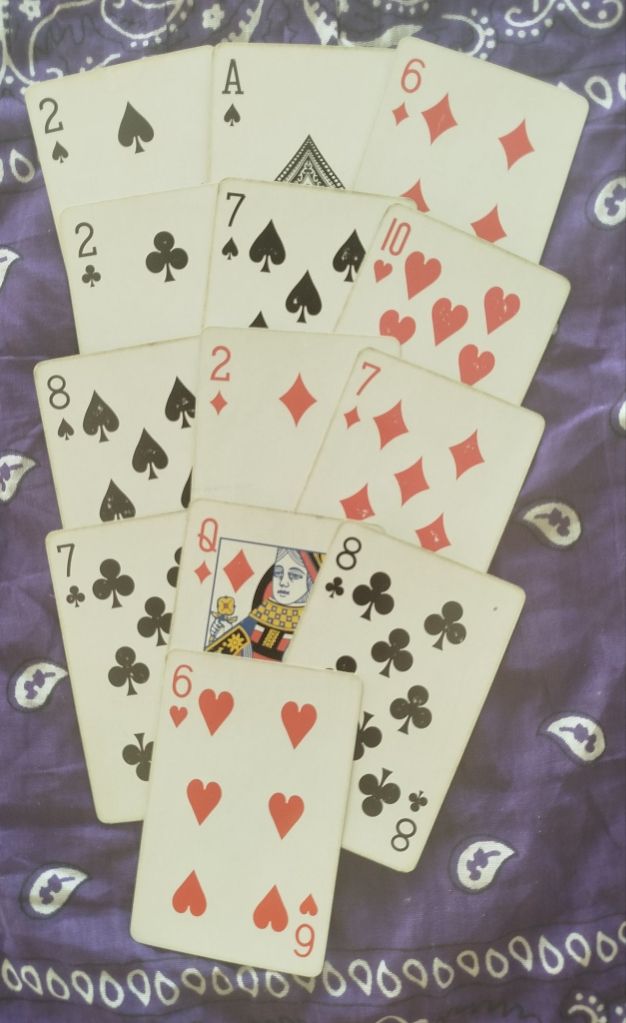
The first thing I noticed is that the reading ends with a very positive combination of Queen of Diamonds, Eight of Clubs (work) and Six of Hearts (reconciliation/solution/adjustment). This bodes well, but the rest of the spread is more disastrous.
The first row shows that the subject is a thorn in the heart of the person (Two of Spades, Ace of Spades and the Six of Diamonds showing worry). Then we see that every step taken (Two of Clubs) to solve the issue has met with misfortune (Seven of Spades), meaning that the person has probably tried to find a job repeatedly but failed. This explains the very emotional cards in the first row, as well as the fact that the Happiness card (Ten of Hearts) is squeezed between Misfortune (Seven of Spades) and Tears (Eight of Spades). This is a whole unfortunate period unfolding in the person’s life.
There are some cards I am not quite sure about: the Two of Diamonds, Seven of Diamonds, Seven of Clubs. 2♦️ + 7♦️ can be a cheque or paper money, or projects about money. I asked the querent a couple of questions and it didn’t really help. I think a more general reading would be that, quite obviously, the lack of a job has impacted negatively (7♣️) his financial situation.
Then finally we have a woman who is either going to help him find a job or give him a job. If I had to bet I would say this is a female boss, since she shows up as a Diamond and not as a Heart. Either way, the period of misfortune is going to thankfully end.
MQS
In many supernatural movies about exorcism, the priest trying to free the victim needs to discover the demon’s name. This is actually founded in (part of) the real practice of exorcism and does have its roots in the magical belief of the power of names. For instance, there are certain practices in folk magic in Italy that require the magician to go to the christening of a child whose name translates to the effect he or she wants to achieve.
But belief in the power of names is not just found in Italy and it probably goes back to the most ancient and elemental relationship that humans established with the things around them in their attempt to dominate them. Traces of this fact are found in the doctrines of many Greek philosophers, sophists, poets and playwrights, and I have also found some similarities with Chinese Daoist literature. A wonderful fictionalized account of this belief is found in Ursula LeGuin’s Earthsea saga, which anyone interested in magic should read, in my humble opinion.
I am not one who seeks to psychologize occultism, although I believe that psychology is not at all a useless discovery and can be part of a modern magus’ training. I think that the attempt to reduce occultism to psychology is just as misguided as the attept to condemn anything that modernity has brought us as a deviation from an ancient splendor.
That being said, as someone who practices divination for others, there is also a certain sense in which naming works in a cathartic way. Most of the people that consult me are rather upfront about their problems, especially since I don’t ask for money and therefore feel no guilt in telling them to go sit on a cactus if they are trying to waste my time.
But people can be reticent about their issues for a variety of reasons, and malice is not always the motivation. Among the many possible reasons is the fact that people sometimes feel the need to have their demons driven out of them by someone outside of their regular field of experience.
Having someone discover our particular demon’s name without us feeding it to them can be a powerful and cathartic experience, because it smokes the demon out of the dark recesses of our subjective experience and into the light of objectivity, where it can be addressed as a definite and therefore limited issue, rather than being consumed by its overwhelming lack of contours.
Not every divination session calls forth such existential experiences, nor should we as diviners try to turn each session into a catharsis. We are not therapists and our duty is not to give people advice, although advice can certainly be given if required. Our role is to provide information, whatever that may mean in the context of each particular reading. For this reason, our language and that of our divination tool needs to be earthly, concrete and objective.
But sometimes informing the querent can mean gathering the diffuse knowledge that they already have festering inside of them and turning it into useable information by giving it its proper name.
MQS