Category Archives: Playing Cards

Fixed Significators and Modern Issues

Some decks have variable significators, while others assign certain cards to always represent the querent and their partner. This can cause confusion when reading for people who would not have lived their life out in the open back when cartomancy emerged, such as gay or trans people. Following are some experimental notes on how to deal with such instances in the various decks I use.

I want to stress that these are based on my practical experience, not on that of someone else and not on some theory I am trying force onto the cards. My aim is to improve my accuracy as a diviner, not to pontificate on academic eventualities.

Vera Sibilla

The Sibilla doesn’t have fixed significators, meaning that the querent will, if at all, be represented by a court card that indicates their role in the situation and/or society at the moment of the reading, always compatibly with their sex.1

And this is already problematic nowadays. I haven’t read for too many trans people, but I have noticed that if the person has either transitioned, fully or in part, or has at least adapted considerably to the other sex, then they are represented by a court card of that sex (ftm as a male, mtf as a female).

To be blunt: Jane, cashier, who has been living as Jane despite being born as Jim, and lives out her concrete life as Jane, is described as a woman in the cards, although the cards may hint at the transition, if relevant in the context; Jim, cashier, who would like to become Jane and maybe one day will, is represented as a man, even if he’s started to play with makeup since watching Myra Breckinridge; Becky, professional TikTok cheese grater, special traits no personality, who thinks an androgynous look makes her stand out, still comes up as a woman even if she pretends to identify as a man on every day with an R in it.

This has nothing to do with politics or tolerance or “passing as the other sex” and everything to do with concrete life: divination mirrors life, but social media clout simply doesn’t transfer to the cards, and there’s nothing I can do about it, even if it may offend some. The good news is that indentification with a significator is just a divinatory device and lasts only for the fifteen minutes needed to conduct a reading, and then is over.

IMPORTANT: we are talking about trans people, not crossdressers. A crossdressing man is a man who cosplays as a woman for whatever reason, but remains a man and lives as a man, at least until that fake business trip to Atlanta that his wife knows nothing about.

Talking about gay people, the Sibilla is very straightforward. In the few readings I do for myself, I usually come up as the Boyfriend, my husband as the Gentleman, and some years ago I came up as the Helper and my husband as the Boyfriend.

As for “but what about…” particular cases about any of the identities that are created daily, the best I can offer is: I’ll cross that bridge when I get to it. I trust the cards to simply describe the situation as it is and I accept the risk of not being able to understand how complex it may be, either in reality or in someone’s perception.

Playing cards and Bolognese Tarot

In some systems of cartomancy with playing cards, significators are not fixed. The way I was taught, though, the male querent is the King of Clubs and the female querent the Queen of Clubs, and the other card is the person they love. Similarly, in the Bolognese tarot the male querent is the King of Wands and the female querent the Queen of Wands.

For trans people, I think what I said about the Sibilla still holds true. Again, all I can say is to keep your mind and your eyes open (on the cards, I mean. Looking if the querent has an adam’s apple doesn’t count.)

For gay people, I have generally found that a degree of flexibility is required on the diviner’s part. Some readers seem to believe that you can just dictate to the cards how to behave, including in the case of gay querents. If that works, then bully for you, but I have always found the cards to have a mind of their own, regardless of the conventions we try to establish for them, so all I can do is be flexible.

Some people think the querent is represented by the court card of their gender, the partner by the other main significator, regardless of their sex. This theory is predicated on the fact that the two main significators are meant to show those people, and the fact that they are of two different genders is accidental or a matter of historical bias.

This may sound convincing, but have I found it to be true in practice? Sometimes. Sometimes the partner will come up as the other Club/Wand figure and there is simply no way of interpreting it other than as the partner, even if the stuff under the dress doesn’t match. Sometimes the cards will represent the partner as a court card of another suit that matches them. Sometimes the cards will throw in both cards for good measure: hubby has come up as the Queen of Clubs + King of Hearts together on more than one occasion in the past. Talk about a big personality.

Tarot

This is like the Sibilla, and doesn’t require much discussion. The male querent is usually the Emperor or the Pope, the female querent is usually the Empress or the Popess. Two men in a relationship can be shown as Emperor and Pope.

MQS

  1. I am aware of the difference between the word ‘sex’ and the word ‘gender’, but I am going to use them quasi-interchangeably to avoid too many repetitions that hurt the ear. ↩︎

An Experiment (Example Reading)

A friend and I have decided to do a little experiment with the German skat deck. He has applied for a job and we wanted to see if he’ll be hired.

An Experiment with the German Skat deck

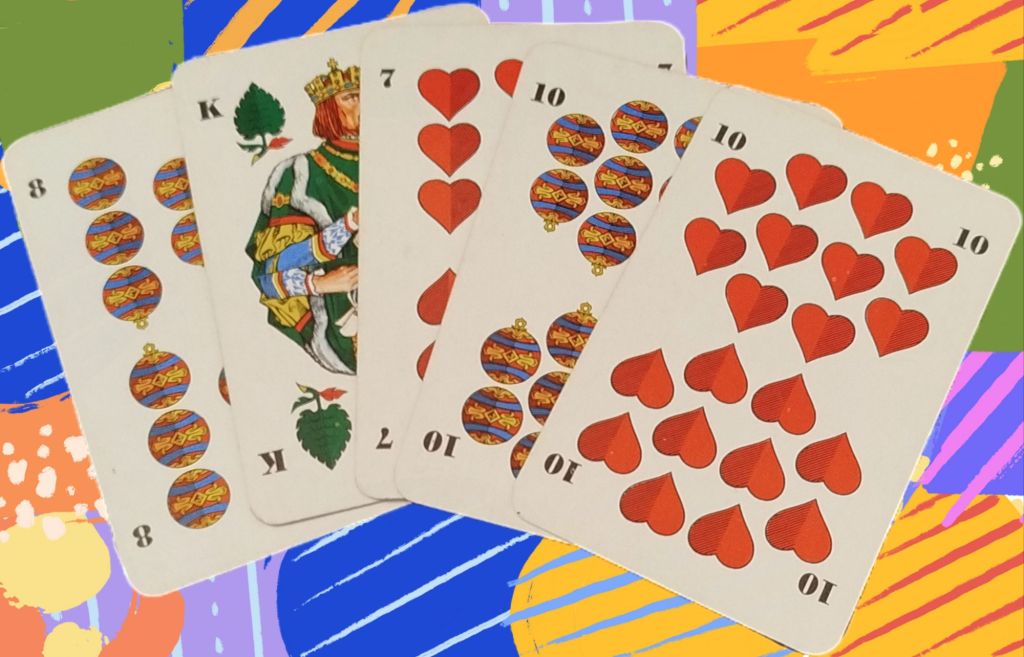
According to the meanings I’ve received, the Eight of Diamonds (here the Eight of Bells) is the card of work and business, so the cards seem to be on the ball. We also have the Ten of Hearts which is a contract (a marriage/union) with the Ten of Diamonds/Bells indicating it’s a relatively well-paid full-time opportunity. The Seven of Hearts here should indicate relief and pleasantness in general. It could also mean the querent is going to have fun, but considering it comes before the contract, I incline more toward the former interpretation.

There’s that King of Spades / King of Leaves there, which puzzles me. Technically the querent is the King of Hearts. This could show that someone else gets the contract, but this would be a really weird way for the cards to communicate (“Will I get the job?” “Someone else is going to be really pleased”). It can happen that the cards say someone else gets the job, but they would show this as a negative for the querent. Also, this cannot be the boss, because two women are the boss and are looking for someone to hire.

Maybe the King of Leaves could represent the type of job. It is in the medical field. Technically, medical subjects would be indicated by the Ten of Clubs/Acorns or the King of Clubs/Acorns, however I have seen many sources that assign the meaning of doctor to the King of Leaves / Spades. It could indicate that the job is going to have to do with lots of bureaucracy and office stuff, and that would true.

I will update this article when I get the result.

MQS

Playing Cards That Indicate Stability

Let’s move on with our look at the playing cards divided by concept. This time, we see which cards represent stability.

Ace of Hearts
The Ace of Hearts, like in many systems of reading playing cards, represents the home. It is a symbol of durability and stability, since houses tend to be stable things that don’t change. Mostly, the Ace of Hearts symbolizes the house or the family, however, when describing someone’s character, for instance, it shows them to be family-oriented, looking at stabilizing their life, being rooted in traditional values, etc.

Four of Hearts
The Four of Hearts usually brings agreement in all fields of life. However, the type of agreement it shows is effortless, and it resembles more a state of peace where the waters aren’t ruffled (and if they are, the waves calm down immediately). Usually this card indicates harmony, harmonious surroundings and ease.

Six of Hearts
Unlike the previous two cards, the Six of Hearts, which represents such things as reconciliation, healing, etc. does often imply the presence of some disturbing factors (though not necessarily. We need to look at the spread as a whole), but it shows that these disturbing factors, such as a break-up or a disagreement, can and probably will be overcome, returning the situation to its previous stability.

Ten of Hearts
The Ten of Hearts is one of the most powerful in the deck, as it is often capable of diminishing the negative impact of negative cards. Since it is symbolic of paradise, heaven or ultimate attainment of one’s happiness, it hints at a situation either being stable (and happy) or becoming stable (and happy). When it is followed by very negative cards, though, it can show this paradise being lost. In fact, it is sometimes a bad sign when we find the Ten of Hearts at the beginning of the spread without other strong cards, because it shows that the best is already in the past.

Three of Clubs
The Three of Clubs brings union and unity. It causes situations or people to become locked in place, usually by signing contracts, celebrating a marriage of making a commitment to each other or doing things together. Sometimes it can show that a situation perseveres (it remains married to us).

Six of Clubs
A somewhat obnoxious card, the Six of Clubs isn’t tragic, but it brings disturbance. It shows situations that have lost their momentum, and problems that we thought we had overcome reemerging. It shows a sort of static discontent with no disruption in sight, either for good or bad, unless other cards clearly show it.

Nine of Clubs
This is the card of distance, either in terms of miles or in terms of time. As such, it lengthens out the timeframe, but unlike the Six, the Nine of Clubs has no negative undertones, except in the sense that often we want all the good in the world to happen to us quickly, and this card stalls us for some time. However, it can also make a good situation last longer.

Four of Diamonds
Unlike the Four of Hearts, which shows effortless stability and agreement, the Four of Diamonds represents agreement following either tensions or negotiations. Thus it represents all things to do with bureaucracy and the government that seek to regulate life and make it more stable within the borders of a country.

Ten of Diamonds
Of the Ten of Diamonds we can say something similar to the Ten of Hearts, except that the success promised by Diamonds tends to be more material, and doesn’t necessarily imply happiness. However, it does represent situations that have developmed to their utmost in a positive sense and have reached their aim.

Five of Spades
Being the card of prison, the Five of Spades symbolizes constraints, blockages and the need to make great sacrifices. As such, it means that the person (symbolized by the central pip, hemmed in by the four other pips at the corners) cannot move and is bound to a situation. Usually this is in a negative sense. Even when surrounded by positive cards, thus showing a positive commitment, it still indicates a certain sense of being stifled.

Six of Spades
The Six of Spades is the card of illness, and it shows all situations that are ill, broken, suffering, etc. In itself it is not the most tragic card in the suit, but it represents a state of suffering stillness, which may be overcome or lead to disruption, depending on the cards that follow this one.

MQS

A Quirk of the Thirteen-Card Spread

The last thirteen-card spread I posted was interesting for a couple of reasons. One reason I already talked about: the need to be flexible with significators.

Another reason is that it showcases what I suspect to be an interesting quirk of the thirteen-card spread. This is a purely experimental anecdote, so take it with a pinch of salt, but I have found it to be true on more than one occasion.

The quirk is that, in the thirteen-card spread (which I discussed here), the rows seem to be connected not just one after the other, but also alternately, i.e., the first row with the third row and the second row with the fourth row.

I cannot stress this enough: this is NOT a rule, it is simply something I have found to be true on occasion. There are situations where the thirteen-card spread is perfectly smooth from start to finish, reading like a little story with a beginning, a middle and an end. In this sort of situation we don’t need to pair up the rows 1-3 and 2-4.

However, sometimes we can recognize snippets of story mixed together in an odd way. I have found that pairing odd rows together and then even rows together can help sort these snippets out, giving them a more logical order.

In the example of the spread I posted, the second and fourth rows seemed to talk more about material issues, whereas the first and third were more centered on the person’s emotional life. Pairing them odd-with-odd and even-with-even, the spread became more clear.

If the spread is talking about more than one issue at once (which can happen), then this kind of pairing often makes sense. However, sometimes it makes sense even if there is only one topic in play, and this particular case the rows that we pair up talk about subtopics within the same topic.

It may be that this technique simply stems from my limitations as a reader, so that I find ways to circumvent difficulties in the interpretation of the spread. Still, I found this to be accurate enough to bring up, in case anyone wants to experiment with it.

Finally, it may simply be that we need to be very flexible with the rows, and take for granted that they may pair up in unlikely ways. Who knows, maybe I’ll find that the first and fourth row really go well together in some readings. The point is always that the techniques we apply need to shed light on the querent’s life, not simply add flourishes and complications to the interpretation.

MQS

Three Decks For One Inheritance (Example Reading)

We did a little experiment with a friend. She wanted to know if the bureaucratic process to get the inheritance from the recently deceased grandfather would finally come to an end, since there had been several delays (leave it to the Italian bureaucracy). We started with the Sibilla.

Sibilla

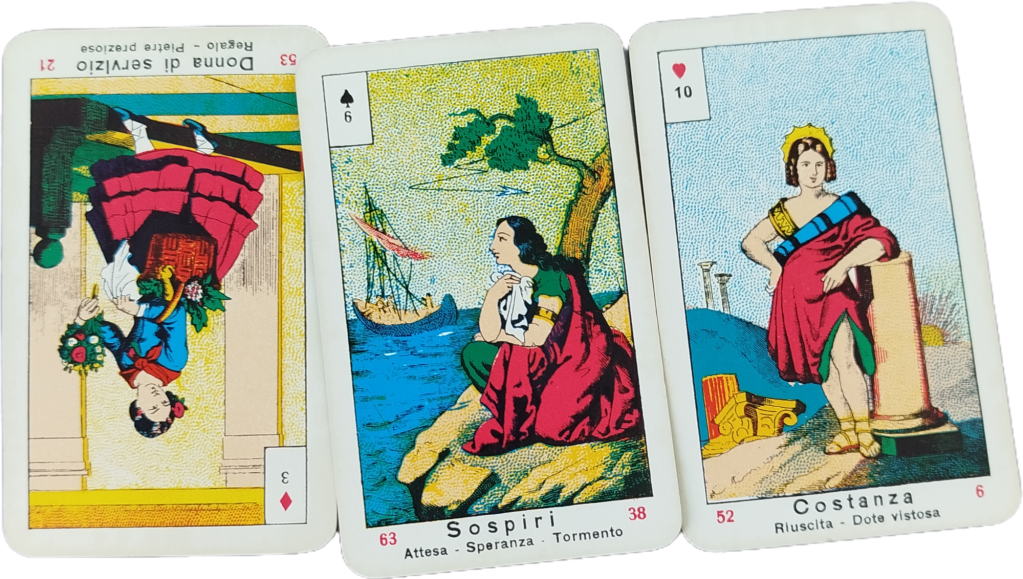
A three card reading with the Vera Sibilla

In this case, the Handmaid reversed indicates money going out (of the querent’s wallet). The Sighs card simply indicates that the person worries they’ll have to pay money. The Ten of Hearts here is not a positive influence, because it is a card that makes the uncertain certain (in the context of a trial, for instance, it might indicate the sentence being decided). So in this case the worries shown by the Sighs are confirmed.

I asked my friend if she was worried about having to pay some extra money, and she said that this was her and her dad’s worry, but that they had looked into inheritance law and thought they were safe and wouldn’t need to pay . Clearly the Sibilla begs to differ.

Playing cards

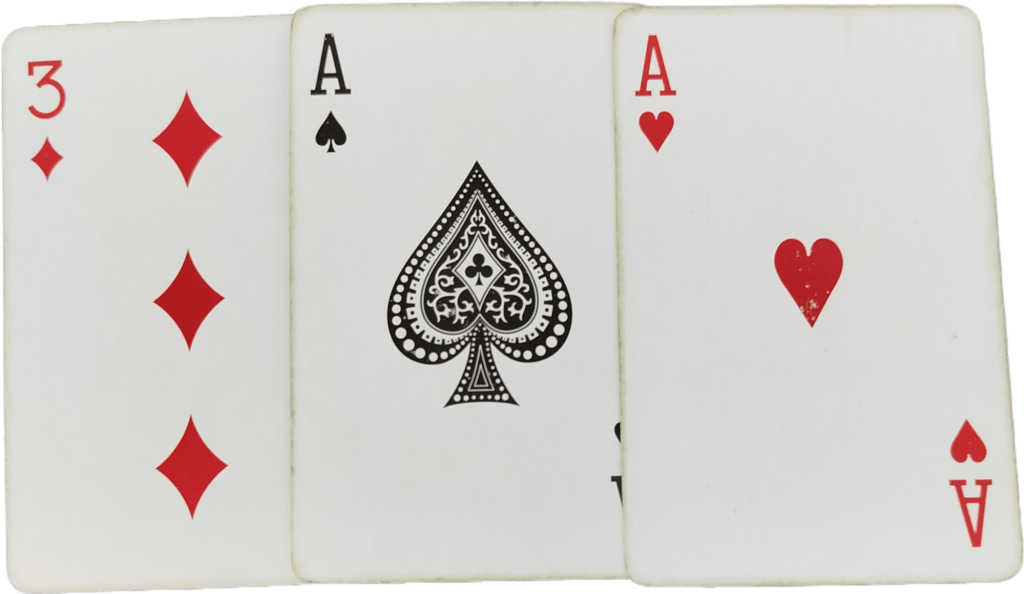
A three card reading with regular playing cards

In this case we don’t have the querent’s state of mind (which the Sibilla talked about). However, we do have, once again, the loss of money, indicated by the Three of Diamonds being covered by the Ace of Spades. The Ace of Hearts shows us that the money going out is due to family issues, something which was absent from the Sibilla.

Skat cards

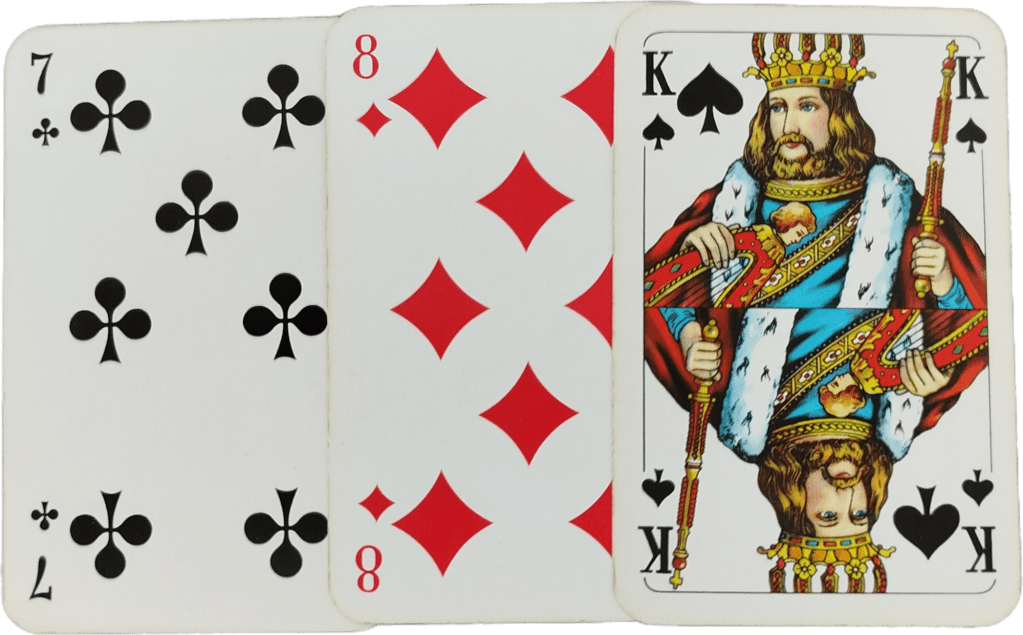
A three card reading with the Skat / Piquet deck

I decided to make an experiment with the Skat cards as well, just for kicks. The Eight of Diamonds is technically the card of work. However, if I understand the meanings correctly, it represents work because it shows the flow of money, money being exchanged. So it can represent, more broadly, the economy. With the Seven of Clubs, which indicates tears, the economy will take a hit. The King of Spades might be the office worker who will give the querent the news.

A week ago they received news that they needed to pay an extra 3000€ to unfreeze the granddad’s money. My friend doesn’t know if the office worker who worked on their case was a man (the King). Still I think the Skat cards were rather accurate.

MQS

How Long to Shuffle the Deck?

This may sound like a silly question, but it is one I get asked constantly in private. I think the reason is that, especially at the beginning, we are very unsure of how to go about the reading and we are afraid we may get it wrong on technical grounds even before the interpretation starts.

Unfortunately, there is no clear answer to this. I know of old-time diviners who shuffle the deck for a fixed (usually odd) number of times, like seven, nine or thirteen. I have never been able to get behind this way of doing things. It is, however, a traditional approach, so I thought it better to mention it.

I distinguish between when I’m reading for myself, or even for someone else, but who isn’t there; and when the person is with me, even just on the phone or on skype (I used to do skype readings for friends all the time when I was in college).

The second case is the easiest, so I’ll talk about it first: when I’m reading for someone and I am directly in contact with them, I simply ask them to think about the question and to give me a stop when they are ready. Meanwhile, I decide which spread to use, then I relax and I take on an attitude of calm focus, without strain.

The person may have me shuffle for two minutes, or they may tell me to stop after two shuffles. After the stop, if the person is physically there, I also let them cut the deck, otherwise I do it for them after knocking three times on its back (that’s my little ritual). As weird as it sounds, the cards always seem to fall into place very well regardless of how long it took to shuffle them.

I believe this is because, in a reading, there is more at play than just two eccentrics’ focus on a topic. We may like to concoct philosophies that give us ultimate power over external reality, but the fact remain that we live at the intersection of cosmic, personal and interpersonal currents, a number of which are beyond our control. Our focus may catalyze these forces, but they are more ingenious than our conscious awareness could be.

In the first case, i.e., when I’m reading for myself or for someone who isn’t there, I need to be especially at peace with myself. If I’m distracted, depressed, in a heightened mood or very sick, the reading won’t go well. Even when I am at peace, there is always a question mark at the end of my readings, like they are never as crisp as when I’m reading for someone else who is there with me.

So, how long do I shuffle in this case? The answer may be disheartening for some, but it’s: as long as I feel I need to. This is hard to explain, but one soon learns to recognize the feeling of a well-shuffled deck. Some may feel the deck becomes heavier, others seem to just get an undefined feeling.

For my part, I usually feel a sensation akin to being full after eating a hearty meal and being unable to take another bite, while at the same time the deck itself seems to oppose resistance to being shuffled as the cards lock into the right place. Your experience may vary.

MQS

Making Sense of Daily Readings

Daily readings are not my passion. Divination moves from the assumption that something is going to happen. But life is full of uneventful days, where time seems to stand still. Yet the oracle must necessarily tell us something, for the simple fact that we allow it to speak.

This is not to say that the cards (or other means) don’t mean anything, but often we need to tone down the interpretation to such a degree, or retrieve such inconsequential shades of meaning that, unless you are a god of divination, you aren’t going to be able to consistently predict much, and I am definitely not a god of divination.

On the other hand, daily readings can sometimes be easy to read into once the event has come to pass (see my recent example). Reading into the oracle always leaves us in danger of deluding ourselves. The question I always ask myself is: would I be able to see it if I didn’t know it? Often a vaguer prediction that is true to what we can see in the cards is preferable to a highly detailed account that simply regurgitates what we already know or what we have been fed.

Still, sometimes we can afford the luxury of reading-into after the fact, and daily readings can be one such instance, because at least we can learn something, if we are careful. In the example I posted about the pregnancy, the three cards, called at random to disclose a daily influence, could have meant a variety of different things, but news about a pregnancy is without a doubt one possible interpretation. Furthermore, sometimes if we know that something is bound to happen, we may gauge by the daily reading if it is likely to happen on a particular day, or if it is going to go well.

Another thing to consider is that limiting the timeframe is always somewhat arbitrary. Do you seriously think that if you ask the cards what is going to happen this week and in ten days something terrible or wonderful is bound to happen the cards are going to keep quiet about it? Just because you told them to keep it within the week?

Often, if you pull daily cards, a major event or major influence or vibe shift will start manifesting in the cards many days in advance. A romantic reunion happening next week may start manifesting with cards of love now, even if today or tomorrow aren’t especially romantic days.

What I personally prefer to do is occasionally pulling three cards for the day, while knowing that they may describe something happening further along the way. By occasionally I mean every two or three weeks, rarely every week. That way the cards are usually more meaningful than if I stress them every day on how the day is going to go. This doesn’t mean I’m going to be able to predict something, but the careful, tentative reading-into is going to be more certain and less based on wishful thinking.

MQS

Flexibility in Divination (and Other Occult Branches)

In my latest reading, an interesting phenomenon happened: I had to partly go beyond the basic rules of the oracle (in this case the tarot) in order to interpret its message.  Specifically, I had to get past the rule that only the Wand figures represent the querents and accept the Queen of Cups as an alternative version of the subject in question.

There is always a reason why something happens, and in this case I believe the possible reasons were 1) that I was asking about my mother, so the cards described her not only as the protagonist of the reading (Wand) but also as mother of the person asking the question (Cup) 2) the reading was, in part, about her still viewing herself as wife, even though she is widowed, so not only is she the protagonist (Wand) but also a wife (Cup).

I am pretty sure this sort of things (that is, the need to apply the ground rules with discretion) can happen in different respects with any deck. In fact, I think it can happen with any oracle. The late Robert Zoller often showed that good astrologers need to be guided by what the chart is saying, which often requires one to start from recorded knowledge and then stretch that knowledge to cover each individual case. William Lilly, possibly the most important horary astrologer in history, often repeated that one must “mix discretion with art”, that is, understand the rules and then apply them intelligently.

The thing is, divination is not an assembly line type of work: it’s a Hermetic art (where the word ‘Hermetic’ is understood in its classical sense, not the Kybalion-style crap). If even the rules of biology need to be interpreted smartly by doctors in order to cure the human body, then how much more flexible do we need to be to interpret a device whose permutations can give us the blueprint for anything that could happen?

Anything goes vs informed pragmatism

My understanding of divination is a never-ending journey. The way I currently see the rules of divination is as posts along the way in a thick snowstorm. If a post has been put somewhere, that means someone was there before and has figured out something. We do not discard such knowledge lightly, unless the contingent reality of our current situation makes us prefer another route.

This approach is very different from the ‘anything goes’ non-method used by so many, which is almost expected and even bragged about, largely due to the widespread rejection of rationality in our milieu. Too many people who dabble into esoteric subjects today seem to believe that throwing overboard logic is the first step on the journey. In part this is due to mistaken orientalist fantasies, in part to a post-modern Zeitgeist that sees all structures as dispensable, reactionary dead weight only good for restraining us– who wants to be restrained?

The way I currently see rules in the esoteric arts is neither reactionary nor revolutionary. It is an attempt at appraising reality through lenses as simple as possible and as complex as they need to be, a kind of pragmatism that is informed by the past but future-oriented in looking for concrete solutions to concrete issues.

As far as divination is concerned, it is a language, but it is a language with no native speakers, and for which no Rosetta stone exists, except the tentative hypotheses of those who have grappled with the language before. We don’t need to vest them with our superstitious awe, but we do owe them a serious, dispassionate look at the conclusions they have reached before either accepting them as they are, discarding them or expanding them with discretion.

MQS

Divination With The Piquet Deck – The Meanings

The great thing about occultism being my life but not my job is that I get to do whatever I please. Well, right now it pleases me to talk about this deck, somehow.

Fortune-telling with Piquet cards or Skat cards. Like the video and subscribe

MQS

The Oracle of the Silver Mirror

Well, Skat cards and I keep crossing paths. Ebay showed me this:

The Silberspiegel Orakel on Ebay

I won’t buy it, because there’s really no point in me owning it, but I’m going to post a personal translation of the meanings found on the cards, just as a comparison to the other systems I posted. Note: in German the descriptions rhyme (sort of). Since poetry is not among my many, many gifts, I’m not even going to try it in English. We’ll wait for the next Lord Byron to stumble upon this blog and give it a go. However, I will leave in bold type the words that are in bold in German, where possible.

The fact that some of the meanings coincide with the ones I posted, which I know to be traditional because I trust the sources, tells me that this Oracle of the Silver Mirror isn’t something someone just pulled out of his heinie, but they probably at least did some reaserch or had access to someone who could read skat cards. Still, I don’t want to exaggerate the importance of this deck: it is just a little bit of Skat trivia, in the long tradition of card fortune-telling as a parlor game.

The Silberspiegel Orakel is a fortune-telling deck about which very little is known. A source online says it’s from the 50s. Considering the old-fashioned language and the pre-reform orthography it might as well be true.

Silberspiegel Orakel (Oracle of the Silver Mirror)

A♥️ Soon an event will involve the house. It appears as though it is something good!
K♥️ The King of Hearts is your reflection in the mirror, or “He” who envelops you in his love
Q♥️ The Queen of Hearts is your reflection in the mirror, or “She” who envelops you in her love.
J♥️ The Jack of Hearts can be your son or your daughter, or just a child, broadly speaking.
10♥️ You can expect much love, much joy. The world becomes your enchanted garden.
9♥️ Kisses and love-making await you. Don’t lose your head, whether in December or in May. (This sounds much cuter in the original)
8♥️ A bit of good news is headed your way. It could also be an invitation.
7♥️ Everything turns out for the best and is cause for joy, as shown here in this card.

A♠️ Taxes, the courthouse or the government await you. Don’t pull a long face!
K♠️ There is a wealthy man (around you). He could be your father, who loves you very much
Q♠️ A well-meaning woman coddles you. She could be your mother, who protects you and takes care of you.
J♠️ The postilion brings you a letter or message with much excitement. He’s almost here!
10♠️ You are planning a long journey, toward new horizons (shores) and harbors.
9♠️ A positive change in your personal situation. That’s a certain thing.
8♠️ An unexpected gift will bring you much joy, perhaps tomorrow, maybe even today.
7♠️ You can expect a visit, with flowers from the most beautiful garden.

A♦️ An important letter or a merry celebration, perhaps a marriage or something from the stork’s nest.
K♦️ A blond man will propose to you. He may also be a relative (!!!)
Q♦️ You will go out with a blonde woman. If she’s a relative, forget about her (!!!)
J♦️ This is the big, big luck. Cut yourself a nice slice of it.
10♦️ You manage to accomplish something great, everything brings you success and lots of money.
9♦️ You may expect a bit of money. This is what the cards clearly show.
8♦️ You’ll have golden rings to wear. Maybe you’ll celebrate an engagement or a marriage.
7♦️ A small journey will restore you. Have a good journey and some fun!

A♣️ Affliction and a doctor are in your home, but a cheerful disposition can drive the devil out.
K♣️ An older man is around you. Maybe a father-in-law, maybe a public official.
Q♣️ An older woman is by your side. If she’s your mother-in-law, do as she says.
J♣️ A false person wants to charm you. Be careful, and you will charm the snake!
10♣️ Luck, affluence and a long life are gifted to you as treasures.
9♣️ Something will soon become certain. Now ask yourself what it may be.
8♣️ Aggravations are coming to your house. Someone may exploit your good will.
7♣️ Tears, loss and fights threaten you. You will overcome them with a merry disposition.

Spreads

In the LWB, two spreads are described. One is the classic große Tafel, the grand tableau of 8×4, where one reads the lines that intersect the querent’s card.

The other is a cross spread (once again), where the person’s significator is taken out, the cards fanned out and fifteen cards chosen: covering him (“Was dich deckt!”, i.e., “what covers you”), to his right (“Was dich schreckt!” i.e., “What scares you/shocks you”), below him (“Was du mit Füßen trittst”, i.e., “What you tread on with your feet”), to his left (“Was dir gewiß ist”, i.e., “what you hold for certain”) and above (“Was du im Kopfe trägst”, i.e, “What you have in your head”). The “what shocks you” position on the right is probably the opposite of the “what you hold for certain” position on the left. It probably indicates something the person doesn’t expect.

Clearly this is yet another variant of the cross spread that is so widespread across Europe, of which I was taught another variation.

The general tone of the LWB is very cautious and markedly negative toward divination, which reinforces the hypothesis that the deck originates from before the late 60s or early 70s. The reader is constantly encouraged to practice it only as a game with family members and not to practice professionally.

MQS