The founder of BOTA, Paul Foster Case, proudly started his short book “Oracle of the Tarot” with the assertion that Tarot divination is not fortune-telling. The reason, he explains, is that fortune-telling is grounded in the belief in luck, chance or fate, while divination understands that everything is about our personality. The same statement is found at the beginning of the advanced BOTA course on tarot divination (Oracle of Tarot, without the ‘the’). Ann Davies clearly had a hand in rewriting it, considering how verbose the course is, but the substance was similar.
Paul Case was tapping into the spirit of the times when he made that statement. Since Tarot had the (mis)fortune of attracting the attention of XVIII and XIX century occultists, it hasn’t enjoyed a moment of peace: everyone wants to believe it to be not an obvious masterpiece of Renaissance art and Medieval philosophy, but an occult device made to transmit mystical knowledge unknown to most people (even though most people prior to the Enlightenment and the French revolution would have been able to tell you what the Tarot was about).
The same has happened to Astrology. Once a practical art for foretelling the ups and downs of actual life, it became the victim of the occult intelligentsia of the last couple of centuries and was turned into a hodgepodge of pseudomysticism, ill-digested psychoanalytic concepts and “it’s true if you believe it” New Thought crap.1
But this is not the whole story. If one takes the time to study, say, the Golden Dawn system, one quickly finds out that their traditional way of reading the Tarot is grounded in fortune-telling (just read MacGregor Mathers’ example of the Opening of the Key spread). Even the BOTA system, which derives from it, preserves very concrete meanings to be strung together into sentences, despite Ann Davies’ attempt to turn divination into a form of Kabbalistic meditation.
In other words, the occultist attempt at reappropriating the Tarotand Astrology (which in part continues to this day with some bogus theories about the so-called Tarot of Marseille, but more on this in another post) is only partly responsible for the divination/fortune-telling dichotomy. Much of contemporary occultism is grounded in the psychoanalyzation of magic and spirituality, which, in turn, is a defense mechanism against the death of the classical spiritual worldview. Yet, for all its shortcomings, it at least preserves some core tenets of the magical worldview.
But the problem with this is that while it does preseve in some ways the roots of the worldview in which divination can flourish, it has lost the intellectual basis for defending it. Intellectually speaking, even today occultism is largely stuck in the pre-WWII era, with its myths of scientific positivism, of constant historical progress and of magic as misunderstood technology (while I would argue the opposite, namely that technology is misunderstood magic).
Essentially, what has gone lost is the philosophical framework that allows us to keep together divination as spiritual practice and divination as uttering of concrete, verifiable truths.2 That’s largely because spirituality, in the post-XVIII-century Western world, was only allowed to survive as private indulgence in irrational behavior, a weakness to be tolerated.
Thus the split was born: 1) on one hand divination: a ‘serious’, and therefore unverifiable endeavor, a tool for vague self-reflection, cheap catharsis and shallow instagrammable aha moments. In other words, something that the small judgmental scientist constantly perched on most people’s shoulder could smile upon as at least benign, if not really true; 2) on the other hand fortune-telling: a crass or quaint superstition that is just a scam when it gets things wrong and just a coincidence when it gets them right. The little scientist can be free to frown on it. In other words, the distinction was born out of the guilty conscience of “spiritual” people, i.e., out of their subconscious scientism, as a way of telling themselves and society “I indulge in this silliness, but I am just quirky, not stupid.”
The occultists of yore were at least intelligent men and women who actually had something to say. They may have worked in an intellectually hostile environment, but they at least gave it their best shot, and for this they deserve leniency. What happened next is worse: that the already battered art of divination fell into the hands of stoned hippies and people with degrees in the most useless branches of socially acceptable knowledge. Then along came the Liz Greene’s and the Rachel Pollack’s (to make just two examples) who destroyed Astrology and Tarot even further. From then on it could only go in one direction: past life readings, divine feminine, empty motivationalism and strategizing, healing of generational traumas and all the attendant nonsense.3
Interestingly, the more contemporary divination’s fake husk rots, the more one needs to be intellectually dead to practice it, the more it becomes reintegrated in the higher spheres of society. I believe I already talked about a friend of mine who works for Google and has to endure meaningless meetings with tarot readers and astrologers because her boss is the manifestation-obsessed boss babe type. Nor are tarot readers a rarity in corporate America. This probably says something about how brain-damaged this kind of environments is. The nicest thing we can say about this part of society and this strand of divination is that they deserve each other.
MQS
This is not to say that Astrology or divination were unanimously accepted, but the debate was much more complex. ↩︎
This, by the way, is not a call to “go back” to some long lost good old times. I am no reactionary. Nor am I a progressive. I am a realist. ↩︎
By which, of course, I do not mean that there is not a feminine side of the divine, nor that trauma cannot be a real thing. I only mean that these words correspond to nothing but the most vapid pseudointellectual nonsense when coming out of most people’s mouths nowadays. ↩︎
Here Abano explains the broad signification of the sixteen geomantic figuresand the seven traditional planets.
In order that one may more easily judge every question without much effort, what follows is the signification of the sixteen figures.1
Acquisitio is the figure of Jupiter in Aries, good, fortunate, mobile, entering, masculine, airy, eastern, hot and wet. Good in the first house and bad in the seventh. It signifies good fortune in what one seeks to obtain, and in things of friendship, weddings, merchandise, company, in traveling, in getting what you desire. It is bad for sick people and prisoners. It signifies blood loss, torments and a long time, and similarly it signifies pregnancy, and changing abode, and sailing, and for the sailor it announces storms. The absent party is delayed, and it is not good for changing from one lord to another, and it shows damage from enemies. In war against enemies it promises victory, and it’s good for obtaining honors and offices, but it doesn’t grant greater accumulation. In case of suspected pregnancy, or theft or other crime, or when one hears rumors, this figures confirms that they are true. The stolen goods are retrieved. The baby is a boy. In sending money or making down payments/deposits it is good. It is good for children and friends and relatives and indicates holiness, abundance, great harvest, but famine will soon follow.2
Amissio is a figure of Venus in Scorpio, unfortunate, mobile, exiting, masculine, fiery, hot and dry, southern, evil. Good in the eighth and bad in the second. Good for travel and selling, the sick person will heal soon, the prisoners comes out of prison soon, it is good for pregnant women, the baby is a boy, the medicine is good. It is bad for fights and enmities, it signifies unfaithfulness, end of friendship, theft, murder and similar things, and if an army marches against the other it will be victorious without effort. If one is in the right it solves matters quickly. It signifies droughts, dearth, flax, legumes. Sending money to make gain is fruitless, you will lose. The fugitive is not found, nor the stolen goods. One doesn’t obtain the pardon, nor anything one seeks. There is no marriage, and when there is, it is soon broken with great shame. It is the enemy of all pleasure and usefulness. Favors, honors, dignity and friendship are not lasting. It is good for asking about family and friends that one hasn’t seen: they are well. If one departs to go damage someone else, one doesn’t succeed, but still comes back safe and sound. One doesn’t acquire the besieged place, but it is good for taking medicines. Abundance of fruits, shortage of everything else.
Fortuna Maior is a figure of the Sun in Acquarius, fortunate, entering, fixed, well-meaning, feminine, earthy, western, nocturnal, cold and dry. Good in the eleventh, bad in the fifth. It denotes increment and accumulation and increases the wealth of one’s lords, friendship with people in high places, with noble people and women, good marriage, pleasure in writing and through messengers, good news, honors, dignity, friendship, the absent party and the pilgrim are well. It grants all that one wishes, except if one wants to gain it from an enemy or suspicious person, especially if it’s about money. Love and hate are firm and unshakable, positive for building and sowing. Rumors and suspicions of theft and pregnancy are true. It is good for coming out of a bad situation, but at the beginning it is hard. In traveling it will be hard at first and easy and with mirth afterward. One can flee from danger. There is no war. The baby is a boy, born without danger. Sickness and imprisonment are of long duration, and difficult to overcome, and it is hard to get back one’s dues. Fertile year. Lots of rain.
Fortuna Minor is a figure of the Sun in Taurus. Unfortunate, mobile, exiting, fiery, masculine, hot and dry, southern, evil, good in the second and bad in the eighth. It signifies company of noble people, traveling with noblemen and buying and selling on their account. It is good for the sick and the imprisoned, and for anyone who wants to flee dangers or problems. It helps pregnant women, and the baby is a girl. Sailing. Sentences can be appealed victoriously, good for entering in other people’s places and country, the besieged town is not captured. It is not good for starting something that is meant to last. The stolen goods are not found. The army will be defeated. Bad for marriage, and if the marriage is made soon there will be rumors. It doesn’t concede anything. Dignity and honor don’t last. Suspicions and rumors are false. The messenger and the absent party come back and bring gain. Damaged merchandise. Promises are not kept. Debts are not collected. Family and friends in good state. If one takes a medicine one heals soon, but it also signifies bleeding. A year of dearth, few fruits, lots of barley and spelt. Problems while traveling.
Laetitia is a figure of Jupiter in Taurus, eastern, airy, fortunate, hot and wet, masculine, sanguine, mobile, entering, positive, diurnal. It means honors, exaltation, dignity, good travel and good for returning. The messenger and the absent party come back bringing joy, good news, it is useful to travel, albeit belatedly, and the dignity one has obtained may falter. Good for buying and selling, the prisoner will be released, changing one’s lord or king or one’s place is positive, it is good to be at the service of a lord, to make down payments/deposits, taking medicines. Long life, increase of wealth. The sickness is long, even though one will heal eventually, bad for partnerships. Every suspicion is false. The stolen goods and runaway servant are not found, the debt won’t be paid back. Hatred and friendship are both steadfast, the servant or subject don’t love you. In questions of faith, of doubt about treason, and when asking about absent friends or family members, they are well. It helps pregnant women, the baby is a boy. Good for sailing, dreams are positive. A year of dearth, but it doesn’t last long, good rain. If you wonder about a friend’s death, it’s not true, and he’ll heal. Good in all houses, except the seventh, eighth, twelfth and the occupied place won’t be conquered.
Tristitia is a figure of Saturn in Scorpio, unfortunate, fixed, entering, malicious, earthy, melancholic, cold and dry, western, feminine. Good to be with noblemen and not bad for departing. Going up against an enemy won’t cause damage out of doubt,3 risk of death in conflict, you will stay in prison, good for partnerships, and the occupied place will be conquered unexpectedly. Good to buy animals, bad for selling them. Good for down payments/deposits, bad for sending money, lots of rain which is helpful, the shunned woman will go back to the friend, victory in a fight, one can keep one’s salaried office. It is bad for the sick and the prisoner, for it lasts long, bad for traveling, danger of death. It doesn’t give you anything that you may wish, except trifles. When there’s suspicion of someone’s death, or of robbery, or any other rumor of the sort, it is true. Accidents by water. The absent party is in trouble, sickness or poverty, the marriage will cause trouble, damage, enmity, moving to another region will cause ill, and wanting to conquer it will cause defeat, the debt is paid back but with great trouble and many issues. One’s life or that of those around you will be problematic or full of sickness, when one has an office, or some dignity, one will suffer through it. Little honor. Childbirth causes issues and comes late, and perhaps results in miscarriage. The baby will be a girl. Both love and hatred are steadfast. Whatever is damaged won’t be fixed. The year will be plentiful. Evil in all houses, except the eighth. Worst of all in the eleventh. When trying to hurt others one will cause even worse damage.
Albus is a figure of Mercury in Cancer, fortunate, common, feminine, nocturnal, phlegmatic, watery, cold and wet, southern, mobile, benign. It means good profit, increase of wealth, honor, influence and being in the right, merchandise, useful partnership, excellent marriage, the stolen goods are retrieved, it concedes everything one asks, honors, servants, buying livestock, conquering a land, the debt is paid back, the rumors or suspicions are true. The runaway servant comes back. Good friendship and money or other possessions. Risk of losing something through oversight. Short life. In war it is bad for the querent, it implies flight and loss of blood, infirmity, long time in prison, problems in pregnancy, the baby is a girl, storms during the sailing, if one has doubts about traveling, the travel will cause harm, the absent party won’t come back, and it is bad for changing place. If one asks for friends or relatives, they are well, and he who is in the right will win the fight [or court case]. Good for agriculture, abundance, good and fruitful rains. Good in the fourth house, bad in the tenth.
Rubeus is a figure of Mars in Gemini, unfortunate, mobile, exiting, masculine, fiery, hot and dry, diurnal, malicious, southern, evil in everything, except in war, in which case it is the best. Good for writing and for marriage, in occult things, and he who seeks honors will obtain them. Good for bloodletting or bleeding, good for going up against the enemy, war will cause death and blood, good for not changing room [place?] or country, the pregnant woman will, after great trouble, be happy with the child, the suspicion of theft or other vice is true. Every good company (or partnership) is good, except in traveling, and the sick will heal after long trouble, and the prisoner will stay long in prison, will need to pay a bail, the down payment is secure, it grants everything one wants from a nobleman, the rumor coming from afar is false, love is steadfast, especially if adulterous, and war will be victorious. Good for buying animals, bad for selling them. The absent party won’t come back, debts are paid back but there will be controversies, and if one wants to speak to a lord one will find him occupied in many things. Very bad for the sick and for prisoners, it means damage, and burials. In travel there is damage and danger when changing place. The marriage is surrounded by suspicions and issues, sailing bad, winds against your way, bad for selling. The occupied place is conquered, the lost item is not found. Good fortune for the querent, and everyone he asks about is well except one.4 The year is dearthful at the beginning, abundant later, lots of rain. Wrath and hatred and danger, bad for taking medicine. Bad in the fourth, seventh and eleventh house, and also in the first except for war and conflict.
Puella is a figure of Venus in Gemini, fortunate, positive, temperate, fixed, entering, feminine, nocturnal, watery, cold and wet, phlegmatic, southern. Good for buying, it brings peace with problematic friends, it solves fights. The absent party comes back with profit, inheritance, increases wealth, confirms marriage, but it will be with suspicions, enemies are won, the journey is delayed but will bring profit. In war there will be loss, sickness and prison are of long duration, and one will pay a fine, sailing causes trouble but only at the beginning. One gets what one wants. Animals and servants will be lost. The pregnant woman will give birth with some problems, the baby is a girl. The suspicion of death, or that a woman is pregnant, is false, suspicion of theft and vice are true. Good for taking medicines, and even if the illness is serious one will heal. You will get your goods back. For obtaining honors, dignity and office it is positive. Good for getting back money, bad for sending money, what is lost is found. If you fear a lord or any other danger, you are not without danger, the down payment/deposit is not secure, as you will lose a good deal of it, changing place or lord is bad, better to stay where you are. If you are accused of something you will be punished, the occupied place won’t be conquered, good for one’s or other people’s health. Average year, at first abundant, then with dearth, lots of rain, which will endanger fruits and plants, good in all houses except the seventh.
Puer is a figure of Mars in Libra, unfortunate, airy, hot and wet, sanguine, masculine, eastern, exiting, malicious, good in war and in sickness, it means overcoming and vanquishing the enemy. Obtaining a favor from a lord will be hard at the beginning, but then you’ll succeed, good for sending money and traveling, the sick and the prisoner and the absent party are fine, and after trouble they’ll come out of it. Suspicion of theft and other wicked deeds is true, suspicion of pregnancy is true, and the woman is give birth with great trouble, and the baby will be a boy. Good for traveling to other countries, good for buying animals and servants. The suspicion of enmity is false. Death will be due to chance happenings and disasters. Good for serving a lord, but bad for gaining from other people; the absent party will come back with usefulness; reconciliation with enemies, the bandits will go back to their homeland, long life, one will die rich. Friendships won’t last, the journey is long and full of issues, problems with merchandise. Not getting back your dues without fighting harshly and with great controversy. Bad for relocating, risk of drowning, promises are not kept. Family and friends are fine, but some of them will fall sick soon. Good for agriculture. A year of dearth, with little rain. Only ryegrass will be abundant. Good in the second and seventh houses, not in the others.
Populus is a figure of the Moon in Capricorn, temperate, of mixed fortune, mobile, common, watery, phlegmatic, cold and wet, bicorporeal, feminine and masculine, northern, nocturnal. Good in things done in company and with many people or animals, and for commerce, siblings, sailing and travel, in sailing positive powerful winds, good for selling and buying but with difficulty in marriage, childbirth will be easy, and there will be twins, in travel rain and lots of water, the sick person dies, the absent party and the pilgrim come back with gain: the prisoner will be released soon but with issues and money problems. The figure grants what one wants, good in things of fathers and mothers, and in occult things. In war and fights one can flee without causing rumors, the besieged place is not conquered. Bad for travels by land, and war and fights are long, and relocating will cost a lot of money. Suspicion of theft or other vice are true, as well as love and hate, if a lord waves war he’ll have a hard time winning. In things of faith and Church it means disunion and schism. Marriage is not easy, will cause debts and divorce with infamy. In making contracts and down payments and partnership, they won’t last. Long life, useful for the querent, but when asking for friends or family, it means infirmity and death, honor and dignity don’t last. The year will be in every way abundant, with much rain and water. It is middling in all houses.
Via is a figure of the Moon in leo. Temperate, mediocre for good or ill, though more bad than good, watery, cold, wet, phlegmatic, nocturnal, feminine, northern. Good in travel and things that are done soon and don’t last. Good for gardens and fields and for taking water from the river, for sowing small grains, in marriage in selling and in buying with little gain, for going from place to place, but not for staying a long time. The pregnant woman will give birth soon, the baby is a boy. The prisoner and the sick are soon free, the absent party and the pilgrim will come back soon. In things of war it causes quick resolution, and one must be cautious, because it threatens flight.5 And every thing is easy and good in the beginning, but doesn’t last. Buildings, marriage, contract, company, friendship, servants, honor, offices, commerce and in every thing it means some diminishment and loss, except in travel, and it is not very good in the eleventh.
Carcer is a figure of Saturn in Pisces, unfortunate, fixed, earthy, feminine, cold and dry, melancholic, western, bicorporeal, malicious for possessions, marriage, contracts, down payments/deposits. It means6 secret sciences, occult things, company. Good for travel by road, and in earthy things, suspicion of prison and news of death are true. Good in building, in inheritance, in entering a region or city or office. The besieged place won’t be conquered, the lord lasts in his dominion. In war and in other strifes, the enemy will flee, in planting trees and wineyards, it means great inner turmoil, grave sickness, possibly deadly, burial. The absent party doesn’t come back, long term in prison, lack of success, not good for asking for help, bad for travel by water, dangers in pregnancy, the baby is a boy. Faith is steadfast, in everything else it’s bad. A year of dearth. Good only in the second.
Conjunctio is a figure of Mercury in Virgo, bicorporeal, mediocre, fortunate, airy, hot and wet, sanguine, eastern, masculine, diurnal, common, benign. Good intellect, science, doctrine, scriptures, writings, company, partnership, commerce, but the partnership will be with ulterior motives, and with issues, and one will need to be cunning to take advantage of the partner, good for marriage. The lost good or stolen good are returned, betrayal and such things are found out, in office and dignity it is good, mediocre wealth and inheritance, easy and short travel, woman with child, but childbirth with issues, twins. The besieged place will be freed with cunning and betrayals. War with shrewdness and deceit, rumors, fights will lead to bleeding, discord and bad advice among fellow citizens. It promises death and burial to the sick, the prisoner will be condemned to death if he is a thief, one can be bailed out belatedly by paying, dangers in travel and problems through it, and storms on the sea, accidents and drowning. The absent party comes back with difficulties. Messengers and letters are false, sent by occult enemies, all kinds of machinations, duplicity, bad in the second house.
Caput is a figure of Jupiter and Venus in Virgo, entering, fortunate, earthy, cold and dry, fixed, melancholic, benign, late, feminine, western, nocturnal. Good for being at the court of the king or of a lord, and good for them, improvement of one’s status, lordship, noblemen, mirth, marriage, long travel and with honor. The absent party comes back belatedly, but with profit. The childbirth is easy, the baby is a boy, good children and siblings, obtaining help from noblemen, victory in war and conflict, the besieged place won’t be conquered, ecclesiastic honor, good for sailing and buying animals. Long trouble for the sick and the imprisoned. The lost or stolen goods are not found. Good in every other thing. Best in the sixth house, bad in the twelfth.
Cauda is a figure of Mars and Saturn in Capricorn, unfortunate, exiting, malicious, choleric, fiery, hot and dry, southern, diurnal, masculine, mobile. Good in retrieving stolen goods and lost things, but with trouble, and in finding out occult things, and for betraying. Travel will happen soon, but with danger. It frees one from enemies and allows to sell animals, and it is good for asking help to one’s superiors. The sick person will heal after great trouble, and the prisoner will be freed after great danger. Suspicion of theft and other vice is true. The marriage is cause for suspicions, the pregnant woman will give birth soon with many issues, the baby is a boy. In water and sea there are storm and wind. The besieged place is conquered, it means rumors and controveries and what one doubts will happen, love is false, buying causes damange, and the lost honor won’t be won back, except with grave diffulties. And it is good for being soon freed from trouble. Good in the sixth, seventh, twelfth and tenth and fourth house, bad in the second, fourth, eleventh.
MQS
Footnotes
For the modern mind, this is one of the most maddening and frustrating sections of Abano’s book due to the seemingly unreconcilable descriptions of the figures. Still, I believe it is important to take this section seriously as it gives insight into the way of thinking of the old practicioners of Geomancy. In the original text, Abano sorts the meanings of each figure out into ‘Good’ or ‘Bad’ but because he often doesn’t keep to the classification (attributing good meanings to the ‘bad’ category and vice versa) I have eliminated the headings of ‘good’ and ‘bad’. It may be that I am wrong in doing so. ↩︎
Admittedly, the above is quite a mishmash of significations, some of which are hard to reconcile among themselves and with the general meaning of the figure. In the following figures similar discrepancies can be observed. We ought to bear in mind that, as it often happens with Medieval authorities on occult subjects, Abano is aiming at giving us extremely concrete examples so that the intelligent reader can extract a general signification from them. As for the seemingly nonsensical meanings (why would Acquisitio signify famine?) it may be that I am missing something, or it may mean we ought to keep an open mind in judging the figures. It may also be a blind placed deliberately to confound readers. This may explain such gross inconsistencies as Laetitia being given as entering instead of exiting (note that Abano said the opposite in the first section) and being given some of Tristitia’s ideas of stuckness. ↩︎
“Andando contra lo inimico per sola dubbitatione non patira alcun damno”. This sentence is not clear to me. Could it mean that the enemy will be assailed by doubts? ↩︎
This sentence is not clear, as it seems to imply everyone around the querent is fine, except one person. Also, this description of Rubeus has to be one of the most puzzling I have ever come across. ↩︎
it is not clear if this means the flight of the querent’s side or of the enemy’s side. ↩︎
I have added this “it means”, as otherwise it seems that Carcer would be bad for occult things as well. However, this addition also causes another problem, as it makes it seem as though Carcer means company, while usually it is seen as a figure of solitude. ↩︎
Here Abano teaches how to cast a reading and then explains the main meanings of the astrological houses.
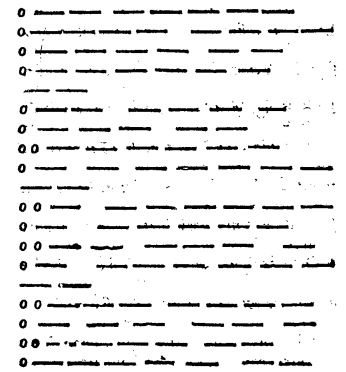
The method of forming the above mentioned sixteen figures is to use a pen to mark sixteen rows of points on a piece of paper. These must then be paired two by two, until, at the end of each row, either two points are left or only one.
Abano’s illustration of how the four mothers are formed
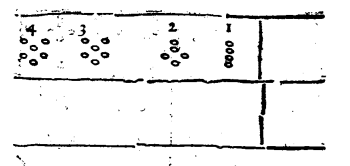
Then one must take the geomantic figures that emerge, in the following way.
Abano illustrates how to add the Four Mothers to their place
Note, however, that the previous operation is not carried out by counting the points one makes, nor by following one’s fancy, but rather by virtue of the Primum Mobile and First Motor God the Eternal, who moves one’s hand, and is to be carried out with good intentions and by invoking God’s grace and help.1
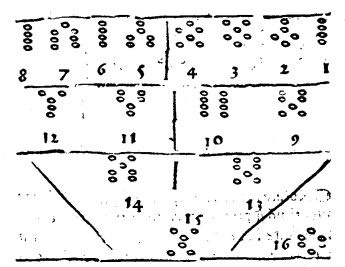
From the first four figures, four other figures are derived by taking the first points of each of the first four figures, which go to form the fifth figure; then by taking the second points of each figure to form the sixth figure, and so on with the third row of points to form the seventh, and the fourth row to form the eighth, as shown below.
Abano’s illustration of the Geomantic Shield
Once the eighth figure has been drawn, take the first and second [figure] and, proceeding in the same way as at the beginning, form the ninth; then take the third and fourth to form the tenth; then the fifth and sixth to form the eleventh; then the seventh and eighth to form the twelfth.
Then, add the tenth and the eleventh to form the thirteenth, known as the First Witness, and the eleventh and the twelfth to form the fourteenth, known as the Second Witness. Add the witnesses to discover the Judge.
This completes the chart, with every figure in its necessary place according to the question asked, as will be explained. However, often one may take the Judge and the first figure and add them together to obtain the Judge of the Judge,2 which is the sixteenth figure, which we will discuss later.
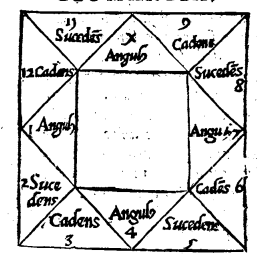
It is to be noted that the main figures are the first twelve, of which four are strongest. The first and the tenth are the best, but the first is even better. The seventh and fourth are also good. These four figures are called the angles, noting which one may know the strength and virtue of the chart. Following them, the second and fifth figure, and the eighth and the eleventh are known as succedent. Finally the last four are the third, the sixth, the ninth and the twelfth, which are called cadent, as shown in the following figure.3
Abano’s illustration of the principle of angularity as it applies to geomancy
And the first figure is called the strongest and best of all, because it signifies the virtue of the Heavens on the querent, that is, he who asks the question.4 It is called the Ascendant. Following that, the tenth is in the middle of the heavens and has great power and influence. When it is good it bodes well, but when it is unfortunate it means great misfortune in terms of how the question is going to end.5
The seventh figure is opposite the Ascendant and is called the Western Angle, and it bodes well when good, ill when bad, especially in questions concerning the seventh house, as will be shown. The fourth figure or house, although categorized as an angle, is called the feeblest of them, because it is at the bottom of the skies in our hemisphere. Nonetheless it indicates the end of the matter and of the querent’s intention.
Then we have the second, fifth, eighth and eleventh, which are succedent houses because they come after the angles, and are good or bad according to the figure [that falls in them] and the question asked, and they indicate the present and what is yet to come for the question asked. The third, sixth, ninth and twelfth figure are called cadent, meaning what runs against the question, and the worst are the sixth are twelfth. The eighth is also among the evil houses.
The above is especially to be noted because every figure has two virtues, one according to its nature and an accidental virtue depending on where it falls in the chart.6 As such, if a good figure falls in the first house, its goodness is amplified, and similarly in any other angle. When it falls in a succedent house, it has less power, and when it is cadent it has even less. And this point holds true for evil figures as well in their ability to cause bad fortune. An evil figure in an angle, therefore, will mean a great bad fortune, especially in the fourth.
Nonetheless, among the bad houses, the sixth and eighth and twelfth are the worst, and every figure falling therein is dangerous in any question.7 And they are especially dangerous if they are evil by their own nature. Said figures are considered not just according to their virtue and the places where they fall, but also according to the question, that is, according that they are appropriate or inappropriate concerning the thing asked.8 As such, what follows is the signification and the property of each of the houses.
The first house signifies the life and body, the being and soul and intention of the querent or the one for whom the question is asked. It also means the beginning of all things. It sits opposite the seventh, and signifies the goods and money of the prisoner. It is the joy of Mercury.9
The second house is wealth,10 gain and loss, and all that the querent owns. It is opposite the eighth, and it signifies the gain of the querent’s family.
The third house indicates siblings, blood relatives, short journeys and enemies of faith and of the Roman Church,11 neighbors, etc. This house is opposite the ninth. It also signifies rumors, and travel companions. It is the joy of the Moon.
The fourth house indicates buildings, buried things, the end of every question. Also, the father, the wealth of a brother or sister.12 It is opposite the tenth.
The fifth house indicates mirth and happiness, children, messengers and letters, music, food, clothes, mid-range travel, the father’s wealth. It is opposite the eleventh and it is the joy of Venus.
The sixth house indicates wrath and an evil mind, toil, malady, servants, people who are subjected to the querent, small animals. This house is the joy of Mars.
The seventh signifies the wife,13 the lover, an opponent, public enemies, games of chance, thieves, bandits, partners. The place the querent goes to, medicine, the wealth of one’s servants. It is opposite the fist house, and is absent.14
The eighth house indicates death, fear, danger, the wealth of the enemy, inheritance from the dead, the wife’s dowry, gain from the land one moves to,15 debts, Necromancy, evil spells. It is opposite the second.
The ninth house signifies religion, Ecclesiastics, the Pope, preferment, priests, the Christian faith, burials, fame or infamy, long travels, the wealth of the absent party.16 It is opposite the third, and is the joy of the Sun.
The tenth signifies the Emperor, the King, the lord,17 great honor, a doctor, a master, art, profession, sea, ship, towers, the thing stolen, famine, fertility, the church’s wealth, and advantages gained from the church. It is opposite the second.18
The eleventh signifies friends, hopes, fortune, courtesans, a lord’s wealth, common goods, the mother’s dowry. It is opposite the fifth, and is the joy of Jupiter.
The twelfth house signifies prison, prisoners, pilgrims and endless wandering, long violence,19 adversities, traitors, occult enemies, great beasts, the friend’s wealth. It is opposite the sixth. It is the joy of Saturn.
Whenever a question is asked, the issue always involves the first house, and in the second place the figure found in the house that is appropriate for the question, and depending on whether it is fortunate or not, together with the four angles, thus does one judge the issue. And especially [it is to be considered] whether the Witnesses and Judge are good.
MQS
Footnotes
Here again, as in Part 1, Abano insists on the role of the divine (and again, he does it in a typical Christian Aristotelean fashion). He is doing more than just paying lip service to the religious ideas and institutions of the time, in so much as he asserts a central point common to all forms of divination: that it is divine nature that shines through the divination process. This explains his assertion that the points must not be counted nor be created following one’s fancy: the diviner’s ego must be switched off in order for the divine to act through it. ↩︎
‘Sopragiudice’ in Italian, which literally means Superjudge or Overjudge. ↩︎
Abano follows the relatively standard (by that time) association of the astrological houses with varying degrees of strength. ↩︎
The first house is given to the querent, so a good figure in it would indicate something positive for them or that they are positive. ↩︎
This seems intended more to emphasize the importance of the angles than to link the tenth house with the ‘end of the matter’, which is a meaning typical of the fourth house. ↩︎
This is meant to reflect the notions, common in Medieval astrology, of accidental and essential dignity of the planets, though the concept must be modified a little in order for it to apply to geomancy. ↩︎
There is a certain digree of ambiguity concerning this issue, as it is not always clear if a figure in a weak house will see its power decreased or its evil import amplified. This ambiguity is present in astrology as well. ↩︎
This is an important concept. A good figure becomes bad if its meaning is opposite to the querent’s intention, and vice versa. ↩︎
Joy is an astrological term. The joys of the planets are houses where the planets are supposed to perform their heavenly duty better. A typical attribution is: the first to Mercury, the third to the Moon, the fifth to Venus, the sixth to Mars, the ninth to the Sun, the eleventh to Jupiter, the twelfth to Saturn. Abano follows this scheme. ↩︎
The term used by Abano is ‘robba’ or, in current Italian, roba. This literally means ‘stuff’. Keep in mind that in the Middle Ages, for many people, stuff was more important than money, and that the moneyed economy we have today was barely in its infancy back then. The second house indicates stuff, and therefore all moveable possessions. ↩︎
Because the third house sits opposite the ninth, which is the house of God. Obviously, Abano wrote at a time when Catholicism was the dominant and (for the most part) only allowed creed. ↩︎
This is by the principle of turned houses. The second house from every house indicates the wealth of the thing or person signified by that house. ↩︎
or husband, if the querent is a woman or a man interested in men. ↩︎
It’s unclear to me what Abano means by this. The seventh house is sometimes given to ‘the absent party’ to know if the person will come back, but the wording Abano uses is strange. ↩︎
The land one moves to is ‘there’, which is the opposite of ‘here’, signified by the first house. ↩︎
I don’t understand why the ninth should indicate the absent party’s wealth. ↩︎
‘Signore’ i.e., the ruler of a Signoria, a small Italian monarchy typical of the time. ↩︎
Here Abano introduces the subject matter and the names and main qualities of the sixteen figures.
Geomancy is a simple science to master. It employs the same methods of astrology to answer any question the person might have—whether what one wants to undertake will meet with success or not, according to natural virtue and celestial influence.1
This method of judging [questions] and receiving information avails itself of four figures made of ink points on a piece of paper by the Geomancer’s hand, which is moved by the heavenly influence of God’s eternal grace.2 As such, one must ask one’s question with sincerity and a pure soul.
From the initial four figures, sixteen are derived (and no more than sixteen) to answer any question the person might desire to know [the answer to]. However, not all the figures are necessary in answering a specific question. Only fifteen are, and they are enough to answer any question.3 These fifteen figures don’t always come up in the same way, but only as Heaven influences them to come up.4
These are the sixteen figures and their names:
Abano’s illustration of the sixteen figures with their latin name
Four figures are assigned to each quadrant of the Heaven (North, South, East, West) and to the four elements (Fire, Air, Water, Earth) as will become clear shortly. They are called fortunate or unfortunate.
Rubeus, Amissio, Fortuna Minor and Cauda are Fiery, that is, hot and dry, and of choleric complexion,5 southern, diurnal, masculine, strongly malicious, haughty and furious.6
Acquisitio, Laetitia, Conjunctio and Puer are airy, that is, hot and wet, of sanguine complexion, eastern, masculine and diurnal, very good and temperate, and good wherever they fall in the chart.7
Puella, Populus, Via and Albus are cold and wet, of phlegmatic complexion, northern, feminine and nocturnal. Generally fortunate and good where they fall in the chart.
Caput, Fortuna Maior, Tristitia and Carcer are earthy, that is, cold and dry, and of melancholic complexion, western, feminine, nocturnal. Two are good, Caput and Fortuna Maior, while two are bad, Tristitia and Carcer. They are slow and slothful in their meanings, but they cause what they promise nonetheless.
All the above is to be noted when a figure represents a person and another figure a different person, that we may know their character and how well they may get along.
The sixteen figures have yet another cycle of attributes that renders them positive or negative. Depending on whether they are mobile or fixed, we may know how soon or how late the effect will manifest, and how the situation shall be resolved according that they are entering or exiting or mixed.
Acquisitio, Fortuna Maior, Albus, Caput, Puella and Tristitia are entering, fixed, good and fortunate, except Tristitia, which is always bad.
Amissio, Fortuna Minor, Rubeus, Cauda, Puer and Laetitia are exiting, mobile, bad and malicious, except Letitia, which is always good.
Populus, Via, Conjunctio and Carcer are said to be common, that is, neither very quick nor very slow, and they are also neither too good nor too bad, though they tend to err on the side of goodness, except for Carcer, which is always evil.8
And yet another meaning must be added, which shows whether the people signified by the figures conform to one another in terms of will and soul, according that the figures are mobile, quick or slow, and according that they are single-bodied or accompanied [double-bodied].9
Acquisitio, Fortuna Maior, Puella, Caput, Tristitia and Albus are fixed, single-bodied and regular.
Amissio, Puer, Cauda, Letitia and Rubeus are mobile, half-bodied and diminished.10
Fortuna Minor, Carcer, Conjunctio, Via and Populus are common, that is, between mobile and fixed, and they are neither too quick nor too slow, and are double-bodied and accompanied, except for Via.
And in order that one may easily know the virtue and influence of the Heavens through the sixteen figures, we must also note their correlation with the twelve zodiac signs. Similarly, they are attributed to the seven heavenly planets, according to their influence on the twelve signs.
Abano’s illustration of the astrological attributes of the geomantic figures
However, each figure does not mean the same as the other [assigned to the same planet]. Each has a separate meaning. As such, Carcer is Saturn direct, Tristitia is Saturn retrograde; Acquisitio is Jupiter direct; Letitia is Jupiter retrograde; Rubeus is Mars direct, Puer is Mars retrograde;11 Fortuna Maior is the Sun when elevated, Fortuna Minor is the Sun when depressed and obscured; Puella is Venus direct, Amissio is Venus retrograde; Albus is Mercury direct, Conjunctio is Mercury retrograde; Populus is the waxing Moon, Via the waning Moon. Consequently, the direct signs are better than the retrograde. Furthermore, Caput is attributed to Jupiter and Venus, Cauda to Saturn and Mars.12 But this is not always the case, but rather depends on the question asked.
MQS
Footnotes
The concept of natural virtue underpins the Western magical worldview. The word ‘virtue’ must not be understood in a moral sense, but rather in the sense of ‘property’ or ‘power’. It forms part of the Hermetic doctrine of Signatures. The virtues of the things under the Heavens are generally seen as corresponding to certain celestial factors. ↩︎
This is a rather typical phrasing found in various premodern handbooks. It is connected with the Christian Aristotelean worldview prevalent at the time, whereby God, the unmoved mover, ruled the world not directly, but through a series of concentric spheres, each one corresponding to a planet, except the sphere of the fixed stars and that of the primum mobile. ↩︎
The sixteenth figure is what is commonly referred to as the Judge of the Judge, formed by the Judge plus the first Mother. ↩︎
The word ‘complexion’ is used in a slightly different way from today. It refers to the theory of the four humors (black bile, yellow bile, blood and phlegm). These humors influenced not just the character, but also, up to a point, the appearance of the subject as well as their being prone to this or that illness. ↩︎
Abano seems to include Fortuna Minor among the malicious figures, though later in the text he treats it as generally positive. ↩︎
Abano however does not always treat Puer as a positive figure. ↩︎
In all this section Abano seems to be painting with a very broad brush, talking of the figures as “always good” or “always bad”. Of course things get more complicated. ↩︎
This is borrowed, as so much in geomancy, from astrological practice, where the mutable signs (Gemini, Virgo, Pisces and Sagittarius) are also called double-bodied. Double-bodied signs, and therefore geomantic figures, can indicate the involvement of more than one person. ↩︎
The concept of half-bodied does not, to the best of my current knowledge, come from astrology, but I may be wrong. ↩︎
This seems prima facie counterintuitive, as a retrograde planet is generally considered worse than a direct one, and Puer is generally not considered worse than Rubeus. ↩︎
This is in accordance with the relatively standard Medieval practice of attributing the North Node of the Moon to the two benefics, Jupiter and Venus, and the South Node to the two malefics, Saturn and Mars. This practice developed over time and does not seem to originate in older astrology of the Hellenistic period, when both nodes appear to have been considered more or less malefic, when considered at all. ↩︎
Some days ago I was talking to a fellow occult student and we were comparing notes on how we go about the process of divination. When I told her that I tend to say a little prayer before divination she was surprised, so I thought it would make for a nice topic.
First off, I do not think that praying before divination is mandatory, nor do I think that it’s the prayer that makes divination work. It doesn’t matter if it’s synchronicity, as Jung said, or if it’s the spirits that live inside the cards, as my first teacher told me, or if it’s the Soul of the World, as the Platonists believe, or if symbols are living beings, as I believe: the point is that the cards always rearrange themselves in a meaningful pattern, the planets always find themselves in the right aspects, the right geomantic figures always emerge, the right I Ching Hexagram always forms.
As such, in a way, divination is a natural activity, so much so that it’s probably one of the earliest activities humans have undertaken. The reading of symbols came much sooner than the reading of characters, because symbols occur naturally to the mind whenever we realize that X means Y. The moment the first men drew any kind or conclusion from any kind of observation, divination was born.
And yet, I believe that divination is also essentially extraordinary. In a way, divining is as normal as cleaning your cat’s litter box, but in another sense it is also very different. In divining we read a part of the whole (the divination system) to derive conclusions on the whole (life itself). Indeed most divination systems are universal languages that mirror the complexity of the Macrocosm.
As such, divination cannot be decoupled from a global understanding of life, and this global plane is where philosophy, spirituality and occultism unfurl their wings.
In my own view, occultism is divided into three branches: devotion, divination and magic. But these three aspects are not discretely separated. For instance, theurgy brings together magic and devotion. Divination and magic are often coupled together, such as in electing the right time to make a talisman or in asking if a magical action is warranted or advisable or effective.
Praying before divination brings together devotion and divination. It is a way of recognizing the extraordinary import of the action I’m about to take, despite this action being, in another sense, perfectly ordinary.
It helps me more than it helps the divination system itself. Nor does it have to be prayer. I know of some people who wash their hands before divining. In Imperial China official diviners had to cleanse themselves before attempting divination, and this is true all over the world.
No one divines willy-nilly. No one *should* divine willy-nilly. This has nothing to do with respect (unless you are receiving information from a particular spirit), it has nothing to do with asking deep questions (divination should always be practical) and it has nothing to do with not having a sense of humor (you can have a sense of humor, in spite of how bland and vapid many of us are). It does have to do with knowing what place divination has in the scheme of things and reaching that place. I do it through prayer, others may do it by just taking a second to clear their mind, but everyone does it one way or another.
Remember those listicles that were much in demand about ten years ago, before people grew tired of the rage-bait? Yea, they still do them, but they have somewhat fallen out of favor, especially since they are so basic even AI can do them better than the poorly paid saps who wrote them back then. Anyway, here’s a short one, hopefully more interesting than the average listicle, on what generally hinders good divination, plus a bonus entry for what helps.
Mechanic Behavior
Divination eschews mechanic repetition. Asking the same question one or two times is fine because there is still enough emotion behind it to put the system into motion. In fact, it is fine to ask the same question many times as long as the querent is truly invested in it, but the more the querent asks the same question with the same emotional drive as the first time, the more you know the querent is cuckoo and is best avoided. In general, it is best to wait a little between divinations.
This point is one that skeptics seem unable to wrap their heads around, because it seems to run against the principle that experiments can be repeated ad libitum, but it is really quite simple: divination is not an experiment, and the more you mechanically ask the same question, the more the real question changes to whatever it was at the beginning to “does divination really work?” and this question cannot be answered by divination itself.
All in all, a balanced relationship to divination as a means of intelligence gathering, together with the understanding that we are attempting something more exceptional than cleaning the cat’s litterbox, is in order.
Shallow Understanding of the System You Work With
If you asked your doctor how he knows his diagnosis is right and he told you it was just his intuition, you’d feel justified in seeking a second opinion. Yet among ‘spiritual seekers’ anything that reeks of effort and study is frowned upon and people go to extraordinary lengths in order to avoid the simple fact that both knowledge and experience are needed to perform satisfactorily in any sector of life. So they come up with anything from intuitive advice (which essentially means “don’t ask me how I know”) to the great angel HRU to fairies to ‘kickass schools of non-duality.’
The reality is that divination is a method for the acquisition of knowledge. If we don’t make the effort of studying the method we don’t get much knowledge. I believe the current distrust of study comes in part from the distrust of intellectual knowledge (see the bonus entry in this list) and in part from the fact that many people who become interested in divination do it to create a little bubble of mystery and mysticism away from the golden cage that is modernity.
Either way, it is a misguided attitude. Divination requires study. Lots of it. In fact, the study will never end. The good news is that we can start practicing much sooner. As for intuition, it does have a place in divination, and I’ll talk about it in the future, but unbridled intuition is just a badly behaved kid.
Bias and Preconceptions
I’ve already talked at length about this, and I will probably still talk about it in the future. It bears repeating: the more we think we know, the less we’re open to discovery.
Aside from ideological forms of bias, which are always bad regardless of the ideology, there are also other forms. One of the most deadly forms of bias is, for instance, the belief that the querent knows what they are talking about. A querent doesn’t need to be malicious in order to confuse us: they can just be confused themselves, or they can have built a whole scenario inside their heads before sitting in front of us.
On the other hand, talking over our querent and treating them like a special needs child won’t do either. There needs to be a balance between our ability to see the truth of the matter in a dispassionate way (thanks to the divination system we are employing) and open-heartedness toward the querent. As a matter of fact, an open heart can go a long way.
Querents can also be biased against us, but we can do nothing about it. People sometimes ask me what happens when someone asks false questions maliciously. What happens is that if I’m lucky, I’ll understand it from the cards, while if I’m not lucky I’ll make a fool of myself. Either way, the person won’t change their mind about divination or about me, so why bother getting worked up about it? Stuff happens.
Your Brain, Your Best Friend
Ever since Madame Blavatsky disgracefully started peddling poorly understood principles of oriental philosophy, the Western esoteric world has become convinced that the “mind is the enemy”. People generally think so (isn’t it ironic? The mind thinking that the mind is the enemy) because they are incapable of using it but want to sound deep in their incompetence.
In reality, if there is such a thing as overthinking, there is also such a thing as underthinking. The idea that everything must come immediately and instinctively to us in a space of pure knowing and that everything resembling logic is the work of the devil is patently wrong.
Aside from the fact that this is philosophically delusional, most people who think only the mind lies never stop to consider how many times their instincts or their heart actually let them down on a day-to-day basis. The reality is that our mind, our body and our heart are ways for us to acquaint ourselves with the world, and all three can lead us astray depending on the context, just as much as they can guide us to profound insight.
Therefore, if it is not correct to let the other two dry up, it is also not correct to become mindless pseudomystics, sacrificing our understanding on the altar of an ill-digested and rather offensive orientalism (“Counterfeit Asian philosophy 101 says the mind is poo poo, therefore it’s true. See how smart I am? I misquote exotic people!”)
The funny thing is that most Eastern forms of divination are not at all intuitive, and in fact verge on the overly technical (see Da Liu Ren, Qi Men Dun Jia, Wen Wang Gua, Vedic Astrology, Purple Emperor Astrology, etc.) They are also incredibly accurate exactly because of how majestically brainy they are, though they may not have the glamour of the latest useless set of empowering witchy cards. Traditional Western divination systems, of course, can be just as accurate, but people usually have the expectation that they need to unplug their brains on the way in. Let’s not do this. Our mind can sometimes lead us astray. It can also help a great deal.
I come from a rather traditionalist school of divination. One of the ways I learned was that my teacher often told me to do a spread on an aspect of her past I knew nothing about to see if I managed to discover what happened. Another way was when she told me to do a spread to see what would be the problem of the next person going to her for a reading. Interestingly, I have met other people, who have taught me other techniques, who used the same method.
As can be expected, there was little room for anything other than the literal interpretation of the cards. This has helped me a lot to remain with my feet on the ground as I forged my path, which is very good, considering how littered with nonsense the esoteric landscape is.
On the other side of the spectrum you have a sizeable chunk of diviners today, though the situation now is slightly more balanced than it was just twenty years ago. These readers simply interpret the cards (or the planets, or whatever) as if they were benevolent tips from the universe about some inner issue that the person needs to work through to progress.
The problem I have with this approach, aside from the fact that it leads to unverifiable predicitions, is that it presupposes a superstitious view of the universe as some kind of benevolent nanny that teaches you how you ought to behave. These people, I should remind you, are the ones who often loathe Christianity as a bundle of silly dogmas and think they are the reasonable ones.
If there is one thing that my study of philosophy as well as my experience as fortune-teller has taught me is that there is no such thing as an ‘ought’. There’s what is and what isn’t, what was and what wasn’t, what will be and what won’t be, as well as what can be, or is more or less likely to be. For instance, there is no way you ‘ought’ to eat. You either eat well or you don’t. Eating well only becomes an ought when your current diet is checked against your desire to minimize health risks. It’s your desires that create oughts, not the universe.
I already discussed how I believe that divination tools are essentially something that gives us a bird-eye view of existence, affording us a glance at a number of considerations about our situation that we might not otherwise have. To use my old analogy, it is like being in a crowded city center and talking to a person on a walkie talkie, this person looking at your position from the top of a skyscraper and therefore seeing things you cannot see.
It goes without saying that I believe divination tools never give advice.* As maps, they simply tell you what is. Advice is contingent on what either someone wants to do or what they believe a superior authority wants them to do. My view of the superior authority is that it is too occupied exploring all its potential through us to pick and choose what’s best for us.
Does it therefore mean that a diviner should not give advice? I actually believe advice is a perfectly fine thing, as long as it is not delusional advice. I think a good divination session should always be of help to the querent in living their own life better. This is done by checking the querent’s wishes (sometimes implied, sometimes stated outright) against the wider situation as portrayed by the oracle, with its potentials, its risks, its possibilities and impossibilities, its certainties and its uncertainties.
In other words, advice must come from the diviner on the backdrop of the oracle, and not be projected onto the oracle, which just pictures reality as it is, not as it should be (because there is no way reality should be, from an objective standpoint). Sure, sometimes I tell my querents “the cards are advising you to do X”, but this is short for “I am advising you to do X based on what the cards are telling me about your situation.”
Sometimes the right bit of advice at the right time can help the querent make a turn for the better in life. These are the readings I love the most. Sometimes it can improve a situation. Sometimes, though, the advice is not enough to change an objectively difficult situation. The more heroic and nietzschean reaction to these slings and arrows that life throws at us is that of amor fati: in knowing what’s coming, one can learn to love it, thus overcoming it, making it part of oneself instead it being an alien destiny. But this is not always possible. Sometimes, all the querent can get from a difficult reading is peace of mind. And peace of mind is a great thing, all too often undervalued until it’s no longer there.
MQS
* In this, divination tools are very different from inspired divinations caused by spirits or deities, since these actually do have their own particular views and preferences.
or “Summa Scientiae Nihil Scire” in Latin. This motto is very useful in practical fortune-telling. One of the greatest risks we run is of assuming. “She’s 85, how is she gonna find love?” “He’s a 23-year-old jock, he’s probably not a priest.” “She looks so prim and proper, she’s unlikely to have seven lovers.”
All these preconceptions and more cloud our mind as we try to read the oracle’s answer, regardless of the oracle, whether it be the Tarot, playing cards, astrology, the I Ching, etc. All these preconceptions are poison to the art of divination. They are not of service to us, nor to our querent. Let’s delve into why.
Let us start from the fact that bias is a natural and necessary phenomenon, as politically incorrect as this may sound. Bias comes to us from our experience, but also from the experience of others, especially family members, friends, teachers and people we trust. Bias orients our life, and this cannot be otherwise. The attempt to forcibly eliminate bias from people’s minds only causes suffering, and is its own kind of irrational crusade.
You know who is NOT biased? God. You know what God does? Everything. But you can’t do everything. You can only do something. And in order to do something, you must be biased against something else. That’s life.
This is not to say that all bias is good. For instance, I may have accepted some preconceptions from my parents, who got them from their grandparents, who got them from the priest, who got them from a crazy lady next door, etc. This kind of bias is the worst because it can needlessly limit our options and create likewise needless suffering in those around us. The best kind of bias is the critically examined one that you accept based on your actual life experience and keep open to revision.
Yet even this kind of “good” bias is harmful to divination. When someone comes to us for a reading, or when we read for ourselves, what we are doing is trying to look at reality from the point of view of a symbolic system that reflects life from an objective, or at least less subjective standpoint.
Divination is a language with no native speakers, except maybe the guy upstairs, which means that our understanding of it is always going to be imperfect and faulty. But this is a technical kind of difficulty, and in its own way it’s excusable. What is less excusable is the additional confusion we create by reading our biases into the divination. This is not just about politics, philosophy, morality or religion. It’s everything.
“A 85-year-old is not going to find love again” is one sort of bias. “An attractive young guy is probably not a priest” is another. The aim of divination is to read the truth, not ourselves.That’s why the height of science is to know nothing. If we start with a clean slate we can receive much more information from the tool we are using, simply because we are not randomly blocking out information we consciously or subconsciously deem unlikely.
The unlikely happens everyday. Think about it. Almost everyday something unlikely happens in the world. That’s not to say we must feel the urge to make our predictions as unlikely as possible in order to impress the querent. Most of the time, what’s likely is what ends up happening. Still the unlikely is not the impossible.
I am big on comparing divination with language, as those reading this blog know. And as you know, I am not a native speaker. Around fifteen years ago, I was trying to improve my English by watching youtube videos. Yet this was very hard, because the language people use on youtube is very inconsistent, erratic at times, filled as it is with memes, asides, jokes, ancdotes, interruptions… I was trying to project the artificial English I had learned in school onto this truer, more lived English.
“Surely he can’t have said what he has just said. It doesn’t make any sense,” I constantly thought. It was when I stopped projecting my presuppositions and started just taking in what was objectively being said that my English truly improved. That’s the same with divination. The height of science is to know nothing. Only if we know nothing we can take in what is being said.
When I was a teen, I remember stumbling upon Aristotle’s definition of the “educated mind” as being able to hold a thought without accepting it, and I remember thinking how silly and basic the definition was. The older I get, the more I find myself agreeing with him, as I see fewer and fewer people capable of doing it (the fact that Aristotle never actually wrote the sentence is a whole ‘nother can of worms)
A lot of people don’t have an educated mind per the definition above. One would like to think that tarot readers, astrologers and the like would not be like a lot of people, seeing how much the word “wisdom” gets thrown around in their circles. But one would be wrong. Leave it to the “spiritual community” to be among the most ideological and stiff. And, consequently, not among the brightest. If there is a group of people I don’t trust to be capable of holding any thought except the ones they agree with, that’s these people.
I believe I already talked a little about this, but one of the most memorable examples I can think of is the 2016 US election, when every tarot reader on youtube and their mom were busy predicting Trump would lose the election disgracefully, poop his pants, writhe on the floor, throw a tantrum and retreat into the hell that spawned him while Hillary Clinton swung her throbbing, veiny, 25 inch hard-on at the glass ceiling. While I am slightly exaggerating, this was pretty much the tone. (interestingly, those same readers routinely claim that the tarot is not for fortune-telling)
One such reader went as far as channeling Trump’s character. I do not remember the exact spread, nor most of the cards, but two things stuck with me: first, no egregiously bad card showed up, and second, the King of Cups featured prominently in the spread. She interpreted the card as Trump being a violent man prey to his base emotions and instincts. I took a quick look at some of that reader’s other videos, only to discover that she never, ever interpreted the King of Cups this way. In fact, she always interpreted it as the significator of a good man who takes care of the querent.
This is a good time to point out that I am fiercely apolitical, so this is not about politics. All ideologies are, as far as I am concerned, clouds over the mind’s clarity. I’m not saying everyone needs to think like me. Everyone has their delusion of choice, and everyone (including me) has their way of slanting reality in one direction or the other, whether politically, spiritually or philosophically (or even scientifically, for that matter). In fact, slanting reality is probably needed in order to filter information that might be useful to us.
Yet divination should be something else. What that reader did was merely using the cards as a mirror of her own (perfectly legitimate) bias. This is fine, and can even be useful at times–if you are aware that you are doing it. Even that would not be actual divination, but at least it wouldn’t be a waste of time.
I already discussed that divination is really a process of deification, that is, the process of allowing the dispassionate, bird-eye view clarity of the divine into one’s limited, subjective world by letting new information in. In other words, true divination is the opposite of retreating into one’s bubble: it’s the bursting of the bubble.
This, in turn, requires a certain readiness to accept the information we get (which is why it is always best to get someone you don’t know to read your cards.) Divination without intellectual honesty is just a crutch for one’s ego, and that’s how it is currently being used by the vast majority of diviners.
Unfortunately, intellectual honesty won’t make you many friends. Back in 2016 I had arguments with more tarot readers than I care to remember and was routinely labeled a dangerous extremist just because I called into question the usefulness of this type of reading (back then I still tried to entertain fruitful conversations with people). But occultism, in all its branches, is a narrow path.
Two lessons from all this: 1) if you are reading for yourself and the cards (or chart, or dice, or whatever) seem to confirm what you already think or wish, apply a bucketful of salt to the reading; 2) invest some money into a simple handbook of logic, or at least expand your knowledge of logical fallacies. This will repay you many times over, regardless of what branch of sorcery you practice.
This post is part of my Notes on Divination series.This gets somewhat philosophical and is rough and not organized, so bear with me.
In the previous post in this series, I started discussing some general ideas on why fatalism is an inherently flawed view, while in the one before I had shown why pure free will makes just as little sense. To summarize, pure free will simply doesn’t take into account the fact that we don’t live and move within a blank space that we can change at whim.
On the other hand, pure fatalism cannot even be articulated as a view without contradicting itself: if fatalism is real, then my fatalism is not due to me assessing reality and forming a fatalistic worldview that corresponds to how reality factually is, but it’s due to destiny forcing me to be a fatalist. This implies that when I say I am a fatalist, I don’t really mean it. I *cannot* really mean it – It is conceptually impossible. In order to be a fatalist, I must have the freedom to develop a fatalistic worldview. This is a contradiction.
My view of the universe is consequently inherently libertarian, though it is a reasonable and limited libertarianism.* No matter how small our personal freedom is, it exists and is the place we our soul inhabits. Freedom is the consequence of consciousness. When I become aware of something, I posit it as the object of my awareness, outside of myself, and therefore incapable of completely determining my whole being.
Now let us ask: what happens during a (serious) divination session? What does divination do, at heart? At the very least, divination must either make us aware of unknown facts about the past, present or future, or it must shed new light on known facts, thus revealing them from a different, previously unknown point of view. A divination session that does not do this is not a divination session. It may or may not be helpful in other regards, but it is not divination.
The Moment of Divination
It is clear, therefore, that divination is inherently connected to consciousness and to increasing our conscious awareness of (our) reality. This is another reason why a (mildly) libertarian view of divination makes more sense. Suppose you cross the fortune-teller’s palm with silver and then you get told you will win over your crush: is the fortune-teller right because she actually sees this in the crystal ball or is she doomed to say this to you? If she is doomed to say it, then the fact that she is saying it has nothing to do with the statement being true and everything to do with destiny forcing her to say it.
Furthermore, in revealing your future to you, the fortune-teller cannot help but modify it. This has nothing to do with some odd theories I’ve read on the internet, about the fact that if you predict something you make it happen. If that were true, I could predict myself into a billionaire. Besides, even if the fortune-teller saw your future and didn’t tell you, she would still be modifying your future.
Reality is much more subtle. Suppose that X is going to happen to you. If the fortune-teller tells you, then you are aware of X happening. X happening with your awareness is different from X happening without your awareness. The fabric of the fact itself changes with your awareness of it, for the simple fact that something that happens with your knowledge is not something that happens without your knowledge.
The moment of divination, therefore, has a very important place in our life, because it is part of our life, but it is also a part of our life wherein our awareness of reality increases, thereby changing our reality. This does not automatically mean that divination can make us realize every whim that crosses our mind, nor that it can always save our butt. Sometimes the only choice possible is between accepting a fact and not accepting it.
I like to liken an oracle to a friend on top of a high building, who has a wider view of our surroundings than us as we move in a busy intersection of streets, and who texts us hints that increase our understanding of our reality and can help us make better choices, though sometimes the choices we can make are so severely limited as to border on predestination.
MQS
* I mean ‘libertarian’ from a metaphysical standpoint.