Back in my smoking days, I remember thinking that the biggest obstacle to quitting was not just the physical addiction to nicotine, but the fact that cigarettes had simply become a part of my day. Addictions slowly (or quickly) carve time for themselves in our life, so that even when we decide to stop engaging in the addictive behavior, there is a chasm left between the time before engaging in it and the time after engaging in it that needs to be filled. The hardest thing is beginning to reimagine our life as something whole even without the thing we stop doing.
I was talking to my husband’s little cousin the other day. She’s 16 and she is the typical fried-brained teenager who has been conditioned to expect that anything should be presented in small 15-second soundbites that you can scroll through if the gratification doesn’t hit within the first two seconds. By the way, I’m not saying this as a jab at the younger generations: my generation was fried-brained in a different sense, and besides, I know plenty of people older than me whose mind has been beaten to a pulp by the mechanisms of social media.
What I thought was funny, but also a bit worrying, was her fidgety demeanor whenever she had to spend more than a couple of minutes without fiddling with her phone. She was in principle no different than me after an hour of not smoking–except that the withdrawal symptoms kick in much more quickly. I asked her if she could fathom spending a day doing absolutely nothing that she didn’t have to do (e.g., going to school, help clean the house, etc.) and she looked at me as if I started speaking in tongues.
To be fair, asking this of most teenagers is asking too much, regardless of the generation, and she’s the ‘go go go’ type anyway. But yesterday I spent the day doing exactly that–nothing that I didn’t have to do. It was refreshingly hard to accomplish.
Coming to a point of stillness is difficult when we are constantly bombarded by stimuli. Plus, our conscience of other people’s awareness and attention has expanded in recent years from the couple of people around us to potentially the whole world.
The ringing silence I experienced was a reminder of how abstract this type of conscience actually is: I am not in front of an audience. I am alone, a point in the existence reflecting upon itself. It was one of the longest days I had in my recent memory, but not in a bad sense. I can start to see why so many ancient stoics said that each day can be treated as a lifetime in and of itself.
I feel this is a good exercise to do regularly, so I will incorporate it into my practice. It is not meant to be a flight from reality. It is a way of coming back to it so I don’t lose sight of its right proportions.
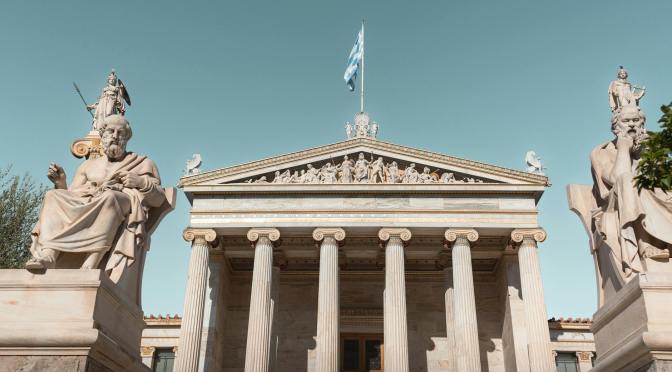
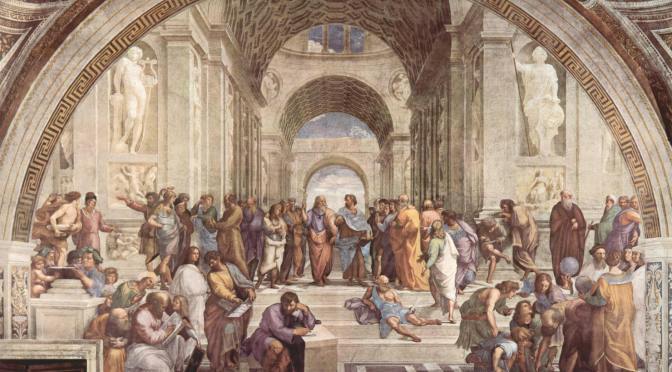
When it comes to searching for philosophical-magical inspiration from pre-Christian times, many occultists look at Plotinus and Proclus, two of the most important among Plato’s successors. After Plato, they are the most noteworthy representatives of Platonism, and if Platonism is up your alley, as it is right up mine, you’ve probably looked into them.
Proclus, who was one of Plotinus’ successors as head of the Academy, and was also the last noteworthy Platonist, is especially popular among those who seek inspiration for magical work. The reason is that, unlike Plotinus, Proclus did have a strong interest in religious and magical practices as well as being an important philosopher.
My personal preference, though, is Plotinus. I discovered his work, the Enneads, in my late teens and read it all throughout college. Unlike Proclus, Plotinus was a pure philosopher, with no interests outside of philosophy. Yet his writings have inspired many generations of theologians, occultists, hermeticians and devotees.
Writing at a time when Christianity and other early odd religious beliefs held sway, Plotinus managed to single-handedly revive philosophy as an exalted pursuit that connected the mind with the divine realm. Although he did not appear out of nowhere (his predecessors at the Academy had already laid the groundwork), his genius does tower over anything and anyone who lived in his time.
Plotinus had the aspiration to simply explain Plato’s work, and as a matter of fact we often find assertions in his writings that he is doing nothing more than saying what Plato has already said. But this is not true. His philosophy sought to coherently explain the whole of reality starting from the initial unity, and to trace the steps that mortals can take to re-experience that unity in their ascent back to the One. Although one could argue that the same aspiration is present in Plato, and especially in his esoteric doctrines, the two philosophers are still very much distinct, as is to be expected, considering how many centuries separate them.
From a philosophical standpoint, Proclus is not a cipher like some others of Plotinus’ successors. In fact, he was a gifted philosopher, who would have probably contributed much more, had he lived a couple of centuries earlier. Yet most of the innovations he introduced in the Platonic doctrine feel like complications rather than meaningful developments. His (over)zealous attempts at systematizing and consolidating the entire wisdom of the Greeks, from religion to philosophy to magic, may appear impressive at first, but soon one realizes that they are just the last ossification of the dying world of classical antiquity.
His systematic fervor, so appreciated by Hegel, finds a neat little place to everything that the Greeks had produced, yet at the cost of sucking them dry of their lymph. Everything is there–the gods, the beliefs, the art, the spirituality, the science of the time–yet only as an empty husk, as a relic with a tag underneath in an intellectual museum.
What many occultists today admire in Proclus is his commitment to theurgy. And from that standpoint, Proclus is definitely an important source of inspiration for us. Yet even that was a product of the crisis of the Greek worldview and of Proclus’ spiritual weakness (or rather, of the spiritual weakness that was typical of his time).
Plotinus, still firmly rooted in the Greek tradition, had no place for rituals. Union with the divine was certainly the aim of his philosophy, but his method was and remained that of philosophy, that is, pure inner moral, intellectual and spiritual cultivation. It’s not that he didn’t believe in the gods or in magic. He simply thought the method of philosophy was superior.
But by the time Proclus came to prominence, the old Greek confidence in the sole power of the human mind had crumbled under the attacks of early Christian or Christian-inspired irrationalism. Everywhere Proclus looked, people were scrambling for a source of salvation outside of themselves, because they felt small and powerless in an uncertain world. Come to think of it, we don’t live in much different times today.
Nothing that belongs to history can ever be retrieved and applied 1:1. But it is certainly permissible to look for inspiration. From a philosophical standpoint, there is no contest: Plotinus’ philosophy is still very much alive, if one knows how to get to its pulp, how to work with it, where to trim, where to add, where to change a part. By contrast, Proclus’ philosophy feels rigid, like a sculpted sarcophagus lid trying to capture the likeness of the dear departed.
From a magical standpoint, one would think that Proclus, given his interest in the topic, would have more to offer than the scoffing, eyebrow-raising Plotinus. Yet a look at Renaissance magic, heavily inspired by Plotinus’ philosophy, tells us otherwise. In fact, though Plotinus’ Enneads are a challenging text, the reader often comes across evocative bits full of beauty and wonder that may be easily adapted to prayer, ritual and other magical aims.
The fact is that Plotinus’ philosophy is a living thing that captures something universal, so it is a good framework for other pursuits, including occultism, while Proclus tried to supplement philosophy with magic because he had no confidence in it, so even his view of magic is remedial and somewhat desperate.
I do not mean to be overly critical of Proclus. He did what he had to, given the circumstances he found himself in. Plus, there is much in his work that can be salvaged, if one has the patience to wade through the abstractions. But what one cannot get from Proclus, or at least what I cannot get from him, is the sense that the cohesive picture he presents is still alive, whereas Plotinus’ system is considerably harder to recontruct, and less cohesive than Proclus’, but feels animated by a flame that was alive before him, was alive in him and will be alive forever.
I don’t know about you, but at the ripe old age of 35 I’m an old fart who remembers the wild west days of the Internet, when people tried cool stuff just because they could. In the last few years I’ve noticed a shift, which probably started in the early 2010s when governments and corporations decided the internet wasn’t something to be vilified as they had done up until that point, but a space to be sanitized, homogenized and monetized.
I am not one to decry money as evil: money is simply an equivalent for one’s work that may be exchanged for the equivalent of another person’s work. In this sense, money has deep metaphysical properties and implications.
What I did notice, however, is that now, wherever I go, someone is trying to sell me something, even if it’s just a free, safe, “binge-worthy” series of videos designed to hook me in so that they may make money out of my attention.
And the more safe formulas get proofed and tested for grabbing people’s attention as quickly as possible, often with AI to provide the missing accelerationist flavor, the more the content that is peddled can be identified as slop. The existential ennui of someone who browses the internet in the year of our Lord 2025 with a smidgen of self-awareness is not to be undererstimated.
I’m bringing this up because I recently received an (automated) email on the account I use for my youtube channel where I was invited to take a course for blowing up my channel, which included such thoughtful advice as “make bad content” (their words, not mine). And honestly, that might very well work, if it wasn’t for the fact that I don’t give a rat’s tutu about drawing big numbers and am perfectly happy with my little corner.
Essentially, slop has been acknowledged as the fastest and most effective way to plug oneself into a premade template of ‘Internet success story’. This, in itself, is not a revolutionary discovery: crap has always existed and has always had success, and the reason why we often don’t know about the crap that existed in the past is that crap tends to be forgotten in the long run, unless it’s so bad it becomes an acquired taste.
What is new is the psychotic speed at which this is happening as attention spans get shorter, the number of people competing for them gets higher and the tools for achieving the result get more powerful.
From a metaphysical and esoteric standpoint, slop is simply the elevation of the lower aspects of the human consciousness to the status of aim to be pursued, with a result that might very well be seen as a form of anti-initiation.
The word initiation tends to conjure images of hooded figures bestowing grace on a supplicant. While the ritual aspect of it is not insignificant, the idea of initiation is far broader and it applies to many fields, not just esoteric, as a path that forces the person’s spirit to acquire, develop or balance certain qualities that allow it to adapt to the ideals of that path.
An anti-initiation, in this sense, is a process whereby the human spirit ossifies, rots and collapses in on itself, having lost any semblance of a guiding light and being only stirred into motion by the gravitational pull of its own ass.
I am not a prude and I am not a no-fun Fräulein Rottenmeier. I enjoy some of the products of our current age, and I accept the rest with some irony (what else is left?) I am merely observing an interesting trend. It is often repeated that initiation (any initiation) is for the few, but it seems to me that is becoming something for the fewer.
In many supernatural movies about exorcism, the priest trying to free the victim needs to discover the demon’s name. This is actually founded in (part of) the real practice of exorcism and does have its roots in the magical belief of the power of names. For instance, there are certain practices in folk magic in Italy that require the magician to go to the christening of a child whose name translates to the effect he or she wants to achieve.
But belief in the power of names is not just found in Italy and it probably goes back to the most ancient and elemental relationship that humans established with the things around them in their attempt to dominate them. Traces of this fact are found in the doctrines of many Greek philosophers, sophists, poets and playwrights, and I have also found some similarities with Chinese Daoist literature. A wonderful fictionalized account of this belief is found in Ursula LeGuin’s Earthsea saga, which anyone interested in magic should read, in my humble opinion.
I am not one who seeks to psychologize occultism, although I believe that psychology is not at all a useless discovery and can be part of a modern magus’ training. I think that the attempt to reduce occultism to psychology is just as misguided as the attept to condemn anything that modernity has brought us as a deviation from an ancient splendor.
That being said, as someone who practices divination for others, there is also a certain sense in which naming works in a cathartic way. Most of the people that consult me are rather upfront about their problems, especially since I don’t ask for money and therefore feel no guilt in telling them to go sit on a cactus if they are trying to waste my time.
But people can be reticent about their issues for a variety of reasons, and malice is not always the motivation. Among the many possible reasons is the fact that people sometimes feel the need to have their demons driven out of them by someone outside of their regular field of experience.
Having someone discover our particular demon’s name without us feeding it to them can be a powerful and cathartic experience, because it smokes the demon out of the dark recesses of our subjective experience and into the light of objectivity, where it can be addressed as a definite and therefore limited issue, rather than being consumed by its overwhelming lack of contours.
Not every divination session calls forth such existential experiences, nor should we as diviners try to turn each session into a catharsis. We are not therapists and our duty is not to give people advice, although advice can certainly be given if required. Our role is to provide information, whatever that may mean in the context of each particular reading. For this reason, our language and that of our divination tool needs to be earthly, concrete and objective.
But sometimes informing the querent can mean gathering the diffuse knowledge that they already have festering inside of them and turning it into useable information by giving it its proper name.
Often people associate meditation with the quest for aha-moments. There is more than one kind of meditation. While realizations can come from any kind, the one that tends to produce them is discursive meditation, where attention is fixed on a symbol, image, phrase, prayer or problem.
Meditation, understood as simply sitting somewhere, catching one’s attention in the act of wandering off and bringing it back, does not necessarily entail the reaching of any conclusion on any particular subject, although it can foster clarity, which is conducive of finding solutions.
Many occult schools and spiritual organizations recommend meditation, and even though I am no longer part of any of them at the current stage, I think it is for good reason. The stilling of the “monkey mind” before ritual work is only the most obvious of the benefits of meditating.
Deeper than that is the fact that meditation is not a state we get into. It is a state we get out of and must return to consciously. Our attention’s natural place is here, next to us. Our attention is like a blade: it belongs sheathed on our belt, ready for action when needed. Instead, we spend our time swinging it about maniacally, blunting it by hitting it against anything that crosses our path.
There is tremendous power in keeping our attention by ourselves, in the present moment. Here and now, being and changing coincide one with the other, and together they coincide the the state of initial void from which the power needed for magic comes.
All too often I hear phrases like “you are the magic” or “the power comes from you.” Although these are supposed to be empowering statements and they mean well, they are founded on an egocentric misunderstanding typical of our age, where old ideas that would otherwise be dismissed as superstitions, like magic, seek to survive by psychologizing themselves.1
But Magic is the art of creating vessels for spiritual forces to dwell in. We, too, are vessels. Magic comes through us, not from us. In meditation, with our attention sheathed by our side, we slowly make room from something other than our ego to incarnate through us.
MQS
This is not meant to discredit psychological work, which can and often is necessary in our line of work. But psychology is not spirituality or occultism. ↩︎
There is a common myth that the West doesn’t have its own spiritual tradition. Although it is true that the West, in its history, is marked by a strong ideological unpredictability, there are important strands of the spiritual tradition intertwined in our history, especially if we look back at before Christianity took over (and this, by the way, is not an attempt at disparating Christianity, which actually added to the tradition).
I am planning a series of articles on Platonic spirituality. Aside from my study of philosophy, I’ve been lucky enough to find mentors and teachers throughout my life who were well within this tradition, which I consider to be part of my personal brand. It is not an easy task: Platonism is not merely a set of practices but it is, first and foremost, a philosophical tradition, so it becomes hard to write a “breviary” of Platonism, for the simple fact that the Platonic and Neoplatonic traditions were never meant to be reduced to a simple catechism (and this is part of the reason why Neoplatonism lost in its battle to Christianity and was assimilated within it).
Still, I think it has to be done, in light of the fact that we are slowly entering a post-Christian era in the West which has many similarities with the Hellenistic period in which Neoplatonism thrived as a spiritual and magical tradition. Post-Christianity can never be pre-Christianity, and history only moves on and never really goes back. Still, in the past we can often find seeds that may be planted again in new soil. In this sense, it is worth it to see which parts of Platonism are alive and which are dead.
A couple of weeks ago I received a message about the question of whether we, as readers, risk causing self-fulfilling prophecies with our predictions. For instance, if I tell a querent that the relationship she is in is going to end, I may end up causing the break-up. What follows is a slight elaboration on my response.
First off, we need to recognize that some things we can change or at least improve, others we can’t and they will happen regardless of what we do and what a reader tells us. Most people who go about their life with their brain switched on can recognize this. It is only when we get into delulu territory and body-mind-spirit-section pseudomysticism that we encounter people who deny the existence of unavoidable happenings.
On the other hand, sheer fatalism is also a gross misunderstanding. Consider simply this fact: if two people X and Y are exactly the same and go exactly through the same life experience, except that X also uses divination or consults a diviner, this is enough to tell them apart.
The fact that X knows about what is going to happen in advance is enough to make him a different individual, which in turn is enough to change the nature of his fate, because our ability to change a situation is contingent on our knowledge of what the situation truly is. Even if X cannot change a certain fact in any meaningful way, but knows about it enough in advance that he can make his peace with it, the same event Z won’t be the same if X’s attitude toward it changes, because X is part of the event that takes place in his life, and so if X change, the event changes. Even if X cannot bring himself to accept Z, his knowledge of Z is enough to change Z, because X with knowledge of Z is not equal to X without knowledge of Z.
Fate patterns are a difficult topic to tackle without a previous sound philosophical and occult discussion, and I plan on starting that discussion at some point, once I’ve organized my notes. For now, it suffices to say that we, as readers, can play a rather important role in the querent’s life if we are consulted at the right moment.
Yet, this doesn’t mean that we are capable of empowering querents to always turn their life around, and I don’t even think empowering is our mission: our mission is to provide information. On a number of occasions, especially when I was less experienced, I gave querents the wrong prediction on purpose because I didn’t want to disappoint them, even though the cards were clearly negative: Yes, you’ll get the job, yes the relationship is going to last and be wonderful. But it didn’t happen.
On some of those occasions you may even think that because I didn’t bring up the negative aspects, the querent wasn’t prepared to tackle them, so my not bringing them up may have been just as bad as another diviner handing out negative predictions willy-nilly. That’s because I wasn’t able to give accurate information.
It is nice that some things can be changed even if some things can’t, but unfortunately we don’t always know which is which. Therefore, we must also recognize that we have a degree of power over our querent just by virtue of using odd, mysterious counters to give our predictions, and we must not abuse this power.
Whenever possible, we should either frame our predictions as potentials and/or accompany them with positive suggestions. These suggestions, though, must ALWAYS be based on what the oracle describes, never on vague self-help platitudes. Sometimes (many times) it is best to highlight critical points so that the querent can become conscious of them (e.g., “you know, this relationship is headed down a pumpy road. You should address x, y and z if you want to try to make it work”) while avoiding drastic predictions unless necessary.
Furthermore, we must never frame our predictions in such way as to take away all hope. It is not our right to do so. Deluding and disillusioning are the two capital sins that we must avoid, even though striking the right balance is sometimes hard. There is plenty of space between being a pushover to our querent’s wishes and being an insufferable sassy tough-love prick.
If there are positive aspects to a situation, we should emphasize those and try to put them at the center of the querent’s life so that they can address the negative points more positively.
Finally, we ought to always remind our querent that diviners are people and are therefore fallible. In a world where doctors, lawyers, judges, scientists and bakers can get things wrong it would be absurd to expect diviners to always be right. Always encourage the querent to take your predictions as an additional input.
I’m currently still doing readings in exchange for recommendations for when I decide to start offering readings from this site. After a short reading with a querent we began chatting about the process of divination, and he asked me if fantasy is required to interpret the cards. I thought this was a really great question. I’m taking fantasy as a synonym with imagination, that is, the ability to conjure up images in one’s mind.
First off, we need to distinguish fantasy/imagination from (true) intuition. True intuition is relatively rare and it does not originate from the limited structure of the personality. It is, for all intents and purposes, otherworldly. Before being appropriated by boss babes on TikTok, intuition was rightfully considered a gift of the gods. It is hard to obtain and even harder to train, although the practice of divination, as it leads to the divine, does allow for the development of intuition.
Fantasy or imagination is mostly the product of neurons bouncing together, and it is at least in good part under our control (though whether imagination is also merely a personal power is up for debate. Many occultists think it isn’t, and I agree.)
Imagination plays a large role in modern magic, and, it could be argued, in the magic of all times (though with different implications and within different frameworks), but I’ll leave this discussion for another time. The point is that imagination is one among the many legitimate sources of understanding that we have at our disposal, including in the occult world.
Ordinarily, if someone asked me what’s the one thing that is required in order to become a diviner, I would answer that they need to understand the vocabulary, grammar and syntax of what is essentially a divine language.
Yet, in philosophy of language, and even more in philosophy of science, there is a concept called underdetermination. In its most frequent use, the principle of underdetermination states that, given a number of facts, there exist more than one theory that can explain those facts and account for them. How we then choose the most appropriate theory has sparked a debate that largely goes on to this day between scientists, philosophers, psychologists and anthropologists.
Something similar happens with divination: given a spread of cards, or a chart, it is often the case that more than one explanation might appear plausible at first. True, the more cards we string together, the fewer the possible interpretations are, just as a single word out of context might mean many things, but the more words there are, the more we understand the sentence.
But take a sentence like “we saw her duck“. Was she avoiding a bullet or does she live on a farm? This is a form of underdetermination, because the possible mental images evoked by the sentence cannot be reduced to the sentence itself.
Probably if we had a perfect understanding of the language of divination we would get unambiguous results, but we don’t. We must therefore use logic and context to weed out the less likely predictions, yet even so we might be left with more than one possible image of the future in mind. The word image here is key.
Can we predict a future we cannot imagine? That is, can we predict a future (or reveal a past) that we cannot put in the form of a picture or series of pictures? If one asks me: would you be able to understand a sentence you’ve never heard before? The answer is: if I know the language, yes. We hear sentences we’ve never heard before everyday and we rarely have problems. But going back to “we saw her duck”, if I didn’t know that duck can also be a verb, I would interpret the sentence univocally, as I wouldn’t be able to create a mental image corresponding to the interpretation of “duck” as verb instead of noun.
In real world languages the ambiguity is often removed by clear context. But in divination context is not always clear, meaning it is harder to exclude possible interpretations, and we need to be capable of creating mental images of all the most likely interpretations of an oracle before choosing which one is the most likely.
We need to be able to extrapolate the many possible meanings a spread can have before submitting them to inquiry. The ability to construct mental images or scenes from the divination tool we are using is consequently incredibly important. In other words, yes, imagination is key in divination.
But the imagination I am talking about is not the unbridled imagination that so many mistake for intuition, and which usually leads either to error or to unverifiable predictions. Imagination is the ability to create possible images derived from our (limited) understanding of the medium we are using, so that we can then see which one is more likely to be accurate by finding testimonies in the spread or by asking the querent.
Like all other occult arts, divination therefore requires the cooperation of both sides of the brain (to which we may add the importance of bodily grounding, but that’s a matter for another post).
One of the questions that occupy way too many people in the esoteric community is whether divination or even magic require the person to believe in it in order for it to work. If you’ve ever watched the movie The Skeleton Key, you’ll know that this concept has seeped into the collective consciousness enough for it to find its way into mainstream products (I will not spoil the movie here, since it is actually a fun watch, but it depends heavily on its twist).
If you open most premodern books on magic, you’ll be stunned to discover that their content bears very little resemblance to the post-Golden Dawn landscape. This, by the way, is neither good nor bad. Things change. But we need to be aware of the change to avoid being unconsciously ruled by it. One clear difference is that the magician’s will1 or his imagining/manifesting faculties are barely taken into consideration in older sources, at least outwardly.
This is not to say that there aren’t sources that encourage the practitioner to be of firm mind and clear intent (after all, you’d want your doctor to focus, too, even though their focus is not what make their science work), but even those old sources do not consider, generally speaking, the magician’s mind to be the cause of the change. Broadly speaking, when dealing with sources that date back to before the invention of modern psychoanalysis and psychology, we must be extremely careful when interpreting their concept of mind, soul, psyche, etc.
An example will suffice. In his De Vita, Neoplatonic Renaissance philosopher and magus Marsilio Ficino encourages us, among other things, to “think solar thoughts”, or jovial, or venusian, depending on the aim. Similar remarks are found, in various form, in many old sources. A contemporary practitioner might be tempted to interpret Ficino’s invitation as saying that we must envision solar things in order for them to manifest. But neither the language nor the substance of this interpretation belong to his worldview.
Ficino’s view of the cosmos is essentially the same as Agrippa’s and that of many other premodern magi: we are surrounded by chains of sympathy and antipathy between universal powers (typified by the planets). When we think “solar thoughts” we are doing essentially nothing except stepping inside a current of power that has its own metaphysical reality regardless of our attitude toward it. This is because in Renaissance naturalism, the mind is essentially like the body, i.e., a part of the cosmos, and a movement of the mind is like a movement of the body, and just like the body can create a talisman or a concoction, so can the mind shape images that allow it to shower in certain currents of universal power.
Thus, the invitation to think certain thoughts found in Ficino (and others) is not a precursor to manifestation, attraction and other modern concepts, but a natural consequence of the old view of the mind and the world.
On the other hand, from a postmodern standpoint, reality is for us to create at will. Yes, I am exaggerating, but not too much. Therefore, there is the widespread idea, or at least the widespread implication, that what happens happens because we believe in it.
Let us leave magic alone for now and concentrate on divination. Does divination work because we believe in it? Well, no. Certainly divination doesn’t require the querent to believe in it in order for it to work. In fact, it is my belief that, considering how many frauds there are in this field, a querent should be borderline psychotic to blindly believe in divination without a healthy dose of scepticism.
What about diviners? Do they need to believe in divination in order for it to work? That’s complicated, in my view. On the surface of it I would argue that, again, no, we don’t need to believe in divination for it to work. Divination systems work because they have their own internal consistency. The most obvious is Natal Astrology, which presents us with an objective set of symbols that have nothing to do with the manipulation of counters on the part of the diviner.
On the other hand, we need to allow for the fact that divination is not a mechanic set of behaviors, especially with the overwhelming majority of divination systems that do require manipulation (cartomancy, geomancy, dice, etc.) As I often repeat on this blog, divination is and remains something extraordinary. The honest desire for an answer, or at least for a picture of the future, tends to guarantee a crisp and clear answer. This is because the honest desire for an answer allows us to honestly connect with the symbols in a way that makes them fall in the appropriate order.
The querent doesn’t need to be honest in his or her desire, unless they are also the diviner. But if the diviner does not have at least a degree of confidence in what he or she is doing, then the question they put to the system is not the surface question (e.g., “Does X love Y?”) but “Do you really work?” which is an impossible question for the system to answer (if the answer is no, then the system does work).
Even then, I would be cautious in overexaggerating the importance of the diviner’s attitude. As I believe I have mentioned, one of the ways my teacher trained me was by asking me to discover secrets about her past. Clearly, the exercise was not meant to discover something new that might benefit my querent or me, but rather to build my confidence and skill. Yet it worked, and it worked well. Maybe the diviner doesn’t need to believe in divination (I know I am always skeptical until proven right), but they do need to at least be open to the idea that this is a legitimate way of receiving information, just enough to enter into the system rather than operating it from the outside as a scientist would manipulate a bunch of molecules.
My general belief at this point is that the esoteric arts do not require our consent in order to work, but they are also not the product of the mechanistic application of abstract principles. It is indeed a fine balance.
MQS
Let’s leave aside the fact that the concept of Will found in modern magic is actually more complex than what it appears to be on the surface ↩︎
Danielle Johnson‘s posts on social media were like those of most popular astrology influencers: cheap mystical drivel devoid of any serious study and insight, constantly hyping up the next big astrological nothing-burger. I’ve known enough people like her in my life to know that this kind of fraudster is the worst exactly because they tend to buy the crap they peddle. Like many cult leaders, they become pleasantly accustomed to the smell of their own farts.
I am not going to examine her tragedy as a whole. You can look it up yourself if you want. Suffice to say that she ended her boyfriend’s and child’s lives, as well as her own. All because of an eclipse she thought was “the epitome of spiritual warfare” where people needed “to pick a side” in the upcoming apocalypse.
For sure there is enough going wrong in the world at present that new millenarian movements pop up from all religious and political directions. Furthermore, it is not unlikely that Johnson suffered from some kind of mental condition.
But there is more to this type of behavior. No one who seriously studies history can believe there was ever a golden age where nothing went wrong, nor there ever will be. These are the dangers of utopianism as opposed to pragmatism: in the name of something that was or will be, the utopian believer feels justified in trampling over others, either rationally (like the left-wing and right-wing dictators of yore) or psychotically.
But, again, there is more. There is a widespread malaise in the “spiritual” milieu at present, in spite of its ever growing popularity on social media. This malaise is the culmination of a historical process of decoupling of reason and spirituality. I have already touched upon this issue elsewhere.
Since official science embraced meterialism in the late XVIII century, those who believe there is more to life have found themselves without an intellectual foundation for their beliefs, and have therefore become prone to accepting any delusion as fact. This is relatively unprecedented in the history of humanity. Not that knowledge and spirituality have otherwise always enjoyed a frictionless relationship, but there had never been so stark and unanimous a rejection of the spiritual in the scientific community.
How the spiritual community tried to cope with this abandonment is paradigmatic. If you read many XVIII and early XIX century occultists, you will often find desperate attempts at fitting their ideas into the tight dress of the new scientific language. Spiritualism and vitalism, which is how occultism survived until around the 1960s are, in many ways, the evil twins of scientific materialism: they are groundless irrationalism masquerading as legitimate scientific concepts (electromagnetism, mesmerism, ‘energy’, etc.)
Yet, for all their attempts at sounding scientific, these authors have never managed to convince anyone who wasn’t already convinced. Furthermore, their attempts at proving, for instance, that this or that scientific discovery is foreshadowed in this or that spiritual doctrine made them look like asses when said discoveries were later disproved and replaced with better scientific theories–because, and this is something many occultists failed to understand, science in the modern sense ceased dealing with the eternally true in favor of ever-improving approximations of what’s likely to be the case. This is what makes modern science effective, but also what ‘spiritual seekers’ desperate for answers don’t want to hear.
Then along rolled the New Age, and the already washed-out spiritual movement started supplementing its diet with saccarine platitudes and politically correct, ill-digested mish-mashes of doctrines coming from all over the world washed down with copious drafts of unproved psychology. Any attempt at using reason became futile, or even frowned upon as a non-enlightened stance. And this is where we are now.
The medieval and Renaissance magus was as much an occultist and diviner as he was a doctor, a scientist, a philosopher, a political strategist, a war counsellor and many, many more things. In Ancient Greece, many great magi were also great philosophers and scientists (Empedocles and Pythagoras come to mind). Apparently, the contemporary spiritual guru just needs a couple of self-help concepts with a spirituar flair and he is qualitifed to tell people they need to “pick a side in the upcoming apocalypse”.
So, what is the solution? I do not know. I do not believe I have one, especially not at the collective level. All I know is that irrationalism is not the blood that sustains spirituality. it is merely the electric shock that makes its corpse convulse and appear to be alive. I also know that the future of occultism, magic and spirituality lies with few individuals who are capable of using their head rather than with desperate masses of unhinged spiritual seekers (“unhinged” because their life hinges on nothing) who let any “astrology influencer” peddle cheap illusions to them.