I’m always on the look-out for opportunities to deepen my knowledge of esoteric topics. Since the esoteric world is filled to the brim with junk covering a couple of pearls on the bottom (but don’t worry, things don’t get much better outside of lalaland) it is very useful to know some forms of divination to supplement my bullshitometer.
I recently came across a certain course on traditional Italian witchcraft which passed all my preliminary tests (no mention of Wicca or neopaganism, relating anecdotes on practices I’m already familiar with and know are valid, etc.)
Still something was off, though I couldn’t put my finger on it. On thing was probably the reference to authors, like Raven Grimassi, who have been largely debunked. I asked the heavens for a sign, and then pulled some cards. Let’s start with the cards. They were:
4♣ – 2♠ – K♦ – 2♣ – 6♦
Right off the bat, I don’t like the teacher being represented by a King of Diamonds. The King of Diamonds is the merchant, the banker, the one whose end goal is money. If he had been the King of Hearts or even the King of Spades I would have been reassured. You may argue that obviously a course is offered to earn money, to which I respond that there is a difference between earning through your passion and earning through other people’s passion.
I am unsure about the preceding combination of Four of Clubs and Two of Spades, but it likely represents contradictory (2♠, arguments, going apart) doctrines (4♣, that which is told). The Two of Clubs and Six of Diamonds traditionally represent limping (insecure steps). The King of Diamonds is not secure enough in his knowledge. Limping is still better than being bed-ridden, so there is something good to the course, but probably not enough to offset the negatives.
Horary Astrology Reading
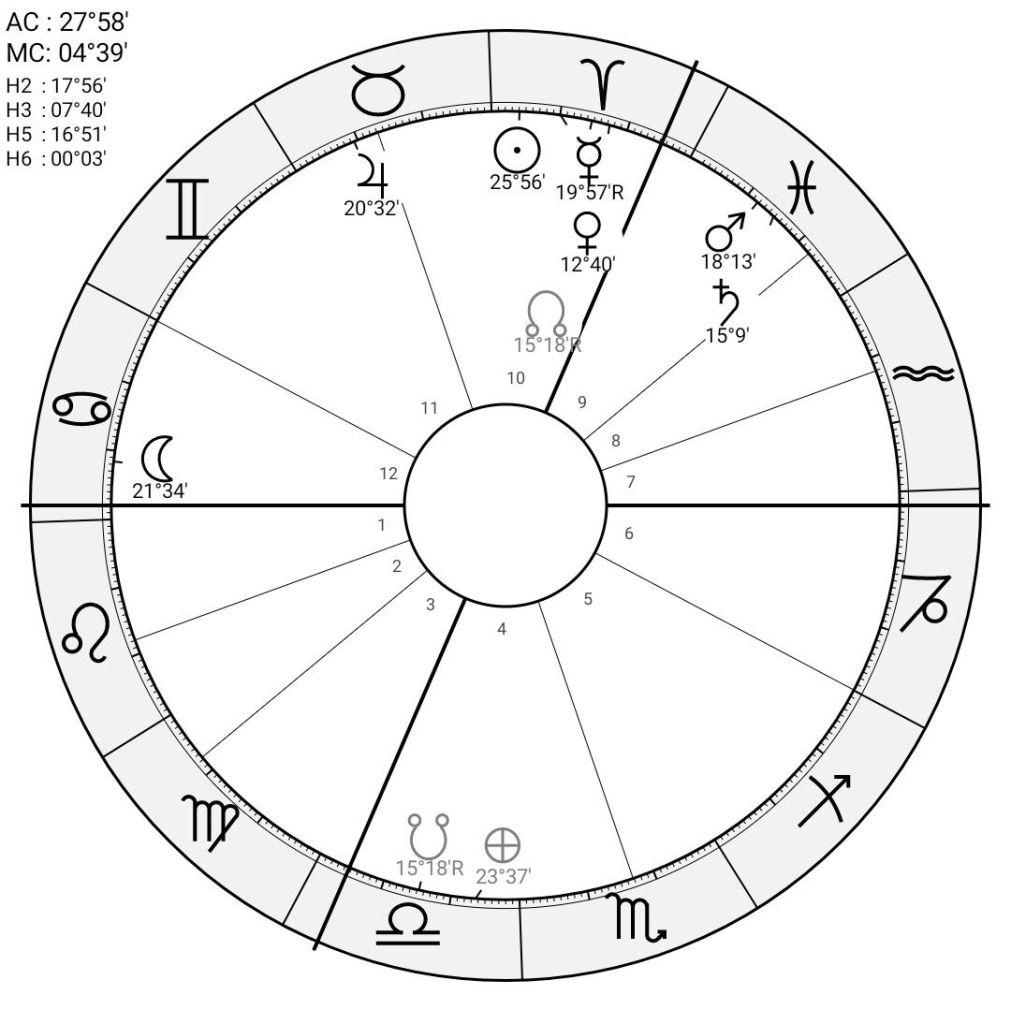
Let’s look at the horary chart:
Is the course good for me?
The Moon is the Lady of the Ascendant and thus represents me. Magic is higher knowledge, so it’s Ninth House. This is Jupiter. The two malefics Mars and Jupiter are present in the Ninth house, and are both peregrine, so they afflict the house.
The Moon is in her sign, but she’s also tucked away in the very malefic Twelfth house. Interestingly, the Twlefth house represents witchcraft, but only in the sense of something done behind the querent’s back to hurt him, not magic in general (which, again, is higher knowledge). So while I’d be capable of learning (Moon in own sign) my position is not good. There’s something iffy.
Jupiter is mildly dignified by term and in the succedent Eleventh house. The Moon is in sextile with Jupiter, which is technically good, but it is separating from it, indicating growing divergence. The Moon’s next aspect is a square of the Sun, which is negative. The Sun rules the second house, the house of money. So proceeding would put a strain on my finances. This isn’t necessarily to say that it costs too much in absolute terms, but it costs too much compared to its quality. Interestingly, Jupiter is disposited by Venus, which is in detriment and moving toward the Sun, which hurts her, so Venus has a rather excessive love of my money compared to the necessary love of knowledge.
All in all, based on both readings, I would say that the course would probably contain some valuable information, but would not be a great investment in my education.
In one of my recent posts I discussed how playing cards can detect curses (of course, it’s not just playing cards that can do it). Today I wanted to add to this subject by discussing the esoteric use of Playing Cards to check if a spell (in this case, a talisman) is a good idea or has been successfully created and is working.
I should perhaps first explain that there is a modicum of belief in magic involved in all this. The modern worldview tends to react to the idea of magic in two ways: the skeptical way (“it’s not really true”) and the new age way (“it’s not really true, but I would really love for it to be true, so I’ll play make belief and tailor everything to my preconceptions”)
Either way, magic is reduced to the acceptable role of cathartic theater or psychological tool (unfortunately, even great minds within the occult scene, like William Gray, have partly fallen for this approach, or at least considered it viable). From here it has even found its way even into the corporate sphere (a friend of mine working for Google told me she was forced to attend a “magical” day with a psychic who talked to them about tarot and Wicca). You know something is crap when pandering megacorporations appropriate it.
At least since Aleister Crowley (but there are predecessors) magic has been understood as the way of the will. Granted, Crowley’s understanding of the word “Will” is not the same as how we understand it in our everyday life, which would rather be “whim“. His view resembles more closely Nietzsche’s view of the will, so it does have some nobility.
But this doesn’t detract from the fact that most people whose view of magic has been colored by Crowley’s (and that’s almost everyone today, whether they know it or not) don’t REALLY believe in magic. Instead, they tend to see it as, again, little more than a placebo. It’s true if you believe in it. It’s true if you want it to be true.
Still, it’s my experience that belief in magic is not really required for magic to work. In fact, one would be hard pressed to find any trace of the concept of the magician’s will in the traditional Western approach to magic (or in the Eastern approach, for that matter).
Because just believing in it was usually not considered a prerequisite for success, the use of divination to check the efficacy of magical workings has been advocated a long time. Besides, if belief is not enough, other, more objective factors must be checked. *
The Arab mages of old, for instance, invited people to do a horary reading to see if the use of planetary magic was warranted. Agrippa probably used geomancy for the same purpose. We don’t know about Abano, but it is not a stretch to think he would have consulted a geomantic shield to check how his spellwork was doing.
In general, all forms of divination take the reality of magic for granted within the worldview that informs their language. After all, why would divination work, but not magic? ** This is true for playing cards as well. Here is an example.
Last year while the Sun was in Leo I was working on a Sun talisman. I’m not going to disclose the aim of the talisman. It was nothing untoward, but I’d rather keep it to myself. After the creation of the talisman I set out to consecrate it. The number of days varies.
On the first day, after the first consecration, I got the following spread:
A♠ – 6♣ – 5♠
Definitely a bad start. And I wouldn’t have expected anything less. The majority is Spades, which is bad for anything but black magic.
6♣ – 8♣ – 10♣
Second day of consecration. A mash of clubs is not positive. It shows difficulties and toil without success. Still, Spades have abandoned the spread, which is a positive.
6♣ – A♦ – 3♠
This is the third day. Close but no banana. It is still a negative spread. It has the Six of Clubs in common with the previous spread, and it closes with an unpromising Three of Spades, which bring Spades and large obstacles back into the equation. Note that this is the third day in a row I get the Six of Clubs. But the Ace of Diamonds has appeared, which indicates success, talismans and even the Sun.
A♦ – 9♦ – 10♦
Fourth day. This is the sign I was waiting for. The Ace of Diamonds is back. This time it is well-placed. The Nine of Diamonds and Ten of Diamonds together just mean “it works”, whether we are talking about an object, a business plan or a spell.
MQS
* This is not to say that the old magi wanted you to do your homeworks half-heartedly. Marsilio Ficino talks about the importance putting your heart in your spellwork.
** this would lead us off into an interesting discussion of all those that practice divination without believing it to actually work (“it’s just a brainstorming method” being the most common rationalization)
Most systems of divination can also be used to explore esoteric topics. For instance, I have answered the question “have I been hexed?” way more than I would like. The answer is no 95% of the times. Only two times in my life have I sent someone straight to see a priest because something supernatural was objectively at play. Most of the times, people use dark magic as a scapegoat to rationalize natural periods of bad luck.
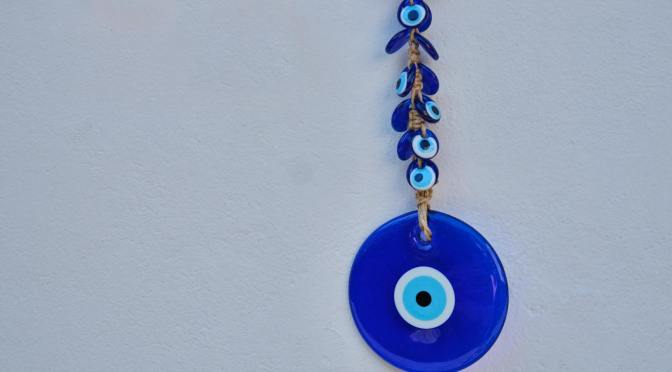
Of the the two times I did detect a curse I can only find records of one (my notes tend to be rather messy). The girl in question asked me if she’d received the evil eye (malocchio). This was the spread:
10♠ – 5♠ – 5♥ – J♠ – Q♠
I added two cards to the queen, and I got the Q♦ and the 2♥. The reading is quite obvious: a woman cursed her (the Queen of Spades with the Jack) on behalf of a relative (the Queen of Diamonds and Two of Hearts) though probably not a blood relative. The Ten and Five of Spades, when read together with the other spades, indicate the use of negative occult powers, probably at night.
The Five of Hearts in the center of the spread probably showed the sector of the querent’s life that was impacted by the curse: the ‘abundance’ sector. The young woman had lost a ton of weight in a short timeframe, she looked wasted, had started losing her hair and her beauty, had started developing money problems (in that she couldn’t retain any money she made). Her significator is absent, meaning she was completely passive to the hex.
It seems her mother-in-law had gone to see a country witch to try to harm her. This is far more troublesome than the evil eye, which sometimes can even be cast inadvertently without a ritual. The hex was broken by a priest, or rather, thanks to a priest who put her in contact with a monk specializing in this kind of stuff.
I’m bringing up the topic because I was recently asked the same question by a friend of mine who is going through a rough patch (lost her job, broke up with her boyfriend, argued with her sister, etc), which she believed was due to some ‘bad vibes’ or the malocchio. The spread was:
3♠ – 6♣ – Q♣ – 7♠ – 5♦
This time we have the querent in the middle of the spread. This, coupled with the fact that there are no combinations of curse, is encouraging: the querent has not been displaced from the center stage of her life.
The cards are negative, but they don’t reference supernatural phenomena: the Three of Spades could indicate curses or evil eye in combinations, but here there is no such combo, so it just indicates problems, things that don’t go smoothly. The querent is surrounded by the Six of Clubs and the Seven of Spades, the latter showing unfortunate events, the former reiterating the idea of difficulties. The Seven of Spades connects to the Five of Diamonds to indicate a period of misfortune, that is, of natural bad luck, which will pass (there will be change, it won’t stay that way forever).
I’m currently studying horary astrology under Chris Warnock’s supervision. He puts a great deal of emphasis on studying old sources, which is perfect for a guy like me who breaks out in hives when occultism is boiled down to “just wear a deep knowing expression, drink herbal tea and let the ascended masters guide your intuition.”
Geomancy is similar to horary astrology in that it allows you to answer questions, though it is less dependent on the time the question is asked. It is also similar in that you need to go back to really old books in order to study it seriously.
When reading premodern sources we always run a couple of risks:
Unless they’ve been edited and discussed by a modern, they are probably written in a language that is not our own, or, even if it is, it’s an old version of it. This makes room for misunderstanding.
More subtly, the world in which the author lived and wrote is not our world: it has different cultural, political and spiritual reference points.
The source is written by someone who is just as fallible as we moderns (or rather postmoderns) are.
If one thing that grinds my gears is when people just turn occultism into their little escape from reality (“I wanna believe the world is magical but I’m too special for Christianity”), the other thing that equally grinds my gears is when people desperately seek a doctrine to follow blindly just because it happens to run against the Zeitgeist.
An occultist (and divination is a branch of occultism, though we often forget it) must be capable of being equally distant from intellectual lassitude and fanaticism, from scientism and religion. It takes a particular temperament that most people don’t possess, and I say this in a neutral sense: most people simply don’t have the temperament for most things, which is why only few people in any generation do any one thing.
Point three on the list is what I’m referring to here. The few on the occult path who have what it takes to move beyond the sanitized, advertiser-friendly version of occultism that gets tarot readers invited to corporate meetings often run the contrary risk: that of believing “if something says the opposite of what we hear everyday in our decadent world, it must be true and I must worship at its altar.”
When reading old sources (and I’m talking about geomancy, but it could refer to any other branch) this can turn us into fanatics if we don’t constantly remind ourselves that a book, even in the old days, could be written for a variety of reasons:
to pass on important knowledge (but still from the author’s limited perspective)
to record your experience
to help others
as a publicity stunt
to impress others
to confuse others
a mix of all the above
Furthermore, old authors are just as capable as modern ones of believing crap. As such, while it is vital to question our own worldview, it is also just as vital to question all others. The moment you are asked (or you feel like you ought) to stop questioning is exactly the point where prejudice has crystallized, be it yours or someone else’s. It is also the point where you can break new ground if you proceed cautiously and with intelligence.
All this is to say, old books are treasure troves of information that we can study, learn from, adapt sensibly to our current needs, and much more. But if you are looking for a new Bible, you’re better off sticking to the old one.
When I was a teen, I remember stumbling upon Aristotle’s definition of the “educated mind” as being able to hold a thought without accepting it, and I remember thinking how silly and basic the definition was. The older I get, the more I find myself agreeing with him, as I see fewer and fewer people capable of doing it (the fact that Aristotle never actually wrote the sentence is a whole ‘nother can of worms)
A lot of people don’t have an educated mind per the definition above. One would like to think that tarot readers, astrologers and the like would not be like a lot of people, seeing how much the word “wisdom” gets thrown around in their circles. But one would be wrong. Leave it to the “spiritual community” to be among the most ideological and stiff. And, consequently, not among the brightest. If there is a group of people I don’t trust to be capable of holding any thought except the ones they agree with, that’s these people.
I believe I already talked a little about this, but one of the most memorable examples I can think of is the 2016 US election, when every tarot reader on youtube and their mom were busy predicting Trump would lose the election disgracefully, poop his pants, writhe on the floor, throw a tantrum and retreat into the hell that spawned him while Hillary Clinton swung her throbbing, veiny, 25 inch hard-on at the glass ceiling. While I am slightly exaggerating, this was pretty much the tone. (interestingly, those same readers routinely claim that the tarot is not for fortune-telling)
One such reader went as far as channeling Trump’s character. I do not remember the exact spread, nor most of the cards, but two things stuck with me: first, no egregiously bad card showed up, and second, the King of Cups featured prominently in the spread. She interpreted the card as Trump being a violent man prey to his base emotions and instincts. I took a quick look at some of that reader’s other videos, only to discover that she never, ever interpreted the King of Cups this way. In fact, she always interpreted it as the significator of a good man who takes care of the querent.
This is a good time to point out that I am fiercely apolitical, so this is not about politics. All ideologies are, as far as I am concerned, clouds over the mind’s clarity. I’m not saying everyone needs to think like me. Everyone has their delusion of choice, and everyone (including me) has their way of slanting reality in one direction or the other, whether politically, spiritually or philosophically (or even scientifically, for that matter). In fact, slanting reality is probably needed in order to filter information that might be useful to us.
Yet divination should be something else. What that reader did was merely using the cards as a mirror of her own (perfectly legitimate) bias. This is fine, and can even be useful at times–if you are aware that you are doing it. Even that would not be actual divination, but at least it wouldn’t be a waste of time.
I already discussed that divination is really a process of deification, that is, the process of allowing the dispassionate, bird-eye view clarity of the divine into one’s limited, subjective world by letting new information in. In other words, true divination is the opposite of retreating into one’s bubble: it’s the bursting of the bubble.
This, in turn, requires a certain readiness to accept the information we get (which is why it is always best to get someone you don’t know to read your cards.) Divination without intellectual honesty is just a crutch for one’s ego, and that’s how it is currently being used by the vast majority of diviners.
Unfortunately, intellectual honesty won’t make you many friends. Back in 2016 I had arguments with more tarot readers than I care to remember and was routinely labeled a dangerous extremist just because I called into question the usefulness of this type of reading (back then I still tried to entertain fruitful conversations with people). But occultism, in all its branches, is a narrow path.
Two lessons from all this: 1) if you are reading for yourself and the cards (or chart, or dice, or whatever) seem to confirm what you already think or wish, apply a bucketful of salt to the reading; 2) invest some money into a simple handbook of logic, or at least expand your knowledge of logical fallacies. This will repay you many times over, regardless of what branch of sorcery you practice.
(Note: this is a collection of the meanings attributed to the cards by some occultists in the past centuries. It does not reflect my own study or opinion of the cards. It is only meant as a quick comparative reference as I develop my own take.)
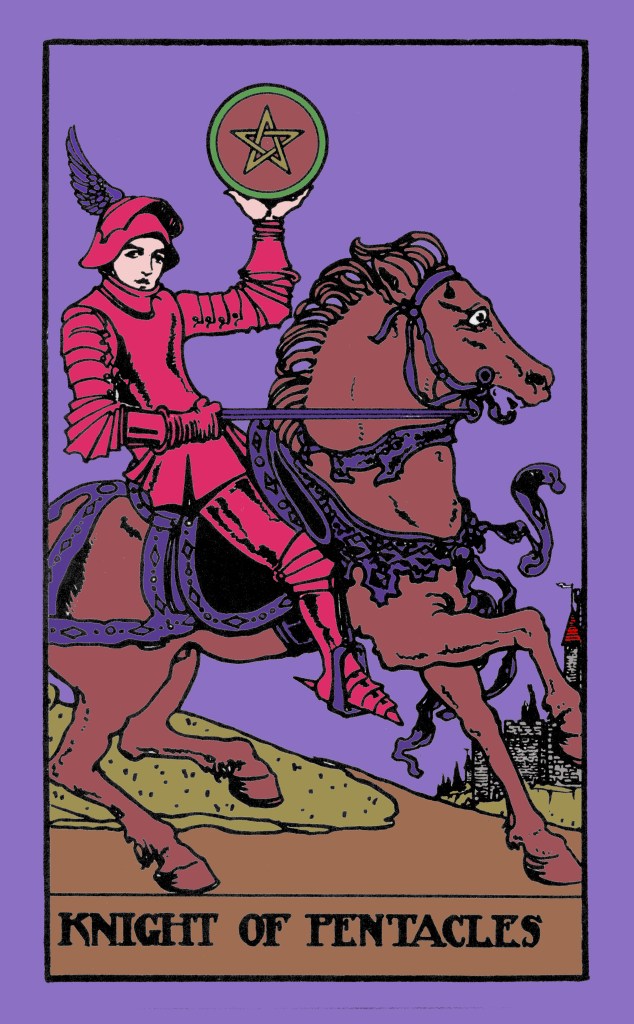
The Knight of Pentacles from the Builders of the Adytum (BOTA) tarot deck
Paul Foster Case (and Ann Davies)
The time period is from the beginning of the third decanate of Leo to the end of the second decanate of Virgo, August 13 to September 12. This period is under the rulership of Mars, Mercury and Saturn. Meanings: Well-Dignified: ability to use actions effectively; good mind, able to see through the veils of sense experience to their true import. In specific divination, a man younger than the King and though intelligent, somewhat matter-of-fact; not original or imaginative; good at carrying out any plan calling for intelligent action on the physical plane. Ill-Dignified: avaricious, mean, jealous, somewhat violent and cruel. Dark brown hair and dark eyes. (From the Oracle of Tarot course)
A. E. Waite
He rides a slow, enduring, heavy horse, to which his own aspect corresponds. He exhibits his symbol, but does not look therein. Divinatory Meanings: Utility, serviceableness, interest, responsibility, rectitude-all on the normal and external plane. Reversed: inertia, idleness, repose of that kind, stagnation; also placidity, discouragement, carelessness. (From The Pictorial Key to the Tarot)
Aleister Crowley
(Note: Crowley and the Golden Dawn make a mess with the Kings and Knights) The Prince of Disks represents the airy part of Earth, indicating the florescence and fructification of that element. He rules from the 21st degree of Aries to the 20th degree of Taurus.
The figure of this Prince is meditative. He is the element of Earth become intelligible. Clothed in light armour, his helmet is crowned with the head of a bull; and his chariot is drawn by an ox, this animal being peculiarly sacred to the Element of Earth. In his left hand he holds his disk, which is an orb resembling a globe, marked with mathematical symbols as if to imply the planning involved in agriculture. In his right hand he bears an orbed sceptre surmounted by a cross, a symbol of the Great Work accomplished; for it is his function to bring forth from the material of the element that vegetation which is the sustenance of the Spirit itself.
The character denoted by this card is that of great energy brought to bear upon the most solid of practical matters. He is energetic and enduring, a capable manager, a steadfast and per severing worker. He is competent, ingenious, thoughtful, cautious, ‘trustworthy, imperturbable; he constantly seeks new uses for common things, and adapts his circumstances to his purposes in a slow, steady, well-thought out plan.
He is lacking almost entirely in emotion. He is somewhat in sensitive, and may appear dull, but he is not; it so appears because he makes no effort to understand ideas which are beyond his scope. He may often appear stupid, and is inclined to be resentful of more spiritual types. He is slow to anger, but, if driven, becomes implacable. It is not very practicable to distinguish between the good and evil dignities in this card; one can merely say that, in case of his being ill-dignified, both the quality and quantity of his characteristics are somewhat degraded. The reaction of others to him will depend almost entirely upon their own temperaments.
In the Yi King, the airy part of Earth is represented by the 53rd hexagram, Kien. The commentary concerns the flight of wild geese, “gradually approaching the shore”, then “the large rocks”, then “advanced to the dry plains-the trees-the high ~ finally, to “the large heights”. It thus symbolizes slow, steady emancipation from repressive conditions.
The description is even happier than that given by the Qabalah, although in every way congruous with it. Practical considerations are never absent from Chinese thought, even at its most abstruse and metaphysical. The fundamental heresy of the Black Lodge is con tempt for “the world, the flesh, and the devil”, all which are essential to the plan of the Universe; it is cardinal to the Great Work for the Adept so to order affairs that “even the evil germs of Matter shall alike become useful and good”.
The error of Christian Mystics on this point has been responsible for more cruelty, misery, and collective insanity than all others put together; its poison can be traced even in the teaching of Freud, who assumed that the Unconscious was “the devil”, whereas in fact it is the instinct which expresses, beneath a veil, the inherent Point-of-View of each, and, properly understood, is the key to Initiation, and a hint of what seed may blossom and fructify as the “Knowledge and Conversation of the Holy Guardian Angel”. For “Every man and every woman is a star”.
But no doubt the judgment of the Adepts Exempt (for it is they who determine, under the guidance of the Masters of the Temple, all such details of doctrine) in respect of this card has been influenced by its transition from Aries to Taurus. It is too often forgotten that Taurus is the House of Venus, and that Luna is exalted therein. The new doctrine set forth in this present Essay makes the primary colour of Earth not black, but green; it insists that every Disk is a living and revolving symbol. The central thesis of the Book of the Law asserts the Perfection of the Universe. In its pantheistic conception all possibilities are equal in value; each and every Point-Event is “a play of Nuit”, as it is written in the Book of Wisdom or Folly, “Bind nothing! Let there be no difference made among you between any one thing & any other thing; for thereby there cometh hurt. But whose availeth in this, let him be the chief of all!” Liber Al. 1. 22. Or, yet more comprehensively and simply: “Every number is infinite; there is no difference.” Ib I.4. (From The Book of Thoth)
Weirdly adorable AI generated illustration for the Knight of Coins
Golden Dawn’s Book T
A WINGED Kingly Figure seated in a chariot drawn by a bull. He bears as a crest the symbol of the head of the winged bull. Beneath the chariot is land, with many flowers. In the one hand he bears an orb of gold held downwards, and in the other a sceptre surmounted by an orb and cross.
Increase of matter. Increases good or evil, solidifies; practically applies things. Steady; reliable. If ill dignified he is selfish, animal and material: stupid. In either case slow to anger, but furious if roused. Rules from 20 Degree Aries to 20 Degree Taurus. Air of Earth
Etteilla
Utility Upright. This card, as far as the medicine of the spirit is concerned, means, in its natural position: Useful, Advantageous, Gainful, Profitable, Interesting. – Interesting, Important, Necessary, Obligatory. Reversed. Peace, Tranquility, Rest, Sleep, Apathy, Inertia, Rest, Inactivity, Unemployment. – Leisure, Pastime. – Recreation, Carefreeness, Indifference, Indolence, Laziness, Poltrony, Numbness, Discouragement, Annihilation.
(Note: this is a collection of the meanings attributed to the cards by some occultists in the past centuries. It does not reflect my own study or opinion of the cards. It is only meant as a quick comparative reference as I develop my own take.)
The Knight of Wands in the Builders of the Adytum (BOTA) tarot deck
Paul Foster Case (and Ann Davies)
Astrologically the Knight of Wands includes the time period from the third decanate of Scorpio through the second decanate of Sagittarius, November 12 to December 11, representing, as we have seen, the combined influences of the Moon in Scorpio and of Jupiter and Mars in Sagittarius. In Divination we find the more specific meanings of each Key, but always remember that as advanced B.O.T.A. members, treading the Path of Return, you must use this art with discretion. It is best not to give querents for your help too specific instruction. Try to act as an emissary for the Hierophant and give them the principles behind their problems as they are unveiled to you by the sequence of Keys. Leave it to those you are helping to apply universal principles to specific problems in their lives. Well Dignified: an active, generous, impetuous, quickmoving man, younger than the King of Wands. He is secretive, probably interested in the occult, somewhat psychic and mysterious. He is friendly to the querent and may bring him news relating to his enterprises. Ill Dignified: e vil-minded, false, cruel, bigoted, brutal young man (or situation), dangerous or unfriendly to the querent1 s affairs. This card sometimes signifies departure or change of residence. (From the Oracle of Tarot course)
A.E. Waite
He is shewn as if upon a journey, armed with a short wand, and although mailed is not on a warlike errand. He is passing mounds or pyramids. The motion of the horse is a key to the character of its rider, and suggests the precipitate mood, or things connected therewith. Divinatory Meanings: Departure, absence, flight, emigration. A dark young man, friendly. Change of residence. Reversed: Rupture, division, interruption, discord. (From The Pictorial Key to the Tarot)
AI-generated illustration for the Knight of Wands
Aleister Crowley
(note that Crowley and the Golden Dawn made a mess with the knights and kings) The Prince of Wands represents the airy part of Fire, with its faculty of expanding and volatilising. He rules from the 21st degree of Cancer to the 20th degree of Leo. He is a warrior in complete armour of scale mail, but his arms are bare on account of his vigour and activity. He wears a rayed crown surmounted by a lion’s head winged, and from this crown depends a curtain of flame. On his breast is the sigil of To Mega Therion. In his left hand he bears the Phoenix wand of the Second Adept in the Ritual of 5○=6□ of R.R. at A.C.), the wand of Power and Energy, while with his other arm he reins the lion which draws his chariot, the chariot which is fortified by a wheel radiating flame. He rides upon a sea of flames, both waved and salient.
The moral qualities appropriate to this figure are swiftness and strength. But he is sometimes inclined to act on impulse; sometimes easily led by external influences; sometimes, especially in trifles, a prey to indecision. He is often violent, especially in the expression of an opinion, but he does not necessarily hold the opinion about which he is so emphatic. He states a vigorous proposition for the sake of stating it. He is in fact very slow to make up his mind thoroughly on any subject, but always sees both sides of every question. He is essentially just, but always feels that justice is not to be attained in the intellectual world.
His character is intensely noble and generous. He may be an extravagant boaster, while slyly laughing both at the object of his boast and at himself for making it. He is romantic, especially in matters of history and tradition, to the point of folly, and may engineer “stunts” or play elaborate practical jokes. He might select some inoffensive nobody, and pursue him for years with every weapon of ridicule) as Swift tormented the unhappy Partridge, all without the least animus, ready to give the shirt off his back, should his victim be in need. His sense of humour is omnivorous, and may make him a mysterious figure, dreaded without reason by people who actually know nothing about him but his name-as a symbol of Terror.
This is due to the influence of the last decan of Cancer upon this card. One of his greatest faults is pride; meanness and pettiness of any kind he holds in infinite scorn. His courage is fanatically strong, and his endurance indefatigable. He is always fighting against odds, and always wins in the long-the very long-run. This is principally due to his enormous capacity for work, which he exercises for its own sake, “without lust of result”; perhaps his haughty contempt for the world at large-which however coexists with profound and ecstatic respect for “every man and every woman” as “a star”-is responsible for this.
When this card is badly dignified, the character degenerates. Each of the qualities mentioned above is found in its antithesis. There is great cruelty in him, partly sadistic and partly due to callousness arising from indifference-and, in a sense, laziness! So too he may be intolerant, prejudiced and idle-principally because it saves trouble. He may furthermore be an empty boaster and a great coward.
In the YI King, the airy part of Fire is represented by the 42nd Hexagram, Yi, which signifies addition, increase. Full of virtue, and confident therein, he contemplates work of stupendous scope, often with the idea expressed in line 5: “with sincere heart seeking to benefit all below”. In this he may achieve immense success. But this course is fraught with commensurate danger. “We see one to whose in crease none will contribute, while many will seek to assail him. He observes no regular rule in the ordering of his heart”. (line 6) This peril avoided, there come “parties adding to the store of its subject ten pairs of tortoise shells whose oracles cannot be opposed-Let the King employ them in presenting his offerings to God….” (line 2). (From The Book of Thoth) Note: Crowley clearly sees himself in this card, which is why he depicts the Prince as the adorable occult prankster he saw himself as.
Golden Dawn’s Book T
A KINGLY Figure with a golden, winged crown, seated on a chariot. He has large white wings. One wheel of his chariot is shewn. He wears corslet and buskins of scale armour decorated with a winged lion’s head, which symbol also surmounts his crown. His chariot is drawn by a lion. His arms are bare, save for the shoulder-pieces of the corslet, and he bears a torch or fire-wand, somewhat similar to that of the Zelator Adeptus Minor. Beneath the chariot are flames, some waved, some salient. Swift, strong, hasty; rather violent, yet just and generous; noble and scorning meanness. If ill dignified — cruel, intolerant, prejudiced and ill natured.
Etteilla
Departure Upright: This card, as far as the medicine of the spirit is concerned, means, in its natural position: Departure, Displacement, Removal, Absence, Abandonment, Change, Escape, Desertion, Transmigration, Emigration. – Transposition, Translocation, Transplantation, Transmutation, Evasion. Reversed: Disunion, Disagreement, Rupture, Dissension, Division, Competition, Separation, Partition. – Faction, Party. – Complaint, Altercation. – Cut, Fracture, Discontinuity, Interruption.
(Note: this is a collection of the meanings attributed to the cards by some occultists in the past centuries. It does not reflect my own study or opinion of the cards. It is only meant as a quick comparative reference as I develop my own take.)
The Knight of Cups in the Builders of the Adytum (BOTA) tarot deck.
Paul Foster Case (and Ann Davies)
The time period is from the beginning of the last decanate of Aquarius to the end of the second decanate of Pisces, February 9 to March 10, under the rulerships of Venus, Jupiter, Neptune and the Moon. Well Dignified: a man of graceful, somewhat indolent, personality; generous and enthusiastic, when he is really interested. Somewhat impressionable and psychic. Fond of home and probably puts all women more or less on a pedestal. Friendly to the Querent. Ill Dignified: lazy, untruthful, likely to be effeminate and ‘catty’. Brown hair, grey or brown eyes. (From the Oracle of Tarot course)
A. E. Waite
Graceful, but not warlike; riding quietly, wearing a winged helmet, referring to those higher graces of the imagination which sometimes characterize this card. He too is a dreamer, but the images of the side of sense haunt him in his vision. Divinatory Meanings: Arrival, approach–sometimes that of a messenger; advances, proposition, demeanour, invitation, incitement. Reversed: Trickery, artifice, subtlety, swindling, duplicity, fraud. (From The Pictorial Key to the Tarot)
Aleister Crowley
(Note: Crowley and the Golden Dawn made a mess with Knights and Kings) The Prince of Cups represents the airy part of Water. On the one hand, elasticity, volatility, hydrostatic equilibrium; on the other hand, the catalytic faculty and the energy of steam. He rules from the 21st degree of Libra to the 20th degree of Scorpio.
He is a warrior partly clad in armour, which seems, however, rather a growth than a covering. His helmet is surmounted by an eagle, and his chariot, which resembles a shell, is also drawn by an eagle. His wings are tenuous, almost of gas.. This is a reference to his power of volatilization understood in the spiritual sense.
In his right hand he bears a Lotus flower, sacred to the element of Water, and in his left hand is a cup from which issues a serpent.
The third totem, the scorpion, is not shewn in the picture, for the putrefaction which it represents is an extremely secret process. Beneath his chariot is the calm and stagnant water of a lake upon which rain falls heavily.
The whole symbolism of this card is exceedingly complicated, for Scorpio is the most mysterious of the Signs, and the manifested portion of it symbolized by the eagle is in reality the least important part of his nature.
The moral characteristics of the person pictured in this card are subtlety, secret violence, and craft. He is intensely secret, an artist in all his ways. On the surface he appears calm and imperturbable, but this is a mask of the most intense passion. He is on the surface susceptible to external influences, but he accepts them only to transmute them to the advantage of his secret designs. He is thus completely without conscience in the ordinary sense of the word, and is therefore usually distrusted by his neighbours. They feel they do not, and can never, understand him. Thus he inspires unreasonable fear. He is in fact perfectly ruthless. He cares intensely for power, wisdom, and his own aims. He feels no responsibility to others, and although his abilities are so immense, he cannot be relied upon to work in harness.
In the Yi King, the airy part of Water is represented by the 61st hexagram, Kung Fu. This is one of the most important figures in the Yi: it “moves even pigs and fish, and leads to great good fortune”. Its dignities and correspondences are manifold and great; for it is also a “big Li”, the trigram of Sol formed by doubling the lines. By shape it suggests a boat, but also the geomantic figure of Cancer, Saturn in Capricornus.
This card is in consequence one of great power; Libra going over into Scorpio is of tremendous, active, critical energy and weight. To such people good will, sincerity, and right mating are the essentials of success; their danger is overweening ambition. (From The Book of Thoth)
An AI generated illustration for the Knight of Cups
Golden Dawn’s Book T
A WINGED Kingly Figure with winged crown seated in a chariot drawn by an eagle. On the wheel is the symbol of a scorpion. The eagle is borne as a crest on his crown, cuirass and buskins. General attire like King of Wands. Beneath his chariot is the calm and stagnant water of a lake. His armour resembles feathers more than scales. He holds in one hand a lotus, and in the other a cup, charged with the sigil of his scale. A serpent issues from the cup, and has its head tending down to the waters of the lake.
He is subtle, violent, crafty and artistic; a fierce nature with calm exterior. Powerful for good or evil but more attracted by the evil if allied with apparent Power or Wisdom. If ill dignified, he is intensely evil and merciless. He rules from 20 Degree Libra to 20 Degree Scorpio. Air of Water
Etteilla
Arrival Upright: This card, as far as the medicine of the spirit is concerned, means, in its natural position: Arrival, Coming, Approach, Landing, Welcoming, Entrance, Reapproachment. – Conformity. – Coming, Approximation. – Access. – Affluence. – Comparison. Reversed: Deception, Scoundrelishness, Briccony, Deception, Artifice. – Fineness, Dexterity, Cunning, Fraud. – Subtlety, Irregularity. Nefariousness.
(Note: this is a collection of the meanings attributed to the cards by some occultists in the past centuries. It does not reflect my own study or opinion of the cards. It is only meant as a quick comparative reference as I develop my own take.)
The Queen of Swords in the Builders of the Adytum (BOTA) tarot deck
Paul Foster Case (and Ann Davies)
The time period is from the beginning of the third decanate of Capricorn to the end of the second decanate of Aquarius, January 10 to February 8, under the combined rulerships of Mercury in Capricorn, Saturn-Uranus in Aquarius and Mercury in Gemini. Meanings: a woman of some authority, outwardly agreeable and complaisant, but inwardly ambitious and subtle. She has keen perceptions, is a good observer and self-confident. She is accurate in superficial details; is often graceful and fond of dancing. Well-Dignified: she is friendly to the Querent. Ill-Dignified: she can be deceitful, sly, cruel. Usually light brown hair and gray eyes. (From the Oracle of Tarot course)
A. E. Waite
Her right hand raises the weapon vertically and the hilt rests on an arm of her royal chair the left hand is extended, the arm raised her countenance is severe but chastened; it suggests familiarity with sorrow. It does not represent mercy, and, her sword notwithstanding, she is scarcely a symbol of power. Divinatory Meanings: Widowhood, female sadness and embarrassment, absence, sterility, mourning, privation, separation. Reversed: Malice, bigotry, artifice, prudery, bale, deceit. (From The Pictorial Key to the Tarot)
Aleister Crowley
The Queen of Swords represents the watery part of Air, the elasticity of that element, and its power of transmission. She rules from the 21St degree of Virgo to the 20th degree of Libra. She is enthroned upon the clouds. The upper part of her body is naked, but she wears a gleaming belt and a sarong. Her helmet is crested by the head of a child, and from it stream sharp rays of light, illuminating her empire of celestial dew. In her right hand, she bears a sword; in her left hand, the newly severed head of a bearded man. She is the clear, conscious perception of Idea, the Liberator of the Mind.
The person symbolized by this card should be intensely perceptive, a keen observer, a subtle interpreter, an intense individualist, swift and accurate at recording ideas; in action confident, in spirit gracious and just. Her movements will be graceful, and her ability in dancing and balancing exceptional.
If ill-dignified, these qualities will all be turned to unworthy purposes. She will be cruel, sly, deceitful and unreliable; in this way, very dangerous, on account of the superficial beauty and attractiveness which distinguish her.
In the Yi King, the watery part of Air is represented by the 28th hexagram, Ta Kwo. The Shape suggests a weak beam.
The character, excellent in itself, cannot support interference. Foresight and prudence, care in preparation of action, are a safeguard (line i.) Advantage is to be won, moreover, by reliance on help from apparently unsuitable comrades (lines 2 and 5). This alien strength often supplies the defeat of inherent weakness, and may even create definite superiority to circumstance (line 4). In such an event, there may be temptation to undertake rash adventures, foredoomed to failure. But even so, no blame is incurred (line 6); the conditions of True Will have been satisfied, and the issue is compensated by the feeling that the right (however unfortunate) course has been adopted.
Such people acquire intense love and devotion from the most unexpected quarters. (From the Book of Thoth)
an alien-looking AI-generated Queen of Swords (without a sword, but it was too cool)
Golden Dawn’s Book T
A GRACEFUL woman with wavy, curling hair, like a Queen seated upon a Throne and crowned. Beneath the Throne are grey cumulus clouds. Her general attire is as that of the Queen of Wands, but she wears as a crest a winged child’s head. A drawn sword in one hand, and in the other a large, bearded, newly severed head of a man. Intensely perceptive, keen observation, subtle, quick and confident: often persevering, accurate in superficial things, graceful, fond of dancing and balancing. If ill dignified, cruel, sly, deceitful, unreliable, though with a good exterior. Rules from 20 Degree Virgo to 20 Degree Libra.
Etteilla
Widowhood Upright: As far as the medicine of the spirit is concerned, this card means, in its upright position: Widowhood, Widow, Deprivation, Absence, Famine, Sterility, Indigency, Poverty. – Empty, Vacant, Unemployed, Idle, Free. Reversed: Evil Woman. – Malignity, Malice, Cunning, Craftiness, Machination, Bigotry, Prudery, Hypocrisy.
(Note: this is a collection of the meanings attributed to the cards by some occultists in the past centuries. It does not reflect my own study or opinion of the cards. It is only meant as a quick comparative reference as I develop my own take.)
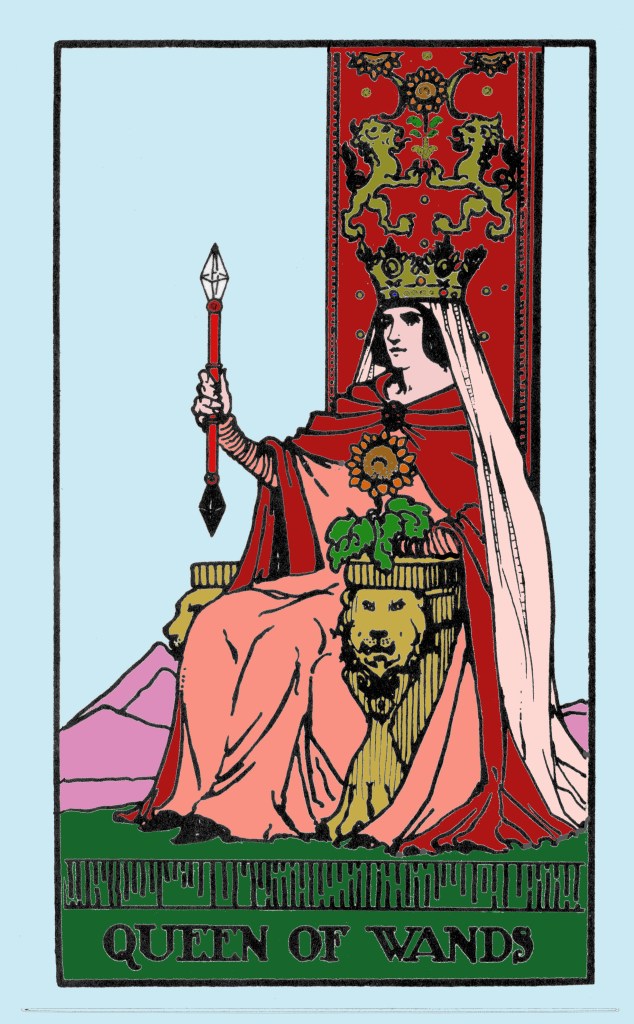
The Queen of Wands from the Builders of the Adytum (BOTA) tarot deck
Paul Foster Case (and Ann Davies)
The time period related to the Queen of Wands is from July 13 to August 12, symbolizing the influence of Jupiter and Neptune in Cancer and of the Sun and Jupiter in Leo. The basic power suggested by this Key is that of command. Well Dignified: in a divination the Queen of Wands symbolizes a kind, generous woman, resolute in the face of opposition, strongly psychic and intuitive but practical in applying her spiritual gifts; intense; magnetic ; friendly to the querent and a favorable influence for the success or business of the querent. Ill Dignified: Inimical to the querent; obstinate, dangerous woman, unfavorable to querent’s affairs; revengeful and tyrannical. (From the Oracle of Tarot course)
A. E. Waite
The Wands throughout this suit are always in leaf, as it is a suit of life and animation. Emotionally and otherwise, the Queen’s personality corresponds to that of the King, but is more magnetic. Divinatory Meanings: A dark woman, countrywoman, friendly, chaste, loving, honourable. If the card beside her signifies a man, she is well disposed towards him; if a woman, she is interested in the Querent. Also, love of money, or a certain success in business. Reversed: Good, economical, obliging, serviceable. Signifies also–but in certain positions and in the neighbourhood of other cards tending in such directions–opposition, jealousy, even deceit and infidelity. (From The Pictorial Key to the Tarot)
Aleister Crowley
The Queen of Wands represents the watery part of Fire, its fluidity and colour. Also, she rules in the Zodiac from the 21st degree of Pisces to the 20th degree of Aries. Her crown is topped with the winged globe and rayed with flame. Her long red golden hair flows down upon her armour of scaled mail. She is seated upon a throne of flame, ordered into geometrical light by her material power. Beneath the throne the surging flames are steady. She bears a wand in her left hand; but it is topped with a cone suggestive of the mysteries of Bacchus. She is attended by a couchant leopard upon whose head she lays her hand. Her face expresses the ecstasy of one whose mind is well in-drawn to the mystery borne beneath her bosom.
The characteristics of the Queen are adaptability, persistent energy, calm authority which she knows how to use to enhance her attractiveness. She is kindly and generous, but impatient of opposition. She has immense capacity for friendship and for love, but always on her own initiative.
There is as much pride in this card as in the Knight, but it lacks the spontaneous nobility which excuses that error. It is not true pride, but self-complacent vanity and even snobbery.
The other side of her character is that she may have a tendency to brood, come to a wrong decision thereon, and react with great savagery. She may be easily deceived; then she is likely to shew herself stupid, obstinate, tyrannical. She may be quick to take offence, and harbour revenge without good cause. She might turn and snap at her best friends without intelligible excuse. Also, when she misses her bite, she breaks her jaw!
In the YI King, the watery part of Fire is represented by the 17th hexagram, Sui. It indicates reflection upon impulse, and the consequently even flow of action. There is great capacity for lucid conception and steady prosecution of work; but this is only at the bidding, and under the guidance, of some creative mind. There is a tendency to be fickle, even disloyal; the ideas which she obeys make no deep or permanent impression. She will “cleave to the little boy and let go the man of age and experience” or the reverse (lines 2 and 3) without realizing what she is doing. There is liability of fits of melancholy, which she seeks to cure by bouts of intoxication, or by panic-stricken outbursts of ill-considered fury. (From The Book of Thoth)
Strangely Crowley-esque AI-generated illustration for the Queen of Wands
Golden Dawn’s Book T
A CROWNED queen with long red-golden hair, seated upon a Throne, with steady flames beneath. She wears a corslet and buskins of scale-mail, which latter her robe discloses. Her arms are almost bare. On cuirass and buskins are leopard’s heads winged, and the same symbol surmounteth her crown. At her side is a couchant leopard on which her hands rest. She bears a long wand with a very heavy conical head. The face is beautiful and resolute. Adaptability, steady force applied to an object, steady rule, great attractive power, power of command, yet liked notwithstanding. Kind and generous when not opposed. If ill dignified, obstinate, revengeful, domineering, tyrannical, and apt to turn against another without a cause. She rules the heavens from above the last Decan of Pisces to above the 20 Degree of Aries: including thus a part of Andromeda.
Etteilla
Country Woman Upright: This card, as far as the medicine of the spirit is concerned, means, when upright: Country woman, housewife, economy, honesty, civility – Sweetness, virtue – Honor, chastity Reversed: Good woman, goodness, excellence – Respectful, caring, obliging – Service, favor, benefit