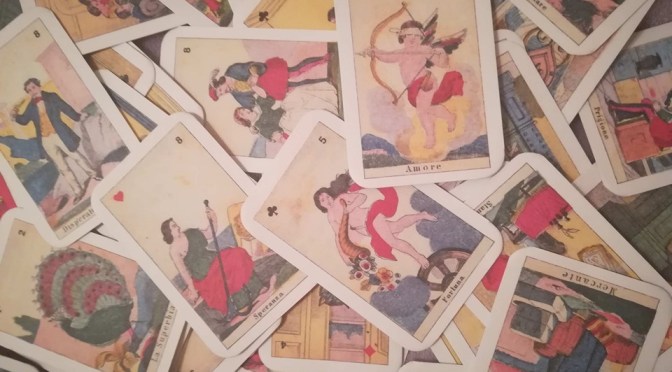
The way I read playing cards, sixes are the difficult number. In general, six brings out the worst in the cards. I’ve noticed that this is a trend in Italian systems of cartomancy (althouth not in Kapherus’ system).
The Six of Hearts is the only positive card of the bunch, as it signifies the solution of trouble, adjustment and the return to happiness, health, etc. It shows peace, improvement and relax. Only when hemmed in by nasty cards it turns foul and it brings tears (which the card graphically reminds me of) and the impossibility of a solution.
The Six of Clubs is a very static card. It signifies tiredness and a situation with all work and no play and no enthusiasm. It is symbolic of subordinate work and, more broadly, it implies the inability to definitely put a problem behind you, as it keeps showing up. With positive cards, it shows the ability to reach your goal, but usually without a great sense of realization.
The Six of Diamonds is also a meh card. It is connected with insecurity, worries, confusion and indecision, especially but not exclusively of a financial nature. It shows all those situations where you can’t stop thinking about something and being tormented by it. However, with positive cards it can signify a situation that is sorted out by being resourceful, planning and making an informed decision.
The Six of Spades is a card of illness, as it figuratively depicts the wards of a hospital. It is one of those cards that is very difficult to put a positive spin on. The illness can be literal or figurative, when it symbolizes a situation of suffering and upset, or even one that is noxious or damaged. In itself, it negates reconciliations and the possibility of returning to the past, though of course the following cards may alleviate it.
In cartomancy with playing cards, fives have an affinity with the idea of change, just as fours are related to stability.
The Five of Hearts shows positive change coming our way without effort. It is a card of evolution, good opportunities, gifts, offers (it is somewhat similar to the Three) and in general it shows that the querent thrives. Its general meaning is that of abundance and flourishing, freedom and being in a positive environment.
The Five of Clubs also signifies change, but change that is enacted by the querent. It implies effort, even physical effort. Nothing is free in the realm of Clubs, and therefore the card implies combativeness and even competition and the need to fight for what you want. While the Five of Hearts shows abundance, this card has an inherent sense of scarcity to it and the need to make the best of your chances.
The Five of Diamonds is the card that I thought exemplifies this number best, because in my system it just means change in a neutral sense. Generally it’s a positive card and it can bring some dynamic energy to a static spread. Of course it is also connected to the movement of money, information and energy, all of which are themes of the suit of Diamonds.
The Five of Spades is a bad card. The main meaning is that of prison, but of course it needs to be interpreted figuratively most of the times. It signifies the inability to move or to act, and it is symbolic of all things that keep us fenced in (like the pip in the middle) and chained, unable to change, be it guilt or an addiction. In general it signifies lack of opportunities, scarcity, dejection, the need for great sacrifice or, if followed by negative cards, a definite turn for the worse.
In most systems of cartomancy with playing cards, the fours are cards of stability. However, a further connotation that I think attaches to them is that of pact or agreement between parts. Possibly this is due to the four pips resembling the legs of a table where people sit to talk.
The Four of Hearts is the card of reunions, gatherings and positive social occasions. It is also a symbol of agreements that come easy or are easily restored (Hearts): harmony and affinity all play into the meaning of the card. Because of the emotional connotation of the suit, the card can signify sex.
The Four of Clubs represents talks, and it is mainly the conversation card. However, it is not splendid. Because of the neutral nature of the suit of Clubs, which implies struggle and the need for action, the Four can go either way: toward agreement or toward breakup. It implies a degree of difference that needs to be reconciled, which is why talks are necessary. It’s not a bad card, but it is open-ended.
The Four of Diamonds is the card of formal agreements. It represents all things to do with papers, documents, offices, etc. Because the suit is more material than that of Hearts, the agreement can be interpreted as a transaction, and therefore the card represents buying and selling, and, by extension, all objects. In general, it signifies economic activity and has an affinity with the more material side of life.
The Four of Spades takes the basic theme of the number and runs it into the ground. The card represents loneliness and isolation. It shows the inability to get along or reach a positive conclusion. It shows complete disharmony and the impossibility of proceeding in a given direction, thus implying blockage. With other negative cards it means failure and trouble that cannot be overcome.
The threes or treys share their low value with the twos. Once again, we are dealing with small cards. They are, however, stronger than the twos, and tend to form strong or noteworthy combinations when the fall with the two of the same suit.
All threes are connected with the idea of interaction, mediation and that of “getting” or receiving.
The Three of Hearts is the Gift card. This can be a real gift, or it can signify anything that we receive easily and for nothing. Allegorically, it signifies solution, the overcoming of small obstacles, positive development and happiness. It also means positive interactions, small gatherings, good mediation between parts and the positive influence of a third party.
The Three of Clubs represents the binding of people together by common interests that they pursue together. It can signify a small group of people, like all threes, and a union, a contract, a marriage etc. More broadly the card means doing things together. It is also the card of intermediation in a neutral sense. As for “getting”, nothing is free in the world of Clubs, so the card indicates enterprise and getting progressively nearer to your goals, heaping those small steps of the Two on top of each other to get where you want. In general, it signifies situations slowly taking root.
The Three of Diamonds is a small money card. It shows the receiving of money or of profitable offers. It can indicate things appreciating in value, but generally the card is restricted to material affairs. Symbolizing the reception of money, it can indicate a job, but usually part-time. Like the Three of Hearts, it shows positive interactions, but more transactional in nature.
The Three of Spades is the card of Intrigue, but the title is rather dramatic. Unless the cards point specifically to third party interference (which is how this card interprets the idea of interaction and mediation) it can signify other more plausible things. One of the classical meanings is that of “loss”, which is the opposite of getting something. Alternatively, it can point to the receiving of something bad. Broadly, the card symbolizes bumps on the road between you and what you want, but not huge bumps, unless the following cards are horrible. Think intrigue in the sense of complication or tangled affair that needs to be sorted out.
The Twos or Deuces in the playing card deck are often considered of low value, the reason being that they are the smallest number beside the Aces, which however have great symbolic value, and even great value in many games. In general, when taken alone, the Twos do not have tremendous power in changing the course of a reading, but of course they gain it by connecting to other cards.
All Twos are connected to the idea of movement in some form or another.
The Two of Hearts was taught to me as the card of the “Door Knockers”. Just as the Ace is the home, the Two is what is coming to the home. Broadly speaking, it shows things happening in a short timeframe. The general idea is that of imminent arrival. Being the card of arrival and visits, it signifies the shortening of distances and a principle of reconciliation when appropriate (but other cards must be present). Having a connection with expectation, it can show the arrival of a child if with other cards (note how this card is similar to the Three of Hearts in the Vera Sibilla).
The Two of Clubs does not signal arrival, where the querent is passively waiting for something. It shows the taking of steps. Literally, this is the card of walking and of moving, usually a short distance, visiting instead of being visited. It shows going out (as befits the Club suit) and being active in a matter. Figuratively, it can signify the idea of putting things into motion and getting your ducks in a row.
The Two of Diamonds heralds letters. It is the card of messages and all that is written: invitations, post, emails, etc. Nowadays, though, the card covers telephone calls as well. Figuratively, the card is connected with the movement of ideas, the elaboration of the thoughts and with all that has to do with evolving your perspective. It’s movement, but of the mind.
The Two of Spades is the opposite of the Two of Hearts. It’s the card of anger and of all those feelings that create fractures and distance. It can signify a separation and movement away from something or someone. Broadly, the card means annoyances and small difficulties that frustrate the querent, obnoxious things coming your way. If drowned in a sea of positive cards, the Two of Spades simply heralds delays and small difficulties. It is not a tragic card. It does show frustrations and differences of opinion.
One word of caution: back when I was taught to read playing cards, I was simply given their meanings. Just like for the Sibilla, there were no number meanings. The numerology was something I came up with to make sense of the meanings, remember them better and further expand upon them. You are free to come up with different associations, or even to disregard numerology entirely.
Aces in playing cards are connected to beginnings, obviously, but also to how and where things begin based on the associations of the suit.
In the suit of Hearts, the Ace is famously the House card. This is because our emotional sphere begins at home. The walls of the house protect us from what is outside. Thus, the Ace of Hearts represents the idea of inside. The house is the core of our individuality, where our roots are (it can also signify our origins, and the idea of origins, source, spring, well in general). It is also connected with positive beginnings or the beginning of positive things.
In the suit of Clubs, beginnings are interpreted differently. Here things begin objectively, they take root concretely out there in the world and not just inside of us, hence the Ace of Clubs’ connection with outside buildings and the idea of “outside” in general. More broadly, the Ace of Clubs is a card of production, commitment, activity, vigor and willpower. It also signifies signing papers, which is how documents become objectively valid.
In the suit of Diamonds, the beginning is seen in more absolute terms. This is the card of things starting out, of new things and, because the suit is connected to information and impulses, to news. It is also the card of all things that are first or of the highest value, such as diamonds, jewels, gold, a capital city, the sun, etc. The card can herald changes of phase, usually positive, and it is great for starting new ventures.
The suit of Spades is negative, so the beginning turns into an ending. Thus, this is almost universally the Death card. It heralds change, but painful change, change which is seen as the ending of something rather than the beginning of something else. It’s connected to all things that confine us. On a broader level it can even signify a country’s borders because that’s where the country ends. It is the card of cuts and knives. Broadly, this is the card of bad things beginning or of bad beginnings. It is also connected to all things that are last or of least value, and to where things end or end up.
In the Vera Sibilla, the Sixes represent the natural evolution of the number Five. Whereas Fives dealt with transition, the Sixes represent the flow of time, with all its philosophical annexes: the idea of duration (or lack thereof), the notions of past, present and future, etc.
The four Sixes in the Vera Sibilla: The Six of Hearts (Money), The Six of Clubs (Surprise), The Six of Diamonds (Thought), The Six of Spades (Sighs)
The Six of Hearts is called Money. A better name for it would perhaps be The Safe or The Archive, because while it is true that it does represent money, liquid assets and wealth, this meaning is derived from the idea of accumulation which is a consequence of the traditional meaning of the Six of Hearts in cartomancy in Italy: the past.
And, indeed, the past is one of the main meanings of the Money card, strange as this may sound. Often, when together with a court card, it shows someone whom we already know, or an ex. In general, this card shows that we inherit something from the past, whether it be a situation, a person, an illness (which maybe we haven’t treated properly, or simply one that runs in the family, i.e. a hereditary disease), etc.
Money, the other main meaning of this card, is simply a logical consequence of the notion of time (number six) understood in a positive sense (suit of Hearts), i.e. as a resource and therefore as convertible in resources to be accumulated. Note that, reversed, the Six of Hearts talks about the future, as in future occurrences, unknown places, situations and people. It also heralds money trouble, but it is especially a card of avarice, i.e. unwillingness to let go of what we already have (or of the past).
At the opposite end of the spectrum, the Six of Spades, Sighs, is the card of anxiety and tormented hope. This card, too, can represent something that already happened, but this time it doesn’t show it in a neutral way, but as a source of anguish. More in general, however, rather than to the past, this card is connected with the passage of time as a neutral-to-negative element that comes between us and our desire: the need to wait.
When reversed, one of the meanings of the Six of Spades is that it can represent the idea of letting go of our tormented desires or of our anxiety concerning the past. This is one of the cards that can show, when reversed, opening up to new possibilities rather than clinging to what causes us nothing but grief.
It’s the ability to step outside of ourselves or of our issue and listen to reason, whether it’s in the form of new inspiration or some professional advice. When surrounded by more neutral or negative cards, however, it remains a card of instability, material or psychological even when reversed.
In between Hearts and Spades we find the Six of Clubs, the Surprise, and the Six of Diamonds, Thought. The Six of Clubs is the card of the present time. It represents things happening now, or at least in the very near future. With it are connected the ideas of suddenness and immediacy, and therefore marvel and surprise, of coming across something that was unexpected. Since the suit of Clubs is positive, this unexpected surprise is usually positive.
Taking this idea of “chancing upon” further, we get to the meanings of receiving, getting, acquiring that this card also shows. But this is also the card of things that start flourishing. Note how, in the image, the guy is fishing a bag of money out of a river or lake, which means that, while the result was beyond his expectations, he did have to cast his net. As such, this is the card of minimum effort for great results: small past efforts paying off in the present and possibly heralding a positive future.
Finally, the Six of Diamonds, Thought, also represents the present, but it’s more the a-temporal present that exists in the mind, rather than the physical present of the Six of Clubs. As the card of consciousness, the Six of Diamonds is the point where past, present and future converge and are organized, made sense of and shaped into alternative ideas of reality that we then seek to act out.
As such, this card also shows plans, ideas, etc. Not necessarily true ideas, not necessarily good plans, and not necessarily plans that we are going to be able to act out: this is the card of pure consciousness, the timeless present which fluctuates above the flow of real time.
The Eights in the Vera Sibilla are a natural continuation of the sevens. They represent the concept of balance and evolution toward balance. If you look at the number 8, you’ll see that it’s made up of two loops, which represent the inside or inner world and the outside or outer world. One of the two loops is represented by the “intention” set forth by the number seven, while the other loop represents whether or not that intention finds actual expression in reality.
The Eights in the Vera Sibilla: The Eight of Hearts (Hope), The Eight of Clubs (Reunion), The Eight of Diamonds (Handmaid) and the Eight of Spades (Jealousy)
The Eight of Hearts, Hope, is connected with the realization of one’s expectations and dreams. At its best, this card shows things going as hoped, at its worst, when it ends a negative sequence, the Eight of Hearts promises us that all will be well anyway and things will evolve in a positive direction.
The two “loops” that make up the number eight are, in this case, in perfect balance: inner and outer are as one. As such, aside from showing the realization of hopes, this is the card that represents clairvoyant abilities, dreams and faith as a whole, as these are manifestations of the concrete reality of our inner world.
The Eight of Spades, Consumed with Jealousy, is by far the most interesting card in the deck. In the Italian title, the word “Disperato” actually means “desperate”, not consumed. Desperation is the opposite of Hope. And, indeed, the two images convey opposite ideas.
Let’s look at the two cards. On one hand, a young woman is gazing confidently in the distance. She is poised and dignified, and there is a sense of peace, of perspective, of having a future in front of us that is clear and peaceful. Her titties out to the wind don’t exactly scream insecurity, if I may add. The connection of this card with the element of water can also be interpreted as things flowing smoothly and calmly, which is itself an extension of the eight-ish idea of balance, understood as our inner wishes flowing out and permeating reality.
On the other hand we have one of the most disturbing images in the history of cartomancy: a guy who has lost all sense of perspective and all hope for the future, whose life has stopped flowing smoothly and who finds himself at a desperate turning point, and he’s about to possibly end his own life. Not someone you’d ask to look after the kids while you are out shopping.
This is the card of crisis, of the world closing in on you, of oppression and lack of positive ways out of this impasse (at least, unless other cards show otherwise). This card behaves as a landmine that our hopes and desires step onto while on the way toward realization. Here, the two loops of the number eight are imbalanced with one another. This imbalance can also be understood not just as unfulfilled hope or crisis, but also as negative hope, hence the card’s connection with envy, slander etc.
In between Spades and Hearts we have the Eight of Clubs, the Reunion and the Eight of Diamonds, the Handmaid, which represent evolution toward balance in two opposite senses. The Eight of Clubs is the card of the positive evolution toward a good conclusion, but it implies either a previous upset or a previous distance.
This is the card that can show winning a court case, which implies the upset of having gone through a trial, it’s the card of the date or meeting, which implies being apart (otherwise we wouldn’t be able to meet), it’s the card of reconciliation, which implies break-up, it’s the card of healing, which implies illness, it’s the card of getting back the money you’ve lent, which implies a previous parting with your money. In general, this card represents an evolution leading us back to a previous balance that has been interrupted, and a positive offsetting of the situation as a whole.
The Eight of Diamonds, The Handmaid, is also a card of evolution, but one that doesn’t necessarily lead us back: it’s an evolution that leads us forward toward a new equilibrium (or lack thereof). It is said that this card, when it falls in the spread without any specific reason, heralds new phases in life, and we must always look where the young woman is going.
The staircase she’s climbing is a symbol for improvement, expansion, growth. As such, this is one of the cards representing nobility, refinement, good manners and climbing up the social ladder. The evolution here is therefore not intended as a re-establishment of a former positive situation as the Reunion (Re-union) often implies, but rather as a building on what is already there to reach a new equilibrium. Note that the handmaid is also the card of offers and money, things and situations being given to us: the new equilibrium or balance may be coming toward us from the outside.
The threes in the Vera Sibilla are all connected with the concept of movement. Card Reader and Youtuber Etienne Valancourt, who inspired me to study numerological hints in the Vera Sibilla, noted in one of his videos that threes seem to refer to spacial or metaphorcial movement. If the Ace was the single dot and the Two was the extension of the dot into a line, the Three brings in the idea of moving up and down, left and right, since movement implies at least two directions (where you start from and where you finish) that are connected by the movement itself.
The Threes in the Vera Sibilla Oracle: The Three of Hearts (Balcony), The Three of Clubs (Journey), The Three of Diamonds (Gift of Precious Stones), The Three of Spades (Widower)
The Three of Hearts, The Balcony, and the Three of Spades, The Widower, show, as usual, two opposite interpretations of the concept. The Three of Hearts, as the illustration points at, is a card of arrival. The lady is waiting for something or someone that are on their way to her (or, at least, that are supposed to). It’s a positive card, although, like all red cards, relatively easily influenced by the black cards around it.
The Balcony is also connected with sight, the eyes and looking (either literally or figuratively), which are a natural extension of its primary meaning: when something is coming our way, it becomes easier to spot than if it is parting from us. In general, the arrival, i.e. the notion of “getting closer”, may be interpreted as a general remark that new developments are on the way, that the issue under consideration has not reached its conclusion yet, and that the matter is not yet settled. For all its connection to the concept of “getting closer”, this card is also associated with great distances, especially when with cards that reinforce this meaning.
The Three of Hearts is a generally favorable card. The Three of Spades, on the other hand, is extremely negative. In the Widower we find the idea of separation, of getting away. When it’s not a character card depicting an older man, the Widower is always connected with feeling unwell, not necessarily in a health-related sense. He’s not the type of guy you’d want over for a cup of tea, he’s really gonna bring the mood down.
The main ideas connected with it are those of abandonment, loss (things getting away from us), bereavement, deprivation, and something being generally taken from us. If the Balcony points to new things and people coming our way, the Widower is a card of loneliness and isolation, of no news and no people arriving (it can function as a kind of “minus” sign, showing us what we don’t have). This card is pervaded by a general sense of finality, of matters being ready for burial. How fun, right?
In between, we have the Three of Clubs, The Journey, and the Three of Diamonds, The Gift of Precious Stones. The Journey card speaks for itself: it represents journey and movement in general. It can, however, also show change in general. This card is connected with things not remaining the same, of things going through some kind of change. This can be positive or negative, external or internal (e.g. changing point of view). It’s not a difficult card, aside from the fact that it’s one of those in the Vera Sibilla where directional cues need to be taken into account.
The Three of Diamonds is, in most editions of the Sibilla, assigned to the Gift card, but some newer and easily accessible editions have popularized its connection with the card of the Handmaid, The Eight of Diamonds. While I chose to stick with the traditional numerology, I am going to discuss this issue in a separate blog article to show how both attributions make sense. After all, the Gift and the Handmaid have some astounding similarities in their meanings.
In general, The Gift is a card of gifts (duh!) and proposals, of situations moving in our direction to allow us to jump on board. It represents the movement of objects, i.e. packages being sent or received, and, as an extended meaning, this is the card of objects in general, i.e. moveable goods. Another important connection of this card is with opulence and wealth, and therefore with upward mobility and a higher social status. The Handmaid card can also be appropriate as Three, considering that it, too, represents evolution, things that are given to us and a higher position in society. It also has other traits, however, that make her a good Eight as well.
The sevens in the Vera Sibilla are mainly connected with the ideas of intentions, mindset, projects and planning. They speak, in other words, of our ability to conjure up visions of reality and of ourselves that may then be planted into the outside world and grown. While the sixes spoke of the passage of time and the flow of events, the sevens represent our ability to see an alternative that may be tapped into to alter that flow. Differently put, they show us how the Self reacts to that flow.
The Sevens in the Vera Sibilla Oracle – The Seven of Hearts (Scholar or Artist), The Seven of Clubs (Gratification), The Seven of Diamonds (Child) and The Seven of Spades (Disaster)
As it should by now be clear, Hearts and Spades are direct opposites of one another. The Seven of Hearts, the Scholar or Artist, represents the power of reason. Notice the difference between the Seven of Hearts and the Six of Diamonds, the Thought card. The latter is about our inner reality, which may or may not be reasonable. A passing look at the amount of psychic crap that comes pouring out whenever we hit a shrink’s couch shows us that the Thought card, i.e. what goes on on the inside, may bear little to no resemblance to reality in its absolute, objective sense.
The Six of Diamonds may show projects, but only in so far as they are inside and not yet outside. The Seven of Hearts, on the other hand, represents the ability to plan. It represents rationality, brain power, the ability to measure and count (when reversed, the idea of measuring and counting becomes the negative notion of ulterior motives, of doing something because you are calculating individual).
It is also the card connected with the skill of coherently putting together a vision of reality that may be used to then mold reality itself. Hence its connection with creativity and art, which are not the opposite of reason, but its extension into the world. As unfashionable as thinking straight is among us new-agey folks, this card is very important. The most important practical meaning of the Scholar, i.e. contracts, comes from the fact that the juridical side of life is founded on the concept of “meeting of minds”, which is what generates contracts: it’s when my mind meets yours midways to create a stable, reasonable intersubjective agreement.
Let’s turn to the Seven of Spades, Disaster, which is notoriously similar to the Tower card in the tarot. This card is, in more than one sense, the direct opposite of the Scholar. In its most general sense, this is the card of immeasurability. It shows all those things that, no matter how “scholarly” we might be, hit us from the outside, without forewarning and without any discernible cause that we might prepare for in advance. It shows shit happening because shit just happens, and that’s kind of it.
As an extended, neutral meaning, this card also represents things happening all of a sudden, and usually very quickly, though not necessarily in a bad sense. A third important meaning of this card is that of negative projects. While the Scholar is the good architect of reality, the Disaster card can show ill-will, the desire to hurt or harm another. It is connected with anger and choler, all forces that blur the line between what’s reasonable and what isn’t.
In between we have the Seven of Clubs, Gratification, and the Seven of Diamonds, the Child. These, too, are starkly different cards in many ways, although with a common tread. The Seven of Diamonds is the card of all things new and novel. It represents new projects, new plans, new things in general coming into our lives. More subtly, this is also the card of new visions, of opening up to new points of view, new stimuli, new perspectives and new ways of understanding ourselves and others.
Its archetype extends to cover ideas such as purity of soul, candor, innocence, but also naivety. The Suit of Diamonds is the suit of seeds, of all those little impulses, positive or negative, that are planted into our lives. Among the other Diamonds cards, the Child is the one that most of all represents a seed: small, ready to grow and full of promise and potential.
The Seven of Clubs, Gratification, is anything except small. It is deeply connected with our sense of self, with what makes us secure in our identity and what supports our narrative of who we are and of how who we are finds its deepest fulfillment in real life. If the Child is the seed, Gratification is the tree ripe with succulent, plump fruits.
This is not a “theoretical” card, but a very material one. In the most general sense, it is connected with our sense of stability in the world: it may have to do with fame, recognition, our good or bad name (depending on the cards around and on whether this one is upright or reversed). Furthermore, the Seven of Clubs has strong ties with the concept of concreteness and concretization: it shows the next logical step in making a situation more stable, concrete and fulfilling, whether it’s marriage (the ring in the picture) a promotion at work (the bag of money) or a positive reception by our fellow humans (the wreath).
As Alessandra Venturi says in her book, this card can be the light at the end of the tunnel, in that after a slew of negative cards it can allow us to regain a sense of balance and a more positive outlook. Whatever the field, this card doesn’t speak of emotions, but it does speak of personal fulfillment in the situation.