MQS

MQS
I was asked in a private message about the difference between the Ace of Spades and the Five of Diamonds in my way of reading playing cards, since both seem to signify change. This is a nice question, so I thought I’d write an article about it. Maybe I’ll write other comparative articles if I feel inspired to.
First off, let’s start with two obvious facts. The Ace of Spades belongs to the Suit of Spades, which is the most negative in the deck. Spades have very few redeeming qualities. They represent the dark side of existence, pain, grief and sorrow. The Suit of Diamonds, on the other hand, is neutral, with some positive undertones. It is a symbol of energy, change, progress. It is connected to technology and science, to money, wealth, intelligence. Broadly, it shows impulses and new impulses. This fact alone indicates that the Ace of Spades must have more negative connotations than the Five of Diamonds.
Furthermore, the Ace of Spades is, well, an ace. Aces have a powerful impact on any reading, as they can show the manifestation of new currents of destiny, new life phases, etc. They indicate the beginning of something. Even when they don’t, they are still very dominant cards, and we must always pay close attention to them. Fives, on the other hand, are roughly in the middle of the sequence, so the change they indicate is more akin to a transition within the same sequence or current of events.
This is, of course, somewhat vague and needs to be understood within the context of each reading. However, when we combine the suit with the number, we do have a general picture of the Ace of Spades as a very drastic card, whereas the Five of Diamonds, unless supported by drastic cards, tends to show a smoother transition, which is also less all-encompassing.
There is something else to take into account. Calling the Ace of Spades the card of change is somewhat reductive, as if we were trying to neutralize it. The Ace of Spades is, for the most part, a negative card. One of the ways my teacher called it, in addition to ‘the Death card’ was also ‘a thorn in the heart‘ though I don’t remember if I talked about this in the post. Perhaps I, too, have been guilty of playing it down.
A thorn in the heart is something that makes us suffer beyond words. It symbolizes grief, bereavement, sometimes even trauma. Even when followed by positive cards, the Ace of Spades represents painful changes that take a toll on our psyche, changes we are likely to perceive as some kind of great loss. The somewhat sterile concept of ‘change’ pales in comparison to this description.
The Five of Diamonds has, by itself, none of these connotations. It shows transition in the most neutral sense possible. For instance, when found next to the Ace of Hearts, i.e., the house, the Five of Diamonds can show renovations or changing the place of some piece of furniture, depending on the accompanying cards. The Ace of Spades next to the House can show grief in the family or coming from the family, and if it does indicate change, it is more likely to indicate an eviction or an unwanted change of residence.
Again, this is rather vague: we need to understand the cards within the context of a concrete reading, but by and large that’s my experience.
MQS
My version has keywords. Should I use them?
Honestly? No. The keywords provided are extremely limiting, they are sometimes completely stupid (the Gift card does NOT mean obstacles) and they were clearly added by people working on the graphics of that particular version in the 60s or 70s. People working on a deck’s graphics in a big manufacturing company are NOT card readers. Their boss probably told them to add keywords so they could market the deck as ‘now improved and easier to read’ or something to that effect.
What are the little numbers supposted to mean?
They are lottery numbers. Some older versions even have three numbers. I’ve never paid attention to them, but then again my eyes glaze over at the mere mention of lottery and games of chance.
In my deck the cards of the Three of Diamonds and Eight of Diamonds are swapped. Why?
I honestly have no clue. My best guess is that there was an error made during the reelaboration of the deck for that specific edition. The traditional numbering is 3♦ for the Gift and the 8♦ for the Handmaid. If they are swapped in your version it’s not a big deal. Just don’t expect it to be due to some deep kabbalistic consideration. No “tzaddi is not the Star” and all that jazz. The Sibilla is much simpler.
Can I use playing cards with the meanings you provide?
Yes. If it helps you, write the title on each card.
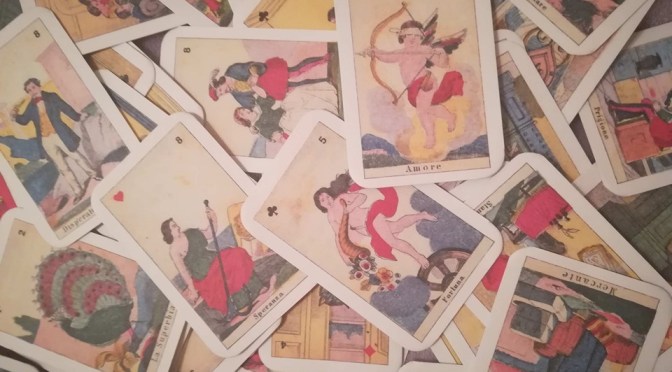
What is the difference between the Vera Sibilla and the Sibilla della Zingara?
The Sibilla della Zingara (sometimes marketed as Gypsy oracle cards) is a reimagining of the Vera Sibilla, and is relatively recent compared to it. It was created because the Sibilla was popular and they wanted to update the graphics. Whether you choose it or the Vera Sibilla is a matter of taste, though I personally prefer the original. There is no difference in terms of meanings.
Do you recommend any books on the Vera Sibilla/Sibilla della Zingara?
I am a sucker for books. I believe I am aware of most, if not all books written on this deck in most languages, which isn’t to say much. I can, in all honesty, only recommend one which is still available: Alessandra Venturi’s Italian Cartomancy. It is poorly organized and it doles out information in hopes or making you fork out more money for the author’s course. There are no examples, no combinations, no spreads. But the information it does contain is solid. All other books on the Vera Sibilla/Sibilla della Zingara in all languages I PERSONALLY consider pretty bad (you are welcome to your own judgment). Italian cartomancer Etienne Valancourt is working on a book. It’s been years in the making, so I don’t know if he’ll ever publish it, but I have great respect for him and I already recommend it even before having read it.
Can I skip reversals?
Yes, you can do what you want. I myself do not actively create reversals when shuffling: any card reader will tell you that cards simply have a way of reversing themselves. I deal out the cards as they are, and then, in gathering them up, I don’t pay too much attention to how they face. However, I always try to start a new reading session with my cards upright. Even then, often one or two cards will reverse themselves. Call it chance, call it magic, but it happens. I would suggest that you pay attention when a card comes up reversed, but you can do what you want.
Can I make up my own meanings?
The first thing to realize when it comes to any psychic skill is that there is no psychic police. So yes. You can. I know some people who don’t use traditional meanings and give perfectly satisfactory readings. My own meanings are a mix of tradition and experience, and the numerology I use is invented, not traditional.
The second thing to realize is that if you are asking me, or anyone, for permission to do what you want, you’ve already lost. Detract further points if you pay someone in order to be told.
The third thing to realize is that just because you can reinvent the wheel doesn’t mean you have to. There is no psychic police, but there are established practices. To dismiss them out of hand without knowing them can be just as much an act of weakness as slavishly following them. Another point worth mentioning is that when we make up something we place our own limitations on it. It can be good to measure yourself against something you didn’t make up even just to stretch your imagination, skill and preconceptions.
My advice would be to educate yourself (here or somewhere else), make your own experience and adjust accordingly.
Or do what you want. Just don’t ask me to validate you. You don’t need validation and I am not inclined to validate people.
Can I just use the pictures as a guide?
Again, you can do what you want. Remember to keep a record of your readings, though, so you can go back to them and see what was accurate and what wasn’t.
Can I use the information you give as basis and develop it in my own way?
Of course! That’s what I did.
Do I have to memorize the combinations?
A handful of combinations are so classic (like that for pregnancy) that not to know them would be a mistake in my opinion, but combinations don’t need to be memorized, especially because you will find that the same combination could mean something totally different when surrounded by other cards. Just use the ones I provide as a mental gymnastics, but don’t confine yourself to them, nor to the interpretations I provide.
Do I need to consecrate/purify the deck?
No, but you can. I do. I would also suggest that you keep your deck near you for some time. As a rule, anything that helps you feel attuned to the deck is good.
Can I make up my own spread?
Absolutely!
Who taught you?
The mother of one of my professors. The numerology is something I made up to make sense of the meanings I learned and to expand on them.
Will you teach me one-to-one?
I will not. I don’t have the time. Besides, theory will only get you so far, and this blog is, I believe, most if not all the theory you need. You need to practice and keep a record of your readings. Don’t exaggerate with readings for yourself. Don’t force yourself to ask questions just out of idle curiosity to see what the cards say. Strive to read for others. Nag your friends and relatives. That’s the best way to start. That’s not to say you can’t read for yourself. Just know your limits.
If I send you my spread will you interpret it for me?
I will not. I don’t have the time. Also, I believe everyone should take responsibility for their spreads and I also think that the language of the cards is somewhat personal, just like different dialects within the same language. Just because all the words are found in the same general dictionary doesn’t mean every word has the same significance and importance for every speaker. Learn your own cartomancy language. You can do it!
In cartomancy with playing cards, Kings are almost always significators for men. On rare occasion, Kings can come up to signify action, judgments and protection.
In some systems, the significators for the querents vary, but in the one I have been taught, it’s normally the Queen and King of Clubs that represent the querent.
The King of Hearts is a family man. He can be a father, a brother, an uncle, etc. For a gay man, the King of Hearts can be a partner. He is a good man, one who has an interest in the querent’s welfare. He is the archetype of the philanthrope. Even when he is not close to the querent, he is warm and kind. Even on the rare occasions when it doesn’t stand for an actual man, the card symbolizes a positive opinion of the querent (for instance, a judge ruling in the querent’s favor or a public servant furthering his aims). It shows positive outcomes thanks to protection. In general, it shows action taken in favor of the querent.
The King of Clubs is the male querent or the female querent’s male partner. When this figure doesn’t exist, he still represents a man, not necessarily related to the querent. Broadly, the card speaks of action, a positive role model, fair judgement and fair procedures.
The King of Diamonds is a man who is not close to the querent. He can be an acquaintance, a boss, a professor, a businessman. He is a person of good means and, like the Queen of Diamonds, one who follows primarily his self-interest, though he is not necessarily evil. He can be a rival in love in the appropriate context. Even when it doesn’t represent a man, the card symbolizes financial institutions, decisions concerning money and situations where there are interests at play that are greater and more powerful than the querent’s.
The King of Spades can be the male counterpart to the Queen of Spades, a man who is lonely, bitter, a rival, an enemy, an ex etc. He can be a difficult person, a bad father and all the things that apply to the Queen. However, the allegorical meaning of this card is also quite common, in that it represents the law itself, as well as a doctor or even the concept itself of medicine. It signifies great power being brought to bear on the querent, often in a cold and impersonal manner, if not altogether antagonistic. With negative cards it also signifies evil deeds and the will (and ability) to hurt
In cartomancy with playing cards, Queens are generally representative of women, and this is just about their only role. It is very rare that they come up to signify something else. That being said, they also have a connection with receptivity, nourishment and growth.
In some systems, the significators for the querents vary, but in the one I have been taught, it’s normally the Queen and King of Clubs that represent the querent.
The Queen of Hearts is usually a woman who is known to the querent. She represents a mother, daughter, relative or close friend. In general, she is a woman who has the querent’s best interest at heart, or at least should (you’ll need to check the surrounding cards). Even if she is not related, she could stand for a positive woman in general. For a lesbian querent, the Queen or Hearts can be the partner. The Queen of Hearts is also a symbol of acceptance and receptivity. It shows an environment where the querent thrives and is allowed to grow. Broadly, it confirms the receipt of something and it is a symbol of motherhood.
The Queen of Clubs is the female querent. If the querent is a man, she is usually the partner, either actual or perspective. If this interpretation is out of the question, she is still a woman in the querent’s life, usually not related to him. The Queen of Clubs is also connected to the idea of tending to something, working on it to make it grow or perfect it. She is not a symbol of great accomplishments, but she signifies honest effort, and doing what’s honorable. She is connected to harvest.
The Queen of Diamonds is a woman outside of the querent’s immediate circle. She is an acquaintance, a superior, a businesswoman, a professor. Her role is ambiguous, because her primary loyalty is to herself and her interests, but this doesn’t make her evil (after all, the woman you buy flowers from sells flowers to make money, not to please you). Compared to the Queen of Hearts she can be colder. She can also be a rival. The card is also a symbol of prosperity and of reaping the good fruits of one’s labor.
The Queen of Spades is a lonely or elderly woman. She can be an enemy or a difficult person. She doesn’t love the querent, nor does she further the querent’s aims (this is a great difference with the Queen of Diamonds, that the latter’s aims can allign with the querent’s, while those of the Queen of Spades are usually opposite). She can also be a woman who is very powerful, wears a uniform or represents the law. She can be an ex or a doctor. The card is a symbol of things that rot or are overripe or spoiled, and also signifies lack of acceptance (including lack of submission) privation, hunger, miscarriage. Finally, the card signifies falsehood, false words, false promises and false people.
The way I was taught to read playing cards, Queens and Kings are often real people, representing women and men respectively, while Jacks are only rarely real people, although the Jack of Hearts can represent a real child.
Jacks tend to represent news and attitudes.
The Jack of Hearts, in addition to representing a child, can represent someone or something who is fresh, naive, immature, honest, happy-go-lucky. In love readings, for instance, it tends to show flirts and situations that haven’t fully matured yet. It is also a card of inexperience.
The Jack of Clubs represents friendship and help. It represents also service to others. Next to another court card representing a person, it shows that he or she is helpful, friendly, positive, serious, constructive. The card is also connected to cooperation and, as an extended meaning, to co-workers.
The Jack of Diamonds represents messages and the knowledge of facts. It shows the acquisition of information. As an extended meaning, it signifies study and research. It can also signify a go-between (you will notice that the Jacks of Diamonds and Clubs are similar to their Sibilla counterparts). The card points to someone who is inquisitive, curious and desirous to delve deeper into something.
The Jack of Spades signifies enmity. It shows a negative attitude toward the querent (or of the querent toward someone or something). It is a card of ill-will. It is also the uniform card, especially when together with the King of Spades. Animosity, a competitive attitude and the desire to dominate another are all part of the meanings of this card.
Despite the Jack of Hearts being the Child card, all Jacks can represent children. Usually, the Jack of Spades is a child with problems, or a sick child, or a child that misbehaves. The Jack of Clubs is a good child, while the Jack of Diamonds is a smart child.
The tens in playing cards represent goals and destinations.
The Ten of Hearts is another lucky card in the deck, signifying happiness and well-being. Just like the Nine of Hearts, the Ten has the power to greatly reduce the negative impact of other cards. It represents lasting joy and a sense of not needing to look further. It is a great love card. It is also connected with the querent’s city or homeland.
The Ten of Clubs is the card of travel. Clubs are cards of action, but the aim of the action is represented by Diamonds. By themselves, Clubs are just a means, and travel is the means to get from where you are to your destination. Likewise, the Ten of Clubs signifies metaphorical pathways, the course of action.
The Ten of Diamonds is the card of success, and broadly speaking of accomplishment of aims. It is a generally material card, and can signify a large sum of money, or at the very least that money is not an issue. It also represents cities other than the querent’s, seen as goals or destinations to travel toward.
The Ten of Spades has a variety of meanings. Some are neutral. For instance, it represents unknown destinations, stranger places and destinations abroad. It is also a card of negative goals, illegal aims and, more generally, of secrets and silence. It is connected to night time, just as the Ten of Hearts is connected to day time. Broadly, it is a card of failure, but only if together with other cards that point in that direction.
The nines in cartomancy with playing cards are associated with the idea of wishes and hopes.
The Nine of Hearts is, as in many other systems, the wish card. It represents realization, fulfillment, sincerity of heart and, in general, things going as we wish them to go. It’s a positive card in most instances, as it has the power to alleviate the negative import of other cards that precede it.
The Nine of Clubs represents distance. It is a neutral card that represents things of long duration, long waits and delays, matters slowing down. It can also relate to physical distance. Generally, it shows the separation between what what we want and us. It’s the long road ahead.
If the Nine of Clubs is the road, the Nine of Diamonds is making progress on that road, and advancement in general. It is an extremely positive card, showing improvement, recognition, increase, fame, even. It represents other people’s views and expectations concerning the querent, if he has a good name or not, etc. By itself, it shows a good name. It is symbolic of career.
The Nine of Spades is notoriously the worst card in the deck, and some call it the wish denied card. If the Nine of Hearts shows things going as we wish them to go, the Nine of Spades mean things going against our wish. As a further consequence, it signifies things happening that we don’t want to happen, and against which we are relatively powerless.
The eights in cartomancy with playing cards represent people, consciousness/conscience and the concept of time. They show how we relate to other people and how we interact with them. In studying other systems of cartomancy, I’ve been struck by how similar my approach to the Eights is to the hedgewytchery system. Look it up for a comparison. I also find them quite similar to the eights of the Sibilla.
The Eight of Hearts is the card of cheerfulness. It represents optimism, satisfaction, good outcomes and the gathering of people to celebrate, public holidays, etc. It represents things done with a positive intent in mind, positive thinking in general, honesty, choosing the high road. It is also a flirtatious card and it is connected with watery places, possibly because in Italy people tend to turn flirtatious during the summer months while tanning on the beach (this card is somewhat similar to the Hope card in the Vera Sibilla). Broadly, it symbolizes peace. It is connected with relatives and with people taking an interest in the querent, as well as to the clergy.
The Eight of Clubs is representative of working people, the “common folk”, although more specifically it relates to the peasantry, and by extension it signifies work. There are other cards that can signify employment (Three, Seven, Eight of Diamonds, for instance) but in the case of the Eight of Clubs, work is seen as how people who don’t have the luxury of wasting the day sitting on their hands or soapboxing on Twitter spend their time. The card is connected to the fields and to the countryside. It is also the card of things done according to a plan or knowing full well what their consequences are, for better or worse.
The Eight of Diamonds is the card of business. It’s all things that bring in money or we invest money in. Because this card signifies where money comes from and where it is headed (compare to the Eight of Diamonds in the Sibilla), and because for most people money comes from working, this is another possible work card. It represents financial markets, banks and the bourgeoisie, as well as the city as an environment (usually not the querent’s city, though). The card represents investments, savings, transactions etc. depending on where it falls. It shows concerns with money and can imply aridity or ulterior motives, or, more neutrally, thinking about yourself and about your “business”.
The Eight of Spades is the card of tears. It represents the falling through of plans and the shattering of hopes and desperation in general. But this is also a card of negative thoughts, and of things done with the intent to hurt. Ill-will and malice are indicated. It can represent difficulties with other people, interpersonal trouble. It also has a connection with groups of spade-like people, such as armies, juries, medical teams, adjudicating boards, committees and all those situations where there are people who have the querent by the balls (in war it would represent a siege). The card is connected to isolated places in general.
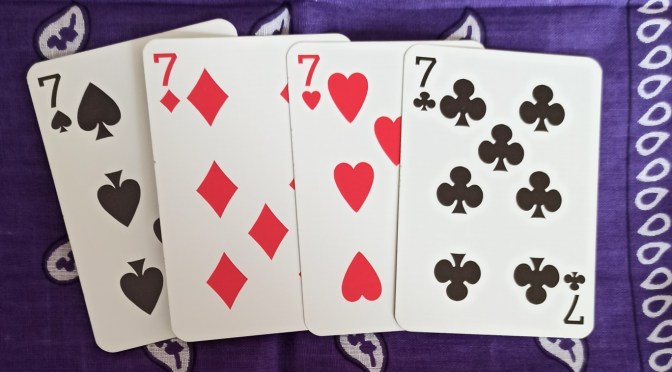
In cartomancy with playing cards, the sevens in general represent the idea of achievement.
The Seven of Hearts has the general meaning of surprise. This is because the suit of Hearts does not contemplate the notion of effort, so anything that happens happens either thanks to other people or thanks to positive circumstances. This card signals positive turns of events, fortunate breakthroughs and good luck. It is also connected with the idea of talent, because if we have a talent for something, achieving great results in it is easy.
The Seven of Clubs is less fortunate. It is a card of problems, things that stand in the way of achievement and that need to be worked through. It is not a tragic card. Sometimes it limits the amount of success shown by the other cards, while at other times it signifies that the sailing will be less than smooth. Either way, the problems shown by this card are solvable (which doesn’t automatically mean they will be solved). Supported by positive cards, the Seven of Clubs becomes a card of hard-won achievement. It can signal the conclusion of an agreement or that of a practical project.
The Seven of Diamonds is the card of money and financial achievement, and of achievement in general. It is a simple card most of the times. Unlike the Seven of Hearts, here effort is implied. By extension, this card is positive for recognition and winning prizes, and allegorically it is connected to harvesting.
The Seven of Spades is a card of misfortune. It shows obstacles that are difficult to solve, against which the querent has little power. More broadly, the card has to do with all negative unforeseen circumstances that either prevent us from achieving what we want or strongly limit us. With positive cards it shows that success won’t be complete, while with negative cards it’s a sign of utter capitulation.