Category Archives: I Ching / Yi Jing

The Height of Science is to Know Nothing

or “Summa Scientiae Nihil Scire” in Latin. This motto is very useful in practical fortune-telling. One of the greatest risks we run is of assuming. “She’s 85, how is she gonna find love?” “He’s a 23-year-old jock, he’s probably not a priest.” “She looks so prim and proper, she’s unlikely to have seven lovers.”

All these preconceptions and more cloud our mind as we try to read the oracle’s answer, regardless of the oracle, whether it be the Tarot, playing cards, astrology, the I Ching, etc. All these preconceptions are poison to the art of divination. They are not of service to us, nor to our querent. Let’s delve into why.

Let us start from the fact that bias is a natural and necessary phenomenon, as politically incorrect as this may sound. Bias comes to us from our experience, but also from the experience of others, especially family members, friends, teachers and people we trust. Bias orients our life, and this cannot be otherwise. The attempt to forcibly eliminate bias from people’s minds only causes suffering, and is its own kind of irrational crusade.

You know who is NOT biased? God. You know what God does? Everything. But you can’t do everything. You can only do something. And in order to do something, you must be biased against something else. That’s life.

This is not to say that all bias is good. For instance, I may have accepted some preconceptions from my parents, who got them from their grandparents, who got them from the priest, who got them from a crazy lady next door, etc. This kind of bias is the worst because it can needlessly limit our options and create likewise needless suffering in those around us. The best kind of bias is the critically examined one that you accept based on your actual life experience and keep open to revision.

Yet even this kind of “good” bias is harmful to divination. When someone comes to us for a reading, or when we read for ourselves, what we are doing is trying to look at reality from the point of view of a symbolic system that reflects life from an objective, or at least less subjective standpoint.

Divination is a language with no native speakers, except maybe the guy upstairs, which means that our understanding of it is always going to be imperfect and faulty. But this is a technical kind of difficulty, and in its own way it’s excusable. What is less excusable is the additional confusion we create by reading our biases into the divination. This is not just about politics, philosophy, morality or religion. It’s everything.

“A 85-year-old is not going to find love again” is one sort of bias. “An attractive young guy is probably not a priest” is another. The aim of divination is to read the truth, not ourselves. That’s why the height of science is to know nothing. If we start with a clean slate we can receive much more information from the tool we are using, simply because we are not randomly blocking out information we consciously or subconsciously deem unlikely.

The unlikely happens everyday. Think about it. Almost everyday something unlikely happens in the world. That’s not to say we must feel the urge to make our predictions as unlikely as possible in order to impress the querent. Most of the time, what’s likely is what ends up happening. Still the unlikely is not the impossible.

I am big on comparing divination with language, as those reading this blog know. And as you know, I am not a native speaker. Around fifteen years ago, I was trying to improve my English by watching youtube videos. Yet this was very hard, because the language people use on youtube is very inconsistent, erratic at times, filled as it is with memes, asides, jokes, ancdotes, interruptions… I was trying to project the artificial English I had learned in school onto this truer, more lived English.

“Surely he can’t have said what he has just said. It doesn’t make any sense,” I constantly thought. It was when I stopped projecting my presuppositions and started just taking in what was objectively being said that my English truly improved. That’s the same with divination. The height of science is to know nothing. Only if we know nothing we can take in what is being said.

MQS
Divination and Intellectual Honesty

When I was a teen, I remember stumbling upon Aristotle’s definition of the “educated mind” as being able to hold a thought without accepting it, and I remember thinking how silly and basic the definition was. The older I get, the more I find myself agreeing with him, as I see fewer and fewer people capable of doing it (the fact that Aristotle never actually wrote the sentence is a whole ‘nother can of worms)

A lot of people don’t have an educated mind per the definition above. One would like to think that tarot readers, astrologers and the like would not be like a lot of people, seeing how much the word “wisdom” gets thrown around in their circles. But one would be wrong. Leave it to the “spiritual community” to be among the most ideological and stiff. And, consequently, not among the brightest. If there is a group of people I don’t trust to be capable of holding any thought except the ones they agree with, that’s these people.

I believe I already talked a little about this, but one of the most memorable examples I can think of is the 2016 US election, when every tarot reader on youtube and their mom were busy predicting Trump would lose the election disgracefully, poop his pants, writhe on the floor, throw a tantrum and retreat into the hell that spawned him while Hillary Clinton swung her throbbing, veiny, 25 inch hard-on at the glass ceiling. While I am slightly exaggerating, this was pretty much the tone. (interestingly, those same readers routinely claim that the tarot is not for fortune-telling)

One such reader went as far as channeling Trump’s character. I do not remember the exact spread, nor most of the cards, but two things stuck with me: first, no egregiously bad card showed up, and second, the King of Cups featured prominently in the spread. She interpreted the card as Trump being a violent man prey to his base emotions and instincts. I took a quick look at some of that reader’s other videos, only to discover that she never, ever interpreted the King of Cups this way. In fact, she always interpreted it as the significator of a good man who takes care of the querent.

This is a good time to point out that I am fiercely apolitical, so this is not about politics. All ideologies are, as far as I am concerned, clouds over the mind’s clarity. I’m not saying everyone needs to think like me. Everyone has their delusion of choice, and everyone (including me) has their way of slanting reality in one direction or the other, whether politically, spiritually or philosophically (or even scientifically, for that matter). In fact, slanting reality is probably needed in order to filter information that might be useful to us.

Yet divination should be something else. What that reader did was merely using the cards as a mirror of her own (perfectly legitimate) bias. This is fine, and can even be useful at times–if you are aware that you are doing it. Even that would not be actual divination, but at least it wouldn’t be a waste of time.

I already discussed that divination is really a process of deification, that is, the process of allowing the dispassionate, bird-eye view clarity of the divine into one’s limited, subjective world by letting new information in. In other words, true divination is the opposite of retreating into one’s bubble: it’s the bursting of the bubble.

This, in turn, requires a certain readiness to accept the information we get (which is why it is always best to get someone you don’t know to read your cards.) Divination without intellectual honesty is just a crutch for one’s ego, and that’s how it is currently being used by the vast majority of diviners.

Unfortunately, intellectual honesty won’t make you many friends. Back in 2016 I had arguments with more tarot readers than I care to remember and was routinely labeled a dangerous extremist just because I called into question the usefulness of this type of reading (back then I still tried to entertain fruitful conversations with people). But occultism, in all its branches, is a narrow path.

Two lessons from all this: 1) if you are reading for yourself and the cards (or chart, or dice, or whatever) seem to confirm what you already think or wish, apply a bucketful of salt to the reading; 2) invest some money into a simple handbook of logic, or at least expand your knowledge of logical fallacies. This will repay you many times over, regardless of what branch of sorcery you practice.

MQS

Predictions that Change Behaviors

I don’t remember if I already talked about a reading I did for myself some time ago. I was expecting a parcel but needed to go somewhere else, so I asked the cards if the package would come on that day. The cards clearly answered in the negative, and I was right: I went out, and the parcel arrived the day after.

Thinking back on this, I was reminded of an experience reported by famous British astrologer John Frawley. I cannot remember if he discusses it in The Real Astrology or in his Horary Textbook, but it goes somewhat like this: he was waiting for some repairman to come to his house, but he also wanted to take a relaxing bath, so he cast a horary chart to know when the guy would come, only to discover that he wouldn’t. So he slipped into the bathtube, and his prediction proved correct

I believe this kind of readings is the most fun and instructive on the nature of divination. Ultimately, divination is intelligence-gathering. Sentient beings organize their behavior based on the information available to them. Therefore, new information is bound to change the being’s behavior.

The more complex the organism, of course, the more factors come into play, but the basic principle remains true. This is not to say that anything is possible, because only someone with infinite knowledge would know how to overcome all kinds of situations he or she finds unpleasant. We humble mortals are always restricted by difficult circumstances. Still, the information we gather through divination is not, in principle, different from the one we gather through other means which are all just as imperfect.

A fatalist might try to defend the idea of an all-encompassing destiny by arguing that the prediction is itself part of the person’s fate. I was destined to pull those cards and go out. But this stance, interestingly enough, invalidates the idea of prediction itself. If everything is destiny, then even knowledge that everything is destiny is destiny, rather than the truth.

I believe that divination is not simply communication with the divine, but also a form of deification: if we take God on one hand, that is, someone who is capable to be the pure consequence of its own choice, and a rock on the other, that is, something that simply passively receives whatever action external forces exert on it, then divination moves us closer to the divine condition of being the consequence of our own choice.

This is also why I am skeptical of airy-fairy forms of divination that try to take the focus away from concrete life in the name of some vapid divine idea. Ultimately, there is far more divine depth to Frawley’s ability to take a bath thanks to a horary chart than there is to questions like “How can I embody the divine feminine and honor my ancestral heritage more fully?”

MQS

To Understand Divination You Need to Understand Its Place in the World

While in Italy for the holidays, I retrieved my first notes from when I had started learning cartomancy from the person who taught me to read playing cards and the Sibilla. It’s just a couple of loose sheets on the basic meanings of the playing cards, the main combinations and two spreads (the row of cards, hardly a spread at all, and the cross).

This brought back so many memories of that period, but most of all it reminded me of how eminently practical divination used to be before its current glamorization. Of course, over time I learned a lot more from that lady than what is on that couple of now yellowed sheets, but the core of the system is there, and I believe she must have passed it on to me in no more than two sittings, if not just in one.

People who spend their time musing on the arcane meaning of the splotch of color on this or that card in the latest glossy and overly ornate oracle deck may laugh at how bare-bones that system is, but they would forget what significance divination had for the regular folks that used it to solve everyday matters.

Folk systems of fortune-telling, especially by cards, were designed to be quickly memorizable in their main lines, because they formed part of every housewife/househusband’s toolkit of remedies to the difficulties and uncertainties of life.

When an elderly person passed their meanings on to you, they did so not to introduce you to a different world detached from the real one, where you could dilly-dally with pleasant platitudes, but to send you into this life with another string to your bow. In principle, they revealed their system to you for the same reason that they taught you how to make preserves and liquors and how to best cultivate your garden.

Folk fortune-telling, in a word, was just another traditional remedy to the complexities of life. It did not involve stepping into a different plane of existence, because the everyday one was already enough, and it was looked on with the same pragmatic, solution-oriented gaze that was cast on all other problems people faced back in the day. “Don’t forget to add a small pinch of sugar to your tomato sauce. The Ace of Spades is a thorn in the heart.”

This is an attitude toward life that is hard to recapture nowadays. The idea of divination being useful has been so utterly eradicated from our mind that, when we approach it again, we do it as if it were an exotic, quaint, arcane world separate from our own. Our immediate reaction is therefore to keep it separate from our life, divorcing it from veriafiable prediction.

This stance is fatal, because it implies that our world is not inherently meaningful as it is; that meaning is found elsewhere and cannot be reconciled with our real life; that in order to find it, one must learn to look at one’s everyday struggles as illusions or as silly preoccupations not worthy of the attention of those in the know about the cosmic mechanism. All this ends up debasing both life and divination, because once life is debased, divination, which is the language of life’s drama, becomes a meaningless mirror only reflecting vague vapors.

MQS

Fatalism and the Moment of Divination (Notes on Divination)

This post is part of my Notes on Divination series. This gets somewhat philosophical and is rough and not organized, so bear with me.

In the previous post in this series, I started discussing some general ideas on why fatalism is an inherently flawed view, while in the one before I had shown why pure free will makes just as little sense. To summarize, pure free will simply doesn’t take into account the fact that we don’t live and move within a blank space that we can change at whim.

On the other hand, pure fatalism cannot even be articulated as a view without contradicting itself: if fatalism is real, then my fatalism is not due to me assessing reality and forming a fatalistic worldview that corresponds to how reality factually is, but it’s due to destiny forcing me to be a fatalist. This implies that when I say I am a fatalist, I don’t really mean it. I *cannot* really mean it – It is conceptually impossible. In order to be a fatalist, I must have the freedom to develop a fatalistic worldview. This is a contradiction.

My view of the universe is consequently inherently libertarian, though it is a reasonable and limited libertarianism.* No matter how small our personal freedom is, it exists and is the place we our soul inhabits. Freedom is the consequence of consciousness. When I become aware of something, I posit it as the object of my awareness, outside of myself, and therefore incapable of completely determining my whole being.

Now let us ask: what happens during a (serious) divination session? What does divination do, at heart? At the very least, divination must either make us aware of unknown facts about the past, present or future, or it must shed new light on known facts, thus revealing them from a different, previously unknown point of view. A divination session that does not do this is not a divination session. It may or may not be helpful in other regards, but it is not divination.

The Moment of Divination

It is clear, therefore, that divination is inherently connected to consciousness and to increasing our conscious awareness of (our) reality. This is another reason why a (mildly) libertarian view of divination makes more sense. Suppose you cross the fortune-teller’s palm with silver and then you get told you will win over your crush: is the fortune-teller right because she actually sees this in the crystal ball or is she doomed to say this to you? If she is doomed to say it, then the fact that she is saying it has nothing to do with the statement being true and everything to do with destiny forcing her to say it.

Furthermore, in revealing your future to you, the fortune-teller cannot help but modify it. This has nothing to do with some odd theories I’ve read on the internet, about the fact that if you predict something you make it happen. If that were true, I could predict myself into a billionaire. Besides, even if the fortune-teller saw your future and didn’t tell you, she would still be modifying your future.

Reality is much more subtle. Suppose that X is going to happen to you. If the fortune-teller tells you, then you are aware of X happening. X happening with your awareness is different from X happening without your awareness. The fabric of the fact itself changes with your awareness of it, for the simple fact that something that happens with your knowledge is not something that happens without your knowledge.

The moment of divination, therefore, has a very important place in our life, because it is part of our life, but it is also a part of our life wherein our awareness of reality increases, thereby changing our reality. This does not automatically mean that divination can make us realize every whim that crosses our mind, nor that it can always save our butt. Sometimes the only choice possible is between accepting a fact and not accepting it.

I like to liken an oracle to a friend on top of a high building, who has a wider view of our surroundings than us as we move in a busy intersection of streets, and who texts us hints that increase our understanding of our reality and can help us make better choices, though sometimes the choices we can make are so severely limited as to border on predestination.

MQS

* I mean ‘libertarian’ from a metaphysical standpoint.

Yes, Pregnancies May Be Predicted in Divination

I read somewhere that pregnancies cannot be predicted because it is impossible to bring someone into the equation who doesn’t yet exist. The cards (or any other method) supposedly cannot talk about inexistent people, and they may only be used to check on pregnancies that have already started.

I certainly agree that it may not be wise to use divination on health-related issues, especially on such delicate topics, since we diviners are fallible, and should never forget it.

That it *is* possible to use them to this end, though, is confirmed by experience. I believe I even discussed a spread where I predicted that a woman would become pregnant, even though the question wasn’t even about pregnancy.

The idea that the cards cannot talk about people that don’t exist, though, is poppycock. The child may not exist, but the woman’s body certainly does. If we can predict that the woman’s body will betake itself to a job interview, to the mall or to a date, it’s unclear why we shouldn’t be able to predict that an organism will start growing inside of it after a spirited round of nooky.

MQS

Why You Can’t Be a Fatalist

This post is part of my Notes on Divination series. This gets somewhat philosophical and is rough and not organized, so bear with me.

I already talked about the limitations of free will in divination. Undoubtedly I will need to talk a lot more about it in the future. For now, though, I want to discuss the other side of the coin, namely predestination.

Predesination is the idea that the future is predetermined. This is already vague, because the way in which the future is supposed to be predetermined changes based on the particular view: the way in which a flower necessarily follows from a seed is not the same way as the ending of a movie necessarily follows its beginning. No matter how many times you rewind, Baby Jane always snaps. She cannot do otherwise, for her life has been scripted and it plays out from beginning to end according to the script.

In the case of the seed, although there are contingent factors at play (for instance, the quality of the soil or the amount of water it receives) we are talking about a form of internal necessity. Baby Jane’s life, though, is determined by external factors: she is nothing more than what the author of the book and those of the movie wanted her to be.

The question is: could Baby Jane understand that her life is so predetermined, if someone told her? Let us suppose that the writers had added a scene where she consults a diviner and has her fortunes told to her. The diviner is a good one, and correctly tells her what is going to happen to her, her sister, etc.

Does this change things? The answer, in this case, is no. It doesn’t change anything, because the fortune teller’s scene has also been scripted and plays out for the same reason every other scene in the movie plays out. From an external standpoint, the meeting with the diviner would be no different than any other part of the movie. It would be just another link in the chain.

The Fatalist

But this is not how divination works in real life. In real life, we don’t have the privilege of an external poit of view from which to witness our existence in the same way as when we watch a movie. We can watch a movie because we are not in any meaningful sense part of it.

But we are part of life. We are part of the flow of existence. More specifically, we are that section of existence that is capable of reflecting on existence itself, or, if we want to get trippy, we are the section of existence through which existence reflects on itself: we are existence’s self-consciousness.

This has enormous consequences on our freedom. Let us suppose someone tried to argue that our life is predetermined by a kind of external destiny that uses us like sockpuppets in the same way a character is written by a writer.

The first and most important consequence is that the very fact that they are saying that we are predetermined would itself be predetermined. That is to say, the person does not believe that we are predetermined because it is true that we are predetermined, but because he or she has been written as a fatalist.

Of course, the person in question would like to argue back that they are a fatalist because it is true that we are predetermined. But in defending this view, what they are truly saying is “everything is predetermined, except me when I argue that everything is predetermined.” This is obviously inconsistent: a theory–any theory–must be consistent with its own uttering. But fatalism cannot be truly uttered without incurring self-contradiction. The moment one says “Everything is predetermined,” they place themselves outside of the destiny they try to describe.

This happens for a subtle reason. Consciousness is inherently the place of freedom. It would take me a whole treatise to discuss this (and maybe I will write one at some point) but to be concise, we cannot be conscious of something without placing ourselves outside of it and beyond it. If I am conscious of this pen or this flower, this pen or this flower are the object of my attention, and I am the subject. No matter how strictly connected subject and object are, they are not the same, and when they are, there is no consciousness.*

If you read a few paragraphs back, I said that we are essentially existence’s self-consciousness. This means that through us existence perceives itself as its own object. Furthermore, in being conscious of itself, existence moves beyond necessity, exactly in the same way that any person (even a fatalist) places themselves outside of their own fatalism by being conscious of it.

In the next blog post I will discuss more closely how the ideas I just presented impact divination.

MQS

* I know that mystics like to argue that the subject-object distinction is artificial, but I’ll leave this for another post. My short answer is that without duality, unity is barren, while without unity, duality is inconsistent and inconceivable.

Free Will and Prediction (Notes on Divination)

This post is part of my Notes on Divination series. This gets somewhat philosophical and is rough and not organized, so bear with me.

I have been playing with the idea of writing a book on the philosophy of divination. In fact, I have been playing with ideas for a lot of books on occultism, but I need to start somewhere. This is the first in a series of articles on such topics. Don’t take the following as an organized treatise–it is more like a random gathering of thoughts.

It’s impossible to be self-aware diviners without sooner or later stumbling upon the question of free will, the two most simplistic options being that we have complete free will and therefore divination is not about the future or that we have no free will at all and everything is predestined. I will argue in another article that both options actually prevent meaningful prediction.

Often people talk about “compatibilism” that is, the idea that prediction and free will can be seen as compatible. This is all very well, but it means nothing unless one explains how. Inevitably, explaining it requires one to clearly define the space alloted to both. Here I talk about all things that limit our choice, while in a future article I will talk about the limits of prediction.

Firstly, we need to acknowledge that when it comes to divination, it is not at all clear that we talk about prediction. After decades of New Age nonsense, divination has largely been relegated to the uttering of ‘inspired wisdom’, wisdom apparently being the consolation prize for those that can’t look at reality for what it is.

People who usually manage to compose their faces in a mask of sanity abandon all commonsense as soon as they pick up a tarot deck: you create your own destiny, you can do whatever you want. Well, you don’t. This is provably so. We cannot treat people as if they were bundles of free will floating in empty space. People come from specific backgrounds and have specific problems, idiosyncrasies and preferences that dictate their course.

You may be free, for instance, to choose between vanilla and chocolate, but if you hate chocolate you’ll probably pick vanilla. This is often seen as part of people’s free choice, but if we think about it for a second, it is actually a limit to personal freedom: an inner disgust toward something leads you toward something else without you being able to control it.

Free Will and Destiny

In other words, your choice, which is theoretically open to everything, is already limited by a number of psychological hangups that push you around like a sock puppet. That is a limit to free will in my book. Divination may very well be used to delve into these issues and to widen your options. In fact, it is a very good use of divination. But we cannot use divination to do so if we don’t first acknowledge that our options are limited, sometimes severely so.

But preferences are just one kind of limit. Another one comes in the form of ( the much reviled in spiritual circles) objective reality. If you are in a blind alley, know no martial arts, have no means of self-defense and an armed thug is walking toward you, that’s a pickle you can’t meditate or visualize your way out of.

This is not to say that you’ll inevitably lose. Maybe the dude is drunk and collapses to the ground as soon as he stumbles on that banana peel; maybe you are very good at talking and you persuade him to let you go by striking the right note; maybe a falling bit of debris from a ramshackle building takes care of him.

All this (and more) is possible. But the objective fact that you are in the blind alley in a less-than-desirable situation instead of sucking on a Capri Sun on your way to Hawaii imposes certain limits (just as this latter scenario imposes other limits)

The example above is situational, but our whole life is a series of determining factors that limit our trajectory. Look back on your personal history and you’ll probably be able to see traces of many, many past situations that still accompany you to this day, for better or worse. Even past choices become hard, unchangeable facts once enough time passes. You cannot, for instance, ungraduate from that useless gender studies degree in order to pursue a STEM subject. Although you can divorce, you cannot unmarry the person you married. Although you can abandon your child, you cannot unbirth it.

We could go on, but this point is clear enough: at any given moment in time we find ourselves shaped by a series of objective, subjective and intersubjective factors that limit us and our possible trajectory.

The delusional New Age view that we are the product of our current decisions does happen to stumble upon a little bit of truth, though it mischaracterizes it. It is true that, in so far as we abstract from ourselves and we move toward the universal, we peel backs layers of individual conditioning and we move toward the unconditional, however you may choose to call it (God, Being, One, Reality, Ensoph, etc.)

But there is a catch: moving toward the unconditional means not just letting go of our limits, but also of the aims that would lead us to want to overcome those limits as, however we may understand the unconditional, it is not conditioned by this or that choice. The fact of the matter is that free will may very well be the substance of reality, but in so far as it is the substance of reality it is not the substance of my limited whims.

In practice, therefore, the idea of unconditional free will is untenable from the standpoint of a diviner, as abiding by it renders the divination process futile, however we may understand it. This is not to say that complete determinism fares much better, as I shall show in the next article.

MQS

Weather Forecasts with the I Ching

Wen Wang Gua is such a fun oracle. It is rather cerebral in its functioning, not unlike horary astrology, but it is incredibly accurate. In fact, I think the I Ching (in its Wen Wang Gua or Plum Blossom forms) is to Chinese Astrology what horary astrology is to Western astrology. There are some limitations to the analogy, but it is a good one, as far as it goes.

Some days ago, I asked the I Ching when it would rain, just for kicks. Being the end of August, some rain wouldn’t be bad.

Subject: Here
Object: the Weather
Focus: Parents line (represents rain, because it is life-giving)

“When will it rain?” answered with Wen Wang Gua (I Ching). Software used: Four Pillars & Feng Shui

Parents hold the Object line with Shen (Monkey, metal.) It also holds the Month branch, therefore not only is it vibrant: it is also useful. But it doesn’t move. Furthermore, the Subject, Wealth Snake, moves to restrict it, and while it is untimely at the Month branch, it is supported by being at the Day branch which is also Snake (although Metal is born at Snake). The Day Branch holds the Parents up in a combination. It is a very uncertain picture, and indeed we’ve been having a very changeable weather, with clouds and sun, but not rain. It is complicated by the fact that this is a six-combination Hexagram, which doesn’t favor change.

But the situation should change on Goat day, that is, in two days, when the Goat Wei clashes the void Ox line from void to compact to drain away the restricting Snake energy and generate the Parents line. It is more likely to rain in Wei or Shen hours (1pm-5pm). However it probably won’t last very long as the resulting Hexagram is an all-clash.

(Note: these are my notes on the reading taken on the day of the reading)

Flashforward to two days later

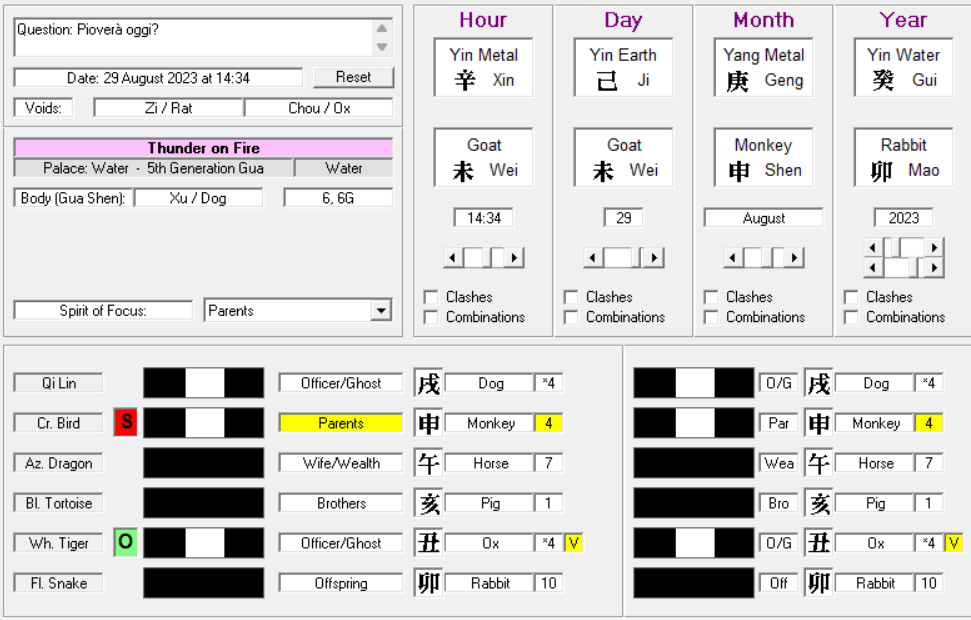
I asked again. This time the question was if it would rain that day

“Will it rain today?” answered with Wen Wang Gua (I Ching) Software used: Four Pillars & Feng Shui

The Hexagram is still. Technically this would mean that there are no changes, but this is not necessarily the case, as change can happen in many ways. For instance, in this case we have the Parents line still represented by the Monkey Shen at Subject and, again, at the Month Branch, while the Object is void, which usually is said to indicate unpredictable weather. Voids prelude to change. In this case, Goat at the Day Branch clashes the Ox from void to compact to generate the Monkey. It will probably rain in Goat or Monkey hours.

Result: it rained in Monkey hour, at 15:30, but it lasted less than an hour, as predicted by the six clash Gua. I’m wondering if there is something I was missing that would have allowed me to narrow down the hour to just Monkey and not Goat in the prediction.

A Sport Prediction with Wen Wang Gua (I Ching)

As I’m currently dabbling in Chinese philosophy and metaphysics, I have inevitably come into contact with an incredible system of reading the I Ching that I had never heard of. In the Western world, the I Ching (or Yi Jing) is mostly associated with tossing coins and reading passages in an old book.

However, a couple of other different systems of interpretation exist, including Mei Hua Yi Shu, or Plum Blossom, and my new favorite, Wen Wang Gua, or King Wen Oracle. Plum Blossom is essentially a form of Horary Astrology (another huge interest of mine.) You don’t really cast a hexagram: you deduce it from the time the question is asked (although there are other methods as well.)

Wen Wang Gua, on the other hand, is a mix of Horary and regular divination. Like horary, it takes into account the current astrological climate (using Chinese astrology in the form of Ba Zi, the eight characters or four pillars.) However, it also involves using coins or yarrow stalks to cast a Hexagram with a varying number of changing lines. The answer is not read in a book, but deduced almost mathematically by applying a set of interpretive rules.

I am by no means a master of anything in life, and even less of Wen Wang Gua, whose rules I still struggle to keep in mind (there’s way too many,) let alone apply coherently. However, I tried making a prediction today on a soccer match. Now, I couldn’t give a rat’s behind about soccer, and the match I chose to predict I picked at random from an online newspaper. I know nothing about the teams.

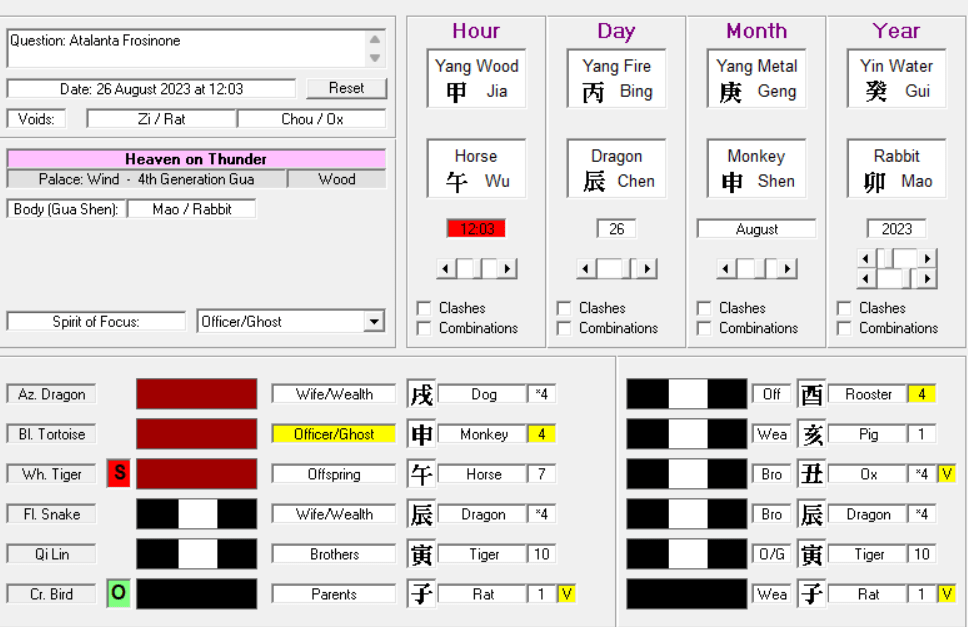
It was Frosinone versus Atalanta, two Italian teams. In order to predict a competition in Wen Wang Gua, we need to assign a Subject and an Object. In this case it doesn’t really matter which team is assigned to what, as long as this is done beforehand. I cannot go into the subtleties of the system. I will start talking about it once I’ve managed to get the basics down. This is my Hexagram (original plus resulting Hexagram) and my line of reasoning.

Subject: Atalanta
Object: Frosinone
Focus line: Officer (because it is a fight) although I’m doubtful that a Focus line was needed. After all, the objective of a match is to beat the opponent, not to win something else

The Wen Wang Gua cast for the match. The program I used is Four Pillars & Feng Shui

Subject (Wu, Horse) is extremely weak, being jailed by the Month Branch and exhausted by the Day Branch. Furthermore, the line moves to become void. Object Zi controls Subject Wu (Water controls Fire.)

Object (Zi, Rat) is technically void, but because it is generated by a moving line, it is not. It is also generated by the Month Branch and forms two Water Triangles, one with the Officer and the Day Branch Dragon and one with the Wealth Dragon and the Month Branch Monkey. This strengthens it. Officer also moves to generate it. Line 6, the Dog, moves to attack it, but it is dispersed by a clash with the Day Branch.

However, the Hexagram is a six-clash gua, and the Body line Mao does not appear, which indicates uncertainty, so it cannot be a unilateral triumph. Furthermore, Subject seeks to control Officer, and while it is too weak to win (furthermore, Officer is at the Month Branch), still it shows that the losing team doesn’t go down without a fight, especially considsting the White Tiger at Subject. Subject also moves to become the Ox and attack the Object, although, again, the Ox is void, so it doesn’t accomplish much. Finally, the Object Zi is not especially strong in itself, although it is a good deal stronger than the opponent.

In short, a mixed picture where Object (Frosinone) should prevail but not triumph.

I cast the hexagram at around midday of the day of the match. The match started at 18.30. The result:

The Frosinone – Atalanta match